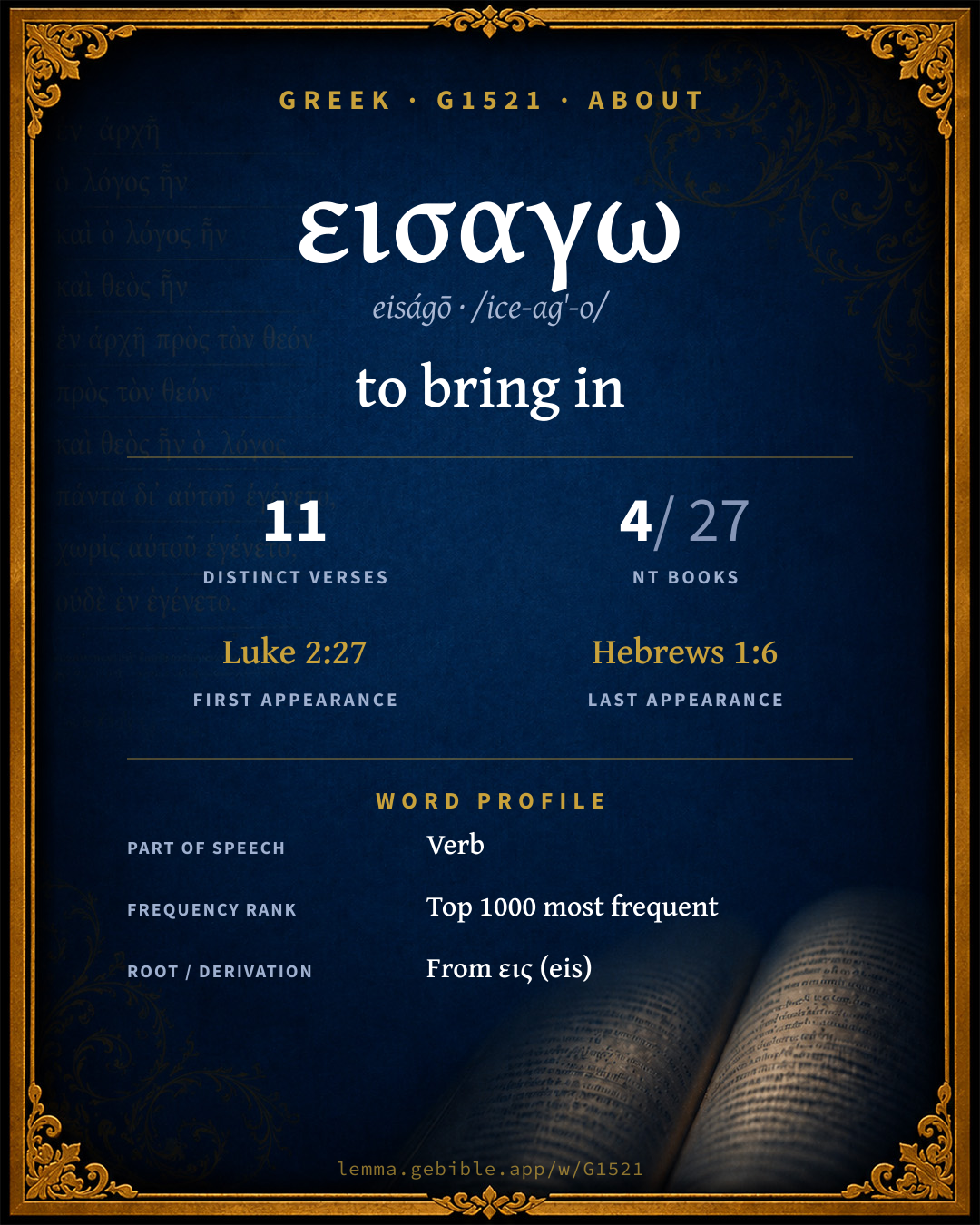
εἰσάγω
to bring in
‘to bring in’ is one of 2 main senses fuller range ↓
Full lexicon entry — Thayer's Greek Lexicon
From Thayer's Greek Lexicon
Where this word appears
See every Aorist-tense verb in the Greek New Testament →
Grammar key — what these labels mean
Part of speech
- Verb
- An action or state-of-being word.
Tense
- Aorist
- Action viewed as a simple whole, without regard to duration — often past (perfective aspect).
- Present
- Ongoing or general action in present time (imperfective aspect).
Voice
- Active
- The subject performs the action.
- Passive
- The subject receives the action.
Mood
- Indicative
- States a fact or asks a factual question (the mood of reality).
- Infinitive
- A verbal noun (“to write”), unmarked for person or number.
- Imperative
- Expresses a command or request.
- Subjunctive
- Expresses probability, purpose, or possibility (the mood of contingency).
Person
- 3rd person
- The one spoken about (“he / she / it / they”).
- 2nd person
- The one addressed (“you”).
Number
- Plural
- More than one.
- Singular
- One.
4 verses where G1521 appears in the Aorist tense in the Book of Acts. Filtered view — show all forms. Click any verse to open its interlinear word-by-word view. Verse text shown in the World English Bible for context — . Each verse’s Greek form is shown with its reference; the English is not keyword-highlighted, since the data carries no word-level English alignment. Use “Compare translations” on any verse to read it across multiple English versions. This concordance covers the Greek New Testament; Septuagint (Greek Old Testament) occurrences of this word are not indexed here.
Acts
- Acts 7:45 εἰσήγαγον aor act ind 3pl which also our fathers, in their turn, brought in with Joshua when they entered into the possession of the nations, whom God drove out before the face of our fathers, to the days of David,
- Acts 9:8 εἰσήγαγον aor act ind 3pl Saul arose from the ground, and when his eyes were opened, he saw no one. They led him by the hand, and brought him into Damascus.
- Acts 21:28 εἰσήγαγεν aor act ind 3sg crying out, "Men of Israel, help! This is the man who teaches all men everywhere against the people, and the law, and this place. Moreover, he also brought Greeks into the temple, and has defiled this holy place!"
- Acts 21:29 εἰσήγαγεν aor act ind 3sg For they had seen Trophimus, the Ephesian, with him in the city, and they supposed that Paul had brought him into the temple.
About this entry
At a glance — auto-summarized from this page’s data, not written by a person. Every figure links to its source below. This summary describes the numbers; it doesn’t interpret them.
At its core, εισαγω (eiságō) means “to bring in.” Its uses cluster heavily in Acts (55% of all occurrences). Spanning 11 verses in 4 books, it ranks among the uncommon words of the Greek New Testament. It first appears in Luke 2:27. Ranging over 2 senses, it is not a single-sense word. Each statement above links to its evidence; the full detail follows below.
Gloss history
Strong's 1890 vs modern scholarship
About this word
Strong's G1521 catalogs a Greek word from the Greek New Testament.
These counts are not copied from any lexicon or concordance. They are computed here, from the morphology-tagged Greek New Testament. What Lemma adds →
- 11
- distinct verses
- The word appears in 11 distinct verses.
- 4 / 27
- NT books
- The word appears in 4 of 27 New Testament books.
- #978
- by frequency
- Top 1000 most frequent Greek words (rank 978 of 5,347 Greek words by occurrence).
View all 11 occurrences in the concordance →
By section of the New Testament
By traditional corpus
Conventional, traditional groupings — biblical authorship is debated, so this is a traditional corpus grouping, not an authorship claim. Some books belong to more than one corpus (Luke is in both the Gospels and the Lukan corpus, and so on), so these shares overlap and need not total 100%. Each figure is a share of the word’s 11 distinct verses.
- Lukan (Luke–Acts) 9 verses · 82%
- Gospels 4 verses · 36%
- Johannine 1 verse · 9%
- Hebrews 1 verse · 9%
How translations render this word
Counts come from each version’s own published word-to-Strong’s tagging or interlinear alignment — an approximate guide to how each version renders this word, not a word-level alignment the data otherwise carries. Because each total is that version’s own tagged count, the per-version totals vary from one another and need not match the appearance or distinct-verse counts above. These counts may also differ from a printed concordance because Lemma counts each distinctly tagged rendering and does not collapse phrase taggings into a single head-word total. This is a fixed set of word-tagged versions (KJV, ASV, BSB, ULT) and does not change with the reading translation you choose elsewhere. Each version’s license is shown beside its name below (and on Sources).
- King James Version: Brought 4×
- American Standard Version: Brought in 3×, Brought 2×
- Berean Standard Bible: Brought 2×
- unfoldingWord Literal Text: Be brought 2×, Brought 2×, Brought in 2×
King James Version Public Domain
Renders G1521 across 10 tagged occurrences — most commonly:
Plus 6 renderings that appear only once — usually multi-word phrases or single function words the recovered tagging swept in, not distinct renderings.
American Standard Version Public Domain
Renders G1521 across 10 tagged occurrences — most commonly:
Plus 5 renderings that appear only once — usually multi-word phrases or single function words the recovered tagging swept in, not distinct renderings.
Berean Standard Bible Public Domain
Renders G1521 across 10 tagged occurrences — most commonly:
Plus 8 renderings that appear only once — usually multi-word phrases or single function words the recovered tagging swept in, not distinct renderings. Not rendered by a distinct English word in 1 further occurrence.
unfoldingWord Literal Text CC BY-SA 4.0
Renders G1521 across 14 tagged occurrences — most commonly:
Plus 8 renderings that appear only once — usually multi-word phrases or single function words the recovered tagging swept in, not distinct renderings.
Senses in Thayer's
The 2 senses Thayer's distinguishes for this word, in lexicon order (not ranked by frequency or importance). The full entry — with sub-senses — is in the Lexicon Entry tab.
- to lead in
- to bring in, the place into which not being expressly stated
Word origin
Derived from εις (eis) (G1519) — into.
Forms in the corpus
The 6 distinct written forms G1521 takes in the Greek New Testament, most frequent first — each parse links to that tense’s occurrences in the concordance.
| Form | Parsing | Example | Uses |
|---|---|---|---|
| εἰσήγαγεν eisḗgagen | Verb, Aorist, Active, Indicative, 3rd person, Singular | John 18:16 | 3 |
| εἰσήγαγον eisḗgagon | Verb, Aorist, Active, Indicative, 3rd person, Plural | Luke 22:54 | 3 |
| εἰσάγεσθαι eiságesthai | Verb, Present, Passive, Infinitive | Acts 21:37 | 2 |
| εἰσάγαγε eiságage | Verb, Aorist, Active, Imperative, 2nd person, Singular | Luke 14:21 | 1 |
| εἰσαγάγῃ eisagágē | Verb, Aorist, Active, Subjunctive, 3rd person, Singular | Hebrews 1:6 | 1 |
| εἰσαγαγεῖν eisagageîn | Verb, Aorist, Active, Infinitive | Luke 2:27 | 1 |
Same root — word family
Other Thayer's entries built from the same root as G1521, grouped by Strong’s listed origin. These share a root / origin per the lexicon — not necessarily a shared meaning. Each links to that word’s own entry.
Derives from
Shares the same root
- εισακουω eisakoúō G1522 to obey
- εισδεχομαι eisdéchomai G1523 to receive
- εισειμι eíseimi G1524 to go in
- εισερχομαι eisérchomai G1525 to enter
- εισκαλεω eiskaléō G1528 to invite
- εισοδος eísodos G1529 entrance
- εισπηδαω eispēdáō G1530 to rush in
- εισπορευομαι eisporeúomai G1531 to enter
- ειστρεχω eistréchō G1532 to run in
- εισφερω eisphérō G1533 to bring in
- εν en G1722 in
- εσοπτρον ésoptron G2072 mirror
- εσω ésō G2080 within
- σκυβαλον skýbalon G4657 refuse
Compare all same-root words → Showing 4 of 16 — not the complete family. They share a root, not necessarily a meaning.
Septuagint usage
The same Greek word εισαγω appears 137 times in the Greek Old Testament (Septuagint), across 133 verses in 24 books.
- 137
- LXX occurrences
- Tagged occurrences of this Greek word in the Septuagint.
- 133
- verses
- Distinct Septuagint verses containing this word.
- 24 / 39
- OT books
- The word appears in 24 of the 39 Old Testament books.
Sample Septuagint occurrences
- Genesis 6:19 εἰςἄγω
- Exodus 2:10 εἰςἄγω
- Leviticus 10:18 εἰςἄγω
- Numbers 14:3 εἰςἄγω
- Deuteronomy 4:27 εἰςἄγω
- Judges 2:1 εἰςἄγω
- 1 Samuel 7:1 εἰςἄγω
- 2 Samuel 5:2 εἰςἄγω
- 1 Kings 2:35 εἰςἄγω
- 2 Kings 9:2 εἰςἄγω
- 1 Chronicles 11:2 εἰςἄγω
- 2 Chronicles 25:23 εἰςἄγω
Septuagint occurrences (same lexeme)
Every verse where the same Strong’s number (G1521) appears in the Greek Septuagint — showing the first 50 of 133. Verse text shown in the World English Bible for context; the Greek form is the matched word — the English is not keyword-highlighted.
- Genesis 6:19 εἰςἄγω Of every living thing of all flesh, you shall bring two of every sort into the ark, to keep them alive with you. They shall be male and female.
- Genesis 7:2 εἰςἄγω You shall take seven pairs of every clean animal with you, the male and his female. Of the animals that are not clean, take two, the male and his female.
- Genesis 8:9 εἰςἄγω but the dove found no place to rest her foot, and she returned to him into the ark; for the waters were on the surface of the whole earth. He put forth his hand, and took her, and brought her to him into the ark.
- Genesis 12:15 εἰςἄγω The princes of Pharaoh saw her, and praised her to Pharaoh; and the woman was taken into Pharaoh's house.
- Genesis 29:13 εἰςἄγω It happened, when Laban heard the news of Jacob, his sister's son, that he ran to meet Jacob, and embraced him, and kissed him, and brought him to his house. Jacob told Laban all these things.
- Genesis 29:23 εἰςἄγω It happened in the evening, that he took Leah his daughter, and brought her to him. He went in to her.
- Genesis 39:14 εἰςἄγω that she called to the men of her house, and spoke to them, saying, "Behold, he has brought in a Hebrew to us to mock us. He came in to me to lie with me, and I cried with a loud voice.
- Genesis 39:17 εἰςἄγω She spoke to him according to these words, saying, "The Hebrew servant, whom you have brought to us, came in to me to mock me,
- Genesis 43:16 εἰςἄγω When Joseph saw Benjamin with them, he said to the steward of his house, "Bring the men into the house, and butcher an animal, and make ready; for the men will dine with me at noon."
- Genesis 43:17 εἰςἄγω The man did as Joseph commanded, and the man brought the men to Joseph's house.
- Genesis 43:18 εἰςἄγω The men were afraid, because they were brought to Joseph's house; and they said, "Because of the money that was returned in our sacks at the first time are we brought in; that he may seek occasion against us, and fall on us, and take us for bondservants, along with our donkeys."
- Genesis 47:7 εἰςἄγω Joseph brought in Jacob, his father, and set him before Pharaoh, and Jacob blessed Pharaoh.
- Exodus 2:10 εἰςἄγω The child grew, and she brought him to Pharaoh's daughter, and he became her son. She named him Moses, and said, "Because I drew him out of the water."
- Exodus 3:8 εἰςἄγω I have come down to deliver them out of the hand of the Egyptians, and to bring them up out of that land to a good and large land, to a land flowing with milk and honey; to the place of the Canaanite, the Hittite, the Amorite, the Perizzite, the Hivite, and the Jebusite.
- Exodus 6:8 εἰςἄγω I will bring you into the land which I swore to give to Abraham, to Isaac, and to Jacob; and I will give it to you for a heritage: I am Yahweh.'"
- Exodus 13:5 εἰςἄγω It shall be, when Yahweh shall bring you into the land of the Canaanite, and the Hittite, and the Amorite, and the Hivite, and the Jebusite, which he swore to your fathers to give you, a land flowing with milk and honey, that you shall keep this service in this month.
- Exodus 13:11 εἰςἄγω "It shall be, when Yahweh shall bring you into the land of the Canaanite, as he swore to you and to your fathers, and shall give it you,
- Exodus 15:17 εἰςἄγω You shall bring them in, and plant them in the mountain of your inheritance, The place, Yahweh, which you have made for yourself to dwell in; The sanctuary, Lord, which your hands have established.
- Exodus 18:7 εἰςἄγω Moses went out to meet his father-in-law, and bowed and kissed him. They asked each other of their welfare, and they came into the tent.
- Exodus 23:20 εἰςἄγω "Behold, I send an angel before you, to keep you by the way, and to bring you into the place which I have prepared.
- Exodus 23:23 εἰςἄγω For my angel shall go before you, and bring you in to the Amorite, the Hittite, the Perizzite, the Canaanite, the Hivite, and the Jebusite; and I will cut them off.
- Exodus 25:14 εἰςἄγω You shall put the poles into the rings on the sides of the ark to carry the ark.
- Exodus 26:29 εἰςἄγω You shall overlay the boards with gold, and make their rings of gold for places for the bars: and you shall overlay the bars with gold.
- Exodus 27:7 εἰςἄγω Its poles shall be put into the rings, and the poles shall be on the two sides of the altar, when carrying it.
- Exodus 33:3 εἰςἄγω to a land flowing with milk and honey: for I will not go up in the midst of you, for you are a stiff-necked people, lest I consume you in the way."
- Leviticus 10:18 εἰςἄγω Behold, its blood was not brought into the inner part of the sanctuary: you certainly should have eaten it in the sanctuary, as I commanded."
- Leviticus 18:3 εἰςἄγω You shall not do as they do in the land of Egypt, where you lived: and you shall not do as they do in the land of Canaan, where I am bringing you; neither shall you walk in their statutes.
- Leviticus 20:22 εἰςἄγω "'You shall therefore keep all my statutes, and all my ordinances, and do them; that the land, where I am bringing you to dwell, may not vomit you out.
- Numbers 14:3 εἰςἄγω Why does Yahweh bring us to this land, to fall by the sword? Our wives and our little ones will be a prey: wouldn't it be better for us to return into Egypt?
- Numbers 14:8 εἰςἄγω If Yahweh delight in us, then he will bring us into this land, and give it to us; a land which flows with milk and honey.
- Numbers 14:16 εἰςἄγω Because Yahweh was not able to bring this people into the land which he swore to them, therefore he has slain them in the wilderness.
- Numbers 14:24 εἰςἄγω but my servant Caleb, because he had another spirit with him, and has followed me fully, him will I bring into the land into which he went; and his seed shall possess it.
- Numbers 14:31 εἰςἄγω But your little ones, that you said should be a prey, them will I bring in, and they shall know the land which you have rejected.
- Numbers 15:18 εἰςἄγω Speak to the children of Israel, and tell them, When you come into the land where I bring you,
- Numbers 16:14 εἰςἄγω Moreover you haven't brought us into a land flowing with milk and honey, nor given us inheritance of fields and vineyards: will you put out the eyes of these men? we won't come up.
- Numbers 20:12 εἰςἄγω Yahweh said to Moses and Aaron, Because you didn't believe in me, to sanctify me in the eyes of the children of Israel, therefore you shall not bring this assembly into the land which I have given them.
- Numbers 27:17 εἰςἄγω who may go out before them, and who may come in before them, and who may lead them out, and who may bring them in; that the congregation of Yahweh not be as sheep which have no shepherd.
- Deuteronomy 4:27 εἰςἄγω Yahweh will scatter you among the peoples, and you shall be left few in number among the nations, where Yahweh shall lead you away.
- Deuteronomy 4:38 εἰςἄγω to drive out nations from before you greater and mightier than you, to bring you in, to give you their land for an inheritance, as at this day.
- Deuteronomy 6:10 εἰςἄγω It shall be, when Yahweh your God shall bring you into the land which he swore to your fathers, to Abraham, to Isaac, and to Jacob, to give you, great and goodly cities, which you didn't build,
- Deuteronomy 6:23 εἰςἄγω and he brought us out from there, that he might bring us in, to give us the land which he swore to our fathers.
- Deuteronomy 7:1 εἰςἄγω When Yahweh your God shall bring you into the land where you go to possess it, and shall cast out many nations before you, the Hittite, and the Girgashite, and the Amorite, and the Canaanite, and the Perizzite, and the Hivite, and the Jebusite, seven nations greater and mightier than you;
- Deuteronomy 8:7 εἰςἄγω For Yahweh your God brings you into a good land, a land of brooks of water, of springs and springs, flowing forth in valleys and hills;
- Deuteronomy 9:4 εἰςἄγω Don't speak in your heart, after that Yahweh your God has thrust them out from before you, saying, For my righteousness Yahweh has brought me in to possess this land; whereas for the wickedness of these nations Yahweh does drive them out from before you.
- Deuteronomy 9:28 εἰςἄγω lest the land whence you brought us out say, Because Yahweh was not able to bring them into the land which he promised to them, and because he hated them, he has brought them out to kill them in the wilderness.
- Deuteronomy 11:29 εἰςἄγω It shall happen, when Yahweh your God shall bring you into the land where you go to possess it, that you shall set the blessing on Mount Gerizim, and the curse on Mount Ebal.
- Deuteronomy 21:12 εἰςἄγω then you shall bring her home to your house; and she shall shave her head, and pare her nails;
- Deuteronomy 26:9 εἰςἄγω and he has brought us into this place, and has given us this land, a land flowing with milk and honey.
- Deuteronomy 30:5 εἰςἄγω and Yahweh your God will bring you into the land which your fathers possessed, and you shall possess it; and he will do you good, and multiply you above your fathers.
- Deuteronomy 31:20 εἰςἄγω For when I shall have brought them into the land which I swore to their fathers, flowing with milk and honey, and they shall have eaten and filled themselves, and grown fat; then will they turn to other gods, and serve them, and despise me, and break my covenant.
These are occurrences of the same Greek lexeme (G1521) in the Septuagint — not a translation of any one Hebrew word. The store carries no word-level Hebrew↔Greek alignment, so no Hebrew original is asserted here. Counts come from the recovered LXX Strong's tagging — high-frequency vocabulary is well covered, while rare or late forms may be untagged — so they reflect tagged occurrences and may slightly undercount.