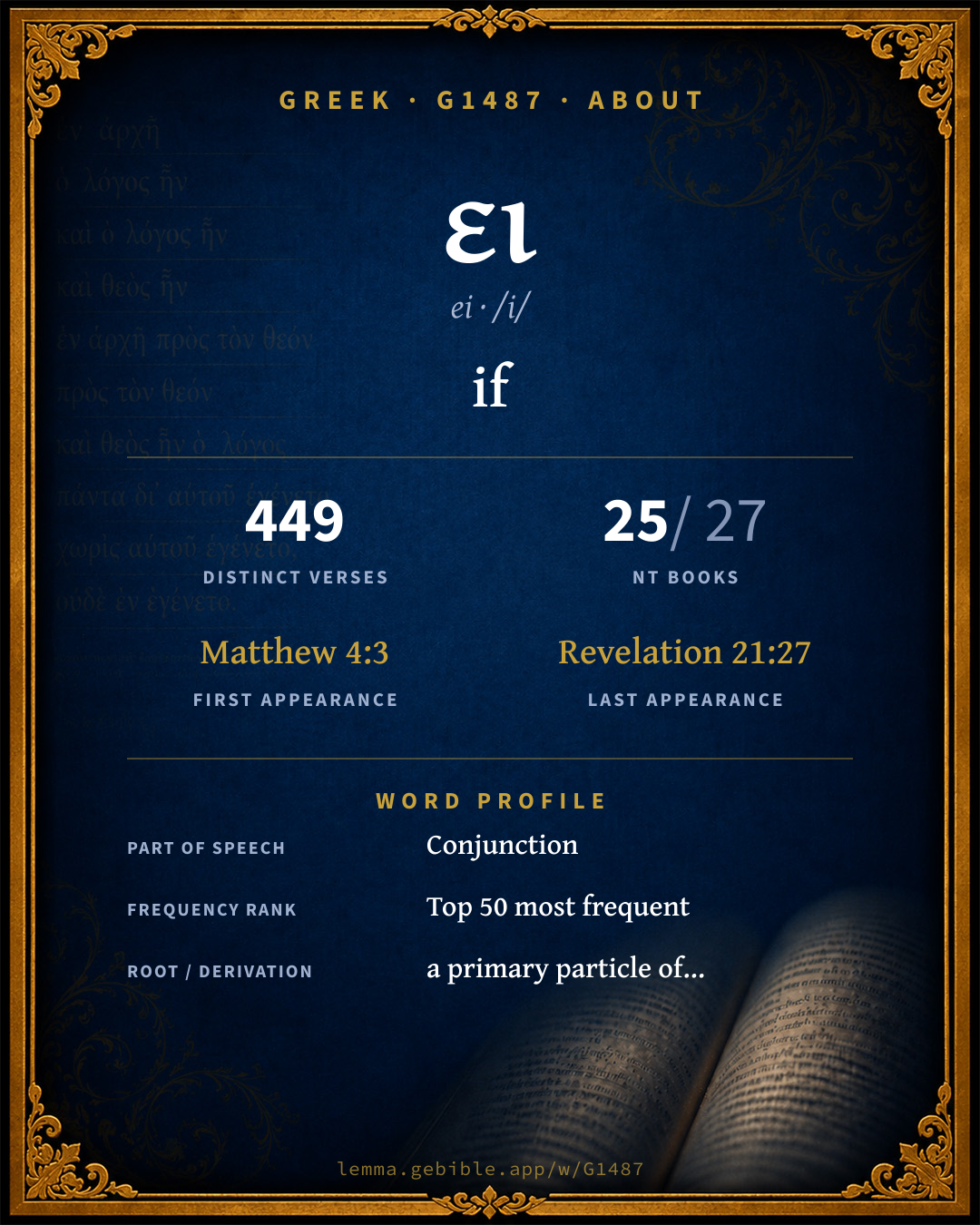
εἰ
if
Full lexicon entry — Thayer's Greek Lexicon
From Thayer's Greek Lexicon
Where this word appears
Grammar key — what these labels mean
Part of speech
- Conditional
- A particle introducing a condition (“if”).
Every verse where G1487 appears in the Book of 2 Thessalonians — 2 distinct verses. Click any verse to open its interlinear word-by-word view. Verse text shown in the World English Bible for context — . Each verse’s Greek form is shown with its reference; the English is not keyword-highlighted, since the data carries no word-level English alignment. Use “Compare translations” on any verse to read it across multiple English versions. This concordance covers the Greek New Testament; Septuagint (Greek Old Testament) occurrences of this word are not indexed here.
2 Thessalonians
About this entry
At a glance — auto-summarized from this page’s data, not written by a person. Every figure links to its source below. This summary describes the numbers; it doesn’t interpret them.
“if” is the headline sense of the Greek conjunction ει (ei). Its earliest occurrence is Matthew 4:3. It turns up in 449 verses across 25 books, a common footprint. It clusters with εαν, ειγε and ει δε μη(γε) under a shared root. The sections below give every sense, occurrence, and version rendering.
Gloss history
Strong's 1890 vs modern scholarship
About this word
Strong's G1487 catalogs a Greek word from the Greek New Testament.
These counts are not copied from any lexicon or concordance. They are computed here, from the morphology-tagged Greek New Testament. What Lemma adds →
- 449
- distinct verses
- The word appears in 449 distinct verses.
- 25 / 27
- NT books
- The word appears in 25 of 27 New Testament books.
- #40
- by frequency
- Top 50 most frequent Greek words (rank 40 of 5,347 Greek words by occurrence).
View all 449 occurrences in the concordance →
Most concentrated in
- 1 Corinthians 56 verses 12%
- Matthew 54 verses 12%
- Luke 52 verses 12%
By section of the New Testament
By traditional corpus
Conventional, traditional groupings — biblical authorship is debated, so this is a traditional corpus grouping, not an authorship claim. Some books belong to more than one corpus (Luke is in both the Gospels and the Lukan corpus, and so on), so these shares overlap and need not total 100%. Each figure is a share of the word’s 449 distinct verses.
- Gospels 184 verses · 41%
- Pauline corpus 171 verses · 38%
- Lukan (Luke–Acts) 83 verses · 18%
- Johannine 68 verses · 15%
- General (Catholic) Epistles 33 verses · 7%
- Hebrews 16 verses · 4%
- Revelation 14 verses · 3%
How translations render this word
Counts come from each version’s own published word-to-Strong’s tagging or interlinear alignment — an approximate guide to how each version renders this word, not a word-level alignment the data otherwise carries. Because each total is that version’s own tagged count, the per-version totals vary from one another and need not match the appearance or distinct-verse counts above. These counts may also differ from a printed concordance because Lemma counts each distinctly tagged rendering and does not collapse phrase taggings into a single head-word total. This is a fixed set of word-tagged versions (KJV, ASV, BSB, ULT) and does not change with the reading translation you choose elsewhere. Each version’s license is shown beside its name below (and on Sources).
- King James Version: If 236×, Whether 21×, That 5×
- American Standard Version: If 305×, Whether 22×, But 10×
- Berean Standard Bible: If 322×, Except 37×, Only 17×
- unfoldingWord Literal Text: If 400×, Except 65×, Whether 17×
King James Version Public Domain
Renders G1487 across 281 tagged occurrences — most commonly:
Plus 12 renderings that appear only once — usually multi-word phrases or single function words the recovered tagging swept in, not distinct renderings. Not rendered by a distinct English word in 11 further occurrences.
American Standard Version Public Domain
Renders G1487 across 424 tagged occurrences — most commonly:
Plus other, less common renderings. Plus 49 renderings that appear only once — usually multi-word phrases or single function words the recovered tagging swept in, not distinct renderings. Not rendered by a distinct English word in 4 further occurrences.
Berean Standard Bible Public Domain
Renders G1487 across 441 tagged occurrences — most commonly:
Plus 17 renderings that appear only once — usually multi-word phrases or single function words the recovered tagging swept in, not distinct renderings. Not rendered by a distinct English word in 38 further occurrences.
unfoldingWord Literal Text CC BY-SA 4.0
Renders G1487 across 514 tagged occurrences — most commonly:
Plus 13 renderings that appear only once — usually multi-word phrases or single function words the recovered tagging swept in, not distinct renderings.
Senses in Thayer's
The 1 sense Thayer's distinguishes for this word, in lexicon order (not ranked by frequency or importance). The full entry — with sub-senses — is in the Lexicon Entry tab.
- if, whether
Word origin
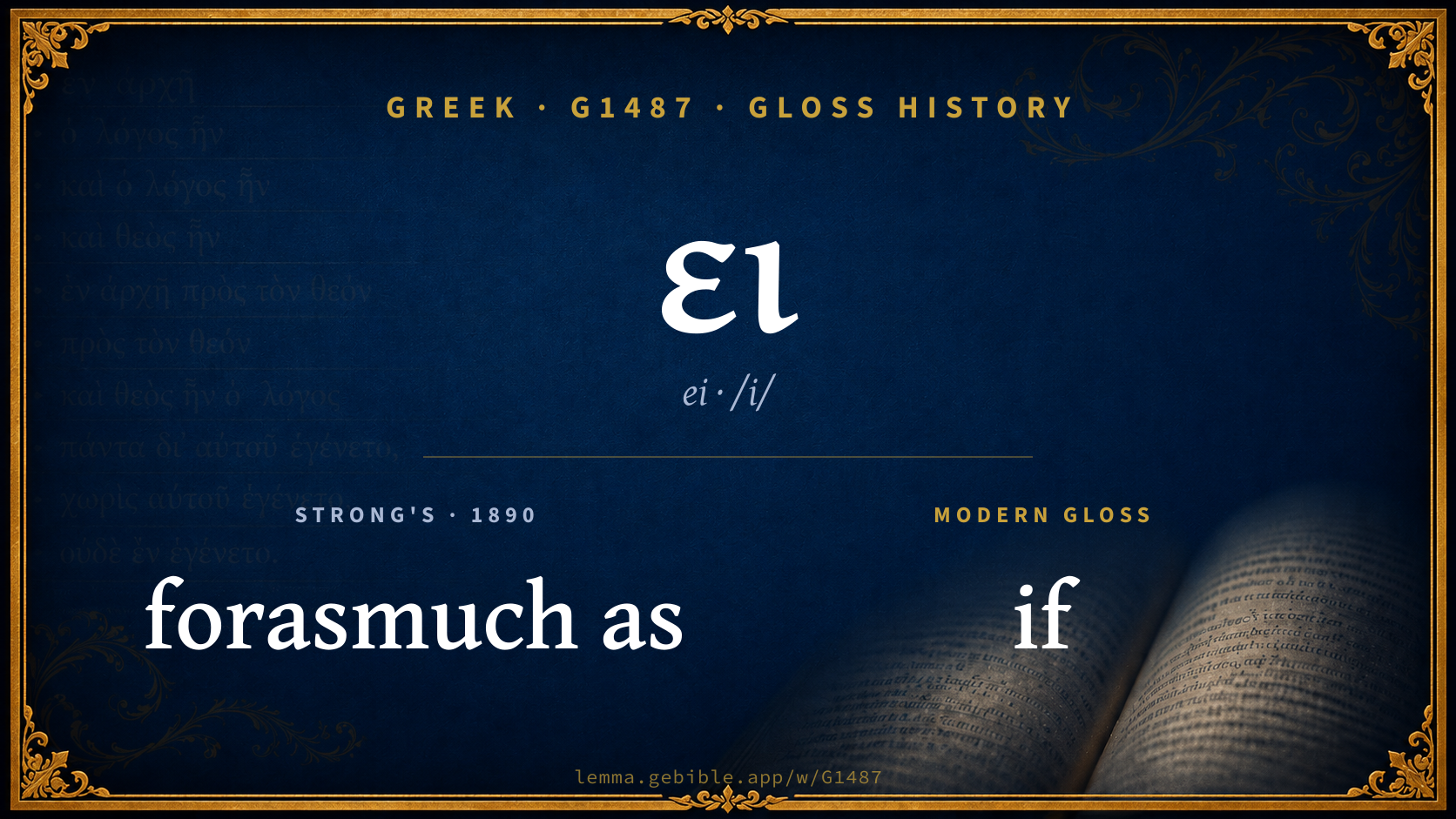
Origin: a primary particle of conditionality
A primary particle of conditionality; if whether that etc. : - forasmuch as if that ([al-]) though whether. Often used in connection or composition with other particles especially as in G1489 G1490 G1499 G1508 G1509 G1512 G1513 G1536 and G1537 . See also G1437 .
— Strong’s Exhaustive Concordance (1890), public domain.
Forms in the corpus
The 5 distinct written forms G1487 takes in the Greek New Testament, most frequent first — each parse links to that case’s occurrences in the concordance.
| Form | Parsing | Example | Uses |
|---|---|---|---|
| εἰ ei | Conditional | Matthew 4:3 | 414 |
| εἴ eí | Conditional | Matthew 16:24 | 64 |
| Εἰ Ei | Conditional | John 15:18 | 10 |
| Εἴ Eí | Conditional | 1 Corinthians 14:37 | 2 |
| εἶ eî | Conditional | Acts 7:1 | 1 |
Same root — word family
Other Thayer's entries built from the same root as G1487, grouped by Strong’s listed origin. These share a root / origin per the lexicon — not necessarily a shared meaning. Each links to that word’s own entry.
Derived from this word
- εαν eán G1437 if
- ειγε eíge G1489 if indeed
- ει δε μη(γε) ei dè mḗ(ge) G1490 but if not
- ει και ei kaí G1499 even if
- ει μη ei mḗ G1508 except
- ει περ eí per G1512 if indeed
- ει πως eí pōs G1513 if indeed
- ειτε eíte G1535 whether or
- ει τις eí tis G1536 whoever
Compare all same-root words → Showing 4 of 10 — not the complete family. They share a root, not necessarily a meaning.
Septuagint usage
The same Greek word ει appears 617 times in the Greek Old Testament (Septuagint), across 531 verses in 35 books.
- 617
- LXX occurrences
- Tagged occurrences of this Greek word in the Septuagint.
- 531
- verses
- Distinct Septuagint verses containing this word.
- 35 / 39
- OT books
- The word appears in 35 of the 39 Old Testament books.
Sample Septuagint occurrences
- Genesis 4:14 εἰ
- Exodus 2:14 εἰ
- Leviticus 10:19 εἰ
- Numbers 5:19 εἰ
- Deuteronomy 1:31 εἰ
- Joshua 2:5 εἰ
- Judges 2:22 εἰ
- Ruth 4:4 εἰ
- 1 Samuel 3:14 εἰ
- 2 Samuel 2:1 εἰ
- 1 Kings 1:27 εἰ
- 2 Kings 1:2 εἰ
Septuagint occurrences (same lexeme)
Every verse where the same Strong’s number (G1487) appears in the Greek Septuagint — showing the first 50 of 531. Verse text shown in the World English Bible for context; the Greek form is the matched word — the English is not keyword-highlighted.
- Genesis 4:14 εἰ Behold, you have driven me out this day from the surface of the ground. I will be hidden from your face, and I will be a fugitive and a wanderer in the earth. It will happen that whoever finds me will kill me."
- Genesis 8:7 εἰ and he sent forth a raven. It went back and forth, until the waters were dried up from off the earth.
- Genesis 8:8 εἰ He sent forth a dove from him, to see if the waters were abated from off the surface of the ground,
- Genesis 13:9 εἰ Isn't the whole land before you? Please separate yourself from me. If you go to the left hand, then I will go to the right. Or if you go to the right hand, then I will go to the left."
- Genesis 13:16 εἰ I will make your offspring as the dust of the earth, so that if a man can number the dust of the earth, then your seed may also be numbered.
- Genesis 14:23 εἰ that I will not take a thread nor a shoe-latchet nor anything that is yours, lest you should say, 'I have made Abram rich.'
- Genesis 15:5 εἰ Yahweh brought him outside, and said, "Look now toward the sky, and count the stars, if you are able to count them." He said to Abram, "So shall your seed be."
- Genesis 17:17 εἰ Then Abraham fell on his face, and laughed, and said in his heart, "Will a child be born to him who is one hundred years old? Will Sarah, who is ninety years old, give birth?"
- Genesis 18:3 εἰ and said, "My lord, if now I have found favor in your sight, please don't go away from your servant.
- Genesis 18:21 εἰ I will go down now, and see whether they have done altogether according to the cry of it, which is come to me. If not, I will know."
- Genesis 19:12 εἰ The men said to Lot, "Do you have anybody else here? Sons-in-law, your sons, your daughters, and whoever you have in the city, bring them out of the place:
- Genesis 20:7 εἰ Now therefore, restore the man's wife. For he is a prophet, and he will pray for you, and you will live. If you don't restore her, know for sure that you will die, you, and all who are yours."
- Genesis 23:8 εἰ He talked with them, saying, "If it be your mind that I should bury my dead out of my sight, hear me, and entreat for me to Ephron the son of Zohar,
- Genesis 24:21 εἰ The man looked steadfastly at her, holding his peace, to know whether Yahweh had made his journey prosperous or not.
- Genesis 24:23 εἰ and said, "Whose daughter are you? Please tell me. Is there room in your father's house for us to lodge in?"
- Genesis 24:42 εἰ I came this day to the spring, and said, 'Yahweh, the God of my master Abraham, if now you do prosper my way which I go.
- Genesis 24:49 εἰ Now if you will deal kindly and truly with my master, tell me. If not, tell me. That I may turn to the right hand, or to the left."
- Genesis 25:22 εἰ The children struggled together within her. She said, "If it be so, why do I live?" She went to inquire of Yahweh.
- Genesis 27:21 εἰ Isaac said to Jacob, "Please come near, that I may feel you, my son, whether you are really my son Esau or not."
- Genesis 27:37 εἰ Isaac answered Esau, "Behold, I have made him your lord, and all his brothers have I given to him for servants. With grain and new wine have I sustained him. What then will I do for you, my son?"
- Genesis 27:46 εἰ Rebekah said to Isaac, "I am weary of my life because of the daughters of Heth. If Jacob takes a wife of the daughters of Heth, such as these, of the daughters of the land, what good will my life do me?"
- Genesis 30:1 εἰ When Rachel saw that she bore Jacob no children, Rachel envied her sister. She said to Jacob, "Give me children, or else I will die."
- Genesis 30:27 εἰ Laban said to him, "If now I have found favor in your eyes, stay here, for I have divined that Yahweh has blessed me for your sake."
- Genesis 31:27 εἰ Why did you flee secretly, and deceive me, and didn't tell me, that I might have sent you away with mirth and with songs, with tambourine and with harp;
- Genesis 31:42 εἰ Unless the God of my father, the God of Abraham, and the fear of Isaac, had been with me, surely now you would have sent me away empty. God has seen my affliction and the labor of my hands, and rebuked you last night."
- Genesis 31:50 εἰ If you will afflict my daughters, and if you will take wives besides my daughters, no man is with us; behold, God is witness between me and you."
- Genesis 33:10 εἰ Jacob said, "Please, no, if I have now found favor in your sight, then receive my present at my hand, because I have seen your face, as one sees the face of God, and you were pleased with me.
- Genesis 37:14 εἰ He said to him, "Go now, see whether it is well with your brothers, and well with the flock; and bring me word again." So he sent him out of the valley of Hebron, and he came to Shechem.
- Genesis 37:32 εἰ They took the coat of many colors, and they brought it to their father, and said, "We have found this. Examine it, now, whether it is your son's coat or not."
- Genesis 39:8 εἰ But he refused, and said to his master's wife, "Behold, my master doesn't know what is with me in the house, and he has put all that he has into my hand.
- Genesis 42:16 εἰ Send one of you, and let him get your brother, and you shall be bound, that your words may be tested, whether there is truth in you, or else by the life of Pharaoh surely you are spies."
- Genesis 42:19 εἰ If you are honest men, then let one of your brothers be bound in your prison-house; but you go, carry grain for the famine of your houses.
- Genesis 42:20 εἰ Bring your youngest brother to me; so will your words be verified, and you won't die." They did so.
- Genesis 43:4 εἰ If you will send our brother with us, we will go down and buy you food,
- Genesis 43:5 εἰ but if you will not send him, we will not go down, for the man said to us, 'You shall not see my face, unless your brother is with you.'"
- Genesis 43:6 εἰ Israel said, "Why did you treat me so badly, telling the man that you had another brother?"
- Genesis 43:7 εἰ They said, "The man asked directly concerning ourselves, and concerning our relatives, saying, 'Is your father still alive? Have you another brother?' We just answered his questions. Is there any way we could know that he would say, 'Bring your brother down?'"
- Genesis 43:10 εἰ for unless we had lingered, surely we would have returned a second time by now."
- Genesis 43:11 εἰ Their father, Israel, said to them, "If it be so now, do this. Take from the choice fruits of the land in your bags, and carry down a present for the man, a little balm, a little honey, spices and myrrh, nuts, and almonds;
- Genesis 43:27 εἰ He asked them of their welfare, and said, "Is your father well, the old man of whom you spoke? Is he yet alive?"
- Genesis 44:8 εἰ Behold, the money, which we found in our sacks' mouths, we brought again to you out of the land of Canaan. How then should we steal silver or gold out of your lord's house?
- Genesis 44:19 εἰ My lord asked his servants, saying, 'Have you a father, or a brother?'
- Genesis 44:26 εἰ We said, 'We can't go down. If our youngest brother is with us, then will we go down: for we may not see the man's face, unless our youngest brother is with us.'
- Genesis 45:28 εἰ Israel said, "It is enough. Joseph my son is still alive. I will go and see him before I die."
- Genesis 47:5 εἰ Pharaoh spoke to Joseph, saying, "Your father and your brothers have come to you.
- Genesis 47:16 εἰ Joseph said, "Give your cattle; and I will give you food for your cattle, if money fails."
- Genesis 47:18 εἰ When that year was ended, they came to him the second year, and said to him, "We will not hide from my lord how our money is all spent, and the herds of cattle are my lord's. There is nothing left in the sight of my lord, but our bodies, and our lands.
- Genesis 47:29 εἰ The time drew near that Israel must die, and he called his son Joseph, and said to him, "If now I have found favor in your sight, please put your hand under my thigh, and deal kindly and truly with me. Please don't bury me in Egypt,
- Genesis 50:4 εἰ When the days of weeping for him were past, Joseph spoke to the house of Pharaoh, saying, "If now I have found favor in your eyes, please speak in the ears of Pharaoh, saying,
- Exodus 2:14 εἰ He said, "Who made you a prince and a judge over us? Do you plan to kill me, as you killed the Egyptian?" Moses was afraid, and said, "Surely this thing is known."
These are occurrences of the same Greek lexeme (G1487) in the Septuagint — not a translation of any one Hebrew word. The store carries no word-level Hebrew↔Greek alignment, so no Hebrew original is asserted here. Counts come from the recovered LXX Strong's tagging — high-frequency vocabulary is well covered, while rare or late forms may be untagged — so they reflect tagged occurrences and may slightly undercount.