Revelation 21:27

Greek (Tischendorf 8th ed.) Revelation 21:27 appears in the Greek New Testament. The text above is from the Tischendorf 8th edition. Each word links to its Strong’s number and a concise gloss. Click any word for its full Thayer’s Greek Lexicon entry.
Download image
Cite this verse

Revelation 21:27 (World English Bible). Public Domain. Lemma interlinear Bible study tool, https://lemma.gebible.app/v/revelation/21/27.

Show BibTeX & RIS
BibTeX
RIS
English Translation
There will in no way enter into it anything profane, or one who causes an abomination or a lie, but only those who are written in the Lamb's book of life.
World English Bible · Public Domain
Download a study sheet

One document with this verse’s original text, its word-by-word gloss line, the meaning frame, cross-references with their text, attributed commentary, and full source and license credits — printable, and it pastes into notes with its structure intact.

This verse Autodidact and up

Study sheet (.html) Plain text (.txt)

A passage Seminary Student

Up to 50 verses in one chapter. A passage sheet keeps up to 6 commentary sources and 12 cross-references per verse, in the order this page ranks them, and says so on the sheet whenever that leaves anything out. Ask for a single verse and you get the Autodidact verse sheet above.

Everything on this page stays free to read, with no account — the sheet is a download of what is already on screen, not access to it.

Want to remove ads? Support Godless Engineer
Compare translations 3

The same verse in 3 English versions, stacked beneath the original-language interlinear above. Click any original word for its lexicon entry.

Each is an independent rendering of the whole verse — the interlinear is not word-aligned to these translations.

Highlighted words mark where these versions differ — a whole-verse word diff, not a word-by-word alignment.

  • World English Bible Public Domain
    There will in no way enter into it anything profane, or one who causes an abomination or a lie, but only those who are written in the Lamb's book of life.
  • King James Version Public Domain
    And there shall in no wise enter into it any thing that defileth, neither whatsoever worketh abomination, or maketh a lie: but they which are written in the Lamb's book of life.
  • unfoldingWord Literal Text CC BY-SA 4.0
    but everything unclean will certainly not enter into her and the one doing abomination and falsehood, if not the ones having been written in the Book of Life of the Lamb.

unfoldingWord Literal Text — © unfoldingWord, licensed CC BY-SA 4.0. Word-aligned USFM3 via Door43 (git.door43.org/unfoldingWord/en_ult).

Versions to compare (up to 4)

3 of 4 selected

Show all 19 translations

Every available English version of this verse, each an independent rendering of the whole verse.

  • World English Bible Public Domain
    There will in no way enter into it anything profane, or one who causes an abomination or a lie, but only those who are written in the Lamb's book of life.
  • Berean Standard Bible Public Domain
    But nothing unclean will ever enter it, nor anyone who practices an abomination or a lie, but only those whose names are written in the Lamb’s Book of Life.
  • Majority Standard Bible Public Domain
    But nothing unclean will ever enter it, nor anyone who practices an abomination or a lie, but only those whose names are written in the Lamb’s Book of Life.
  • King James Version Public Domain
    And there shall in no wise enter into it any thing that defileth, neither whatsoever worketh abomination, or maketh a lie: but they which are written in the Lamb's book of life.
  • American Standard Version (1901) Public Domain
    and there shall in no wise enter into it anything unclean, or he that maketh an abomination and a lie: but only they that are written in the Lamb's book of life.
  • Revised Version (1885) Public Domain
    and there shall in no wise enter into it anything unclean, or he that maketh an abomination and a lie: but only they which are written in the Lamb’s book of life.
  • Geneva Bible (1599) Public Domain
    And there shall enter into it none vncleane thing, neither whatsoeuer woorketh abomination or lies: but they which are written in ye Lambes booke of life.
  • Douay-Rheims (1899) Public Domain
    There shall not enter into it any thing defiled, or that worketh abomination or maketh a lie, but they that are written in the book of life of the Lamb.
  • Young's Literal Translation Public Domain
    and there may not at all enter into it any thing defiling and doing abomination, and a lie, but -- those written in the scroll of the life of the Lamb.
  • Literal Standard Version CC BY-SA 4.0
    and there may never enter into it anything defiling and doing abomination, and a lie, if not those written in the Lamb’s Scroll of Life.
  • Unlocked Literal Bible CC BY-SA 4.0
    but nothing unclean will ever enter into it, nor anyone who does what is shameful or deceitful, but only those whose names are written in the Lamb's Book of Life.
  • unfoldingWord Literal Text CC BY-SA 4.0
    but everything unclean will certainly not enter into her and the one doing abomination and falsehood, if not the ones having been written in the Book of Life of the Lamb.
  • Darby Bible Public Domain
    And nothing common, nor that maketh an abomination and a lie, shall at all enter into it; but those only who [are] written in the book of life of the Lamb.
  • World Messianic Bible Public Domain
    There will in no way enter into it anything profane, or one who causes an abomination or a lie, but only those who are written in the Lamb’s book of life.
  • Webster's Bible Public Domain
    And there shall in no wise enter into it any thing that defileth, neither whatever worketh abomination, or maketh a lie; but they who are written in the Lamb's book of life.
  • Free Bible Version CC BY-SA 4.0
    Nothing unclean will ever enter into it, or anyone who worships idols, or who is a liar—only those who are written in the Lamb's book of life.
  • Bible in Basic English Public Domain
    And nothing unclean may come into it, or anyone whose works are cursed or false; but only those whose names are in the Lamb's book of life.
  • Text-Critical English NT CC BY 4.0
    No unclean thing and no one who causes an abomination or a lie will ever enter it, but only those whose names are written in the Lamb's book of life.
  • Tyndale New Testament (1534) Public Domain
    And there shall entre into it none vnclene thynge: nether what soever worketh abhominacion: or maketh lyes: but they only which are wrytten in the lambes boke of lyfe.

Literal Standard Version (2020), Covenant Press — licensed CC BY-SA 4.0. Text via the HelloAO Bible API (eBible.org). Unlocked Literal Bible (unfoldingWord) — licensed CC BY-SA 4.0. Text via the HelloAO Bible API (eBible.org). unfoldingWord Literal Text — © unfoldingWord, licensed CC BY-SA 4.0. Word-aligned USFM3 via Door43 (git.door43.org/unfoldingWord/en_ult). Free Bible Version, Dr. Jonathan Gallagher — licensed CC BY-SA 4.0. Text via the HelloAO Bible API (eBible.org).

Word by word

More ways to search: Search by grammar → Find every occurrence → Compare this word →

Practice this passage: Drill this verse → Learn its vocabulary →

βδέλυγμα
bdélygma
G946
“abomination”
Noun, Accusative, Singular, Neuter
Part of Speech
Noun
Case
Accusative
Number
Singular
Gender
Neuter
Full Thayer's Definition

Origin: from G948

TDNT: 10:58,1

1. a foul thing, a detestable thing a. of idols and things pertaining to idolatry
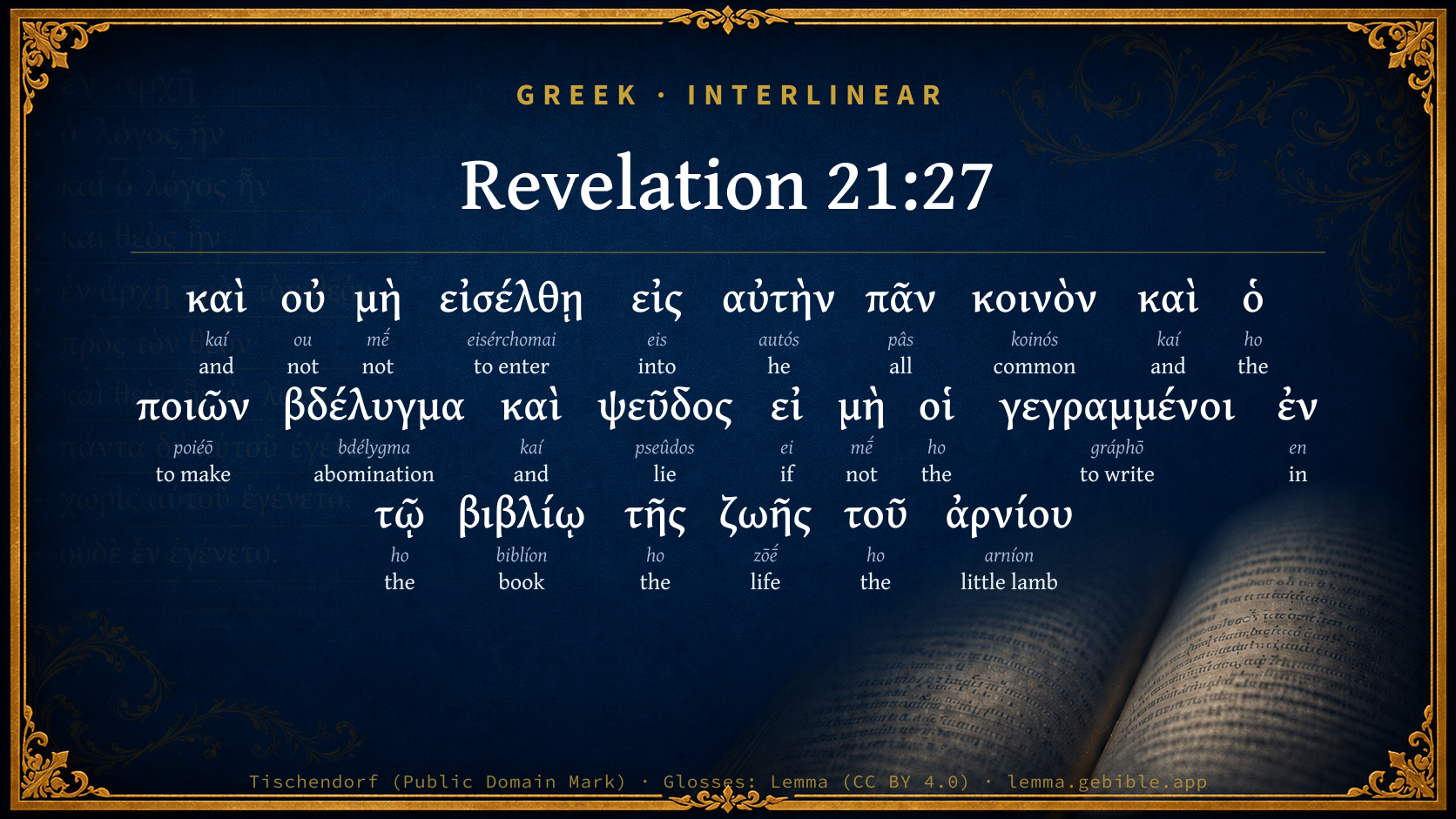
  1. καὶ kaí G2532 “and” Conjunction
  2. οὐ ou G3756 “not” Particle, Negative
  3. μὴ mḗ G3361 “not” Particle, Negative
  4. εἰσέλθῃ eisérchomai G1525 “to enter” Verb, Aorist, Active, Subjunctive, 3rd person, Singular
  5. εἰς eis G1519 “into” Preposition
  6. αὐτὴν autós G846 “he” Personal pronoun, Accusative, Singular, Feminine
  7. πᾶν pâs G3956 “all” Adjective, Nominative, Singular, Neuter
  8. κοινὸν koinós G2839 “common” Adjective, Nominative, Singular, Neuter
  9. καὶ kaí G2532 “and” Conjunction
  10. ὁ ho G3588 “the” Article, Nominative, Singular, Masculine
  11. ποιῶν poiéō G4160 “to make” Verb, Present, Active, Participle, Nominative, Singular, Masculine
  12. καὶ kaí G2532 “and” Conjunction
  13. ψεῦδος pseûdos G5579 “lie” Noun, Accusative, Singular, Neuter
  14. εἰ ei G1487 “if” Conditional
  15. μὴ mḗ G3361 “not” Particle, Negative
  16. οἱ ho G3588 “the” Article, Nominative, Plural, Masculine
  17. γεγραμμένοι gráphō G1125 “to write” Verb, Perfect, Passive, Participle, Nominative, Plural, Masculine
  18. ἐν en G1722 “in” Preposition
  19. τῷ ho G3588 “the” Article, Dative, Singular, Neuter
  20. βιβλίῳ biblíon G975 “book” Noun, Dative, Singular, Neuter
  21. τῆς ho G3588 “the” Article, Genitive, Singular, Feminine
  22. ζωῆς zōḗ G2222 “life” Noun, Genitive, Singular, Feminine
  23. τοῦ ho G3588 “the” Article, Genitive, Singular, Neuter
  24. ἀρνίου arníon G721 “little lamb” Noun, Genitive, Singular, Neuter

About this verse

These counts appear in no published source. They are computed here, from the morphology-tagged text and Lemma’s own curated glosses. What Lemma adds →

25
words
18
distinct lemmas
Revelation
section

Notable vocabulary

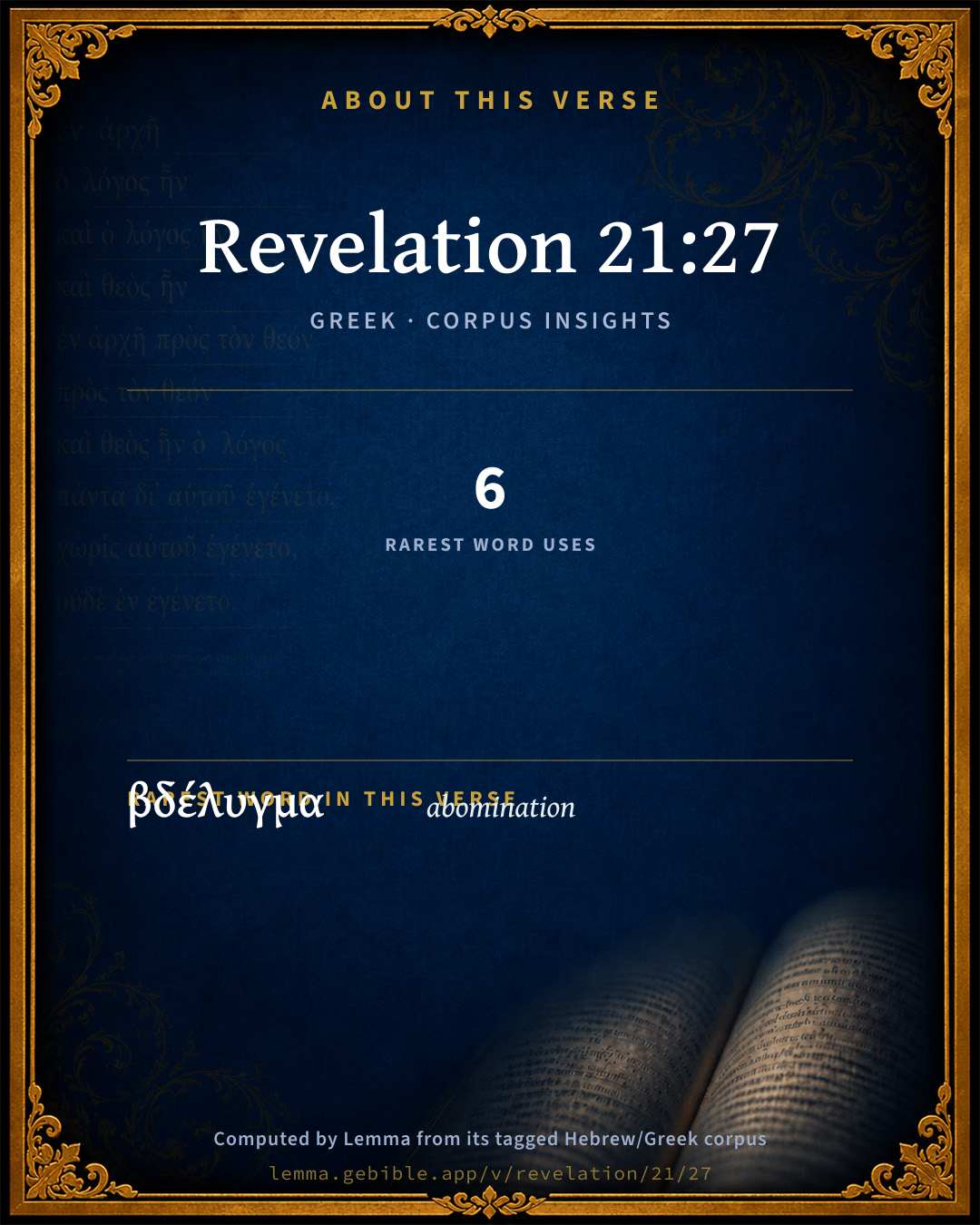
The rarest word here is βδέλυγμα abomination G946 — appearing just 6 times in the whole Greek New Testament.

Shared distinctive vocabulary

βδέλυγμα abomination G946 occurs in 6 verses of the Greek New Testament. Also found in:

Repetition

Words recur within this verse:

Cross-references

20

Topical passages linked to Revelation 21:27 in the Treasury of Scripture Knowledge — connected by theme and wording, ordered by reader-vote popularity; previews shown in the World English Bible.

  • Revelation 22:14–15 Blessed are those who do his commandments, that they may have the right to the tree of life, and may enter in by the gates into the city.
  • Isaiah 52:1 Awake, awake, put on your strength, Zion; put on your beautiful garments, Jerusalem, the holy city: for henceforth there shall no more come into you the uncircumcised and the unclean.
  • Revelation 20:15 If anyone was not found written in the book of life, he was cast into the lake of fire.
  • Revelation 3:5 He who overcomes will be arrayed in white garments, and I will in no way blot his name out of the book of life, and I will confess his name before my Father, and before his angels.
  • Isaiah 35:8 A highway shall be there, and a way, and it shall be called The way of holiness. The unclean shall not pass over it, but is shall be for for him who walks in the Way. Wicked fools will not go there.
  • Matthew 13:41 The Son of Man will send out his angels, and they will gather out of his Kingdom all things that cause stumbling, and those who do iniquity,
  • Ezekiel 44:9 Thus says the Lord Yahweh, No foreigner, uncircumcised in heart and uncircumcised in flesh, shall enter into my sanctuary, of any foreigners who are among the children of Israel.
  • Joel 3:17 "So you will know that I am Yahweh, your God, Dwelling in Zion, my holy mountain. Then Jerusalem will be holy, And no strangers will pass through her any more.
  • Galatians 5:19–21 Now the works of the flesh are obvious, which are: adultery, sexual immorality, uncleanness, lustfulness,
  • Psalms 101:8 Morning by morning, I will destroy all the wicked of the land; To cut off all the workers of iniquity from Yahweh's city.
  • 1 Corinthians 6:9–10 Or don't you know that the unrighteous will not inherit the Kingdom of God? Don't be deceived. Neither the sexually immoral, nor idolaters, nor adulterers, nor male prostitutes, nor homosexuals,
  • Ephesians 5:5 Know this for sure, that no sexually immoral person, nor unclean person, nor covetous man, who is an idolater, has any inheritance in the Kingdom of Christ and God.
  • Revelation 13:8 All who dwell on the earth will worship him, everyone whose name has not been written from the foundation of the world in the book of life of the Lamb who has been killed.
  • Hebrews 12:14 Follow after peace with all men, and the sanctification without which no man will see the Lord,
  • Revelation 21:8 But for the cowardly, unbelieving, sinners, abominable, murderers, sexually immoral, sorcerers, idolaters, and all liars, their part is in the lake that burns with fire and sulfur, which is the second death."
  • Revelation 20:12 I saw the dead, the great and the small, standing before the throne, and they opened books. Another book was opened, which is the book of life. The dead were judged out of the things which were written in the books, according to their works.
  • Isaiah 60:21 Your people also shall be all righteous; they shall inherit the land forever, the branch of my planting, the work of my hands, that I may be glorified.
  • Zechariah 14:21 Yes, every pot in Jerusalem and in Judah will be holy to Yahweh of Hosts; and all those who sacrifice will come and take of them, and cook in them. In that day there will no longer be a Canaanite in the house of Yahweh of Hosts.
  • Philippians 4:3 Yes, I beg you also, true yoke-fellow, help these women, for they labored with me in the Gospel, with Clement also, and the rest of my fellow workers, whose names are in the book of life.
  • Revelation 17:4–5 The woman was dressed in purple and scarlet, and decked with gold and precious stones and pearls, having in her hand a golden cup full of abominations and the impurities of the sexual immorality of the earth.

Cross-references courtesy of OpenBible.info (CC BY 4.0).

Commentary

Notes on Revelation 21:27 from classic Christian and Jewish commentators (each source and its license shown beneath its notes). The classic Christian expositions comment on the surrounding passage and are grouped to its opening verse, so a note may address several verses; the Jewish commentaries on the Tanakh (Rashi and others) are per-verse, so they appear only where the commentator wrote on this verse.

Lemma curates 59 commentaries, every one of them public domain or Creative Commons licensed, each selected and text-cleaned for this edition rather than reprinted as found. About our sources →

The Biblical Illustrator

Joseph S. Exell

Rev_21:27

There shall in no wise enter into it anything that defileth.

The barrier

I. The word of exclusion. This is no arbitrary decree, it is a solemn declaration to which all holy spirits give their willing assent and consent; an ordinance of which even the excluded themselves shall admit the justice.

1. For, first, it is not meet that so royal and divine a corporation as the glorified Church of God should be ruined by defilement. God forbid that her light, which is like unto a stone most precious, even like a jasper stone, clear as crystal, should ever be dimmed by the breath of sin.

2. There can be no entrance of evil into the kingdom of God, for it is the very essence of the bliss of the glorified Church that evil should be excluded.

3. Furthermore, consider that there is an impossibility of any sinful, unrenewed person ever entering into the body corporate of the glorified Church of God--an impossibility within the persons themselves. The sea cannot rest because it is the sea, and the sinner cannot be quiet because he is a sinner.

4. Our own hearts forbid that evil should so enter. You know how a few rags from the East have sometimes carried a plague into a city; and if you were standing at the quay when a plague-laden ship arrived you would cry, Burn those rags; do anything with them, but do keep them away from the people. Bring not the pest into a vast city, where it may slay its thousands! So do we cry, Great God, forbid it that anything that defileth should enter into Thy perfected Church! We cannot endure the thought thereof.

II. The word of exclusion working within the soul--within my soul, within yours. No person who defiles, no fallen spirit, or sinful man can enter. And as no person, so no tendency, leaning, inclination, or will to sin can gain admission. No wish, no desire, no hunger towards that which is unclean shall ever be found in the perfect city of God. Nor even a thought of evil can be conceived there, much less a sinful act performed. Nothing shall ever be done within those gates of pearl contrary to the perfect law, nor anything imagined in opposition to spotless holiness. Consider such purity, and wonder at it. It is altogether perfect! And, mark well, that no untruth can enter--neither whatsoever maketh a lie. Nothing can enter heaven which is not real; nothing erroneous, mistaken, conceited, hollow, professional, pretentious, unsubstantial, can be smuggled through the gates. Only truth can dwell with the God of truth. Bethink you that not only does actual sin shut men out of heaven, but this text goes to the heart by reminding us that we have within us inbred sin, which would defile us speedily, even if we were now clean of positive transgression. How can you and I enter heaven while there is unholy anger in us? There shall in no wise enter into heaven a hasty temper, or a quick imperious spirit, or a malicious mind; for these defile. But then look at the other part of the difficulty--that is, the making of your own heart pure and clean. How shall this be done? Have you tried to master your temper? I hope you have. Have you managed it? Your tendencies this way or that, you have striven against them, I hope, but have you mastered them? I cannot overcome myself, nor overcome my sin. I will never cease from the task, God helping me, but apart from the Divine Spirit the task is as impossible as to make a world.

III. The word of salvation, which just meets the difficulty raised by the sentence--There shall in no wise enter into it anything that defileth. But, first, my past sin, what of that? Washed in the blood of the Lamb! This is our first great comfort, He that believeth in Him is not condemned. But here is the point, there is still no entrance into the holy city so long as there are any evil tendencies within us. This is the work, this is the difficulty, and since these are to be overcome, how is the work to be done? Simple believing upon Christ brings you justification, but you want more than that; you need sanctification, the purgation of your nature. Faith in Christ tells us of something else beside the blood. There is a Divine Person--let us bow our heads and worship Him--the Holy Ghost who proceedeth from the Father, and He it is Who renews us in the spirit of our minds. (C. H. Spurgeon.)

Heaven

I. Into heaven shall enter nothing that defileth. Every one, and everything whatsoever that is tainted with any impurity shall be utterly excluded. Not merely that eventually heaven will be cleared of such blemishes, but such shall never enter there. Absolute truthfulness and perfect purity, without any admixture of defilement at all, these are what God requires in all who cross the threshold of His home above. Better to be blind to the glory altogether than to gaze longingly upon it, if we must also gaze with despair on the forbidding regulation that those defiled, as we are, shall in no wise enter.

II. This is true; but, God be thanked! it is not the whole truth. For, note--the lamb was slain to cleanse the defiled. There would never have been found in heaven a Lamb as it had been slain, unless it had been Gods intention that some poor defiled creatures should get rid of their defilement and be found there too. We could not have climbed that frowning wall; we could not have burst through those glorious gates; a flaming sword of cherubims would have kept us, the defiled, from entering. But where Christ our atonement goes, there, clinging to His feet, we may go too. If He mounts to heaven, we may follow Him.

II. He sits upon the throne of God, there, too, our dwelling-place shall be. The transgressor may be sunk in the guiltiest pollution; but if in his distress he casts his sinful soul into the forgiving arms of the Redeemer, he shall surely be forgiven. Out of his great tribulation he shall come, and wash his robes and make them white in the blood of the Lamb, and therefore he, too, once defiled, and banished, and despairing, shall be found before the throne of God, and serve Him day and night in His temple.

III. Those recorded in Christs book of life, and washed in His blood, shall enter into life. But we stand here in our pollution, full of abomination, and falsehood, and defilement. The antagonism is frightful, the exclusion complete. But the Lamb is in the midst of the throne, and His blood cleanseth from all sin. In that fountain, whosoever will may wash and be clean. Being justified by faith he has peace with God. The Holy One will regenerate and sanctify his soul. (T. M. Herbert, M. A.)

The impassable gulf

The other day our Australian colonists were urging us on to what might have been a very formidable struggle with France. They pleaded, and that justly, that it was almost fatal to the well-being and security of the communities on the east coast of Australia that France should have its convict station in such close proximity. Men steeped in triple murders and every unnatural abomination made their way across from New Caledonia from time to time to a colony planted with fair and virtuous homes. Of course we all sympathised with the colonists; we should resent the existence of a passable gulf between our homes and culprits of that sort. If by an income tax of sixpence in the pound we could make the strip of sea an impassable gulf, we should all be ready to do it. When man has passed impenitent into eternity, his sin is just as much an abomination to the God of light and the children of light as the crime of the French convict is to us. How is it that we sympathise with the colonist, but question Gods right m fixing this impassable gulf? Had He no right to protect His children in their new home? Heaven would be no heaven if the proud Pharisee could come sweeping by, wounding some poor saint of God at every step, and seeking to press Gods emancipated sufferers into new serfdoms. (T. G. Selby.)

Future punishment retributive

I wonder that men should have such faith in the reformative effect of punishment. When we call to mind that forty-five per cent of the convictions in our police courts are the convictions of people who have been sentenced before, and that ninety-five per cent of sentences to penal servitude are passed upon people who have previously had an acquaintance with the pains and rigours of prison life, it does not seem very reasonable to hope much from the reformative tendency of the punishment that will overtake the wicked beyond the grave. (T. G. Selby.)

The Lambs book of life.--

The Heavenly Church Book

I. The register. The Infinite One must know everything--what it is, where it is; its nature, character, and uses. But it is not said that there is an indiscriminate register for all, but simply for the holy and true. Not for the wicked. Are you enrolled in that book among the saints? If in Christ, you are, you must be--no one can keep you out of it. If not in Christ, you must be out of it, and no one can put you in.

II. The registrar. The Lambs book. The Book of Life must be the most difficult to keep. What wisdom--discrimination and justice are required! The combined intelligence of heaven and earth could not keep it; even archangels would make mistakes, but the Lamb cannot. Think of His high qualifications. His wisdom is perfect, His omniscience unfailing, His justice unsullied, and His love deep and eternal.

III. The registered. To be in that book is to be safe. To be there is to have heaven for an eternal possession. To be there, is to be among the highest and the best. What honour can be comparable with this? (Homilist.)

The heavenly register

I. The book referred to--

1. The book of life.

2. The Lambs book.

(1) As the author of life.

(2) As the Head of the Church.

(3) As the final Judge.

II. The names recorded--

1. Repentant sinners.

2. Living believers.

3. Sanctified disciples. Of all ages--countries--dispensations--conditions.

III. The privileges of the registered.

1. Divine honour.

2. Divine riches.

3. Every good.

4. Heavenly glory.

Conclusion: The subject should produce--

1. Unspeakable joy.

2. Entire confidence.

3. Holy circumspection.

4. Fidelity and obedient perseverance. (Homilist.)

.

The Biblical Illustrator, edited by Joseph S. Exell (c. 1880s–1900s) — public domain. Text from a community e-Sword module.

Tyndale Open Study Notes

Tyndale Open Resources

21:27 evil (or ceremonially unclean): Spiritual impurity is a basic concern in Revelation (see 21:8). Evil is here generalized as idolatry and dishonesty (see Rev 14:5; 21:8; 22:15). Those who fail to appear in the Book of Life are excluded from the city of God. Only those whose names are written in the Book of Life, the pure of heart (Matt 5:8), will see God.

Tyndale Open Study Notes — © Tyndale Open Resources, licensed CC BY-SA 4.0. Text via the HelloAO Bible API.

Bengel's Gnomon

Johann Albrecht Bengel

Rev 21:27. [236]Ποιῶν) Others read, ὁ ποιῶν.[237] But the article is absent also, ch. Rev 22:15, Πᾶς ΠΟΙῶΝ: and here also Πᾶς may be understood from ΠᾶΝ, which immediately precedes.— ΨΕῦΔΟς) ἘΡΓΑΖΌΜΕΝΟΙ ΨΕῦΔΟς, Sir 51:2.

[236] καὶ οὐ μὴ εἰσέλθῃ, and there shall not enter) From this any one may collect, whether he shall enter or not.—V. g.

[237] A omits the article. The best MS. of Vulg. “aliquid coinquinatum faciens ahominationem;” so B and Rec. Text, ποιοῦν.—E.

Bengel's Gnomon of the New Testament — English translation (T&T Clark, Edinburgh, 1860) — public domain. Text from a community e-Sword module.

Cambridge Greek Testament for Schools and Colleges

27. εἰσέλθῃ. א has εἰσέλθωσιν.

ὁ ποιῶν. אcA omit ὁ. Iren[849]gr[850] has πᾶς ποιῶν. Text. Rec[851] ποιοῦν with B2P 1.

[849] St Irenaeus where the Greek is extant.

[850] St Irenaeus where the Greek is extant.

[851] Rec. Textus Receptus as printed by Scrivener.

τοῦ ἀρνίου. א has τοῦ οὐρανοῦ, Iren[852]gr[853] omits.

[852] St Irenaeus where the Greek is extant.

[853] St Irenaeus where the Greek is extant.

27. πᾶν κοινὸν καὶ ὁ ποιῶν. Isa 52:1. No unclean thing can enter without an unclean person. The point of view seems to change abruptly between Rev 21:26 and Rev 21:27. We should naturally suppose that as the city is always receiving the fulness of the Gentiles so it is always fenced against the evil that is in the World, cf. Rev 22:15, but the mention of the Book of Life may be meant for a reminder that after the Judgement there is no evil to enter.

βδέλυγμα καὶ ψεῦδος. Both these words are used of idols by LXX., the latter to translate the Hebrew word which A. V[862] renders “vanity.”

[862] Authorised Version.

ἐν τῷ … τοῦ ἀρνίου. So Rev 13:8.

Cambridge Greek Testament for Schools and Colleges (Cambridge University Press, 1896; 21 vols, various authors incl. Carr, Maclear, Plummer, Farrar, Lumby, Moule, M. R. James, Simcox) — public domain. Text from a community e-Sword module.

Jamieson, Fausset & Brown

Robert Jamieson, A. R. Fausset & David Brown

anything that defileth--Greek, "koinoun." A and B read [koinon,] "anything unclean."

in the Lamb's book of life--(See on Rev 20:12; Rev 20:15). As all the filth of the old Jerusalem was carried outside the walls and burnt there, so nothing defiled shall enter the heavenly city, but be burnt outside (compare Rev 22:15). It is striking that the apostle of love, who shows us the glories of the heavenly city, is he also who speaks most plainly of the terrors of hell. On Rev 21:26-27, ALFORD writes a Note, rash in speculation, about the heathen nations, above what is written, and not at all required by the sacred text: compare Note, see on Rev 21:26.

Next: Revelation Chapter 22

Jamieson, Fausset & Brown — Commentary Critical and Explanatory on the Whole Bible (1871) — public domain (CC PDM 1.0). Text via the HelloAO Bible API.

Adam Clarke's Commentary

Verse 27. There shall in nowise enter into it any thing that defileth] See Isa 35:8; Isa 52:1. Neither an impure person-he who turns the grace of God into lasciviousness, nor a liar-he that holds and propagates false doctrines.

But they which are written] The acknowledged persevering members of the true Church of Christ shall enter into heaven, and only those who are saved from their sins shall have a place in the Church militant.

ALL Christians are bound by their baptism to renounce the devil and all his works, the pomps and vanities of this wicked world, and all the sinful lusts of the flesh; to keep God's holy word and commandments; and to walk in the same all the days of their life. This is the generation of them that seek thy face, O God of Jacob! Reader, art thou of this number? Or art thou expecting an eternal glory while living in sin? If so, thou wilt be fearfully disappointed. Presuming on the mercy of God is as ruinous as despairing of his grace. Where God gives power both to will and to do, the individual should work out his salvation with fear and trembling.

Adam Clarke's Commentary on the Bible (1810–1826) — public domain. Text from a community e-Sword/MySword module.

Ellicott's Commentary for English Readers

(27) And there shall in no wise enter into . . .—Better, And there shall never enter into her anything unclean, and he that worketh abomination and falsehood, but only (or, except) they that have been written in the book of life of the Lamb. The gates stand open always, but no evil thing may find a home there. The emphatic repetition here (see Rev_21:8) of the idea that all sin is excluded, is in harmony with all other Scripture: no unholiness can dwell in the presence of God. The allusion is to the care of the Jews to exclude all things unclean from the precincts of the sanctuary. The legal and ceremonial defilement had its spiritual significance, which the Apostles utilised elsewhere. (Comp. 2Co_6:17-18; 2Co_7:1; Rev_18:4. On the “book of life,” see Rev_20:12.)

A Bible Commentary for English Readers, edited by Charles John Ellicott (1878–1897) — public domain. Text from a community e-Sword module.

The Cambridge Bible for Schools and Colleges

gen. ed. J. J. S. Perowne

27. that defileth] Read unclean, lit. common.

whatsoever worketh] Read, he that worketh, or rather doeth.

the Lamb’s book of life] So Rev_13:8.

The Cambridge Bible for Schools and Colleges (gen. ed. J. J. S. Perowne; Cambridge University Press, 1878–1918) — public domain. Text from a community e-Sword module.

Trapp's Complete Commentary

John Trapp

27 And there shall in no wise enter into it any thing that defileth, neither whatsoever worketh abomination, or maketh a lie: but they which are written in the Lamb’s book of life.

Ver. 27. And there shall in no wise] Though the serpent could wind himself into paradise, yet no unclean person can come into this holy city. Tertullian called Pompey’s theatre (which was the greatest ornament of old Rome) arcem omnium turpitudinum, the sty of all uncleanness. Heaven is none such.

John Trapp, A Commentary or Exposition upon All the Books of the Old and New Testament (1647–1656) — public domain. Text from a community e-Sword module.

Albert Barnes' Notes on the Bible

And there shall in no wise - On no account; by no means. This strong language denotes the absolute exclusion of all that is specified in the verse.

Anything that defileth - Literally, anything “common.” See the notes on Act 10:14. It means here that nothing will be found in that blessed abode which is unholy or sinful. It will be a pure world, 2Pe 3:13.

Neither whatsoever worketh abomination, or maketh a lie - See the notes on Rev 21:8.

But they which are written in the Lamb’s book of life - Whose names are there recorded. See the notes on Rev 3:5. Compare the notes on Rev 21:8.

Albert Barnes' Notes on the Bible (1834–1885) — public domain. Text from a community e-Sword/MySword module.

Haydock's Catholic Bible Commentary

There shall not enter it any thing defiled. This is what we ought always to remember and have in our minds. (Witham)

George Leo Haydock (1774–1849), Haydock's Catholic Family Bible and Commentary, 1859 edition — public domain. Excludes Psalms (Douay-Rheims chapter numbering differs from Protestant) and Deuterocanonical books (Catholic canon only).

Matthew Poole's English Annotations

And there shall in no wise enter into it: in the Greek there are two negative particles, which though in the Latin they make an affirmative, yet in the Greek make a stronger negative, which we translate in no wise, or by no means.

Any thing that defileth: this strongly denying particle is brought to make the bar excluding all unclean persons from heaven evident. And alas! How often had this need be denied, to make men and women, mad of their lusts, believe it! The word translated, that defileth, signifieth, what is common; nothing, no person that hath not by a holy life separated himself from the world, and all sin and wickedness, and dedicated himself to God.

Neither whatsoever worketh abomination; no profane or lewd person.

Or maketh a lie; nor any false or lying hypocrites, nor any idolaters, for idols are lies.

But they which are written in the Lamb’s book of life; none but those whose names are written in the book of life, predetermined to salvation, and redeemed with the blood of Christ. Some am not pleased with this sense; but what other thing can be meant? This is, at least, the sixth time we have met with this phrase in this book, Rev 3:5; Rev 13:8; 17:8; 20:12,15. It is also mentioned, Phi 4:3. And what else can be meant in Moses’s prayer, Exo 32:32? It is twice {Rev 13:8; 17:8} said, that names were written in it from the foundation of the world. God hath a particular, certain, infallible knowledge who are his, and had it from eternity; and whence he should know it, without willing of it, is very hard to conceive. It is called the Lamb’s book, to let us know, that the act of redemption by Christ bears proportion to the counsels of election.

Matthew Poole's English Annotations on the Holy Bible (1683–1685) — public domain. Text from a community e-Sword/MySword module.

Whedon's Commentary on the Bible

Daniel D. Whedon

27. But open as are these gates, there is a terrible yet salutary exclusion. As this city is glorious in structure, and most gloriously lighted, so its society is pure.

Any thing that defileth—No filthy object shall disgust the sense, or spread miasms through the pure atmosphere.

Whatsoever—Rather, no person, as the change to the masculine implies, that worked abomination or flagitious vice. The elegant debauchee is not admitted into good society. No author of any baseness—of any offense against chastity, decency, honour, or uprightness—shall enter. They have no citizenship in the heavenly earth, but are assigned their abode in a darker region.

Maketh a lie—Manufacturers of a damnable dogma, deceiving men’s souls; utterers of slanders, destroying men’s characters; writers of fictions, depraving men’s imaginations. The authors of the theory of wickedness, great “philosophers” though esteemed, take share with the practisers of the license they have preached.

Written—It is not necessary to record your name as at a modern hotel. It was written at the day of judgment analysis.

Book of life—Ephesus had its “town-clerk,” and this city has its registry of citizens; nay, a record, a census-book, of all the names of the individuals of all the nations of the heavenly earth. Augustus sent forth the decree that all the world should be enrolled for taxation. The august monarch of heaven has an enrollment of all the inhabitants of heaven.

It may be asked, Are these chapters a true description of heaven? We may ask in reply, What higher heaven can corporeal and spiritual man conceive than is here described? On a transfigured earth, immortal man walks in the atmosphere of the divine Essence, in the midst of a society of holy beings, in sight of the glorious palace of the present God. What can the sublimest human conception imagine more celestial?

Daniel D. Whedon (gen. ed.), Commentary on the Old and New Testaments (1874–1909) — public domain. Text from a community e-Sword module.

The Pulpit Commentary

And there shall in no wise enter into it any thing that defileth, neither whatsoever worketh abomination, or maketh a lie; anything unclean, or he that doeth an abomination, and a lie. It is thus evident that "the nations" of ver. 24 are among the redeemed. (cf. Isa_52:1, "O Jerusalem, the holy city: for henceforth there shall no more come into thee the uncircumcised and the unclean The lot of such as are here described is the lake of fire (ver. 8); cf. the "abomination" of the harlot. (cf. Rev_17:4, Rev_17:5) (On "lie," cf. Rev_2:2 Rev_3:9. "Unclean, Rev_3:4 Rev_14:4) But they which are written in the Lamb"s book of life; but only they, etc. (cf. Rev_3:5 Rev_13:8 Rev_17:8 Rev_20:12, Rev_20:15)

The heavenly Church book.

"The Lamb"s book of life." So has one named this book. Some pastors are very familiar with "Church books," containing, as they do, the roll of the names of those under their pastoral charge. With what gladness have they entered names there, when those who bore those names have avowed themselves the servants of the Lord! With what sorrow have they removed names from that book when death or, far worse, evil conduct, has compelled such removal! How often they have prayed over that book, remembering one by one those whose names are there written, and supplicating God"s grace for them! And in the text we read of a like book. Note

I THE WRITING the book itself. "The Lamb"s book of life." It is the heart of Christ. "The names of all his saints he bears Deep graven on his heart.

As the high priest of Israel bore on his jewelled breastplate the names of the twelve tribes, so the record of Christ"s people is Christ"s heart. He forgets no name and no "work of faith and labour of love" done for him; not even the "cup of cold water" given for his sake. Is it hard to believe? Why, do we not know how he is remembering us every day? our wants, our weaknesses, our sorrows? And he supplies all our need. These facts of experience may well make us trust this record more than any book the heart of Christ, the true book of life.

II THE WRITER OF THIS BOOK. It is Christ himself. Ministers cannot enter your name there. Sacraments and sacred services, though often observed, have not this power. Birth and parentage, creed and profession, likewise fail.

III THE WRITTEN THEREIN. We have spoken of the record and the Recorder; we speak now of the recorded ones those written in the book. And who are these? We reply All save those whose names have been blotted out of that book. When any child of man is born into this world, at once his name goes into this book; and because it is there, Christ"s representative, his Church, through her ministers, lays claim to the child at the very beginning of its life. Children are baptized in the name of the Triune God, because they belong to him, are his by creation, redemption, and the gift of his blessed Spirit. So have we "learned Christ." But will the name stay in the book? We are clearly taught that a process of erasure as well as entry goes on in regard to that book. "Lord, blot not out my name!" should be the prayer of each of us. And what will ensure its permanence in the record? Faith, love, obedience, these three. And where one is, the others are never far off. S.C.

The Pulpit Commentary (1880–1919), ed. H.D.M. Spence-Jones & Joseph S. Exell — public domain. Text from a community e-Sword module.

John Wesley's Explanatory Notes

Common - That is. unholy. But those who are written in the Lamb's book of life - True, holy, persevering believers. This blessedness is enjoyed by those only; and, as such, they are registered among them who are to inherit eternal life.

John Wesley, Explanatory Notes Upon the Whole Bible (1754–1765) — public domain. Text via the GEBible commentary corpus.

The People's New Testament

B. W. Johnson

27. There shall in no wise enter. Nothing sinful or unclean shall ever enter, “neither whatever worketh abomination, or maketh a lie; but they that are written in the Lamb's book of life.”

B. W. Johnson's The People's New Testament with Notes (1889–1891) — public domain. Electronic text from the Christian Classics Ethereal Library (CCEL) ThML edition.

Expositor's Greek Testament

ed. W. Robertson Nicoll

R. Jochanan (Baba-Bathra f. 76, 2,) said the coming Jerusalem would not be like the present one: in hanc ingreditur quicunque uult, in illam uero non nisi qui ad eam ordinati sunt. Citizenship similarly in John’s new city is a matter of moral character and of divine election, not of nationality. The Lord’s city is like the Lord’s table, as the Ep. to Diognetus finely puts it (5) κοινή ἀλλʼ οὐ κοινή , communis but not profanus , “common and open to all, yet in another sense no common thing.” The trait is adapted from Slav. En. ix., where the garden-paradise of the third heaven is only for those loyal to their faith, humble, just, charitable and benevolent, blameless and whole hearted, while the hell of torture (Rev 10:4-6 ) is reserved for all addicted to sodomy, witchcraft, theft, lying, murder, and fornication, besides oppression and callousness to human suffering. But βδ . and ψ . may be simply “idolatry” (as in LXX); the keynote of the book being struck once more (as in En. xcix. 9). In the Egyptian litany of the nine gods ( E. B. D. 35) every petition ends with the words, “I have not spoken lies wittingly, nor have I done aught with deceit,” and in Apoc. Bar. xxxix. 6 the seer accuses the Roman Empire thus: “by it the truth will be hidden, and all those who are polluted with iniquity will flee to it, as evil beasts flee and creep into the forest”.

The Expositor's Greek Testament, edited by W. Robertson Nicoll (1897–1910) — public domain. Text from a community e-Sword module.

Vincent's Word Studies in the New Testament

Marvin R. Vincent

That defileth [κοινουν] . The participle. But the correct reading is the adjective koinon common, hence unhallowed. Rev., unclean.

Worketh [ποιουν] . Lit,, maketh or doeth.

"In this present life, I reckon that we make the nearest approach to knowledge when we have the least possible communion or fellowship with the body, and are not infected with the bodily nature, but remain pure until the hour when God himself is pleased to release us. And then the foolishness of the body will be cleared away, and we shall be pure and hold converse with other pure souls, and know of ourselves the clear light everywhere, which is no other than the light of truth. For no impure thing is allowed to approach the pure" (Plato, "Phaedo," 67).

Marvin R. Vincent, Word Studies in the New Testament (1887–1900) — public domain. Text from a community e-Sword/MySword module.

Lesson kit

Teaching starters — assembled from the data on this page, not authored interpretation. Every prompt links to the verse data it draws on. Edit before teaching.

Revelation, in the Revelation, opens this verse with 25 words (18 distinct Greek lemmas). Its most distinctive word is bdélygma (“abomination”). A historical commentator’s framing appears above. Read the whole chapter for the surrounding context.

Discussion questions

  1. How does “abomination” (bdélygma) shape what this verse is saying?
  2. How does Matthew 24:15, which shares the word «abomination», read alongside this verse?
  3. What does the repetition of “the” (5× in this one verse) do in this verse?
  4. These translations render this verse differently; the difference is in the English rendering, not the original. What questions does that raise?
  5. Compare how The Biblical Illustrator and Tyndale Open Study Notes read this verse. Where do they agree or differ?

Things to notice

Reading settings

Reading text

Shown beneath each verse's original-language words.

Old Testament
Old Testament edition

Read the OT as the Masoretic Hebrew (MT) or the Greek Septuagint (LXX).

English shown for the Greek Septuagint (in the Hebrew ↔ Greek comparison).

Comparing translations? Open the Compare panel on any verse page to stack up to four side by side.