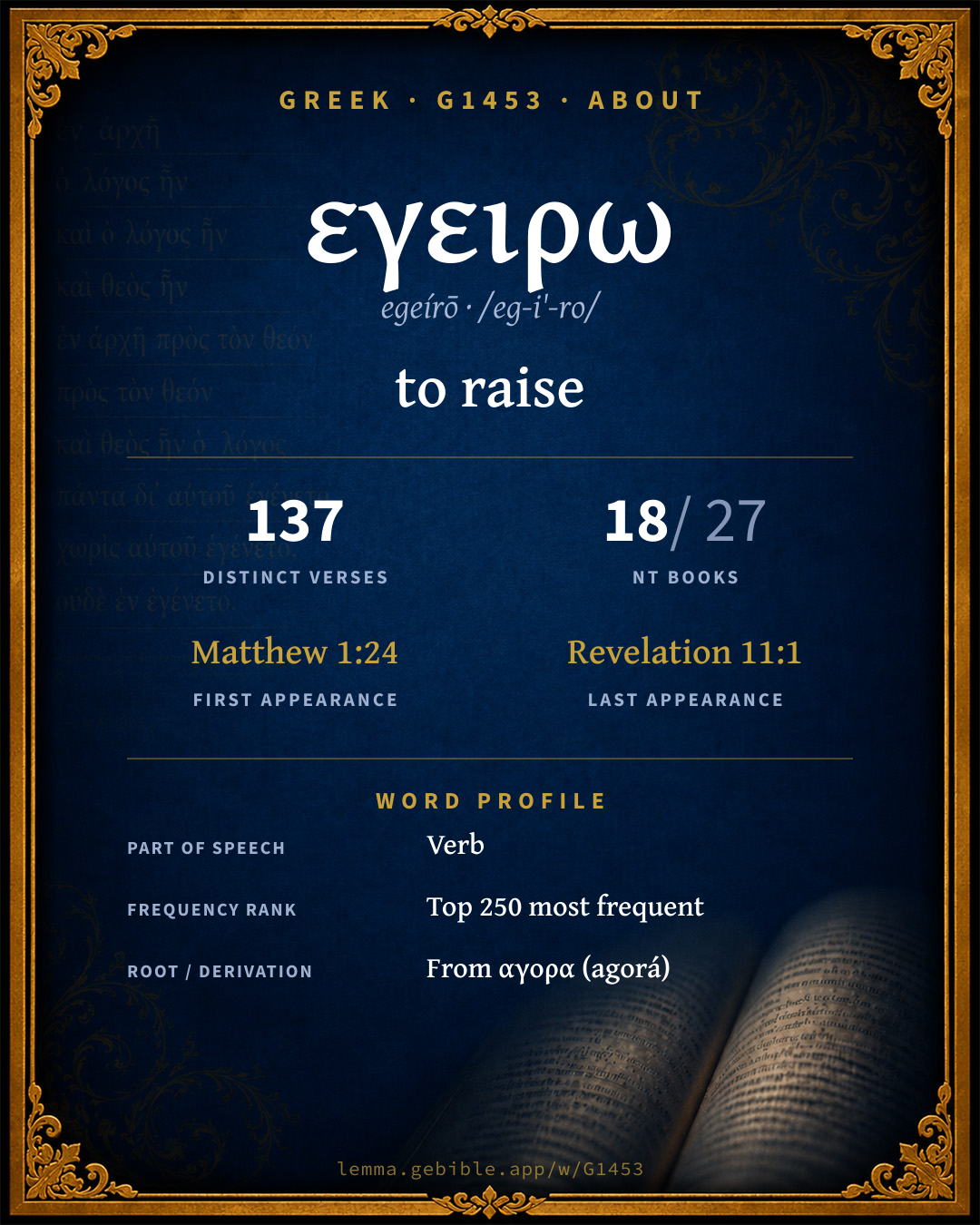
ἐγείρω
to raise
‘to raise’ is one of 4 main senses fuller range ↓
Full lexicon entry — Thayer's Greek Lexicon
From Thayer's Greek Lexicon
Where this word appears
See every Aorist-tense verb in the Greek New Testament →
Grammar key — what these labels mean
Part of speech
- Verb
- An action or state-of-being word.
Tense
- Aorist
- Action viewed as a simple whole, without regard to duration — often past (perfective aspect).
- Present
- Ongoing or general action in present time (imperfective aspect).
- Perfect
- A completed past action with continuing present results.
- Future
- Action expected in future time.
Voice
- Active
- The subject performs the action.
- Passive
- The subject receives the action.
- Middle or Passive
- A form that may be middle or passive — resolved by context.
Mood
- Indicative
- States a fact or asks a factual question (the mood of reality).
- Participle
- A verbal adjective (“writing,” “having written”).
- Imperative
- Expresses a command or request.
- Infinitive
- A verbal noun (“to write”), unmarked for person or number.
- Subjunctive
- Expresses probability, purpose, or possibility (the mood of contingency).
Case
- Nominative
- The case of the subject (and the predicate nominative).
- Genitive
- The case of source, possession, or “of” — answers “whose / from what.”
- Accusative
- The case of the direct object and of extent.
- Dative
- The case of the indirect object, means, or location — “to / for / with / in.”
Person
- 3rd person
- The one spoken about (“he / she / it / they”).
- 2nd person
- The one addressed (“you”).
- 1st person
- The speaker (“I / we”).
Gender
- Masculine
- Grammatically masculine.
Number
- Singular
- One.
- Plural
- More than one.
Every verse where G1453 appears in the Book of Acts — 12 distinct verses. Click any verse to open its interlinear word-by-word view. Verse text shown in the World English Bible for context — . Each verse’s Greek form is shown with its reference; the English is not keyword-highlighted, since the data carries no word-level English alignment. Use “Compare translations” on any verse to read it across multiple English versions. This concordance covers the Greek New Testament; Septuagint (Greek Old Testament) occurrences of this word are not indexed here.
Acts
- Acts 3:7 ἤγειρεν aor act ind 3sg He took him by the right hand, and raised him up. Immediately his feet and his ankle bones received strength.
- Acts 3:15 ἤγειρεν aor act ind 3sg and killed the Prince of life, whom God raised from the dead, to which we are witnesses.
- Acts 4:10 ἤγειρεν aor act ind 3sg be it known to you all, and to all the people of Israel, that in the name of Jesus Christ of Nazareth, whom you crucified, whom God raised from the dead, in him does this man stand here before you whole.
- Acts 5:30 ἤγειρεν aor act ind 3sg The God of our fathers raised up Jesus, whom you killed, hanging him on a tree.
- Acts 9:8 ἠγέρθη aor pass ind 3sg Saul arose from the ground, and when his eyes were opened, he saw no one. They led him by the hand, and brought him into Damascus.
- Acts 10:26 ἤγειρεν aor act ind 3sg But Peter raised him up, saying, "Stand up! I myself am also a man."
- Acts 10:40 ἤγειρεν aor act ind 3sg God raised him up the third day, and gave him to be revealed,
- Acts 12:7 ἤγειρεν aor act ind 3sg And behold, an angel of the Lord stood by him, and a light shone in the cell. He struck Peter on the side, and woke him up, saying, "Stand up quickly!" His chains fell off from his hands.
- Acts 13:22 ἤγειρεν aor act ind 3sg When he had removed him, he raised up David to be their king, to whom he also testified, 'I have found David the son of Jesse, a man after my heart, who will do all my will.'
- Acts 13:30 ἤγειρεν aor act ind 3sg But God raised him from the dead,
- Acts 13:37 ἤγειρεν aor act ind 3sg But he whom God raised up saw no decay.
- Acts 26:8 ἐγείρει pres act ind 3sg Why is it judged incredible with you, if God does raise the dead?
About this entry
At a glance — auto-summarized from this page’s data, not written by a person. Every figure links to its source below. This summary describes the numbers; it doesn’t interpret them.
At its core, εγειρω (egeírō) means “to raise.” Older and newer Bibles part ways — “arise” in the King James Version, “get up” (Berean Standard Bible) in modern versions. See the renderings breakdown. It turns up in 137 verses across 18 books, a common footprint. The word gravitates to Matthew (26%), then Mark and Luke. Catalogued under 4 senses, its meaning is not single-sense. Each statement above links to its evidence; the full detail follows below.
Gloss history
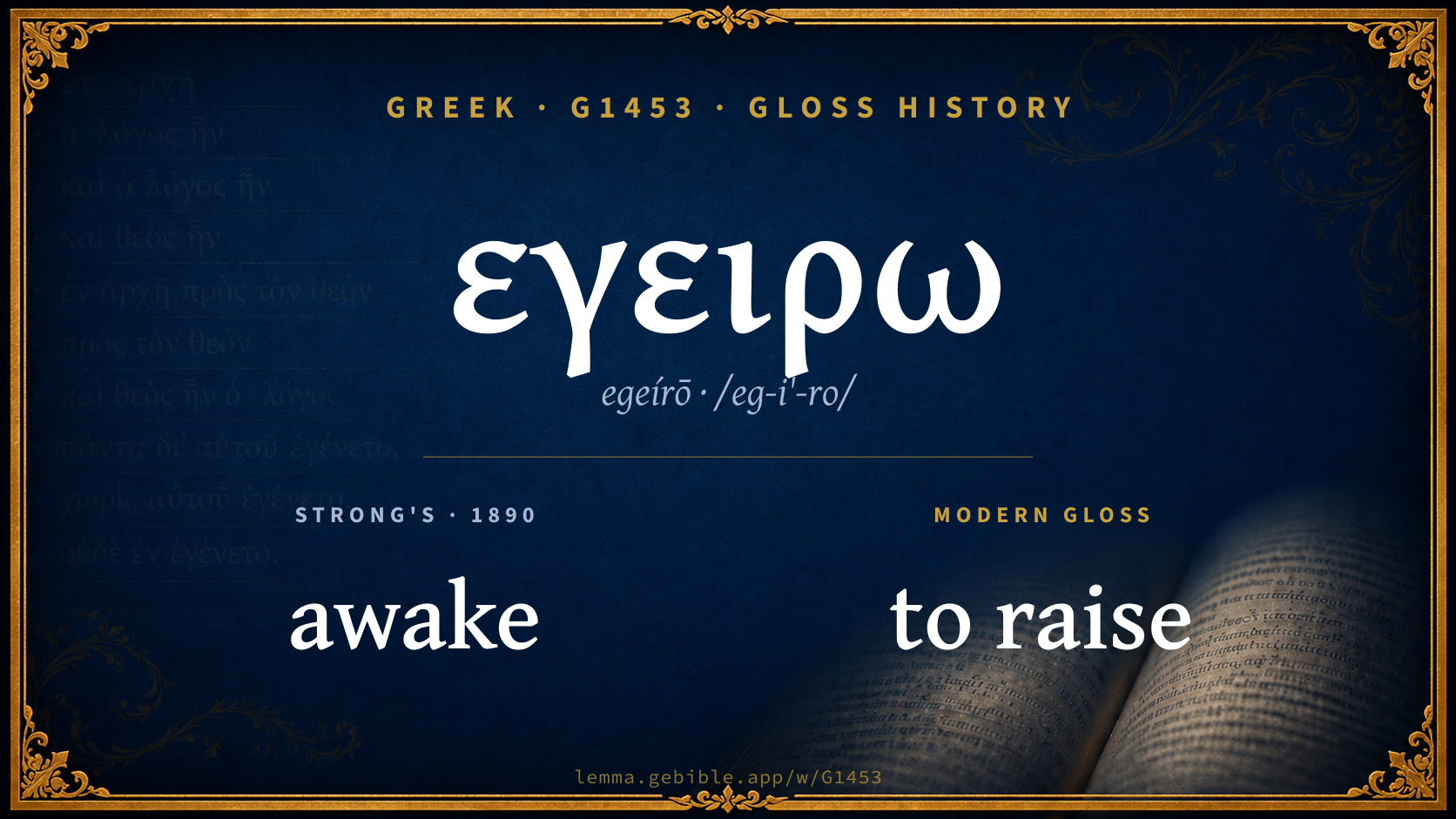
Strong's 1890 vs modern scholarship
About this word
Strong's G1453 catalogs a Greek word from the Greek New Testament.
These counts are not copied from any lexicon or concordance. They are computed here, from the morphology-tagged Greek New Testament. What Lemma adds →
- 137
- distinct verses
- The word appears in 137 distinct verses.
- 18 / 27
- NT books
- The word appears in 18 of 27 New Testament books.
- #115
- by frequency
- Top 250 most frequent Greek words (rank 115 of 5,347 Greek words by occurrence).
View all 137 occurrences in the concordance →
By section of the New Testament
By traditional corpus
Conventional, traditional groupings — biblical authorship is debated, so this is a traditional corpus grouping, not an authorship claim. Some books belong to more than one corpus (Luke is in both the Gospels and the Lukan corpus, and so on), so these shares overlap and need not total 100%. Each figure is a share of the word’s 137 distinct verses.
- Gospels 86 verses · 63%
- Pauline corpus 35 verses · 26%
- Lukan (Luke–Acts) 30 verses · 22%
- Johannine 14 verses · 10%
- General (Catholic) Epistles 2 verses · 1%
- Hebrews 1 verse · 1%
- Revelation 1 verse · 1%
How translations render this word
Counts come from each version’s own published word-to-Strong’s tagging or interlinear alignment — an approximate guide to how each version renders this word, not a word-level alignment the data otherwise carries. Because each total is that version’s own tagged count, the per-version totals vary from one another and need not match the appearance or distinct-verse counts above. These counts may also differ from a printed concordance because Lemma counts each distinctly tagged rendering and does not collapse phrase taggings into a single head-word total. This is a fixed set of word-tagged versions (KJV, ASV, BSB, ULT) and does not change with the reading translation you choose elsewhere. Each version’s license is shown beside its name below (and on Sources).
- King James Version: Arise 12×, Rise 10×, Raised 9×
- American Standard Version: Raised 19×, Arise 16×, Up 9×
- Berean Standard Bible: Get up 17×, Raised 14×, Got up 7×
- unfoldingWord Literal Text: Get up 14×, Raised 14×, Up 10×
King James Version Public Domain
Renders G1453 across 160 tagged occurrences — most commonly:
Plus other, less common renderings. Plus 46 renderings that appear only once — usually multi-word phrases or single function words the recovered tagging swept in, not distinct renderings. Not rendered by a distinct English word in 1 further occurrence.
American Standard Version Public Domain
Renders G1453 across 157 tagged occurrences — most commonly:
Plus other, less common renderings. Plus 42 renderings that appear only once — usually multi-word phrases or single function words the recovered tagging swept in, not distinct renderings. Not rendered by a distinct English word in 1 further occurrence.
Berean Standard Bible Public Domain
Renders G1453 across 144 tagged occurrences — most commonly:
Plus other, less common renderings. Plus 37 renderings that appear only once — usually multi-word phrases or single function words the recovered tagging swept in, not distinct renderings.
unfoldingWord Literal Text CC BY-SA 4.0
Renders G1453 across 162 tagged occurrences — most commonly:
Plus other, less common renderings. Plus 30 renderings that appear only once — usually multi-word phrases or single function words the recovered tagging swept in, not distinct renderings.
Senses in Thayer's
The 4 senses Thayer's distinguishes for this word, in lexicon order (not ranked by frequency or importance). The full entry — with sub-senses — is in the Lexicon Entry tab.
- to arouse from sleep, to awake
- to arouse from the sleep of death, to recall the dead to life
- to cause to rise from a seat or bed etc.
- to raise up, produce, cause to appear
Word origin
Derived from αγορα (agorá) (G58) — assembly.
Probably akin to the base of G58 (through the idea of collecting one´ s faculties); to waken (transitively or intransitively) that is rouse (literally from sleep from sitting or lying from disease from death; or figuratively from obscurity inactivity ruins nonexistence): - awake lift (up) raise (again up) rear up (a-) rise (again up) stand take up.
— Strong’s Exhaustive Concordance (1890), public domain.
Forms in the corpus
The 35 distinct written forms G1453 takes in the Greek New Testament, most frequent first — each parse links to that tense’s occurrences in the concordance.
Same root — word family
Other Thayer's entries built from the same root as G1453, grouped by Strong’s listed origin. These share a root / origin per the lexicon — not necessarily a shared meaning. Each links to that word’s own entry.
Derives from
Shares the same root
Derived from this word
Proper names from this root
People and places named from this root — a name, not an additional meaning of the word.
Compare all same-root words → Showing 4 of 7 — not the complete family. 1 of the same-root words is a proper name (a person or place). They share a root, not necessarily a meaning.
Septuagint usage
The same Greek word εγειρω appears 40 times in the Greek Old Testament (Septuagint), across 39 verses in 16 books.
- 40
- LXX occurrences
- Tagged occurrences of this Greek word in the Septuagint.
- 39
- verses
- Distinct Septuagint verses containing this word.
- 16 / 39
- OT books
- The word appears in 16 of the 39 Old Testament books.
Sample Septuagint occurrences
- Genesis 41:4 ἐγείρω
- Judges 7:19 ἐγείρω
- 1 Samuel 2:8 ἐγείρω
- 2 Samuel 12:17 ἐγείρω
- 2 Kings 4:31 ἐγείρω
- 1 Chronicles 10:12 ἐγείρω
- 2 Chronicles 21:9 ἐγείρω
- Psalms 112:7 ἐγείρω
- Proverbs 6:9 ἐγείρω
- Ecclesiastes 4:10 ἐγείρω
- Song of Solomon 2:7 ἐγείρω
- Isaiah 5:11 ἐγείρω
Septuagint occurrences (same lexeme)
Every verse where the same Strong’s number (G1453) appears in the Greek Septuagint. Verse text shown in the World English Bible for context; the Greek form is the matched word — the English is not keyword-highlighted.
- Genesis 41:4 ἐγείρω The ill-favored and lean-fleshed cattle ate up the seven well-favored and fat cattle. So Pharaoh awoke.
- Genesis 41:7 ἐγείρω The thin heads of grain swallowed up the seven healthy and full ears. Pharaoh awoke, and, behold, it was a dream.
- Genesis 49:9 ἐγείρω Judah is a lion's cub. From the prey, my son, you have gone up. He stooped down, he crouched as a lion, As a lioness. Who will rouse him up?
- Judges 7:19 ἐγείρω So Gideon, and the hundred men who were with him, came to the outermost part of the camp in the beginning of the middle watch, when they had but newly set the watch: and they blew the trumpets, and broke in pieces the pitchers that were in their hands.
- 1 Samuel 2:8 ἐγείρω He raises up the poor out of the dust, He lifts up the needy from the dunghill, To make them sit with princes, Inherit the throne of glory: For the pillars of the earth are Yahweh's, He has set the world on them.
- 2 Samuel 12:17 ἐγείρω The elders of his house arose, [and stood] beside him, to raise him up from the earth: but he would not, neither did he eat bread with them.
- 2 Kings 4:31 ἐγείρω Gehazi passed on before them, and laid the staff on the face of the child; but there was neither voice, nor hearing. Therefore he returned to meet him, and told him, saying, The child has not awakened.
- 1 Chronicles 10:12 ἐγείρω all the valiant men arose, and took away the body of Saul, and the bodies of his sons, and brought them to Jabesh, and buried their bones under the oak in Jabesh, and fasted seven days.
- 1 Chronicles 22:19 ἐγείρω Now set your heart and your soul to seek after Yahweh your God; arise therefore, and build the sanctuary of Yahweh God, to bring the ark of the covenant of Yahweh, and the holy vessels of God, into the house that is to be built to the name of Yahweh.
- 2 Chronicles 21:9 ἐγείρω Then Jehoram passed over with his captains, and all his chariots with him: and he rose up by night, and struck the Edomites who surrounded him, along with the captains of the chariots.
- 2 Chronicles 22:10 ἐγείρω Now when Athaliah the mother of Ahaziah saw that her son was dead, she arose and destroyed all the seed royal of the house of Judah.
- Psalms 112:7 ἐγείρω He will not be afraid of evil news. His heart is steadfast, trusting in Yahweh.
- Psalms 126:2 ἐγείρω Then our mouth was filled with laughter, And our tongue with singing. Then they said among the nations, "Yahweh has done great things for them."
- Proverbs 6:9 ἐγείρω How long will you sleep, sluggard? When will you arise out of your sleep?
- Proverbs 6:22 ἐγείρω When you walk, it will lead you. When you sleep, it will watch over you. When you awake, it will talk with you.
- Proverbs 10:12 ἐγείρω Hatred stirs up strife, But love covers all wrongs.
- Proverbs 11:16 ἐγείρω A gracious woman obtains honor, But violent men obtain riches.
- Proverbs 15:1 ἐγείρω A gentle answer turns away wrath, But a harsh word stirs up anger.
- Proverbs 15:18 ἐγείρω A wrathful man stirs up contention, But one who is slow to anger appeases strife.
- Proverbs 17:11 ἐγείρω An evil man seeks only rebellion; Therefore a cruel messenger shall be sent against him.
- Proverbs 21:14 ἐγείρω A gift in secret pacifies anger; And a bribe in the cloak, strong wrath.
- Proverbs 28:2 ἐγείρω In rebellion, a land has many rulers, But order is maintained by a man of understanding and knowledge.
- Ecclesiastes 4:10 ἐγείρω For if they fall, the one will lift up his fellow; but woe to him who is alone when he falls, and doesn't have another to lift him up.
- Song of Solomon 2:7 ἐγείρω I adjure you, daughters of Jerusalem, By the roes, or by the hinds of the field, That you not stir up, nor awaken love, Until it so desires.
- Song of Solomon 3:5 ἐγείρω I adjure you, daughters of Jerusalem, By the roes, or by the hinds of the field, That you not stir up, nor awaken love, Until it so desires.
- Song of Solomon 8:4 ἐγείρω I adjure you, daughters of Jerusalem, That you not stir up, nor awaken love, Until it so desires. Friends
- Isaiah 5:11 ἐγείρω Woe to those who rise up early in the morning, that they may follow strong drink; Who stay late into the night, until wine inflames them!
- Isaiah 14:9 ἐγείρω Sheol from beneath is moved for you to meet you at your coming; it stirs up the dead for you, even all the chief ones of the earth; it has raised up from their thrones all the kings of the nations.
- Isaiah 26:19 ἐγείρω Your dead shall live; my dead bodies shall arise. Awake and sing, you who dwell in the dust; for your dew is [as] the dew of herbs, and the earth shall cast forth the dead.
- Jeremiah 1:12 ἐγείρω Then said Yahweh to me, You have well seen: for I watch over my word to perform it.
- Jeremiah 27:9 ἐγείρω But as for you, don't you listen to your prophets, nor to your diviners, nor to your dreams, nor to your soothsayers, nor to your sorcerers, who speak to you, saying, You shall not serve the king of Babylon:
- Jeremiah 28:12 ἐγείρω Then the word of Yahweh came to Jeremiah, after that Hananiah the prophet had broken the bar from off the neck of the prophet Jeremiah, saying,
- Jeremiah 28:39 ἐγείρω
- Jeremiah 51:27 ἐγείρω Set up a standard in the land, blow the trumpet among the nations, prepare the nations against her, call together against her the kingdoms of Ararat, Minni, and Ashkenaz: appoint a marshal against her; cause the horses to come up as the rough canker-worm.
- Lamentations 4:14 ἐγείρω They wander as blind men in the streets, they are polluted with blood, So that men can't touch their garments.
- Ezekiel 21:33 ἐγείρω
- Ezekiel 38:14 ἐγείρω Therefore, son of man, prophesy, and tell Gog, Thus says the Lord Yahweh: In that day when my people Israel dwells securely, shall you not know it?
- Daniel 9:2 ἐγείρω in the first year of his reign I, Daniel, understood by the books the number of the years about which the word of Yahweh came to Jeremiah the prophet, for the accomplishing of the desolations of Jerusalem, even seventy years.
- Daniel 11:25 ἐγείρω He shall stir up his power and his courage against the king of the south with a great army; and the king of the south shall war in battle with an exceeding great and mighty army; but he shall not stand; for they shall devise devices against him.
These are occurrences of the same Greek lexeme (G1453) in the Septuagint — not a translation of any one Hebrew word. The store carries no word-level Hebrew↔Greek alignment, so no Hebrew original is asserted here. Counts come from the recovered LXX Strong's tagging — high-frequency vocabulary is well covered, while rare or late forms may be untagged — so they reflect tagged occurrences and may slightly undercount.