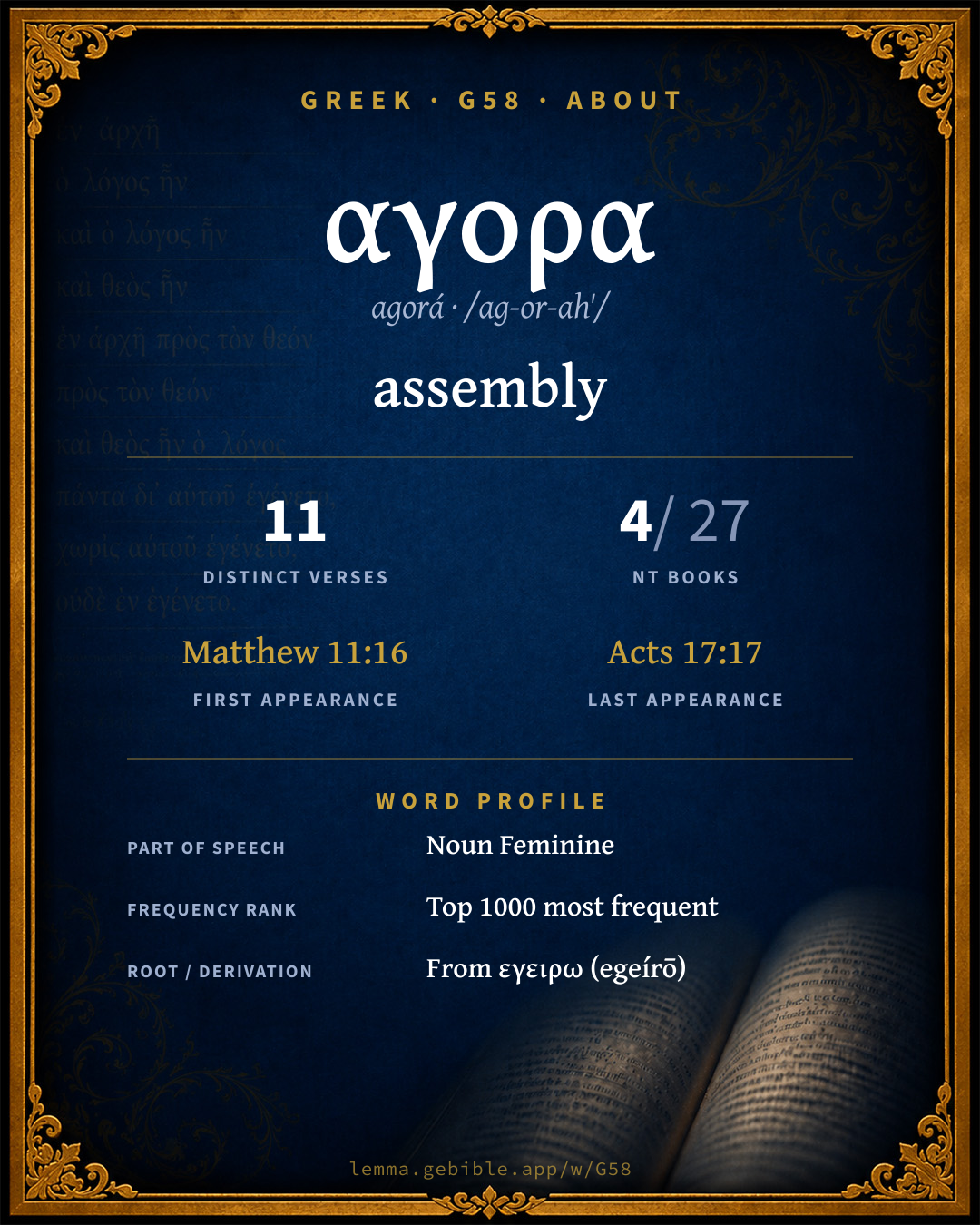
ἀγορά
assembly
‘assembly’ is one of 7 main senses fuller range ↓
Full lexicon entry — Thayer's Greek Lexicon
From Thayer's Greek Lexicon
Where this word appears
See every Dative-case word in the Greek New Testament →
Grammar key — what these labels mean
Part of speech
- Noun
- A naming word — a person, place, thing, or idea.
Case
- Dative
- The case of the indirect object, means, or location — “to / for / with / in.”
- Accusative
- The case of the direct object and of extent.
- Genitive
- The case of source, possession, or “of” — answers “whose / from what.”
Gender
- Feminine
- Grammatically feminine.
Number
- Plural
- More than one.
- Singular
- One.
Grammatical forms
- Noun, Dative, Plural, Feminine 6 times (55%)
- Noun, Dative, Singular, Feminine 3 times (27%)
- Noun, Accusative, Singular, Feminine 1 time (9%)
- Noun, Genitive, Singular, Feminine 1 time (9%)
Parsed forms decoded from the imported morphology (Robinson–Tischendorf, public domain), counted across 11 parsed occurrences — not distinct verses.
Every verse where G58 appears — 11 distinct verses across 4 books. Click any verse to open its interlinear word-by-word view. Verse text shown in the World English Bible for context — . Each verse’s Greek form is shown with its reference; the English is not keyword-highlighted, since the data carries no word-level English alignment. Use “Compare translations” on any verse to read it across multiple English versions. This concordance covers the Greek New Testament; Septuagint (Greek Old Testament) occurrences of this word are not indexed here.
Matthew 3 verses
- Matthew 11:16 ἀγοραῖς n dat pl fem "But to what shall I compare this generation? It is like children sitting in the marketplaces, who call to their companions
- Matthew 20:3 ἀγορᾷ n dat sg fem He went out about the third hour, and saw others standing idle in the marketplace.
- Matthew 23:7 ἀγοραῖς n dat pl fem the salutations in the marketplaces, and to be called 'Rabbi, Rabbi' by men.
Mark 3 verses
- Mark 6:56 ἀγοραῖς n dat pl fem Wherever he entered, into villages, or into cities, or into the country, they laid the sick in the marketplaces, and begged him that they might touch just the fringe of his garment; and as many as touched him were made well.
- Mark 7:4 ἀγορᾶς n gen sg fem They don't eat when they come from the marketplace, unless they bathe themselves, and there are many other things, which they have received to hold to: washings of cups, pitchers, bronze vessels, and couches.)
- Mark 12:38 ἀγοραῖς n dat pl fem In his teaching he said to them, "Beware of the scribes, who like to walk in long robes, and to get greetings in the marketplaces,
Luke 3 verses
- Luke 7:32 ἀγορᾷ n dat sg fem They are like children who sit in the marketplace, and call one to another, saying, 'We piped to you, and you didn't dance. We mourned, and you didn't weep.'
- Luke 11:43 ἀγοραῖς n dat pl fem Woe to you Pharisees! For you love the best seats in the synagogues, and the greetings in the marketplaces.
- Luke 20:46 ἀγοραῖς n dat pl fem "Beware of the scribes, who like to walk in long robes, and love greetings in the marketplaces, the best seats in the synagogues, and the best places at feasts;
Acts 2 verses
- Acts 16:19 ἀγορὰν n acc sg fem But when her masters saw that the hope of their gain was gone, they seized Paul and Silas, and dragged them into the marketplace before the rulers.
- Acts 17:17 ἀγορᾷ n dat sg fem So he reasoned in the synagogue with the Jews and the devout persons, and in the marketplace every day with those who met him.
About this entry
At a glance — auto-summarized from this page’s data, not written by a person. Every figure links to its source below. This summary describes the numbers; it doesn’t interpret them.
“assembly” is the headline sense of the Greek noun αγορα (agorá). Its lexical range runs to 7 senses. It appears 11 verses across 4 books of the Greek New Testament, among its uncommon vocabulary. More than a quarter of its appearances fall in Matthew. Debuting at Matthew 11:16, it then recurs through the corpus. The sections below give every sense, occurrence, and version rendering.
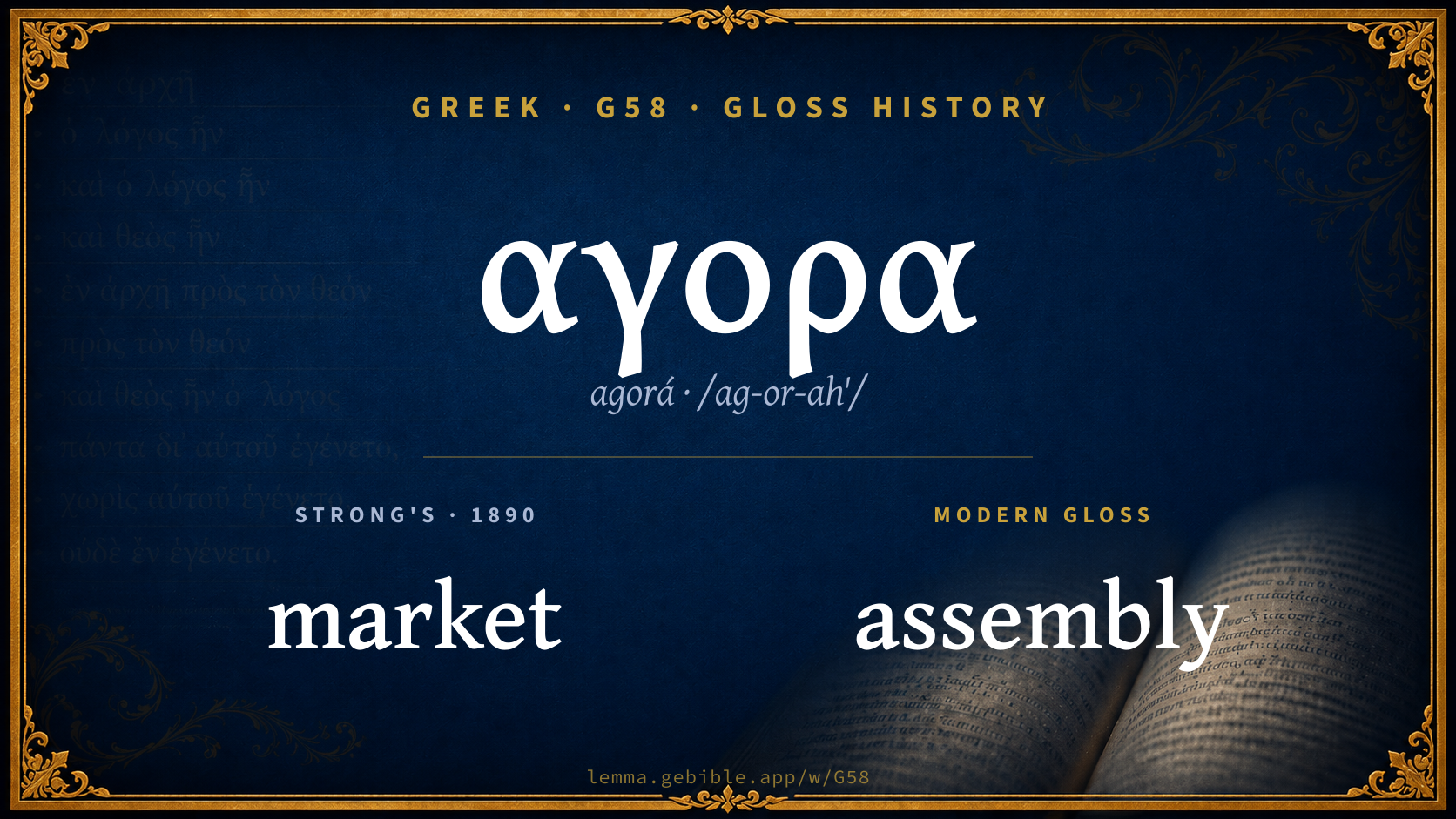
Gloss history
Strong's 1890 vs modern scholarship
About this word
Strong's G58 catalogs a Greek word from the Greek New Testament.
These counts are not copied from any lexicon or concordance. They are computed here, from the morphology-tagged Greek New Testament. What Lemma adds →
- 11
- distinct verses
- The word appears in 11 distinct verses.
- 4 / 27
- NT books
- The word appears in 4 of 27 New Testament books.
- #978
- by frequency
- Top 1000 most frequent Greek words (rank 978 of 5,347 Greek words by occurrence).
View all 11 occurrences in the concordance →
By section of the New Testament
By traditional corpus
Conventional, traditional groupings — biblical authorship is debated, so this is a traditional corpus grouping, not an authorship claim. Some books belong to more than one corpus (Luke is in both the Gospels and the Lukan corpus, and so on), so these shares overlap and need not total 100%. Each figure is a share of the word’s 11 distinct verses.
- Gospels 9 verses · 82%
- Lukan (Luke–Acts) 5 verses · 45%
How translations render this word
Counts come from each version’s own published word-to-Strong’s tagging or interlinear alignment — an approximate guide to how each version renders this word, not a word-level alignment the data otherwise carries. Because each total is that version’s own tagged count, the per-version totals vary from one another and need not match the appearance or distinct-verse counts above. These counts may also differ from a printed concordance because Lemma counts each distinctly tagged rendering and does not collapse phrase taggings into a single head-word total. This is a fixed set of word-tagged versions (KJV, ASV, BSB, ULT) and does not change with the reading translation you choose elsewhere. Each version’s license is shown beside its name below (and on Sources).
- King James Version: Markets 4×, Marketplace 3×, Market 2×
- American Standard Version: Marketplaces 6×, Marketplace 5×
- Berean Standard Bible: Marketplaces 6×, Marketplace 4×
- unfoldingWord Literal Text: Marketplace 6×, Marketplaces 5×
King James Version Public Domain
Renders G58 across 11 tagged occurrences — most commonly:
Plus 2 renderings that appear only once — usually multi-word phrases or single function words the recovered tagging swept in, not distinct renderings.
American Standard Version Public Domain
Renders G58 across 11 tagged occurrences — most commonly:
Berean Standard Bible Public Domain
Renders G58 across 11 tagged occurrences — most commonly:
Plus 1 rendering that appears only once — usually multi-word phrases or single function words the recovered tagging swept in, not distinct renderings.
unfoldingWord Literal Text CC BY-SA 4.0
Renders G58 across 11 tagged occurrences — most commonly:
7 senses in Thayer's, in lexicon order
The 7 senses Thayer's distinguishes for this word, in lexicon order (not ranked by frequency or importance). The full entry — with sub-senses — is in the Lexicon Entry tab.
- any assembly, especially of the people
- for public debating,
- for elections
- for trials
- for buying and selling
- for all kinds of business
- market place, street
Word origin
Derived from εγειρω (egeírō) (G1453) — to raise.
From ἀγείρω ageiro (to gather ; probably akin to G1453 ); properly the town square (as a place of public resort); by implication a market or thoroughfare : - market (-place) street.
— Strong’s Exhaustive Concordance (1890), public domain.
Forms in the corpus
The 4 distinct written forms G58 takes in the Greek New Testament, most frequent first — each parse links to that case’s occurrences in the concordance.
| Form | Parsing | Example | Uses |
|---|---|---|---|
| ἀγοραῖς agoraîs | Noun, Dative, Plural, Feminine | Matthew 11:16 | 6 |
| ἀγορᾷ agorâ | Noun, Dative, Singular, Feminine | Matthew 20:3 | 3 |
| ἀγορὰν agoràn | Noun, Accusative, Singular, Feminine | Acts 16:19 | 1 |
| ἀγορᾶς agorâs | Noun, Genitive, Singular, Feminine | Mark 7:4 | 1 |
Same root — word family
Other Thayer's entries built from the same root as G58, grouped by Strong’s listed origin. These share a root / origin per the lexicon — not necessarily a shared meaning. Each links to that word’s own entry.
Derives from
Shares the same root
Derived from this word
- αγοραζω agorázō G59 to loiter in marketplace
- αγοραιος agoraîos G60 of marketplace
- εγειρω egeírō G1453 to raise
Proper names from this root
People and places named from this root — a name, not an additional meaning of the word.
Compare all same-root words → Showing 4 of 7 — not the complete family. 1 of the same-root words is a proper name (a person or place). They share a root, not necessarily a meaning.
Septuagint usage
The same Greek word αγορα appears 8 times in the Greek Old Testament (Septuagint), across 8 verses in 3 books.
- 8
- LXX occurrences
- Tagged occurrences of this Greek word in the Septuagint.
- 8
- verses
- Distinct Septuagint verses containing this word.
- 3 / 39
- OT books
- The word appears in 3 of the 39 Old Testament books.
Sample Septuagint occurrences
- Ecclesiastes 12:4 ἀγορά
- Song of Solomon 3:2 ἀγορά
- Ezekiel 27:12 ἀγορά
Septuagint occurrences (same lexeme)
Every verse where the same Strong’s number (G58) appears in the Greek Septuagint. Verse text shown in the World English Bible for context; the Greek form is the matched word — the English is not keyword-highlighted.
- Ecclesiastes 12:4 ἀγορά And the doors shall be shut in the street; When the sound of the grinding is low, And one shall rise up at the voice of a bird, And all the daughters of music shall be brought low;
- Ecclesiastes 12:5 ἀγορά Yes, they shall be afraid of heights, And terrors will be in the way; And the almond tree shall blossom, And the grasshopper shall be a burden, And desire shall fail; Because man goes to his everlasting home, And the mourners go about the streets:
- Song of Solomon 3:2 ἀγορά I will get up now, and go about the city; In the streets and in the squares I will seek him whom my soul loves. I sought him, but I didn't find him.
- Ezekiel 27:12 ἀγορά Tarshish was your merchant by reason of the multitude of all kinds of riches; with silver, iron, tin, and lead, they traded for your wares.
- Ezekiel 27:14 ἀγορά They of the house of Togarmah traded for your wares with horses and war-horses and mules.
- Ezekiel 27:16 ἀγορά Syria was your merchant by reason of the multitude of your handiworks: they traded for your wares with emeralds, purple, and embroidered work, and fine linen, and coral, and rubies.
- Ezekiel 27:19 ἀγορά Vedan and Javan traded with yarn for your wares: bright iron, cassia, and calamus, were among your merchandise.
- Ezekiel 27:22 ἀγορά The traffickers of Sheba and Raamah, they were your traffickers; they traded for your wares with the chief of all spices, and with all precious stones, and gold.
These are occurrences of the same Greek lexeme (G58) in the Septuagint — not a translation of any one Hebrew word. The store carries no word-level Hebrew↔Greek alignment, so no Hebrew original is asserted here. Counts come from the recovered LXX Strong's tagging — high-frequency vocabulary is well covered, while rare or late forms may be untagged — so they reflect tagged occurrences and may slightly undercount.