
Jeremiah 27:9

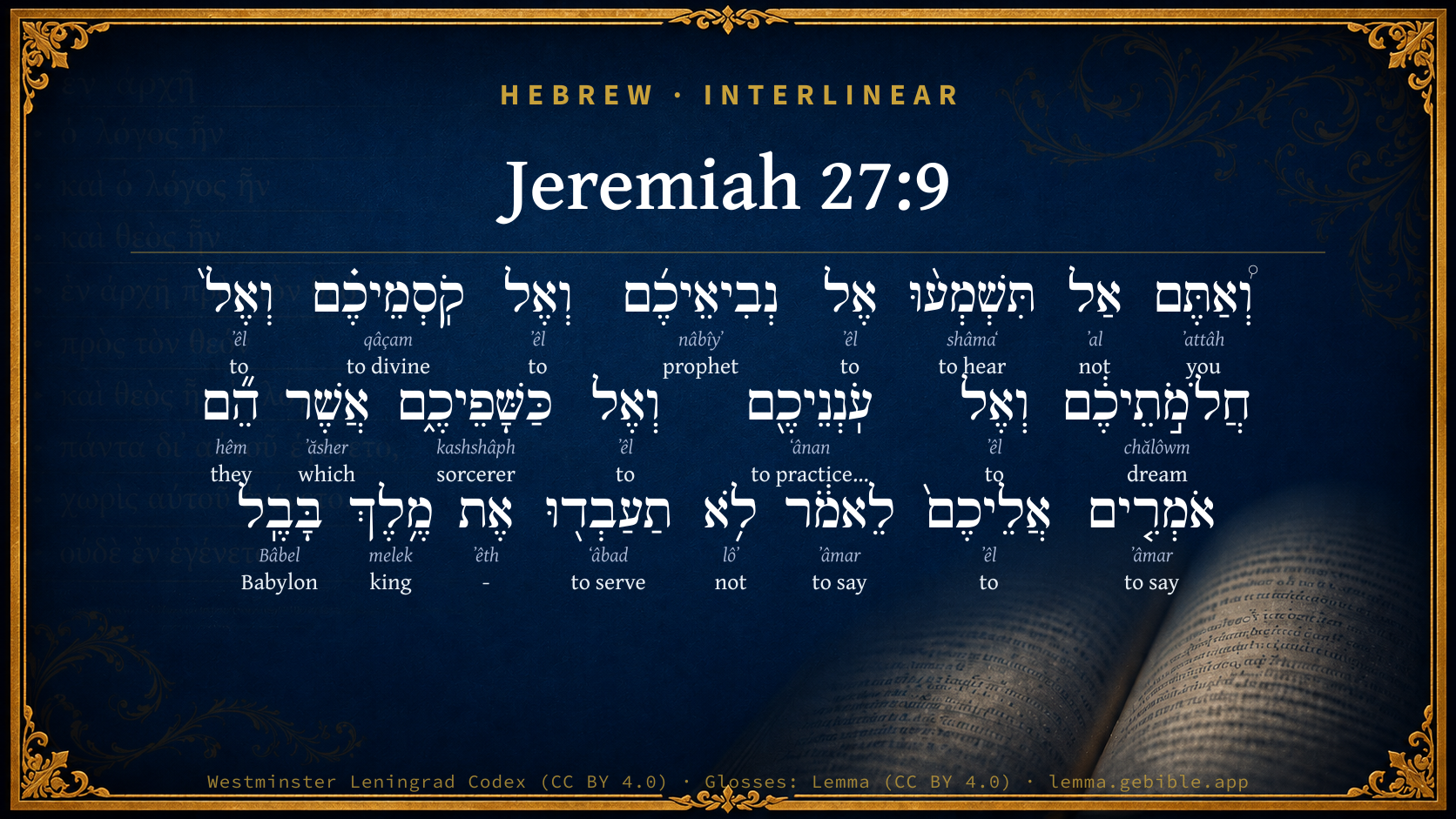
Hebrew (Westminster Leningrad Codex) Jeremiah 27:9 appears in the Hebrew Old Testament. The text above is from the Westminster Leningrad Codex. Each word links to its Strong’s number, a concise gloss, and parsing drawn from the Open Scriptures Hebrew Bible morphology. Click any word for its full Brown-Driver-Briggs (BDB) entry.
Download image
Cite this verse

Jeremiah 27:9 (World English Bible). Public Domain. Lemma interlinear Bible study tool, https://lemma.gebible.app/v/jeremiah/27/9.

Show BibTeX & RIS
BibTeX
RIS
English Translation
But as for you, don't you listen to your prophets, nor to your diviners, nor to your dreams, nor to your soothsayers, nor to your sorcerers, who speak to you, saying, You shall not serve the king of Babylon:
World English Bible · Public Domain
Highlights
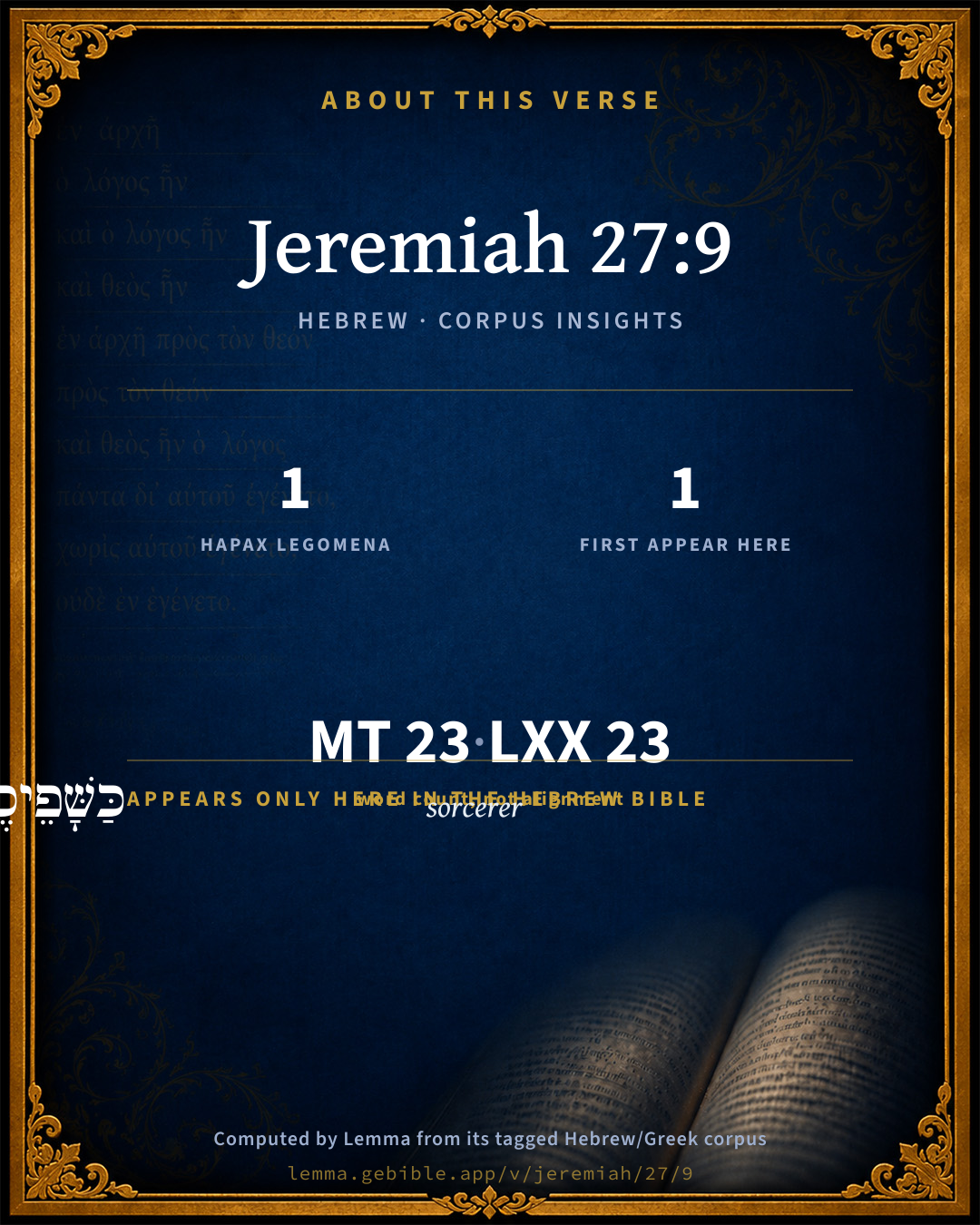
  • 1 hapax legomenon — only here in the Hebrew Bible
  • 1 first appearance in the Hebrew Bible
Full analysis ↓
Download a study sheet

One document with this verse’s original text, its word-by-word gloss line, the meaning frame, cross-references with their text, attributed commentary, and full source and license credits — printable, and it pastes into notes with its structure intact.

This verse Autodidact and up

Study sheet (.html) Plain text (.txt)

A passage Seminary Student

Up to 50 verses in one chapter. A passage sheet keeps up to 6 commentary sources and 12 cross-references per verse, in the order this page ranks them, and says so on the sheet whenever that leaves anything out. Ask for a single verse and you get the Autodidact verse sheet above.

Everything on this page stays free to read, with no account — the sheet is a download of what is already on screen, not access to it.

Want to remove ads? Support Godless Engineer
Compare translations 3

The same verse in 3 English versions, stacked beneath the original-language interlinear above. Click any original word for its lexicon entry.

Each is an independent rendering of the whole verse — the interlinear is not word-aligned to these translations.

Highlighted words mark where these versions differ — a whole-verse word diff, not a word-by-word alignment.

  • World English Bible Public Domain
    But as for you, don't you listen to your prophets, nor to your diviners, nor to your dreams, nor to your soothsayers, nor to your sorcerers, who speak to you, saying, You shall not serve the king of Babylon:
  • King James Version Public Domain
    Therefore hearken not ye to your prophets, nor to your diviners, nor to your dreamers, nor to your enchanters, nor to your sorcerers, which speak unto you, saying, Ye shall not serve the king of Babylon:
  • unfoldingWord Literal Text CC BY-SA 4.0
    And as for you, do not listen to your prophets, and to your diviners, and to your dreamers, and to your soothsayers, and to your sorcerers, they who are speaking to you, saying, ‘You shall not serve the king of Babylon.’

unfoldingWord Literal Text — © unfoldingWord, licensed CC BY-SA 4.0. Word-aligned USFM3 via Door43 (git.door43.org/unfoldingWord/en_ult).

Versions to compare (up to 4)

3 of 4 selected

Show all 18 translations

Every available English version of this verse, each an independent rendering of the whole verse.

  • World English Bible Public Domain
    But as for you, don't you listen to your prophets, nor to your diviners, nor to your dreams, nor to your soothsayers, nor to your sorcerers, who speak to you, saying, You shall not serve the king of Babylon:
  • Berean Standard Bible Public Domain
    But as for you, do not listen to your prophets, your diviners, your interpreters of dreams, your mediums, or your sorcerers who declare, ‘You will not serve the king of Babylon.’
  • Majority Standard Bible Public Domain
    But as for you, do not listen to your prophets, your diviners, your interpreters of dreams, your mediums, or your sorcerers who declare, ‘You will not serve the king of Babylon.’
  • King James Version Public Domain
    Therefore hearken not ye to your prophets, nor to your diviners, nor to your dreamers, nor to your enchanters, nor to your sorcerers, which speak unto you, saying, Ye shall not serve the king of Babylon:
  • American Standard Version (1901) Public Domain
    But as for you, hearken ye not to your prophets, nor to your diviners, nor to your dreams, nor to your soothsayers, nor to your sorcerers, that speak unto you, saying, Ye shall not serve the king of Babylon:
  • Revised Version (1885) Public Domain
    But as for you, hearken ye not to your prophets, nor to your diviners, nor to your dreams, nor to your soothsayers, nor to your sorcerers, which speak unto you, saying, Ye shall not serve the king of Babylon:
  • Geneva Bible (1599) Public Domain
    Therefore heare not your prophets nor your southsayers, nor your dreamers, nor your inchanters, nor your sorcerers, which say vnto you thus, Ye shall not serue the King of Babel.
  • Douay-Rheims (1899) Public Domain
    Therefore hearken not to your prophets, and diviners, and dreamers, and soothsayers, and sorcerers, that say to you: You shall not serve the king Babylon.
  • Young's Literal Translation Public Domain
    `And ye, ye do not hearken unto your prophets, and unto your diviners, and unto your dreamers, and unto your observers of clouds, and unto your sorcerers who are speaking unto you, saying, Ye do not serve the king of Babylon, --
  • Literal Standard Version CC BY-SA 4.0
    And you, you do not listen to your prophets, and to your diviners, and to your dreamers, and to your observers of clouds, and to your sorcerers who are speaking to you, saying, You do not serve the king of Babylon—
  • Unlocked Literal Bible CC BY-SA 4.0
    So do not listen to your prophets, your diviners, your seers, your soothsayers, and sorcerers, who have been speaking to you and saying, 'Do not serve the king of Babylon.'
  • unfoldingWord Literal Text CC BY-SA 4.0
    And as for you, do not listen to your prophets, and to your diviners, and to your dreamers, and to your soothsayers, and to your sorcerers, they who are speaking to you, saying, ‘You shall not serve the king of Babylon.’
  • Darby Bible Public Domain
    And ye, hearken not to your prophets, nor to your diviners, nor to your dreamers, nor to your soothsayers, nor to your sorcerers, who speak unto you saying: Ye shall not serve the king of Babylon.
  • World Messianic Bible Public Domain
    But as for you, don’t listen to your prophets, to your diviners, to your dreams, to your soothsayers, or to your sorcerers, who speak to you, saying, “You shall not serve the king of Babylon;”
  • Webster's Bible Public Domain
    Therefore hearken ye not to your prophets, nor to your diviners, nor to your dreamers, nor to your enchanters, nor to your sorcerers, who speak to you, saying, Ye shall not serve the king of Babylon:
  • Free Bible Version CC BY-SA 4.0
    Don't you listen to your prophets, your fortune-tellers, your interpreters of dreams, your mediums, or your magicians when they tell you, “You won't serve the king of Babylon.”
  • Bible in Basic English Public Domain
    And you are not to give attention to your prophets or your readers of signs or your dreamers or those who see into the future or those who make use of secret arts, who say to you, You will not become servants of the king of Babylon:
  • JPS Tanakh (1917) Public Domain
    But as for you, hearken ye not to your prophets, nor to your diviners, nor to your dreams, nor to your soothsayers, nor to your sorcerers, that speak unto you, saying: Ye shall not serve the king of Babylon;

Literal Standard Version (2020), Covenant Press — licensed CC BY-SA 4.0. Text via the HelloAO Bible API (eBible.org). Unlocked Literal Bible (unfoldingWord) — licensed CC BY-SA 4.0. Text via the HelloAO Bible API (eBible.org). unfoldingWord Literal Text — © unfoldingWord, licensed CC BY-SA 4.0. Word-aligned USFM3 via Door43 (git.door43.org/unfoldingWord/en_ult). Free Bible Version, Dr. Jonathan Gallagher — licensed CC BY-SA 4.0. Text via the HelloAO Bible API (eBible.org).

Word by word

More ways to search: Search by grammar → Find every occurrence → Compare this word →

Practice this passage: Drill this verse → Learn its vocabulary →

כַּשָּׁפֵיכֶ֑ם
kashshâph
H3786
“sorcerers · your”
Noun, Common, Masculine, Plural, Construct + Suffix, Personal, 2nd Person, Masculine, Plural
Part of Speech
Noun
Type
Common
Gender
Masculine
Number
Plural
State
Construct
Full BDB Definition

Origin: from H3784

TWOT: 1051b

sorcerer
  1. וְ֠אַתֶּם ʼattâh H859 “and · you” Conjunction + Pronoun, Personal, 2nd Person, Masculine, Plural
  2. אַל ʼal H408 “not” Particle, Negative
  3. תִּשְׁמְע֨וּ shâmaʻ H8085 “to hear” Verb, Qal, Jussive, 2nd Person, Masculine, Plural
  4. אֶל ʼêl H413 “to” Preposition
  5. נְבִיאֵיכֶ֜ם nâbîyʼ H5030 “prophets · your” Noun, Common, Masculine, Plural, Construct + Suffix, Personal, 2nd Person, Masculine, Plural
  6. וְאֶל ʼêl H413 “and · to” Conjunction + Preposition
  7. קֹֽסְמֵיכֶ֗ם qâçam H7080 “divining · you” Verb, Qal, Participle Active, Masculine, Plural, Construct + Suffix, Personal, 2nd Person, Masculine, Plural
  8. וְאֶל֙ ʼêl H413 “and · to” Conjunction + Preposition
  9. חֲלֹמֹ֣תֵיכֶ֔ם chălôwm H2472 “dreams · your” Noun, Common, Masculine, Plural, Construct + Suffix, Personal, 2nd Person, Masculine, Plural
  10. וְאֶל ʼêl H413 “and · to” Conjunction + Preposition
  11. עֹֽנְנֵיכֶ֖ם ʻânan H6049 “practicing sorcery · you” Verb, Poel, Participle Active, Masculine, Plural, Construct + Suffix, Personal, 2nd Person, Masculine, Plural
  12. וְאֶל ʼêl H413 “and · to” Conjunction + Preposition
  13. אֲשֶׁר ʼăsher H834 “which” Particle, Relative
  14. הֵ֞ם hêm H1992 “they” Pronoun, Personal, 3rd Person, Masculine, Plural
  15. אֹמְרִ֤ים ʼâmar H559 “saying” Verb, Qal, Participle Active, Masculine, Plural, Absolute
  16. אֲלֵיכֶם֙ ʼêl H413 “to · you” Preposition + Suffix, Personal, 2nd Person, Masculine, Plural
  17. לֵאמֹ֔ר ʼâmar H559 “to say” Preposition + Verb, Qal, Infinitive Construct
  18. לֹ֥א lôʼ H3808 “not” Particle, Negative
  19. תַעַבְד֖וּ ʻâbad H5647 “to serve” Verb, Qal, Imperfect, 2nd Person, Masculine, Plural
  20. אֶת ʼêth H853 “-” Particle, Direct Object
  21. מֶ֥לֶךְ melek H4428 “king of” Noun, Common, Masculine, Singular, Construct
  22. בָּבֶֽל Bâbel H894 “Babylon” Noun, Proper

About this verse

These counts appear in no published source. They are computed here, from the morphology-tagged text and Lemma’s own curated glosses. What Lemma adds →

23
words
17
distinct lemmas
Prophets
section

Notable vocabulary

1 hapax legomenon — a word that appears only here in the entire Hebrew Bible:

  • כַּשָּׁפֵיכֶ֑ם sorcerer H3786

First appearance in Scripture

This word makes its first canonical appearance in the Hebrew Bible here:

  • כַּשָּׁפֵיכֶ֑ם sorcerer H3786

Shared distinctive vocabulary

עֹֽנְנֵיכֶ֖ם to practice sorcery H6049 occurs in 11 verses of the Hebrew Bible. Also found in:

Grammatical profile

  • 6 verbs
  • 5 nouns
  • 2 pronouns
  • 6 prepositions
  • 4 particles

Verb forms

  • תִּשְׁמְע֨וּ Qal · Jussive
  • קֹֽסְמֵיכֶ֗ם Qal · Participle Active
  • עֹֽנְנֵיכֶ֖ם Poel · Participle Active
  • אֹמְרִ֤ים Qal · Participle Active
  • לֵאמֹ֔ר Qal · Infinitive Construct
  • תַעַבְד֖וּ Qal · Imperfect

Repetition

Words recur within this verse — often emphatic in Hebrew:

  • אֹמְרִ֤ים to say H559 ×2
  • אֶל to H413 ×6

Hebrew & Septuagint length

In the original languages it is 23 Hebrew tokens and 23 Greek tokens — but the two are counted differently (Hebrew bundles its prefixes and suffixes into one token; the Greek is in lemma form), so that isn’t a like-for-like length.

Cross-references

20

Topical passages linked to Jeremiah 27:9 in the Treasury of Scripture Knowledge — connected by theme and wording, ordered by reader-vote popularity; previews shown in the World English Bible.

  • Jeremiah 14:14 Then Yahweh said to me, The prophets prophesy lies in my name; I didn't send them, neither have I commanded them, neither spoke I to them: they prophesy to you a lying vision, and divination, and a thing of nothing, and the deceit of their own heart.
  • Isaiah 8:19 When they shall tell you, "Consult with those who have familiar spirits and with the wizards, who chirp and who mutter:" shouldn't a people consult with their God? on behalf of the living [should they consult] with the dead?
  • Jeremiah 29:8 For thus says Yahweh of hosts, the God of Israel: Don't let your prophets who are in the midst of you, and your diviners, deceive you; neither listen you to your dreams which you cause to be dreamed.
  • Malachi 3:5 I will come near to you to judgment; and I will be a swift witness against the sorcerers, and against the adulterers, and against the perjurers, and against those who oppress the hireling in his wages, the widow, and the fatherless, and who deprive the foreigner of justice, and don't fear me," says Yahweh of Hosts.
  • Exodus 7:11 Then Pharaoh also called for the wise men and the sorcerers. They also, the magicians of Egypt, did in like manner with their enchantments.
  • Deuteronomy 18:10–12 There shall not be found with you anyone who makes his son or his daughter to pass through the fire, one who uses divination, one who practices sorcery, or an enchanter, or a sorcerer,
  • Deuteronomy 18:14 For these nations, that you shall dispossess, listen to those who practice sorcery, and to diviners; but as for you, Yahweh your God has not allowed you so to do.
  • Joshua 13:22 Balaam also the son of Beor, the soothsayer, did the children of Israel kill with the sword among the rest of their slain.
  • Isaiah 47:12–14 Stand now with your enchantments, and with the multitude of your sorceries, in which you have labored from your youth; if so be you shall be able to profit, if so be you may prevail.
  • Jeremiah 23:16 Thus says Yahweh of Hosts, Don't listen to the words of the prophets who prophesy to you: they teach you vanity; they speak a vision of their own heart, and not out of the mouth of Yahweh.
  • Jeremiah 23:25 I have heard what the prophets have said, who prophesy lies in my name, saying, I have dreamed, I have dreamed.
  • Jeremiah 23:32 Behold, I am against those who prophesy lying dreams, says Yahweh, and do tell them, and cause my people to err by their lies, and by their vain boasting: yet I didn't send them, nor commanded them; neither do they profit this people at all, says Yahweh.
  • Jeremiah 27:14–16 Don't listen to the words of the prophets who speak to you, saying, You shall not serve the king of Babylon; for they prophesy a lie to you.
  • Micah 3:7 The seers shall be disappointed, And the diviners confounded. Yes, they shall all cover their lips; For there is no answer from God."
  • Acts 8:11 They listened to him, because for a long time he had amazed them with his sorceries.
  • Revelation 9:21 They didn't repent of their murders, nor of their sorceries, nor of their sexual immorality, nor of their thefts.
  • Revelation 18:23 The light of a lamp will shine no more at all in you. The voice of the bridegroom and of the bride will be heard no more at all in you; for your merchants were the princes of the earth; for with your sorcery all the nations were deceived.
  • Revelation 21:8 But for the cowardly, unbelieving, sinners, abominable, murderers, sexually immoral, sorcerers, idolaters, and all liars, their part is in the lake that burns with fire and sulfur, which is the second death."
  • Revelation 22:15 Outside are the dogs, the sorcerers, the sexually immoral, the murderers, the idolaters, and everyone who loves and practices falsehood.
  • Zechariah 10:2 For the teraphim have spoken vanity, and the diviners have seen a lie; And they have told false dreams. They comfort in vain. Therefore they go their way like sheep. They are oppressed, because there is no shepherd.

Cross-references courtesy of OpenBible.info (CC BY 4.0).

Hebrew and Greek witnesses Masoretic Hebrew ↔ Greek Septuagint

The same verse in the two great witnesses to the Old Testament, shown verse-for-verse.

These are two independent witnesses, not word-aligned to each other, and the Septuagint is shown in lemma (dictionary) form.

Hebrew Jeremiah 27:9 Masoretic · Westminster Leningrad Codex

וְ֠אַתֶּם אַל תִּשְׁמְע֨וּ אֶל נְבִיאֵיכֶ֜ם וְאֶל קֹֽסְמֵיכֶ֗ם וְאֶל֙ חֲלֹמֹ֣תֵיכֶ֔ם וְאֶל עֹֽנְנֵיכֶ֖ם וְאֶל כַּשָּׁפֵיכֶ֑ם אֲשֶׁר הֵ֞ם אֹמְרִ֤ים אֲלֵיכֶם֙ לֵאמֹ֔ר לֹ֥א תַעַבְד֖וּ אֶת מֶ֥לֶךְ בָּבֶֽל

But as for you, don't you listen to your prophets, nor to your diviners, nor to your dreams, nor to your soothsayers, nor to your sorcerers, who speak to you, saying, You shall not serve the king of Babylon:

World English Bible · Public Domain

Greek LXX Structure differs

In the Septuagint, Jeremiah is about an eighth shorter than the Hebrew and arranges its material differently — the Oracles Against the Nations (Hebrew chapters 46–51) appear in the middle of the Greek book, after 25:13. Because the chapter and verse boundaries do not line up, a verse-for-verse comparison with the Hebrew is not shown.

A verse-for-verse comparison isn’t shown here because the chapters and verses don’t line up. Switch to the LXX edition with the MT / LXX toggle above to read the Greek directly.

On this verse, The Cambridge Bible for Schools and Colleges discusses the Septuagint’s reading. Read the note in Commentary ↓

Hebrew: Westminster Leningrad Codex (CC BY 4.0). Greek: Septuagint (public domain); English from a public-domain English Septuagint. How the Septuagint differs from the Hebrew →

Targum (Aramaic paraphrase)

1

The Targum is the ancient Jewish Aramaic paraphrase of the Hebrew Scriptures — an interpretive translation, not the Hebrew text itself. Onkelos (literal) and Pseudo-Jonathan (expansive) render the Torah, and Jonathan the Prophets. Coverage is partial: where no permissively-licensed English translation exists for a verse, only the Aramaic is shown. This is verse-level text, not a word-by-word alignment to the Hebrew.

  1. Targum Jonathan Prophets (Joshua–Malachi)
    וְאַתּוּן לָא תְקַבְּלוּן מִן נְבִיֵיכוֹן דְשִׁקְרָא וּמִן קִסְמֵיכוֹן וּמִן חֶלְמֵי חֶלְמֵיכוֹן וּמִן עוֹנְנֵיכוֹן וּמִן חָרְשֵׁיכוֹן דְאִינוּן אָמְרִין לְכוֹן לְמֵימַר לָא תִפְלְחוּן יַת מַלְכָּא דְבָבֶל:

    (no public-domain English translation for this verse)

    Targum Jonathan — Aramaic: “Mikraot Gedolot” (public domain). English: “Sefaria Community Translation” (CC0 1.0 (public-domain dedication)); “London "Chaldee Paraphrase," 1871” (public domain). Text via Sefaria.

Commentary

Notes on Jeremiah 27:9 from classic Christian and Jewish commentators (each source and its license shown beneath its notes). The classic Christian expositions comment on the surrounding passage and are grouped to its opening verse, so a note may address several verses; the Jewish commentaries on the Tanakh (Rashi and others) are per-verse, so they appear only where the commentator wrote on this verse.

Lemma curates 59 commentaries, every one of them public domain or Creative Commons licensed, each selected and text-cleaned for this edition rather than reprinted as found. About our sources →

Trapp's Complete Commentary

John Trapp

Jer 27:9 Therefore hearken not ye to your prophets, nor to your diviners, nor to your dreamers, nor to your enchanters, nor to your sorcerers, which speak unto you, saying, Ye shall not serve the king of Babylon:

Ver. 9. Therefore hearken not ye to your prophets.] Whom the devil setteth to work to persuade you otherwise to your ruin; as he is an old manslayer, and hath his breathing devils abroad as his agents, such as are here mentioned.

John Trapp, A Commentary or Exposition upon All the Books of the Old and New Testament (1647–1656) — public domain. Text from a community e-Sword module.

Joseph Benson's Commentary

Jer 27:9-11. Hearken not ye to your prophets, nor to your diviners — These nations, it must be observed, had their prophets as well as the Jews, or rather persons that pretended to foretel future events by consulting the stars, by dreams, and various arts of divination; and they, to please their patrons, flattered them with assurances that they should not be brought into subjection and servitude by the king of Babylon. By these means they designed to animate them to a vigorous resistance: and though they had no ground for such an expectation, they hoped hereby to do them service. But Jeremiah here tells them, that it would prove to their destruction; for by resisting they would provoke the conqueror to deal severely with them, to remove them from their land, and to drive them out into a miserable captivity, in which they should be buried in oblivion, and perish. But the nations that bring their neck under the yoke, &c. — That, upon the first summons, or without making any hostile opposition, shall yield themselves subjects to the king of Babylon, shall continue in their own country and possessions, being only made tributaries to that king.

Joseph Benson's Commentary on the Old and New Testaments (1811–1818) — public domain. Text from a community e-Sword module.

Tyndale Open Study Notes

Tyndale Open Resources

27:9-10 Jeremiah warned against those who delivered messages contrary to those of the Lord. False prophets made predictions that supported idol worship; fortune-tellers claimed to have special abilities to predict future events by reading the stars, staring into crystal balls, and analyzing animal livers; interpreters of dreams predicted the future by analyzing people’s dreams and explaining what would happen; mediums claimed to converse with dead people; sorcerers specialized in casting spells to hurt or bless people by saying certain words or phrases that would concentrate evil or blessing on someone. • The king of Babylon will not conquer you: This prediction was false; Nebuchadnezzar conquered the entire region beginning in 605 BC.

Tyndale Open Study Notes — © Tyndale Open Resources, licensed CC BY-SA 4.0. Text via the HelloAO Bible API.

Jamieson, Fausset & Brown

Robert Jamieson, A. R. Fausset & David Brown

ye--the Jews especially, for whom the address to the rest was intended.

enchanters--augurs [CALVIN], from a root, the "eyes," that is, lookers at the stars and other means of taking omens of futurity; or another root, a "fixed time," observers of times: forbidden in the law (Lev 19:26; Deu 18:10-11, Deu 18:14).

Jamieson, Fausset & Brown — Commentary Critical and Explanatory on the Whole Bible (1871) — public domain (CC PDM 1.0). Text via the HelloAO Bible API.

Adam Clarke's Commentary

Verse 9. Therefore hearken not ye to your prophets] Who pretend to have a revelation from heaven.

Nor to your diviners] קסמיכם kosemeychem, from קסם kasam, to presage or prognosticate. Persons who guessed at futurity by certain signs in the animate or inanimate creation.

Nor to your dreamers] חלמתיכם chalomotheychem, from חלם chalam, to break in pieces; hence chalom, a dream, because it consists of broken fragments. Dream-interpreters, who, from these broken shreds patch up a meaning by their own interpolations.

Nor to your enchanters] ענניכם oneneychem, from ענן anan, a cloud-cloud-mongers. Diviners by the flight, colour, density, rarity, and shape of clouds.

Nor to your sorcerers] כשפיכם cashshapheychem, from כשף kashaph, to discover; the discoverers, the finders out of hidden things, stolen goods, c. Persons also who use incantations, and either by spells or drugs pretend to find out mysteries, or produce supernatural effects. Every nation in the world had persons who pretended to find out hidden things, or foretell future events and such were gladly encouraged by the ignorant multitude; and many of them were mere apes of the prophets of God. Man knows that he is short-sighted, feels pain at the uncertainty of futurity, and wishes to have his doubts resolved by such persons as the above, to put an end to his uncertainty.

Adam Clarke's Commentary on the Bible (1810–1826) — public domain. Text from a community e-Sword/MySword module.

John Calvin's Commentaries

As Jeremiah had declared to the king, as well as to the citizens, that they could not escape the punishment that was at hand, he now shakes off from them that vain confidence, which was as an obstacle in the way, so that they were not touched by threatenings, nor received wholesome warnings. For the false prophets deceived them by their flatteries, and promised that all things would happen prosperously to them. As then the Prophet saw that the ears both of the king and of the people were closed against him, so that he could do little or nothing by exhorting and threatening them, he added what he deemed necessary, even that all the things which the false prophets vainly said were altogether fallacious.

He therefore said, Hear ye not your prophets and your diviners; for קסם, kosam, is to divine; then he adds, your dreamers; in the fourth place, your augurs; in the fifth place, your sorcerers, or charmers. Some indeed regard עננים, onnim, as observers of time, for עונה, oune, is a stated time, hence they who imagine that a thing is to be done on this or that day, and promise a happy issue, were called, as they think, עננים onnim, because they superstitiously observed hours and periods of time. But as ענן, onen, means a cloud, they may also be called עננים, onnim, who divined by the stars, and hence took counsel as to what was to be done.

But let us now inquire, whether Jeremiah speaks of such dreamers, and others as were among the Jews, or whether he includes also such as were found among the neighboring nations. It seems probable to me, that what he says ought to be confined to the Jews; for I take the word ye, as emphatical, Hear ye not, etc. There follows afterwards an explanation, According to these words have I spoken to the king; and then he adds, that he spoke to the priests and to the people. Hence then we conclude, that the whole of this part was probably addressed to the Jews alone. Divinations,

auguries, and incantations, were indeed prohibited in the Law; but we well know how often the Jews gave up themselves to these tricks of the devil, the Law of God being wholly despised by them. It is then no wonder if at this time there were among them magicians, as well as augurs and diviners, notwithstanding the manifest prohibition of the Law. We may, however, so understand these words, as that the Prophet compared these false prophets to diviners, as well as to augurs and sorcerers. He sets, in the first place, the prophets, but in mentioning them, he seems to mark them with disgrace, because they had departed from their own office, and had assumed another character, for they deceived the people, as augurs, diviners, and magicians were wont to deceive the nations.

It is indeed certain, as I have before reminded you, that the Prophet spoke, not for the sake of other nations, but that the Jews might be rendered inexcusable, or, if there was any hope of repentance, that they might be reminded not to proceed in their usual course. We hence see the meaning of the words, and at the same time perceive the design of the Prophet, or rather of the Holy Spirit, who spoke by his mouth.

I said at first that the Prophet met an objection, which might have lessened or taken away the authority of his doctrine; for it was not a small trial, that the prophets denied that any evil was at hand. For the prophetic name was ever held in great repute and respect among the Jews. But we see also at this day, and experience sufficiently teaches us, that men are more ready to receive error and vanity, than to receive the word of God; and so it was then, and the Jews imagined that they honored God, because they regarded his Prophets. But when any one faithfully performed the prophetic office, he was often despised. The Jews therefore were taken up only with a mere name, and thought that they did all that was required by saying that they attended to the prophets, while at the same time they boldly despised the true servants of God. It is so at this day; while the name of the Catholic Church is boasted of under the Papacy, it seems that a regard is had for God; but when the word of God is brought forward, when what has been spoken by apostles and prophets is adduced, it is regarded almost as nothing. We hence see that the Papists separate God as it were from himself, as the Jews formerly did.

And hence also we see how necessary it was for Jeremiah to remove such a stumblingblock; for the Jews might have pertinaciously insisted on this objection, — “Thou alone threatenest us with exile; but we have many who glory in being prophets, and who promise safety to us: wouldest thou have us to believe thee alone rather than these who are many?” Thus the Prophet, being alone, had to contend with the false prophets, who were many. And we have now a similar contest with the Papists; for they boast, of their number; and then they object, that nothing would be certain, if it was allowed to every one to appeal to the word of God. They hence conclude that we ought simply to believe the Church, and to receive whatever is brought under the pretense of being Scripture. But Jeremiah had confidence in his own vocation, and had really proved his divine mission, and also that he proclaimed the messages which he had received from the mouth of God. As then he had given certain proofs of his vocation, he had a right to oppose all those false prophets, and not only to disregard their lies, but also in a manner to tread them under his feet, as he seems to have done, Hear ye not, he says, your prophets

He concedes to them an honorable name, but improperly. It is therefore a catachristic way of speaking, when he names them prophets; but he leaves them their title, as it was not necessary to contend about words. Yet he shews at the same time that they were wholly unworthy of being heard. Hence no authority was left them, though a mere empty name was conceded to them. It is the same at this day, when we call those priests, bishops, and presbyters, who cover themselves with these masks, and yet shew that there is in them nothing episcopal, nothing ecclesiastical, and, in short, nothing that belongs to the doctrine of Christ, or to any lawful order.

He afterwards adds, Who say to yote, saying, Ye shall not serve the king of Babylon We have said that the last clause is rendered by some as an exhortation, Serve ye not the king of Babylon, as though the false prophets stimulated the Jews to shake off the yoke.: But the proper meaning of the verb may be still retained, Ye shall not serve; for we know that the false prophets, when they came forth, pretended to be God’s ambassadors, sent to promise tranquillity, peace, and prosperity to the Jews. Thus they reigned to do, when yet God, as it has been stated, and as we shall again see presently, had testified that there was no other remedy for the people but by submitting to the king of Babylon. It follows —

John Calvin's Commentaries (1540-1563) — public domain. Text from the Calvin Translation Society English edition (1840s-50s) via the Christian Classics Ethereal Library (ccel.org). Calvin's coverage is partial (roughly two-thirds of the Bible); uncommented books and verses are honest gaps, never fabricated. The 19th-century editor's footnotes and remarks are omitted so the notes are faithfully Calvin's own voice.

Ellicott's Commentary for English Readers

(9) Therefore hearken ye not to your prophets.—The almost exhaustive list of the names given to the men who claimed the power of prevision, may have had its ground in the fact that each of the five names was characteristic of this or that among the five nations to whom the message was sent. Of the names themselves, the prominent idea in “prophet” is that of full-flowing utterance; in “diviners,” that of casting lots, as in Eze_21:21; in “dreamers,” what the English word indicates; in enchanters, that of practising “veiled” or “secret” arts (Lev_19:26; Deu_18:10); in “sorcerers,” that of muttered and whispered spells (Isa_8:19; Isa_47:9-13; 2Ki_9:22). It is clear that the five nations of the confederacy were sustained in their rebellion against Nebuchadnezzar by a unanimity of prediction from men of all these classes like that which lured Ahab to his destruction (1Ki_22:22). Every oracle was tuned, as it were, in favour of the policy of resistance.

A Bible Commentary for English Readers, edited by Charles John Ellicott (1878–1897) — public domain. Text from a community e-Sword module.

The Cambridge Bible for Schools and Colleges

gen. ed. J. J. S. Perowne

9. dreams] those which the diviners, etc. professed to have had. Cp. Jer_23:25, Jer_29:8. We should have expected rather dreamers (so LXX Syr. Targ.), and MT. may have been introduced here from the analogy of the latter passage.

The Cambridge Bible for Schools and Colleges (gen. ed. J. J. S. Perowne; Cambridge University Press, 1878–1918) — public domain. Text from a community e-Sword module.

John Gill's Exposition

Therefore hearken not ye to your prophets,.... False prophets, as the Targum. These words are not directed to the Jews, but are a continuation of what the messengers of the nations should say to their masters from the God of Israel, by the mouth of his prophet; for they had their prophets as well as the Jews; as the prophets of Baal, and others:

nor to your diviners; or soothsayers; such an one as was Balaam:

nor to your dreamers; or "dreams"; such as they had themselves, and laid great stress upon; or to those who pretended to interpret them to them:

nor to your enchanters; or stargazers; astrologers, who pretended by the position of the stars to foretell what would come to pass:

nor to your sorcerers; or wizards, or necromancers; who, by unlawful methods, pretended to acquire knowledge of future things:

which speak unto you, saying, ye shall not serve the king of Babylon; meaning, either that they ought not to become tributary to him; or they should not be brought into subjection by him: and so were stirred up to oppose him, and not submit to him.

John Gill's Exposition of the Whole Bible (1746–1763) — public domain (CC PDM 1.0). Text via the HelloAO Bible API.

Albert Barnes' Notes on the Bible

Dreamers - literally, as in the margin. People dream dreams for themselves, and go to diviners to ask the explanation of them.

Albert Barnes' Notes on the Bible (1834–1885) — public domain. Text from a community e-Sword/MySword module.

Haydock's Catholic Bible Commentary

Prophets, who deluded the Jews, as diviners did the Gentiles.

George Leo Haydock (1774–1849), Haydock's Catholic Family Bible and Commentary, 1859 edition — public domain. Excludes Psalms (Douay-Rheims chapter numbering differs from Protestant) and Deuterocanonical books (Catholic canon only).

Matthew Poole's English Annotations

It is uncertain whether these words were part of the message which Jeremiah by command from God sent to the kings above mentioned, or the prophet’s words to the Jews; for as those pagan nations had

diviners, dreamers, enchanters, and sorcerers, so the Jews had them also, Isa 47:12,13; the meaning is, Hearken to none of them that pretend as from God to foretell your escape from this judgment, and not being brought into servitude to the king of, Babylon, for you shall serve the king of Babylon. By prophets he means such as pretended to some Divine revelations. By diviners he means soothsayers, of which were several sorts. By dreamers, such as pretend to revelations in their sleep. By enchanters and sorcerers, he means their astrologers, and such as used necromancy, or by any unlawful ways and means pretended to know the mind and will of God.

Matthew Poole's English Annotations on the Holy Bible (1683–1685) — public domain. Text from a community e-Sword/MySword module.

Whedon's Commentary on the Bible

Daniel D. Whedon

9. Prophets… diviners… dreamers… enchanters… sorcerers — Five kinds of heathen prophecy are here mentioned, and five kings have also been introduced. (See Jer_27:5.) But this correspondence is, without doubt, purely accidental. The only significance to be attached to the fact that so many terms are here employed is, that they suggest and illustrate the variety of delusive schemes for supplying to the people the lack of inspiration. Error is many; truth is one.

Daniel D. Whedon (gen. ed.), Commentary on the Old and New Testaments (1874–1909) — public domain. Text from a community e-Sword module.

The Pulpit Commentary

Your dreamers; rather, your dreams. So in Jer_29:8 the "dreams" of the people are expressly distinguished from the utterances of the prophets and soothsayers. In our passage the "dreamers" are appropriately mentioned between the "diviners" and the "enchanters," because the skill of the soothsayers partly lay in the interpretation of dreams. (comp. Gen_41:8 Dan_2:2)

The Pulpit Commentary (1880–1919), ed. H.D.M. Spence-Jones & Joseph S. Exell — public domain. Text from a community e-Sword module.

Keil & Delitzsch

C. F. Keil & F. Delitzsch

Therefore they must not hearken to their prophets, soothsayers, and sorcerers, that prophesy the contrary. The mention of dreams between the prophets and soothsayers on the one hand, and the enchanters and sorcerers on the other, strikes us as singular. It is, however, to be explained from the fact, that prophets and soothsayers often feigned dreams and dream-revelations (cf. Jer 23:25); and other persons, too, might have dreams, and could give them out as significant. Cf. Jer 29:8, where dreams are expressly distinguished from the discourse of the prophets and soothsayers. Whether the reckoning of five kinds of heathen prophecy has anything to do with the naming of five kings (Hitz.), appears to us to be questionable; but it is certain that Jeremiah does not design to specify five different, i.e., distinct and separate, kinds of heathen divination. For there was in reality no such distinction. Heathen prophecy was closely allied with sorcery ad soothsaying; cf. Deu 18:9., and Oehler on the Relation of Old Testament Prophecy to Heathen Divination (Tb. 1861). The enumeration of the multifarious means and methods for forecasting the future is designed to show the multitude of delusive schemes for supplying the lack of true and real divine inspiration. כּשּׁפים, equivalent to מכשּׁפים , the same which in Deu 18:10 is used along with מעונן. The explanation of the last-mentioned word is disputed. Some take it from ענן, cloud = cloud-maker or storm-raiser; others from עין, eye = fascinator, the idea being that of bewitching with the evil eye; see on Lev 19:26. The use of the word along with מנחשׁ וּמכשּׁף, Deu 18:10, favours the latter rendering, whereas no passage in which the word is used in the Old Testament supports the sig. storm-raiser. "That I should remove you," as is shown by the continuation of the infinitive by והדּחתּי. The false prophets delude the people, inducing them to rise in rebellion against Nebuchadnezzar, contrary to God's will, and thus simply bringing about their expulsion from their land, i.e., removal into banishment. למען shows, as frequently, that the inevitable consequence of these persons' proceedings is designed by them.

Keil & Delitzsch — Biblical Commentary on the Old Testament (1861–1891) — public domain (CC PDM 1.0). Text via the HelloAO Bible API. (Old Testament only.)

unfoldingWord translationNotes

Door43 World Missions Community

General Information:

Yahweh continues to speak through Jeremiah to the people of Judah

soothsayers

people who say what will happen in the future

the nation that places its neck under the yoke of the king

Being the king's slave is spoken of as being an animal onto the shoulders of which the king puts a yoke so it can do heavy work. See how similar words are translated in Jeremiah 27:8. AT: "the nation whose people willingly becomes slaves of the king" (See: Metaphor)

the nation that places

The nation here is a metonym for the people of that nation. AT: "the nation of people who place"

this is Yahweh's declaration

Yahweh speaks of himself by name to express the certainty of what he is declaring. See how you translated this in Jeremiah 1:8. AT: "this is what Yahweh has declared" or "this is what I, Yahweh, have declared" (See: First, Second, or Third Person)

cultivate

This means to prepare and use land to grow food crops

make their homes in it

"make their homes in their own land"

translationWords

prophet

divination

sorcerer

deceive

die

rest

unfoldingWord translationNotes — © Distant Shores Media and the Door43 World Missions Community, licensed CC BY-SA 4.0. Source: git.door43.org/Door43/en_tn.

Lesson kit

Teaching starters — assembled from the data on this page, not authored interpretation. Every prompt links to the verse data it draws on. Edit before teaching.

Jeremiah, in the Prophets, opens this verse with 23 words (17 distinct Hebrew lemmas). Its most distinctive word is kashshâph (“sorcerer”). A historical commentator’s framing appears above. Read the whole chapter for the surrounding context.

Discussion questions

  1. What does “sorcerer” (kashshâph) contribute to the verse as a whole?
  2. 1 word here appears nowhere else in the Hebrew Bible. Why might the author reach for such rare wording?
  3. This is the first place “sorcerer” appears in Scripture (first appears here). What does its debut here establish?
  4. How does Genesis 9:14, which shares the word «to practice sorcery», read alongside this verse?
  5. What does the repetition of “to say” (2× in this one verse) do in this verse?
  6. These translations render this verse differently; the difference is in the English rendering, not the original. What questions does that raise?
  7. «תִּשְׁמְע֨וּ» is a Qal Jussive verb. How does that grammatical form shape the action described?
  8. Compare how Trapp's Complete Commentary and Joseph Benson's Commentary read this verse. Where do they agree or differ?

Things to notice

  • 1 word in this verse appears nowhere else in the Hebrew Bible.
  • 1 word makes its first canonical appearance in Scripture here.
  • This verse counts 23 Hebrew ↔ 23 Greek words.
  • These translations choose different wording for 13 words in this verse.
  • “to say” occurs 2× in this single verse.

Reading settings

Reading text

Shown beneath each verse's original-language words.

Old Testament
Old Testament edition

Read the OT as the Masoretic Hebrew (MT) or the Greek Septuagint (LXX).

English shown for the Greek Septuagint (in the Hebrew ↔ Greek comparison).

Comparing translations? Open the Compare panel on any verse page to stack up to four side by side.