
Proverbs 21:14

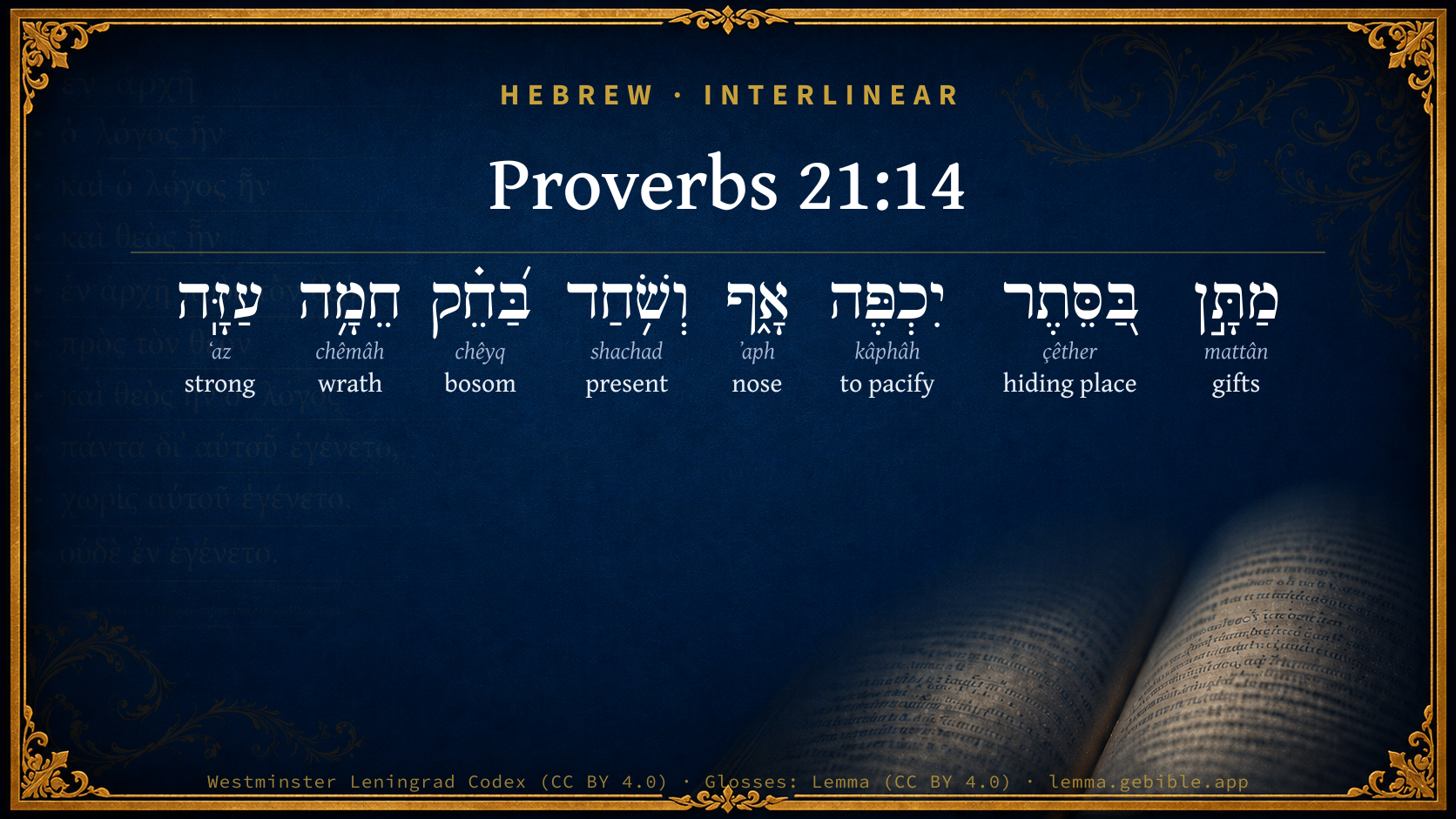
Hebrew (Westminster Leningrad Codex) Proverbs 21:14 appears in the Hebrew Old Testament. The text above is from the Westminster Leningrad Codex. Each word links to its Strong’s number, a concise gloss, and parsing drawn from the Open Scriptures Hebrew Bible morphology. Click any word for its full Brown-Driver-Briggs (BDB) entry.
Download image
Cite this verse

Proverbs 21:14 (World English Bible). Public Domain. Lemma interlinear Bible study tool, https://lemma.gebible.app/v/proverbs/21/14.

Show BibTeX & RIS
BibTeX
RIS
English Translation
A gift in secret pacifies anger; And a bribe in the cloak, strong wrath.
World English Bible · Public Domain
Highlights
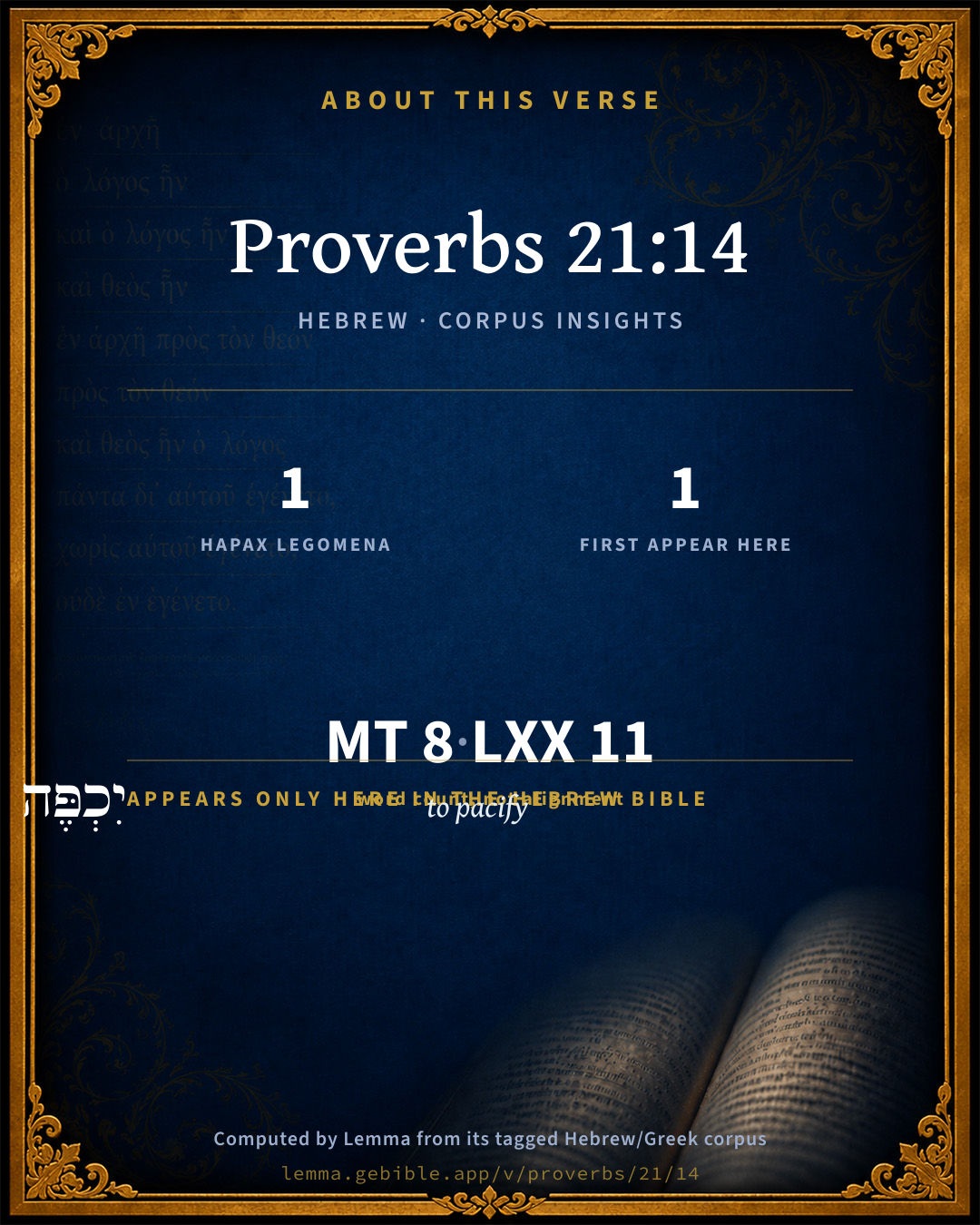
  • 1 hapax legomenon — only here in the Hebrew Bible
  • 1 first appearance in the Hebrew Bible
Full analysis ↓
Download a study sheet

One document with this verse’s original text, its word-by-word gloss line, the meaning frame, cross-references with their text, attributed commentary, and full source and license credits — printable, and it pastes into notes with its structure intact.

This verse Autodidact and up

Study sheet (.html) Plain text (.txt)

A passage Seminary Student

Up to 50 verses in one chapter. A passage sheet keeps up to 6 commentary sources and 12 cross-references per verse, in the order this page ranks them, and says so on the sheet whenever that leaves anything out. Ask for a single verse and you get the Autodidact verse sheet above.

Everything on this page stays free to read, with no account — the sheet is a download of what is already on screen, not access to it.

Want to remove ads? Support Godless Engineer
Compare translations 3

The same verse in 3 English versions, stacked beneath the original-language interlinear above. Click any original word for its lexicon entry.

Each is an independent rendering of the whole verse — the interlinear is not word-aligned to these translations.

Highlighted words mark where these versions differ — a whole-verse word diff, not a word-by-word alignment.

  • World English Bible Public Domain
    A gift in secret pacifies anger; And a bribe in the cloak, strong wrath.
  • King James Version Public Domain
    A gift in secret pacifieth anger: and a reward in the bosom strong wrath.
  • unfoldingWord Literal Text CC BY-SA 4.0
    A gift in secrecy subdues nose, and a bribe in the bosom, strong heat.

unfoldingWord Literal Text — © unfoldingWord, licensed CC BY-SA 4.0. Word-aligned USFM3 via Door43 (git.door43.org/unfoldingWord/en_ult).

Versions to compare (up to 4)

3 of 4 selected

Show all 18 translations

Every available English version of this verse, each an independent rendering of the whole verse.

  • World English Bible Public Domain
    A gift in secret pacifies anger; And a bribe in the cloak, strong wrath.
  • Berean Standard Bible Public Domain
    A gift in secret soothes anger, and a covert bribe pacifies great wrath.
  • Majority Standard Bible Public Domain
    A gift in secret soothes anger, and a covert bribe pacifies great wrath.
  • King James Version Public Domain
    A gift in secret pacifieth anger: and a reward in the bosom strong wrath.
  • American Standard Version (1901) Public Domain
    A gift in secret pacifieth anger; And a present in the bosom, strong wrath.
  • Revised Version (1885) Public Domain
    A gift in secret pacifieth anger, and a present in the bosom strong wrath.
  • Geneva Bible (1599) Public Domain
    A gift in secret pacifieth anger, and a gift in the bosome great wrath.
  • Douay-Rheims (1899) Public Domain
    A secret present quencheth anger: and a gift in the bosom the greatest wrath.
  • Young's Literal Translation Public Domain
    A gift in secret pacifieth anger, And a bribe in the bosom strong fury.
  • Literal Standard Version CC BY-SA 4.0
    A gift in secret pacifies anger, || And a bribe in the bosom—strong fury.
  • Unlocked Literal Bible CC BY-SA 4.0
    A gift in secret appeases anger and a concealed gift appeases strong wrath.
  • unfoldingWord Literal Text CC BY-SA 4.0
    A gift in secrecy subdues nose, and a bribe in the bosom, strong heat.
  • Darby Bible Public Domain
    A gift in secret pacifieth anger; and a present in the bosom, vehement fury.
  • World Messianic Bible Public Domain
    A gift in secret pacifies anger, and a bribe in the cloak, strong wrath.
  • Webster's Bible Public Domain
    A gift in secret pacifieth anger: and a reward in the bosom, strong wrath.
  • Free Bible Version CC BY-SA 4.0
    A gift given in secret calms down anger, and a hidden bribe soothes furious rage.
  • Bible in Basic English Public Domain
    By a secret offering wrath is turned away, and the heat of angry feelings by money in the folds of the robe.
  • JPS Tanakh (1917) Public Domain
    A gift in secret pacifieth anger, and a present in the bosom strong wrath.

Literal Standard Version (2020), Covenant Press — licensed CC BY-SA 4.0. Text via the HelloAO Bible API (eBible.org). Unlocked Literal Bible (unfoldingWord) — licensed CC BY-SA 4.0. Text via the HelloAO Bible API (eBible.org). unfoldingWord Literal Text — © unfoldingWord, licensed CC BY-SA 4.0. Word-aligned USFM3 via Door43 (git.door43.org/unfoldingWord/en_ult). Free Bible Version, Dr. Jonathan Gallagher — licensed CC BY-SA 4.0. Text via the HelloAO Bible API (eBible.org).

Word by word

More ways to search: Search by grammar → Find every occurrence → Compare this word →

Practice this passage: Drill this verse → Learn its vocabulary →

About this verse

These counts appear in no published source. They are computed here, from the morphology-tagged text and Lemma’s own curated glosses. What Lemma adds →

8
words
8
distinct lemmas
Wisdom
section

Notable vocabulary

1 hapax legomenon — a word that appears only here in the entire Hebrew Bible:

  • יִכְפֶּה to pacify H3711

First appearance in Scripture

This word makes its first canonical appearance in the Hebrew Bible here:

  • יִכְפֶּה to pacify H3711

Shared distinctive vocabulary

מַתָּ֣ן gifts H4976 occurs in 5 verses of the Hebrew Bible. Also found in:

Grammatical profile

  • 1 verb
  • 6 nouns
  • 1 adjective

Verb forms

  • יִכְפֶּה Qal · Imperfect

Hebrew & Septuagint length

In English translation the verse runs 14 words from the Hebrew and 15 from the Septuagint (LXX English) — closely comparable.

A rough comparison of the two English renderings, which tokenize alike — not a word-level alignment.

Word counts can differ between the Hebrew and the Greek without any difference in meaning — e.g. the Hebrew direct-object marker אֵת has no separate Greek word, and Greek often adds the article ὁ.

In the original languages it is 8 Hebrew tokens and 11 Greek tokens — but the two are counted differently (Hebrew bundles its prefixes and suffixes into one token; the Greek is in lemma form), so that isn’t a like-for-like length.

Cross-references

8

Topical passages linked to Proverbs 21:14 in the Treasury of Scripture Knowledge — connected by theme and wording, ordered by reader-vote popularity; previews shown in the World English Bible.

  • Proverbs 19:6 Many will entreat the favor of a ruler, And everyone is a friend to a man who gives gifts.
  • Proverbs 18:16 A man's gift makes room for him, And brings him before great men.
  • 1 Samuel 25:35 So David received of her hand that which she had brought him: and he said to her, Go up in peace to your house; behold, I have listened to your voice, and have accepted your person.
  • Proverbs 17:8 A bribe is a precious stone in the eyes of him who gives it; Wherever he turns, he prospers.
  • Matthew 6:3–4 But when you do merciful deeds, don't let your left hand know what your right hand does,
  • Genesis 32:20 You shall say, 'Not only that, but behold, your servant, Jacob, is behind us.'" For, he said, "I will appease him with the present that goes before me, and afterward I will see his face. Perhaps he will accept me."
  • Genesis 43:11 Their father, Israel, said to them, "If it be so now, do this. Take from the choice fruits of the land in your bags, and carry down a present for the man, a little balm, a little honey, spices and myrrh, nuts, and almonds;
  • Proverbs 17:23 A wicked man receives a bribe in secret, To pervert the ways of justice.

Cross-references courtesy of OpenBible.info (CC BY 4.0).

Hebrew and Greek witnesses Masoretic Hebrew ↔ Greek Septuagint

The same verse in the two great witnesses to the Old Testament, shown verse-for-verse.

These are two independent witnesses, not word-aligned to each other, and the Septuagint is shown in lemma (dictionary) form.

Hebrew Proverbs 21:14 Masoretic · Westminster Leningrad Codex

מַתָּ֣ן בַּ֭סֵּתֶר יִכְפֶּה אָ֑ף וְשֹׁ֥חַד בַּ֝חֵ֗ק חֵמָ֥ה עַזָּֽה

A gift in secret pacifies anger; And a bribe in the cloak, strong wrath.

World English Bible · Public Domain

Greek LXX Proverbs 21:14 Septuagint · lemma form

δόσις λάθριος ἀνατρέπω ὀργή δῶρον δέ ὁ φείδομαι θυμός ἐγείρω ἰσχυρός

A secret gift calms anger: but he that forbears to give stirs up strong wrath.

LXX2012 (modern English Septuagint) · Public Domain

On this verse, The Cambridge Bible for Schools and Colleges discusses the Septuagint’s reading. Read the note in Commentary ↓

Hebrew: Westminster Leningrad Codex (CC BY 4.0). Greek: Septuagint (public domain); English from LXX2012 (modern English Septuagint) (Public Domain). How the Septuagint differs from the Hebrew →

Commentary

Notes on Proverbs 21:14 from classic Christian and Jewish commentators (each source and its license shown beneath its notes). The classic Christian expositions comment on the surrounding passage and are grouped to its opening verse, so a note may address several verses; the Jewish commentaries on the Tanakh (Rashi and others) are per-verse, so they appear only where the commentator wrote on this verse.

Lemma curates 59 commentaries, every one of them public domain or Creative Commons licensed, each selected and text-cleaned for this edition rather than reprinted as found. About our sources →

Trapp's Complete Commentary

John Trapp

Pro 21:14 A gift in secret pacifieth anger: and a reward in the bosom strong wrath.

Ver. 14. A gift in secret pacifieth anger.] That is, say some, Alms rightly performed {Mat 6:1} pacifieth God’s displeasure - compare Dan 4:27; and the Jews at this day write this sentence of Solomon (in an abbreviation) upon their alms box. {a} This sense suits well with the previous verse; but I conceive the wise man’s drift here is to show how prevalent gifts are, if closely conveyed especially - which takes away the shame of open receiving - and what a pave they have to an amicable reconciliation. Thus Jacob pacified Esau; Abigail, David; Hezekiah, the Assyrian that came up against him. {2Ki 18:24-25} Howbeit this doth not always do the deed. Our chronicler tells us that the Lady de Bruse had, by her virulent and railing tongue, more exasperated the fury of King John, whom she reviled as a tyrant and a murderer of her husband, than could be pacified by her strange present - viz., four hundred kine and one bull, all milk-white, except only the ears, which were red - sent unto the queen. {b} {See Trapp on "Pro 17:8"}

{a} Buxtorf., Synag. Jud.

{b} Speed, p. 572.

John Trapp, A Commentary or Exposition upon All the Books of the Old and New Testament (1647–1656) — public domain. Text from a community e-Sword module.

Joseph Benson's Commentary

Pro 21:14. A gift — Bestowed on a person offended and angry with us, as the following words show; in secret — That is, given in secret, which makes it more acceptable; for gifts openly given savour of ostentation in the giver: and cause some shame to the receiver; pacifieth anger — Removes all resentment, and conciliates love; and a reward in the bosom — Secretly conveyed into the bosom; strong wrath — Will extinguish that wrath which was thought implacable.

Joseph Benson's Commentary on the Old and New Testaments (1811–1818) — public domain. Text from a community e-Sword module.

The Preacher's Complete Homiletical Commentary

Joseph S. Exell (gen. ed.)

MAIN HOMILETICS OF Pro_21:14

THE PACIFICATION OF ANGER

I. Human anger is an evil to be avoided. Even the anger of a righteous man exposes the object of it to danger. David had good reason to be angry with Nabal, but his anger, though it was the anger of a man just in the main, so nearly overmastered him for the time as to lead him to meditate a very bitter revenge. For even righteous indignation has a tendency to run into unrighteous action, as in the case of Esau and Jacob. The elder brother had just cause to be angry with the younger for his meanness and deceit, but lawful displeasure soon degenerated into an unlawful purpose, and Jacob had to flee for his life. If, then, even the anger of the righteous man is to be feared because it may lead him to visit the offender with justice without mercy, much more is the anger of the unrighteous man likely to lead him to extreme measures, and the anger of either is an evil to be avoided when it can be done without sin.

II. Gifts may appease human anger. This proverb does not, we think, refer to bribery but to lawful tokens of goodwill, and of a desire to be reconciled—to gifts by which we seek to make some atonement for a wrong done. Such were the presents which Jacob offered to Esau, and Abigail to David. A bribe is a gift offered to a third person who is to judge between the parties at strife, but the gift here is from the offender to the person offended.

OUTLINES AND SUGGESTIVE COMMENTS

A gift in itself is gracious, but if it be secretly given it is yet more acceptable; for privy bestowing taketh away the blush of open receiving. When as then a present shall even so closely be conveyed unto the receiver as that it shall covertly be put into his bosom, then it will be most welcome and even forcible.—Muffett.

“Have gifts,” says a judicious writer, “such a powerful influence to disarm resentment? Then let no man plead, in apology for the fury of his passions, that he is not able to conquer them. If money can conquer them, shall reason, and the fear of God, and the command of Christ, be too weak to bridle them? Surely the commandments of God our Saviour have too little authority with us, if they have less influence upon our spirits than gold and jewels have upon the spirits of almost all men.”—Wardlaw.

The Preacher's Complete Homiletical Commentary (gen. ed. Joseph S. Exell; Funk & Wagnalls, c. 1892) — public domain (pre-1929). A full-Bible homiletical/sermon-outline anthology covering 65 of 66 books (2 John is absent from the source module). Text from a community e-Sword module.

Geneva Bible (1599)

Geneva Bible translators

To do a pleasure to the angry man pacifieth him.

Geneva Bible (1599) marginal notes — public domain. Text via Bolls.life.

Matthew Henry's Commentary

Here is, 1. The power that is commonly found to be in gifts. Nothing is more violent than anger. O the force of strong wrath! And yet a handsome present, prudently managed, will turn away some men's wrath when it seemed implacable, and disarm the keenest and most passionate resentments. Covetousness is commonly a master-sin and has the command of other lusts. Pecuniae obediunt omnia - Money commands all things. Thus Jacob pacified Esau and Abigail David. 2. The policy that is commonly used in giving and receiving bribes. It must be a gift in secret and a reward in the bosom, for he that takes it would not be thought to covet it, nor known to receive it, nor would he willingly be beholden to him whom he has been offended with; but, if it be done privately, all is well. No man should be too open in giving any gift, nor boast of the presents he sends; but, if it be a bribe to pervert justice, that is so scandalous that those who are fond of it are ashamed of it.

Matthew Henry's Commentary on the Whole Bible (1708–1710) — public domain (CC PDM 1.0). Text via the HelloAO Bible API.

Jamieson, Fausset & Brown

Robert Jamieson, A. R. Fausset & David Brown

The effect of bribery (Pro 17:23) is enhanced by secrecy, as the bribed person does not wish his motives made known.

Jamieson, Fausset & Brown — Commentary Critical and Explanatory on the Whole Bible (1871) — public domain (CC PDM 1.0). Text via the HelloAO Bible API.

Ellicott's Commentary for English Readers

(14) A gift in secret.—Comp. Abigail and David (1Sa_25:18).

A Bible Commentary for English Readers, edited by Charles John Ellicott (1878–1897) — public domain. Text from a community e-Sword module.

The Cambridge Bible for Schools and Colleges

gen. ed. J. J. S. Perowne

14. pacifieth] The Heb. word occurs only here, and scholars, both ancient and modern, are divided between pacifieth (A.V. and R.V. text), turneth away, or bendeth (ἀνατρέπει, LXX.; frangit, Syr.; bendeth, R.V. marg.), and extinguisheth (extinguit, Vulg.); the word in this last case being regarded as synonymous with the similar word rendered quenched (of God’s anger), Jer_7:20. Both renderings are admissible, but the former is to be preferred.

a reward] Rather, a present, R.V., as the same Heb. word is rendered in Pro_6:35, Pro_17:8, A.V.

in the bosom] brought in the folds of the garment from which it is drawn out stealthily and presented, see Pro_17:23.

The Cambridge Bible for Schools and Colleges (gen. ed. J. J. S. Perowne; Cambridge University Press, 1878–1918) — public domain. Text from a community e-Sword module.

John Gill's Exposition

A gift in secret pacifieth anger,.... Appeases an angry man; humbles and "brings his anger down" (y), as Aben Ezra and Gersom observe the word signifies; which before rose very high, and showed itself in big words and disdainful looks, as proud wrath does; or extinguishes it, as the Targum and Vulgate Latin version render it, and very fitly. Anger is a fire in the breast; and a restraining or causing it to cease is properly expressed by an extinguishing of it: this a gift or present does, as it did in Esau from Jacob, in David from Abigail; but then it must be secretly given, otherwise it may more provoke; since it may show vanity in the giver, and covetousness in the receiver; and the former may have more honour than the latter. Some understand this of a gift for a bribe to a judge, to abate the severity of the sentence; and others of alms deeds to the poor, to pacify the anger of God (z): Jarchi interprets it of alms; and the Jews write this sentence upon the poor's box, understanding it in this sense; but the first sense is best;

and a reward in the bosom strong wrath: the same thing in different words; the meaning is, that a reward or gift, secretly conveyed into the bosom of an angry man, pacifies his wrath, when at the greatest height. The Septuagint, Syriac, and Arabic versions, understand it in a quite different sense, of a gift retained in the bosom, and not given, and render it thus, "he that spareth gifts stirreth up strong wrath".

(y) "deprimit", Piscator; so some in Mercerus; "subigit", Cocceius; "pensat nasum", Schultens. (z) "Munera (crede mihi) placant hominesque deosque", Ovid. de Arte Amandi, l. 3.

John Gill's Exposition of the Whole Bible (1746–1763) — public domain (CC PDM 1.0). Text via the HelloAO Bible API.

Haydock's Catholic Bible Commentary

Bosom. In private. (Calmet) --- They put all valuable things in the bosom. (Haydock)

George Leo Haydock (1774–1849), Haydock's Catholic Family Bible and Commentary, 1859 edition — public domain. Excludes Psalms (Douay-Rheims chapter numbering differs from Protestant) and Deuterocanonical books (Catholic canon only).

Matthew Poole's English Annotations

A gift, to a person offended and angry with us, as the following words show.

In secret; which makes it more acceptable; for gifts openly given savour of ostentation in the giver, and cause some shame or contempt to the receiver.

In the bosom; secretly conveyed into his bosom. See Poole "Pro 17:8", See Poole "Pro 18:16".

Matthew Poole's English Annotations on the Holy Bible (1683–1685) — public domain. Text from a community e-Sword/MySword module.

Whedon's Commentary on the Bible

Daniel D. Whedon

14. A gift… pacifieth — Subdues, allays, or diverts. The proverb only states a fact, without approving or condemning. It is presumed to refer to lawful presents, not to bribes. Compare Pro_17:8; Pro_17:23; Pro_18:16; Pro_19:6. The Septuagint reads the latter clause: “But he that forbears to give, stirs up strong wrath.”

Daniel D. Whedon (gen. ed.), Commentary on the Old and New Testaments (1874–1909) — public domain. Text from a community e-Sword module.

The Pulpit Commentary

A gift in secret pacifieth anger. We have had above various maxims about bribes and presents; e.g. Pro_17:8, 23 18:16. The word translated "pacifieth" is from the apax legomenon verb hpke, "to turn away," "avert." Septuagint, anatrepei ; Vulgate, extinguit; Venetian, kamqei . A gift offered secretly to one incensed, whether personal enemy, judge, or prince, averts the consequences of the offence. The next hemistich is parallel in meaning. And a reward (present) in the bosom strong wrath. A present kept handy in the bosom of the petitioner"s garment, ready to be transferred at a fitting moment, as experience proves, calms the most violent wrath. Septuagint, "He that is sparing of gifts amuses strong wrath.

Vers. 14-17. Lights and shades of the earthly scene.

I THE POWER OF GIFTS. (Ver. 14) They are neither good nor evil in themselves, but may be employed for good or evil ends. Let us make a good use of this text. We learn that gifts should be quiet, unobtrusive, unobserved; and the same is true of all acts of kindness which are real gilts from the heart. They should neither irritate pride nor depress independence. By such little attentions and marks at love, how much evil may be warded off, how many asperities of temper or circumstance may be soothed!

II DELIGHT IN OR DISGUST FOR RIGHT CONDUCT. (Ver. 15). There is no joy in the world to be compared for depth and purity to that of the good conscience; no exercise that brings so much health and pleasure as acting rightly and doing good. But the corrupt mind of evil men can take no delight in looking at goodness, in contemplating pure and noble conduct. For the consequences can only be the judgment and punishment of their own iniquity.

III THE END OF ALL MORAL OBSERVATIONS. (Ver. 16) One of the most solemn passages of the Bible. Taken literally or figuratively, of the present or of the future, they contain a statement, a prophecy, a fact. The wicked and unrepentant pass into a night without the hope of a sunrise to follow.

IV THE END OF IDLE AND FRIVOLOUS MIRTH. (Ver. 17) He that will squander more than his plough can earn must utterly waste. (RAPC Sir 3:3) Magnum vectigal est parsimonia, or "Economy is income;" "Waste not, want not." "Better than merry Nineveh" is recorded as an old proverb. J. (see Zep_2:15)

The Pulpit Commentary (1880–1919), ed. H.D.M. Spence-Jones & Joseph S. Exell — public domain. Text from a community e-Sword module.

John Wesley's Explanatory Notes

In secret - Which makes it more acceptable. In the bosom - Secretly conveyed into the bosom.

John Wesley, Explanatory Notes Upon the Whole Bible (1754–1765) — public domain. Text via the GEBible commentary corpus.

Keil & Delitzsch

C. F. Keil & F. Delitzsch

14 A gift in secret turneth away anger;

And a bribe into the bosom violent wrath.

Hitzig reads with Symmachus, the Targ., and Jerome, יכבּה, and translates: "extinguishes anger;" but it does not follow that they did read יכבה; for the Talm. Heb. כּפה signifies to cover by turning over, e.g., of a vessel, Sanhedrin 77a, which, when it is done to a candle or a fire, may mean its extinction. But כפה of the post-bibl. Heb. also means to bend, and thence to force out (Aram. כּפא, כּפי), according to which Kimchi hesitates whether to explain: overturns = smothers, or: bends = forces down anger. The Venet. follows the latter signification: κάμψει (for Villoison's καλύψει rests on a false reading of the MS). But there is yet possible another derivation from the primary signification, curvare, flectere, vertere, according to which the lxx translates ἀνατρέπει, for which ἀποτρέπει would be yet better: כפה, to bend away, to turn off, ἀρκεῖν, arcere, altogether like the Arab. (compared by Schultens) kfâ, and kfy, ἀρκεῖν, to prevent, whence, e.g., ikfı̂ni hada: hold that away from me, or: spare me that (Fleischer); with the words hafı̂ka sharran (Lat. defendaris semper a malo) princes were anciently saluted; kfy signifies "to suffice," because enough is there, where there is a keeping off of want. Accordingly we translate: Donum clam acceptum avertit iram, which also the Syr. meant by mephadka (מפרק). This verb is naturally to be supplied to 14b, which the lxx has recognised (it translates: but he who spares gifts, excites violent anger). Regarding שׂחד, vid., at Pro 17:8; and regarding בּחק, at Pro 17:23. Also here חק (חיק = חיק), like Arab. jayb, 'ubb, חב, denotes the bosom of the garment; on the contrary (Arab.) hijr, hiḍn, חצן, is more used of that of the body, or that formed by the drawing together of the body (e.g., of the arm in carrying a child). A present is meant which one brings with him concealed in his bosom; perhaps 13b called to mind the judge that took gifts, Exo 23:8 (Hitzig).

Keil & Delitzsch — Biblical Commentary on the Old Testament (1861–1891) — public domain (CC PDM 1.0). Text via the HelloAO Bible API. (Old Testament only.)

Bridges on Proverbs

Charles Bridges

We have before noticed†1 cases of resentment, where a legitimate and prudent distribution of gifts may quell the storm, and restore the calm. But a gift in secret implies a perversion;†2 else why should the light be dreaded?†3 Both parties are involved in the guilt. The giver acts as a tempter. The receiver willfully breaks the law of God.†4 The passions of men are easily charmed. But rarely will a covetous man be so angry with his friends, as not to be pacified with his gift, especially when, given in secret, it tells no tales. A reward in the bosom to such a man is stronger far than strong wrath; and when it has shewn its errand, the melting process is rapidly accomplished. (Ecc 10:19 .) Thus is the wounded pride expelled by another ruling passion — avarice! Who then can excuse himself in the indolent cry — ’I cannot help my passion, or gain any power over it!’ For if it can be pacified by sordid motives, it leaves us inexcusable, if we do not subdue it by Christian motives. But it is too evident, that secret covetousness cankers many a plausible exercise of forbearance. How do we need a close watch and keeping of our own hearts, in order to a Christian walk with God!

Footnotes:

†1 Pro 18:16.

†2 Pro 17:23.

†3 Joh 3:20.

†4 Exo 23:8. Deu 16:19 .

Charles Bridges, An Exposition of the Book of Proverbs (1846) — public domain. Text from a community e-Sword module.

Kretzmann's Popular Commentary

Paul E. Kretzmann

v. 14. A gift in secret pacifieth anger, a gift brought concealed in the bosom and presented at the proper moment; and a reward in the bosom, a gift of bribery, strong wrath, for the more liberal the present, the more readily will it influence the one who receives it.

Paul E. Kretzmann, Popular Commentary of the Bible (1921–1924) — public domain. Text from a community e-Sword module.

Rashi

Rabbi Shlomo Yitzchaki (Rashi)

A gift in secret Charity.

and a bribe in the pocket This too refers to charity. It will appease even strong wrath.

Rashi on the Tanakh — English translations: “The Judaica Press complete Tanach with Rashi, translated by A. J. Rosenberg” (CC BY 4.0); “Pentateuch with Rashi's commentary by M. Rosenbaum and A.M. Silbermann, 1929-1934” (public domain); “The Metsudah Tanach series, Lakewood, N.J” (CC BY 4.0); and “The Book of Joshua, Metsudah Publications, 1997” (CC BY 4.0). Text via Sefaria.

Lesson kit

Teaching starters — assembled from the data on this page, not authored interpretation. Every prompt links to the verse data it draws on. Edit before teaching.

Proverbs, in the Wisdom, opens this verse with 8 words (8 distinct Hebrew lemmas). Its most distinctive word is kâphâh (“to pacify”). A historical commentator’s framing appears above. Read the whole chapter for the surrounding context.

Discussion questions

  1. The word kâphâh carries the sense “to pacify.” How does it shape the verse?
  2. 1 word here appears nowhere else in the Hebrew Bible. Why might the author reach for such rare wording?
  3. This is the first place “to pacify” appears in Scripture (first appears here). What does its debut here establish?
  4. How does Genesis 34:12, which shares the word «gifts», read alongside this verse?
  5. These translations render this verse differently; the difference is in the English rendering, not the original. What questions does that raise?
  6. «יִכְפֶּה» is a Qal Imperfect verb. How does that grammatical form shape the action described?
  7. Compare how Trapp's Complete Commentary and Joseph Benson's Commentary read this verse. Where do they agree or differ?

Things to notice

Reading settings

Reading text

Shown beneath each verse's original-language words.

Old Testament
Old Testament edition

Read the OT as the Masoretic Hebrew (MT) or the Greek Septuagint (LXX).

English shown for the Greek Septuagint (in the Hebrew ↔ Greek comparison).

Comparing translations? Open the Compare panel on any verse page to stack up to four side by side.