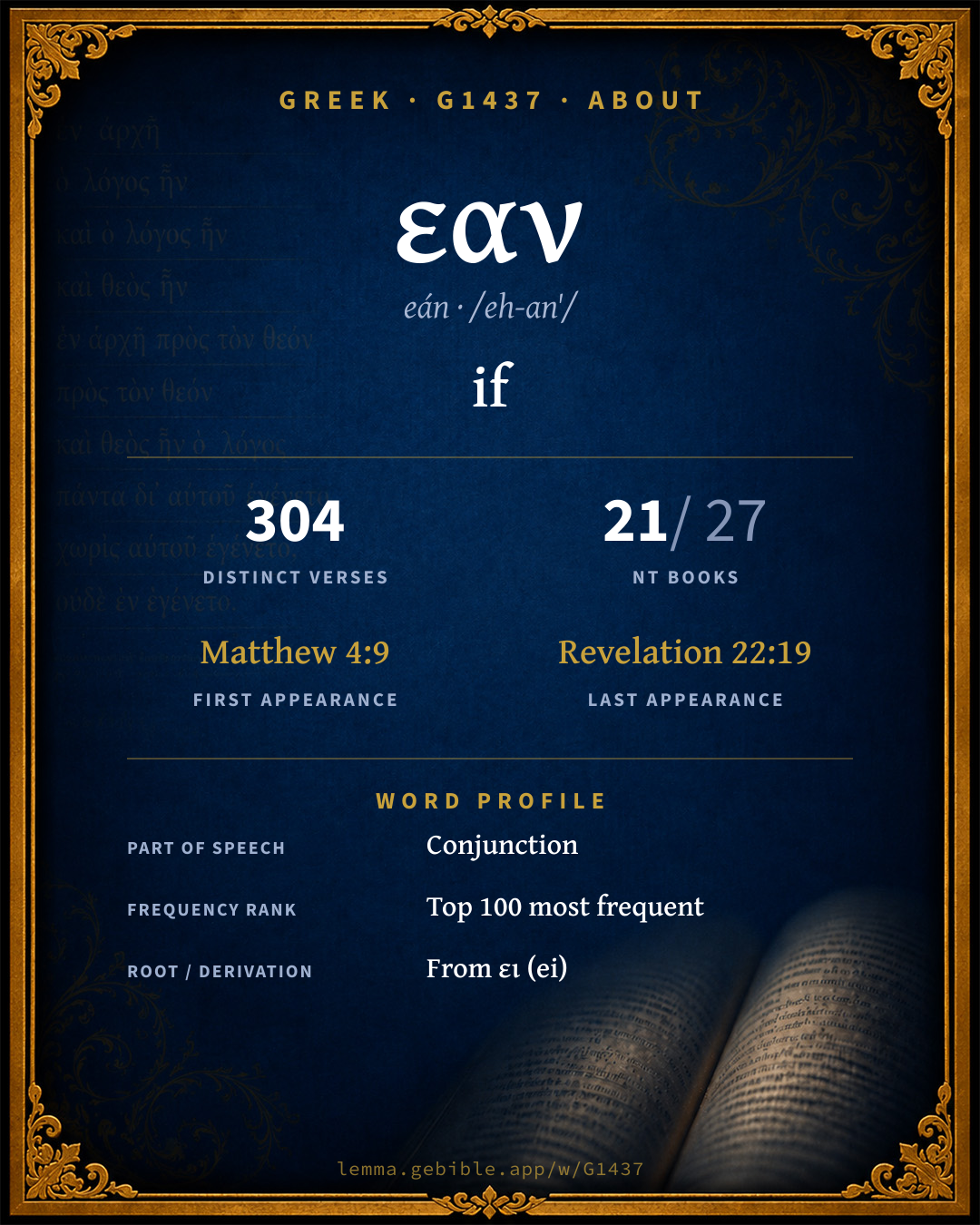
ἐάν
if
Full lexicon entry — Thayer's Greek Lexicon
From Thayer's Greek Lexicon
Where this word appears
Grammar key — what these labels mean
Part of speech
- Conditional
- A particle introducing a condition (“if”).
Every verse where G1437 appears in the Book of 2 Thessalonians — 1 distinct verse. Click any verse to open its interlinear word-by-word view. Verse text shown in the World English Bible for context — . Each verse’s Greek form is shown with its reference; the English is not keyword-highlighted, since the data carries no word-level English alignment. Use “Compare translations” on any verse to read it across multiple English versions. This concordance covers the Greek New Testament; Septuagint (Greek Old Testament) occurrences of this word are not indexed here.
2 Thessalonians
About this entry
At a glance — auto-summarized from this page’s data, not written by a person. Every figure links to its source below. This summary describes the numbers; it doesn’t interpret them.
εαν — transliterated eán — is a Greek conjunction carrying the sense “if.” Its earliest occurrence is Matthew 4:9. It appears 304 verses across 21 books of the Greek New Testament, among its common vocabulary. It shares a root with ει, ειγε and ει δε μη(γε). See the sense tree, 304-verse concordance, and the renderings breakdown below.
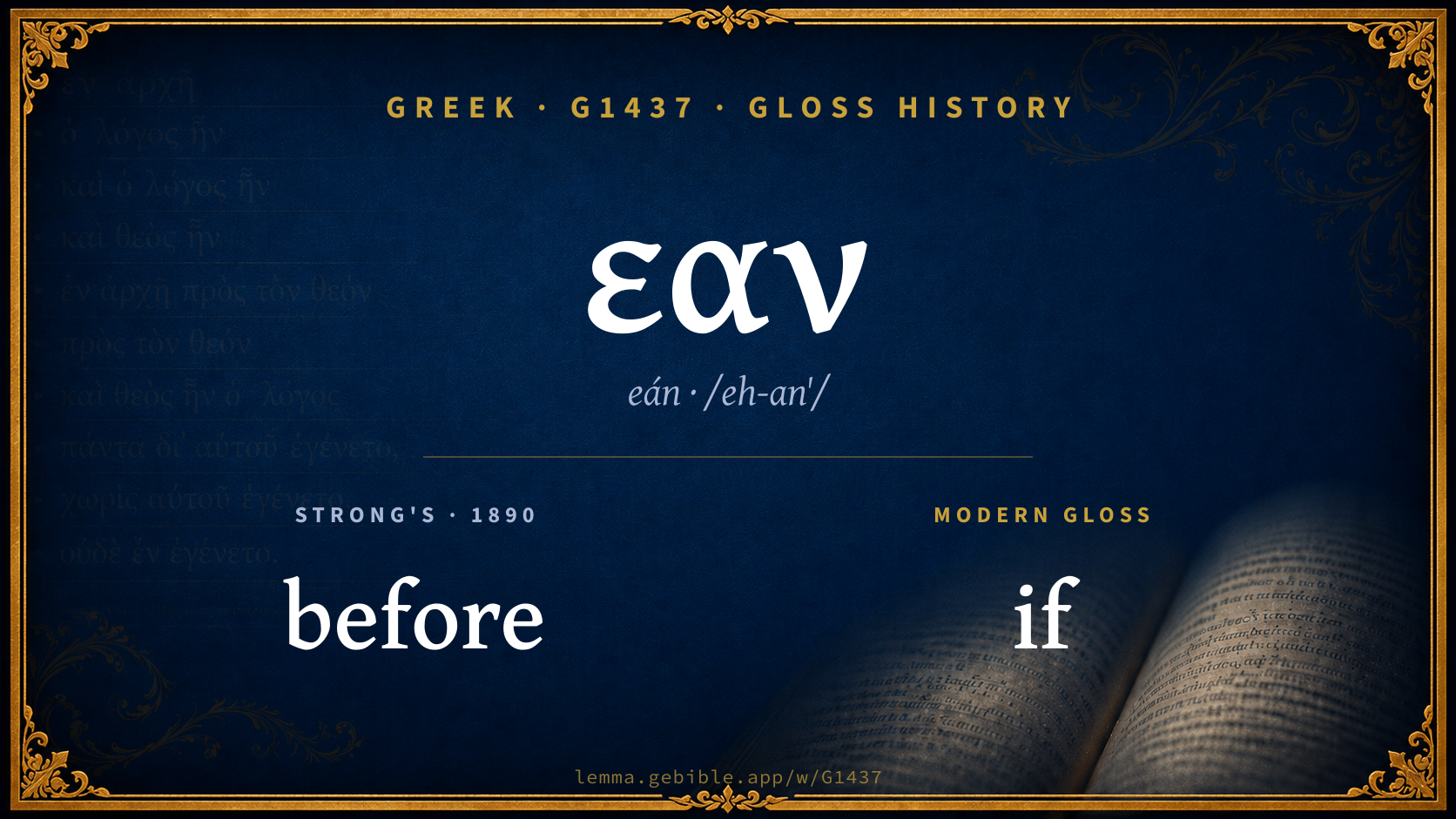
Gloss history
Strong's 1890 vs modern scholarship
About this word
Strong's G1437 catalogs a Greek word from the Greek New Testament.
These counts are not copied from any lexicon or concordance. They are computed here, from the morphology-tagged Greek New Testament. What Lemma adds →
- 304
- distinct verses
- The word appears in 304 distinct verses.
- 21 / 27
- NT books
- The word appears in 21 of 27 New Testament books.
- #55
- by frequency
- Top 100 most frequent Greek words (rank 55 of 5,347 Greek words by occurrence).
View all 304 occurrences in the concordance →
Most concentrated in
- Matthew 57 verses 19%
- John 52 verses 17%
- 1 Corinthians 41 verses 13%
By section of the New Testament
By traditional corpus
Conventional, traditional groupings — biblical authorship is debated, so this is a traditional corpus grouping, not an authorship claim. Some books belong to more than one corpus (Luke is in both the Gospels and the Lukan corpus, and so on), so these shares overlap and need not total 100%. Each figure is a share of the word’s 304 distinct verses.
- Gospels 168 verses · 55%
- Johannine 83 verses · 27%
- Pauline corpus 80 verses · 26%
- Lukan (Luke–Acts) 36 verses · 12%
- General (Catholic) Epistles 30 verses · 10%
- Revelation 9 verses · 3%
- Hebrews 8 verses · 3%
How translations render this word
Counts come from each version’s own published word-to-Strong’s tagging or interlinear alignment — an approximate guide to how each version renders this word, not a word-level alignment the data otherwise carries. Because each total is that version’s own tagged count, the per-version totals vary from one another and need not match the appearance or distinct-verse counts above. These counts may also differ from a printed concordance because Lemma counts each distinctly tagged rendering and does not collapse phrase taggings into a single head-word total. This is a fixed set of word-tagged versions (KJV, ASV, BSB, ULT) and does not change with the reading translation you choose elsewhere. Each version’s license is shown beside its name below (and on Sources).
- King James Version: If 197×, Though 13×, Whether 3×
- American Standard Version: If 218×, Except 6×, Shall 6×
- Berean Standard Bible: If 204×, Unless 33×, Suppose 4×
- unfoldingWord Literal Text: If 236×, Unless 26×, Whatever 18×
King James Version Public Domain
Renders G1437 across 225 tagged occurrences — most commonly:
Plus 7 renderings that appear only once — usually multi-word phrases or single function words the recovered tagging swept in, not distinct renderings. Not rendered by a distinct English word in 51 further occurrences.
American Standard Version Public Domain
Renders G1437 across 279 tagged occurrences — most commonly:
Plus 26 renderings that appear only once — usually multi-word phrases or single function words the recovered tagging swept in, not distinct renderings.
Berean Standard Bible Public Domain
Renders G1437 across 256 tagged occurrences — most commonly:
Plus 9 renderings that appear only once — usually multi-word phrases or single function words the recovered tagging swept in, not distinct renderings. Not rendered by a distinct English word in 48 further occurrences.
unfoldingWord Literal Text CC BY-SA 4.0
Renders G1437 across 337 tagged occurrences — most commonly:
Plus 17 renderings that appear only once — usually multi-word phrases or single function words the recovered tagging swept in, not distinct renderings.
Senses in Thayer's
The 1 sense Thayer's distinguishes for this word, in lexicon order (not ranked by frequency or importance). The full entry — with sub-senses — is in the Lexicon Entry tab.
- if, in case
Word origin
Derived from ει (ei) (G1487) — if.
From G1487 and G302 ; a conditional particle; in case that provided etc.; often used in connection with other particles to denote indefiniteness or uncertainty : - before but except (and) if (if) so (what- whither-) soever though when (-soever) whether (or) to whom [who-] so (-ever). See G3361 .
— Strong’s Exhaustive Concordance (1890), public domain.
Forms in the corpus
The 4 distinct written forms G1437 takes in the Greek New Testament, most frequent first — each parse links to that case’s occurrences in the concordance.
| Form | Parsing | Example | Uses |
|---|---|---|---|
| ἐὰν eàn | Conditional | Matthew 4:9 | 280 |
| ἐάν eán | Conditional | Matthew 18:15 | 46 |
| Ἐὰν Eàn | Conditional | Matthew 6:14 | 5 |
| ἐάνπερ eánper | Conditional | Hebrews 3:14 | 2 |
Same root — word family
Other Thayer's entries built from the same root as G1437, grouped by Strong’s listed origin. These share a root / origin per the lexicon — not necessarily a shared meaning. Each links to that word’s own entry.
Derives from
Shares the same root
- ειγε eíge G1489 if indeed
- ει δε μη(γε) ei dè mḗ(ge) G1490 but if not
- ει και ei kaí G1499 even if
- ει μη ei mḗ G1508 except
- ει περ eí per G1512 if indeed
- ει πως eí pōs G1513 if indeed
- ειτε eíte G1535 whether or
- ει τις eí tis G1536 whoever
Derived from this word
Compare all same-root words → Showing 4 of 11 — not the complete family. They share a root, not necessarily a meaning.
Septuagint usage
The same Greek word εαν appears 1,140 times in the Greek Old Testament (Septuagint), across 995 verses in 34 books.
- 1,140
- LXX occurrences
- Tagged occurrences of this Greek word in the Septuagint.
- 995
- verses
- Distinct Septuagint verses containing this word.
- 34 / 39
- OT books
- The word appears in 34 of the 39 Old Testament books.
Sample Septuagint occurrences
- Genesis 2:19 ἐάν
- Exodus 1:16 ἐάν
- Leviticus 1:2 ἐάν
- Numbers 5:6 ἐάν
- Deuteronomy 1:17 ἐάν
- Joshua 1:7 ἐάν
- Judges 1:12 ἐάν
- Ruth 1:16 ἐάν
- 1 Samuel 1:11 ἐάν
- 2 Samuel 3:13 ἐάν
- 1 Kings 1:52 ἐάν
- 2 Kings 2:10 ἐάν
Septuagint occurrences (same lexeme)
Every verse where the same Strong’s number (G1437) appears in the Greek Septuagint — showing the first 50 of 995. Verse text shown in the World English Bible for context; the Greek form is the matched word — the English is not keyword-highlighted.
- Genesis 2:19 ἐάν Out of the ground Yahweh God formed every animal of the field, and every bird of the sky, and brought them to the man to see what he would call them. Whatever the man called every living creature, that was its name.
- Genesis 4:7 ἐάν If you do well, will it not be lifted up? If you don't do well, sin crouches at the door. Its desire is for you, but you are to rule over it."
- Genesis 6:17 ἐάν I, even, I do bring the flood of waters on this earth, to destroy all flesh having the breath of life from under the sky. Everything that is in the earth will die.
- Genesis 15:14 ἐάν I will also judge that nation, whom they will serve. Afterward they will come out with great substance.
- Genesis 18:24 ἐάν What if there are fifty righteous within the city? Will you consume and not spare the place for the fifty righteous who are therein?
- Genesis 18:26 ἐάν Yahweh said, "If I find in Sodom fifty righteous within the city, then I will spare all the place for their sake."
- Genesis 18:28 ἐάν What if there will lack five of the fifty righteous? Will you destroy all the city for lack of five?" He said, "I will not destroy it, if I find forty-five there."
- Genesis 18:29 ἐάν He spoke to him yet again, and said, "What if there are forty found there?" He said, "I will not do it for the forty's sake."
- Genesis 18:30 ἐάν He said, "Oh don't let the Lord be angry, and I will speak. What if there are thirty found there?" He said, "I will not do it, if I find thirty there."
- Genesis 18:31 ἐάν He said, "See now, I have taken it on myself to speak to the Lord. What if there are twenty found there?" He said, "I will not destroy it for the twenty's sake."
- Genesis 18:32 ἐάν He said, "Oh don't let the Lord be angry, and I will speak yet but this once. What if ten are found there?" He said, "I will not destroy it for the ten's sake."
- Genesis 20:13 ἐάν It happened, when God caused me to wander from my father's house, that I said to her, 'This is your kindness which you shall show to me. Everywhere that we go, say of me, "He is my brother."'"
- Genesis 20:15 ἐάν Abimelech said, "Behold, my land is before you. Dwell where it pleases you."
- Genesis 21:12 ἐάν God said to Abraham, "Don't let it be grievous in your sight because of the boy, and because of your handmaid. In all that Sarah says to you, listen to her voice. For from Isaac will your seed be called.
- Genesis 21:22 ἐάν It happened at that time, that Abimelech and Phicol the captain of his host spoke to Abraham, saying, "God is with you in all that you do.
- Genesis 24:8 ἐάν If the woman isn't willing to follow you, then you shall be clear from this my oath. Only you shall not bring my son there again."
- Genesis 24:41 ἐάν Then will you be clear from my oath, when you come to my relatives. If they don't give her to you, you shall be clear from my oath.'
- Genesis 27:40 ἐάν By your sword will you live, and you will serve your brother. It will happen, when you will break loose, That you shall shake his yoke from off your neck."
- Genesis 28:15 ἐάν Behold, I am with you, and will keep you, wherever you go, and will bring you again into this land. For I will not leave you, until I have done that which I have spoken of to you."
- Genesis 28:20 ἐάν Jacob vowed a vow, saying, "If God will be with me, and will keep me in this way that I go, and will give me bread to eat, and clothing to put on,
- Genesis 28:22 ἐάν then this stone, which I have set up for a pillar, will be God's house. Of all that you will give me I will surely give the tenth to you."
- Genesis 30:31 ἐάν He said, "What shall I give you?" Jacob said, "You shall not give me anything. If you will do this thing for me, I will again feed your flock and keep it.
- Genesis 30:33 ἐάν So my righteousness will answer for me hereafter, when you come concerning my hire that is before you. Everyone that is not speckled and spotted among the goats, and black among the sheep, that might be with me, will be counted stolen."
- Genesis 31:8 ἐάν If he said this, 'The speckled will be your wages,' then all the flock bore speckled. If he said this, 'The streaked will be your wages,' then all the flock bore streaked.
- Genesis 31:32 ἐάν With whoever you find your gods, he shall not live. Before our relatives, discern what is yours with me, and take it." For Jacob didn't know that Rachel had stolen them.
- Genesis 31:52 ἐάν May this heap be a witness, and the pillar be a witness, that I will not pass over this heap to you, and that you will not pass over this heap and this pillar to me, for harm.
- Genesis 32:9 ἐάν Jacob said, "God of my father Abraham, and God of my father Isaac, Yahweh, who said to me, 'Return to your country, and to your relatives, and I will do you good.'
- Genesis 32:18 ἐάν Then you shall say, 'They are your servant, Jacob's. It is a present sent to my lord, Esau. Behold, he also is behind us.'"
- Genesis 32:27 ἐάν He said to him, "What is your name?" He said, "Jacob."
- Genesis 33:13 ἐάν Jacob said to him, "My lord knows that the children are tender, and that the flocks and herds with me have their young, and if they overdrive them one day, all the flocks will die.
- Genesis 34:11 ἐάν Shechem said to her father and to her brothers, "Let me find favor in your eyes, and whatever you will tell me I will give.
- Genesis 34:15 ἐάν Only on this condition will we consent to you. If you will be as we are, that every male of you be circumcised;
- Genesis 34:17 ἐάν But if you will not listen to us, to be circumcised, then we will take our sister, and we will be gone."
- Genesis 37:26 ἐάν Judah said to his brothers, "What profit is it if we kill our brother and conceal his blood?
- Genesis 38:16 ἐάν He turned to her by the way, and said, "Please come, let me come in to you:" for he didn't know that she was his daughter-in-law. She said, "What will you give me, that you may come in to me?"
- Genesis 38:17 ἐάν He said, "I will send you a kid of the goats from the flock." She said, "Will you give me a pledge, until you send it?"
- Genesis 41:55 ἐάν When all the land of Egypt was famished, the people cried to Pharaoh for bread, and Pharaoh said to all the Egyptians, "Go to Joseph. What he says to you, do."
- Genesis 42:15 ἐάν Hereby you shall be tested. By the life of Pharaoh you shall not go forth from here, unless your youngest brother come here.
- Genesis 42:37 ἐάν Reuben spoke to his father, saying, "Kill my two sons, if I don't bring him to you. Deliver him into my hand, and I will bring him to you again."
- Genesis 43:3 ἐάν Judah spoke to him, saying, "The man solemnly warned us, saying, 'You shall not see my face, unless your brother is with you.'
- Genesis 43:5 ἐάν but if you will not send him, we will not go down, for the man said to us, 'You shall not see my face, unless your brother is with you.'"
- Genesis 43:9 ἐάν I will be collateral for him. From my hand will you require him. If I don't bring him to you, and set him before you, then let me bear the blame forever,
- Genesis 44:1 ἐάν He commanded the steward of his house, saying, "Fill the men's sacks with food, as much as they can carry, and put every man's money in his sack's mouth.
- Genesis 44:22 ἐάν We said to my lord, 'The boy can't leave his father: for if he should leave his father, his father would die.'
- Genesis 44:23 ἐάν You said to your servants, 'Unless your youngest brother comes down with you, you will see my face no more.'
- Genesis 44:29 ἐάν If you take this one also from me, and harm happens to him, you will bring down my gray hairs with sorrow to Sheol.'
- Genesis 44:30 ἐάν Now therefore when I come to your servant my father, and the boy is not with us; seeing that his life is bound up in the boy's life;
- Genesis 44:32 ἐάν For your servant became collateral for the boy to my father, saying, 'If I don't bring him to you, then I will bear the blame to my father forever.'
- Genesis 46:33 ἐάν It will happen, when Pharaoh summons you, and will say, 'What is your occupation?'
- Genesis 48:6 ἐάν Your issue, who you become the father of after them, will be yours. They will be called after the name of their brothers in their inheritance.
These are occurrences of the same Greek lexeme (G1437) in the Septuagint — not a translation of any one Hebrew word. The store carries no word-level Hebrew↔Greek alignment, so no Hebrew original is asserted here. Counts come from the recovered LXX Strong's tagging — high-frequency vocabulary is well covered, while rare or late forms may be untagged — so they reflect tagged occurrences and may slightly undercount.