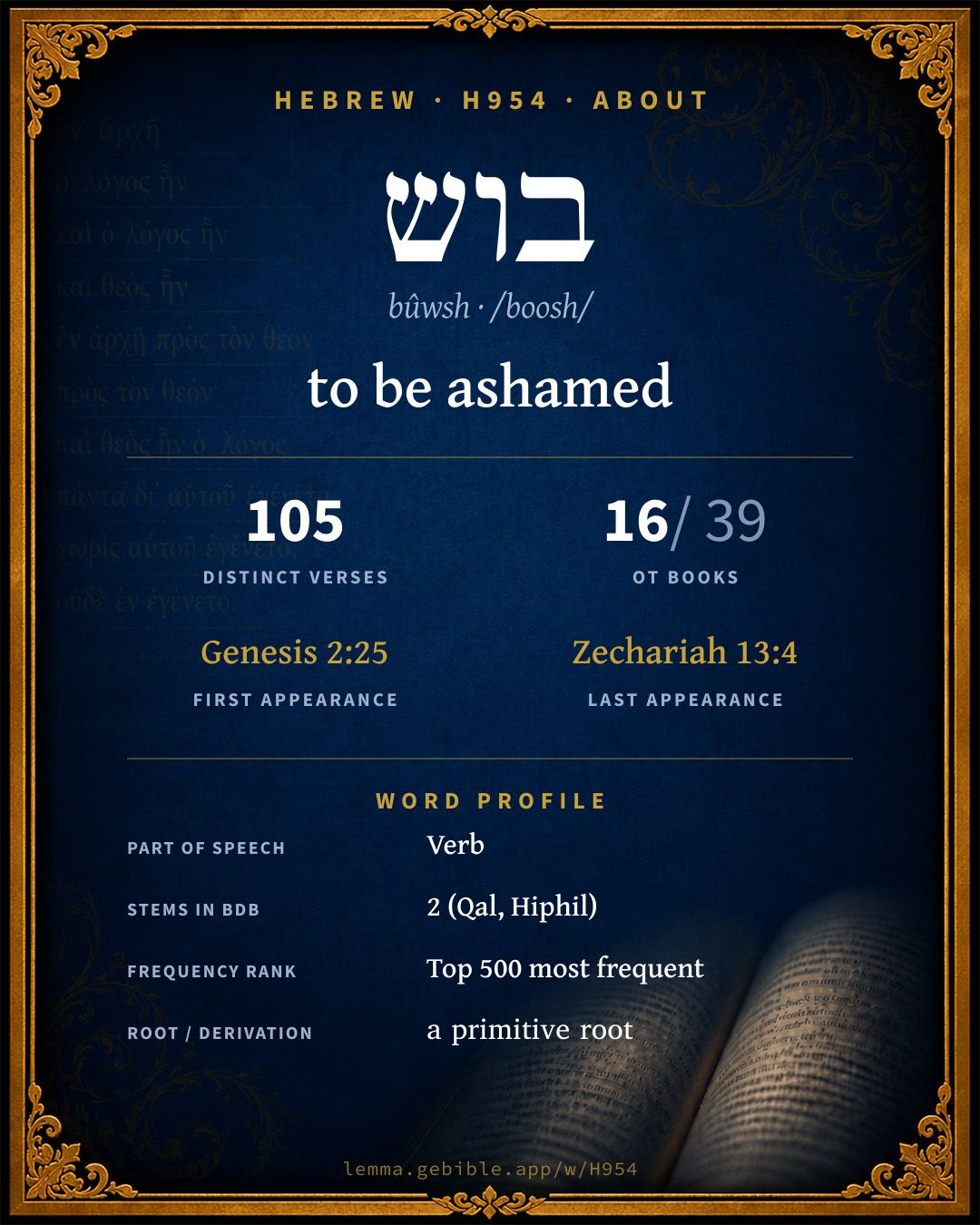
בּוֹשׁ
to be ashamed
‘to be ashamed’ is one of 3 main senses fuller range ↓
Full lexicon entry — Brown-Driver-Briggs (BDB)
From Brown-Driver-Briggs (BDB)
Where this word appears
Grammar key — what these labels mean
Part of speech
- Verb
- An action or state-of-being word.
Stem
- Qal
- The basic, simple active stem — the plain form of the verb (“he wrote”). Here: ‘sq.’
- Hiphil
- The causative active stem (“he caused / brought about”). Here: ‘put to shame 2 S 19’
- Polel
- A stem of hollow/geminate roots functioning like the Piel — intensive active.
- Hithpolel
- The reflexive counterpart of the Polel.
Form
- Imperfect
- An incomplete, ongoing, or future action (“he will / would write”).
- Perfect
- A completed action or state — Hebrew marks aspect (completeness) more than strict tense (“he wrote”).
- Cohortative
- A first-person volitional form expressing wish or resolve (“let me / let us write”).
- Participle Active
- A verbal adjective expressing ongoing or characteristic action (“writing / one who writes”).
- Infinitive Construct
- A bound verbal noun, frequently with prepositions (“to write / in writing”).
- Sequential Perfect
- A perfect with prefixed waw continuing a preceding imperfect or command (waw-consecutive perfect).
- Sequential Imperfect
- An imperfect with prefixed waw — the standard past-narrative form (waw-consecutive imperfect).
- Jussive
- A third- or second-person volitional form expressing wish or command (“let him write”).
- Infinitive Absolute
- An unbound verbal noun, often intensifying or standing in for a finite verb.
- Imperative
- A direct command (“write!”).
State
- Absolute
- The independent form of a noun, not bound to a following word.
Person
- 3rd Person
- The one spoken about (“he / she / it / they”).
- 1st Person
- The speaker (“I / we”).
- 2nd Person
- The one addressed (“you”).
Gender
- Masculine
- Grammatically masculine.
- Common
- Either gender — not distinguished for this form.
- Feminine
- Grammatically feminine.
Number
- Plural
- More than one (in Hebrew, generally three or more).
- Singular
- One.
Every verse where H954 appears in the Book of Proverbs — 6 distinct verses. Click any verse to open its interlinear word-by-word view. Verse text shown in the World English Bible for context — . Each verse’s Hebrew form is shown with its reference; the English is not keyword-highlighted, since the data carries no word-level English alignment. Use “Compare translations” on any verse to read it across multiple English versions. This concordance covers the Hebrew Bible; Septuagint (Greek Old Testament) occurrences are not indexed here.
Proverbs
- Proverbs 10:5 מֵבִֽישׁ Hiphil ptcp.act ms He who gathers in summer is a wise son, But he who sleeps during the harvest is a son who causes shame.
- Proverbs 12:4 מְבִישָֽׁה Hiphil ptcp.act fs A worthy woman is the crown of her husband, But a disgraceful wife is as rottenness in his bones.
- Proverbs 14:35 מֵבִֽישׁ Hiphil ptcp.act ms The king's favor is toward a servant who deals wisely, But his wrath is toward one who causes shame.
- Proverbs 17:2 מֵבִ֑ישׁ Hiphil ptcp.act ms A servant who deals wisely will rule over a son who causes shame, And shall have a part in the inheritance among the brothers.
- Proverbs 19:26 מֵבִ֥ישׁ Hiphil ptcp.act ms He who robs his father and drives away his mother, Is a son who causes shame and brings reproach.
- Proverbs 29:15 מֵבִ֥ישׁ Hiphil ptcp.act ms The rod of correction gives wisdom, But a child left to himself causes shame to his mother.
About this entry
At a glance — auto-summarized from this page’s data, not written by a person. Every figure links to its source below. This summary describes the numbers; it doesn’t interpret them.
בוש (bûwsh) is a Hebrew verb most often rendered “to be ashamed.” Translators differ — “be ashamed” in the King James Version, then “be put to shame” (Berean Standard Bible) and “have shame” (unfoldingWord Literal Text), as the renderings breakdown shows. With 105 verses in 16 books, it is a common word in the Hebrew Bible. It concentrates in Psalms, which alone accounts for 30% of its uses. Across 2 stems, its meaning turns on the binyan (Qal, Hiphil). The sections below give every sense, occurrence, and version rendering.
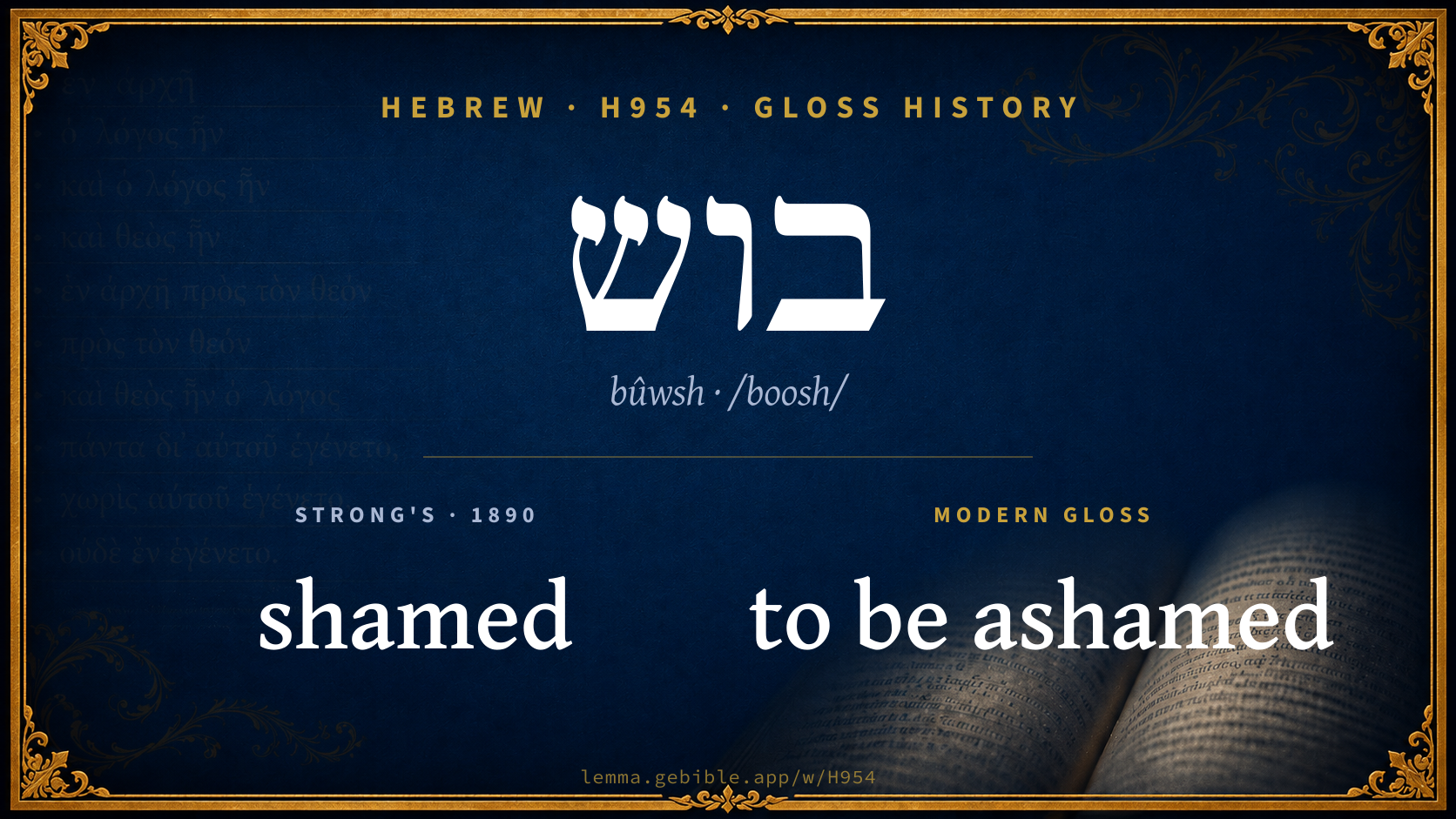
Gloss history
Strong's 1890 vs modern scholarship
About this word
Strong's H954 catalogs a Hebrew word from the Hebrew Old Testament.
These counts are not copied from any lexicon or concordance. They are computed here, from the morphology-tagged Hebrew Old Testament. What Lemma adds →
- 105
- distinct verses
- The word appears in 105 distinct verses.
- 16 / 39
- OT books
- The word appears in 16 of 39 Old Testament books.
- #384
- by frequency
- Top 500 most frequent Hebrew words (rank 384 of 8,640 Hebrew words by occurrence).
View all 105 occurrences in the concordance →
By section of the Old Testament
By traditional corpus
Conventional, traditional groupings — biblical authorship is debated, so this is a traditional corpus grouping, not an authorship claim. Each share is this word’s portion of its verses in that division of the Hebrew canon. Each figure is a share of the word’s 105 distinct verses.
- Prophets (Nevi'im) 62 verses · 59%
- Writings (Ketuvim) 41 verses · 39%
- Torah (Pentateuch) 2 verses · 2%
How translations render this word
Counts come from each version’s own published word-to-Strong’s tagging or interlinear alignment — an approximate guide to how each version renders this word, not a word-level alignment the data otherwise carries. Because each total is that version’s own tagged count, the per-version totals vary from one another and need not match the appearance or distinct-verse counts above. These counts may also differ from a printed concordance because Lemma counts each distinctly tagged rendering and does not collapse phrase taggings into a single head-word total. This is a fixed set of word-tagged versions (KJV, ASV, BSB, ULT) and does not change with the reading translation you choose elsewhere. Each version’s license is shown beside its name below (and on Sources).
- King James Version: Be ashamed 11×, Ashamed 6×, They shall be ashamed 6×
- American Standard Version: Confounded 12×, Let them be put to shame 8×, Be put to shame 6×
- Berean Standard Bible: Be put to shame 21×, Be ashamed 16×, Shame 9×
- unfoldingWord Literal Text: Have shame 21×, Ashamed 8×, Let 8×
King James Version Public Domain
Renders H954 across 109 tagged occurrences — most commonly:
Plus other, less common renderings. Plus 51 renderings that appear only once — usually multi-word phrases or single function words the recovered tagging swept in, not distinct renderings.
American Standard Version Public Domain
Renders H954 across 113 tagged occurrences — most commonly:
Plus other, less common renderings. Plus 59 renderings that appear only once — usually multi-word phrases or single function words the recovered tagging swept in, not distinct renderings.
Berean Standard Bible Public Domain
Renders H954 across 125 tagged occurrences — most commonly:
Plus other, less common renderings. Plus 42 renderings that appear only once — usually multi-word phrases or single function words the recovered tagging swept in, not distinct renderings.
unfoldingWord Literal Text CC BY-SA 4.0
Renders H954 across 149 tagged occurrences — most commonly:
Plus other, less common renderings. Plus 46 renderings that appear only once — usually multi-word phrases or single function words the recovered tagging swept in, not distinct renderings.
10 senses and sub-senses in the full BDB
Hebrew verbs can shift meaning by stem (binyan): Qal is the basic action, Niphal is often passive or reflexive, Piel often intensifies or makes it factitive, and Hiphil is typically causative. The senses below are grouped under the stem BDB assigns to each.
What do BDB’s symbols mean?
BDB uses these scholarly abbreviations:
| Symbol | Meaning |
|---|---|
| 𝔊 | the Septuagint (the ancient Greek translation, LXX) |
| 𝔙 | the Vulgate (the Latin translation) |
| 𝔖 | the Syriac version (the Peshitta) |
| 𝔗 | the Targum (the Aramaic translation) |
| ψ | the Psalms |
| √ | root (the underlying root or stem) |
| ‖ | parallel passage (a synonymous or contrasted parallel) |
| † | the dagger: every passage where the word occurs is cited |
The 10 senses and sub-senses the full Brown-Driver-Briggs lexicon distinguishes for this word, in lexicon order (not ranked by frequency), with BDB’s own verbatim wording and sub-sense lettering. Shown in Hebrew script with BDB’s own scholarly abbreviations. The condensed entry is in the Lexicon Entry tab. See also the Forms in the corpus table below.
Qal
- Pf. Je 48:39; בּשׁ Je 48:13; בּוֹשָׁה Je 15:9; בֹּשְׁתִּי Je 31:19 + 25 times; Impf. יֵבוֹשׁ Is 29:22 + 57 times; Inf. abs. בּוֹשׁ Je 6:15; 8:12; Imv. בּוֹשִׁי Is 23:4 Ez 16:52, בּוֹשׁוּ Ez 36:32; Pt. pl. בּוֹשִׁים Ez 32:30;— e.g. Jeremiah 48:39
- 1. abs. feel shame Je 6:15 + 16 times, Is 19:9; 23:4; 37:27 Is 2 45:16 + 14 times Ez 16:63 Mi 7:16 Jo 2:26, 27 2 K 19:26 Ez 9:6 Jb 6:20 ψ 6:11 (+ 27 times, chiefly in late Psalms). e.g. Jeremiah 6:15
- 2. sq. מִן, be ashamed of, i.e. disconcerted, disappointed by reason of Je 2:36(×2); 12:13; 48:13 Is 1:29; 20:5 Ez 32:30; 36:32. e.g. Jeremiah 2:36
- 3. with obj. בֹּשְׁתִּי לִשְׁאוֹל I am ashamed to ask Ezr 8:22; לֹא תֵבשׁוּ תַּהְכְּרוּ לִי ye are not ashamed to deal hardly with me (impf. subj.) Jb 19:3. בּושׁ often ‖ נכלם & חפר; בּשׁוּ וְהָכְלְמוּ they are ashamed and confounded Je 14:3, 22:22 Is 20:5; 41:11; 45:16, 17 Ez 16:52; 36:32 ψ 35:4; 69:7 Ez 9:6; וּבשׁוּ הַחֹזִים וְחָֽפְרוּ הַקֹּסְמִים and the seers shall be ashamed and the diviners confounded Mi 3:7, cf. Je 15:9 Jb 6:20 ψ 35:26; 40:15; 70:3; 71:24; יֵבוֹשׁ מְקוֹרוֹ Ho 13:15 (read יִיבַשׁ be dry); עַד־בּוֹשׁ †Ju 3:25 2 K 2:17; 8:11. cf. עַד־בּשׁ to the point of confusion †Ju 3:25 (cf. GFM), 2 K 2:17; 8:11. Poʿlēl Pf. בֹּשֵׁשׁ delay (in shame), בּשֵׁשׁ משֶׁה לָרֶדֶת Moses delayed to descend Ex 32:1 (J), מַדּוּעַ בּשֵׁשׁ רִכְבּוֹ לָבוֹא why delay his chariots to come? Ju 5:28. e.g. Ezra 8:22
Hiphil
- 1. הֱבִישׁוֹתָ ψ 44:8; הֱבִישֹׁתָה ψ 53:6; Impf. 2 ms. sf. תְּבִישֵׁנִי ψ 119:31, 116; תָּבִישׁוּ ψ 14:6; put to shame, Pt. מֵבִישׁ Pr 10:5; 14:35; 19:26; 29:15; one causing shame or acting shamefully, ‖ מַשְׂכִּיל; עֶבֶד מַשְׂכִּיל יִמְשֹׁל בְּבֵן מֵבִישׁ a servant acting wisely will rule over a son causing shame Pr 17:2; מְבִישָׁה ‖ אֵשֶׁת חַיִל Pr 12:4. e.g. Psalms 44:8
- 2. הוֹבִישׁ 2 S 19:6 Je 2:26; 6:15 Jo 1:10, 12; הֹבִישׁ Je 10:14 + 7 times, Ho 2:7 Jo 1:12, 17 Is 30:5 (but הבאיש Kt); הֹבִשׁוּ Je 8:9, 12; Imv. הֹבִישׁוּ Jo 1:11 (all the forms in Joel derived √ יָבֵשׁ by ancient versions and some moderns, vid. Ew§ 122e Ges§ 78b). e.g. 2 Samuel 19:6
- a. put to shame 2 S 19:6. e.g. 2 Samuel 19:6
- b. act shamefully Ho 2:7. e.g. Hosea 2:7
- c. to be put to shame Je 2:26; 6:15; 46:24; 48:1(×2), 20; 50:2(×2) Jo 1:10, 12, 17 (?). e.g. Jeremiah 2:26
- d. be ashamed Je 8:9, 12 Jo 1:11, 12 (?) Is 30:5 (Qr); c. מִן Je 10:14 = 51:17. Hithpoʿl Impf. יִתְבּשָׁ֑שׁוּ ashamed before one another Gn 2:25 (J). e.g. Jeremiah 8:9
Senses from the full Brown-Driver-Briggs lexicon (Brown, Driver, Briggs; Oxford 1906 — public domain), digitized via Sefaria, supplemented by the OpenScriptures HebrewLexicon (CC BY 4.0). Full attribution on Sources.
Word origin
vb. be ashamed (Sab. בום; מהבאס = evil-doer DHMZMG 1883, 375, ‖ Aramaic בְּהַת, Syriac ܒܗܶܬ whence Arabic بَهُتَ was surprised)—
— Brown-Driver-Briggs (Oxford 1906, public domain), digitized via Sefaria, supplemented by the OpenScriptures HebrewLexicon (CC BY 4.0). See Sources.
Origin: a primitive root
Jastrow Dictionary
A second Hebrew/Aramaic lexicon for comparison, covering Aramaic and post-biblical (Talmudic, Targumic, Midrashic) usage that the biblical-Hebrew BDB does not. Matched by lemma rather than by Strong’s number, so a lemma may carry more than one Jastrow headword (shown separately below), and the entries cover usage well beyond the Bible.
בּוֹשׁ
- , v. בְּהַת); (as adj.) m. confounded, abashed, ashamed. Zeb. 101ᵃ הודה ולא ביש וכ׳ he confessed and was not ashamed so as to say, ‘I have not learned it’, but he said &c.; ib.ᵇ (v. Rabb. D. S. a. l.).—Ḥag. 22ᵇ בּוֹשְׁנִי = בוש אני; Tosef. Ohol. V, 11 בּוֹשְׁתִּי. Kidd. 81ᵇ בּוֹשָׁה she is too bashful to &c. Keth. VIII, 1 אנו בוֹשִׁין we are confounded (to find a reason); a. fr.—בוש פנים (not בושת) bashful, chaste. Aboth V, 20.
- to put to shame, insult, disgrace. B. Kam. VIII, 1 המְבַיֵּישׁ את הישן he who exposes a sleeping person to shame. Ib. הזיק וב׳ he injured and exposed (a person at the same time). Ib. הכל לפי המְבַ׳ והמתבייש all (the fine) according to the social position of the insulter and of the insulted. Succ. 53ᵃ happy our youth שלא בִּיְּישָׁה וכ׳ which casts no reflection on our old age; a. fr.
- (cmp. הוֹבִיר fr. בור) to trouble, spoil. Tosef. B. Kam. V, 12 ed. Zuck. (Var. הבאיש, v. בָּאַשׁ, as Mish. ib. V, 3).
- to be put to shame, be exposed, insulted; to be bashful. B. Kam. l. c. Ned. 20ᵃ. Num. R. s. 15 התב׳ והטמין he felt ashamed (to offer the king common accommodations) and hid &c. Ib. נִתְבַּיַּישְׁתִּי; a. fr.
A Dictionary of the Targumim, the Talmud Babli and Yerushalmi, and the Midrashic Literature (Marcus Jastrow; London, Luzac, 1903) — Public Domain. Digitized via Sefaria. Digitized via Sefaria. Full attribution on Sources.
Forms in the corpus
The 86 distinct written forms H954 takes in the Hebrew Bible, most frequent first — each parse links to that stem’s occurrences in the concordance. Hebrew forms include their vowel points and cantillation, so a single lemma takes many written forms.
The 60 most common forms are shown; 26 rarer forms follow in the full concordance.
Same root — word family
Other BDB entries built from the same root as H954, grouped by Strong’s listed origin. These share a root / origin per the lexicon — not necessarily a shared meaning. Each links to that word’s own entry.
Derived from this word
- בושה bûwshâh H955 shame
- בשנה boshnâh H1317 shame
- בשת bôsheth H1322 shame
- מבש mâbush H4016 private parts
Compare all same-root words → Showing 4 of 5 — not the complete family. They share a root, not necessarily a meaning.
Septuagint verse parallels
This word appears in 87 verses that also exist in the Greek Old Testament (Septuagint), out of the 105 Hebrew verses it occurs in. You can read those verses in Greek by switching the Old Testament edition to the Septuagint.
Read these verses in the Septuagint
- Genesis 2:25
- Exodus 32:1
- Judges 3:25
- 2 Kings 2:17
- Ezra 8:22
- Job 6:20
- Psalms 6:10
- Proverbs 10:5
- Isaiah 1:29
- Jeremiah 2:26
- Ezekiel 16:52
- Hosea 4:19
This is a verse-level parallel only — the same verses exist in both the Hebrew and Greek Old Testaments. No word-level Hebrew↔Greek correspondence is claimed: the data carries no such alignment, so no Greek word is shown as this Hebrew word’s translation. Coverage is not total — the Septuagint omits the deuterocanon and renumbers the Psalms, so some Hebrew verses have no direct Greek parallel.