
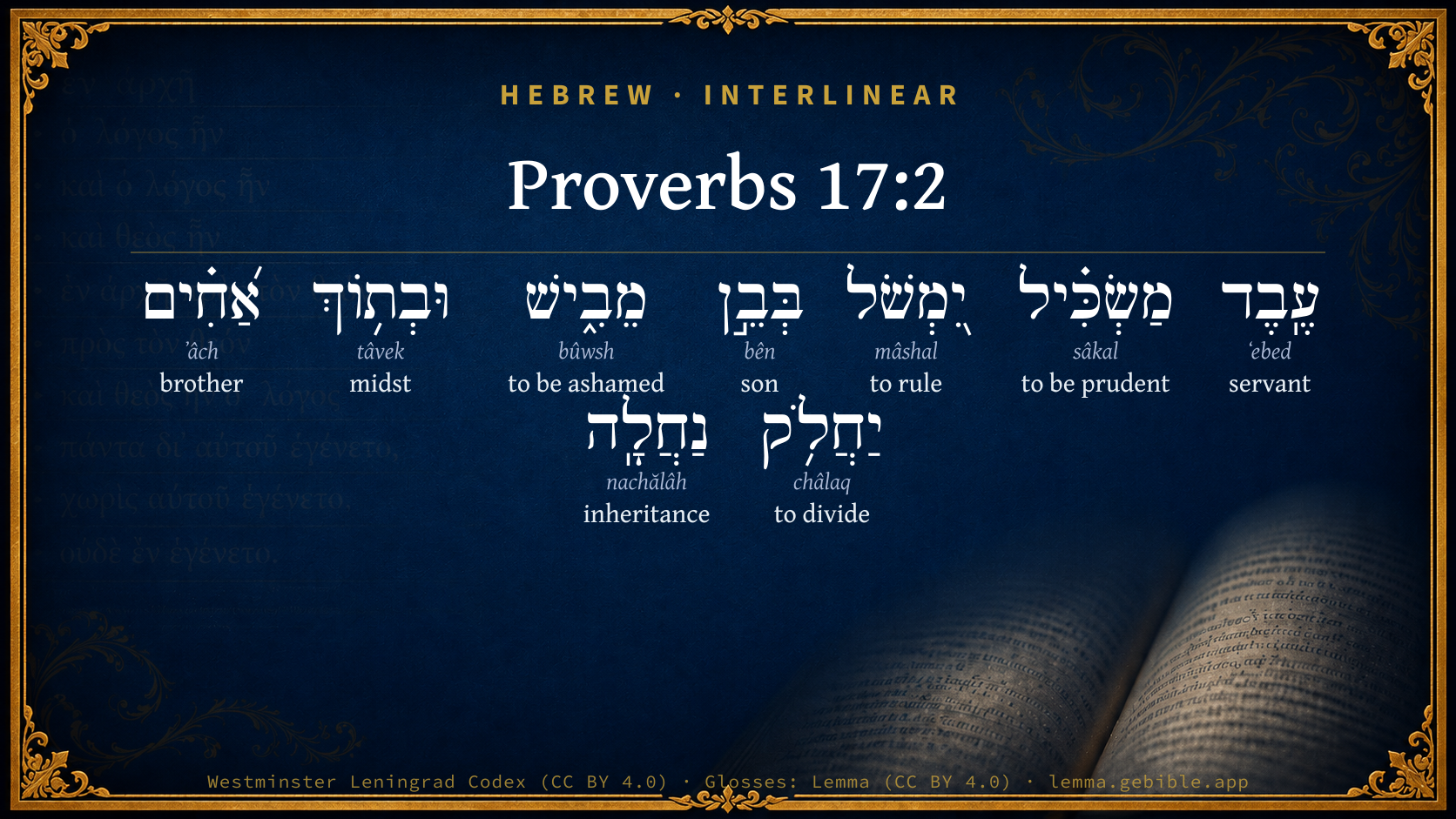
Proverbs 17:2

Hebrew (Westminster Leningrad Codex) Proverbs 17:2 appears in the Hebrew Old Testament. The text above is from the Westminster Leningrad Codex. Each word links to its Strong’s number, a concise gloss, and parsing drawn from the Open Scriptures Hebrew Bible morphology. Click any word for its full Brown-Driver-Briggs (BDB) entry.
Download image
Cite this verse

Proverbs 17:2 (World English Bible). Public Domain. Lemma interlinear Bible study tool, https://lemma.gebible.app/v/proverbs/17/2.

Show BibTeX & RIS
BibTeX
RIS
English Translation
A servant who deals wisely will rule over a son who causes shame, And shall have a part in the inheritance among the brothers.
World English Bible · Public Domain
Download a study sheet

One document with this verse’s original text, its word-by-word gloss line, the meaning frame, cross-references with their text, attributed commentary, and full source and license credits — printable, and it pastes into notes with its structure intact.

This verse Autodidact and up

Study sheet (.html) Plain text (.txt)

A passage Seminary Student

Up to 50 verses in one chapter. A passage sheet keeps up to 6 commentary sources and 12 cross-references per verse, in the order this page ranks them, and says so on the sheet whenever that leaves anything out. Ask for a single verse and you get the Autodidact verse sheet above.

Everything on this page stays free to read, with no account — the sheet is a download of what is already on screen, not access to it.

Want to remove ads? Support Godless Engineer
Compare translations 3

The same verse in 3 English versions, stacked beneath the original-language interlinear above. Click any original word for its lexicon entry.

Each is an independent rendering of the whole verse — the interlinear is not word-aligned to these translations.

Highlighted words mark where these versions differ — a whole-verse word diff, not a word-by-word alignment.

  • World English Bible Public Domain
    A servant who deals wisely will rule over a son who causes shame, And shall have a part in the inheritance among the brothers.
  • King James Version Public Domain
    A wise servant shall have rule over a son that causeth shame, and shall have part of the inheritance among the brethren.
  • unfoldingWord Literal Text CC BY-SA 4.0
    An insightful servant will rule over a shameful son, and in the midst of brothers, he will share an inheritance.

unfoldingWord Literal Text — © unfoldingWord, licensed CC BY-SA 4.0. Word-aligned USFM3 via Door43 (git.door43.org/unfoldingWord/en_ult).

Versions to compare (up to 4)

3 of 4 selected

Show all 18 translations

Every available English version of this verse, each an independent rendering of the whole verse.

  • World English Bible Public Domain
    A servant who deals wisely will rule over a son who causes shame, And shall have a part in the inheritance among the brothers.
  • Berean Standard Bible Public Domain
    A wise servant will rule over a disgraceful son and share his inheritance as one of the brothers.
  • Majority Standard Bible Public Domain
    A wise servant will rule over a disgraceful son and share his inheritance as one of the brothers.
  • King James Version Public Domain
    A wise servant shall have rule over a son that causeth shame, and shall have part of the inheritance among the brethren.
  • American Standard Version (1901) Public Domain
    A servant that dealeth wisely shall have rule over a son that causeth shame, And shall have part in the inheritance among the brethren.
  • Revised Version (1885) Public Domain
    A servant that dealeth wisely shall have rule over a son that causeth shame, and shall have part in the inheritance among the brethren.
  • Geneva Bible (1599) Public Domain
    A discrete seruant shall haue rule ouer a lewde sonne, and hee shall deuide the heritage among the brethren.
  • Douay-Rheims (1899) Public Domain
    A wise servant shall rule over foolish sons, and shall divide the inheritance among the brethren.
  • Young's Literal Translation Public Domain
    A wise servant ruleth over a son causing shame, And in the midst of brethren He apportioneth an inheritance.
  • Literal Standard Version CC BY-SA 4.0
    A wise servant rules over a son causing shame, || And he apportions an inheritance in the midst of brothers.
  • Unlocked Literal Bible CC BY-SA 4.0
    A wise servant will rule over a son who acts shamefully and will share the inheritance as one of the brothers.
  • unfoldingWord Literal Text CC BY-SA 4.0
    An insightful servant will rule over a shameful son, and in the midst of brothers, he will share an inheritance.
  • Darby Bible Public Domain
    A wise servant shall rule over a son that causeth shame, and shall have part in the inheritance among the brethren.
  • World Messianic Bible Public Domain
    A servant who deals wisely will rule over a son who causes shame, and shall have a part in the inheritance among the brothers.
  • Webster's Bible Public Domain
    A wise servant shall have rule over a son that causeth shame, and shall have part of the inheritance among the brethren.
  • Free Bible Version CC BY-SA 4.0
    A servant who acts wisely will be put in charge of a disgraced son, and will share the family inheritance with the brothers.
  • Bible in Basic English Public Domain
    A servant who does wisely will have rule over a son causing shame, and will have his part in the heritage among brothers.
  • JPS Tanakh (1917) Public Domain
    A servant that dealeth wisely shall have rule over a son that dealeth shamefully, and shall have part of the inheritance among the brethren.

Literal Standard Version (2020), Covenant Press — licensed CC BY-SA 4.0. Text via the HelloAO Bible API (eBible.org). Unlocked Literal Bible (unfoldingWord) — licensed CC BY-SA 4.0. Text via the HelloAO Bible API (eBible.org). unfoldingWord Literal Text — © unfoldingWord, licensed CC BY-SA 4.0. Word-aligned USFM3 via Door43 (git.door43.org/unfoldingWord/en_ult). Free Bible Version, Dr. Jonathan Gallagher — licensed CC BY-SA 4.0. Text via the HelloAO Bible API (eBible.org).

Word by word

More ways to search: Search by grammar → Find every occurrence → Compare this word →

Practice this passage: Drill this verse → Learn its vocabulary →

מַשְׂכִּ֗יל
sâkal
H7919
“being prudent”
Verb, Hiphil, Participle Active, Masculine, Singular, Absolute
Part of Speech
Verb
Stem
Hiphil
Form
Participle Active
Gender
Masculine
Number
Singular
State
Absolute
Full BDB Definition

Origin: a primitive root

TWOT: 2263 , 2264

to be prudent, be circumspect, wisely understand, prosper - (Qal) to be prudent, be circumspect - (Hiphil) - to look at or upon, have insight - to give attention to, consider, ponder, be prudent - to have insight, have comprehension - insight, comprehension (substantive) - to cause to consider, give insight, teach - the teachers, the wise - to act circumspectly, act prudently, act wisely - to prosper, have success - to cause to prosper - (Piel) to lay crosswise, cross (hands)
  1. עֶֽבֶד ʻebed H5650 “servant” Noun, Common, Masculine, Singular, Absolute
  2. יִ֭מְשֹׁל mâshal H4910 “to rule” Verb, Qal, Imperfect, 3rd Person, Masculine, Singular
  3. בְּבֵ֣ן bên H1121 “in/at · son” Preposition + Noun, Common, Masculine, Singular, Absolute
  4. מֵבִ֑ישׁ bûwsh H954 “being ashamed” Verb, Hiphil, Participle Active, Masculine, Singular, Absolute
  5. וּבְת֥וֹךְ tâvek H8432 “and · in/at · midst of” Conjunction + Preposition + Noun, Common, Masculine, Singular, Construct
  6. אַ֝חִ֗ים ʼâch H251 “brothers” Noun, Common, Masculine, Plural, Absolute
  7. יַחֲלֹ֥ק châlaq H2505 “to divide” Verb, Qal, Imperfect, 3rd Person, Masculine, Singular
  8. נַחֲלָֽה nachălâh H5159 “inheritance” Noun, Common, Feminine, Singular, Absolute

About this verse

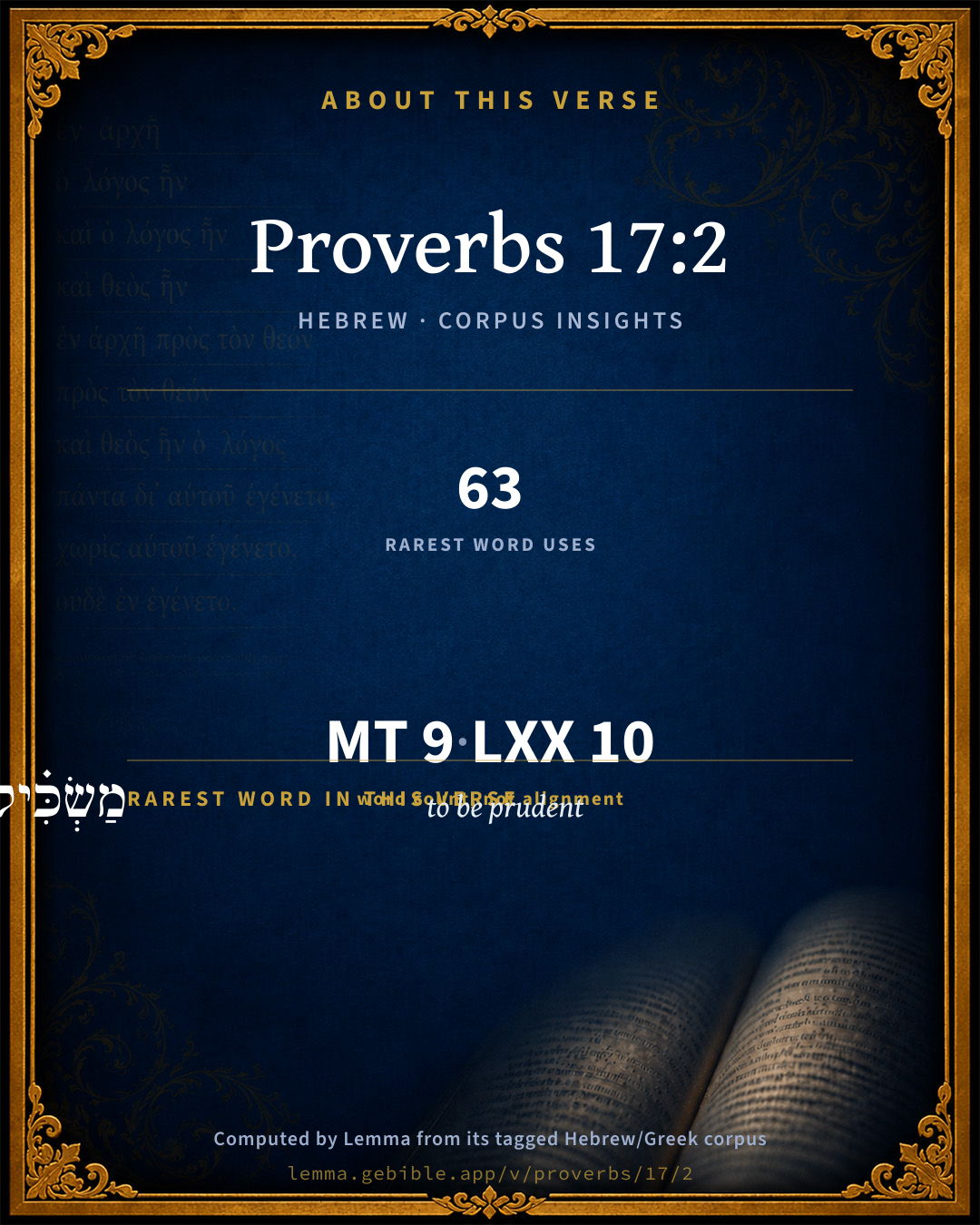
These counts appear in no published source. They are computed here, from the morphology-tagged text and Lemma’s own curated glosses. What Lemma adds →

9
words
9
distinct lemmas
Wisdom
section

Grammatical profile

  • 4 verbs
  • 5 nouns

Verb forms

  • מַשְׂכִּ֗יל Hiphil · Participle Active
  • יִ֭מְשֹׁל Qal · Imperfect
  • מֵבִ֑ישׁ Hiphil · Participle Active
  • יַחֲלֹ֥ק Qal · Imperfect

Hebrew & Septuagint length

In English translation the verse runs 24 words from the Hebrew and 15 from the Septuagint (LXX English) — the Septuagint runs noticeably shorter here. See the side-by-side →

A rough comparison of the two English renderings, which tokenize alike — not a word-level alignment.

Word counts can differ between the Hebrew and the Greek without any difference in meaning — e.g. the Hebrew direct-object marker אֵת has no separate Greek word, and Greek often adds the article ὁ.

In the original languages it is 9 Hebrew tokens and 10 Greek tokens — but the two are counted differently (Hebrew bundles its prefixes and suffixes into one token; the Greek is in lemma form), so that isn’t a like-for-like length.

Cross-references

7

Topical passages linked to Proverbs 17:2 in the Treasury of Scripture Knowledge — connected by theme and wording, ordered by reader-vote popularity; previews shown in the World English Bible.

  • Proverbs 10:5 He who gathers in summer is a wise son, But he who sleeps during the harvest is a son who causes shame.
  • Proverbs 14:35 The king's favor is toward a servant who deals wisely, But his wrath is toward one who causes shame.
  • Proverbs 19:26 He who robs his father and drives away his mother, Is a son who causes shame and brings reproach.
  • Ecclesiastes 4:13 Better is a poor and wise youth than an old and foolish king who doesn't know how to receive admonition any more.
  • Proverbs 11:29 He who troubles his own house shall inherit the wind. The foolish shall be servant to the wise of heart.
  • Proverbs 29:15 The rod of correction gives wisdom, But a child left to himself causes shame to his mother.
  • Genesis 24:4–67 But you shall go to my country, and to my relatives, and take a wife for my son Isaac."

Cross-references courtesy of OpenBible.info (CC BY 4.0).

Hebrew and Greek witnesses Masoretic Hebrew ↔ Greek Septuagint

The same verse in the two great witnesses to the Old Testament, shown verse-for-verse.

Here the Septuagint runs noticeably shorter than the Hebrew — LXX2012 (modern English Septuagint) 15 words vs World English Bible 24. A rough length comparison of the two English translations, not a word-level alignment — read both below.

These are two independent witnesses, not word-aligned to each other, and the Septuagint is shown in lemma (dictionary) form.

Hebrew Proverbs 17:2 Masoretic · Westminster Leningrad Codex

עֶֽבֶד מַשְׂכִּ֗יל יִ֭מְשֹׁל בְּבֵ֣ן מֵבִ֑ישׁ וּבְת֥וֹךְ אַ֝חִ֗ים יַחֲלֹ֥ק נַחֲלָֽה

A servant who deals wisely will rule over a son who causes shame, And shall have a part in the inheritance among the brothers.

World English Bible · Public Domain

Greek LXX Proverbs 17:2 Septuagint · lemma form

οἰκέτης νοήμων κρατέω δεσπότης ἄφρων ἐν δέ ἀδελφός διααἱρέω μέρος

A wise servant shall have rule over foolish masters, and shall divide portions among brethren.

LXX2012 (modern English Septuagint) · Public Domain

On this verse, The Pulpit Commentary discusses the Septuagint’s reading. Read the note in Commentary ↓

Hebrew: Westminster Leningrad Codex (CC BY 4.0). Greek: Septuagint (public domain); English from LXX2012 (modern English Septuagint) (Public Domain). How the Septuagint differs from the Hebrew →

Commentary

Notes on Proverbs 17:2 from classic Christian and Jewish commentators (each source and its license shown beneath its notes). The classic Christian expositions comment on the surrounding passage and are grouped to its opening verse, so a note may address several verses; the Jewish commentaries on the Tanakh (Rashi and others) are per-verse, so they appear only where the commentator wrote on this verse.

Lemma curates 59 commentaries, every one of them public domain or Creative Commons licensed, each selected and text-cleaned for this edition rather than reprinted as found. About our sources →

Trapp's Complete Commentary

John Trapp

Pro 17:2 A wise servant shall have rule over a son that causeth shame, and shall have part of the inheritance among the brethren.

Ver. 2. A wise servant shall have rule over a son, &c.] God hath a very gracious respect unto faithful servants, and hath promised them "the reward of inheritance," {Col 3:24} which properly belongs to sons. This happens sometimes here, as to Joseph, Joshua, those subjects that married Solomon’s daughters; {1Ki 4:10; 1Ki 4:14} but infallibly hereafter, when "they shall come from east and west to sit down with Abraham, Isaac, and Jacob, in the kingdom of heaven," and to "enter into their Master’s joy," "but the children of the kingdom shall be cast out." {Mat 8:11-12}

John Trapp, A Commentary or Exposition upon All the Books of the Old and New Testament (1647–1656) — public domain. Text from a community e-Sword module.

Joseph Benson's Commentary

Pro 17:2. A wise servant shall have rule, &c. — “Probity and prudence are so much better than mere riches and noble birth, that a wise and faithful servant sometimes arrives at the honour of being appointed the governor of a son, whose folly and wickedness make him a discredit to his family;” and shall have part of the inheritance among the brethren — “His merits, perhaps, are rewarded with a portion of the estate, which is to be distributed among them.”

Joseph Benson's Commentary on the Old and New Testaments (1811–1818) — public domain. Text from a community e-Sword module.

The Preacher's Complete Homiletical Commentary

Joseph S. Exell (gen. ed.)

CRITICAL NOTES.—

Pro_17:2. A son that causeth shame, rather, a degenerate son. (Delitzsch and Zöckler).

MAIN HOMILETICS OF Pro_17:2

THE FOOLISH SON AND THE WISE SERVANT

I. High social position is not necessarily the outcome of mental ability or moral worth. Many a man is born heir to a great estate, or even to a throne, who brings shame upon the name he bears and the place he occupies. He may be inferior in intellectual power to many of the dependents upon the house, or he may be worse in his character than they are. Or if he is not so degraded in character, or of such limited ability as to be surpassed by the majority, there may be one who serves him whose aim in life is far more lofty than his own, and who has far greater capabilities than he has.

II. A wise man will acquire influence, whatever position he fills. A servant who understands his duties, and conscientiously fulfils them, will win respect and confidence; and these will give him influence in his master’s house, and over all with whom his business brings him into contact. There are many instances, both in the history of private families and in the history of courts, in which the judicious conduct of a subordinate person has averted evils which would otherwise have followed the crimes of a son of the house, and the father of such a son can but acknowledge such services, and reward them, if he is possessed of any gratitude. But whether he does so or not, it is an ordination of God’s providence, which we see in constant operation around us, that a wise man is a fool’s master. It is a law of nature that a stronger physical body shall govern the weaker, if no other power interferes, and it is a law in the universe of mind that the stronger mind shall rule the weak, and make it serve his purpose in some way. This is the secret of many of the social changes which are always going on, in which some who were born to affluence come down to penury, and those who were born in obscurity take their places.

OUTLINES AND SUGGESTIVE COMMENTS

Eliezer will show the custom that suggests the type. He was a wise servant. Abraham thought he would have to be his heir (Gen_15:2-3). All commentators put “son” in apposition with him who causes shame; i.e., make them the same person. But to be the same person they should be in the same form grammatically, and “son” is in the construct. The causer of shame, therefore, is the father. And this is more consistent, for a wise father could uphold a son, or could give the inheritance to other brethren. In the worldly sense there could be no difficulty. In the spiritual what noted instances!—in the Israelites, who, unlike Abraham, failed to command their households (Gen_18:19), and who gave place to their bought servants, the hated Gentiles!—in Satan, who has given place to man (Psa_8:2)!—in modern men who have professed the faith, but have debauched their children till they see them hardening under their very eyes, and some far-off waif gets before them into the everlasting kingdom. Better, says the last proverb, the utmost poverty, with peace and love; better, says this proverb, the poorest hold upon the Church, if there be the humbler hold upon the service of the Most High.—Miller.

If wisdom make us free, then are we free indeed: as on the other side, he is altogether a servant that dealeth unwisely. But he that is wisdom’s freeman is not only a freeman but a master, not only a master but a son, not only a son but an heir, an heir among the brethren. So highly doth wisdom exalt. But thus it is with the Father of the world, it is not so with worldly fathers. Their foolish love doth honour their son, though his foolish life doth fill them with shame: their proud carriage despiteth their servant, though his wise carriage exalteth their estate. The son shall have all though he deserve nothing, the servant shall not have his wages though they be due unto him. But the wisdom of God bestoweth His love, the justice of God divideth His inheritance in another manner. Oftentimes, even in this life, he putteth the servant in the son’s place … Be wise, then, though thou be a servant, and thou shalt be His son who is the Father of wisdom. Be not wicked, though the son of rich parents, and, it may be, heir to a great estate, for He, the Lord of all, can quickly make thee a poor servant for thy sins, who has made thyself a servant to thy sins.—Jermin.

The Preacher's Complete Homiletical Commentary (gen. ed. Joseph S. Exell; Funk & Wagnalls, c. 1892) — public domain (pre-1929). A full-Bible homiletical/sermon-outline anthology covering 65 of 66 books (2 John is absent from the source module). Text from a community e-Sword module.

Tyndale Open Study Notes

Tyndale Open Resources

17:2 Wisdom is so much more important than privilege that if children act like fools, a wise servant will rise to prominence over the household.

Tyndale Open Study Notes — © Tyndale Open Resources, licensed CC BY-SA 4.0. Text via the HelloAO Bible API.

Geneva Bible (1599)

Geneva Bible translators

That is, shall be made governor over the children.

Geneva Bible (1599) marginal notes — public domain. Text via Bolls.life.

Matthew Henry's Commentary

Note, 1. True merit does not go by dignity. All agree that the son in the family is more worthy than the servant (Joh 8:35), and yet sometimes it so happens that the servant is wise, and a blessing and credit to the family, when the son is a fool, and a burden and shame to the family. Eliezer of Damascus, though Abram could not bear to think that he should be his heir, was a stay to the family, when he obtained a wife for Isaac; whereas Ishmael, a son, was a shame to it, when he mocked Isaac. 2. True dignity will go by merit. If a servant be wise, and manage things well, he shall be further trusted, and not only have rule with, but rule over a son that causes shame; for God and nature have designed that the fool shall be servant to the wise in heart. Nay, a prudent servant may perhaps come to have such an interest in his master as to be taken in for a child's share of the estate and to have part of the inheritance among the brethren.

Matthew Henry's Commentary on the Whole Bible (1708–1710) — public domain (CC PDM 1.0). Text via the HelloAO Bible API.

Jamieson, Fausset & Brown

Robert Jamieson, A. R. Fausset & David Brown

(Compare Pro 14:35).

causeth shame-- (Pro 10:5).

shall . . . inheritance--that is, share a brother's part (compare Num 27:4, Num 27:7).

Jamieson, Fausset & Brown — Commentary Critical and Explanatory on the Whole Bible (1871) — public domain (CC PDM 1.0). Text via the HelloAO Bible API.

Ellicott's Commentary for English Readers

(2) A wise servant shall have rule over a son that causeth shame. . . .—This was strikingly exhibited in the case of Ziba, who by his timely succour to David (2 Samuel 16), first gained all the property of his master, Mephibosheth (i.e., the “man of shame”), and was later confirmed in the possession of half of it. Slaves, especially those “born in the house,” often rose to a position of great trust. (Comp. Gen_24:2; Gen_39:4-6.) Eliezer would have been Abraham’s heir had not Isaac been born (Gen_15:3).

A Bible Commentary for English Readers, edited by Charles John Ellicott (1878–1897) — public domain. Text from a community e-Sword module.

The Cambridge Bible for Schools and Colleges

gen. ed. J. J. S. Perowne

2. a wise servant] or, a servant that dealeth wisely, R.V., in contrast with a son who causeth shame, or dealeth shamefully. Comp.

“Free men shall minister unto a wise servant.”

Sir_10:25, R.V.

The proverb is exemplified in Eliezer of Damascus (Gen_15:2), and Ziba (2Sa_16:4 with 1Ch_2:34-35), and in Jeroboam, Solomon’s “servant” (1Ki_11:26), who, being “industrious,” shared the inheritance with Rehoboam, “a son that dealt shamefully.”

The Cambridge Bible for Schools and Colleges (gen. ed. J. J. S. Perowne; Cambridge University Press, 1878–1918) — public domain. Text from a community e-Sword module.

John Gill's Exposition

A wise servant shall have rule over a son that causeth shame,.... That does wicked and shameful actions: that is slothful, and will not attend to instruction or business; that is prodigal, wasteful, and luxurious, and causes shame to his parents, who blush at his conduct. Now a servant that behaves well and wisely in a family is observed and respected by his master, and he puts his wicked and extravagant son under him, makes him a tutor to him, and sets him to watch over him, and obliges his son to obey his orders. Jarchi illustrates this in Nebuchadnezzar ruling over the children of Israel;

and shall have part of the inheritance among the brethren; be appointed by his master's will to a share in his estate among his children, for his faithful service to him in life, and to encourage him to take care of his family, his children, and his affairs, after his death; or through gifts in his lifetime shall have what is equal to what his sons have; or growing rich shall purchase a part of theirs, as Gussetius (y): or "shall part the inheritance among the brethren" (z); being a wise man, his master shall leave him executor of his will, to divide his substance among his children, and see that everyone have their proper portion and equal share; but it rather is to be understood of his being a co-heir with them. So the Gentiles, through the will of the Lord, become fellow heirs of the same body, and partakers of his promise in Christ with the Jews, and share in the same inheritance with Abraham, Isaac, and Jacob, and their children; nay, when the children of the kingdom shall be shut out; see Eph 3:6. Jarchi gives an ancient exposition of it thus,

"a proselyte of righteousness is better than a wicked native; and in time to come he shall divide the spoil and the inheritance in the midst of the children of Israel, at it is said in Eze 47:23;''

(y) Ebr. Comment. p. 263. (z) "dividet", Mercerus, Gejerus, Michaelis; so Syriac version and the Targum; "partitur", Junius & Tremellius; "partieur", Piscator.

John Gill's Exposition of the Whole Bible (1746–1763) — public domain (CC PDM 1.0). Text via the HelloAO Bible API.

Albert Barnes' Notes on the Bible

The “servant,” it must be remembered, was a slave, but (as in such cases as Gen 15:2; 2Sa 16:4) might succeed to the inheritance.

Albert Barnes' Notes on the Bible (1834–1885) — public domain. Text from a community e-Sword/MySword module.

Haydock's Catholic Bible Commentary

Brethren. Partaking with them, (Abenezra; Tirinus; Menochius) or rather acting as his master’s executor; which evinces the advantages of wisdom, so as to raise a slave above those whom his station requires him to serve. Such was Joseph, who was tried.

George Leo Haydock (1774–1849), Haydock's Catholic Family Bible and Commentary, 1859 edition — public domain. Excludes Psalms (Douay-Rheims chapter numbering differs from Protestant) and Deuterocanonical books (Catholic canon only).

Matthew Poole's English Annotations

Shall have rule over a son that causeth shame; either as being by his father appointed tutor or guardian to his son; or being by his wisdom advanced to that estate and dignity which the other possibly hath lost by his folly.

Shall have part of the inheritance among the brethren; partly as a just recompence for his faithful service, as Gen 15:2,3, &c., and partly as an obligation to him to take care of his children.

Matthew Poole's English Annotations on the Holy Bible (1683–1685) — public domain. Text from a community e-Sword/MySword module.

Whedon's Commentary on the Bible

Daniel D. Whedon

2. A son that causeth shame — By his base conduct; “a degenerate son.” — Zockler.

Among the brethren — The brothers of the family; that is, among the heirs. Servitude among the Orientals, particularly among the Hebrews, was different in its spirit and conditions both from our modern slavery and from modern hired service. The servant, whether bought with money, (as they frequently were,) or born in the house, was regarded as a member of the family; not, indeed, as being naturally the equal of the son and heir, (comp. Gen_21:10,) but as capable of becoming so in certain circumstances; as where there was no legitimate heir, (Gen_15:2-3,) or where the heir or heirs acted basely, and brought upon themselves the displeasure of the father or patriarch, and were disinherited. The trusty, loyal, life-long servant then became heir; in some cases a sole heir, in others a co-heir with the brothers. Comp. 2Sa_9:10; 2Sa_16:4. Such were the customs and laws. Furthermore, as a person by misconduct, or poverty, which is frequently the result of misconduct, might be sold into servitude, the unworthy son, disinherited for his baseness, might also be sold into servitude, and purchased by the man once the servant of his father. Though exactly this cycle of events could not occur in our modern society, yet substantially the same thing does occur. A person brought up in a family as a dependent by his prudence and good conduct frequently rises to distinction in life, while the sons with whom he was reared, by imprudence, folly, improvidence, intemperance, or crime, are reduced to want, or dependence on the former menial of the family. Compare Pro_14:35. Miller renders the first clause, “the son of one who causeth shame.”

Daniel D. Whedon (gen. ed.), Commentary on the Old and New Testaments (1874–1909) — public domain. Text from a community e-Sword module.

The Pulpit Commentary

A wise servant shall have rule over a son that causeth shame. Here is intimated the supremacy of wisdom over folly and vice. The contrast is better emphasized by translating, A servant that dealeth wisely shall have rule over a son that doeth shamefully; i.e. a son of his master. (For similar contrast between "wise" and "shameful," comp. Pro_10:5 Pro_14:35) Slaves were often raised to high honour, and might inherit their master"s possessions. Thus Abraham"s servant, Eliezer of Damascus, was at one time considered the patriarch"s heir; (Gen_15:2, Gen_15:3) Ziba, Saul"s servant, obtained the inheritance of his lord Mephibosheth; ("the Shameful," 2Sa_16:4) Joseph was advanced to the highest post in Egypt. Ecc 10:25, "Unto the servant that is wise shall they that are free do service; and he that is wise will not grudge when he is reformed." Septuagint, "A wise household servant shall rule over foolish masters." "I have seen," says Ecclesiastes, (Ecc_10:7) "servants upon horses, and princes walking as servants upon the earth." Shall have part of the inheritance among the brethren; shall share on equal terms with the sons of the house. This innovation on the usual disposition of property could happen only in the case of an abnormally intelligent and trusted slave. In 1Ch_2:34, etc., mention is made of a case where a master, having no son, gave his daughter in marriage to a slave, and adopted him into the family. Delitzsch understands the clause to mean that the slave shall have the office of dividing his master"s inheritance among the heirs, shall be the executor of his deceased master"s will; but this explanation hardly seems to do justice to the merits of the "wise servant," and takes no account of the idea involved in "shameful son." But the Septuagint appears to countenance this view, rendering, "and among the brethren he shall divide the portions."

The Pulpit Commentary (1880–1919), ed. H.D.M. Spence-Jones & Joseph S. Exell — public domain. Text from a community e-Sword module.

Bridges on Proverbs

Charles Bridges

Folly naturally tends to shame; wisdom to honour. (Pro 3:35 ; Pro 12:8 .) The son, the heir of the family, may degrade himself by misconduct, and, instead of being the glory of the house, cause shame. A wise servant, though having only a temporary interest in the house (Joh 8:35 ), maybe promoted to rule over him. The Scripture hath recorded no literal instances of this interchange of place. But retributive Providence has ordained, that "the foolish shall be servant to the wise in heart." (Pro 11:29 .) The prodigal son, in conscious shame, was ready to take his place among the "hired servants." (Luk 15:19 .) The wise servant has however sometimes shared the inheritance among the brethren. Jacob, by marrying Laban’s daughter, was portioned with the inheritance.†1 Solomon’s own servant probably thus verified this proverb.†2 Abraham also would have made his wise servant his heir, but for the interposing mercy of God.†3

Yet this promotion is a dangerous eminence. No one can bear elevation safely without special grace and painful discipline.†4 Great wisdom, much prayer, and constant watchfulness, are needed to promote humility and Christian consistency; as well as to silence the envy and jealousy, which unexpected prosperity naturally excites. (Dan 6:3-5 .) Honour from man calls for abasement before God, and careful holiness in adorning our profession.

Footnotes:

†1 Gen 30:27-34; Gen 31:1 .

†2 1Ki 4:7, 1Ki 4:11 .

†3 Gen 15:3-4.

†4 2Co 12:1-7 .

Charles Bridges, An Exposition of the Book of Proverbs (1846) — public domain. Text from a community e-Sword module.

Kretzmann's Popular Commentary

Paul E. Kretzmann

v. 2. A wise servant shall have rule over a son that causeth shame, the degenerate, profligate heir of the house, who squanders his fortune, becoming poor to the point of enforced servitude, while the former slave, through diligence and thrift, would become master, and shall have part of the inheritance among the brethren, that is, having squandered his own patrimony, the foolish son, though the firstborn, would be obliged to divide the inheritance among the other heirs, while he himself receives not another cent.

Paul E. Kretzmann, Popular Commentary of the Bible (1921–1924) — public domain. Text from a community e-Sword module.

Rashi

Rabbi Shlomo Yitzchaki (Rashi)

An intelligent slave, etc. Because Nebuchadnezzar was wise enough to take three steps in honor of the Holy One, blessed be He, he achieved greatness and ruled over Israel, who performed disgraceful deeds, and he divided their inheritance before their eyes. Another explanation: A righteous proselyte is better than a wicked person who was home born, and in the future, he will share the spoils and the inheritance among the children of Israel, as it is said (Ezek. 47:23): “And it shall be, in whatever tribe the stranger will live, etc.”

Rashi on the Tanakh — English translations: “The Judaica Press complete Tanach with Rashi, translated by A. J. Rosenberg” (CC BY 4.0); “Pentateuch with Rashi's commentary by M. Rosenbaum and A.M. Silbermann, 1929-1934” (public domain); “The Metsudah Tanach series, Lakewood, N.J” (CC BY 4.0); and “The Book of Joshua, Metsudah Publications, 1997” (CC BY 4.0). Text via Sefaria.

Lesson kit

Teaching starters — assembled from the data on this page, not authored interpretation. Every prompt links to the verse data it draws on. Edit before teaching.

Proverbs, in the Wisdom, opens this verse with 9 words (9 distinct Hebrew lemmas). Its most distinctive word is sâkal (“to be prudent”). The Greek Septuagint runs shorter here. A historical commentator’s framing appears above. Read the whole chapter for the surrounding context.

Discussion questions

  1. What does “to be prudent” (sâkal) contribute to the verse as a whole?
  2. How does Proverbs 10:5, which shares this passage’s theme, read alongside this verse?
  3. The Septuagint runs shorter here than the Hebrew. What might account for the difference?
  4. These translations render this verse differently; the difference is in the English rendering, not the original. What questions does that raise?
  5. «מַשְׂכִּ֗יל» is a Hiphil Participle Active verb. How does that grammatical form shape the action described?
  6. Compare how Trapp's Complete Commentary and Joseph Benson's Commentary read this verse. Where do they agree or differ?

Things to notice

Reading settings

Reading text

Shown beneath each verse's original-language words.

Old Testament
Old Testament edition

Read the OT as the Masoretic Hebrew (MT) or the Greek Septuagint (LXX).

English shown for the Greek Septuagint (in the Hebrew ↔ Greek comparison).

Comparing translations? Open the Compare panel on any verse page to stack up to four side by side.