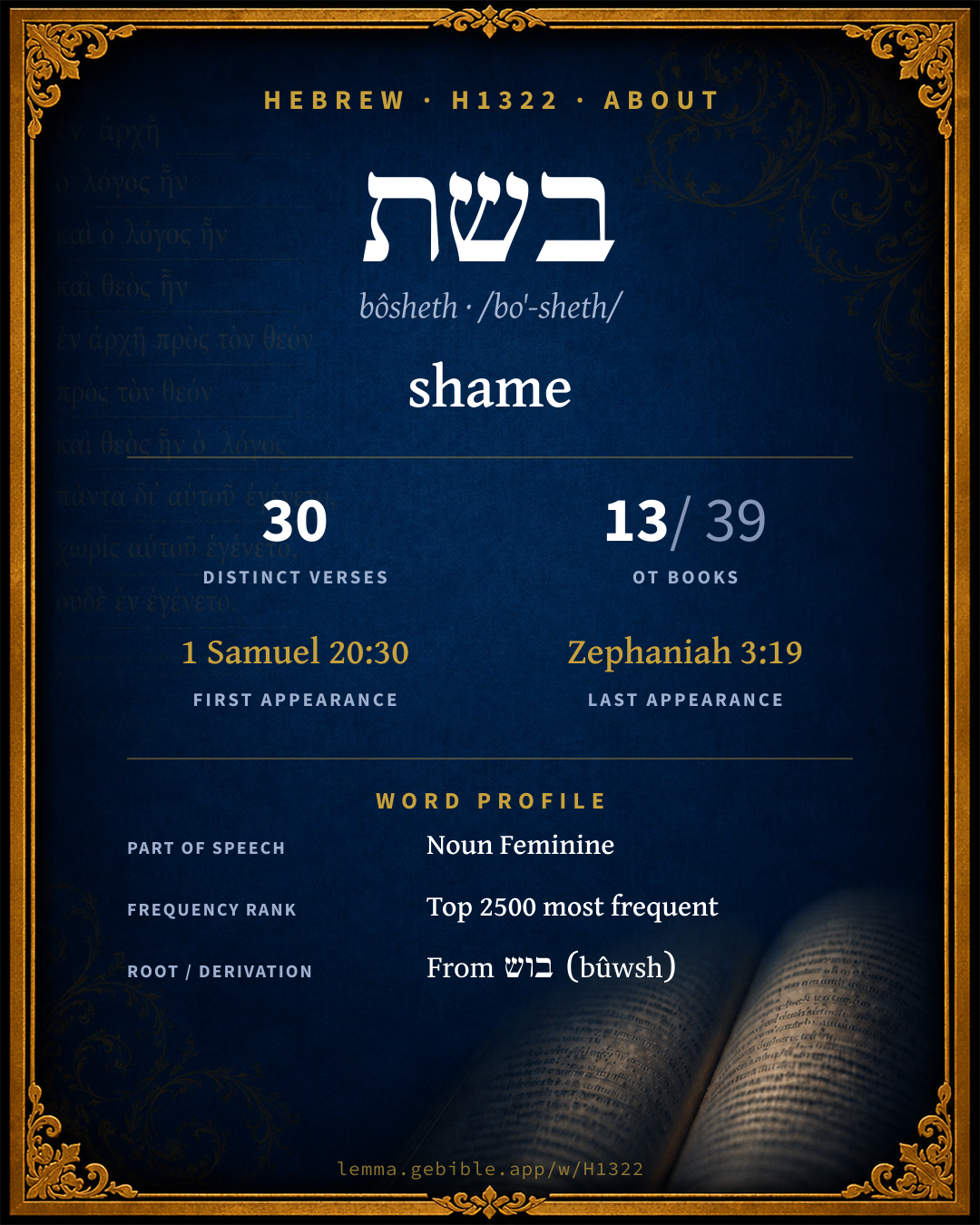
בֹּ֫שֶׁת
shame
‘shame’ is one of 2 main senses fuller range ↓
Full lexicon entry — Brown-Driver-Briggs (BDB)
From Brown-Driver-Briggs (BDB)
Where this word appears
See every Construct-state word in the Hebrew Bible →
Grammar key — what these labels mean
Part of speech
- Noun
- A naming word — a person, place, thing, or idea.
Noun type
- Common
- A common noun — a general class of person, place, or thing (“king,” “city,” “water”), not a specific name.
- Proper
- A name of a specific person, place, or people (e.g. Abraham, Zion, Israel).
State
- Absolute
- The independent form of a noun, not bound to a following word.
- Construct
- A noun bound to a following noun in a possessive / “of” relationship (the construct chain).
Gender
- Feminine
- Grammatically feminine.
Number
- Singular
- One.
Grammatical forms
- Noun, Common, Feminine, Singular, Construct 17 times (55%)
- Noun, Common, Feminine, Singular, Absolute 13 times (42%)
- Noun, Proper 1 time (3%)
Parsed forms decoded from the imported morphology (morphhb / Westminster Leningrad Codex — WLC text public domain, morphhb tagging CC BY 4.0), counted across 31 parsed occurrences — not distinct verses.
Every verse where H1322 appears — 30 distinct verses across 13 books. Click any verse to open its interlinear word-by-word view. Verse text shown in the World English Bible for context — . Each verse’s Hebrew form is shown with its reference; the English is not keyword-highlighted, since the data carries no word-level English alignment. Use “Compare translations” on any verse to read it across multiple English versions. This concordance covers the Hebrew Bible; Septuagint (Greek Old Testament) occurrences are not indexed here.
1 Samuel 1 verse
2 Samuel 1 verse
2 Chronicles 1 verse
Ezra 1 verse
Job 1 verse
Psalms 7 verses
- Psalms 35:26 בֹ֥שֶׁת n c fs Let them be disappointed and confounded together who rejoice at my calamity. Let them be clothed with shame and dishonor who magnify themselves against me.
- Psalms 40:15 בָּשְׁתָּ֑/ם n c fs cs + sfx pers 3mp Let them be desolate by reason of their shame that tell me, "Aha! Aha!"
- Psalms 44:15 וּ/בֹ֖שֶׁת conj + n c fs cs All day long my dishonor is before me, And shame covers my face,
- Psalms 69:19 וּ֭/בָשְׁתִּ/י conj + n c fs cs + sfx pers 1cs You know my reproach, my shame, and my dishonor. My adversaries are all before you.
- Psalms 70:3 בָּשְׁתָּ֑/ם n c fs cs + sfx pers 3mp Let them be turned because of their shame Who say, "Aha! Aha!"
- Psalms 109:29 בָּשְׁתָּֽ/ם n c fs cs + sfx pers 3mp Let my adversaries be clothed with dishonor. Let them cover themselves with their own shame as with a robe.
- Psalms 132:18 בֹּ֑שֶׁת n c fs I will clothe his enemies with shame, But on himself, his crown will be resplendant."
Isaiah 5 verses
- Isaiah 30:3 לְ/בֹ֑שֶׁת prep + n c fs Therefore shall the strength of Pharaoh be your shame, and the refuge in the shadow of Egypt your confusion.
- Isaiah 30:5 לְ/בֹ֖שֶׁת prep + n c fs They shall all be ashamed because of a people that can't profit them, that are not a help nor profit, but a shame, and also a reproach.
- Isaiah 42:17 בֹ֔שֶׁת n c fs They shall be turned back, they shall be utterly disappointed, who trust in engraved images, who tell molten images, You are our gods.
- Isaiah 54:4 בֹ֤שֶׁת n c fs cs Don't be afraid; for you shall not be ashamed: neither be confounded; for you shall not be disappointed: for you shall forget the shame of your youth; and the reproach of your widowhood shall you remember no more.
- Isaiah 61:7 בָּשְׁתְּ/כֶם֙ n c fs cs + sfx pers 2mp Instead of your shame [you shall have] double; and instead of dishonor they shall rejoice in their portion: therefore in their land they shall possess double; everlasting joy shall be to them.
Jeremiah 6 verses
- Jeremiah 2:26 כְּ/בֹ֤שֶׁת prep + n c fs cs As the thief is ashamed when he is found, so is the house of Israel ashamed; they, their kings, their princes, and their priests, and their prophets;
- Jeremiah 3:24 וְ/הַ/בֹּ֗שֶׁת conj + ptcl def.art + n c fs But the shameful thing has devoured the labor of our fathers from our youth, their flocks and their herds, their sons and their daughters.
- Jeremiah 3:25 בְּ/בָשְׁתֵּ֗/נוּ prep + n c fs cs + sfx pers 1cp Let us lie down in our shame, and let our confusion cover us; for we have sinned against Yahweh our God, we and our fathers, from our youth even to this day; and we have not obeyed the voice of Yahweh our God.
- Jeremiah 7:19 בֹּ֥שֶׁת n c fs cs Do they provoke me to anger? says Yahweh; [do they] not [provoke] themselves, to the confusion of their own faces?
- Jeremiah 11:13 לַ/בֹּ֔שֶׁת prep det + n c fs For according to the number of your cities are your gods, Judah; and according to the number of the streets of Jerusalem have you set up altars to the shameful thing, even altars to burn incense to Baal.
- Jeremiah 20:18 בְּ/בֹ֖שֶׁת prep + n c fs Why came I forth out of the womb to see labor and sorrow, that my days should be consumed with shame?
Daniel 2 verses
- Daniel 9:7 בֹּ֥שֶׁת n c fs cs Lord, righteousness belongs to you, but to us confusion of face, as at this day; to the men of Judah, and to the inhabitants of Jerusalem, and to all Israel, who are near, and who are far off, through all the countries where you have driven them, because of their trespass that they have trespassed against you.
- Daniel 9:8 בֹּ֣שֶׁת n c fs cs Lord, to us belongs confusion of face, to our kings, to our princes, and to our fathers, because we have sinned against you.
Hosea 1 verse
Micah 1 verse
Habakkuk 1 verse
Zephaniah 2 verses
- Zephaniah 3:5 בֹּֽשֶׁת n c fs Yahweh, in the midst of her, is righteous. He will do no wrong. Every morning he brings his justice to light. He doesn't fail, but the unjust know no shame.
- Zephaniah 3:19 בָּשְׁתָּֽ/ם n c fs cs + sfx pers 3mp Behold, at that time I will deal with all those who afflict you, and I will save those who are lame, and gather those who were driven away. I will give them praise and honor, whose shame has been in all the earth.
About this entry
At a glance — auto-summarized from this page’s data, not written by a person. Every figure links to its source below. This summary describes the numbers; it doesn’t interpret them.
“shame” is the headline sense of the Hebrew noun בשת (bôsheth). First canonically at 1 Samuel 20:30, it enters the text early. It appears 30 verses across 13 books of the Hebrew Bible, among its moderately common vocabulary. Lexicons map it across 2 senses. Related forms include בוש, בושה and בשנה. The sections below give every sense, occurrence, and version rendering.
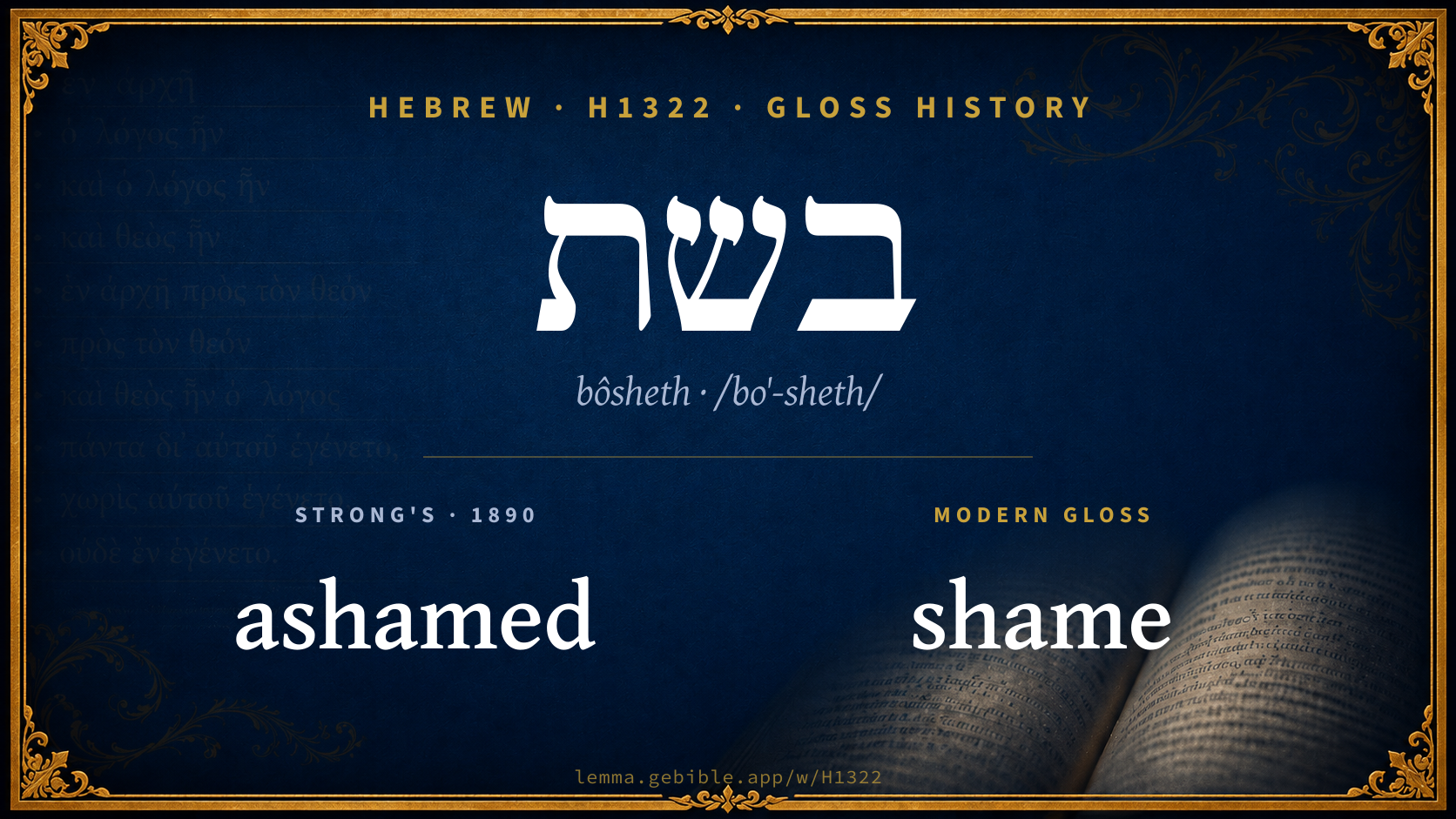
Gloss history
Strong's 1890 vs modern scholarship
About this word
Strong's H1322 catalogs a Hebrew word from the Hebrew Old Testament.
These counts are not copied from any lexicon or concordance. They are computed here, from the morphology-tagged Hebrew Old Testament. What Lemma adds →
- 30
- distinct verses
- The word appears in 30 distinct verses.
- 13 / 39
- OT books
- The word appears in 13 of 39 Old Testament books.
- #1,120
- by frequency
- Top 2500 most frequent Hebrew words (rank 1,120 of 8,640 Hebrew words by occurrence).
View all 30 occurrences in the concordance →
By section of the Old Testament
By traditional corpus
Conventional, traditional groupings — biblical authorship is debated, so this is a traditional corpus grouping, not an authorship claim. Each share is this word’s portion of its verses in that division of the Hebrew canon. Each figure is a share of the word’s 30 distinct verses.
- Prophets (Nevi'im) 18 verses · 60%
- Writings (Ketuvim) 12 verses · 40%
How translations render this word
Counts come from each version’s own published word-to-Strong’s tagging or interlinear alignment — an approximate guide to how each version renders this word, not a word-level alignment the data otherwise carries. Because each total is that version’s own tagged count, the per-version totals vary from one another and need not match the appearance or distinct-verse counts above. These counts may also differ from a printed concordance because Lemma counts each distinctly tagged rendering and does not collapse phrase taggings into a single head-word total. This is a fixed set of word-tagged versions (KJV, ASV, BSB, ULT) and does not change with the reading translation you choose elsewhere. Each version’s license is shown beside its name below (and on Sources).
BDB lists this Strong’s number as 3 distinct words (homographs). Each count above pools all of them and is not split by sense — see the Senses section below. A low-frequency rendering may belong to a different one of those words, not the primary meaning.
- King James Version†: Shame 15×, Confusion 2×
- American Standard Version†: Shame 15×
- Berean Standard Bible†: Shame 18×, Own shame 3×, Shameful 2×
- unfoldingWord Literal Text†: Shame 21×, Shame of 5×, Shame on 2×
King James Version Public Domain
Renders H1322 across 30† tagged occurrences — most commonly:
Plus 13 renderings that appear only once — usually multi-word phrases or single function words the recovered tagging swept in, not distinct renderings.
American Standard Version Public Domain
Renders H1322 across 31† tagged occurrences — most commonly:
Plus 16 renderings that appear only once — usually multi-word phrases or single function words the recovered tagging swept in, not distinct renderings.
Berean Standard Bible Public Domain
Renders H1322 across 30† tagged occurrences — most commonly:
Plus 7 renderings that appear only once — usually multi-word phrases or single function words the recovered tagging swept in, not distinct renderings.
unfoldingWord Literal Text CC BY-SA 4.0
Renders H1322 across 34† tagged occurrences — most commonly:
Plus 6 renderings that appear only once — usually multi-word phrases or single function words the recovered tagging swept in, not distinct renderings.
Senses in BDB
The 2 senses BDB distinguishes for this word, in lexicon order (not ranked by frequency or importance). The full entry — with sub-senses — is in the Lexicon Entry tab.
- shame
- shameful thing
Word origin
n.f. shame (בֹּשֶׁן Ew§ 163 f.) Ho 10:6.
— Brown-Driver-Briggs (Oxford 1906, public domain), digitized via Sefaria, supplemented by the OpenScriptures HebrewLexicon (CC BY 4.0). See Sources.
Derived from בוש (bûwsh) (H954) — to be ashamed.
Jastrow Dictionary
A second Hebrew/Aramaic lexicon for comparison, covering Aramaic and post-biblical (Talmudic, Targumic, Midrashic) usage that the biblical-Hebrew BDB does not. Matched by lemma rather than by Strong’s number, so a lemma may carry more than one Jastrow headword (shown separately below), and the entries cover usage well beyond the Bible.
בּוֹשֶׁת
- (freq. with פנים) shame, insult; bashfulness, chastity. Ber. 32ᵃ; a. fr.—Keth. 67ᵇ בּוֹשְׁתָּהּ של וכ׳ the shame of a woman (in remaining single).—Trnsf. (sub. דמי) indemnity for exposure. B. Kam. VIII, 1 sq. Ib. 85ᵇ ב׳ דרק ליה וכ׳ an indictable insult (without physical injury) is (e.g.) spitting in one’s face. Y. Yeb. VI, 7ᵇ, a. fr. בית הב׳ pudenda. Lev. R. s. 14 במקום בָּשְׁתָּהּ near her pudenda.
בּשֶׁת
- , v. בּוֹשֶׁת
A Dictionary of the Targumim, the Talmud Babli and Yerushalmi, and the Midrashic Literature (Marcus Jastrow; London, Luzac, 1903) — Public Domain. Digitized via Sefaria. Digitized via Sefaria. Full attribution on Sources.
Forms in the corpus
The 26 distinct written forms H1322 takes in the Hebrew Bible, most frequent first — each parse links to that state’s occurrences in the concordance. Hebrew forms include their vowel points and cantillation, so a single lemma takes many written forms.
Same root — word family
Other BDB entries built from the same root as H1322, grouped by Strong’s listed origin. These share a root / origin per the lexicon — not necessarily a shared meaning. Each links to that word’s own entry.
Derives from
Shares the same root
Compare all same-root words → Showing 4 of 5 — not the complete family. They share a root, not necessarily a meaning.
Septuagint verse parallels
This word appears in 25 verses that also exist in the Greek Old Testament (Septuagint), out of the 30 Hebrew verses it occurs in. You can read those verses in Greek by switching the Old Testament edition to the Septuagint.
Read these verses in the Septuagint
- 1 Samuel 20:30
- 2 Samuel 21:7
- 2 Chronicles 32:21
- Ezra 9:7
- Job 8:22
- Psalms 44:15
- Isaiah 30:3
- Jeremiah 2:26
- Daniel 9:7
- Hosea 9:10
- Micah 1:11
- Habakkuk 2:10
This is a verse-level parallel only — the same verses exist in both the Hebrew and Greek Old Testaments. No word-level Hebrew↔Greek correspondence is claimed: the data carries no such alignment, so no Greek word is shown as this Hebrew word’s translation. Coverage is not total — the Septuagint omits the deuterocanon and renumbers the Psalms, so some Hebrew verses have no direct Greek parallel.