
Isaiah 37:27

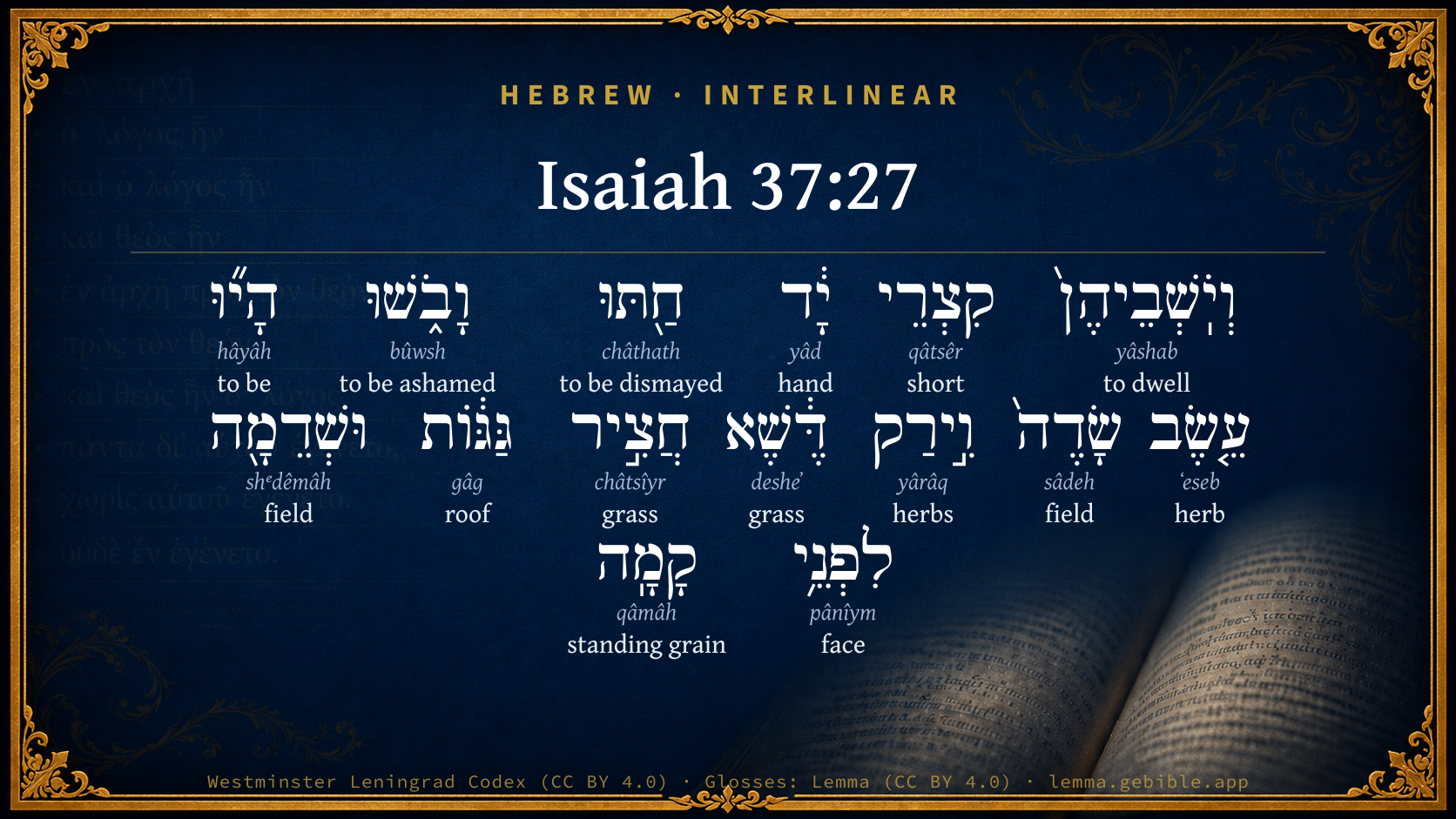
Hebrew (Westminster Leningrad Codex) Isaiah 37:27 appears in the Hebrew Old Testament. The text above is from the Westminster Leningrad Codex. Each word links to its Strong’s number, a concise gloss, and parsing drawn from the Open Scriptures Hebrew Bible morphology. Click any word for its full Brown-Driver-Briggs (BDB) entry.
Download image
Cite this verse

Isaiah 37:27 (World English Bible). Public Domain. Lemma interlinear Bible study tool, https://lemma.gebible.app/v/isaiah/37/27.

Show BibTeX & RIS
BibTeX
RIS
English Translation
Therefore their inhabitants were of small power, they were dismayed and confounded; they were as the grass of the field, and as the green herb, as the grass on the housetops, and as a field [of grain] before it is grown up.
World English Bible · Public Domain
Download a study sheet

One document with this verse’s original text, its word-by-word gloss line, the meaning frame, cross-references with their text, attributed commentary, and full source and license credits — printable, and it pastes into notes with its structure intact.

This verse Autodidact and up

Study sheet (.html) Plain text (.txt)

A passage Seminary Student

Up to 50 verses in one chapter. A passage sheet keeps up to 6 commentary sources and 12 cross-references per verse, in the order this page ranks them, and says so on the sheet whenever that leaves anything out. Ask for a single verse and you get the Autodidact verse sheet above.

Everything on this page stays free to read, with no account — the sheet is a download of what is already on screen, not access to it.

Want to remove ads? Support Godless Engineer
Compare translations 3

The same verse in 3 English versions, stacked beneath the original-language interlinear above. Click any original word for its lexicon entry.

Each is an independent rendering of the whole verse — the interlinear is not word-aligned to these translations.

Highlighted words mark where these versions differ — a whole-verse word diff, not a word-by-word alignment.

  • World English Bible Public Domain
    Therefore their inhabitants were of small power, they were dismayed and confounded; they were as the grass of the field, and as the green herb, as the grass on the housetops, and as a field [of grain] before it is grown up.
  • King James Version Public Domain
    Therefore their inhabitants were of small power, they were dismayed and confounded: they were as the grass of the field, and as the green herb, as the grass on the housetops, and as corn blasted before it be grown up.
  • unfoldingWord Literal Text CC BY-SA 4.0
    And their dwellers short of hand; they have dismay and have shame. They are vegetation of the field or green of herb; grass of roofs, blasting to the face of growing up.

unfoldingWord Literal Text — © unfoldingWord, licensed CC BY-SA 4.0. Word-aligned USFM3 via Door43 (git.door43.org/unfoldingWord/en_ult).

Versions to compare (up to 4)

3 of 4 selected

Show all 18 translations

Every available English version of this verse, each an independent rendering of the whole verse.

  • World English Bible Public Domain
    Therefore their inhabitants were of small power, they were dismayed and confounded; they were as the grass of the field, and as the green herb, as the grass on the housetops, and as a field [of grain] before it is grown up.
  • Berean Standard Bible Public Domain
    Therefore their inhabitants, devoid of power, are dismayed and ashamed. They are like plants in the field, tender green shoots, grass on the rooftops, scorched before it is grown.
  • Majority Standard Bible Public Domain
    Therefore their inhabitants, devoid of power, are dismayed and ashamed. They are like plants in the field, tender green shoots, grass on the rooftops, scorched before it is grown.
  • King James Version Public Domain
    Therefore their inhabitants were of small power, they were dismayed and confounded: they were as the grass of the field, and as the green herb, as the grass on the housetops, and as corn blasted before it be grown up.
  • American Standard Version (1901) Public Domain
    Therefore their inhabitants were of small power, they were dismayed and confounded; they were as the grass of the field, and as the green herb, as the grass on the housetops, and as a field `of grain' before it is grown up.
  • Revised Version (1885) Public Domain
    Therefore their inhabitants were of small power, they were dismayed and confounded; they were as the grass of the field, and as the green herb, as the grass on the housetops, and as a field of corn before it be grown up.
  • Geneva Bible (1599) Public Domain
    Whose inhabitants haue small power, and are afrayd and confounded: they are like the grasse of the field and greene herbe, or grasse on the house tops, or corne blassed afore it be growen.
  • Douay-Rheims (1899) Public Domain
    The inhabitants of them were weak of hand, they trembled, and were confounded: they became like the grass of the field, and the herb of the pasture, and like the grass of the housetops, which withered before it was ripe.
  • Young's Literal Translation Public Domain
    And their inhabitants are feeble-handed, They were broken down, and are dried up. They have been the herb of the field, And the greenness of the tender grass, Grass of the roofs, And blasted corn, before it hath risen up.
  • Literal Standard Version CC BY-SA 4.0
    And their inhabitants are feeble-handed, || They were broken down, and are dried up. They have been the herb of the field, || And the greenness of the tender grass, || Grass of the roofs, || And blasted grain, before it has risen up.
  • Unlocked Literal Bible CC BY-SA 4.0
    Their inhabitants, of little strength, are shattered and ashamed. They are plants in the field, green grass, the grass on the roof or in the field, before the east wind.
  • unfoldingWord Literal Text CC BY-SA 4.0
    And their dwellers short of hand; they have dismay and have shame. They are vegetation of the field or green of herb; grass of roofs, blasting to the face of growing up.
  • Darby Bible Public Domain
    And their inhabitants were powerless, they were dismayed and put to shame; they were [as] the grass of the field and the green herb, [as] the grass on the housetops, and grain blighted before it be grown up.
  • World Messianic Bible Public Domain
    Therefore their inhabitants had little power. They were dismayed and confounded. They were like the grass of the field, and like the green herb, like the grass on the housetops, and like a field before its crop has grown.
  • Webster's Bible Public Domain
    Therefore their inhabitants were of small power, they were dismayed and confounded: they were as the grass of the field, and as the green herb, as the grass on the house-tops, and as corn blasted before it is grown up.
  • Free Bible Version CC BY-SA 4.0
    Their people, powerless, are terrified and humiliated. They're like plants in a field, like soft green shoots, like grass that sprouts on the rooftop—scorched before it can even grow.
  • Bible in Basic English Public Domain
    This is why their townsmen had no power, they were broken and put to shame; they were like the grass of the field, or a green plant; like the grass on the house-tops, which a cold wind makes waste.
  • JPS Tanakh (1917) Public Domain
    Therefore their inhabitants were of small power, they were dismayed and confounded; they were as the grass of the field, and as the green herb, as the grass on the housetops, and as a field of corn before it is grown up.

Literal Standard Version (2020), Covenant Press — licensed CC BY-SA 4.0. Text via the HelloAO Bible API (eBible.org). Unlocked Literal Bible (unfoldingWord) — licensed CC BY-SA 4.0. Text via the HelloAO Bible API (eBible.org). unfoldingWord Literal Text — © unfoldingWord, licensed CC BY-SA 4.0. Word-aligned USFM3 via Door43 (git.door43.org/unfoldingWord/en_ult). Free Bible Version, Dr. Jonathan Gallagher — licensed CC BY-SA 4.0. Text via the HelloAO Bible API (eBible.org).

Word by word

More ways to search: Search by grammar → Find every occurrence → Compare this word →

Practice this passage: Drill this verse → Learn its vocabulary →

קִצְרֵי
qâtsêr
H7116
“short of”
Adjective, Adjective, Masculine, Plural, Construct
Part of Speech
Adjective
Type
Adjective
Gender
Masculine
Number
Plural
State
Construct
Full BDB Definition

Origin: from H7114

TWOT: 2061a

short, impatient - in size, number, life, strength, etc
  1. וְיֹֽשְׁבֵיהֶן֙ yâshab H3427 “and · dwelling · them” Conjunction + Verb, Qal, Participle Active, Masculine, Plural, Construct + Suffix, Personal, 3rd Person, Feminine, Plural
  2. יָ֔ד yâd H3027 “hand” Noun, Common, Both, Singular, Absolute
  3. חַ֖תּוּ châthath H2865 “to be dismayed” Verb, Qal, Perfect, 3rd Person, Common, Plural
  4. וָבֹ֑שׁוּ bûwsh H954 “and · to be ashamed” Conjunction + Verb, Qal, Perfect, 3rd Person, Common, Plural
  5. הָי֞וּ hâyâh H1961 “to be” Verb, Qal, Perfect, 3rd Person, Common, Plural
  6. עֵ֤שֶׂב ʻeseb H6212 “herb of” Noun, Common, Masculine, Singular, Construct
  7. שָׂדֶה֙ sâdeh H7704 “field” Noun, Common, Masculine, Singular, Absolute
  8. וִ֣ירַק yârâq H3419 “and · herbs of” Conjunction + Noun, Common, Masculine, Singular, Construct
  9. דֶּ֔שֶׁא desheʼ H1877 “grass” Noun, Common, Masculine, Singular, Absolute
  10. חֲצִ֣יר châtsîyr H2682 “grass of” Noun, Common, Masculine, Singular, Construct
  11. גַּגּ֔וֹת gâg H1406 “roofs” Noun, Common, Masculine, Plural, Absolute
  12. וּשְׁדֵמָ֖ה shᵉdêmâh H7709 “and · field” Conjunction + Noun, Common, Feminine, Singular, Absolute
  13. לִפְנֵ֥י pânîym H6440 “to/for · face(s) of” Preposition + Noun, Common, Both, Plural, Construct
  14. קָמָֽה qâmâh H7054 “standing grain” Noun, Common, Feminine, Singular, Absolute

About this verse

These counts appear in no published source. They are computed here, from the morphology-tagged text and Lemma’s own curated glosses. What Lemma adds →

15
words
15
distinct lemmas
Prophets
section

Notable vocabulary

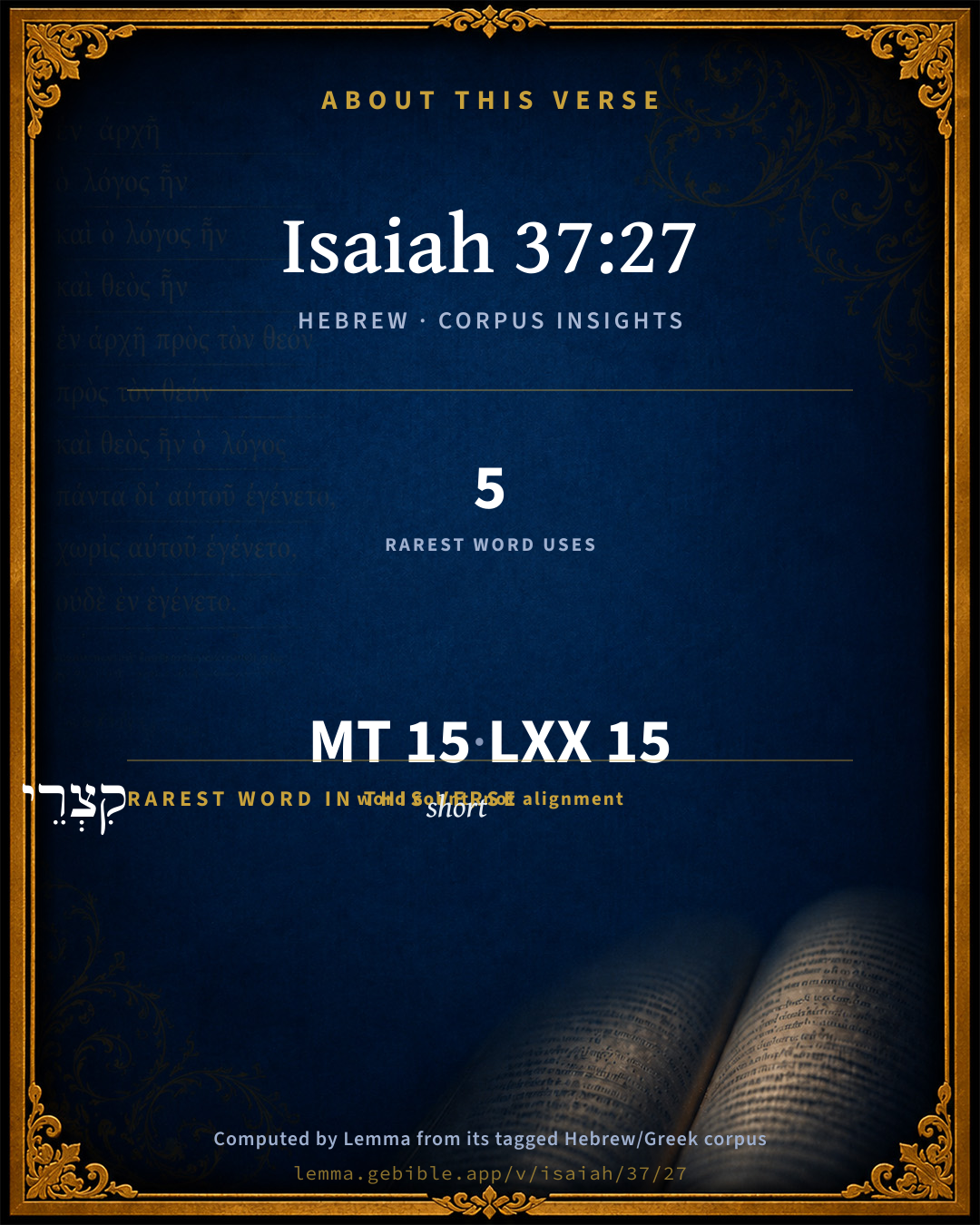
The rarest word here is קִצְרֵי short H7116 — appearing just 5 times in the whole Hebrew Bible.

Shared distinctive vocabulary

קִצְרֵי short H7116 occurs in 5 verses of the Hebrew Bible. Also found in:

Grammatical profile

  • 4 verbs
  • 10 nouns
  • 1 adjective

Verb forms

  • וְיֹֽשְׁבֵיהֶן֙ Qal · Participle Active
  • חַ֖תּוּ Qal · Perfect
  • וָבֹ֑שׁוּ Qal · Perfect
  • הָי֞וּ Qal · Perfect

Hebrew & Septuagint length

In English translation the verse runs 42 words from the Hebrew and 19 from the Septuagint (LXX English) — the Septuagint runs noticeably shorter here. See the side-by-side →

A rough comparison of the two English renderings, which tokenize alike — not a word-level alignment.

Word counts can differ between the Hebrew and the Greek without any difference in meaning — e.g. the Hebrew direct-object marker אֵת has no separate Greek word, and Greek often adds the article ὁ.

In the original languages it is 15 Hebrew tokens and 15 Greek tokens — but the two are counted differently (Hebrew bundles its prefixes and suffixes into one token; the Greek is in lemma form), so that isn’t a like-for-like length.

Cross-references

14

Topical passages linked to Isaiah 37:27 in the Treasury of Scripture Knowledge — connected by theme and wording, ordered by reader-vote popularity; previews shown in the World English Bible.

  • Psalms 129:6 Let them be as the grass on the housetops, Which withers before it grows up;
  • Numbers 14:9 Only don't rebel against Yahweh, neither fear the people of the land; for they are bread for us: their defense is removed from over them, and Yahweh is with us: don't fear them.
  • 2 Kings 19:26 Therefore their inhabitants were of small power, they were dismayed and confounded; they were as the grass of the field, and as the green herb, as the grass on the housetops, and as grain blasted before it is grown up.
  • Psalms 37:2 For they shall soon be cut down like the grass, And wither like the green herb.
  • Psalms 90:5–6 You sweep them away as they sleep. In the morning they sprout like new grass.
  • Psalms 92:7 Though the wicked spring up as the grass, And all the evil-doers flourish, They will be destroyed forever.
  • Psalms 103:15 As for man, his days are like grass. As a flower of the field, so he flourishes.
  • Psalms 127:1–2 Unless Yahweh builds the house, They labor in vain who build it. Unless Yahweh watches over the city, The watchman guards it in vain.
  • Isaiah 19:16 In that day shall the Egyptians be like women; and they shall tremble and fear because of the shaking of the hand of Yahweh of Hosts, which he shakes over them.
  • Isaiah 40:6–8 The voice of one saying, Cry. One said, What shall I cry? All flesh is grass, and all the glory of it is as the flower of the field.
  • Jeremiah 5:10 Go up on her walls, and destroy; but don't make a full end: take away her branches; for they are not Yahweh's.
  • Jeremiah 37:10 For though you had struck the whole army of the Chaldeans who fight against you, and there remained but wounded men among them, yes would they rise up every man in his tent, and burn this city with fire.
  • James 1:10–11 and the rich, in that he is made humble, because like the flower in the grass, he will pass away.
  • 1 Peter 1:24 For, "All flesh is like grass, And all of man's glory like the flower in the grass. The grass withers, and its flower falls;

Cross-references courtesy of OpenBible.info (CC BY 4.0).

Hebrew and Greek witnesses Masoretic Hebrew ↔ Greek Septuagint

The same verse in the two great witnesses to the Old Testament, shown verse-for-verse.

Here the Septuagint runs noticeably shorter than the Hebrew — LXX2012 (modern English Septuagint) 19 words vs World English Bible 42. A rough length comparison of the two English translations, not a word-level alignment — read both below.

These are two independent witnesses, not word-aligned to each other, and the Septuagint is shown in lemma (dictionary) form.

Hebrew Isaiah 37:27 Masoretic · Westminster Leningrad Codex

וְיֹֽשְׁבֵיהֶן֙ קִצְרֵי יָ֔ד חַ֖תּוּ וָבֹ֑שׁוּ הָי֞וּ עֵ֤שֶׂב שָׂדֶה֙ וִ֣ירַק דֶּ֔שֶׁא חֲצִ֣יר גַּגּ֔וֹת וּשְׁדֵמָ֖ה לִפְנֵ֥י קָמָֽה

Therefore their inhabitants were of small power, they were dismayed and confounded; they were as the grass of the field, and as the green herb, as the grass on the housetops, and as a field [of grain] before it is grown up.

World English Bible · Public Domain

Greek LXX Isaiah 37:27 Septuagint · lemma form

ἀναἵημι ὁ χείρ καί ξηραίνω καί γίγνομαι ὡς χόρτος ξηρός ἐπί δῶμα καί ὡς ἄγρωστις

I weakened their hands, and they withered; and they became as dry grass on the housetops, and as grass.

LXX2012 (modern English Septuagint) · Public Domain

Hebrew: Westminster Leningrad Codex (CC BY 4.0). Greek: Septuagint (public domain); English from LXX2012 (modern English Septuagint) (Public Domain). How the Septuagint differs from the Hebrew →

Targum (Aramaic paraphrase)

1

The Targum is the ancient Jewish Aramaic paraphrase of the Hebrew Scriptures — an interpretive translation, not the Hebrew text itself. Onkelos (literal) and Pseudo-Jonathan (expansive) render the Torah, and Jonathan the Prophets. Coverage is partial: where no permissively-licensed English translation exists for a verse, only the Aramaic is shown. This is verse-level text, not a word-by-word alignment to the Hebrew.

  1. Targum Jonathan Prophets (Joshua–Malachi)
    וְיָתְבֵיהוֹן אִתְקַצֵר חֵילֵיהוֹן אִתְבָּרוּ וּבְהִיתוּ הֲווֹ כְּעֵשֶׂב חַקְלַיָא וִירוֹק דִתְאָה כְּעֵשֶׂב אִגָרַיָא דִשְׁלוֹק עַד לָא מָטֵא לְמֶהֱוֵי שׁוּבְּלִין:

    Therefore their inhabitants had their strength cut off, they were dismayed and confounded; they were as the grass of the fields, yea, as the green grass, as the herb on the housetops, as corn blasted before it becomes an ear of corn.

    Targum Jonathan — Aramaic: “Mikraot Gedolot” (public domain). English: “Sefaria Community Translation” (CC0 1.0 (public-domain dedication)); “London "Chaldee Paraphrase," 1871” (public domain). Text via Sefaria.

Commentary

Notes on Isaiah 37:27 from classic Christian and Jewish commentators (each source and its license shown beneath its notes). The classic Christian expositions comment on the surrounding passage and are grouped to its opening verse, so a note may address several verses; the Jewish commentaries on the Tanakh (Rashi and others) are per-verse, so they appear only where the commentator wrote on this verse.

Lemma curates 59 commentaries, every one of them public domain or Creative Commons licensed, each selected and text-cleaned for this edition rather than reprinted as found. About our sources →

Ibn Ezra

Rabbi Abraham ibn Ezra

5. In the book of Kings (19:26) שרפה; in Isaiah (37:27) שדמה; though there be two different words, their meaning is the same, blasted.

Ibn Ezra on the Tanakh — English translations: “Sefaria Community Translation” (CC0 1.0 (public-domain dedication)); “Yalkut, Sifsei Chachomim Chumash, Metsudah Publications, 2009” (CC BY 4.0); and “Commentary of Ibn Ezra on Isaiah - trans. by M. Friedlander, 1873” (public domain). Text via Sefaria.

Geneva Bible (1599)

Geneva Bible translators

Hebrew, are short in hand.

He showeth that the state and power of most flourishing cities endureth but a moment in respect of the Church, which shall remain forever, because God is the maintainer thereof.

Geneva Bible (1599) marginal notes — public domain. Text via Bolls.life.

Jamieson, Fausset & Brown

Robert Jamieson, A. R. Fausset & David Brown

Therefore--not because of thy power, but because I made them unable to withstand thee.

grass--which easily withers (Isa 40:6; Psa 37:2).

on . . . housetops--which having little earth to nourish it fades soonest (Psa 129:6-8).

corn blasted before it be grown up--SMITH translates, "The cornfield (frail and tender), before the corn is grown."

Jamieson, Fausset & Brown — Commentary Critical and Explanatory on the Whole Bible (1871) — public domain (CC PDM 1.0). Text via the HelloAO Bible API.

Adam Clarke's Commentary

Verse 27. Corn blasted] שדמה shedemah, parched: it does not appear that there is any good authority for this word. The true reading seems to be שדפה shedephah, blasted, as it is in six MSS. (two ancient) here, and in the other copy.

Adam Clarke's Commentary on the Bible (1810–1826) — public domain. Text from a community e-Sword/MySword module.

Ellicott's Commentary for English Readers

(27) Therefore.—Better, and.

They were as the grass of the field.—One symbol of weakness follows after another. The “grass upon the housetops” was, in this respect, a proverbial emblem (Psa_129:6). The italics in as corn seem to suggest some error in transcription. The words as they stand give a field before the blades; those in 2Ki_19:26, a blasting.

A Bible Commentary for English Readers, edited by Charles John Ellicott (1878–1897) — public domain. Text from a community e-Sword module.

The Cambridge Bible for Schools and Colleges

gen. ed. J. J. S. Perowne

27. Therefore their inhabitants … confounded] Better, And their inhabitants (being) of small power (lit. “short of hand”) were terrified and ashamed.

grass on the housetops] See Psa_129:6-8.

corn blasted before it be grown up] The Hebr. text reads “a corn-field before it is in stalk” (see R.V.). The A.V. adopts the reading of 2Ki_19:26, which is perhaps to be preferred—“a blasting before it is in stalk.” But neither rendering accounts quite satisfactorily for the words “before it is in stalk.” In all probability they are, as Wellhausen has suggested, a corruption of the opening words of the next verse, which is obviously unsymmetrical as it stands.

The Cambridge Bible for Schools and Colleges (gen. ed. J. J. S. Perowne; Cambridge University Press, 1878–1918) — public domain. Text from a community e-Sword module.

John Gill's Exposition

Because thy rage against me, and thy tumult is come up into mine ears,..... The rage which Sennacherib expressed both by Rabshakeh, and in his letter against Hezekiah and his people, is taken by the Lord as against himself; so great was his care of them, and concern for them; and indeed there was a great deal of blasphemy belched out against himself; and so the Syriac version renders the next word, translated "tumult", "thy blasphemy"; though that may rather intend the blustering noise that Rabshakeh made, or the noise of the Assyrian army, the chariots and horsemen, and the multitude of the soldiers, which was not only heard by the Jews, and was terrible to them, but was taken notice of by the Lord, who had it in derision; hence he adds:

therefore will I put my hook in thy nose, and my bridle in thy lips; comparing Sennacherib to leviathan, or the great whale, or to some very large and unruly fish, not easily caught and managed; see Job 41:1, or to a bear, or buffalo, in whose noses men put iron rings, and lead them about at pleasure; and also to a horse or mule, which are managed by the bit and bridle; signifying hereby the strength, fierceness, and fury of the Assyrian monarch, and the power of God to restrain him, which he could easily do:

and I will turn thee back by the way by which thou camest; from Jerusalem, the same way he came to it, to his own land again, and so he did, Isa 37:37.

John Gill's Exposition of the Whole Bible (1746–1763) — public domain (CC PDM 1.0). Text via the HelloAO Bible API.

Albert Barnes' Notes on the Bible

Therefore - Not because you have so great power; but because I have rendered them incapable of resisting you.

Were of small power - Hebrew, ‘Short of hand;’ they were feeble, imbecile, unable to resist you.

They were dismayed - Hebrew, ‘They were broken and ashamed.’ Their spirits sank; they were ashamed of their feeble powers of resistance; and they submitted to the ignominy of a surrender.

They were as the grass of the field - The same idea is expressed by Sennacherib himself in Isa 10:15, though under a different image (see the note on that verse). The idea here is, as the grass of the field offers no resistance to the march of an army, so it was with the strongly fortified towns in the way of Sennacherib.

As the grass on the housetops - In eastern countries the roofs of houses are always flat. They are made of a mixture of sand gravel, or earth; and on the houses of the rich there is a firmly constructed flooring made of coals, chalk, gypsum, and ashes, made hard by being beaten or rolled. On these roofs spears of wheat, barley, or grass sometimes spring up, but they are soon withered by the heat of the sun Psa 129:6-8. The idea here, therefore, is that of the greatest feebleness. His enemies were not simply like the grass in the field, but they were like the thin, slender, and delicate blade that sprung up in the little earth on the roof of a house, where there was no room for the roots to strike down, and where it soon withered beneath the burning sun.

As corn blasted before it is grown up - Before it acquires any strength. The idea in all these phrases is substantially the same - that they were incapable of offering even the feeblest resistance.

Albert Barnes' Notes on the Bible (1834–1885) — public domain. Text from a community e-Sword/MySword module.

Whedon's Commentary on the Bible

Daniel D. Whedon

27. When, in the order of events, a greatly superior invader comes upon a weak people, the statement that the latter is of small power, literally, short of hand, unable to reach to an equality of fighting force, is very plain. The comparison, as… grass of the field… on the housetops… as corn blasted, etc., under the scorching sun — this adds essential force to the powerlessness of the invaded.

Daniel D. Whedon (gen. ed.), Commentary on the Old and New Testaments (1874–1909) — public domain. Text from a community e-Sword module.

The Pulpit Commentary

Therefore. The original is not so emphatic, but still contains the idea, not merely of sequence, but of consequence. God, having decreed the successes of the Assyrians, effected them (in part) by infusing weakness into the nations that were their adversaries. They were as the grass of the field. (comp. Isa_40:6, Isa_40:7) The comparison is one constantly used by the Hebrew psalmists, (Psa_37:2 Psa_90:5 Psa_92:7 Psa_103:15) and was not unknown to the Assyrians ("Records of the Past," vol. 3. p. 41; vol. 5. p. 14). The delicate grass of spring in the East withers within a few weeks, and the fresh and tender herbage becomes yellow, parched, and sapless. The grass that springs upon the earthen roofs of houses fails even more rapidly. (comp. Psa_129:6) As corn blasted before it be grown up; literally, like a field before the stalk. Our translators seem to have rightly preferred the reading of 2Ki_19:26 (shdephah, equivalent to "blasting") to that of Isaiah (shdemah, equivalent to "field") in this place. Their rendering brings out the true sense.

The Pulpit Commentary (1880–1919), ed. H.D.M. Spence-Jones & Joseph S. Exell — public domain. Text from a community e-Sword module.

J. A. Alexander on Isaiah

Joseph Addison Alexander

“And their inhabitants are short of hand; they are broken and confounded; they are grass of the field and green herbage, grass of the house-tops, and afield before the stalk” (or standing corn), (i.e., before the grain has grown up). This may be regarded either as a description of the weakness of those whom the Assyrian had subdued, or as a description of the terror with which they were inspired at his approach. In the former case this verse extenuates the glory of his conquest; in the latter it enhances it. A short hand or arm implies inability to reach the object, but does not necessarily suggest the idea of mutilation. In a negative sense, it is applied to God (Num 11:23; Isa 50:2; Isa 59:1). The general meaning of the whole verse evidently is that they were unable to resist him.

Joseph Addison Alexander, The Prophecies of Isaiah (1846–1847; New York: Scribner, 1870–1878) — public domain. Text from a community e-Sword module.

Rashi

Rabbi Shlomo Yitzchaki (Rashi)

And their inhabitants became short of strength (lit. short of hand.) I weakened the strength before you.

and stubble before [becoming] standing grain (וּשְׁדֵמָה) That is what is called ‘estoble’ in O.F., stubble, what remains in the ground, the roots of the harvest.

before [becoming] standing grain When it has not yet reached the time to ripen and harden, to become standing grain, and it is weak and tender.

before standing grain Before becoming standing grain.

Rashi on the Tanakh — English translations: “The Judaica Press complete Tanach with Rashi, translated by A. J. Rosenberg” (CC BY 4.0); “Pentateuch with Rashi's commentary by M. Rosenbaum and A.M. Silbermann, 1929-1934” (public domain); “The Metsudah Tanach series, Lakewood, N.J” (CC BY 4.0); and “The Book of Joshua, Metsudah Publications, 1997” (CC BY 4.0). Text via Sefaria.

Lesson kit

Teaching starters — assembled from the data on this page, not authored interpretation. Every prompt links to the verse data it draws on. Edit before teaching.

Isaiah, in the Prophets, opens this verse with 15 words (15 distinct Hebrew lemmas). Its most distinctive word is qâtsêr (“short”). The Greek Septuagint runs shorter here. A historical commentator’s framing appears above. Read the whole chapter for the surrounding context.

Discussion questions

  1. How does “short” (qâtsêr) shape what this verse is saying?
  2. 2 Kings 19:26 shares the word «short» with this verse. How do the two illuminate each other?
  3. Compared with the Hebrew, the Septuagint runs shorter here. What questions does that raise?
  4. These translations render this verse differently; the difference is in the English rendering, not the original. What questions does that raise?
  5. The verb «וְיֹֽשְׁבֵיהֶן֙» is Qal Participle Active. How does its form color the action?
  6. Reading how Ibn Ezra and Geneva Bible (1599) read this verse, where do the two commentators agree and where do they part?

Things to notice

Reading settings

Reading text

Shown beneath each verse's original-language words.

Old Testament
Old Testament edition

Read the OT as the Masoretic Hebrew (MT) or the Greek Septuagint (LXX).

English shown for the Greek Septuagint (in the Hebrew ↔ Greek comparison).

Comparing translations? Open the Compare panel on any verse page to stack up to four side by side.