Isaiah 30:5

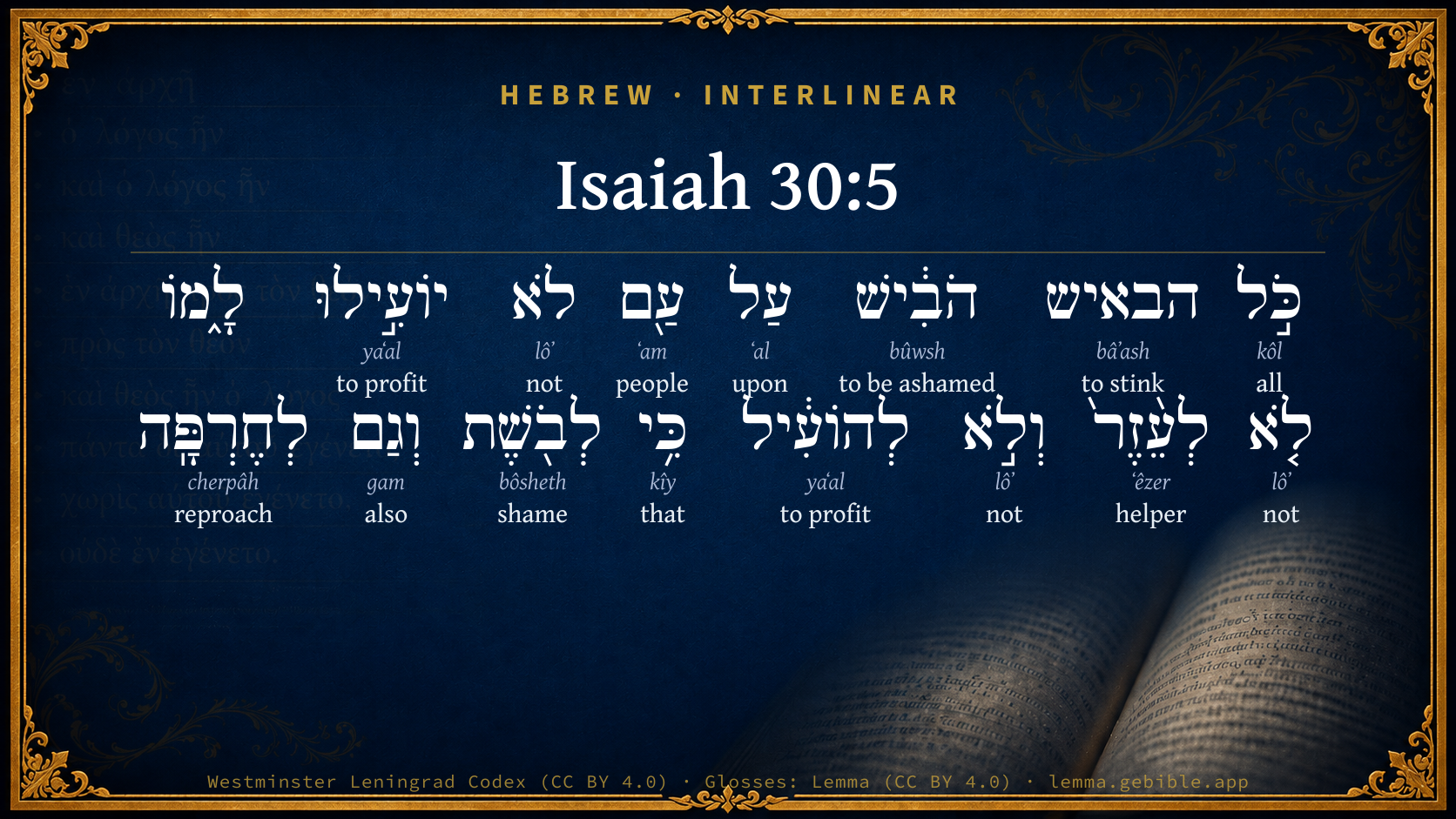
Hebrew (Westminster Leningrad Codex) Isaiah 30:5 appears in the Hebrew Old Testament. The text above is from the Westminster Leningrad Codex. Each word links to its Strong’s number, a concise gloss, and parsing drawn from the Open Scriptures Hebrew Bible morphology. Click any word for its full Brown-Driver-Briggs (BDB) entry.
Download image
Cite this verse

Isaiah 30:5 (World English Bible). Public Domain. Lemma interlinear Bible study tool, https://lemma.gebible.app/v/isaiah/30/5.

Show BibTeX & RIS
BibTeX
RIS
English Translation
They shall all be ashamed because of a people that can't profit them, that are not a help nor profit, but a shame, and also a reproach.
World English Bible · Public Domain
Download a study sheet

One document with this verse’s original text, its word-by-word gloss line, the meaning frame, cross-references with their text, attributed commentary, and full source and license credits — printable, and it pastes into notes with its structure intact.

This verse Autodidact and up

Study sheet (.html) Plain text (.txt)

A passage Seminary Student

Up to 50 verses in one chapter. A passage sheet keeps up to 6 commentary sources and 12 cross-references per verse, in the order this page ranks them, and says so on the sheet whenever that leaves anything out. Ask for a single verse and you get the Autodidact verse sheet above.

Everything on this page stays free to read, with no account — the sheet is a download of what is already on screen, not access to it.

Want to remove ads? Support Godless Engineer
Compare translations 3

The same verse in 3 English versions, stacked beneath the original-language interlinear above. Click any original word for its lexicon entry.

Each is an independent rendering of the whole verse — the interlinear is not word-aligned to these translations.

Highlighted words mark where these versions differ — a whole-verse word diff, not a word-by-word alignment.

  • World English Bible Public Domain
    They shall all be ashamed because of a people that can't profit them, that are not a help nor profit, but a shame, and also a reproach.
  • King James Version Public Domain
    They were all ashamed of a people that could not profit them, nor be an help nor profit, but a shame, and also a reproach.
  • unfoldingWord Literal Text CC BY-SA 4.0
    everyone will have shame because of a people do not benefit them, not for help and not for benefit, but for shame and also for reproach.”

unfoldingWord Literal Text — © unfoldingWord, licensed CC BY-SA 4.0. Word-aligned USFM3 via Door43 (git.door43.org/unfoldingWord/en_ult).

Versions to compare (up to 4)

3 of 4 selected

Show all 18 translations

Every available English version of this verse, each an independent rendering of the whole verse.

  • World English Bible Public Domain
    They shall all be ashamed because of a people that can't profit them, that are not a help nor profit, but a shame, and also a reproach.
  • Berean Standard Bible Public Domain
    everyone will be put to shame because of a people useless to them. They cannot be of help; they are good for nothing but shame and reproach.”
  • Majority Standard Bible Public Domain
    everyone will be put to shame because of a people useless to them. They bring neither help nor benefit, but only shame and disgrace.”
  • King James Version Public Domain
    They were all ashamed of a people that could not profit them, nor be an help nor profit, but a shame, and also a reproach.
  • American Standard Version (1901) Public Domain
    They shall all be ashamed because of a people that cannot profit them, that are not a help nor profit, but a shame, and also a reproach.
  • Revised Version (1885) Public Domain
    They shall all be ashamed of a people that cannot profit them, that are not an help nor profit, but a shame, and also a reproach.
  • Geneva Bible (1599) Public Domain
    They shalbe all ashamed of the people that cannot profite them, nor helpe nor doe them good, but shalbe a shame and also a reproche.
  • Douay-Rheims (1899) Public Domain
    They were all confounded at a people that could not profit them: they were no help, nor to any profit, but to confusion and to reproach.
  • Young's Literal Translation Public Domain
    All he made ashamed of a people that profit not, Neither for help, not for profit, But for shame, and also for reproach!
  • Literal Standard Version CC BY-SA 4.0
    He made all ashamed of a people that do not profit, || Not for help, and not for profit, || But for shame, and also for reproach!
  • Unlocked Literal Bible CC BY-SA 4.0
    They will all be ashamed because of a people who cannot help them, who are neither help nor aid, but a shame, and even a disgrace.”
  • unfoldingWord Literal Text CC BY-SA 4.0
    everyone will have shame because of a people do not benefit them, not for help and not for benefit, but for shame and also for reproach.”
  • Darby Bible Public Domain
    They were all ashamed of a people [that] did not profit them, nor were a help or profit, but a shame, and also a reproach.
  • World Messianic Bible Public Domain
    They shall all be ashamed because of a people that can’t profit them, that are not a help nor profit, but a shame, and also a reproach.”
  • Webster's Bible Public Domain
    They were all ashamed of a people that could not profit them, nor be a help nor profit, but a shame, and also a reproach.
  • Free Bible Version CC BY-SA 4.0
    the Egyptians will offend everyone because they are useless—they're no help and good for nothing, except for causing shame and bringing disgrace.
  • Bible in Basic English Public Domain
    For they have all come with offerings to a people of no use to them, in whom is no help or profit, but only shame and a bad name.
  • JPS Tanakh (1917) Public Domain
    They shall all be ashamed of a people that cannot profit them, that are not a help nor profit, but a shame, and also a reproach.

Literal Standard Version (2020), Covenant Press — licensed CC BY-SA 4.0. Text via the HelloAO Bible API (eBible.org). Unlocked Literal Bible (unfoldingWord) — licensed CC BY-SA 4.0. Text via the HelloAO Bible API (eBible.org). unfoldingWord Literal Text — © unfoldingWord, licensed CC BY-SA 4.0. Word-aligned USFM3 via Door43 (git.door43.org/unfoldingWord/en_ult). Free Bible Version, Dr. Jonathan Gallagher — licensed CC BY-SA 4.0. Text via the HelloAO Bible API (eBible.org).

Word by word

More ways to search: Search by grammar → Find every occurrence → Compare this word →

Practice this passage: Drill this verse → Learn its vocabulary →

הבאיש
bâʼash
H887
“to stink”
Verb, Hiphil, Perfect, 3rd Person, Masculine, Singular
Part of Speech
Verb
Stem
Hiphil
Form
Perfect
Person
3rd Person
Gender
Masculine
Number
Singular
Full BDB Definition

Origin: a primitive root

TWOT: 195

to have a bad smell, stink, smell bad - (Qal) to stink, smell bad - (Niphal) - to become odious - to make oneself odious - (Hiphil) - to stink, emit a stinking odour - to cause to stink - of wickedness (figuratively) - (Hithpael) to make oneself odious - (TWOT) to abhor
  1. כֹּ֣ל kôl H3605 “all” Noun, Common, Masculine, Singular, Absolute
  2. הֹבִ֔ישׁ bûwsh H954 “to be ashamed” Verb, Hiphil, Perfect, 3rd Person, Masculine, Singular
  3. עַל ʻal H5921 “upon” Preposition
  4. עַ֖ם ʻam H5971 “people” Noun, Common, Masculine, Singular, Absolute
  5. לֹא lôʼ H3808 “not” Particle, Negative
  6. יוֹעִ֣ילוּ yaʻal H3276 “to profit” Verb, Hiphil, Imperfect, 3rd Person, Masculine, Plural
  7. לֹ֤א lôʼ H3808 “not” Particle, Negative
  8. לְעֵ֨זֶר֙ ʻêzer H5828 “to/for · helper” Preposition + Noun, Common, Masculine, Singular, Absolute
  9. וְלֹ֣א lôʼ H3808 “and · not” Conjunction + Particle, Negative
  10. לְהוֹעִ֔יל yaʻal H3276 “to profit” Preposition + Verb, Hiphil, Infinitive Construct
  11. כִּ֥י kîy H3588 “that” Conjunction
  12. לְבֹ֖שֶׁת bôsheth H1322 “to/for · shame” Preposition + Noun, Common, Feminine, Singular, Absolute
  13. וְגַם gam H1571 “and · also” Conjunction + Particle, Accusative
  14. לְחֶרְפָּֽה cherpâh H2781 “to/for · reproach” Preposition + Noun, Common, Feminine, Singular, Absolute

About this verse

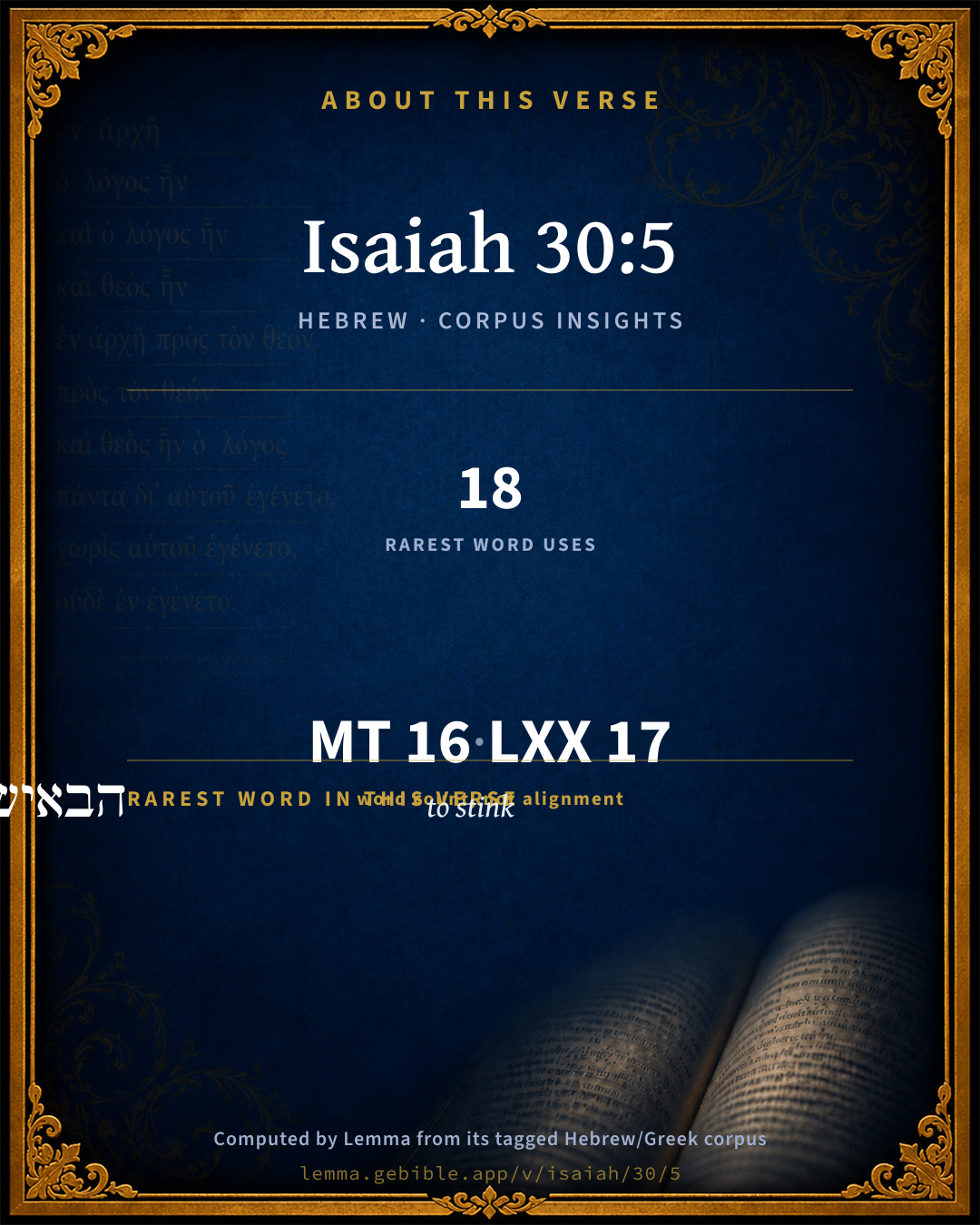
These counts appear in no published source. They are computed here, from the morphology-tagged text and Lemma’s own curated glosses. What Lemma adds →

16
words
12
distinct lemmas
Prophets
section

Notable vocabulary

The rarest word here is הבאיש to stink H887 — appearing just 18 times in the whole Hebrew Bible.

Shared distinctive vocabulary

הבאיש to stink H887 occurs in 17 verses of the Hebrew Bible. Also found in:

Grammatical profile

  • 4 verbs
  • 5 nouns
  • 2 prepositions
  • 1 conjunction
  • 4 particles

Verb forms

  • הבאיש Hiphil · Perfect
  • הֹבִ֔ישׁ Hiphil · Perfect
  • יוֹעִ֣ילוּ Hiphil · Imperfect
  • לְהוֹעִ֔יל Hiphil · Infinitive Construct

Repetition

Words recur within this verse — often emphatic in Hebrew:

  • יוֹעִ֣ילוּ to profit H3276 ×2
  • לֹא not H3808 ×3

Hebrew & Septuagint length

In English translation the verse runs 27 words from the Hebrew and 25 from the Septuagint (LXX English) — closely comparable.

A rough comparison of the two English renderings, which tokenize alike — not a word-level alignment.

Word counts can differ between the Hebrew and the Greek without any difference in meaning — e.g. the Hebrew direct-object marker אֵת has no separate Greek word, and Greek often adds the article ὁ.

In the original languages it is 16 Hebrew tokens and 17 Greek tokens — but the two are counted differently (Hebrew bundles its prefixes and suffixes into one token; the Greek is in lemma form), so that isn’t a like-for-like length.

Cross-references

5

Topical passages linked to Isaiah 30:5 in the Treasury of Scripture Knowledge — connected by theme and wording, ordered by reader-vote popularity; previews shown in the World English Bible.

  • Jeremiah 2:36 Why go you about so much to change your way? you shall be ashamed of Egypt also, as you were ashamed of Assyria.
  • Isaiah 30:7 For Egypt helps in vain, and to no purpose: therefore have I called her Rahab who sits still.
  • Isaiah 20:5–6 They shall be dismayed and confounded, because of Ethiopia their expectation, and of Egypt their glory.
  • Isaiah 30:16 but you said, No, for we will flee on horses; therefore shall you flee: and, We will ride on the swift; therefore shall those who pursue you be swift.
  • Isaiah 31:1–3 Woe to those who go down to Egypt for help, and rely on horses, and trust in chariots because they are many, and in horsemen because they are very strong, but they don't look to the Holy One of Israel, neither seek Yahweh!

Cross-references courtesy of OpenBible.info (CC BY 4.0).

Hebrew and Greek witnesses Masoretic Hebrew ↔ Greek Septuagint

The same verse in the two great witnesses to the Old Testament, shown verse-for-verse.

These are two independent witnesses, not word-aligned to each other, and the Septuagint is shown in lemma (dictionary) form.

Hebrew Isaiah 30:5 Masoretic · Westminster Leningrad Codex

כֹּ֣ל הבאיש הֹבִ֔ישׁ עַל עַ֖ם לֹא יוֹעִ֣ילוּ לָ֑מוֹ לֹ֤א לְעֵ֨זֶר֙ וְלֹ֣א לְהוֹעִ֔יל כִּ֥י לְבֹ֖שֶׁת וְגַם לְחֶרְפָּֽה

They shall all be ashamed because of a people that can't profit them, that are not a help nor profit, but a shame, and also a reproach.

World English Bible · Public Domain

Greek LXX Isaiah 30:5 Septuagint · lemma form

πρός λαός ὅς οὐ ὠφελέω αὐτός οὔτε εἰς βοήθεια οὔτε εἰς ὠφέλεια ἀλλά εἰς αἰσχύνη καί ὄνειδος

In vain shall they labor in seeking to a people, which shall not profit them for help, but shall be for a shame and reproach.

LXX2012 (modern English Septuagint) · Public Domain

Hebrew: Westminster Leningrad Codex (CC BY 4.0). Greek: Septuagint (public domain); English from LXX2012 (modern English Septuagint) (Public Domain). How the Septuagint differs from the Hebrew →

Targum (Aramaic paraphrase)

1

The Targum is the ancient Jewish Aramaic paraphrase of the Hebrew Scriptures — an interpretive translation, not the Hebrew text itself. Onkelos (literal) and Pseudo-Jonathan (expansive) render the Torah, and Jonathan the Prophets. Coverage is partial: where no permissively-licensed English translation exists for a verse, only the Aramaic is shown. This is verse-level text, not a word-by-word alignment to the Hebrew.

  1. Targum Jonathan Prophets (Joshua–Malachi)
    כּוּלְהוֹן אָזְלִין לְמִבְהַת לְוַת עַמָא דְלָא יַהֲנוּן לְהוֹן לָא לְסָעִיד וְלָא לַהֲנָאָה אֲרֵי לְבַהֲתָא וְאַף לְחִסוּדִין:

    All of them go unto a people to be confounded, a people that shall not profit them, who shall be of no help, and of no profit, but for a confusion, and reproaches.

    Targum Jonathan — Aramaic: “Mikraot Gedolot” (public domain). English: “Sefaria Community Translation” (CC0 1.0 (public-domain dedication)); “London "Chaldee Paraphrase," 1871” (public domain). Text via Sefaria.

Commentary

Notes on Isaiah 30:5 from classic Christian and Jewish commentators (each source and its license shown beneath its notes). The classic Christian expositions comment on the surrounding passage and are grouped to its opening verse, so a note may address several verses; the Jewish commentaries on the Tanakh (Rashi and others) are per-verse, so they appear only where the commentator wrote on this verse.

Lemma curates 59 commentaries, every one of them public domain or Creative Commons licensed, each selected and text-cleaned for this edition rather than reprinted as found. About our sources →

Trapp's Complete Commentary

John Trapp

Isa 30:5 They were all ashamed of a people [that] could not profit them, nor be an help nor profit, but a shame, and also a reproach.

Ver. 5. They were all ashamed of a people that could not profit them.] Either could not or would not, for fear of provoking the Assyrian, so potent and formidable a prince. When Queen Elizabeth undertook to protect the Netherlanders against the Spaniard, the King of Sweden, hearing of it, said, that she had taken the crown off her own head and set it on the head of Fortune.

John Trapp, A Commentary or Exposition upon All the Books of the Old and New Testament (1647–1656) — public domain. Text from a community e-Sword module.

Jamieson, Fausset & Brown

Robert Jamieson, A. R. Fausset & David Brown

(Jer 2:36.)

Jamieson, Fausset & Brown — Commentary Critical and Explanatory on the Whole Bible (1871) — public domain (CC PDM 1.0). Text via the HelloAO Bible API.

Adam Clarke's Commentary

Verse 5. Were - ashamed] Eight MSS. (one ancient) of Kennicott's, and ten of De Rossi's, read הביש hobish, without א aleph. So the Chaldee and Vulgate.

But a shame - "But proved even a shame"] Four MSS. (three ancient) after כי ki, add אם im, unless, which seems wanted to complete the phrase in its usual form.

Adam Clarke's Commentary on the Bible (1810–1826) — public domain. Text from a community e-Sword/MySword module.

Ellicott's Commentary for English Readers

(5) They were all ashamed . . .—Better, are: historic present, as before. The prophet paints the dreary disappointment of the embassy. They found Egypt at once weak and false, without the will or power to help them. So Rabshakeh compares that power to a “broken reed,” which does but pierce the hand of him who leans on it. So Sargon (Smith, Assyrian Canon, p. 133, quoted by Cheyne), describing the resistance of his foes, says that they “carried presents, seeking his alliance, to Pharaoh, king of Egypt, a monarch who could not help them.”

A Bible Commentary for English Readers, edited by Charles John Ellicott (1878–1897) — public domain. Text from a community e-Sword module.

John Gill's Exposition

They were all ashamed of a people that could not profit them,.... The princes, the ambassadors that were sent unto them, and the king or people, or both, that sent them, who hoped for and expected great things from them, but, being disappointed, were filled with shame; because either the Egyptians, who are the people here meant, either could not help them, or would not, not daring to engage with so powerful an enemy as the Assyrian monarch, which is illustrated and confirmed by repeating the same, and using other words:

nor be an help, nor profit, but a shame, and also a reproach: so far from being of any advantage to them, by helping and assisting them against their enemy, wanting either inclination or capacity, or both, that it not only turned to their shame, but even was matter of reproach to them, that ever they made any application to them, or placed any confidence in them for help.

John Gill's Exposition of the Whole Bible (1746–1763) — public domain (CC PDM 1.0). Text via the HelloAO Bible API.

Albert Barnes' Notes on the Bible

They were all ashamed - That is, all the legates or ambassadors. When they came into Egypt, they found them either unwilling to enter into an alliance, or unable to render them any aid, and they were ashamed that they had sought their assistance rather than depend on God (compare Jer 2:36).

Albert Barnes' Notes on the Bible (1834–1885) — public domain. Text from a community e-Sword/MySword module.

Matthew Poole's English Annotations

They; both the messengers, and they who sent them.

Matthew Poole's English Annotations on the Holy Bible (1683–1685) — public domain. Text from a community e-Sword/MySword module.

Whedon's Commentary on the Bible

Daniel D. Whedon

5. They were all ashamed — That is, the ambassadors, probably because their application for alliance and aid was not entertained.

Daniel D. Whedon (gen. ed.), Commentary on the Old and New Testaments (1874–1909) — public domain. Text from a community e-Sword module.

The Pulpit Commentary

They were all ashamed; rather, all are ashamed. The reference is not to the ambassadors, who felt no shame in their embassy, and probably returned elated by the promises made them; but to the subsequent feelings of the Jewish nation, when it was discovered by sad experience that no reliance was to be placed on "the strength of Pharaoh." A people that could not profit them. Mr. Cheyne compares, very pertinently, an inscription of Sargon"s, where he says of the people of Philistia, Judah, Edom, and Moab, that "they and their evil chiefs, to fight against me, unto Pharaoh, King of Egypt, a monarch who could not save them, their presents carried, and besought his alliance" (G. Smith, "Eponym Canon," p. 130, II 35-39). Egypt was, in fact, quite unable to cope with Assyria, and knew it. A shame, and also a reproach. A matter of which they would themselves be "ashamed," and with which the Assyrians would "reproach" them. (as they did, 2Ki_18:21, 2Ki_18:24)

The Pulpit Commentary (1880–1919), ed. H.D.M. Spence-Jones & Joseph S. Exell — public domain. Text from a community e-Sword module.

John Wesley's Explanatory Notes

They - Both the messengers, and they who sent them.

John Wesley, Explanatory Notes Upon the Whole Bible (1754–1765) — public domain. Text via the GEBible commentary corpus.

J. A. Alexander on Isaiah

Joseph Addison Alexander

“All are ashamed of a people who cannot profit them, (a people) not for help and not for profit, but for shame, and also for disgrace.” The Hebrew construction is, ‘they are not a profit or a help, for (on the contrary) they are a disgrace and a reproach.’

Joseph Addison Alexander, The Prophecies of Isaiah (1846–1847; New York: Scribner, 1870–1878) — public domain. Text from a community e-Sword module.

Rashi

Rabbi Shlomo Yitzchaki (Rashi)

They all disgraced themselves They all disgraced themselves to acquire a master for nothing, and the people of the land will not avail them.

because of a people (Lit., on a people.) Because of a people that will not avail them.

for disgrace For insult, distraber in O.F., to insult.

Rashi on the Tanakh — English translations: “The Judaica Press complete Tanach with Rashi, translated by A. J. Rosenberg” (CC BY 4.0); “Pentateuch with Rashi's commentary by M. Rosenbaum and A.M. Silbermann, 1929-1934” (public domain); “The Metsudah Tanach series, Lakewood, N.J” (CC BY 4.0); and “The Book of Joshua, Metsudah Publications, 1997” (CC BY 4.0). Text via Sefaria.

Ibn Ezra

Rabbi Abraham ibn Ezra

כל הוביש═כל הבאיש. The א is superfluous; הבאיש is transitive, Every one blamed those that had gone to Egypt; for they went to a people that would not profit them.

Ibn Ezra on the Tanakh — English translations: “Sefaria Community Translation” (CC0 1.0 (public-domain dedication)); “Yalkut, Sifsei Chachomim Chumash, Metsudah Publications, 2009” (CC BY 4.0); and “Commentary of Ibn Ezra on Isaiah - trans. by M. Friedlander, 1873” (public domain). Text via Sefaria.

Lesson kit

Teaching starters — assembled from the data on this page, not authored interpretation. Every prompt links to the verse data it draws on. Edit before teaching.

Isaiah, in the Prophets, opens this verse with 16 words (12 distinct Hebrew lemmas). Its most distinctive word is bâʼash (“to stink”). A historical commentator’s framing appears above. Read the whole chapter for the surrounding context.

Discussion questions

  1. What does “to stink” (bâʼash) contribute to the verse as a whole?
  2. How does Genesis 34:30, which shares the word «to stink», read alongside this verse?
  3. What does the repetition of “to profit” (2× in this one verse) do in this verse?
  4. These translations render this verse differently; the difference is in the English rendering, not the original. What questions does that raise?
  5. «הבאיש» is a Hiphil Perfect verb. How does that grammatical form shape the action described?
  6. Compare how Trapp's Complete Commentary and Jamieson, Fausset & Brown read this verse. Where do they agree or differ?

Things to notice

Reading settings

Reading text

Shown beneath each verse's original-language words.

Old Testament
Old Testament edition

Read the OT as the Masoretic Hebrew (MT) or the Greek Septuagint (LXX).

English shown for the Greek Septuagint (in the Hebrew ↔ Greek comparison).

Comparing translations? Open the Compare panel on any verse page to stack up to four side by side.