
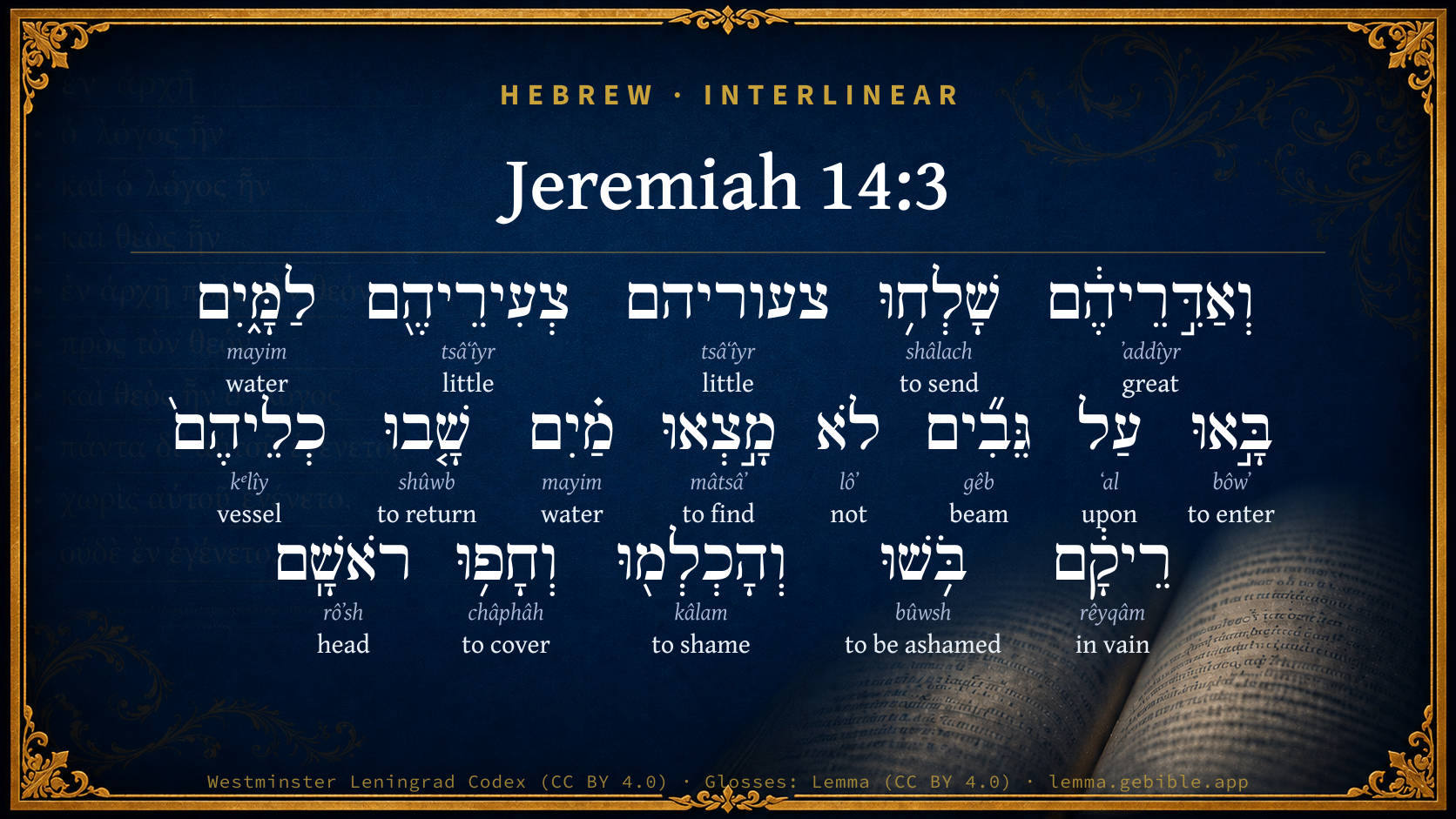
Jeremiah 14:3

Hebrew (Westminster Leningrad Codex) Jeremiah 14:3 appears in the Hebrew Old Testament. The text above is from the Westminster Leningrad Codex. Each word links to its Strong’s number, a concise gloss, and parsing drawn from the Open Scriptures Hebrew Bible morphology. Click any word for its full Brown-Driver-Briggs (BDB) entry.
Download image
Cite this verse

Jeremiah 14:3 (World English Bible). Public Domain. Lemma interlinear Bible study tool, https://lemma.gebible.app/v/jeremiah/14/3.

Show BibTeX & RIS
BibTeX
RIS
English Translation
Their nobles send their little ones to the waters: they come to the cisterns, and find no water; they return with their vessels empty; they are disappointed and confounded, and cover their heads.
World English Bible · Public Domain
Download a study sheet

One document with this verse’s original text, its word-by-word gloss line, the meaning frame, cross-references with their text, attributed commentary, and full source and license credits — printable, and it pastes into notes with its structure intact.

This verse Autodidact and up

Study sheet (.html) Plain text (.txt)

A passage Seminary Student

Up to 50 verses in one chapter. A passage sheet keeps up to 6 commentary sources and 12 cross-references per verse, in the order this page ranks them, and says so on the sheet whenever that leaves anything out. Ask for a single verse and you get the Autodidact verse sheet above.

Everything on this page stays free to read, with no account — the sheet is a download of what is already on screen, not access to it.

Want to remove ads? Support Godless Engineer
Compare translations 3

The same verse in 3 English versions, stacked beneath the original-language interlinear above. Click any original word for its lexicon entry.

Each is an independent rendering of the whole verse — the interlinear is not word-aligned to these translations.

Highlighted words mark where these versions differ — a whole-verse word diff, not a word-by-word alignment.

  • World English Bible Public Domain
    Their nobles send their little ones to the waters: they come to the cisterns, and find no water; they return with their vessels empty; they are disappointed and confounded, and cover their heads.
  • King James Version Public Domain
    And their nobles have sent their little ones to the waters: they came to the pits, and found no water; they returned with their vessels empty; they were ashamed and confounded, and covered their heads.
  • unfoldingWord Literal Text CC BY-SA 4.0
    And their noble ones send out their servants for water; they go to cisterns; they find no water; they return with their vessels empty; they are ashamed and confounded and they cover their head.

unfoldingWord Literal Text — © unfoldingWord, licensed CC BY-SA 4.0. Word-aligned USFM3 via Door43 (git.door43.org/unfoldingWord/en_ult).

Versions to compare (up to 4)

3 of 4 selected

Show all 18 translations

Every available English version of this verse, each an independent rendering of the whole verse.

  • World English Bible Public Domain
    Their nobles send their little ones to the waters: they come to the cisterns, and find no water; they return with their vessels empty; they are disappointed and confounded, and cover their heads.
  • Berean Standard Bible Public Domain
    The nobles send their servants for water; they go to the cisterns, but find no water; their jars return empty. They are ashamed and humiliated; they cover their heads.
  • Majority Standard Bible Public Domain
    The nobles send their servants for water; they go to the cisterns, but find no water; their jars return empty. They are ashamed and humiliated; they cover their heads.
  • King James Version Public Domain
    And their nobles have sent their little ones to the waters: they came to the pits, and found no water; they returned with their vessels empty; they were ashamed and confounded, and covered their heads.
  • American Standard Version (1901) Public Domain
    And their nobles send their little ones to the waters: they come to the cisterns, and find no water; they return with their vessels empty; they are put to shame and confounded, and cover their heads.
  • Revised Version (1885) Public Domain
    And their nobles send their little ones to the waters: they come to the pits, and find no water; they return with their vessels empty: they are ashamed and confounded, and cover their heads.
  • Geneva Bible (1599) Public Domain
    And their nobles haue sent their inferiours to the water, who came to the welles, and founde no water: they returned with their vessels empty: they were ashamed and confounded, and couered their heads.
  • Douay-Rheims (1899) Public Domain
    The great ones sent their inferiors to the water: they came to draw, they found no water, they carried back their vessels empty: they were confounded and afflicted, and covered their heads.
  • Young's Literal Translation Public Domain
    And their honourable ones have sent their little ones to the water, They have come unto ditches, They have not found water, They have turned back -- their vessels empty! They have been ashamed, And have blushed and covered their head.
  • Literal Standard Version CC BY-SA 4.0
    And their majestic ones have sent their little ones to the water, || They have come to ditches, || They have not found water, || They have turned back—their vessels empty! They have been ashamed, || And have blushed and covered their head.
  • Unlocked Literal Bible CC BY-SA 4.0
    Their mighty ones send out their servants for water. When they go to the trenches, they cannot find water. They all return unsuccessful; they cover their heads ashamed and dishonored.
  • unfoldingWord Literal Text CC BY-SA 4.0
    And their noble ones send out their servants for water; they go to cisterns; they find no water; they return with their vessels empty; they are ashamed and confounded and they cover their head.
  • Darby Bible Public Domain
    And their nobles send their little ones for water: they come to the pits, they find no water; they return with their vessels empty; they are ashamed, they are confounded, and have covered their heads.
  • World Messianic Bible Public Domain
    Their nobles send their little ones to the waters. They come to the cisterns, and find no water. They return with their vessels empty. They are disappointed and confounded, and cover their heads.
  • Webster's Bible Public Domain
    And their nobles have sent their little ones to the waters: they came to the pits, and found no water; they returned with their vessels empty; they were ashamed and confounded, and covered their heads.
  • Free Bible Version CC BY-SA 4.0
    Rich people send their servants to get water. They go to the cisterns, but don't find any water. They return with empty jars, disappointed and ashamed, covering their heads.
  • Bible in Basic English Public Domain
    Their great men have sent their servants for water: they come to the holes and there is no water to be seen; they come back with nothing in their vessels; they are overcome with shame and fear, covering their heads.
  • JPS Tanakh (1917) Public Domain
    And their nobles send their lads for water: they come to the pits, and find no water; their vessels return empty; they are ashamed and confounded, and cover their heads.

Literal Standard Version (2020), Covenant Press — licensed CC BY-SA 4.0. Text via the HelloAO Bible API (eBible.org). Unlocked Literal Bible (unfoldingWord) — licensed CC BY-SA 4.0. Text via the HelloAO Bible API (eBible.org). unfoldingWord Literal Text — © unfoldingWord, licensed CC BY-SA 4.0. Word-aligned USFM3 via Door43 (git.door43.org/unfoldingWord/en_ult). Free Bible Version, Dr. Jonathan Gallagher — licensed CC BY-SA 4.0. Text via the HelloAO Bible API (eBible.org).

Word by word

More ways to search: Search by grammar → Find every occurrence → Compare this word →

Practice this passage: Drill this verse → Learn its vocabulary →

גֵּבִ֞ים
gêb
H1356
“beams”
Noun, Common, Masculine, Plural, Absolute
Part of Speech
Noun
Type
Common
Gender
Masculine
Number
Plural
State
Absolute
Full BDB Definition

Origin: from H1461

TWOT: 323a , b

pit, trench, ditch, beam, rafter - pit, trench - beam, rafter
  1. וְאַדִּ֣רֵיהֶ֔ם ʼaddîyr H117 “and · great · their” Conjunction + Adjective, Adjective, Masculine, Plural, Construct + Suffix, Personal, 3rd Person, Masculine, Plural
  2. שָׁלְח֥וּ shâlach H7971 “to send” Verb, Qal, Perfect, 3rd Person, Common, Plural
  3. צעוריהם tsâʻîyr H6810 “little · their” Adjective, Adjective, Masculine, Plural, Construct + Suffix, Personal, 3rd Person, Masculine, Plural
  4. צְעִירֵיהֶ֖ם tsâʻîyr H6810 “little · their” Adjective, Adjective, Masculine, Plural, Construct + Suffix, Personal, 3rd Person, Masculine, Plural
  5. לַמָּ֑יִם mayim H4325 “to/for the · water(s)” Preposition, Determined + Noun, Common, Masculine, Plural, Absolute
  6. בָּ֣אוּ bôwʼ H935 “to enter” Verb, Qal, Perfect, 3rd Person, Common, Plural
  7. עַל ʻal H5921 “upon” Preposition
  8. לֹא lôʼ H3808 “not” Particle, Negative
  9. מָ֣צְאוּ mâtsâʼ H4672 “to find” Verb, Qal, Perfect, 3rd Person, Common, Plural
  10. מַ֗יִם mayim H4325 “water(s)” Noun, Common, Masculine, Plural, Absolute
  11. שָׁ֤בוּ shûwb H7725 “to return” Verb, Qal, Perfect, 3rd Person, Common, Plural
  12. כְלֵיהֶם֙ kᵉlîy H3627 “vessels · their” Noun, Common, Masculine, Plural, Construct + Suffix, Personal, 3rd Person, Masculine, Plural
  13. רֵיקָ֔ם rêyqâm H7387 “in vain” Adverb
  14. בֹּ֥שׁוּ bûwsh H954 “to be ashamed” Verb, Qal, Perfect, 3rd Person, Common, Plural
  15. וְהָכְלְמ֖וּ kâlam H3637 “and · to shame” Conjunction + Verb, Hophal, Perfect, 3rd Person, Common, Plural
  16. וְחָפ֥וּ châphâh H2645 “and · to cover” Conjunction + Verb, Qal, Perfect, 3rd Person, Common, Plural
  17. רֹאשָֽׁם rôʼsh H7218 “head · their” Noun, Common, Masculine, Singular, Construct + Suffix, Personal, 3rd Person, Masculine, Plural

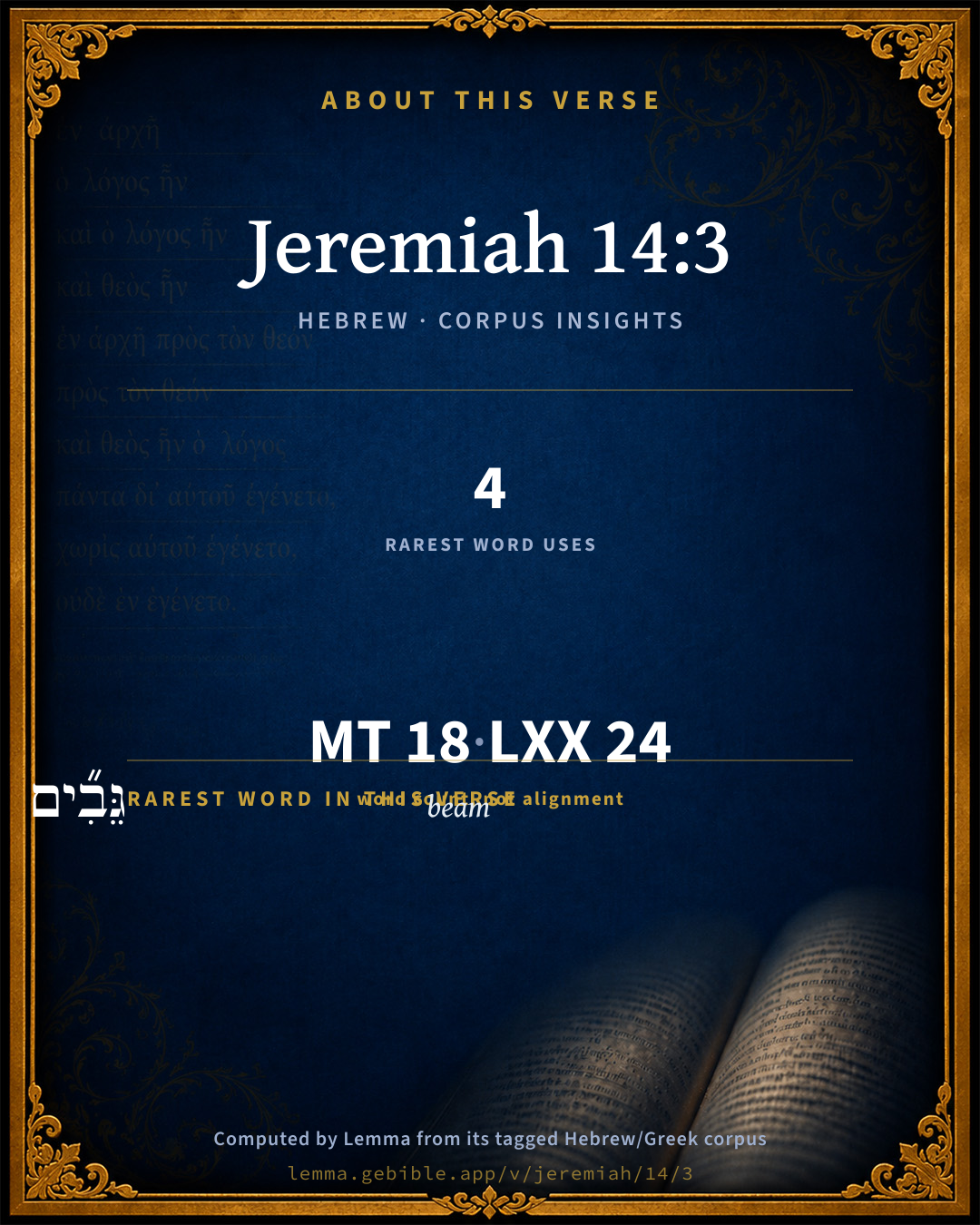
About this verse

These counts appear in no published source. They are computed here, from the morphology-tagged text and Lemma’s own curated glosses. What Lemma adds →

18
words
16
distinct lemmas
Prophets
section

Notable vocabulary

The rarest word here is גֵּבִ֞ים beam H1356 — appearing just 4 times in the whole Hebrew Bible.

Shared distinctive vocabulary

גֵּבִ֞ים beam H1356 occurs in 3 verses of the Hebrew Bible. Also found in:

Grammatical profile

  • 7 verbs
  • 5 nouns
  • 3 adjectives
  • 1 preposition
  • 1 adverb
  • 1 particle

Verb forms

  • שָׁלְח֥וּ Qal · Perfect
  • בָּ֣אוּ Qal · Perfect
  • מָ֣צְאוּ Qal · Perfect
  • שָׁ֤בוּ Qal · Perfect
  • בֹּ֥שׁוּ Qal · Perfect
  • וְהָכְלְמ֖וּ Hophal · Perfect
  • וְחָפ֥וּ Qal · Perfect

Repetition

Words recur within this verse — often emphatic in Hebrew:

  • צעוריהם little H6810 ×2
  • לַמָּ֑יִם water H4325 ×2

Hebrew & Septuagint length

In the original languages it is 18 Hebrew tokens and 24 Greek tokens — but the two are counted differently (Hebrew bundles its prefixes and suffixes into one token; the Greek is in lemma form), so that isn’t a like-for-like length.

Cross-references

16

Topical passages linked to Jeremiah 14:3 in the Treasury of Scripture Knowledge — connected by theme and wording, ordered by reader-vote popularity; previews shown in the World English Bible.

  • 2 Samuel 15:30 David went up by the ascent of the [Mount of] Olives, and wept as he went up; and he had his head covered, and went barefoot: and all the people who were with him covered every man his head, and they went up, weeping as they went up.
  • 2 Kings 18:31 Don't listen to Hezekiah: for thus says the king of Assyria, Make your peace with me, and come out to me; and eat you everyone of his vine, and everyone of his fig tree, and everyone drink the waters of his own cistern;
  • Psalms 40:14 Let them be disappointed and confounded together who seek after my soul to destroy it. Let them be turned backward and brought to dishonor who delight in my hurt.
  • Jeremiah 2:13 For my people have committed two evils: they have forsaken me, the spring of living waters, and hewed them out cisterns, broken cisterns, that can hold no water.
  • Amos 4:8 So two or three cities staggered to one city to drink water, And were not satisfied: Yet you haven't returned to me," says Yahweh.
  • 2 Samuel 19:4 The king covered his face, and the king cried with a loud voice, my son Absalom, Absalom, my son, my son!
  • 1 Kings 17:7 It happened after a while, that the brook dried up, because there was no rain in the land.
  • 1 Kings 18:5–6 Ahab said to Obadiah, Go through the land, to all the springs of water, and to all the brooks: peradventure we may find grass and save the horses and mules alive, that we not lose all the animals.
  • Esther 6:12 Mordecai came again to the king's gate. But Haman hurried to his house, mourning and having his head covered.
  • Job 6:20 They were distressed because they were confident; They came there, and were confounded.
  • Psalms 109:29 Let my adversaries be clothed with dishonor. Let them cover themselves with their own shame as with a robe.
  • Isaiah 45:16–17 They shall be disappointed, yes, confounded, all of them; they shall go into confusion together who are makers of idols.
  • Jeremiah 2:26–27 As the thief is ashamed when he is found, so is the house of Israel ashamed; they, their kings, their princes, and their priests, and their prophets;
  • Jeremiah 14:4 Because of the ground which is cracked, because no rain has been in the land, the plowmen are disappointed, they cover their heads.
  • Jeremiah 20:11 But Yahweh is with me as an awesome mighty one: therefore my persecutors shall stumble, and they shall not prevail; they shall be utterly disappointed, because they have not dealt wisely, even with an everlasting dishonor which shall never be forgotten.
  • Joel 1:20 Yes, the animals of the field pant to you, For the water brooks have dried up, And the fire has devoured the pastures of the wilderness.

Cross-references courtesy of OpenBible.info (CC BY 4.0).

Hebrew and Greek witnesses Masoretic Hebrew ↔ Greek Septuagint

The same verse in the two great witnesses to the Old Testament, shown verse-for-verse.

These are two independent witnesses, not word-aligned to each other, and the Septuagint is shown in lemma (dictionary) form.

Hebrew Jeremiah 14:3 Masoretic · Westminster Leningrad Codex

וְאַדִּ֣רֵיהֶ֔ם שָׁלְח֥וּ צעוריהם צְעִירֵיהֶ֖ם לַמָּ֑יִם בָּ֣אוּ עַל גֵּבִ֞ים לֹא מָ֣צְאוּ מַ֗יִם שָׁ֤בוּ כְלֵיהֶם֙ רֵיקָ֔ם בֹּ֥שׁוּ וְהָכְלְמ֖וּ וְחָפ֥וּ רֹאשָֽׁם

Their nobles send their little ones to the waters: they come to the cisterns, and find no water; they return with their vessels empty; they are disappointed and confounded, and cover their heads.

World English Bible · Public Domain

Greek LXX Structure differs

In the Septuagint, Jeremiah is about an eighth shorter than the Hebrew and arranges its material differently — the Oracles Against the Nations (Hebrew chapters 46–51) appear in the middle of the Greek book, after 25:13. Because the chapter and verse boundaries do not line up, a verse-for-verse comparison with the Hebrew is not shown.

A verse-for-verse comparison isn’t shown here because the chapters and verses don’t line up. Switch to the LXX edition with the MT / LXX toggle above to read the Greek directly.

Hebrew: Westminster Leningrad Codex (CC BY 4.0). Greek: Septuagint (public domain); English from a public-domain English Septuagint. How the Septuagint differs from the Hebrew →

Targum (Aramaic paraphrase)

1

The Targum is the ancient Jewish Aramaic paraphrase of the Hebrew Scriptures — an interpretive translation, not the Hebrew text itself. Onkelos (literal) and Pseudo-Jonathan (expansive) render the Torah, and Jonathan the Prophets. Coverage is partial: where no permissively-licensed English translation exists for a verse, only the Aramaic is shown. This is verse-level text, not a word-by-word alignment to the Hebrew.

  1. Targum Jonathan Prophets (Joshua–Malachi)
    וְתַקִיפֵיהוֹן שְׁלָחוּ תִנְיָנֵיהוֹן לְמַיָא אָתוֹ עַל פְּצִידַיָא וְלָא אַשְׁכָּחוּ מַיָא תָּבוּ מָנֵיהוֹן רֵיקָן בְּהִיתוּ וְאִתְכְּנָעוּ וַחֲפוֹ רֵישֵׁיהוֹן:

    (no public-domain English translation for this verse)

    Targum Jonathan — Aramaic: “Mikraot Gedolot” (public domain). English: “Sefaria Community Translation” (CC0 1.0 (public-domain dedication)); “London "Chaldee Paraphrase," 1871” (public domain). Text via Sefaria.

Commentary

Notes on Jeremiah 14:3 from classic Christian and Jewish commentators (each source and its license shown beneath its notes). The classic Christian expositions comment on the surrounding passage and are grouped to its opening verse, so a note may address several verses; the Jewish commentaries on the Tanakh (Rashi and others) are per-verse, so they appear only where the commentator wrote on this verse.

Lemma curates 59 commentaries, every one of them public domain or Creative Commons licensed, each selected and text-cleaned for this edition rather than reprinted as found. About our sources →

Trapp's Complete Commentary

John Trapp

Jer 14:3 And their nobles have sent their little ones to the waters: they came to the pits, [and] found no water; they returned with their vessels empty; they were ashamed and confounded, and covered their heads.

Ver. 3. And their nobles.] Who would be sure to have it if it were to be had.

Sent their little ones.] Their boys, as they used to call their menial servants of the younger sort. See Mat 14:2. {See Trapp on "Mat 14:2"}

To the waters.] Such as were the waters of Siloe, which only fountain, saith Jerome, Jerusalem maketh use of so long as it lasteth.

To the pits,] Or, Cisterns. {Jer 2:13}

They covered their heads.] As close mourners do still.

John Trapp, A Commentary or Exposition upon All the Books of the Old and New Testament (1647–1656) — public domain. Text from a community e-Sword module.

Joseph Benson's Commentary

Jer 14:3-6. And their nobles, &c. — This scarcity of water afflicted not poor persons only, who had not such means of supplying their necessities as the rich; but the greatest among them, who sent their little ones, (or inferiors, as צעיריהם, seems here rather to signify,) to the places made to receive and retain water; who, finding none, returned with their vessels empty, like persons ashamed, and troubled upon seeing their expectations frustrated. Jerusalem, it must be observed, was supplied with water by two lakes, or pools, termed the upper pool, and the lower pool; Isa 7:3; and Isa 22:9; from which the water was conveyed by pipes or conduits, for the use of the city. Because the ground is chapt — Hebrew, חתה, broken, bruised, turned into dust. The ploughmen — The husbandmen, as אכרים, properly signifies; were ashamed — Disappointed in their hopes of reaping fruit from their labours. They covered their heads — An expression of great affliction and mourning. The hind also calved and forsook it — The hinds are loving creatures, and as all creatures, by a natural instinct, love their young, so the hinds especially; but their moisture being dried up, they had not milk for them, but were forced to leave them, and to run hither and thither to seek grass to eat. And the wild asses, &c. — The wild asses, wanting water, got upon the high places, or cliffs, where the air was cooler and its current stronger than in lower places, and their sucked in the wind; and this, it is said, they did like dragons, which are reputed to delight in cool places, and are said by Aristotle and Pliny to stand frequently upon high places imbibing the cool air. Their eyes did fail, &c. — They languished, or pined away for want of food; in which case the natural splendour of the eyes, which is very great in wild asses, grows dull or languid.

Joseph Benson's Commentary on the Old and New Testaments (1811–1818) — public domain. Text from a community e-Sword module.

Geneva Bible (1599)

Geneva Bible translators

To wit, with ashes in token of sorrow.

Geneva Bible (1599) marginal notes — public domain. Text via Bolls.life.

Jamieson, Fausset & Brown

Robert Jamieson, A. R. Fausset & David Brown

little ones--rather, "their inferiors," that is, domestics.

pits--cisterns for collecting rain water, often met with in the East where there are no springs.

covered . . . heads-- (Sa2 15:30). A sign of humiliation and mourning.

Jamieson, Fausset & Brown — Commentary Critical and Explanatory on the Whole Bible (1871) — public domain (CC PDM 1.0). Text via the HelloAO Bible API.

Adam Clarke's Commentary

Verse 3. Their nobles have sent their little ones] So general was this calamity, that the servants no longer attended to their lords, but every one was interested alone for himself; and the nobles of the land were obliged to employ their own children to scour the land, to see if any water could be found in the tanks or the pits. In the dearth in the time of Elijah, Ahab the king, and Obadiah his counsellor, were obliged to traverse the land themselves, in order to find out water to keep their cattle alive. This and the three following verses give a lively but distressing picture of this dearth and its effects.

Adam Clarke's Commentary on the Bible (1810–1826) — public domain. Text from a community e-Sword/MySword module.

John Calvin's Commentaries

It is then added, Their chiefs will send the common people to the waters The Prophet’s object was again to point out something extraordinary, — that the great, possessing authority, would constrain and compel the common sort to draw water. They have sent them, he says, that is, by authority; they who could command others sent them to the waters. They came, he says, to the cisterns By the word גבים gabim, he means deep ditches, or pits; but some render them cisterns. With regard to the subject in hand, it signifies not; for the Prophet no doubt meant that they would come to the deepest wells or pits, as it is usually done ia a great drought; for many springs become often dry, and pits also, situated in high places; but in valleys some water remains, and there it may be had: there are also some wells ever full of water, where its abundance never fails. It was therefore the Prophet’s design to refer to such wells. They came, he says, to the wells, where they thought they could find a sufficient supply; but he adds, They found no waters; they returned with their empty vessels

We now perceive what I have said, — that the Prophet here reproves the Jews for their stupidity in not understanding that God was angry with them when the order of nature, which ought ever to continue the same, thus failed. Droughts indeed often happen when there are no waters in most places; but when no well supplies any water, when there is not a drop of water to be found in the most favorable places, then indeed it ought to be concluded that God’s curse is on the people, who find nothing to drink; for in nothing does God deal more bountifully with the world than in the supply of water. We do not speak now of wine; but we see fountains everywhere pouring forth waters, and rivers also flow through countries: moreover, pits are dug through the labors of men; there are also cisterns in which the rain is preserved in places that are commonly dry: but when in cisterns no water remains, and when the fountains themselves refuse any supply, we may hence surely know that it is the special judgment of God; and this is what Jeremiah intended here to shew; and therefore he says that they were confounded and ashamed, and that they covered their head It now follows —

John Calvin's Commentaries (1540-1563) — public domain. Text from the Calvin Translation Society English edition (1840s-50s) via the Christian Classics Ethereal Library (ccel.org). Calvin's coverage is partial (roughly two-thirds of the Bible); uncommented books and verses are honest gaps, never fabricated. The 19th-century editor's footnotes and remarks are omitted so the notes are faithfully Calvin's own voice.

Ellicott's Commentary for English Readers

(3) Their little ones.—Not their children, but their menial servants. The word is peculiar to Jeremiah, and occurs only here and in Jer_48:4. The vivid picture of the messengers running hither and thither to all wells, and springs, and tanks, reminds us of Ahab’s search for wells or springs in the time of the great drought of his reign (1Ki_18:5), of the “two or three cities wandering” to the one city that was yet supplied with water of Amo_4:8.

The pits.—The tanks or reservoirs where, if anywhere, water might be looked for.

Covered their heads.—The extremest sign of a grief too great to utter itself to others, craving to be alone in its wretchedness (2Sa_15:30; 2Sa_19:4). The student will recollect it as occurring also in the account of the painting of Agamemnon at the Sacrifice of Iphigenia, ascribed to Timanthes.

A Bible Commentary for English Readers, edited by Charles John Ellicott (1878–1897) — public domain. Text from a community e-Sword module.

The Cambridge Bible for Schools and Colleges

gen. ed. J. J. S. Perowne

3. little ones] rather, as mg. inferiors, i.e. servants.

pits] cisterns, or tanks, where the water was kept till wanted for use. See on ch. Jer_2:13.

ashamed] See on Jer_2:26.

cover their heads] as a sign of the greatest grief or confusion. Cp. 2Sa_15:30; Est_6:12.

The Cambridge Bible for Schools and Colleges (gen. ed. J. J. S. Perowne; Cambridge University Press, 1878–1918) — public domain. Text from a community e-Sword module.

John Gill's Exposition

And their nobles have sent their little ones to the waters,.... To places where water used to be; to the pools, the upper and the lower, particularly to the fountain of Shiloah, which, Jerom says, was the only one the city of Jerusalem used. The meaning either is, that the nobles in Jerusalem sent their own children to get water for them, they having no servants to attend them, these being put away because they could not support them, the famine being so sore; or rather that they sent their menial servants, their subjects, as the Targum renders it, to fetch them a little water to refresh themselves with:

they came to the pits and found no water; their servants came according to order to the pools and cisterns, or to the deep wells, and to such places where there used to be a great confluence of water, and plenty of it, but now they could find none:

they returned with their vessels empty; just as they came:

they were ashamed and confounded; either the servants that were sent, or rather their masters that sent them, when they saw them come with their empty vessels; having been looking out and longing for their return, expecting they would have brought water with them for their refreshment; but to their great disappointment and confusion brought none:

and covered their heads; as persons ashamed, or as mourners used to do, being full of anguish and distress because of the drought.

John Gill's Exposition of the Whole Bible (1746–1763) — public domain (CC PDM 1.0). Text via the HelloAO Bible API.

Albert Barnes' Notes on the Bible

Little ones - mean ones, the common people. The word is unique to Jeremiah Jer 48:4.

The pits - i. e., tanks for holding water.

Covered their heads - The sign of grief.

Albert Barnes' Notes on the Bible (1834–1885) — public domain. Text from a community e-Sword/MySword module.

Haydock's Catholic Bible Commentary

Water. Siloe was the only spring near, and it was often dry, (St. Jerome) though it was formerly abundant, (Josephus, Jewish Wars vi. 6.) as well as the fountain of Gehon. The city was furnished with cisterns. (Calmet) --- But all was now dry. (Haydock) --- Heads; mourning, 2 Kings xv. 30.

George Leo Haydock (1774–1849), Haydock's Catholic Family Bible and Commentary, 1859 edition — public domain. Excludes Psalms (Douay-Rheims chapter numbering differs from Protestant) and Deuterocanonical books (Catholic canon only).

Matthew Poole's English Annotations

This scarcity of water afflicted not mean persons only, who have not so good means to supply their necessities as others; but their greatest persons; so as they sent their

little ones (it were better translated servants, for they are meant) to the places made to receive and retain water; but finding no water in the pits, they came back again with their vessels empty, like men ashamed and confounded, and troubled upon the seeing their expectations frustrated.

Matthew Poole's English Annotations on the Holy Bible (1683–1685) — public domain. Text from a community e-Sword/MySword module.

Whedon's Commentary on the Bible

Daniel D. Whedon

3. Little ones — Not children, but the common people, in contrast with the nobles — the great ones. The word is used besides only in chap. Jer_48:4.

Pits — Cisterns.

Covered their heads — “Covering the head is a token of deep grief turned in upon itself. See 2Sa_15:30; 2Sa_19:5.” — Keil.

Daniel D. Whedon (gen. ed.), Commentary on the Old and New Testaments (1874–1909) — public domain. Text from a community e-Sword module.

The Pulpit Commentary

Their nobles i.e. the upper classes of Judah and Jerusalemhave sent their little ones; rather, their mean ones; i.e. their servants, or perhaps (as Naegelsbach and Payne Smith) simply, "the common people;" it was not a matter concerning the rich alone. To the pits; i.e. to the cisterns. Covered their heads; a sign of the deepest mourning. (2Sa_15:30 2Sa_19:4 Est_6:12)

The Pulpit Commentary (1880–1919), ed. H.D.M. Spence-Jones & Joseph S. Exell — public domain. Text from a community e-Sword module.

Rashi

Rabbi Shlomo Yitzchaki (Rashi)

upon pits Pits in which the water is usually gathered.

their vessels have returned empty for no rain has fallen.

and have covered an expression of covering.

Rashi on the Tanakh — English translations: “The Judaica Press complete Tanach with Rashi, translated by A. J. Rosenberg” (CC BY 4.0); “Pentateuch with Rashi's commentary by M. Rosenbaum and A.M. Silbermann, 1929-1934” (public domain); “The Metsudah Tanach series, Lakewood, N.J” (CC BY 4.0); and “The Book of Joshua, Metsudah Publications, 1997” (CC BY 4.0). Text via Sefaria.

Lesson kit

Teaching starters — assembled from the data on this page, not authored interpretation. Every prompt links to the verse data it draws on. Edit before teaching.

Jeremiah, in the Prophets, opens this verse with 18 words (16 distinct Hebrew lemmas). Its most distinctive word is gêb (“beam”). A historical commentator’s framing appears above. Read the whole chapter for the surrounding context.

Discussion questions

  1. The word gêb carries the sense “beam.” How does it shape the verse?
  2. How does 1 Kings 6:9, which shares the word «beam», read alongside this verse?
  3. What does the repetition of “little” (2× in this one verse) do in this verse?
  4. The translations on this page render this verse differently — a whole-verse word diff, not a word-by-word alignment. What might account for the different wordings?
  5. «שָׁלְח֥וּ» is a Qal Perfect verb. How does that grammatical form shape the action described?
  6. Compare how Trapp's Complete Commentary and Joseph Benson's Commentary read this verse. Where do they agree or differ?

Things to notice

Reading settings

Reading text

Shown beneath each verse's original-language words.

Old Testament
Old Testament edition

Read the OT as the Masoretic Hebrew (MT) or the Greek Septuagint (LXX).

English shown for the Greek Septuagint (in the Hebrew ↔ Greek comparison).

Comparing translations? Open the Compare panel on any verse page to stack up to four side by side.