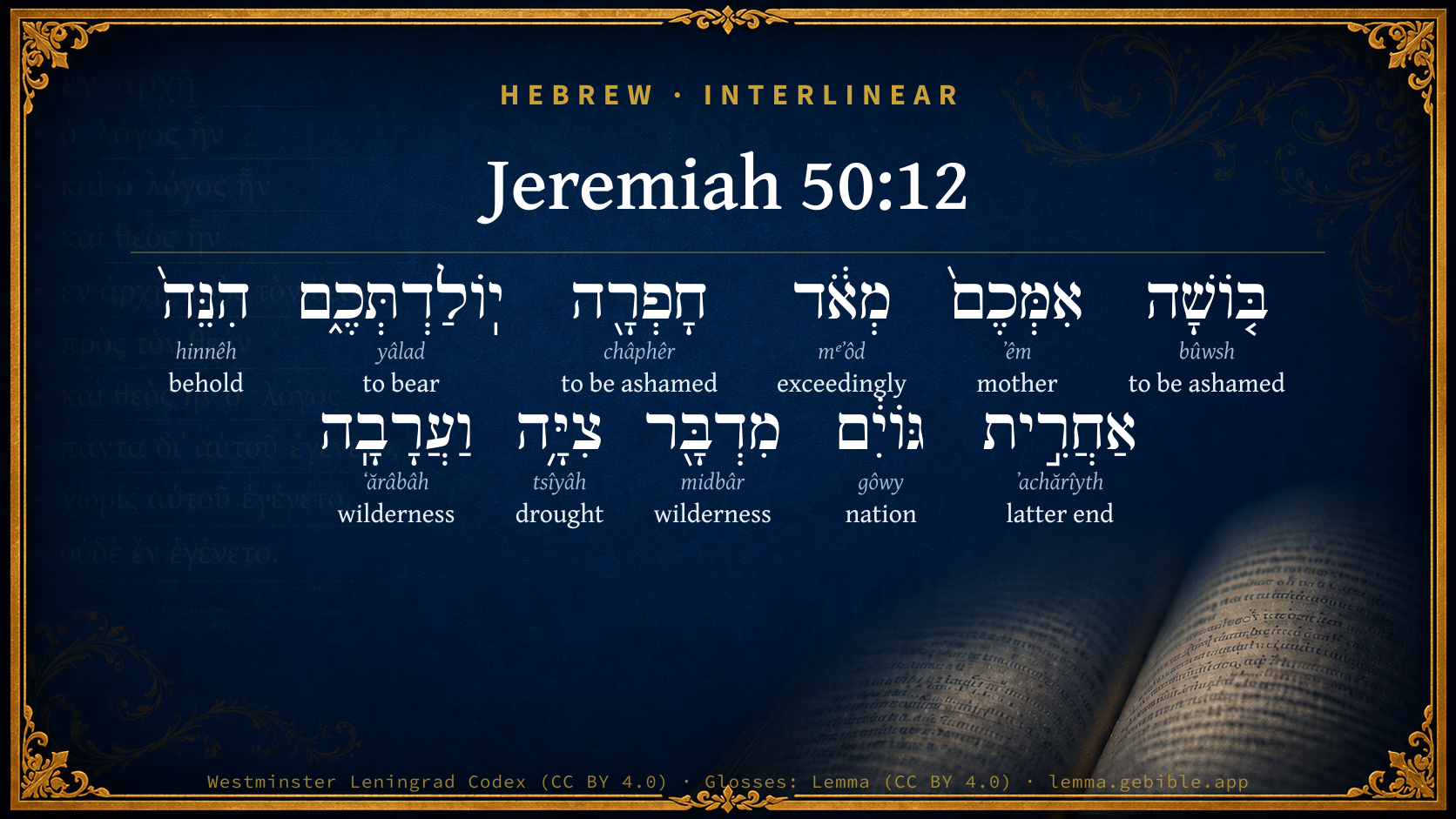
Jeremiah 50:12

Hebrew (Westminster Leningrad Codex) Jeremiah 50:12 appears in the Hebrew Old Testament. The text above is from the Westminster Leningrad Codex. Each word links to its Strong’s number, a concise gloss, and parsing drawn from the Open Scriptures Hebrew Bible morphology. Click any word for its full Brown-Driver-Briggs (BDB) entry.
Download image
Cite this verse

Jeremiah 50:12 (World English Bible). Public Domain. Lemma interlinear Bible study tool, https://lemma.gebible.app/v/jeremiah/50/12.

Show BibTeX & RIS
BibTeX
RIS
English Translation
your mother shall be utterly disappointed; she who bore you shall be confounded: behold, she shall be the least of the nations, a wilderness, a dry land, and a desert.
World English Bible · Public Domain
Download a study sheet

One document with this verse’s original text, its word-by-word gloss line, the meaning frame, cross-references with their text, attributed commentary, and full source and license credits — printable, and it pastes into notes with its structure intact.

This verse Autodidact and up

Study sheet (.html) Plain text (.txt)

A passage Seminary Student

Up to 50 verses in one chapter. A passage sheet keeps up to 6 commentary sources and 12 cross-references per verse, in the order this page ranks them, and says so on the sheet whenever that leaves anything out. Ask for a single verse and you get the Autodidact verse sheet above.

Everything on this page stays free to read, with no account — the sheet is a download of what is already on screen, not access to it.

Want to remove ads? Support Godless Engineer
Compare translations 3

The same verse in 3 English versions, stacked beneath the original-language interlinear above. Click any original word for its lexicon entry.

Each is an independent rendering of the whole verse — the interlinear is not word-aligned to these translations.

Highlighted words mark where these versions differ — a whole-verse word diff, not a word-by-word alignment.

  • World English Bible Public Domain
    your mother shall be utterly disappointed; she who bore you shall be confounded: behold, she shall be the least of the nations, a wilderness, a dry land, and a desert.
  • King James Version Public Domain
    Your mother shall be sore confounded; she that bare you shall be ashamed: behold, the hindermost of the nations shall be a wilderness, a dry land, and a desert.
  • unfoldingWord Literal Text CC BY-SA 4.0
    So your mother will be greatly ashamed; the one who bore you will be embarrassed. See, she will be the least of nations, a wilderness, a dry land, and a desert.

unfoldingWord Literal Text — © unfoldingWord, licensed CC BY-SA 4.0. Word-aligned USFM3 via Door43 (git.door43.org/unfoldingWord/en_ult).

Versions to compare (up to 4)

3 of 4 selected

Show all 18 translations

Every available English version of this verse, each an independent rendering of the whole verse.

  • World English Bible Public Domain
    your mother shall be utterly disappointed; she who bore you shall be confounded: behold, she shall be the least of the nations, a wilderness, a dry land, and a desert.
  • Berean Standard Bible Public Domain
    your mother will be greatly ashamed; she who bore you will be disgraced. Behold, she will be the least of the nations, a wilderness, a dry land, and a desert.
  • Majority Standard Bible Public Domain
    your mother will be greatly ashamed; she who bore you will be disgraced. Behold, she will be the least of the nations, a wilderness, a dry land, and a desert.
  • King James Version Public Domain
    Your mother shall be sore confounded; she that bare you shall be ashamed: behold, the hindermost of the nations shall be a wilderness, a dry land, and a desert.
  • American Standard Version (1901) Public Domain
    your mother shall be utterly put to shame; she that bare you shall be confounded: behold, she shall be the hindermost of the nations, a wilderness, a dry land, and a desert.
  • Revised Version (1885) Public Domain
    your mother shall be sore ashamed; she that bare you shall be confounded: behold, she shall be the hindermost of the nations, a wilderness, a dry land, and a desert.
  • Geneva Bible (1599) Public Domain
    Therefore your mother shall bee sore confounded, and she that bare you, shall be ashamed: beholde, the vttermost of the nations shalbe a desert, a drie land, and a wildernes.
  • Douay-Rheims (1899) Public Domain
    Your mother is confounded exceedingly, and she that bore you is made even with the dust: behold she shall be the last among the nations, a wilderness unpassable, and dry.
  • Young's Literal Translation Public Domain
    Ashamed hath been your mother greatly, Confounded hath she been that bare you, Lo, the hindermost of nations `is' a wilderness, A dry land, and a desert.
  • Literal Standard Version CC BY-SA 4.0
    Your mother has been greatly ashamed, || She who bore you has been confounded, || Behold, the last of nations [is] a wilderness, || A dry land, and a desert.
  • Unlocked Literal Bible CC BY-SA 4.0
    So your mother will be greatly ashamed; the one who bore you will be embarrassed. See, she will be the least of nations, a wilderness, a dry land, and a desert.
  • unfoldingWord Literal Text CC BY-SA 4.0
    So your mother will be greatly ashamed; the one who bore you will be embarrassed. See, she will be the least of nations, a wilderness, a dry land, and a desert.
  • Darby Bible Public Domain
    Your mother hath been sorely put to shame; she that bore you hath been covered with reproach: behold, [she is become] hindmost of the nations, a wilderness, a dry land, and a desert.
  • World Messianic Bible Public Domain
    your mother will be utterly disappointed. She who bore you will be confounded. Behold, she will be the least of the nations, a wilderness, a dry land, and a desert.
  • Webster's Bible Public Domain
    Your mother shall be greatly confounded; she that bore you shall be ashamed: behold, the hindermost of the nations shall be a wilderness, a dry land, and a desert.
  • Free Bible Version CC BY-SA 4.0
    you are going to bring shame on your mother, you are going to disgrace the one who gave birth to you. Watch as she becomes the least important of all the nations, a wilderness, a dry desert land.
  • Bible in Basic English Public Domain
    Your mother will be put to shame; she who gave you birth will be looked down on: see, she will be the last of the nations, a waste place, a dry and unwatered land.
  • JPS Tanakh (1917) Public Domain
    Your mother shall be sore ashamed, she that bore you shall be confounded; behold, the hindermost of the nations shall be a wilderness, a dry land, and a desert.

Literal Standard Version (2020), Covenant Press — licensed CC BY-SA 4.0. Text via the HelloAO Bible API (eBible.org). Unlocked Literal Bible (unfoldingWord) — licensed CC BY-SA 4.0. Text via the HelloAO Bible API (eBible.org). unfoldingWord Literal Text — © unfoldingWord, licensed CC BY-SA 4.0. Word-aligned USFM3 via Door43 (git.door43.org/unfoldingWord/en_ult). Free Bible Version, Dr. Jonathan Gallagher — licensed CC BY-SA 4.0. Text via the HelloAO Bible API (eBible.org).

Word by word

More ways to search: Search by grammar → Find every occurrence → Compare this word →

Practice this passage: Drill this verse → Learn its vocabulary →

צִיָּ֥ה
tsîyâh
H6723
“drought”
Noun, Common, Feminine, Singular, Absolute
Part of Speech
Noun
Type
Common
Gender
Feminine
Number
Singular
State
Absolute
Full BDB Definition

Origin: from an unused root meaning to parch

TWOT: 1909a

dryness, drought, desert
  1. בּ֤וֹשָׁה bûwsh H954 “to be ashamed” Verb, Qal, Perfect, 3rd Person, Feminine, Singular
  2. אִמְּכֶם֙ ʼêm H517 “mother · your” Noun, Common, Feminine, Singular, Construct + Suffix, Personal, 2nd Person, Masculine, Plural
  3. מְאֹ֔ד mᵉʼôd H3966 “exceedingly” Adverb
  4. חָפְרָ֖ה châphêr H2659 “to be ashamed” Verb, Qal, Perfect, 3rd Person, Feminine, Singular
  5. יֽוֹלַדְתְּכֶ֑ם yâlad H3205 “bearing · you” Verb, Qal, Participle Active, Feminine, Singular, Construct + Suffix, Personal, 2nd Person, Masculine, Plural
  6. הִנֵּה֙ hinnêh H2009 “behold” Particle, Demonstrative
  7. אַחֲרִ֣ית ʼachărîyth H319 “latter end of” Noun, Common, Feminine, Singular, Construct
  8. גּוֹיִ֔ם gôwy H1471 “nations” Noun, Common, Masculine, Plural, Absolute
  9. מִדְבָּ֖ר midbâr H4057 “wilderness” Noun, Common, Masculine, Singular, Absolute
  10. וַעֲרָבָֽה ʻărâbâh H6160 “and · wilderness” Conjunction + Noun, Common, Feminine, Singular, Absolute

About this verse

These counts appear in no published source. They are computed here, from the morphology-tagged text and Lemma’s own curated glosses. What Lemma adds →

11
words
11
distinct lemmas
Prophets
section

Notable vocabulary

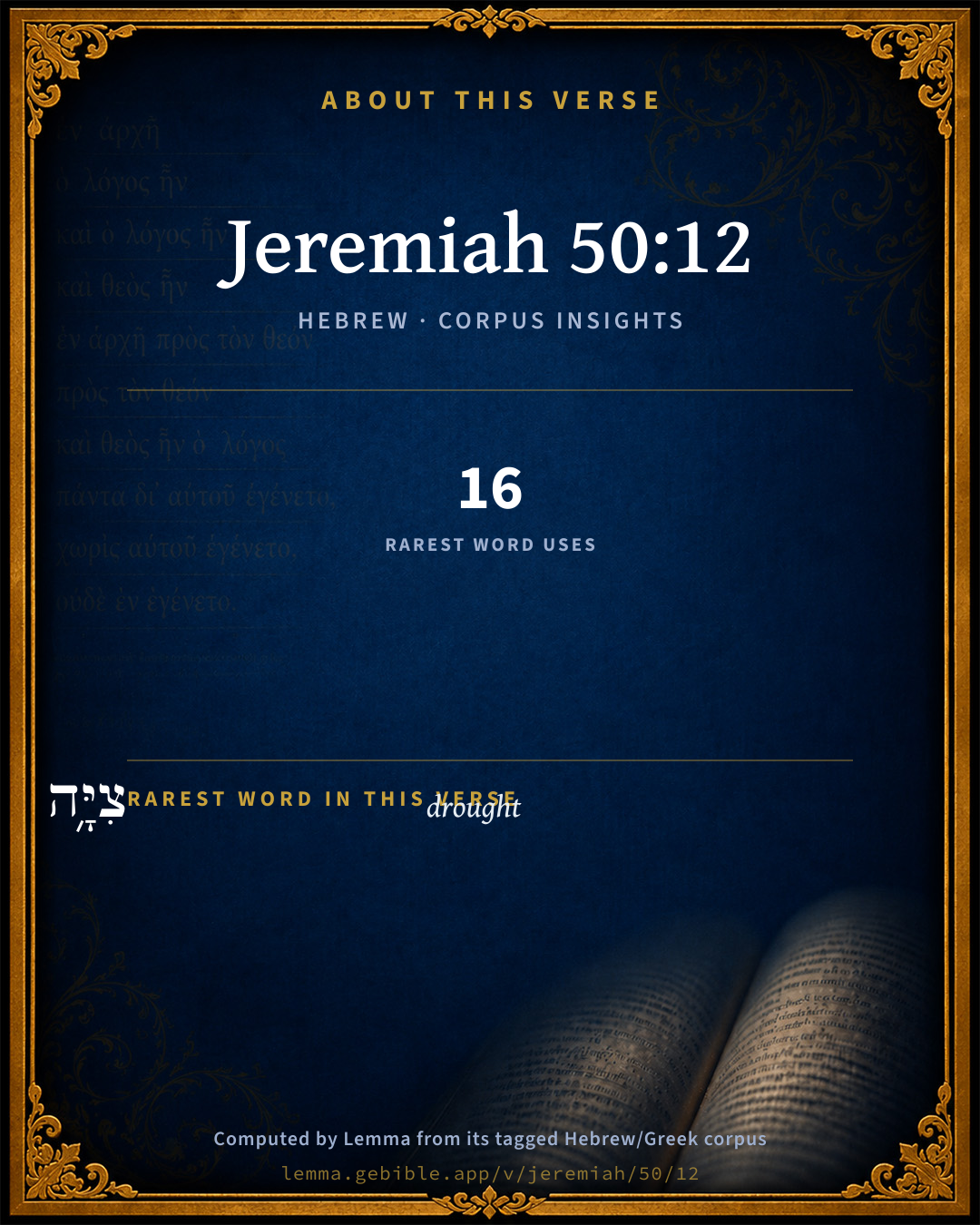
The rarest word here is צִיָּ֥ה drought H6723 — appearing just 16 times in the whole Hebrew Bible.

Shared distinctive vocabulary

צִיָּ֥ה drought H6723 occurs in 16 verses of the Hebrew Bible. Also found in:

Grammatical profile

  • 3 verbs
  • 6 nouns
  • 1 adverb
  • 1 particle

Verb forms

  • בּ֤וֹשָׁה Qal · Perfect
  • חָפְרָ֖ה Qal · Perfect
  • יֽוֹלַדְתְּכֶ֑ם Qal · Participle Active

Cross-references

13

Topical passages linked to Jeremiah 50:12 in the Treasury of Scripture Knowledge — connected by theme and wording, ordered by reader-vote popularity; previews shown in the World English Bible.

  • Jeremiah 51:43 Her cities are become a desolation, a dry land, and a desert, a land in which no man dwells, neither does any son of man pass thereby.
  • Isaiah 13:20–22 It shall never be inhabited, neither shall it be lived in from generation to generation: neither shall the Arabian pitch tent there; neither shall shepherds make their flocks to lie down there.
  • Isaiah 14:22 I will rise up against them, says Yahweh of Hosts, and cut off from Babylon name and remnant, and son and son's son, says Yahweh.
  • Isaiah 23:13 Behold, the land of the Chaldeans: this people was not; the Assyrian founded it for those who dwell in the wilderness; they set up their towers; they overthrew the palaces of it; they made it a ruin.
  • Jeremiah 25:12 It shall happen, when seventy years are accomplished, that I will punish the king of Babylon, and that nation, says Yahweh, for their iniquity, and the land of the Chaldeans; and I will make it desolate forever.
  • Jeremiah 25:26 and all the kings of the north, far and near, one with another; and all the kingdoms of the world, which are on the surface of the earth: and the king of Sheshach shall drink after them.
  • Jeremiah 49:2 Therefore, behold, the days come, says Yahweh, that I will cause an alarm of war to be heard against Rabbah of the children of Ammon; and it shall become a desolate heap, and her daughters shall be burned with fire: then shall Israel possess those who did possess him, says Yahweh.
  • Jeremiah 50:35–40 A sword is on the Chaldeans, says Yahweh, and on the inhabitants of Babylon, and on her princes, and on her wise men.
  • Jeremiah 51:25–26 Behold, I am against you, destroying mountain, says Yahweh, which destroy all the earth; and I will stretch out my hand on you, and roll you down from the rocks, and will make you a burnt mountain.
  • Jeremiah 51:62–64 and say, Yahweh, you have spoken concerning this place, to cut it off, that none shall dwell therein, neither man nor animal, but that it shall be desolate forever.
  • Galatians 4:26 But the Jerusalem that is above is free, which is the mother of us all.
  • Revelation 17:5 And on her forehead a name was written, "MYSTERY, BABYLON THE GREAT, THE MOTHER OF THE PROSTITUTES AND OF THE ABOMINATIONS OF THE EARTH."
  • Revelation 18:21–23 A mighty angel took up a stone like a great millstone and cast it into the sea, saying, "Thus with violence will Babylon, the great city, be thrown down, and will be found no more at all.

Cross-references courtesy of OpenBible.info (CC BY 4.0).

Hebrew and Greek witnesses Masoretic Hebrew ↔ Greek Septuagint

The same verse in the two great witnesses to the Old Testament, shown verse-for-verse.

These are two independent witnesses, not word-aligned to each other, and the Septuagint is shown in lemma (dictionary) form.

Hebrew Jeremiah 50:12 Masoretic · Westminster Leningrad Codex

בּ֤וֹשָׁה אִמְּכֶם֙ מְאֹ֔ד חָפְרָ֖ה יֽוֹלַדְתְּכֶ֑ם הִנֵּה֙ אַחֲרִ֣ית גּוֹיִ֔ם מִדְבָּ֖ר צִיָּ֥ה וַעֲרָבָֽה

your mother shall be utterly disappointed; she who bore you shall be confounded: behold, she shall be the least of the nations, a wilderness, a dry land, and a desert.

World English Bible · Public Domain

Greek LXX Structure differs

In the Septuagint, Jeremiah is about an eighth shorter than the Hebrew and arranges its material differently — the Oracles Against the Nations (Hebrew chapters 46–51) appear in the middle of the Greek book, after 25:13. Because the chapter and verse boundaries do not line up, a verse-for-verse comparison with the Hebrew is not shown.

A verse-for-verse comparison isn’t shown here because the chapters and verses don’t line up. Switch to the LXX edition with the MT / LXX toggle above to read the Greek directly.

Hebrew: Westminster Leningrad Codex (CC BY 4.0). Greek: Septuagint (public domain); English from a public-domain English Septuagint. How the Septuagint differs from the Hebrew →

Targum (Aramaic paraphrase)

1

The Targum is the ancient Jewish Aramaic paraphrase of the Hebrew Scriptures — an interpretive translation, not the Hebrew text itself. Onkelos (literal) and Pseudo-Jonathan (expansive) render the Torah, and Jonathan the Prophets. Coverage is partial: where no permissively-licensed English translation exists for a verse, only the Aramaic is shown. This is verse-level text, not a word-by-word alignment to the Hebrew.

  1. Targum Jonathan Prophets (Joshua–Malachi)
    בְּהִיתַת כְּנִישַׁתְכוֹן לַחֲדָא אִתְבָרַת מְדִינַתְכוֹן הָא סוֹפְהוֹן דְעַמְמַיָא מִדְבָּר צָדֵי וַחֲרוֹב:

    (no public-domain English translation for this verse)

    Targum Jonathan — Aramaic: “Mikraot Gedolot” (public domain). English: “Sefaria Community Translation” (CC0 1.0 (public-domain dedication)); “London "Chaldee Paraphrase," 1871” (public domain). Text via Sefaria.

Commentary

Notes on Jeremiah 50:12 from classic Christian and Jewish commentators (each source and its license shown beneath its notes). The classic Christian expositions comment on the surrounding passage and are grouped to its opening verse, so a note may address several verses; the Jewish commentaries on the Tanakh (Rashi and others) are per-verse, so they appear only where the commentator wrote on this verse.

Lemma curates 59 commentaries, every one of them public domain or Creative Commons licensed, each selected and text-cleaned for this edition rather than reprinted as found. About our sources →

Trapp's Complete Commentary

John Trapp

Jer 50:12 Your mother shall be sore confounded; she that bare you shall be ashamed: behold, the hindermost of the nations [shall be] a wilderness, a dry land, and a desert.

Ver. 12. Your mother shall be sore confounded,] i.e., Babylon, your mother city, or Babylonia, your country; or your monarchical greatness, which being in the last place laid waste after other nations, {as Jer 25:25-26 was foretold} shall with shame cry out, Heu tam cito me quae primas obtinebam, &c. How is it that I, who was the head of nations, am now the tail, &c.

John Trapp, A Commentary or Exposition upon All the Books of the Old and New Testament (1647–1656) — public domain. Text from a community e-Sword module.

Joseph Benson's Commentary

Jer 50:12-16. Your mother shall be sore confounded — Namely, Babylon the metropolis, or mother-city of the empire. Or, your country shall be ashamed of you, her children, who are not able to defend her. Behold, the hindermost of the nations, &c. — The translation of this clause in the Vulgate seems much preferable to ours, Ecce novissima erit in gentibus, et deserta, invia, et arens, behold, she shall be the hindermost of the nations, a wilderness, desolate and dry. Because of the wrath of the Lord, it shall not be inhabited — See this illustrated in the notes on Isa 13:19-22. Every one that goeth by Babylon shall be astonished — See note on chap. Jer 18:16. For she hath sinned against the Lord — She hath been in a remarkable manner an enemy to God’s truth and people. This may be especially applied to mystical Babylon: see Jer 50:29-31. Shout against her round about — As conquerors do when a city is taken. She hath given her hand — That is, she hath surrendered herself: she hath submitted and promised obedience to the conqueror. The phrase occurs in the same sense Lam 5:6 and also 1Ch 29:24, where see the margin. Thus, dare manus, to give the hands, in Latin, signifies to yield; and most probably alludes to the act of the vanquished, who, throwing down his arms, and stretching forth his defenceless hands, acknowledges himself to be in the victor’s power; her foundations are fallen — Namely, the foundations of her walls, laid in a marshy soil, and surrounded with a deep ditch full of water, to the undermining power of which they were continually exposed: see Herodot. lib. 1. cap. 178. Cut off the sower from Babylon — “Babylon resembled a country walled in rather than a city; the walls, according to Herodotus, being sixty miles in compass. Within this large circuit a great deal of ground was cultivated with corn. So that enough grew within the walls to support the inhabitants during a long siege.” — See Prideaux’s Connections, page 187. Or, by Babylon here, may be understood, not the city only, but the whole province. They shall turn every one to his people — This is spoken of the allies of the Babylonians.

Joseph Benson's Commentary on the Old and New Testaments (1811–1818) — public domain. Text from a community e-Sword module.

Tyndale Open Study Notes

Tyndale Open Resources

50:12 The divine Judge rendered his verdict, describing the disgrace of a defeated Babylon.

Tyndale Open Study Notes — © Tyndale Open Resources, licensed CC BY-SA 4.0. Text via the HelloAO Bible API.

Jamieson, Fausset & Brown

Robert Jamieson, A. R. Fausset & David Brown

Your mother--Babylon, the metropolis of the empire.

hindermost--marvellous change, that Babylon, once the queen of the world, should be now the hindermost of nations, and at last, becoming "a desert," cease to be a nation!

Jamieson, Fausset & Brown — Commentary Critical and Explanatory on the Whole Bible (1871) — public domain (CC PDM 1.0). Text via the HelloAO Bible API.

Adam Clarke's Commentary

Verse 12. Your mother] Speaking to the Chaldeans: BABYLON, the metropolis, or mother city, shall be a wilderness, a dry land, a desert, neither fit for man nor beast.

Adam Clarke's Commentary on the Bible (1810–1826) — public domain. Text from a community e-Sword/MySword module.

John Calvin's Commentaries

WE explained yesterday why the Prophet denounced shame and reproach on the Babylonians, even because they had arrogantly exulted over the children of God. And he says that Babylon would be the extremity of the Nations.

The Chaldeans had flourished in power and wealth, and possessed the empire of the East. It was then an extraordinary revolution to be reduced to the lowest condition, to be, as it were, the dregs of all the nations. And to the same purpose he adds, a barren land, a desert, and a solitude It now follows, —

John Calvin's Commentaries (1540-1563) — public domain. Text from the Calvin Translation Society English edition (1840s-50s) via the Christian Classics Ethereal Library (ccel.org). Calvin's coverage is partial (roughly two-thirds of the Bible); uncommented books and verses are honest gaps, never fabricated. The 19th-century editor's footnotes and remarks are omitted so the notes are faithfully Calvin's own voice.

Ellicott's Commentary for English Readers

(12) Your mother shall be sore confounded . . .—The prophet speaks to the people of Babylon, and the city is therefore described as their mother.

The hindermost of the nations shall be a wilderness . . .—The interpolated words mar the force of the sentence. Better, behold the hindermost of the nations, a wilderness, a waste, and a desert. This was to be the state to which Babylon should be reduced.

A Bible Commentary for English Readers, edited by Charles John Ellicott (1878–1897) — public domain. Text from a community e-Sword module.

The Cambridge Bible for Schools and Colleges

gen. ed. J. J. S. Perowne

12. your mother] Babylon, as mother of the individual citizens. Cp. Hos_2:2; Hos_2:5.

a wilderness … a desert] Cp. Jer_2:6, Jer_51:43.

The Cambridge Bible for Schools and Colleges (gen. ed. J. J. S. Perowne; Cambridge University Press, 1878–1918) — public domain. Text from a community e-Sword module.

John Gill's Exposition

Your mother shall be sore confounded,.... The monarchy of the Chaldeans; so the Targum and jarchi, your congregation; or rather their metropolis, their mother city, the city of Babylon; which would be confounded when taken, none of her sons being able to defend her: the same will be true of mystical Babylon, the mother of harlots, Rev 17:5;

she that bare you shall be ashamed; which is the same as before, in different words:

behold, the hindermost of the nations shall be a wilderness, a dry land, and a desert; or, as the Vulgate Latin version, "she shall be the last among the nations"; she that was the head of them, signified by the head of gold in Nebuchadnezzar's image, shall now be the tail of them, and become like a dry land and desert, without inhabitants, having neither men nor cattle in it; see Jer 50:3; or, as Jarchi and Kimchi, their end, "the latter end" (m) of the kingdom of Babylon; or what should befall that people in their last days would be, that their land should become a wilderness, the habitants being slain, and none to till it; or Babylon is called the last of the nations, because her punishment, in order of time, was last, as Gussetius (n) thinks; Jer 25:26.

(m) "finis seu extremitas gentium", Vatablus, Montanus, Schmidt. (n) Comment. Ebr. p. 30.

John Gill's Exposition of the Whole Bible (1746–1763) — public domain (CC PDM 1.0). Text via the HelloAO Bible API.

Albert Barnes' Notes on the Bible

Your mother - i. e., Babylon. Confounded ... ashamed. Or, ashamed ... blush.

Behold ... - Translate, “Behold she is the hindermost of the nations, a desert, a thirsty land, and a waste:” - the reason why Babylon is to blush. Once the head of gold Dan 2:32, she is now the lowest of earthly powers.

Albert Barnes' Notes on the Bible (1834–1885) — public domain. Text from a community e-Sword/MySword module.

Haydock's Catholic Bible Commentary

Dust, like a suppliant, Isaias xlvii. 1. (Calmet) --- Dry. The country shall be equally unfruitful. The waters of the Euphrates being let off, gave a passage to the enemy, ver. 9. (Haydock) --- Babylon soon lost its splendour. (Calmet) --- Vologeses completed its ruin. (Pliny, [Natural History?] vi. 26.) --- It ceased to be the metropolis or mother city. (Haydock) --- The whole country was laid waste. (Worthington)

George Leo Haydock (1774–1849), Haydock's Catholic Family Bible and Commentary, 1859 edition — public domain. Excludes Psalms (Douay-Rheims chapter numbering differs from Protestant) and Deuterocanonical books (Catholic canon only).

Matthew Poole's English Annotations

Your chief City Babylon, or your country, which is the common mother of all the Chaldeans, shall be destroyed, or

shall be ashamed of you, who are not able to defend her. The sense here seems a little difficult, because it appears no such strange thing that the hindermost of the nations should be a wilderness. It is therefore probable that the words shall be are to be understood before

the hindermost of the nations; our translation supplieth them after; so the reading will be, it shall be the hindermost of the nations, a wilderness, &c.; that is, Babylon, that hath been so famous, and accounted the head of the nations, shall become the meanest of all nations, a mere wilderness, and a dry land, and a desert.

Matthew Poole's English Annotations on the Holy Bible (1683–1685) — public domain. Text from a community e-Sword/MySword module.

Whedon's Commentary on the Bible

Daniel D. Whedon

12. Your mother — Babylon, the nation considered as a unit.

Hindermost of the nations — Balaam calls Amalek “the first of the nations.” Babylon, the “head of gold,” is here called the last “of the nations.”

Daniel D. Whedon (gen. ed.), Commentary on the Old and New Testaments (1874–1909) — public domain. Text from a community e-Sword module.

John Wesley's Explanatory Notes

Mother - Your country, shall be ashamed of you, who are not able to defend her.

John Wesley, Explanatory Notes Upon the Whole Bible (1754–1765) — public domain. Text via the GEBible commentary corpus.

Rashi

Rabbi Shlomo Yitzchaki (Rashi)

Your mother Your nation.

the end of the nations Although your beginning was great, your end will be a desert.

Rashi on the Tanakh — English translations: “The Judaica Press complete Tanach with Rashi, translated by A. J. Rosenberg” (CC BY 4.0); “Pentateuch with Rashi's commentary by M. Rosenbaum and A.M. Silbermann, 1929-1934” (public domain); “The Metsudah Tanach series, Lakewood, N.J” (CC BY 4.0); and “The Book of Joshua, Metsudah Publications, 1997” (CC BY 4.0). Text via Sefaria.

Lesson kit

Teaching starters — assembled from the data on this page, not authored interpretation. Every prompt links to the verse data it draws on. Edit before teaching.

Jeremiah, in the Prophets, opens this verse with 11 words (11 distinct Hebrew lemmas). Its most distinctive word is tsîyâh (“drought”). A historical commentator’s framing appears above. Read the whole chapter for the surrounding context.

Discussion questions

  1. How does “drought” (tsîyâh) shape what this verse is saying?
  2. How does Job 24:19, which shares the word «drought», read alongside this verse?
  3. The translations on this page render this verse differently — a whole-verse word diff, not a word-by-word alignment. What might account for the different wordings?
  4. «בּ֤וֹשָׁה» is a Qal Perfect verb. How does that grammatical form shape the action described?
  5. Compare how Trapp's Complete Commentary and Joseph Benson's Commentary read this verse. Where do they agree or differ?

Things to notice

Reading settings

Reading text

Shown beneath each verse's original-language words.

Old Testament
Old Testament edition

Read the OT as the Masoretic Hebrew (MT) or the Greek Septuagint (LXX).

English shown for the Greek Septuagint (in the Hebrew ↔ Greek comparison).

Comparing translations? Open the Compare panel on any verse page to stack up to four side by side.