

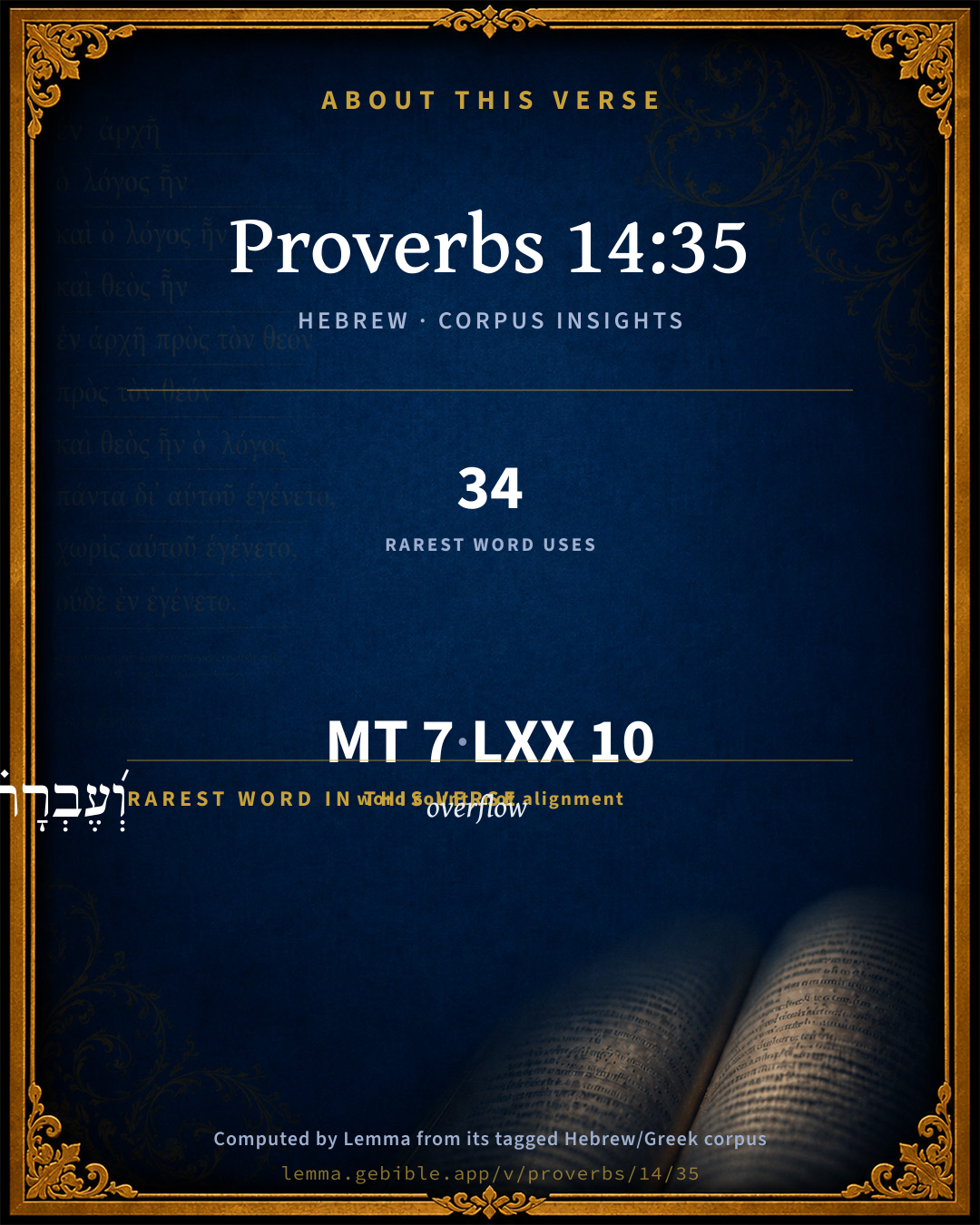
Proverbs 14:35

Hebrew (Westminster Leningrad Codex) Proverbs 14:35 appears in the Hebrew Old Testament. The text above is from the Westminster Leningrad Codex. Each word links to its Strong’s number, a concise gloss, and parsing drawn from the Open Scriptures Hebrew Bible morphology. Click any word for its full Brown-Driver-Briggs (BDB) entry.
Download image
Cite this verse

Proverbs 14:35 (World English Bible). Public Domain. Lemma interlinear Bible study tool, https://lemma.gebible.app/v/proverbs/14/35.

Show BibTeX & RIS
BibTeX
RIS
English Translation
The king's favor is toward a servant who deals wisely, But his wrath is toward one who causes shame.
World English Bible · Public Domain
Download a study sheet

One document with this verse’s original text, its word-by-word gloss line, the meaning frame, cross-references with their text, attributed commentary, and full source and license credits — printable, and it pastes into notes with its structure intact.

This verse Autodidact and up

Study sheet (.html) Plain text (.txt)

A passage Seminary Student

Up to 50 verses in one chapter. A passage sheet keeps up to 6 commentary sources and 12 cross-references per verse, in the order this page ranks them, and says so on the sheet whenever that leaves anything out. Ask for a single verse and you get the Autodidact verse sheet above.

Everything on this page stays free to read, with no account — the sheet is a download of what is already on screen, not access to it.

Want to remove ads? Support Godless Engineer
Compare translations 3

The same verse in 3 English versions, stacked beneath the original-language interlinear above. Click any original word for its lexicon entry.

Each is an independent rendering of the whole verse — the interlinear is not word-aligned to these translations.

Highlighted words mark where these versions differ — a whole-verse word diff, not a word-by-word alignment.

  • World English Bible Public Domain
    The king's favor is toward a servant who deals wisely, But his wrath is toward one who causes shame.
  • King James Version Public Domain
    The king's favour is toward a wise servant: but his wrath is against him that causeth shame.
  • unfoldingWord Literal Text CC BY-SA 4.0
    The delight of a king for the servant who has insight, but his rage is one who acts shamefully.

unfoldingWord Literal Text — © unfoldingWord, licensed CC BY-SA 4.0. Word-aligned USFM3 via Door43 (git.door43.org/unfoldingWord/en_ult).

Versions to compare (up to 4)

3 of 4 selected

Show all 18 translations

Every available English version of this verse, each an independent rendering of the whole verse.

  • World English Bible Public Domain
    The king's favor is toward a servant who deals wisely, But his wrath is toward one who causes shame.
  • Berean Standard Bible Public Domain
    A king delights in a wise servant, but his anger falls on the shameful.
  • Majority Standard Bible Public Domain
    A king delights in a wise servant, but his anger falls on the shameful.
  • King James Version Public Domain
    The king's favour is toward a wise servant: but his wrath is against him that causeth shame.
  • American Standard Version (1901) Public Domain
    The king's favor is toward a servant that dealeth wisely; But his wrath will be `against' him that causeth shame.
  • Revised Version (1885) Public Domain
    The king’s favour is toward a servant that dealeth wisely: but his wrath shall be against him that causeth shame.
  • Geneva Bible (1599) Public Domain
    The pleasure of a King is in a wise seruant: but his wrath shalbe toward him that is lewde.
  • Douay-Rheims (1899) Public Domain
    A wise servant is acceptable to the king: he that is good for nothing shall feel his anger.
  • Young's Literal Translation Public Domain
    The favour of a king `is' to a wise servant, And an object of his wrath is one causing shame!
  • Literal Standard Version CC BY-SA 4.0
    The favor of a king [is] to a wise servant, || And one causing shame is an object of his wrath!
  • Unlocked Literal Bible CC BY-SA 4.0
    The favor of the king is with the servant who acts prudently, but his anger is for the one who acts shamefully.
  • unfoldingWord Literal Text CC BY-SA 4.0
    The delight of a king for the servant who has insight, but his rage is one who acts shamefully.
  • Darby Bible Public Domain
    The king's favour is toward a wise servant; but his wrath is [against] him that causeth shame.
  • World Messianic Bible Public Domain
    The king’s favor is toward a servant who deals wisely, but his wrath is toward one who causes shame.
  • Webster's Bible Public Domain
    The king's favor is towards a wise servant: but his wrath is against him that causeth shame.
  • Free Bible Version CC BY-SA 4.0
    A servant who acts wisely is appreciated by the king, but he gets angry with a servant who acts disgracefully.
  • Bible in Basic English Public Domain
    The king has pleasure in a servant who does wisely, but his wrath is against him who is a cause of shame.
  • JPS Tanakh (1917) Public Domain
    The king's favour is toward a servant that dealeth wisely; but his wrath striketh him that dealeth shamefully.

Literal Standard Version (2020), Covenant Press — licensed CC BY-SA 4.0. Text via the HelloAO Bible API (eBible.org). Unlocked Literal Bible (unfoldingWord) — licensed CC BY-SA 4.0. Text via the HelloAO Bible API (eBible.org). unfoldingWord Literal Text — © unfoldingWord, licensed CC BY-SA 4.0. Word-aligned USFM3 via Door43 (git.door43.org/unfoldingWord/en_ult). Free Bible Version, Dr. Jonathan Gallagher — licensed CC BY-SA 4.0. Text via the HelloAO Bible API (eBible.org).

Word by word

More ways to search: Search by grammar → Find every occurrence → Compare this word →

Practice this passage: Drill this verse → Learn its vocabulary →

וְ֝עֶבְרָת֗וֹ
ʻebrâh
H5678
“and · overflow · his”
Conjunction + Noun, Common, Feminine, Singular, Construct + Suffix, Personal, 3rd Person, Masculine, Singular
Part of Speech
Conjunction + Noun
Type
Common
Gender
Feminine
Number
Singular
State
Construct
Full BDB Definition

Origin: from H5676

TWOT: 1556d

outpouring, overflow, excess, fury, wrath, arrogance - overflow, excess, outburst - arrogance - overflowing rage or fury
  1. רְֽצוֹן râtsôwn H7522 “pleasure of” Noun, Common, Masculine, Singular, Construct
  2. מֶ֭לֶךְ melek H4428 “king” Noun, Common, Masculine, Singular, Absolute
  3. לְעֶ֣בֶד ʻebed H5650 “to/for · servant” Preposition + Noun, Common, Masculine, Singular, Absolute
  4. מַשְׂכִּ֑יל sâkal H7919 “being prudent” Verb, Hiphil, Participle Active, Masculine, Singular, Absolute
  5. תִּהְיֶ֥ה hâyâh H1961 “to be” Verb, Qal, Imperfect, 3rd Person, Feminine, Singular
  6. מֵבִֽישׁ bûwsh H954 “being ashamed” Verb, Hiphil, Participle Active, Masculine, Singular, Absolute

About this verse

These counts appear in no published source. They are computed here, from the morphology-tagged text and Lemma’s own curated glosses. What Lemma adds →

7
words
7
distinct lemmas
Wisdom
section

Shared distinctive vocabulary

וְ֝עֶבְרָת֗וֹ overflow H5678 occurs in 34 verses of the Hebrew Bible. Also found in:

Grammatical profile

  • 3 verbs
  • 4 nouns

Verb forms

  • מַשְׂכִּ֑יל Hiphil · Participle Active
  • תִּהְיֶ֥ה Qal · Imperfect
  • מֵבִֽישׁ Hiphil · Participle Active

Hebrew & Septuagint length

In English translation the verse runs 19 words from the Hebrew and 16 from the Septuagint (LXX English) — closely comparable.

A rough comparison of the two English renderings, which tokenize alike — not a word-level alignment.

Word counts can differ between the Hebrew and the Greek without any difference in meaning — e.g. the Hebrew direct-object marker אֵת has no separate Greek word, and Greek often adds the article ὁ.

In the original languages it is 7 Hebrew tokens and 10 Greek tokens — but the two are counted differently (Hebrew bundles its prefixes and suffixes into one token; the Greek is in lemma form), so that isn’t a like-for-like length.

Cross-references

14

Topical passages linked to Proverbs 14:35 in the Treasury of Scripture Knowledge — connected by theme and wording, ordered by reader-vote popularity; previews shown in the World English Bible.

  • Matthew 24:45–51 "Who then is the faithful and wise servant, whom his lord has set over his household, to give them their food in due season?
  • Proverbs 22:11 He who loves purity of heart and speaks gracefully Is the king's friend.
  • Proverbs 25:5 Take away the wicked from the king's presence, And his throne will be established in righteousness.
  • Proverbs 29:12 If a ruler listens to lies, All of his officials are wicked.
  • Matthew 25:21 "His lord said to him, 'Well done, good and faithful servant. You have been faithful over a few things, I will set you over many things. Enter into the joy of your lord.'
  • Matthew 25:23 "His lord said to him, 'Well done, good and faithful servant. You have been faithful over a few things, I will set you over many things. Enter into the joy of your lord.'
  • Luke 12:42–48 The Lord said, "Who then is the faithful and wise steward, whom his lord will set over his household, to give them their portion of food at the right times?
  • Psalms 101:4–8 A perverse heart will be far from me. I will have nothing to do with evil.
  • Proverbs 10:5 He who gathers in summer is a wise son, But he who sleeps during the harvest is a son who causes shame.
  • Proverbs 17:2 A servant who deals wisely will rule over a son who causes shame, And shall have a part in the inheritance among the brothers.
  • Proverbs 19:12–13 The king's wrath is like the roaring of a lion, But his favor is like dew on the grass.
  • Proverbs 19:26 He who robs his father and drives away his mother, Is a son who causes shame and brings reproach.
  • Proverbs 20:8 A king who sits on the throne of judgment Scatters away all evil with his eyes.
  • Proverbs 20:26 A wise king winnows out the wicked, And drives the threshing wheel over them.

Cross-references courtesy of OpenBible.info (CC BY 4.0).

Hebrew and Greek witnesses Masoretic Hebrew ↔ Greek Septuagint

The same verse in the two great witnesses to the Old Testament, shown verse-for-verse.

These are two independent witnesses, not word-aligned to each other, and the Septuagint is shown in lemma (dictionary) form.

Hebrew Proverbs 14:35 Masoretic · Westminster Leningrad Codex

רְֽצוֹן מֶ֭לֶךְ לְעֶ֣בֶד מַשְׂכִּ֑יל וְ֝עֶבְרָת֗וֹ תִּהְיֶ֥ה מֵבִֽישׁ

The king's favor is toward a servant who deals wisely, But his wrath is toward one who causes shame.

World English Bible · Public Domain

Greek LXX Proverbs 14:35 Septuagint · lemma form

δεκτός βασιλεύς ὑπηρέτης νοήμων ὁ δέ ἑαυτοῦ εὐστροφία ἀποαἱρέω ἀτιμία

An understanding servant is acceptable to a king; and by his good behavior he removes disgrace.

LXX2012 (modern English Septuagint) · Public Domain

On this verse, Haydock's Catholic Bible Commentary discusses the Septuagint’s reading. Read the note in Commentary ↓

Hebrew: Westminster Leningrad Codex (CC BY 4.0). Greek: Septuagint (public domain); English from LXX2012 (modern English Septuagint) (Public Domain). How the Septuagint differs from the Hebrew →

Commentary

Notes on Proverbs 14:35 from classic Christian and Jewish commentators (each source and its license shown beneath its notes). The classic Christian expositions comment on the surrounding passage and are grouped to its opening verse, so a note may address several verses; the Jewish commentaries on the Tanakh (Rashi and others) are per-verse, so they appear only where the commentator wrote on this verse.

Lemma curates 59 commentaries, every one of them public domain or Creative Commons licensed, each selected and text-cleaned for this edition rather than reprinted as found. About our sources →

Trapp's Complete Commentary

John Trapp

Pro 14:35 The king’s favour [is] toward a wise servant: but his wrath is [against] him that causeth shame.

Ver. 35. The king’s favour is toward a wise servant.] As was Pharaoh’s toward Joseph, Solomon’s toward Jeroboam, Darius’s toward Daniel, Henry VIII’s toward Cromwell, whom, for his wisdom and faithfulness, he raised from a mean man (son to a blacksmith), to be first master of his jewel house, then baron of Oakham in Rutlandshire, then Knight of the Garter, Earl of Essex, lord great chamberlain; and lastly, ordained him his vicar general. {a} And if kings do thus, what will not the King of kings do for every faithful and wise servant of his, whom he hath made "ruler over his household"; {Mat 24:45} "Verily, I say unto you, that he shall make him ruler over all his goods, {Mat 24:47} yea, partaker of his master’s joy." {Mat 25:21; Mat 25:23}

But his wrath is against him that causeth shame.] Such as was Jeroboam at length, Haman, Shebna, Ziba, Gehazi, Ahithophel, Judas, &c. It fares with many princes, as it doth with the creature called millepede, which the more feet it hath, the slower it goeth. Corrupt servants hinder the course of justice, that it cannot run down as a torrent. This reflects upon their lords, and at length fails heavily upon themselves.

{a} Speed.

John Trapp, A Commentary or Exposition upon All the Books of the Old and New Testament (1647–1656) — public domain. Text from a community e-Sword module.

Joseph Benson's Commentary

Pro 14:35. The king’s favour is toward a wise servant — He will respect and prefer those who behave themselves wisely and virtuously, whatever enemies they may have that seek to undermine them. This Solomon was determined to do. He was resolved that no man’s services should be neglected to please a party, or a favourite. But his wrath is against him that causeth shame — He will displace and banish from the court those who are selfish and false, who betray their trust, oppress the poor, sow the seeds of discord in the country, and thus cause shame both to themselves, for their foolish and improper management of the king’s affairs, and to the king, who made so foolish a choice of servants.

Joseph Benson's Commentary on the Old and New Testaments (1811–1818) — public domain. Text from a community e-Sword module.

The Preacher's Complete Homiletical Commentary

Joseph S. Exell (gen. ed.)

CRITICAL NOTES.—

Pro_14:35. Miller reads, “The kindness of a king is a wise servant, but his wrath becomes one that bringeth shame” (See his comments).

MAIN HOMILETICS ON Pro_14:35

A WISE SERVANT

In this verse we adopt Miller’s translation as being the more probable meaning. See Critical Notes and also his Comment.

I. The law of kindness is a law of power. Whether a man be the ruler of a nation or the ruler of a family, if he would acquire real power over those whom he rules, he must obey this law himself. Human nature is in a fallen condition, and it cannot be lifted into a state of obedience even to wise and good laws except they are enforced in a spirit of kindness. Kindness will bind men to loyal devotion with a far firmer chain than any force. There is, indeed, no principle in obedience to the latter; it rules only the bodily actions, and is powerless over the heart. Those who desire more than the service of half the man must issue their commands—must exercise their authority—in the spirit of mercy. The king, the master or the father, who is a despot, is only obeyed because he has power to punish. Consequently the obedience will only last as long as the power. This is a thought which parents especially should lay to heart.

II. The law of kindness is a law of policy. He who rules to-day may one day be at the mercy of him whom he rules. Kings have often needed favour of their subjects—the master has often been at the mercy of his servant; and what has happened before will happen again in the changes and chances of life, and those who have shown mercy will be the most likely at such times to receive it. “With what measure ye mete, it shall be measured to you again” (Mat_7:2) holds good in this case. Therefore, the “kindness of a king is a wise servant; but his wrath becomes one that bringeth shame.” For remarks on the text as rendered in the authorised version, see below.

OUTLINES AND SUGGESTIVE COMMENTS

Solomon gets back to his king-craft. These maxims were familiar to him. It is rarely wise for “a king” to get in a passion with his people (see Pro_14:29-30). “If thou wilt be a servant unto this people” was said to the successor of this very man (1Ki_12:7); if thou wilt “answer them, and speak good words to them, then they will be thy servants for ever.” But, more than king-craft, it is a rule for saints. The law of “kindness” should be on our lips. The power of gentleness is irresistible. If “the mercy for nations is the sin-offering” (see last verse), then we are all sinners together, and modesty forbids that we should go among the lost with anything but tenderness. The English version is due to the presence of a preposition. “The king’s favour is towards a wise servant.” But that preposition becomes idiomatic in certain cases. I say, “I want such a thing for a shelter.” “The kindness of a king is for a wise servant,” i.e., serves as one. There is no preposition before the words “brings shame;” but, on the contrary, the word is is written out, and, as usual in that case, means “becomes;” all of which state of facts is in favour of our new version.—Miller.

These words state what ought to be. No one ought to be the king or the queen’s servant who is not wise; and toward every such wise servant the royal favour should be specially extended. And who is a wise servant? Not a servant who flatters royal vanity; accommodates itself to royal foibles; indulges royal prejudices; chimes in with royal caprices; tolerates and connives at royal vices, whether personal or official. No; a wise servant must be a servant of conscientious principle, and of bland but unflinching fidelity. He is one who gives prudent and faithful counsel; who “speaks truth as he thinks it in his heart;” whose counsels are dictated by a right understanding of the times, and knowledge of what such times require, not by a wish to ingratiate the minister with the prince, and so to promote his own personal advantage, but by the principles of genuine patriotism as well as loyalty.… That servant “causeth shame” by whom that is encouraged from which reproach arises—who gives counsel to his prince which must prove either prejudicial or abortive; such as can hardly fail to render him unpopular with his subjects, and expose him, by their failure, to the derision of foreign states—a derision in which the kingdom as well as the throne, the people as well as the monarch, are involved.—Wardlaw.

Thus it is with the great King. All of us are His servants, bound to Him by the highest obligations; animated by the most glowing encouragements (1Co_6:19-20; Mat_24:44-46; Mat_25:21-23). All of us have our responsibilities, our talents, our work, our account. Towards the “faithful and wise servant,” who has traded with his talents, who has been diligent in his work, and who is ready for his account—His favour will be infinitely condescending and honourable (Joh_12:26). But against him that causeth shame—reflecting upon his Master, neglectful in his work, unprepared for his account—His wrath will be tremendous and eternal.—Bridges.

Surely well is favour bestowed, where it reflecteth unto the giver’s honour: worthily is favour received, where wisdom’s hands are the receivers of it.—Jermin.

The Preacher's Complete Homiletical Commentary (gen. ed. Joseph S. Exell; Funk & Wagnalls, c. 1892) — public domain (pre-1929). A full-Bible homiletical/sermon-outline anthology covering 65 of 66 books (2 John is absent from the source module). Text from a community e-Sword module.

Matthew Henry's Commentary

This shows that in a well-ordered court and government smiles and favours are dispensed among those that are employed in public trusts according to their merits; Solomon lets them know he will go by that rule, 1. That those who behave themselves wisely shall be respected and preferred, whatever enemies they may have that seek to undermine them. No man's services shall be neglected to please a party or a favourite. 2. That those who are selfish and false, who betray their country, oppress the poor, and sow discord, and thus cause shame, shall be displaced and banished the court, whatever friends they may make to speak for them.

Matthew Henry's Commentary on the Whole Bible (1708–1710) — public domain (CC PDM 1.0). Text via the HelloAO Bible API.

Jamieson, Fausset & Brown

Robert Jamieson, A. R. Fausset & David Brown

wise--discreet or prudent.

causeth shame-- (Pro 10:5; Pro 12:4) acts basely.

Next: Proverbs Chapter 15

Jamieson, Fausset & Brown — Commentary Critical and Explanatory on the Whole Bible (1871) — public domain (CC PDM 1.0). Text via the HelloAO Bible API.

Adam Clarke's Commentary

Verse 35. The king's favour is toward a wise servant] The king should have an intelligent man for his minister; a man of deep sense, sound judgment, and of a feeling, merciful disposition. He who has not the former will plunge the nation into difficulties; and he who has not the latter will embark her in disastrous wars. Most wars are occasioned by bad ministers, men of blood, who cannot be happy but in endeavouring to unchain the spirit of discord. Let every humane heart pray, Lord, scatter thou the people who delight in war! Amen - so be it. Selah!

Adam Clarke's Commentary on the Bible (1810–1826) — public domain. Text from a community e-Sword/MySword module.

The Cambridge Bible for Schools and Colleges

gen. ed. J. J. S. Perowne

35. causeth shame] Or, doeth shamefully, R.V. marg. Comp. Pro_10:5.

The Cambridge Bible for Schools and Colleges (gen. ed. J. J. S. Perowne; Cambridge University Press, 1878–1918) — public domain. Text from a community e-Sword module.

John Gill's Exposition

The king's favour is toward a wise servant,.... Who does his prince's business well, committed to him; manages all his affairs wisely and prudently; is diligent and careful to do everything for the king's honour, and the good of his subjects; such an one has a share in royal favour, a place in the affections of his master; and is sure to be promoted to honour by him, and exalted to higher places of trust and profit, as well as to be protected and defended by him: so Christ, the King of kings, shows favour to his wise and faithful servants, Luk 12:42;

but his wrath is against him that causeth shame; who neglects his business, or does it foolishly; in such a manner as his prince is ashamed of him, and which brings shame and disgrace to himself; all which provokes the anger of his master, who discharges him from his service, and this fixes a mark of infamy upon him; see Luk 12:45.

Next: Proverbs Chapter 15

John Gill's Exposition of the Whole Bible (1746–1763) — public domain (CC PDM 1.0). Text via the HelloAO Bible API.

Haydock's Catholic Bible Commentary

Nothing. Literally, "useless," which often means bad. (Haydock) --- A servant who does not discharge his duty is such. Hebrew, "he that causeth to blush," and has no economy. (Calmet) --- Septuagint, "He removes shame by his good management. Anger destroys the prudent; but a mild," &c. (Haydock)

George Leo Haydock (1774–1849), Haydock's Catholic Family Bible and Commentary, 1859 edition — public domain. Excludes Psalms (Douay-Rheims chapter numbering differs from Protestant) and Deuterocanonical books (Catholic canon only).

Matthew Poole's English Annotations

Both to himself, by his foolish management of the king’s affairs committed to him; and to the king, who made so foolish a choice of a servant.

Matthew Poole's English Annotations on the Holy Bible (1683–1685) — public domain. Text from a community e-Sword/MySword module.

Whedon's Commentary on the Bible

Daniel D. Whedon

35. Wise — Discreet.

His wrath — Indignation.

Causeth shame — Or, acteth shamefully. A discreet minister of state obtains the favour of his prince; but one who disgraces himself and his principal or government excites great indignation. Miller renders: “The kindness of the king is a wise servant, that is, serves him wisely and well. The power of gentleness is irresistible.” For an illustration of the opposite, see 1Ki_12:7, et seq.

Daniel D. Whedon (gen. ed.), Commentary on the Old and New Testaments (1874–1909) — public domain. Text from a community e-Sword module.

The Pulpit Commentary

The king"s favour is toward a wise servant; servant that dealeth wisely (Revised Version). Thus Joseph was advanced to the highest post in Egypt, owing to the wisdom which he displayed; so, too, in the case of Daniel. (comp. Mat_24:45, Mat_24:47) But his wrath is against him that causeth shame; literally, he that doeth shamefully shall be (the object of) his wrath. The Vulgate translates, Iracundiam ejus inutilis sustinebit; the Septuagint makes the second clause parallel to the first, "An intelligent servant is acceptable to the king, and by his expertness (eutorofia ) he removeth disgrace." Then is added, before the first verse of the next chapter, a paragraph which looks like an explanation of the present clause, or an introduction to Pro_15:1: "Anger destroyeth even the prudent."

The Pulpit Commentary (1880–1919), ed. H.D.M. Spence-Jones & Joseph S. Exell — public domain. Text from a community e-Sword module.

John Wesley's Explanatory Notes

Shame - Both to himself, by his foolish management of the king's affairs, and to the king who made so foolish a choice of a servant.

John Wesley, Explanatory Notes Upon the Whole Bible (1754–1765) — public domain. Text via the GEBible commentary corpus.

Keil & Delitzsch

C. F. Keil & F. Delitzsch

35 The king's favour is towards a prudent servant,

And his wrath visits the base.

Regarding the contrasts משׂכּיל and מבישׁ, vid., at Pro 10:5; cf. Pro 12:4. The substantival clause 35a may mean: the king's favour has (possesses)..., as well as: it is imparted to, an intelligent servant; the arrangement of the words is more favourable to the latter rendering. In 35b the gender of the verb is determined by attraction after the pred., as is the case also at Gen 31:8; Job 15:31, Ewald, 317c. And "his wrath" is equivalent to is the object of it, cf. 22b, Pro 13:18. The syntactical character of the clause does not permit the supplying of ל from 35a. Luther's translation proceeds only apparently from this erroneous supposition.

Keil & Delitzsch — Biblical Commentary on the Old Testament (1861–1891) — public domain (CC PDM 1.0). Text via the HelloAO Bible API. (Old Testament only.)

Bridges on Proverbs

Charles Bridges

The administration of the wise servant is often the working cause of national exaltation. (2Ch 24:1-16 .) The king’s favour towards him†1 is therefore the rule of sound policy. Not less so is his wrath against him that causeth shame (Est 7:6-10 ) ’to the office which he beareth, and to the Prince’s choice.’†2

Thus is it with the great King. All of us are his servants, bound to him by the highest obligations;†3 animated by the most glowing encouragements.†4 All of us have our responsibilities, our talents, our work, our account. Towards "the faithful and wise servant," who has traded with his talents, who has been diligent in his work, and who is ready for his account — his favour will be infinitely condescending and honourable. (Joh 12:26 .) But against him that causeth shame — reflecting upon his Master, neglectful of his work, and unprepared for his account — his wrath will be tremendous and eternal. (Mat 25:24-30 .) What will the solemn day of reckoning bring to me? May I — may we all — be found wise servants to the best of Kings! looking with confidence for his welcome!

Footnotes:

†1 Gen 41:38-40. Dan 6:3 . Compare Pro 16:13 ; Pro 22:29 .

†2 Diodati.

†3 Psa 116:16. 1Co 6:19-20 ; 1Co 7:23 .

†4 Mat 25:21, Mat 25:23 ; Mat 24:44-46 .

Charles Bridges, An Exposition of the Book of Proverbs (1846) — public domain. Text from a community e-Sword module.

Kretzmann's Popular Commentary

Paul E. Kretzmann

v. 35. The king’s favor is toward a wise servant, he will naturally prefer and reward one who is discreet and prudent in his work; but his wrath is against him that causeth shame, it will strike the base and give him his well-merited punishment.

Paul E. Kretzmann, Popular Commentary of the Bible (1921–1924) — public domain. Text from a community e-Sword module.

Rashi

Rabbi Shlomo Yitzchaki (Rashi)

but his wrath will be upon a shameful servant.

Rashi on the Tanakh — English translations: “The Judaica Press complete Tanach with Rashi, translated by A. J. Rosenberg” (CC BY 4.0); “Pentateuch with Rashi's commentary by M. Rosenbaum and A.M. Silbermann, 1929-1934” (public domain); “The Metsudah Tanach series, Lakewood, N.J” (CC BY 4.0); and “The Book of Joshua, Metsudah Publications, 1997” (CC BY 4.0). Text via Sefaria.

Lesson kit

Teaching starters — assembled from the data on this page, not authored interpretation. Every prompt links to the verse data it draws on. Edit before teaching.

Proverbs, in the Wisdom, opens this verse with 7 words (7 distinct Hebrew lemmas). Its most distinctive word is ʻebrâh (“overflow”). A historical commentator’s framing appears above. Read the whole chapter for the surrounding context.

Discussion questions

  1. What does “overflow” (ʻebrâh) contribute to the verse as a whole?
  2. Genesis 49:7 shares the word «overflow» with this verse. How do the two illuminate each other?
  3. The translations on this page render this verse differently — a whole-verse word diff, not a word-by-word alignment. What might account for the different wordings?
  4. The verb «מַשְׂכִּ֑יל» is Hiphil Participle Active. How does its form color the action?
  5. Reading how Trapp's Complete Commentary and Joseph Benson's Commentary read this verse, where do the two commentators agree and where do they part?

Things to notice

Reading settings

Reading text

Shown beneath each verse's original-language words.

Old Testament
Old Testament edition

Read the OT as the Masoretic Hebrew (MT) or the Greek Septuagint (LXX).

English shown for the Greek Septuagint (in the Hebrew ↔ Greek comparison).

Comparing translations? Open the Compare panel on any verse page to stack up to four side by side.