
Hosea 4:19

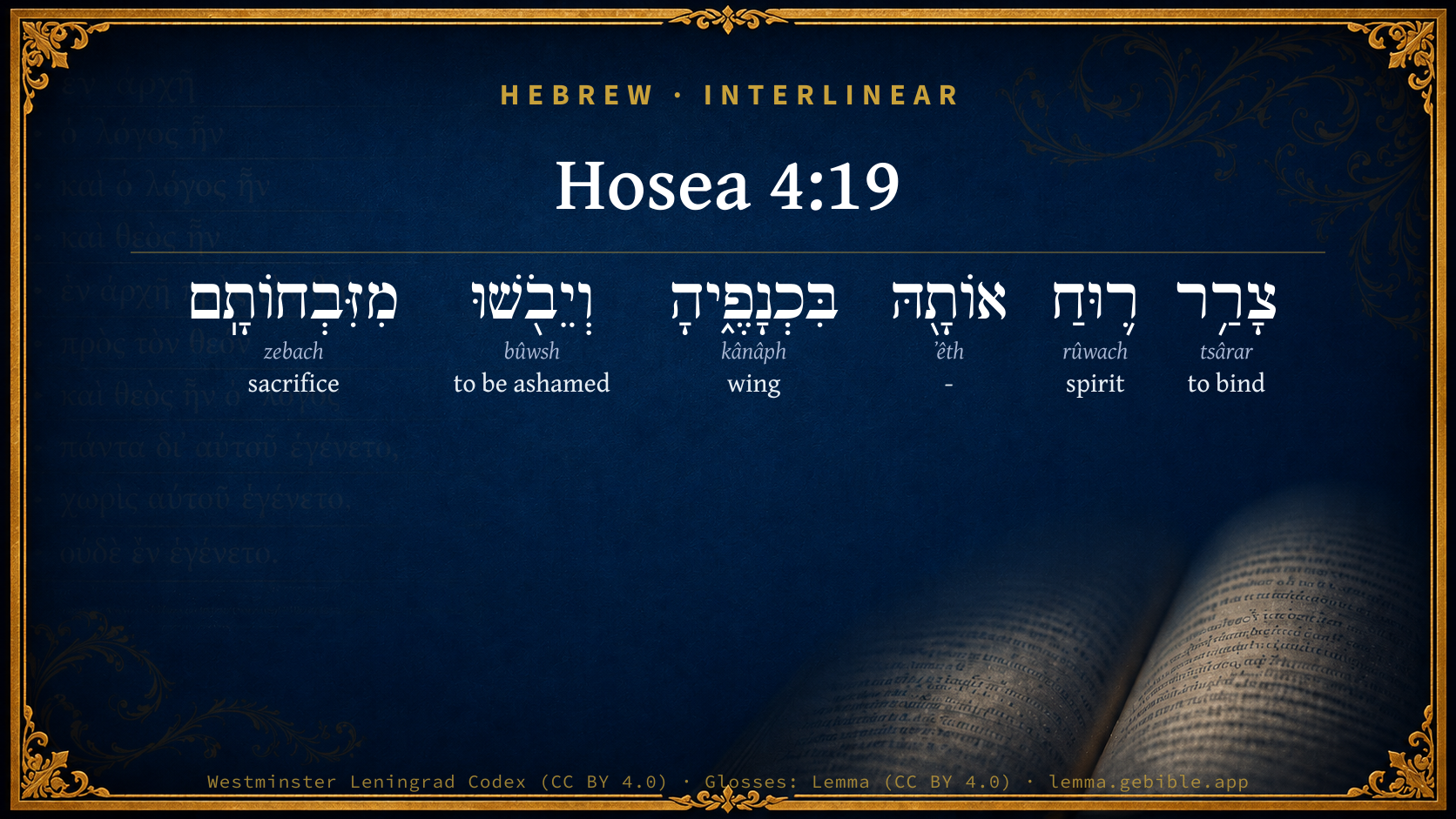
Hebrew (Westminster Leningrad Codex) Hosea 4:19 appears in the Hebrew Old Testament. The text above is from the Westminster Leningrad Codex. Each word links to its Strong’s number, a concise gloss, and parsing drawn from the Open Scriptures Hebrew Bible morphology. Click any word for its full Brown-Driver-Briggs (BDB) entry.
Download image
Cite this verse

Hosea 4:19 (World English Bible). Public Domain. Lemma interlinear Bible study tool, https://lemma.gebible.app/v/hosea/4/19.

Show BibTeX & RIS
BibTeX
RIS
English Translation
The wind has wrapped her up in its wings; And they shall be disappointed because of their sacrifices.
World English Bible · Public Domain
Download a study sheet

One document with this verse’s original text, its word-by-word gloss line, the meaning frame, cross-references with their text, attributed commentary, and full source and license credits — printable, and it pastes into notes with its structure intact.

This verse Autodidact and up

Study sheet (.html) Plain text (.txt)

A passage Seminary Student

Up to 50 verses in one chapter. A passage sheet keeps up to 6 commentary sources and 12 cross-references per verse, in the order this page ranks them, and says so on the sheet whenever that leaves anything out. Ask for a single verse and you get the Autodidact verse sheet above.

Everything on this page stays free to read, with no account — the sheet is a download of what is already on screen, not access to it.

Want to remove ads? Support Godless Engineer
Compare translations 3

The same verse in 3 English versions, stacked beneath the original-language interlinear above. Click any original word for its lexicon entry.

Each is an independent rendering of the whole verse — the interlinear is not word-aligned to these translations.

Highlighted words mark where these versions differ — a whole-verse word diff, not a word-by-word alignment.

  • World English Bible Public Domain
    The wind has wrapped her up in its wings; And they shall be disappointed because of their sacrifices.
  • King James Version Public Domain
    The wind hath bound her up in her wings, and they shall be ashamed because of their sacrifices.
  • unfoldingWord Literal Text CC BY-SA 4.0
    A wind has wrapped her in its wings, and they will have shame from their sacrifices.

unfoldingWord Literal Text — © unfoldingWord, licensed CC BY-SA 4.0. Word-aligned USFM3 via Door43 (git.door43.org/unfoldingWord/en_ult).

Versions to compare (up to 4)

3 of 4 selected

Show all 18 translations

Every available English version of this verse, each an independent rendering of the whole verse.

  • World English Bible Public Domain
    The wind has wrapped her up in its wings; And they shall be disappointed because of their sacrifices.
  • Berean Standard Bible Public Domain
    The whirlwind has wrapped them in its wings, and their sacrifices will bring them shame.
  • Majority Standard Bible Public Domain
    The whirlwind has wrapped them in its wings, and their sacrifices will bring them shame.
  • King James Version Public Domain
    The wind hath bound her up in her wings, and they shall be ashamed because of their sacrifices.
  • American Standard Version (1901) Public Domain
    The wind hath wrapped her up in its wings; and they shall be put to shame because of their sacrifices.
  • Revised Version (1885) Public Domain
    The wind hath wrapped her up in its wings; and they shall be ashamed because of their sacrifices.
  • Geneva Bible (1599) Public Domain
    The winde hath bounde them vp in her wings, and they shalbe ashamed of their sacrifices.
  • Douay-Rheims (1899) Public Domain
    The wind hath bound them up in its wings, and they shall be confounded because of their sacrifices.
  • Young's Literal Translation Public Domain
    Distressed her hath wind with its wings, And they are ashamed of their sacrifices!
  • Literal Standard Version CC BY-SA 4.0
    Wind has distressed her with its wings, || And they are ashamed of their sacrifices!”
  • Unlocked Literal Bible CC BY-SA 4.0
    The wind will wrap her up in its wings; and they will be ashamed because of their sacrifices.
  • unfoldingWord Literal Text CC BY-SA 4.0
    A wind has wrapped her in its wings, and they will have shame from their sacrifices.
  • Darby Bible Public Domain
    The wind hath wrapped her up in its wings, and they shall be ashamed because of their sacrifices.
  • World Messianic Bible Public Domain
    The wind has wrapped her up in its wings; and they shall be disappointed because of their sacrifices.
  • Webster's Bible Public Domain
    The wind hath bound her up in her wings, and they shall be ashamed because of their sacrifices.
  • Free Bible Version CC BY-SA 4.0
    A wind will carry them away; they will be ashamed of their pagan worship.”
  • Bible in Basic English Public Domain
    They are folded in the skirts of the wind; they will be shamed because of their offerings.
  • JPS Tanakh (1917) Public Domain
    The wind hath bound her up in her skirts; and they shall be ashamed because of their sacrifices.

Literal Standard Version (2020), Covenant Press — licensed CC BY-SA 4.0. Text via the HelloAO Bible API (eBible.org). Unlocked Literal Bible (unfoldingWord) — licensed CC BY-SA 4.0. Text via the HelloAO Bible API (eBible.org). unfoldingWord Literal Text — © unfoldingWord, licensed CC BY-SA 4.0. Word-aligned USFM3 via Door43 (git.door43.org/unfoldingWord/en_ult). Free Bible Version, Dr. Jonathan Gallagher — licensed CC BY-SA 4.0. Text via the HelloAO Bible API (eBible.org).

Word by word

More ways to search: Search by grammar → Find every occurrence → Compare this word →

Practice this passage: Drill this verse → Learn its vocabulary →

צָרַ֥ר
tsârar
H6887
“to bind”
Verb, Qal, Perfect, 3rd Person, Masculine, Singular
Part of Speech
Verb
Stem
Qal
Form
Perfect
Person
3rd Person
Gender
Masculine
Number
Singular
Full BDB Definition

Origin: a primitive root

TWOT: 1973 , 1974

to bind, be narrow, be in distress, make narrow, cause distress, besiege, be straitened, be bound - (Qal) - to bind, tie up, shut up - to be scant, be cramped, be in straits - (Pual) to be bound, be tied up - (Hiphil) - to make narrow for, cause distress to, press hard upon - to suffer distress - to show hostility toward, vex - (Qal) - to show hostility toward, treat with enmity, vex, harass - vexer, harasser (participle)
  1. ר֛וּחַ rûwach H7307 “spirit” Noun, Common, Both, Singular, Absolute
  2. אוֹתָ֖הּ ʼêth H853 “- · her” Particle, Direct Object + Suffix, Personal, 3rd Person, Feminine, Singular
  3. בִּכְנָפֶ֑יהָ kânâph H3671 “in/at · wings · her” Preposition + Noun, Common, Feminine, Dual, Construct + Suffix, Personal, 3rd Person, Feminine, Singular
  4. וְיֵבֹ֖שׁוּ bûwsh H954 “and · to be ashamed” Conjunction + Verb, Qal, Imperfect, 3rd Person, Masculine, Plural
  5. מִזִּבְחוֹתָֽם zebach H2077 “from · sacrifices · their” Preposition + Noun, Common, Masculine, Plural, Construct + Suffix, Personal, 3rd Person, Masculine, Plural

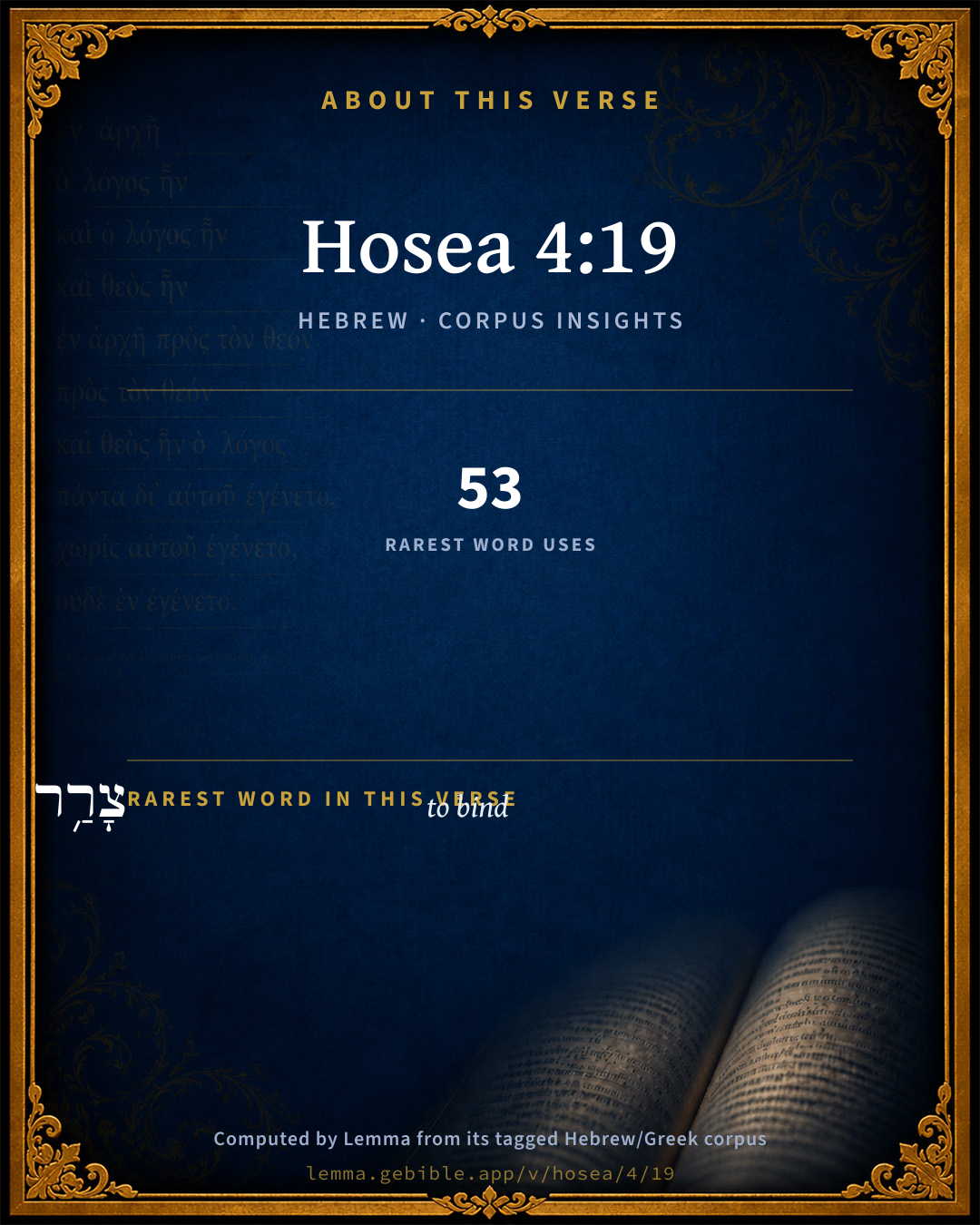
About this verse

These counts appear in no published source. They are computed here, from the morphology-tagged text and Lemma’s own curated glosses. What Lemma adds →

6
words
6
distinct lemmas
Prophets
section

Shared distinctive vocabulary

צָרַ֥ר to bind H6887 occurs in 52 verses of the Hebrew Bible. Also found in:

Grammatical profile

  • 2 verbs
  • 3 nouns
  • 1 particle

Verb forms

  • צָרַ֥ר Qal · Perfect
  • וְיֵבֹ֖שׁוּ Qal · Imperfect

Hebrew & Septuagint length

In English translation the verse runs 18 words from the Hebrew and 18 from the Septuagint (LXX English) — the same length.

A rough comparison of the two English renderings, which tokenize alike — not a word-level alignment.

Word counts can differ between the Hebrew and the Greek without any difference in meaning — e.g. the Hebrew direct-object marker אֵת has no separate Greek word, and Greek often adds the article ὁ.

Cross-references

12

Topical passages linked to Hosea 4:19 in the Treasury of Scripture Knowledge — connected by theme and wording, ordered by reader-vote popularity; previews shown in the World English Bible.

  • Jeremiah 51:1 Thus says Yahweh: Behold, I will raise up against Babylon, and against those who dwell in Lebkamai, a destroying wind.
  • Isaiah 1:29 For they shall be ashamed of the oaks which you have desired, And you shall be confounded for the gardens that you have chosen.
  • Jeremiah 4:11–12 At that time shall it be said to this people and to Jerusalem, A hot wind from the bare heights in the wilderness toward the daughter of my people, not to winnow, nor to cleanse;
  • Hosea 13:15 Though he is fruitful among his brothers, an east wind will come, The breath of Yahweh coming up from the wilderness; And his spring will become dry, And his fountain will be dried up. He will plunder the storehouse of treasure.
  • Isaiah 42:17 They shall be turned back, they shall be utterly disappointed, who trust in engraved images, who tell molten images, You are our gods.
  • Jeremiah 2:26–27 As the thief is ashamed when he is found, so is the house of Israel ashamed; they, their kings, their princes, and their priests, and their prophets;
  • Jeremiah 2:36–37 Why go you about so much to change your way? you shall be ashamed of Egypt also, as you were ashamed of Assyria.
  • Jeremiah 3:24–25 But the shameful thing has devoured the labor of our fathers from our youth, their flocks and their herds, their sons and their daughters.
  • Jeremiah 17:13 Yahweh, the hope of Israel, all who forsake you shall be disappointed. Those who depart from me shall be written in the earth, because they have forsaken Yahweh, the spring of living waters.
  • Hosea 10:6 It also will be carried to Assyria for a present to a great king. Ephraim will receive shame, And Israel will be ashamed of his own counsel.
  • Hosea 12:1 Ephraim feeds on wind, And chases the east wind. He continually multiplies lies and desolation. They make a covenant with Assyria, And oil is carried into Egypt.
  • Zechariah 5:9–11 Then lifted I up my eyes, and saw, and, behold, there were two women, and the wind was in their wings. Now they had wings like the wings of a stork, and they lifted up the ephah basket between earth and the sky.

Cross-references courtesy of OpenBible.info (CC BY 4.0).

Hebrew and Greek witnesses Masoretic Hebrew ↔ Greek Septuagint

The same verse in the two great witnesses to the Old Testament, shown verse-for-verse.

These are two independent witnesses, not word-aligned to each other, and the Septuagint is shown in lemma (dictionary) form.

Hebrew Hosea 4:19 Masoretic · Westminster Leningrad Codex

צָרַ֥ר ר֛וּחַ אוֹתָ֖הּ בִּכְנָפֶ֑יהָ וְיֵבֹ֖שׁוּ מִזִּבְחוֹתָֽם

The wind has wrapped her up in its wings; And they shall be disappointed because of their sacrifices.

World English Bible · Public Domain

Greek LXX Hosea 4:19 Septuagint · lemma form

συστροφή πνεῦμα σύ εἰμί ἐν ὁ πτέρυξ αὐτός καί κατααἰσχύνω ἐκ ὁ θυσιαστήριον αὐτός

You are a blast of wind in her wings, and they shall be ashamed because of their altars.

LXX2012 (modern English Septuagint) · Public Domain

On this verse, John Gill's Exposition discusses the Septuagint’s reading. Read the note in Commentary ↓

Hebrew: Westminster Leningrad Codex (CC BY 4.0). Greek: Septuagint (public domain); English from LXX2012 (modern English Septuagint) (Public Domain). How the Septuagint differs from the Hebrew →

Targum (Aramaic paraphrase)

1

The Targum is the ancient Jewish Aramaic paraphrase of the Hebrew Scriptures — an interpretive translation, not the Hebrew text itself. Onkelos (literal) and Pseudo-Jonathan (expansive) render the Torah, and Jonathan the Prophets. Coverage is partial: where no permissively-licensed English translation exists for a verse, only the Aramaic is shown. This is verse-level text, not a word-by-word alignment to the Hebrew.

  1. Targum Jonathan Prophets (Joshua–Malachi)
    עוֹבְדֵי רַבְרְבֵיהוֹן לָא תַקְנִין כְּמָא דְלֵית אֶפְשַׁר לְמֵיצַר רוּחַ בְּכָנָף כְּעַן אַיְתֵי עֲלֵיהוֹן סָנְאָה וְיִבְהֲתוּן מֵאֱגוֹרֵי טַעֲוָתְהוֹן:

    (no public-domain English translation for this verse)

    Targum Jonathan — Aramaic: “Mikraot Gedolot” (public domain). English: “Sefaria Community Translation” (CC0 1.0 (public-domain dedication)); “London "Chaldee Paraphrase," 1871” (public domain). Text via Sefaria.

Commentary

Notes on Hosea 4:19 from classic Christian and Jewish commentators (each source and its license shown beneath its notes). The classic Christian expositions comment on the surrounding passage and are grouped to its opening verse, so a note may address several verses; the Jewish commentaries on the Tanakh (Rashi and others) are per-verse, so they appear only where the commentator wrote on this verse.

Lemma curates 59 commentaries, every one of them public domain or Creative Commons licensed, each selected and text-cleaned for this edition rather than reprinted as found. About our sources →

Trapp's Complete Commentary

John Trapp

Hos 4:19 The wind hath bound her up in her wings, and they shall be ashamed because of their sacrifices.

Ver. 19. The wind hath bound her up in her wings] The evil spirit (saith Jerome) hurries them towards hell, which is the just hire of the least sin; how much more of these afore mentioned abominations! Take it rather to be spoken of the suddenness, swiftness, and unresistableness of God’s judgments, set forth by mighty winds rending the rocks, and tearing up the mountains by the roots, Job 38:9. How then shall wicked men (compared to chaff or "dust of the mountains") stand before the tempest of God’s wrath, the thunder of his power? Well they may applaud and stroke themselves for a time; but the wind shall bind them up in her wings; God shall blow them to destruction, Job 4:9 : his executioners have the "wings of a stork," large and long, and "wind in those wings," to note their ready obedience, Zec 5:9. And although, Eze 1:26, God be represented as sitting upon a throne to show his slowness to punish, yet that "throne hath wings and hands under those wings," to show his swiftness and readiness to do seasonable execution upon his enemies.

And they shall be ashamed because of their sacrifices] Wherein they trusted, but now see themselves disappointed, their idols not able to help them. Then shall they cast their idols of silver and of gold, which they have made each for himself to worship, "to the moles and to the bats, to go into the clefts of the rocks, and into the tops of the ragged rocks," Isa 2:20-21; see also Isa 30:22. If they be not thus ashamed of their former fopperies, they are the more to be pitied, Illum ego periisse dice cui periit pudor. He is an undone man that shames not, does not hesitate for his evil practices, that blusheth not, bleedeth not before God for them, lying down in his shame, Jer 3:25, as fully ashamed of his former hopes, Psa 119:116, which now he seeth how far they have abused him.

John Trapp, A Commentary or Exposition upon All the Books of the Old and New Testament (1647–1656) — public domain. Text from a community e-Sword module.

The Biblical Illustrator

Joseph S. Exell

Hos_4:19

The wind hath bound her up in her wings.

Retributive justice

The simple meaning is that Israel shall be borne away from her land, suddenly and violently, as by the winds of heaven. There is retributive justice in the universe.

I. Its emblem. The wind. It is like wind--

1. In its agitation. Wind is a disturbance or agitation of the atmosphere, The average condition of the air is silence and serenity. The normal condition of Divine government is quiet. It has no tempest where there is no wickedness.

2. In its violence. Power is in the wind. Cambyses being once in the wilderness with the soldiers, a strong and violent wind broke forth and buried thousands of them in the sand. Who can stand before retributive justice when it comes forth in its power?

II. Its effect. Ashamed because of the sacrifices.

1. The shame of disappointment. All plans broken, all purposes thwarted, all hopes destroyed.

2. The shame of exposure. The wicked always live in masquerade, they always appear to be what they are not. Retributive justice takes off the mask.

3. The shame of remorse. This is the most burning shame of all. It sends its fires down into the very centre of mans being, and sets all the moral nerves aflame. Let the wicked take warning. Let not the present stillness of their atmosphere deceive them. Their sins are generating a heat that must, sooner or later, so disturb the elements about them as to bring on ruin. (Homilist.)

.

The Biblical Illustrator, edited by Joseph S. Exell (c. 1880s–1900s) — public domain. Text from a community e-Sword module.

Joseph Benson's Commentary

Hos 4:19. The wind hath bound her up in her wings — Or rather, binds, or, is binding her up, the present tense being put to denote instant futurity. The passage is strongly figurative, to signify that they should be suddenly taken away out of their country, and carried with irresistible force, and incredible speed, into a distant land. It is not unusual, in other writers, to attribute wings to the winds, to express their swiftness; and when any thing is said to be bound up in the wings of the wind, the expression must signify its being taken far away with great celerity. “An admirable image this,”

says Bishop Horsley, “of the condition of a people, torn by a conqueror from their native land, scattered in exile to the four quarters of the world, and living thenceforward without any settled residence of their own, liable to be moved about at the will of arbitrary masters, like a thing tied to the wings of the wind, obliged to go with the wind which ever way it set, but never suffered for a moment to lie still. The image is striking now; but must have been more striking when a bird with expanded wings, or a huge pair of wings, without head or body, was the hieroglyphic of the element of the air, or rather of the general mundane atmosphere, one of the most irresistible of physical agents.” And they shall be ashamed because of their sacrifices — They shall be confounded to find, by experience, that all their sacrifices to idols have profited them nothing, but brought severe calamities upon them.

Joseph Benson's Commentary on the Old and New Testaments (1811–1818) — public domain. Text from a community e-Sword module.

Geneva Bible (1599)

Geneva Bible translators

To carry them suddenly away.

Geneva Bible (1599) marginal notes — public domain. Text via Bolls.life.

Jamieson, Fausset & Brown

Robert Jamieson, A. R. Fausset & David Brown

Israel shall be swept away from her land (Hos 4:16) suddenly and violently as if by "the wings of the wind" (Psa 18:10; Psa 104:3; Jer 4:11-12).

ashamed . . . of their sacrifices--disappointed to their shame in their hope of help through their sacrifices to idols.

Next: Hosea Chapter 5

Jamieson, Fausset & Brown — Commentary Critical and Explanatory on the Whole Bible (1871) — public domain (CC PDM 1.0). Text via the HelloAO Bible API.

Adam Clarke's Commentary

Verse 19. The wind hath bound her] A parching wind has blasted them in their wings - coasts, borders; or they are carried away into captivity, as with the most rapid blight. These two last verses are very obscure.

Adam Clarke's Commentary on the Bible (1810–1826) — public domain. Text from a community e-Sword/MySword module.

John Calvin's Commentaries

If this rendering be approved, The wind hath bound her in its wings, the meaning is, that a sudden storm would sweep away the people, and thus would they be made ashamed of their sacrifices. So the past tense is to be taken for the future. We may indeed read the words in the past tense, as though the Prophet was speaking of what had already taken place. The wind, then, has already swept away the people; by which he intimates, that they seemed to have struck long and deep roots in their superstitions, but that the Lord had already given them up to the wind, that it might hold them tied in its wings. And wings, we know, is elsewhere ascribed to the wind, Psalm 104:3. And thus the verse will be throughout a denunciation of vengeance.

The other similitude or metaphor is the most appropriate, and harmonizes better with the subject; for were not men to support their minds with vain confidence, they could never with so much audacity despise God’s word. Hence they are said to tie the wind in their wings; being unmindful of their own condition, they attempt as by means of the wind to fly; but when they proudly raise up themselves, they have no support but the wind. Let us now proceed —

John Calvin's Commentaries (1540-1563) — public domain. Text from the Calvin Translation Society English edition (1840s-50s) via the Christian Classics Ethereal Library (ccel.org). Calvin's coverage is partial (roughly two-thirds of the Bible); uncommented books and verses are honest gaps, never fabricated. The 19th-century editor's footnotes and remarks are omitted so the notes are faithfully Calvin's own voice.

The Cambridge Bible for Schools and Colleges

gen. ed. J. J. S. Perowne

19. The wind hath bound her up in her wings] A figure for the suddenness and violence with which the enemy should carry Israel away into exile (comp. Isa_57:13), The perfect is that of prophetic certitude.

The Cambridge Bible for Schools and Colleges (gen. ed. J. J. S. Perowne; Cambridge University Press, 1878–1918) — public domain. Text from a community e-Sword module.

John Gill's Exposition

The wind hath bound her up in her wings,.... That is, the wind in its wings hath bound up Ephraim, Israel, or the ten tribes, compared to a heifer; meaning, that the wind of God's wrath and vengeance, or the enemy, the Assyrian, should come like a whirlwind, and carry them swiftly, suddenly, and irresistibly, out of their own land, into a foreign country: the past tense for the future, as is common in prophecy, because of the certainty of it; so Jarchi and Joseph Kimchi: but Aben Ezra, David Kimchi, Abarbinel, and Abendana, render it "she", that is, Israel, "hath bound up the wind in her wings" (b); meaning that they had laboured in vain in their idolatrous worship; and it was all one as if a than should attempt to gather the wind, and bind it up in the skirts of his garment, and when he opens them there is nothing to be found: and to this sense is the Targum,

"the works of their great men are not right, as it is impossible to bind the wind in a wing;''

referring to the sins of their rulers, as before: or rather the sense is, the wind shall get into the loose skirts of the garments of, he Israelites, which shall be as a sail to it, as Schmidt observes, and shall carry them into distant lands; which falls in with the first sense of the words, and is best:

and they shall be ashamed because of their sacrifices: they of the ten tribes, the people of Israel; or their shields, their rulers, as Aben Ezra, shall be filled with shame, being disappointed of the help they expected from their idols, to whom they offered sacrifices; and the more, inasmuch as they will find that these idolatrous sacrifices are the cause of their ruin and destruction. The Targum is,

"because of the altars of their idols;''

and so the Septuagint, Syriac, and Arabic versions, "because of their altars".

(b) "ligavit illa ventum in alis suis", Munster, Calvin, Tigurine version.

Next: Hosea Chapter 5

John Gill's Exposition of the Whole Bible (1746–1763) — public domain (CC PDM 1.0). Text via the HelloAO Bible API.

Albert Barnes' Notes on the Bible

The wind hath bound her up in her wings - When God brought Israel out of Egypt, He “bare them on eagle’s wings, and brought them unto Himself” Exo 19:4; Deu 32:11. Now they had abandoned God, and God abandoned them as chaff to the wind. The certainty of Israel’s doom is denoted by its being spoken of in the past. It was certain in the divine judgment. Sudden, resistless, irreversible are God’s judgments, when they come. As if “imprisoned in the viewless winds,” and “borne with resistless violence,” as it were on the wings of the whirlwind, Israel should be hurried by the mighty wrath of God into captivity in a distant land, bound up so that none should escape, but, when arrived there, dispersed here and there, as the chaff before the wind.

And they shall be ashamed because of their sacrifices - They had sacrificed to the calves, to Baal, or to the sun, moon, stars, hoping aid from them rather than from God. When then they should see, in deed, that from those their sacrifices no good came to them, but evil only, they should be healthfully ashamed. So, in fact, in her captivity, did Israel learn to be ashamed of her idols; and so does GOd by healthful disappointment, make us ashamed of seeking out of Him, the good things, which He alone hath, and hath in store for them who love Him.

Albert Barnes' Notes on the Bible (1834–1885) — public domain. Text from a community e-Sword/MySword module.

Haydock's Catholic Bible Commentary

Wings. They shall be quickly removed hence. (Calmet)

George Leo Haydock (1774–1849), Haydock's Catholic Family Bible and Commentary, 1859 edition — public domain. Excludes Psalms (Douay-Rheims chapter numbering differs from Protestant) and Deuterocanonical books (Catholic canon only).

Matthew Poole's English Annotations

The whirlwind of wrath from God hath already seized this old adulteress, and carried some of her children away already, 2Ki 15:19,29. Execution of judgment is already begun, and therefore, O Judah, keep distance from Ephraim.

They shall be ashamed; greatly confounded and disappointed of their hopes: as thou, O Judah, wouldst prevent this shame, flee the society of these idolaters.

Because of their sacrifices; what they made their confidence shall be their shame, their own idols cannot help them. but their idolatry shall surely undo them. Their idols which they worshipped and depended on shall be their shame and confusion, for thy God, O Judah, hath cursed such people. Confounded be all they that serve graven images, that boast themselves of idols, Psa 97:7. If Israel do, yet, O Judah, do not thou so.

Matthew Poole's English Annotations on the Holy Bible (1683–1685) — public domain. Text from a community e-Sword/MySword module.

The Pulpit Commentary

Retributive justice.

"The wind hath bound her up in her wings, and they shall be ashamed because of their sacrifices." The simple meaning of this is, Israel shall be borne away from her land, suddenly and violently, as by the winds of heaven. There is retributive justice in the universe. Men are slow to discern it, and it often moves so silently and secretly as to elude the dim vision of the wicked. Still it is in existence, and it works like the thunderstorm; it may sleep silently in the heavens for some time, but break into tempest and fury it must, sooner or later. The verse leads us to notice two things in relation to this retributive justice.

I ITS EMBLEM. It is here compared to the "wind." Why is it like "wind?

1. In its agitatior. Wind is a disturbance or an agitation of the atmosphere. The average condition of the air is silence and serenity. The normal condition of Divine government is quiet, it has no tempest where there is not wickedness. The growing heat of sin so disturbs it that it often breaks into an all-devastating fury, it is like "wind.

2. In its violent. There is often a mighty power in the wind. It sometimes rends the mountains and breaks in pieces the rocks." It has overturned the "mountains by the roots;" it has "broken the cedars, even the cedars of Lebanon, and shaken the wilderness." Cambyses being once in the wilderness with the soldiers, a strong and violent wind broke and buried thousands of them in the sand. Who can stand before retributive justice when it comes forth in its power? "The wind hath bound her up in her wings." Avenging justice binds its victim up, and carries it away whether it be an individual, a nation, or a world as tempests carry off the chaff.

II ITS EFFECT. And they shall be ashamed because of their sacrifices." Shame moral shame, the primary element in the soul"s hell ever comes to the victim of retributive justice.

1. There is the shame of disappointment. All plans broken, all purposes thwarted, all hopes destroyed. "Let me not be ashamed of my hope," said David.

2. There is the shame of exposure. The wicked always live in masquerade; they always appear to be what they are not; they are necessarily hypocrites. Retributive justice takes off the mask and lays bare their hearts in all their revolting foulness.

3. There is the shame of remorse. This is the most burning shame of all. It sends its fires down into the very center of man"s being, and sets all the moral nerves aflame.

CONCLUSION. Take warning, ye wicked sons of men; let not the present stillness of your atmosphere deceive you; your sins are generating a heat that must sooner or later so disturb the elements about you, as to bring on you ruin and fill you with "shame and confusion of face." A year has ended. Let the good man pause, And think, for he can think, of all its crime And toil and suffering. Nature has her laws That will not brook infringement; in all time, All circumstances, all states, in every clime, She holds aloft the same avenging sword; And, sitting on her boundless throne sublime, The vials of her wrath, with justice stored, Shall, in her own good hour, on all that"s ill be poured. (James Gates Percival.) D.T.

The Pulpit Commentary (1880–1919), ed. H.D.M. Spence-Jones & Joseph S. Exell — public domain. Text from a community e-Sword module.

John Wesley's Explanatory Notes

The wind - The whirlwind of wrath from God hath seized this old adulteress, and carried some of her children away already. They shall be ashamed - What they made their confidence, shall be their shame.

John Wesley, Explanatory Notes Upon the Whole Bible (1754–1765) — public domain. Text via the GEBible commentary corpus.

Rashi

Rabbi Shlomo Yitzchaki (Rashi)

The wind has bound her up in its wings The wind has attached itself to its wings, like a bird, which the wind does not permit to alight until it bears it off into the distance. So will the enemies come upon them and drive them into exile.

and they shall be ashamed of their altars Heb. מִזְבְּחוֹתָם, of the altars of their deities (lit. their abominations), to which they do not turn. Now, just as חֵטְא, sin, can be stated in the feminine as חֲטָאָה, so can one say, instead of זֶבח, זִבְחָה, which denotes the places where they would sacrifice. And so did Jonathan render: of the altars of their abominations. Addendum according to Abarbanel: I found a Midrash Tanhuma, where it is an expression of tying, like a man who threatens a person who provokes him, “[I swear] by your life that I will tie it to you at your end.” So does this verse threaten Israel: “My zeal and My fury are tied up to avenge Myself at the end, and they will be ashamed of their deeds.”

Rashi on the Tanakh — English translations: “The Judaica Press complete Tanach with Rashi, translated by A. J. Rosenberg” (CC BY 4.0); “Pentateuch with Rashi's commentary by M. Rosenbaum and A.M. Silbermann, 1929-1934” (public domain); “The Metsudah Tanach series, Lakewood, N.J” (CC BY 4.0); and “The Book of Joshua, Metsudah Publications, 1997” (CC BY 4.0). Text via Sefaria.

Lesson kit

Teaching starters — assembled from the data on this page, not authored interpretation. Every prompt links to the verse data it draws on. Edit before teaching.

Hosea, in the Prophets, opens this verse with 6 words (6 distinct Hebrew lemmas). Its most distinctive word is tsârar (“to bind”). A historical commentator’s framing appears above. Read the whole chapter for the surrounding context.

Discussion questions

  1. What does “to bind” (tsârar) contribute to the verse as a whole?
  2. Exodus 12:34 shares the word «to bind» with this verse. How do the two illuminate each other?
  3. These translations render this verse differently. What is at stake in choosing one wording over another?
  4. The verb «צָרַ֥ר» is Qal Perfect. How does its form color the action?
  5. Reading how Trapp's Complete Commentary and The Biblical Illustrator read this verse, where do the two commentators agree and where do they part?

Things to notice

Reading settings

Reading text

Shown beneath each verse's original-language words.

Old Testament
Old Testament edition

Read the OT as the Masoretic Hebrew (MT) or the Greek Septuagint (LXX).

English shown for the Greek Septuagint (in the Hebrew ↔ Greek comparison).

Comparing translations? Open the Compare panel on any verse page to stack up to four side by side.