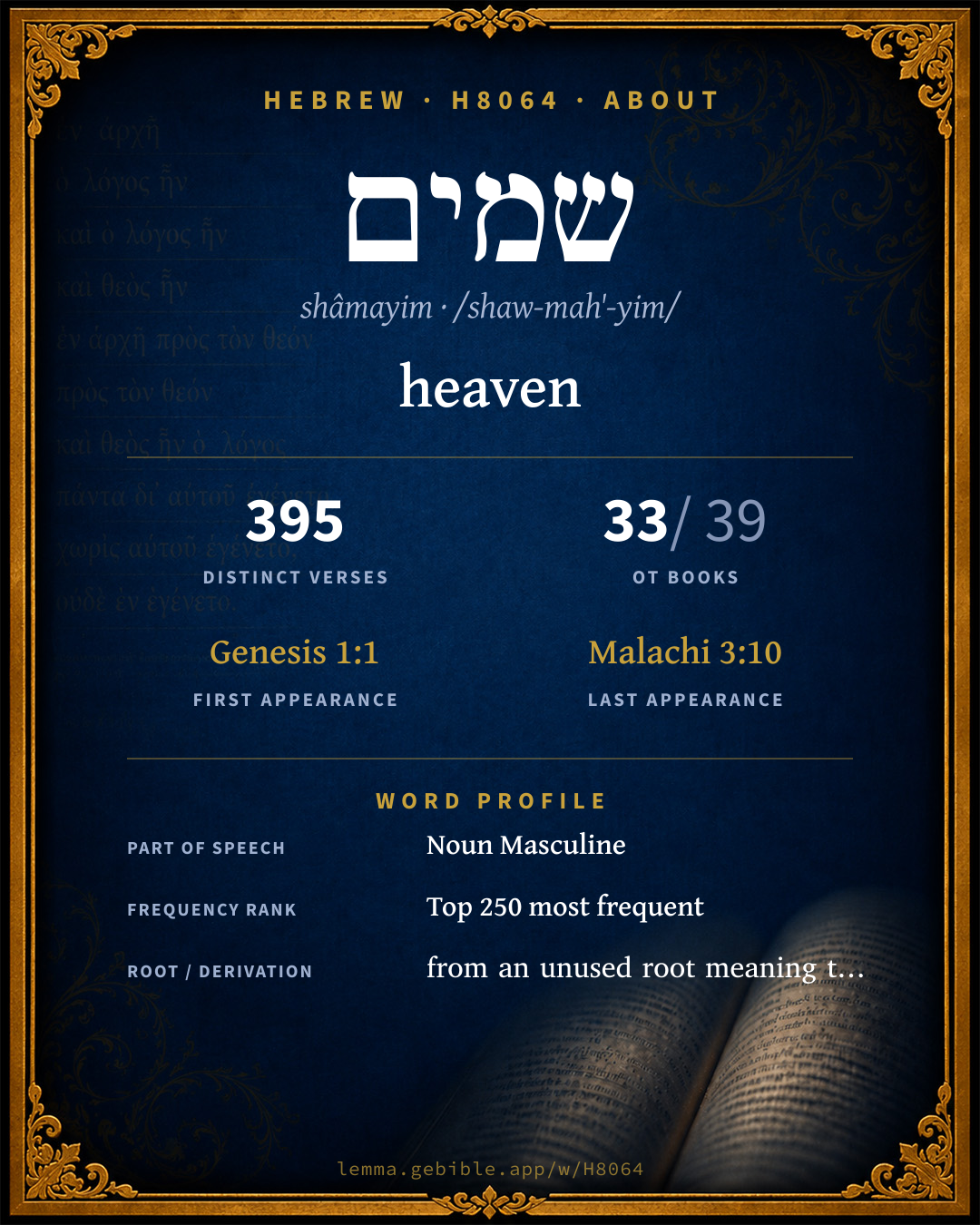
שָׁמַיִם
heaven
also: heavens, sky fuller range ↓
Full lexicon entry — Brown-Driver-Briggs (BDB)
From Brown-Driver-Briggs (BDB)
Where this word appears
See every Absolute-state word in the Hebrew Bible →
Grammar key — what these labels mean
Part of speech
- Noun
- A naming word — a person, place, thing, or idea.
Noun type
- Common
- A common noun — a general class of person, place, or thing (“king,” “city,” “water”), not a specific name.
State
- Absolute
- The independent form of a noun, not bound to a following word.
- Construct
- A noun bound to a following noun in a possessive / “of” relationship (the construct chain).
Gender
- Masculine
- Grammatically masculine.
Number
- Plural
- More than one (in Hebrew, generally three or more).
- Dual
- Exactly two — for natural pairs and some measures of time.
11 verses where H8064 appears in the Absolute state in the Book of Nehemiah. Filtered view — show all forms. Click any verse to open its interlinear word-by-word view. Verse text shown in the World English Bible for context — . Each verse’s Hebrew form is shown with its reference; the English is not keyword-highlighted, since the data carries no word-level English alignment. Use “Compare translations” on any verse to read it across multiple English versions. This concordance covers the Hebrew Bible; Septuagint (Greek Old Testament) occurrences are not indexed here.
Nehemiah
- Nehemiah 1:4 הַ/שָּׁמָֽיִם ptcl def.art + n c mp It happened, when I heard these words, that I sat down and wept, and mourned certain days; and I fasted and prayed before the God of heaven,
- Nehemiah 1:5 הַ/שָּׁמַ֔יִם ptcl def.art + n c mp and said, I beg you, Yahweh, the God of heaven, the great and awesome God, who keeps covenant and loving kindness with those who love him and keep his commandments:
- Nehemiah 1:9 הַ/שָּׁמַ֨יִם֙ ptcl def.art + n c mp but if you return to me, and keep my commandments and do them, though your outcasts were in the uttermost part of the heavens, yet will I gather them from there, and will bring them to the place that I have chosen, to cause my name to dwell there.
- Nehemiah 2:4 הַ/שָּׁמָֽיִם ptcl def.art + n c mp Then the king said to me, For what do you make request? So I prayed to the God of heaven.
- Nehemiah 2:20 הַ/שָּׁמַ֔יִם ptcl def.art + n c mp Then answered I them, and said to them, The God of heaven, he will prosper us; therefore we his servants will arise and build: but you have no portion, nor right, nor memorial, in Jerusalem.
- Nehemiah 9:6 הַ/שָּׁמַיִם֩ שְׁמֵ֨י הַ/שָּׁמַ֜יִם הַ/שָּׁמַ֖יִם ptcl def.art + n c mp n c mp cs ptcl def.art + n c mp ptcl def.art + n c mp You are Yahweh, even you alone; you have made heaven, the heaven of heavens, with all their host, the earth and all things that are thereon, the seas and all that is in them, and you preserve them all; and the host of heaven worships you.
- Nehemiah 9:13 מִ/שָּׁמָ֑יִם prep + n c mp You came down also on Mount Sinai, and spoke with them from heaven, and gave them right ordinances and true laws, good statutes and commandments,
- Nehemiah 9:15 מִ/שָּׁמַ֜יִם prep + n c mp and gave them bread from the sky for their hunger, and brought forth water for them out of the rock for their thirst, and commanded those who they should go in to possess the land which you had sworn to give them.
- Nehemiah 9:23 הַ/שָּׁמָ֑יִם ptcl def.art + n c mp Their children also multiplied you as the stars of the sky, and brought them into the land concerning which you did say to their fathers, that they should go in to possess it.
- Nehemiah 9:27 מִ/שָּׁמַ֣יִם prep + n c mp Therefore you delivered them into the hand of their adversaries, who distressed them: and in the time of their trouble, when they cried to you, you heard from heaven; and according to your manifold mercies you gave them saviors who saved them out of the hand of their adversaries.
- Nehemiah 9:28 מִ/שָּׁמַ֧יִם prep + n c mp But after they had rest, they did evil again before you; therefore left you them in the hand of their enemies, so that they had the dominion over them: yet when they returned, and cried to you, you heard from heaven; and many times did you deliver them according to your mercies,
About this entry
At a glance — auto-summarized from this page’s data, not written by a person. Every figure links to its source below. This summary describes the numbers; it doesn’t interpret them.
The Hebrew noun שמים centers on the idea of “heaven.” First canonically at Genesis 1:1, it enters the text early. It turns up in 395 verses across 33 books, a common footprint. Beyond “heaven” it also covers “heavens” and “sky” — see its full sense range. It clusters with שמין under a shared root. Dig into 395-verse concordance and the renderings breakdown below.
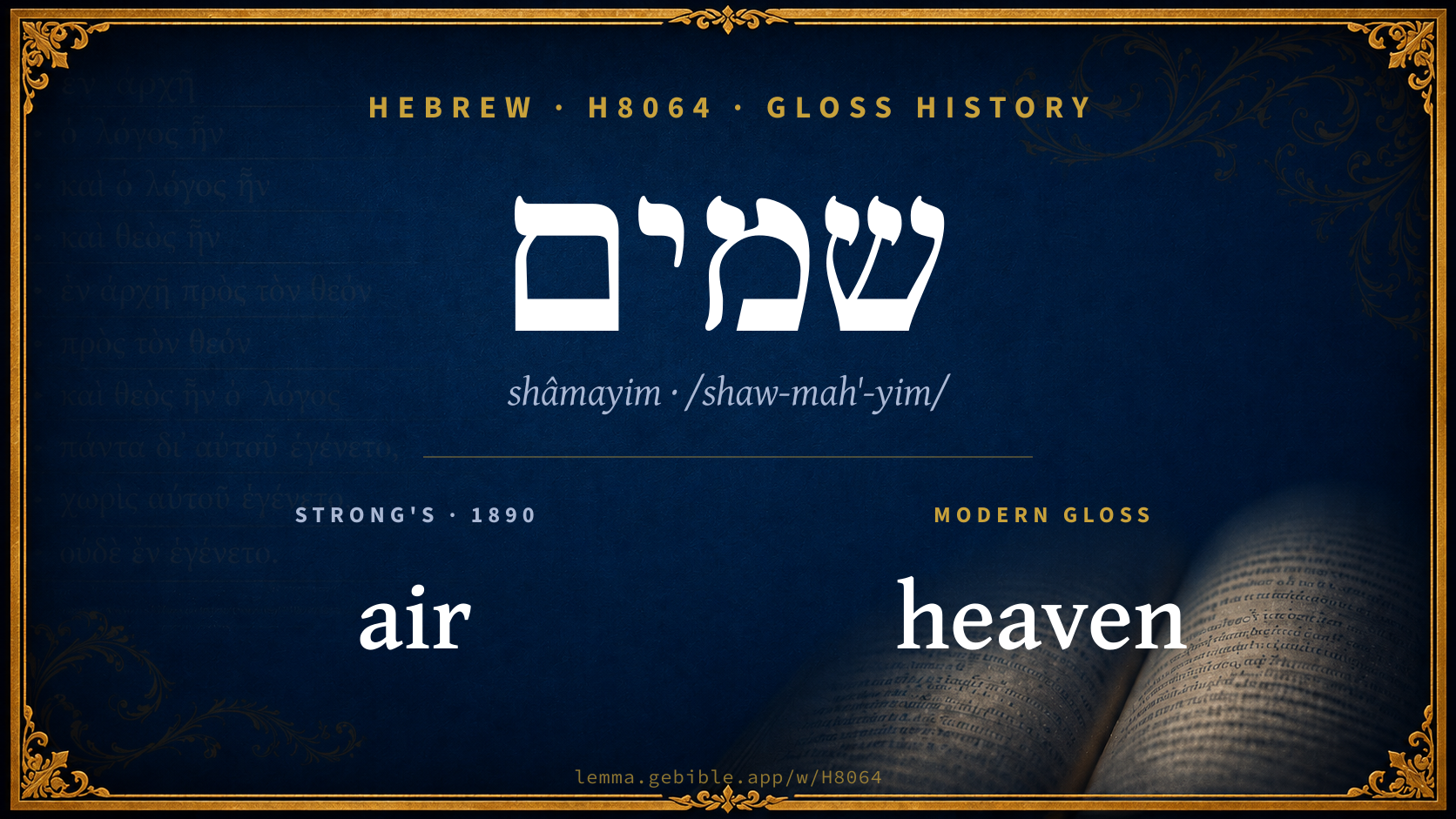
Gloss history
Strong's 1890 vs modern scholarship
About this word
Strong's H8064 catalogs a Hebrew word from the Hebrew Old Testament.
These counts are not copied from any lexicon or concordance. They are computed here, from the morphology-tagged Hebrew Old Testament. What Lemma adds →
- 395
- distinct verses
- The word appears in 395 distinct verses.
- 33 / 39
- OT books
- The word appears in 33 of 39 Old Testament books.
- #117
- by frequency
- Top 250 most frequent Hebrew words (rank 117 of 8,640 Hebrew words by occurrence).
View all 395 occurrences in the concordance →
Most concentrated in
- Psalms 70 verses 18%
- Genesis 39 verses 10%
- Deuteronomy 38 verses 10%
By section of the Old Testament
By traditional corpus
Conventional, traditional groupings — biblical authorship is debated, so this is a traditional corpus grouping, not an authorship claim. Each share is this word’s portion of its verses in that division of the Hebrew canon. Each figure is a share of the word’s 395 distinct verses.
- Writings (Ketuvim) 158 verses · 40%
- Prophets (Nevi'im) 145 verses · 37%
- Torah (Pentateuch) 92 verses · 23%
How translations render this word
Counts come from each version’s own published word-to-Strong’s tagging or interlinear alignment — an approximate guide to how each version renders this word, not a word-level alignment the data otherwise carries. Because each total is that version’s own tagged count, the per-version totals vary from one another and need not match the appearance or distinct-verse counts above. These counts may also differ from a printed concordance because Lemma counts each distinctly tagged rendering and does not collapse phrase taggings into a single head-word total. This is a fixed set of word-tagged versions (KJV, ASV, BSB, ULT) and does not change with the reading translation you choose elsewhere. Each version’s license is shown beside its name below (and on Sources).
- King James Version: Heaven 227×, Heavens 80×, Air 21×
- American Standard Version: Heaven 172×, Heavens 133×, Toward heaven 11×
- Berean Standard Bible: Heaven 154×, Heavens 139×, Air 43×
- unfoldingWord Literal Text: Heavens 297×, Heaven 47×, Sky 21×
King James Version Public Domain
Renders H8064 across 419 tagged occurrences — most commonly:
Plus other, less common renderings. Plus 33 renderings that appear only once — usually multi-word phrases or single function words the recovered tagging swept in, not distinct renderings. Not rendered by a distinct English word in 1 further occurrence.
American Standard Version Public Domain
Renders H8064 across 419 tagged occurrences — most commonly:
Plus other, less common renderings. Plus 53 renderings that appear only once — usually multi-word phrases or single function words the recovered tagging swept in, not distinct renderings.
Berean Standard Bible Public Domain
Renders H8064 across 410 tagged occurrences — most commonly:
Plus other, less common renderings. Plus 14 renderings that appear only once — usually multi-word phrases or single function words the recovered tagging swept in, not distinct renderings. Not rendered by a distinct English word in 11 further occurrences.
unfoldingWord Literal Text CC BY-SA 4.0
Renders H8064 across 414 tagged occurrences — most commonly:
Plus 12 renderings that appear only once — usually multi-word phrases or single function words the recovered tagging swept in, not distinct renderings.
5 senses and sub-senses in the full BDB
What do BDB’s symbols mean?
BDB uses these scholarly abbreviations:
| Symbol | Meaning |
|---|---|
| 𝔊 | the Septuagint (the ancient Greek translation, LXX) |
| 𝔙 | the Vulgate (the Latin translation) |
| 𝔖 | the Syriac version (the Peshitta) |
| 𝔗 | the Targum (the Aramaic translation) |
| ψ | the Psalms |
| √ | root (the underlying root or stem) |
| ‖ | parallel passage (a synonymous or contrasted parallel) |
| † | the dagger: every passage where the word occurs is cited |
The 5 senses and sub-senses the full Brown-Driver-Briggs lexicon distinguishes for this word, in lexicon order (not ranked by frequency), with BDB’s own verbatim wording and sub-sense lettering. Shown in Hebrew script with BDB’s own scholarly abbreviations. The condensed entry is in the Lexicon Entry tab. See also the Forms in the corpus table below.
- 1.
- a. visible heavens, sky, where stars, etc., are
- b. phrases
- 2.
- a. as abode of God
- b. Elijah taken up הַשּׁ׳ in whirlwind
- 3. הַשּׁ׳ personified in various relations
Senses from the full Brown-Driver-Briggs lexicon (Brown, Driver, Briggs; Oxford 1906 — public domain), digitized via Sefaria, supplemented by the OpenScriptures HebrewLexicon (CC BY 4.0). Full attribution on Sources.
Word origin
[ שָׁמַי ] n.m. only pl. שָׁמַיִם 421 heavens, sky
— Brown-Driver-Briggs (Oxford 1906, public domain), digitized via Sefaria, supplemented by the OpenScriptures HebrewLexicon (CC BY 4.0). See Sources.
Origin: from an unused root meaning to be lofty
Jastrow Dictionary
A second Hebrew/Aramaic lexicon for comparison, covering Aramaic and post-biblical (Talmudic, Targumic, Midrashic) usage that the biblical-Hebrew BDB does not. Matched by lemma rather than by Strong’s number, so a lemma may carry more than one Jastrow headword (shown separately below), and the entries cover usage well beyond the Bible.
שָׁמַיִם
- du. m. du. (b. h.)
- 1. heaven; trnsf. Heaven, God. Gen. R. s. 1 הש׳ נבראו תחלה the heaven was first created. Tam. 32ᵃ top מן הש׳ לארץ וכ׳ is it farther from heaven to earth, or from east to west? Lam. R. introd. (R. Joh. 1) מִשְּׁמֵי מרום from the high heavens. Ned. XI, 12 (90ᵇ) ש׳ ביני לביניך heaven is between me and thee (I have an unconquerable aversion to associating with thee, v. Y. ib. 42ᵈ bot., quot. s. v. רָחִיק II; differ. in comment.). R. Hash. 19ᵃ אי ש׳ by Heaven! B. Mets. 37ᵃ לצאת ידי ש׳ to do his duty towards God (v. יָצָא).—Kidd. 40ᵃ, a. e. רע לש׳, v. רַע.—Snh. XI, 5, a. e. בידי ש׳, v. מִיתָה.—ירא ש׳, יראת ש׳, מלכות ש׳ &c., v. respective determinants.
A Dictionary of the Targumim, the Talmud Babli and Yerushalmi, and the Midrashic Literature (Marcus Jastrow; London, Luzac, 1903) — Public Domain. Digitized via Sefaria. Digitized via Sefaria. Full attribution on Sources.
Forms in the corpus
The 97 distinct written forms H8064 takes in the Hebrew Bible, most frequent first — each parse links to that state’s occurrences in the concordance. Hebrew forms include their vowel points and cantillation, so a single lemma takes many written forms.
The 60 most common forms are shown; 37 rarer forms follow in the full concordance.
Same root — word family
Other BDB entries built from the same root as H8064, grouped by Strong’s listed origin. These share a root / origin per the lexicon — not necessarily a shared meaning. Each links to that word’s own entry.
Derived from this word
Compare all same-root words → They share a root, not necessarily a meaning.
Septuagint verse parallels
This word appears in 362 verses that also exist in the Greek Old Testament (Septuagint), out of the 395 Hebrew verses it occurs in. You can read those verses in Greek by switching the Old Testament edition to the Septuagint.
Read these verses in the Septuagint
- Genesis 1:1
- Exodus 9:8
- Leviticus 26:19
- Deuteronomy 1:10
- Joshua 2:11
- Judges 5:4
- 1 Samuel 2:10
- 2 Samuel 18:9
- 1 Kings 8:22
- 2 Kings 1:10
- 1 Chronicles 16:26
- 2 Chronicles 2:6
This is a verse-level parallel only — the same verses exist in both the Hebrew and Greek Old Testaments. No word-level Hebrew↔Greek correspondence is claimed: the data carries no such alignment, so no Greek word is shown as this Hebrew word’s translation. Coverage is not total — the Septuagint omits the deuterocanon and renumbers the Psalms, so some Hebrew verses have no direct Greek parallel.