
Psalms 33:13

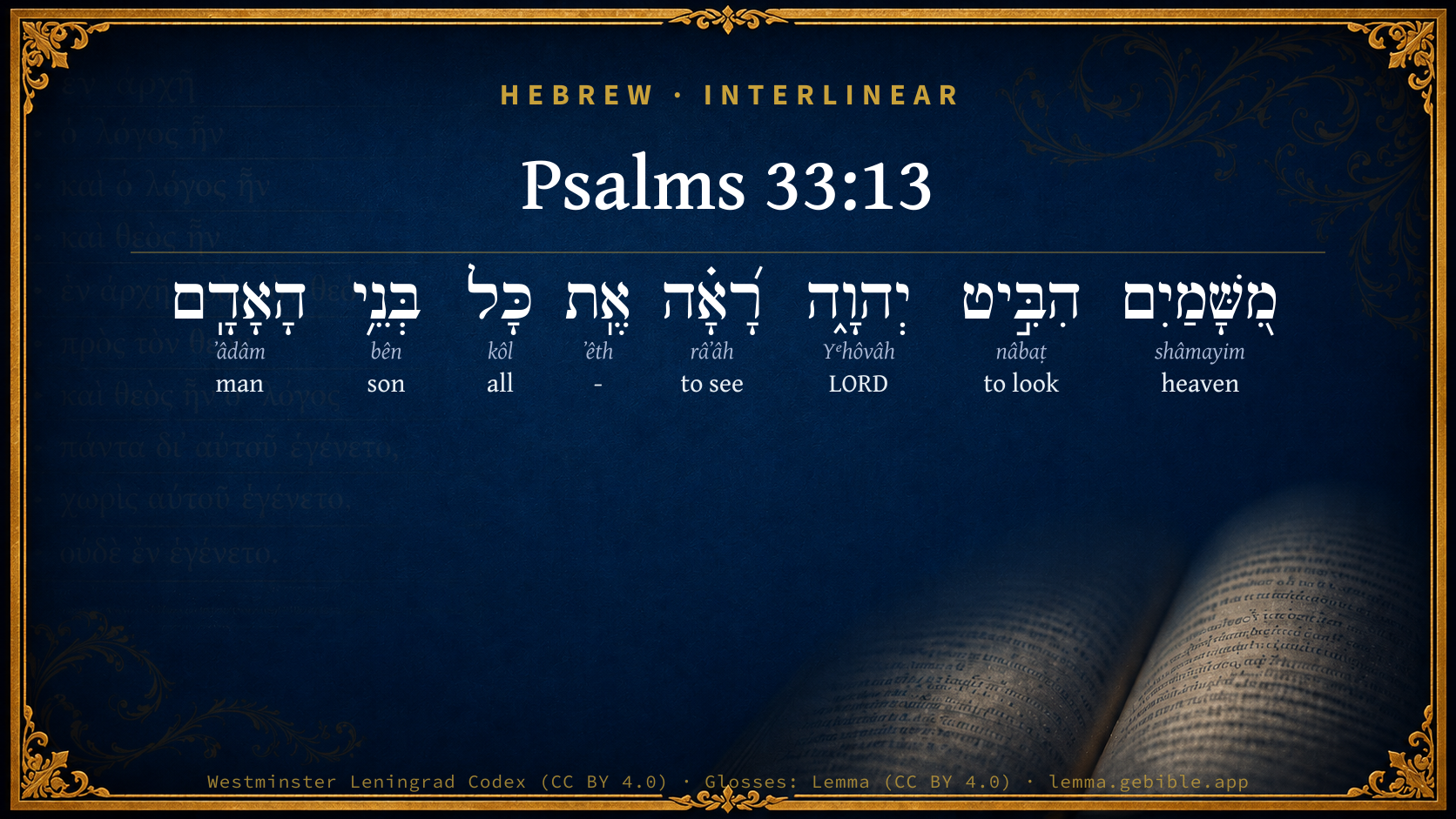
Hebrew (Westminster Leningrad Codex) Psalms 33:13 appears in the Hebrew Old Testament. The text above is from the Westminster Leningrad Codex. Each word links to its Strong’s number, a concise gloss, and parsing drawn from the Open Scriptures Hebrew Bible morphology. Click any word for its full Brown-Driver-Briggs (BDB) entry.
Download image
Cite this verse

Psalms 33:13 (World English Bible). Public Domain. Lemma interlinear Bible study tool, https://lemma.gebible.app/v/psalms/33/13.

Show BibTeX & RIS
BibTeX
RIS
English Translation
Yahweh looks from heaven. He sees all the sons of men.
World English Bible · Public Domain
Download a study sheet

One document with this verse’s original text, its word-by-word gloss line, the meaning frame, cross-references with their text, attributed commentary, and full source and license credits — printable, and it pastes into notes with its structure intact.

This verse Autodidact and up

Study sheet (.html) Plain text (.txt)

A passage Seminary Student

Up to 50 verses in one chapter. A passage sheet keeps up to 6 commentary sources and 12 cross-references per verse, in the order this page ranks them, and says so on the sheet whenever that leaves anything out. Ask for a single verse and you get the Autodidact verse sheet above.

Everything on this page stays free to read, with no account — the sheet is a download of what is already on screen, not access to it.

Want to remove ads? Support Godless Engineer
Compare translations 3

The same verse in 3 English versions, stacked beneath the original-language interlinear above. Click any original word for its lexicon entry.

Each is an independent rendering of the whole verse — the interlinear is not word-aligned to these translations.

Highlighted words mark where these versions differ — a whole-verse word diff, not a word-by-word alignment.

  • World English Bible Public Domain
    Yahweh looks from heaven. He sees all the sons of men.
  • King James Version Public Domain
    The LORD looketh from heaven; he beholdeth all the sons of men.
  • unfoldingWord Literal Text CC BY-SA 4.0
    From the heavens, Yahweh looks down; he sees all of the sons of man.

unfoldingWord Literal Text — © unfoldingWord, licensed CC BY-SA 4.0. Word-aligned USFM3 via Door43 (git.door43.org/unfoldingWord/en_ult).

Versions to compare (up to 4)

3 of 4 selected

Show all 18 translations

Every available English version of this verse, each an independent rendering of the whole verse.

  • World English Bible Public Domain
    Yahweh looks from heaven. He sees all the sons of men.
  • Berean Standard Bible Public Domain
    The LORD looks down from heaven; He sees all the sons of men.
  • Majority Standard Bible Public Domain
    The LORD looks down from heaven; He sees all the sons of men.
  • King James Version Public Domain
    The LORD looketh from heaven; he beholdeth all the sons of men.
  • American Standard Version (1901) Public Domain
    Jehovah looketh from heaven; He beholdeth all the sons of men;
  • Revised Version (1885) Public Domain
    The LORD looketh from heaven; he beholdeth all the sons of men;
  • Geneva Bible (1599) Public Domain
    The Lord looketh downe from heauen, and beholdeth all the children of men.
  • Douay-Rheims (1899) Public Domain
    The Lord hath looked from heaven: he hath beheld all the sons of men.
  • Young's Literal Translation Public Domain
    From the heavens hath Jehovah looked, He hath seen all the sons of men.
  • Literal Standard Version CC BY-SA 4.0
    YHWH has looked from the heavens, || He has seen all the sons of men.
  • Unlocked Literal Bible CC BY-SA 4.0
    Yahweh looks from heaven; he sees all the people.
  • unfoldingWord Literal Text CC BY-SA 4.0
    From the heavens, Yahweh looks down; he sees all of the sons of man.
  • Darby Bible Public Domain
    Jehovah looketh from the heavens; he beholdeth all the sons of men:
  • World Messianic Bible Public Domain
    The LORD looks from heaven. He sees all the sons of men.
  • Webster's Bible Public Domain
    The LORD looketh from heaven; he beholdeth all the sons of men.
  • Free Bible Version CC BY-SA 4.0
    The Lord looks from heaven and sees the whole of humanity,
  • Bible in Basic English Public Domain
    The Lord is looking down from heaven; he sees all the sons of men;
  • JPS Tanakh (1917) Public Domain
    The LORD looketh from heaven; He beholdeth all the sons of men;

Literal Standard Version (2020), Covenant Press — licensed CC BY-SA 4.0. Text via the HelloAO Bible API (eBible.org). Unlocked Literal Bible (unfoldingWord) — licensed CC BY-SA 4.0. Text via the HelloAO Bible API (eBible.org). unfoldingWord Literal Text — © unfoldingWord, licensed CC BY-SA 4.0. Word-aligned USFM3 via Door43 (git.door43.org/unfoldingWord/en_ult). Free Bible Version, Dr. Jonathan Gallagher — licensed CC BY-SA 4.0. Text via the HelloAO Bible API (eBible.org).

Word by word

More ways to search: Search by grammar → Find every occurrence → Compare this word →

Practice this passage: Drill this verse → Learn its vocabulary →

About this verse

These counts appear in no published source. They are computed here, from the morphology-tagged text and Lemma’s own curated glosses. What Lemma adds →

8
words
8
distinct lemmas
Wisdom
section

Grammatical profile

  • 2 verbs
  • 5 nouns
  • 1 particle

Verb forms

  • הִבִּ֣יט Hiphil · Perfect
  • רָ֝אָ֗ה Qal · Perfect

Hebrew & Septuagint length

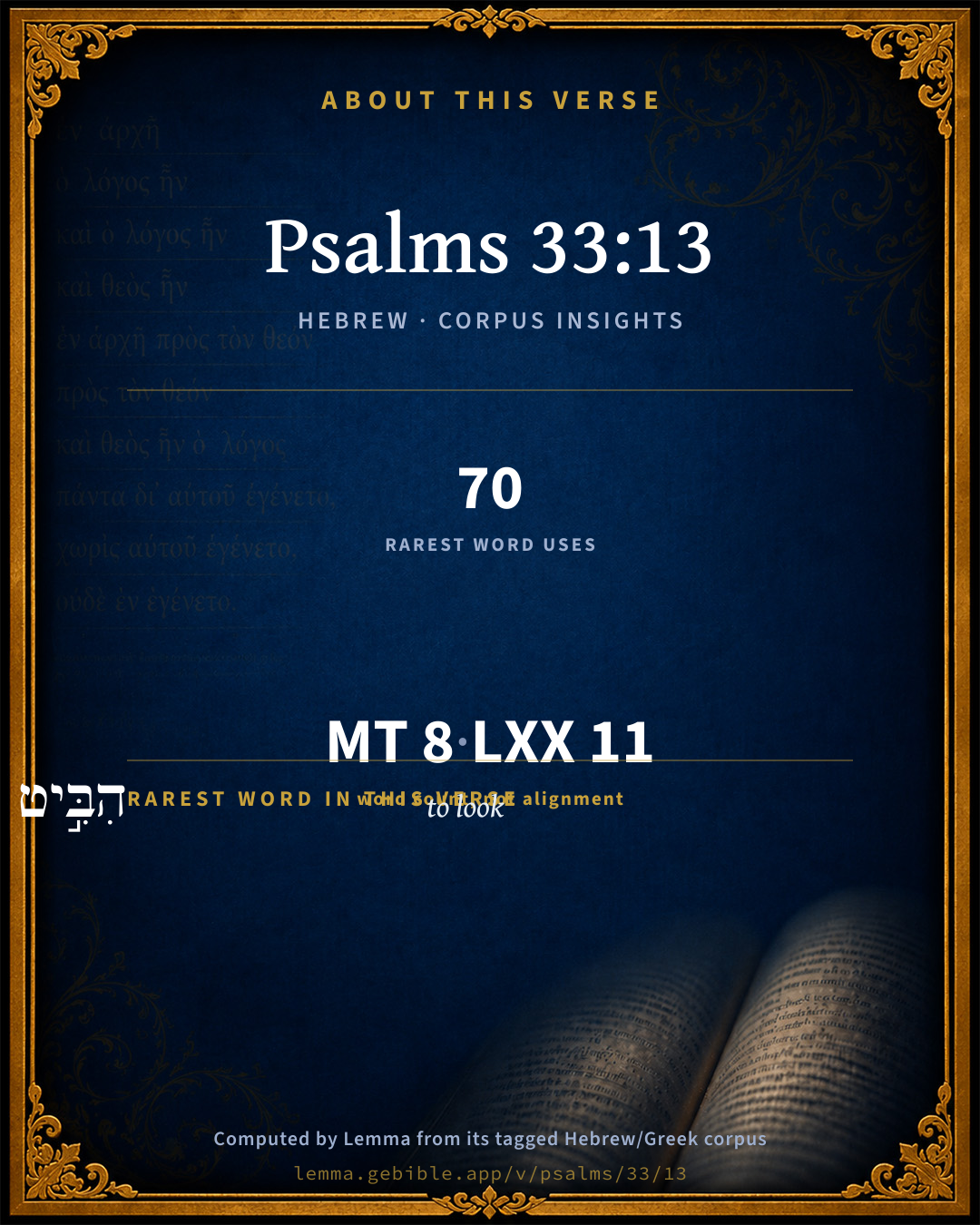
In English translation the verse runs 11 words from the Hebrew and 13 from the Septuagint (LXX English) — closely comparable.

A rough comparison of the two English renderings, which tokenize alike — not a word-level alignment.

Word counts can differ between the Hebrew and the Greek without any difference in meaning — e.g. the Hebrew direct-object marker אֵת has no separate Greek word, and Greek often adds the article ὁ.

In the original languages it is 8 Hebrew tokens and 11 Greek tokens — but the two are counted differently (Hebrew bundles its prefixes and suffixes into one token; the Greek is in lemma form), so that isn’t a like-for-like length.

Cross-references

11

Topical passages linked to Psalms 33:13 in the Treasury of Scripture Knowledge — connected by theme and wording, ordered by reader-vote popularity; previews shown in the World English Bible.

  • Job 28:24 For he looks to the ends of the earth, And sees under the whole sky.
  • Psalms 11:4 Yahweh is in his holy temple. Yahweh is on his throne in heaven. His eyes observe. His eyes examine the children of men.
  • Psalms 53:2 God looks down from heaven on the children of men, To see if there are any who understood, Who seek after God.
  • Hebrews 4:13 There is no creature that is hidden from his sight, but all things are naked and laid open before the eyes of him with whom we have to do.
  • 2 Chronicles 16:9 For the eyes of Yahweh run back and forth throughout the whole earth, to show himself strong in the behalf of them whose heart is perfect toward him. Herein you have done foolishly; for from henceforth you shall have wars.
  • Proverbs 15:3 Yahweh's eyes are everywhere, Keeping watch on the evil and the good.
  • Jeremiah 23:23–24 Am I a God at hand, says Yahweh, and not a God afar off?
  • Psalms 14:2 Yahweh looked down from heaven on the children of men, To see if there were any who did understand, Who did seek after God.
  • Psalms 102:19 For he has looked down from the height of his sanctuary. From heaven, Yahweh saw the earth;
  • Lamentations 3:50 Until Yahweh look down, and see from heaven.
  • Genesis 6:12 God saw the earth, and saw that it was corrupt, for all flesh had corrupted their way on the earth.

Cross-references courtesy of OpenBible.info (CC BY 4.0).

Hebrew and Greek witnesses Masoretic Hebrew ↔ Greek Septuagint

The same verse in the two great witnesses to the Old Testament, shown verse-for-verse.

You’re reading Greek Psalm 32 (Hebrew Psalm 33). The Septuagint counts the superscription, so verse numbers can differ from the Hebrew — chapter-level alignment, not verse-by-verse. Numbering follows Rahlfs.

These are two independent witnesses, not word-aligned to each other, and the Septuagint is shown in lemma (dictionary) form.

Hebrew Psalms 33:13 Masoretic · Westminster Leningrad Codex

מִ֭שָּׁמַיִם הִבִּ֣יט יְהוָ֑ה רָ֝אָ֗ה אֶֽת כָּל בְּנֵ֥י הָאָדָֽם

Yahweh looks from heaven. He sees all the sons of men.

World English Bible · Public Domain

Greek LXX Greek Psalm 32:13 Septuagint · lemma form

ἐκ οὐρανός ἐπιβλέπω ὁ κύριος ὁράω πᾶς ὁ υἱός ὁ ἄνθρωπος

The Lord looks out of heaven; he beholds all the sons of men.

LXX2012 (modern English Septuagint) · Public Domain

On this verse, Whedon's Commentary on the Bible discusses the Septuagint’s reading. Read the note in Commentary ↓

Hebrew: Westminster Leningrad Codex (CC BY 4.0). Greek: Septuagint (public domain); English from LXX2012 (modern English Septuagint) (Public Domain). How the Septuagint differs from the Hebrew →

Commentary

Notes on Psalms 33:13 from classic Christian and Jewish commentators (each source and its license shown beneath its notes). The classic Christian expositions comment on the surrounding passage and are grouped to its opening verse, so a note may address several verses; the Jewish commentaries on the Tanakh (Rashi and others) are per-verse, so they appear only where the commentator wrote on this verse.

Lemma curates 59 commentaries, every one of them public domain or Creative Commons licensed, each selected and text-cleaned for this edition rather than reprinted as found. About our sources →

Trapp's Complete Commentary

John Trapp

Psa 33:13 The LORD looketh from heaven; he beholdeth all the sons of men.

Ver. 13. The Lord looketh from heaven] Ita respicit universos quasi singulos, ita singulos quasi solos. And this doctrine of God’s particular providence is, fides nationum quarum Deus est Dominus, saith Kimchi, taught in the Church only.

John Trapp, A Commentary or Exposition upon All the Books of the Old and New Testament (1647–1656) — public domain. Text from a community e-Sword module.

Joseph Benson's Commentary

Psa 33:13-15. He beholdeth all the sons of men — Although he had a special relation to Israel, yet he hath a general care over all mankind, all whose hearts and ways he observes. He fashioneth their hearts alike —

היצר יחד לבם, hajotzer jachad lib-bam, It is he that formed their hearts, one and all, and consequently must know what are their thoughts and intentions: or, in the present tense, as our version renders it, He formeth, and so it refers to the works of God’s providence; and the psalmist having said that God sees and observes all men, now adds, that he rules and governs them; yea, even their hearts, which are most unmanageable, he disposes and inclines according to the counsel of his will. Alike, or, equally, one as well as another; whether they be Jews or Gentiles, bond or free, princes or peasants; all are alike subject to his jurisdiction. He considereth all their works — Both outward and inward, all the workings of their minds and actions, and all their endeavours and actions. How great then “must be the advantage of living in the favour, and under the protection, of this great Being, who, from the watch-tower of his eternal throne, beholdeth, directeth, and controlleth, at pleasure, not only the actions and the words, but the very thoughts and imaginations of all the inhabitants of the earth!” — Horne.

Joseph Benson's Commentary on the Old and New Testaments (1811–1818) — public domain. Text from a community e-Sword module.

J. A. Alexander on Psalms

Joseph Addison Alexander

13. (Psa 33:13) From heaven looked Jehovah; he saw all the sons of man (or Adam). He looked not at any one time merely, but at all times; he has always looked upon them since he first created them. As his omnipotence is constantly exerted to sustain them in existence, so his omniscience is continually exercised in the same inspection as at first.

Joseph Addison Alexander, The Psalms Translated and Explained (1850) — public domain. Text from a community e-Sword module.

Tyndale Open Study Notes

Tyndale Open Resources

33:13-19 From the heavens, the Lord searches out and cares for anyone who fears him (see 14:2-3).

Tyndale Open Study Notes — © Tyndale Open Resources, licensed CC BY-SA 4.0. Text via the HelloAO Bible API.

Geneva Bible (1599)

Geneva Bible translators

He proveth, that all things are governed by God’s providence and not by fortune.

Geneva Bible (1599) marginal notes — public domain. Text via Bolls.life.

Jamieson, Fausset & Brown

Robert Jamieson, A. R. Fausset & David Brown

looketh--intently (Isa 14:16).

Jamieson, Fausset & Brown — Commentary Critical and Explanatory on the Whole Bible (1871) — public domain (CC PDM 1.0). Text via the HelloAO Bible API.

Adam Clarke's Commentary

Verse 13. The Lord looketh from heaven] This and the following verse seem to refer to God's providence. He sees all that is done in the earth, and his eye is on all the children of men.

Adam Clarke's Commentary on the Bible (1810–1826) — public domain. Text from a community e-Sword/MySword module.

John Calvin's Commentaries

13. Jehovah looked down from heaven. The Psalmist still proceeds with the same doctrine, namely, that human affairs are not tossed hither and thither fortuitously, but that God secretly guides and directs all that we see taking place. Now he here commends God’s inspection of all things, that we on our part may learn to behold, and to contemplate with the eye of faith, his invisible providence. There are, no doubt, evident proofs of it continually before our eyes; but the great majority of men, notwithstanding, see nothing of them, and, in their blindness, imagine that all things are under the conduct of a blind fortune. Nay, the more plenteously and abundantly that he sheds his goodness upon us, the less do we raise our thoughts to him, but preposterously settle them down immovably on the external circumstances which surround us. The prophet here rebukes this base conduct, because no greater affront can be offered to God than to shut him up in heaven in a state of idleness. This is the same as if he were to lie buried in a grave. What kind of life would God’s life be, if he neither saw nor took care of any thing? Under the term throne, too, the sacred writer shows, from what is implied in it, what an absurd infatuation it is to divest God of thought and understanding. He gives us to understand by this word, that heaven is not a palace in which God remains idle and indulges in pleasures, as the Epicureans dream, but a royal court, from which he exercises his government over all parts of the world. If he has erected his throne, therefore, in the sanctuary of heaven, in order to govern the universe, it follows that he in no wise neglects the affairs of earth, but governs them with the highest reason and wisdom.

John Calvin's Commentaries (1540-1563) — public domain. Text from the Calvin Translation Society English edition (1840s-50s) via the Christian Classics Ethereal Library (ccel.org). Calvin's coverage is partial (roughly two-thirds of the Bible); uncommented books and verses are honest gaps, never fabricated. The 19th-century editor's footnotes and remarks are omitted so the notes are faithfully Calvin's own voice.

The Cambridge Bible for Schools and Colleges

gen. ed. J. J. S. Perowne

13, 14. The Psalmist dwells upon Jehovah’s all-seeing omniscience in order to emphasise the peculiar privilege of His people. Throned in heaven (1Ki_8:39 ff.) He surveys all mankind. Cp. Psa_11:4; Psa_14:2; Psa_102:19-20.

The Cambridge Bible for Schools and Colleges (gen. ed. J. J. S. Perowne; Cambridge University Press, 1878–1918) — public domain. Text from a community e-Sword module.

John Gill's Exposition

The Lord looketh from heaven,.... Where his throne and temple are, upon the earth and men, and things in it, as follows;

he beholdeth all the sons of men; the evil and the good; which is contrary to the sense of many wicked men, who imagine he takes no notice of what is done here below; but his eye is upon all, upon all the workers of iniquity, how secret soever they may be; and not only his eye of Providence is upon good men, but his eye of love, grace, and mercy; and he has a special and distinct knowledge of them: agreeably to this are some expressions of Heathen writers; says one (e),

"the eye of God sees all things;''

says another (f),

"there is a great God in heaven who sees all things, and governs.''

(e) , &c. Hesiod. Opera & Dies, l. 1. v. 263. (f) , &c. Sophoclis Electra, v. 174, 175.

John Gill's Exposition of the Whole Bible (1746–1763) — public domain (CC PDM 1.0). Text via the HelloAO Bible API.

Albert Barnes' Notes on the Bible

The Lord looketh from heaven - heaven is represented as his abode or dwelling; and from that place he is represented as looking down upon all the nations of the earth. The meaning here is, that he sees all that dwell upon the earth, and that, therefore, all that worship him are under his eye. He knows their wants, and he will watch over them to protect them. It is not merely to the abstract truth that God sees all who dwell upon the earth that the psalmist means to refer; but that those who are his friends, or who worship him, are all under his eye, so as to enjoy his watchful care and attention.

He beholdeth all the sons of men - All the descendants of “Adam,” for this is the original. There is no improbability in supposing that the word “Adam” here (usually meaning “man”) is employed as a proper name to denote the great ancestor of the human race, and that the psalmist means to refer to the race as one great family descended from a common ancestor, though scattered abroad over the face of the world.

Albert Barnes' Notes on the Bible (1834–1885) — public domain. Text from a community e-Sword/MySword module.

The Treasury of David

Charles H. Spurgeon

Ver. 13. The Lord looketh from heaven. The Lord is represented as dwelling above and looking down below; seeing all things, but peculiarly observing and caring for those who trust in him. It is one of our choicest privileges to be always under our Father's eye, to be never out of sight of our best Friend. He beholdeth all the sons of men. All Adam's sons are as well watched as was Adam himself, their lone progenitor in the garden. Ranging from the frozen pole to the scorching equator, dwelling in hills and valleys, in huts and palaces, alike doth the divine eye regard all the members of the family of man.

None.

Ver. 13. Omniscience and its lessons.

Ver. 13-15. The doctrine of providence.

Psalms 33:14*

Ver. 13-15. The doctrine of providence.

Psalms 33:15*

Ver. 13-15. The doctrine of providence.

Charles H. Spurgeon's The Treasury of David (1869–1885) — public domain. Psalms only. Text from a community e-Sword/MySword module.

Whedon's Commentary on the Bible

Daniel D. Whedon

13-15. The psalmist reiterates the personal and minute inspection of the hearts of all men, to show that this knowledge will make a sure pathway for infinite power to execute eternal justice.

He fashioneth their hearts alike—The Hebrew yahhad, translated “alike,” and usually translated together, here means, wholly, altogether. The idea is, that the creation and endowment of man’s heart—his intellective, moral, and psychical being—is wholly, or altogether, God’s work. The Septuagint renders it μονας, alone, and the Vulgate, sigillatim, individually, every one of them. The argument requires this sense. God alone made the heart, and he alone perfectly understands all its workings. The passage is parallel to Psa_94:9-10

Daniel D. Whedon (gen. ed.), Commentary on the Old and New Testaments (1874–1909) — public domain. Text from a community e-Sword module.

The Pulpit Commentary

The Lord looketh from heaven; he beholdeth all the sons of men. (comp. Psa_11:4:14:2 Psa_102:19) God"s having any care at all for man is a wondrous condescension, and so worthy of all praise; his having regard to all men all the frail sons of weak and sinful Adam is still more wonderful, still more deserving of eulogy.

The Pulpit Commentary (1880–1919), ed. H.D.M. Spence-Jones & Joseph S. Exell — public domain. Text from a community e-Sword module.

John Wesley's Explanatory Notes

All men - Although he hath a relation to Israel, yet he hath a general care over all mankind, all whose hearts and ways he observes.

John Wesley, Explanatory Notes Upon the Whole Bible (1754–1765) — public domain. Text via the GEBible commentary corpus.

unfoldingWord translationNotes

Door43 World Missions Community

he looks down

The place where Yahweh lives is spoken of as if it is above the earth where people live. (See: Metaphor)

shapes the hearts of them all

Here "hearts" refers to the thinking of these people. The writer speaks of Yahweh guiding the thinking of the people as if he were a potter who was shaping a bowl. AT: "guides their thinking as a potter shapes a bowl" (See: Metonymy and Metaphor)

translationWords

heaven

life

earth

heart

works

unfoldingWord translationNotes — © Distant Shores Media and the Door43 World Missions Community, licensed CC BY-SA 4.0. Source: git.door43.org/Door43/en_tn.

Lesson kit

Teaching starters — assembled from the data on this page, not authored interpretation. Every prompt links to the verse data it draws on. Edit before teaching.

Psalms, in the Wisdom, opens this verse with 8 words (8 distinct Hebrew lemmas). Its most distinctive word is nâbaṭ (“to look”). A historical commentator’s framing appears above. Read the whole chapter for the surrounding context.

Discussion questions

  1. How does “to look” (nâbaṭ) shape what this verse is saying?
  2. Job 28:24 shares this passage’s theme. How do the two illuminate each other?
  3. The translations on this page render this verse differently — a whole-verse word diff, not a word-by-word alignment. What might account for the different wordings?
  4. The verb «הִבִּ֣יט» is Hiphil Perfect. How does its form color the action?
  5. Reading how Trapp's Complete Commentary and Joseph Benson's Commentary read this verse, where do the two commentators agree and where do they part?

Things to notice

Reading settings

Reading text

Shown beneath each verse's original-language words.

Old Testament
Old Testament edition

Read the OT as the Masoretic Hebrew (MT) or the Greek Septuagint (LXX).

English shown for the Greek Septuagint (in the Hebrew ↔ Greek comparison).

Comparing translations? Open the Compare panel on any verse page to stack up to four side by side.