
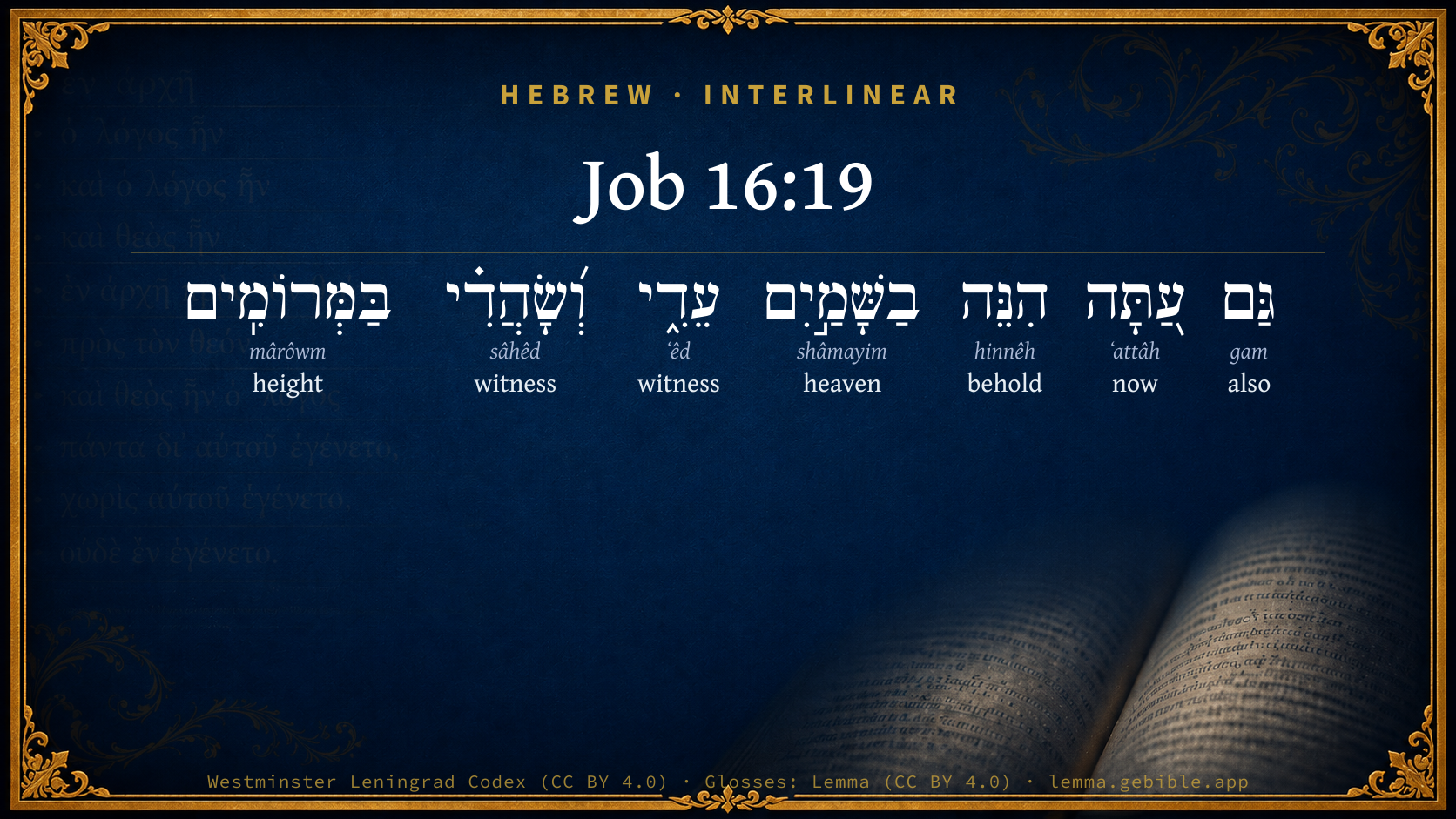
Job 16:19

Hebrew (Westminster Leningrad Codex) Job 16:19 appears in the Hebrew Old Testament. The text above is from the Westminster Leningrad Codex. Each word links to its Strong’s number, a concise gloss, and parsing drawn from the Open Scriptures Hebrew Bible morphology. Click any word for its full Brown-Driver-Briggs (BDB) entry.
Download image
Cite this verse

Job 16:19 (World English Bible). Public Domain. Lemma interlinear Bible study tool, https://lemma.gebible.app/v/job/16/19.

Show BibTeX & RIS
BibTeX
RIS
English Translation
Even now, behold, my witness is in heaven. He who vouches for me is on high.
World English Bible · Public Domain
Highlights
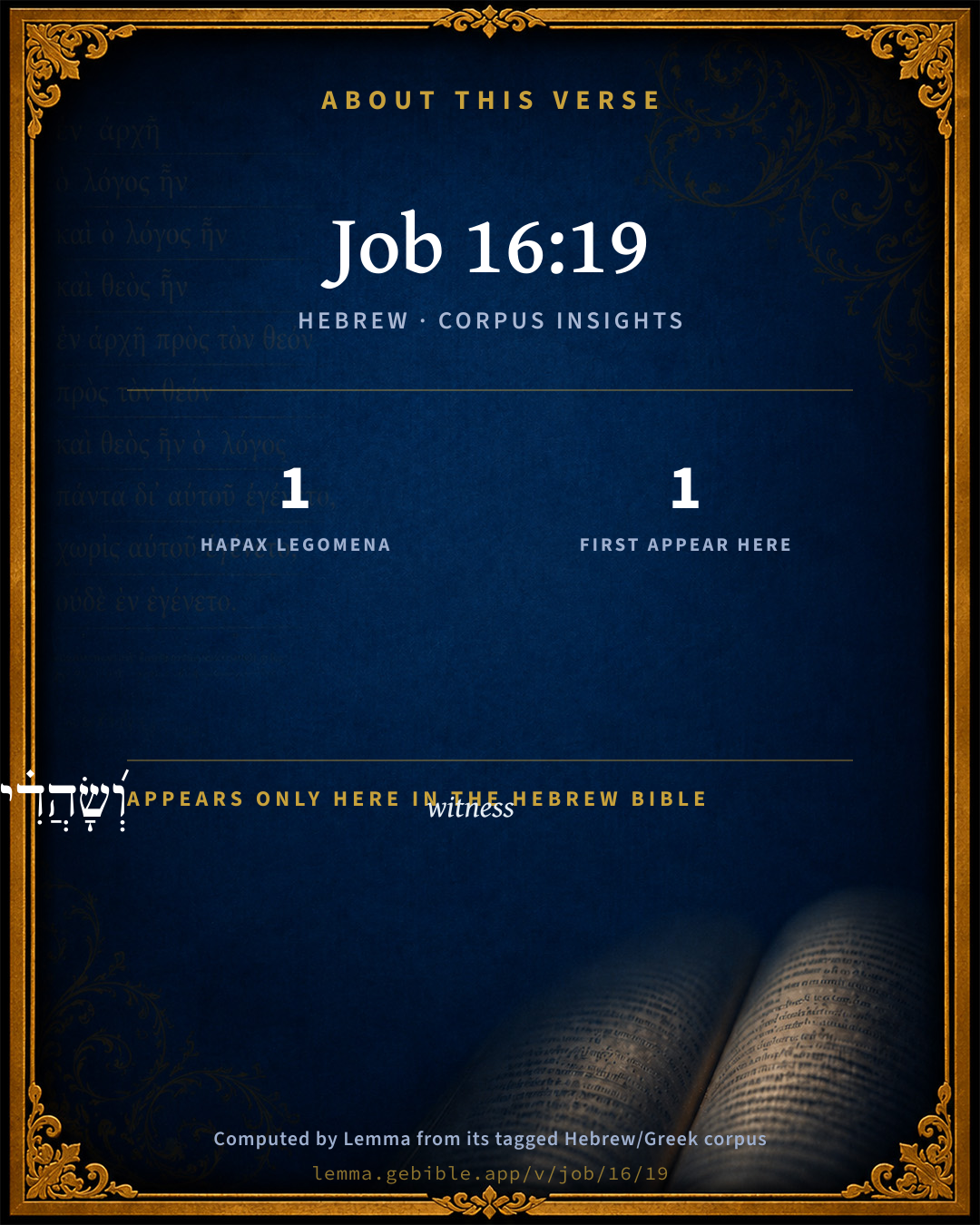
  • 1 hapax legomenon — only here in the Hebrew Bible
  • 1 first appearance in the Hebrew Bible
Full analysis ↓
Download a study sheet

One document with this verse’s original text, its word-by-word gloss line, the meaning frame, cross-references with their text, attributed commentary, and full source and license credits — printable, and it pastes into notes with its structure intact.

This verse Autodidact and up

Study sheet (.html) Plain text (.txt)

A passage Seminary Student

Up to 50 verses in one chapter. A passage sheet keeps up to 6 commentary sources and 12 cross-references per verse, in the order this page ranks them, and says so on the sheet whenever that leaves anything out. Ask for a single verse and you get the Autodidact verse sheet above.

Everything on this page stays free to read, with no account — the sheet is a download of what is already on screen, not access to it.

Want to remove ads? Support Godless Engineer
Compare translations 3

The same verse in 3 English versions, stacked beneath the original-language interlinear above. Click any original word for its lexicon entry.

Each is an independent rendering of the whole verse — the interlinear is not word-aligned to these translations.

Highlighted words mark where these versions differ — a whole-verse word diff, not a word-by-word alignment.

  • World English Bible Public Domain
    Even now, behold, my witness is in heaven. He who vouches for me is on high.
  • King James Version Public Domain
    Also now, behold, my witness is in heaven, and my record is on high.
  • unfoldingWord Literal Text CC BY-SA 4.0
    Even now, behold, my witness in the heavens, and my advocate in the heights.

unfoldingWord Literal Text — © unfoldingWord, licensed CC BY-SA 4.0. Word-aligned USFM3 via Door43 (git.door43.org/unfoldingWord/en_ult).

Versions to compare (up to 4)

3 of 4 selected

Show all 18 translations

Every available English version of this verse, each an independent rendering of the whole verse.

  • World English Bible Public Domain
    Even now, behold, my witness is in heaven. He who vouches for me is on high.
  • Berean Standard Bible Public Domain
    Even now my witness is in heaven, and my advocate is on high.
  • Majority Standard Bible Public Domain
    Even now my witness is in heaven, and my advocate is on high.
  • King James Version Public Domain
    Also now, behold, my witness is in heaven, and my record is on high.
  • American Standard Version (1901) Public Domain
    Even now, behold, my witness is in heaven, And he that voucheth for me is on high.
  • Revised Version (1885) Public Domain
    Even now, behold, my witness is in heaven, and he that coucheth for me is on high.
  • Geneva Bible (1599) Public Domain
    For lo, now my witnesse is in the heauen, and my record is on hie.
  • Douay-Rheims (1899) Public Domain
    O earth, cover not thou my blood, neither let my cry find a hiding place in thee.
  • Young's Literal Translation Public Domain
    Also, now, lo, in the heavens `is' my witness, And my testifier in the high places.
  • Literal Standard Version CC BY-SA 4.0
    Also, now, behold, my witness [is] in the heavens, || And my testifier in the high places.
  • Unlocked Literal Bible CC BY-SA 4.0
    Even now, see, my witness is in heaven; he who vouches for me is on high.
  • unfoldingWord Literal Text CC BY-SA 4.0
    Even now, behold, my witness in the heavens, and my advocate in the heights.
  • Darby Bible Public Domain
    Even now, behold, my Witness is in the heavens, and he that voucheth for me is in the heights.
  • World Messianic Bible Public Domain
    Even now, behold, my witness is in heaven. He who vouches for me is on high.
  • Webster's Bible Public Domain
    Also now, behold, my witness is in heaven, and my record is on high.
  • Free Bible Version CC BY-SA 4.0
    Look, right now my witness is in heaven; the one who speaks for me is on high.
  • Bible in Basic English Public Domain
    Even now my witness is in heaven, and the supporter of my cause is on high.
  • JPS Tanakh (1917) Public Domain
    Even now, behold, my Witness is in heaven, and He that testifieth of me is on high.

Literal Standard Version (2020), Covenant Press — licensed CC BY-SA 4.0. Text via the HelloAO Bible API (eBible.org). Unlocked Literal Bible (unfoldingWord) — licensed CC BY-SA 4.0. Text via the HelloAO Bible API (eBible.org). unfoldingWord Literal Text — © unfoldingWord, licensed CC BY-SA 4.0. Word-aligned USFM3 via Door43 (git.door43.org/unfoldingWord/en_ult). Free Bible Version, Dr. Jonathan Gallagher — licensed CC BY-SA 4.0. Text via the HelloAO Bible API (eBible.org).

Word by word

More ways to search: Search by grammar → Find every occurrence → Compare this word →

Practice this passage: Drill this verse → Learn its vocabulary →

About this verse

These counts appear in no published source. They are computed here, from the morphology-tagged text and Lemma’s own curated glosses. What Lemma adds →

7
words
7
distinct lemmas
Wisdom
section

Notable vocabulary

1 hapax legomenon — a word that appears only here in the entire Hebrew Bible:

  • וְ֝שָׂהֲדִ֗י witness H7717

First appearance in Scripture

This word makes its first canonical appearance in the Hebrew Bible here:

  • וְ֝שָׂהֲדִ֗י witness H7717

Shared distinctive vocabulary

בַּמְּרוֹמִֽים height H4791 occurs in 52 verses of the Hebrew Bible. Also found in:

Grammatical profile

  • 4 nouns
  • 1 adverb
  • 2 particles

Hebrew & Septuagint length

In English translation the verse runs 16 words from the Hebrew and 16 from the Septuagint (LXX English) — the same length.

A rough comparison of the two English renderings, which tokenize alike — not a word-level alignment.

Word counts can differ between the Hebrew and the Greek without any difference in meaning — e.g. the Hebrew direct-object marker אֵת has no separate Greek word, and Greek often adds the article ὁ.

Cross-references

10

Topical passages linked to Job 16:19 in the Treasury of Scripture Knowledge — connected by theme and wording, ordered by reader-vote popularity; previews shown in the World English Bible.

  • Romans 1:9 For God is my witness, whom I serve in my spirit in the Gospel of his Son, how unceasingly I make mention of you always in my prayers,
  • Genesis 31:50 If you will afflict my daughters, and if you will take wives besides my daughters, no man is with us; behold, God is witness between me and you."
  • 1 Thessalonians 2:10 You are witnesses with God, how holy, righteously, and blamelessly we behaved ourselves toward you who believe.
  • 1 Samuel 12:5 He said to them, Yahweh is witness against you, and his anointed is witness this day, that you have not found anything in my hand. They said, He is witness.
  • Job 25:2 "Dominion and fear are with him; He makes peace in his high places.
  • Psalms 113:5 Who is like Yahweh, our God, Who has his seat on high,
  • Romans 9:1 I tell the truth in Christ. I am not lying, my conscience testifying with me in the Holy Spirit,
  • 2 Corinthians 1:23 But I call God for a witness to my soul, that I didn't come to Corinth to spare you.
  • 2 Corinthians 11:31 The God and Father of the Lord Jesus Christ, he who is blessed forevermore, knows that I don't lie.
  • 1 Thessalonians 2:5 For neither were we at any time found using words of flattery, as you know, nor a cloak of covetousness (God is witness),

Cross-references courtesy of OpenBible.info (CC BY 4.0).

Hebrew and Greek witnesses Masoretic Hebrew ↔ Greek Septuagint

The same verse in the two great witnesses to the Old Testament, shown verse-for-verse.

These are two independent witnesses, not word-aligned to each other, and the Septuagint is shown in lemma (dictionary) form.

Hebrew Job 16:19 Masoretic · Westminster Leningrad Codex

גַּם עַ֭תָּה הִנֵּה בַשָּׁמַ֣יִם עֵדִ֑י וְ֝שָׂהֲדִ֗י בַּמְּרוֹמִֽים

Even now, behold, my witness is in heaven. He who vouches for me is on high.

World English Bible · Public Domain

Greek LXX Job 16:19 Septuagint · lemma form

καί νῦν ἰδού ἐν οὐρανός ὁ μάρτυς ἐγώ ὁ δέ συνίστωρ ἐγώ ἐν ὕψιστος

Earth, cover not over the blood of my flesh, and let my cry have no place.

LXX2012 (modern English Septuagint) · Public Domain

On this verse, Whedon's Commentary on the Bible discusses the Septuagint’s reading. Read the note in Commentary ↓

Hebrew: Westminster Leningrad Codex (CC BY 4.0). Greek: Septuagint (public domain); English from LXX2012 (modern English Septuagint) (Public Domain). How the Septuagint differs from the Hebrew →

Commentary

Notes on Job 16:19 from classic Christian and Jewish commentators (each source and its license shown beneath its notes). The classic Christian expositions comment on the surrounding passage and are grouped to its opening verse, so a note may address several verses; the Jewish commentaries on the Tanakh (Rashi and others) are per-verse, so they appear only where the commentator wrote on this verse.

Lemma curates 59 commentaries, every one of them public domain or Creative Commons licensed, each selected and text-cleaned for this edition rather than reprinted as found. About our sources →

Trapp's Complete Commentary

John Trapp

Job 16:19 Also now, behold, my witness [is] in heaven, and my record [is] on high.

Ver. 19. Also now behold my witness is in heaven] Here is his appeal to God. So great is the confidence of a good conscience. We also may do the like, if there be no other way left for clearing our innocence; provided that we do it with a clear conscience, and in a matter of consequence; not in jest, but in judgment. Some of the martyrs appealed thus, and cited their persecutors to answer at God’s tribunal. Yea, to help the truth in necessity, a private oath between two or more may be lawfully taken, so it be done sparingly and warily; for in serious affairs and matters of great importance, if it be lawful in private to admit God as a judge, why should he not as well be called to witness? Again, the examples of holy men show the practice of private oaths as not unlawful. Jacob and Laban confirmed their covenant by a private oath, so did Jonathan and David, &c.

John Trapp, A Commentary or Exposition upon All the Books of the Old and New Testament (1647–1656) — public domain. Text from a community e-Sword module.

Joseph Benson's Commentary

Job 16:19-20. Behold, my witness is in heaven — Besides the witness of men, and of my own conscience, God is witness of my integrity. The witness of men, and even that in our own bosoms for us, will stand us in little stead if we have not a witness in heaven for us also: for God is greater than our own hearts, and than the hearts of all men: neither are we to judge ourselves, nor are men to be our judges. This therefore was Job’s triumph, that he had a witness in heaven, and could appeal to God’s omniscience concerning his integrity. My friends scorn me — Who ought to defend me from the scorns and injuries of others; but mine eye poureth out tears unto God — I pour forth my prayers and tears to him, that he would judge me according to my innocence, and plead my righteous cause against those that accuse and condemn me.

Joseph Benson's Commentary on the Old and New Testaments (1811–1818) — public domain. Text from a community e-Sword module.

Tyndale Open Study Notes

Tyndale Open Resources

16:19-21 my witness is in heaven: Job wished for a benevolent third party who would mediate between him and God (see 9:32-35). Job wanted an advocate from heaven (16:19; cp. Zech 3:1) who would eventually stand on the earth (Job 19:25; cp. 1 Sam 24:15; John 14:16, 26; 15:26; 16:7; 1 Jn 2:1).

Tyndale Open Study Notes — © Tyndale Open Resources, licensed CC BY-SA 4.0. Text via the HelloAO Bible API.

Geneva Bible (1599)

Geneva Bible translators

Though man condemn me, yet God is witness of my cause.

Geneva Bible (1599) marginal notes — public domain. Text via Bolls.life.

Jamieson, Fausset & Brown

Robert Jamieson, A. R. Fausset & David Brown

Also now--Even now, when I am so greatly misunderstood on earth, God in heaven is sensible of my innocence.

record--Hebrew, "in the high places"; Hebrew, "my witness." Amidst all his impatience, Job still trusts in God.

Jamieson, Fausset & Brown — Commentary Critical and Explanatory on the Whole Bible (1871) — public domain (CC PDM 1.0). Text via the HelloAO Bible API.

Adam Clarke's Commentary

Verse 19. My witness is in heaven] I appeal to God for my innocence.

Adam Clarke's Commentary on the Bible (1810–1826) — public domain. Text from a community e-Sword/MySword module.

Ellicott's Commentary for English Readers

(19) My witness is in heaven.—It is very important to note passages such as these, because they help us to understand, and serve to illustrate, the famous confession in Job 19. This is surely a wonderful declaration for a man in the position of Job. What can the believer, in the full light of the Gospel revelation, say more, with the knowledge of One in heaven ever making intercession for him? And yet Job’s faith had risen to such a height as this, and had grasped such a hope as this. In no other book of the Bible is there such a picture of faith clinging to the all-just God for justification as in the Book of Job.

A Bible Commentary for English Readers, edited by Charles John Ellicott (1878–1897) — public domain. Text from a community e-Sword module.

The Cambridge Bible for Schools and Colleges

gen. ed. J. J. S. Perowne

19. If his blood is to cry with an unceasing voice for reparation until it find it, there must be some one to take up the cry and see reparation made. Job is assured that already he has such a Witness and sponsor in heaven. The verse reads,

Even now, behold my witness is in heaven,

And he that voucheth for me is on high.

my record] This is inexact; the word describes a person and means precisely the same as Witness, being the Aramean equivalent to the Heb. in the first clause. The word occurs again in the expression Jegar Sahadutha, heap of witness, Gen_31:47, as the Hebrew word does in the corresponding phrase, Gal-‘Ed. It is difficult to find a corresponding noun in English; perhaps advocate or sponsor comes pretty near, as there was no difference between advocate and witness in the Hebrew courts, the part of a witness being to testify in behalf of one and see justice done to him, as Job_16:21 describes what part Job desires his witness to play for him. “Witness” does not mean merely one who knows Job’s innocence, but one who will testify to it and see it recognised, just as in Job_17:3 surety is one who undertakes to see right maintained.

The Cambridge Bible for Schools and Colleges (gen. ed. J. J. S. Perowne; Cambridge University Press, 1878–1918) — public domain. Text from a community e-Sword module.

John Gill's Exposition

My friends scorn me,.... Not that they scoffed at his afflictions and calamities, and at his diseases and disorders, that would have been very brutish and inhuman, but at his words, the arguments and reasons he made use of to defend himself with, see Job 12:4;

but mine eye poureth out tears unto God; in great plenty, because of his very great sorrows and distresses, both inward and outward; and it was his mercy, that when his friends slighted and neglected him, yea, bore hard upon him, and mocked at him, that he had a God to go to, and pour out not only his tears, but all his complaints, and even his very soul unto him, from whom he might hope for relief; and what he said, when he did this, is as follows.

John Gill's Exposition of the Whole Bible (1746–1763) — public domain (CC PDM 1.0). Text via the HelloAO Bible API.

Albert Barnes' Notes on the Bible

My witness is in heaven - That is, I can appeal to God for my sincerity. He is my witness; and he will bear record for me. This is an evidence of returning confidence in God - to which Job always returns even after the most passionate and irreverent expressions. Such is his real trust in God, that though he is betrayed at times into expressions of impatience and irreverence, yet he is sure to return to calmer views, and to show that he has true confidence in the Most High. The strength, the power, and the point of his expressions of passion and impatience are against his “friends;” but they “sometimes” terminate on God, as if even he was leagued with them against him. But he still had “permanent” or “abiding” confidence in God.

My record is on high - Margin “in the high places.” It means, in heaven. Luther renders this, und der mich kennet, ist in der Hohe - and he who knows me is on high. The Hebrew is שׂהדי śâhêdı̂y - “my witness;” properly an eye witness. The meaning is, that he could appeal to God as a witness of his sincerity.

Albert Barnes' Notes on the Bible (1834–1885) — public domain. Text from a community e-Sword/MySword module.

Haydock's Catholic Bible Commentary

In thee. Let the cry of my blood, which issues from my wounds, and the injury which my reputation has suffered, come before the throne of God. Calumny is a species of murder. See Genesis iv. 10. (Calmet) --- If I be really guilty, I am willing to remain unburied. Let the dogs lick up my blood. (Cajetan) --- Cry. Let the hills re-echo my sufferings. (Pineda) Et quodcumque meæ possunt narrare querelæ,

Cogar ad argutas dicere solus aves. (Propertius)

George Leo Haydock (1774–1849), Haydock's Catholic Family Bible and Commentary, 1859 edition — public domain. Excludes Psalms (Douay-Rheims chapter numbering differs from Protestant) and Deuterocanonical books (Catholic canon only).

Matthew Poole's English Annotations

Besides the witness of men and of my own conscience, God is witness of my integrity.

Matthew Poole's English Annotations on the Holy Bible (1683–1685) — public domain. Text from a community e-Sword/MySword module.

Whedon's Commentary on the Bible

Daniel D. Whedon

19. Record — שׂהד, attestor. Schultens and Lee derive from the Arabic a meaning of eyewitness. The Septuagint renders it joint witness — Συνιστωρ. The translation of Cranmer, “and He that knoweth me is above in the height,” accords with that of Luther. The witness is plainly not documentary, (record,) but a person.

Daniel D. Whedon (gen. ed.), Commentary on the Old and New Testaments (1874–1909) — public domain. Text from a community e-Sword module.

The Pulpit Commentary

Also now, behold, my Witness is in heaven; rather, even now (see the Revised Version). Job claims God for his Witness, looks to him for an ultimate vindication of his character, is sure that in one way or another he will make his righteousness clear as the noonday in the sight of men and angels. (see Job_19:25-27, of which this is in some sort an anticipation) My record or, he that vouches for me (Revised Version) is on high one of the so frequent pleonastic repetitions of one and the same idea.

Vers. 19, 20. The appeal of innocence to the highest tribunal.

Job now turns from man to God. He has the assurance of faith the full assurance which faith gives- that God will requite the injured and justify the pure. Man"s judgment is imperfect. He sees only the outboard circumstance; God looketh upon the heart. To him who knoweth all things Job turns; and to God his "eye poureth out tears." Before man can commit his cause to God with confidence the following is needful

I A THOROUGH CONVICTION OF THE INSUFFICIENCY OF HUMAN JUDGMENTS. Job had thoroughly proved this. Howsoever wise the sayings of his friends, or however just their reflections, Job knew that their accusations of him were unfounded, and that therefore their conclusions were unjust. Hence he turned from them to that "record" of his life which was "on high.

II But this must be supported by A CONSCIOUS INTEGRITY. None can truly commit his cause to God who knows within himself that he is guilty. At the final bar he knows most assuredly that his sin will find him out. But he whose spirit bears him witness of his uprightness, as Job"s did, and as the Divine judgments afterwards affirmed, may with calmness commit his way unto God. He knows that his true "Witness is in heaven." He shall bear testimony to Job"s integrity, uprightness, and purity.

III Further, AN UNHESITATING FAITH IN GOD"S RIGHTEOUS DEALINGS is needed in order to a calm committal of all to his arbitrament. Job, the "servant" of God, knew in whom he could confide. He feared God. On that fear faith builds with safety and assurance. A conception of God which is so low that it inspires no faith must preclude all loving, helpful hope in him.

IV On such foundations may rest A CALM PATIENCE TO AWAIT THE FINAL DIVINE AWARD. The upright, sincere, but misunderstood sufferer leaves all to the final judgment. The "witness" and the "record" are "on high." To that tribunal which is also on high he appeals, and with the "scorn" of his "friends" breaking his already afflicted spirit he turns his tearful eyes "unto God." Self-assured integrity may always thus make its appeal to God, "the righteous Judge" to whose judgment-seat it is the highest wisdom of assailed innocence to appeal. R.G.

Vers. 19, 20. The Witness in heaven.

Job turns from man to God. On earth he is misjudged, but in heaven there is One who sees all, and can witness both his woe and his integrity. More than this; he turns from God as the source of his calamity to God as his Saviour. Dr. S. Cox has pointed out that Job has here made a great discovery. He has found a higher God, a God of love, above the God who torments. Or rather, he has seen the true God above the false, conventional idea of God. To this God he appeals as his Witness in heaven.

I THERE IS A WITNESS IN HEAVEN.

1. He is far above us. "In heaven." God is not to be confined to the narrow range of earthly experiences. He sits above the dust and din of the battle, above all the clouds and storms of earth. He is free from the passion, the limited vision, the personal prejudice of the immediate actors in the earthly scene. Though intimately associated with all we are and do, he is yet so great as to enjoy that detachment of mind which allows of fair and impartial judgment. He looks with other eyes than ours; from his high station he sees all things in their right proportion, and he takes in the whole panorama of existence.

2. He takes note of earthly things. A "Witness." God is not uninterested in earth, like an Epicurean divinity. He looks lute all human affairs, and they are all open to him Every human deed is done under the eye of God; even the darkest and most secret crimes are perfectly open to his all-penetrating scrutiny. He too sees things truly, as they are; and the greatest wrong and injustice is quite clear to him. God never misunderstands any of his children.

3. He can be appealed to. Job even calls God "my Witness." He feels that God is on his side, and he believes that he may call upon God to testify against the enormous wrong that is being done to him. God does not reserve his knowledge uselessly, like a student who is always learning, hut never employing what he acquires. We may appeal to God to come and speak and act for our deliverance, pouring out tears unto him.

II THE WITNESS IN HEAVEN IS TRUE AND GOOD. It is useless to appeal to a false witness, or to one who will give an unfavourable version of what he sees. Satan was a witness of Job"s life; but Satan"s testimony was one-sided, suspicious, and as damaging as the facts could allow. Job appeals without fear to the supreme Witness, knowing that his testimony can be relied upon. Goodness and truth are supreme. The lower earthly experiences of God are contradictory and confusing. What we see in this world of nature and providence perplexes us with hard thoughts of apparent indifference, injustice, cruelty. Some have even supposed that the Creator of a world with so much evil could not be good. Browning"s Caliban imagined, in his poor, dim, low-minded speculation, that his god Setebos made the world "out of spite." This was a common belief with the Gnostic sects. But Caliban, like the Gnostics, saw that there was a Supreme who did justly. The notion appears in modern times. Dr. Jessopp relates a conversation in which an old countryman said that Providence was always against him. This year it was the potato-disease, and last year the oats were blighted. But looking up, he added, "I reckon there"s One above that will call him to account." The delusion is in separating the two divinities. We have to see that the one God appears in lower scenes of darkness and mystery, and also in the heights above as perfect love. Clouds and darkness are round his footstool But his countenance is gracious. W.F.A.

The Pulpit Commentary (1880–1919), ed. H.D.M. Spence-Jones & Joseph S. Exell — public domain. Text from a community e-Sword module.

John Wesley's Explanatory Notes

Witness - Besides the witness of my conscience, God is witness of my integrity.

John Wesley, Explanatory Notes Upon the Whole Bible (1754–1765) — public domain. Text via the GEBible commentary corpus.

Rashi

Rabbi Shlomo Yitzchaki (Rashi)

behold my Witness is in heaven My Creator, Who knows my ways.

Rashi on the Tanakh — English translations: “The Judaica Press complete Tanach with Rashi, translated by A. J. Rosenberg” (CC BY 4.0); “Pentateuch with Rashi's commentary by M. Rosenbaum and A.M. Silbermann, 1929-1934” (public domain); “The Metsudah Tanach series, Lakewood, N.J” (CC BY 4.0); and “The Book of Joshua, Metsudah Publications, 1997” (CC BY 4.0). Text via Sefaria.

Lesson kit

Teaching starters — assembled from the data on this page, not authored interpretation. Every prompt links to the verse data it draws on. Edit before teaching.

Job, in the Wisdom, opens this verse with 7 words (7 distinct Hebrew lemmas). Its most distinctive word is sâhêd (“witness”). A historical commentator’s framing appears above. Read the whole chapter for the surrounding context.

Discussion questions

  1. The word sâhêd carries the sense “witness.” How does it shape the verse?
  2. This verse holds 1 word here found nowhere else in the Hebrew Bible. What might the rare word draw attention to?
  3. The word “witness” first appears here in Scripture. What is being introduced at this debut?
  4. Judges 5:18 shares the word «height» with this verse. How do the two illuminate each other?
  5. These translations render this verse differently. What is at stake in choosing one wording over another?
  6. Reading how Trapp's Complete Commentary and Joseph Benson's Commentary read this verse, where do the two commentators agree and where do they part?

Things to notice

  • 1 word in this verse appears nowhere else in the Hebrew Bible.
  • 1 word makes its first canonical appearance in Scripture here.
  • These translations choose different wording for 11 words in this verse.
  • 7 distinct Hebrew lemmas span 7 words in this verse.

Reading settings

Reading text

Shown beneath each verse's original-language words.

Old Testament
Old Testament edition

Read the OT as the Masoretic Hebrew (MT) or the Greek Septuagint (LXX).

English shown for the Greek Septuagint (in the Hebrew ↔ Greek comparison).

Comparing translations? Open the Compare panel on any verse page to stack up to four side by side.