
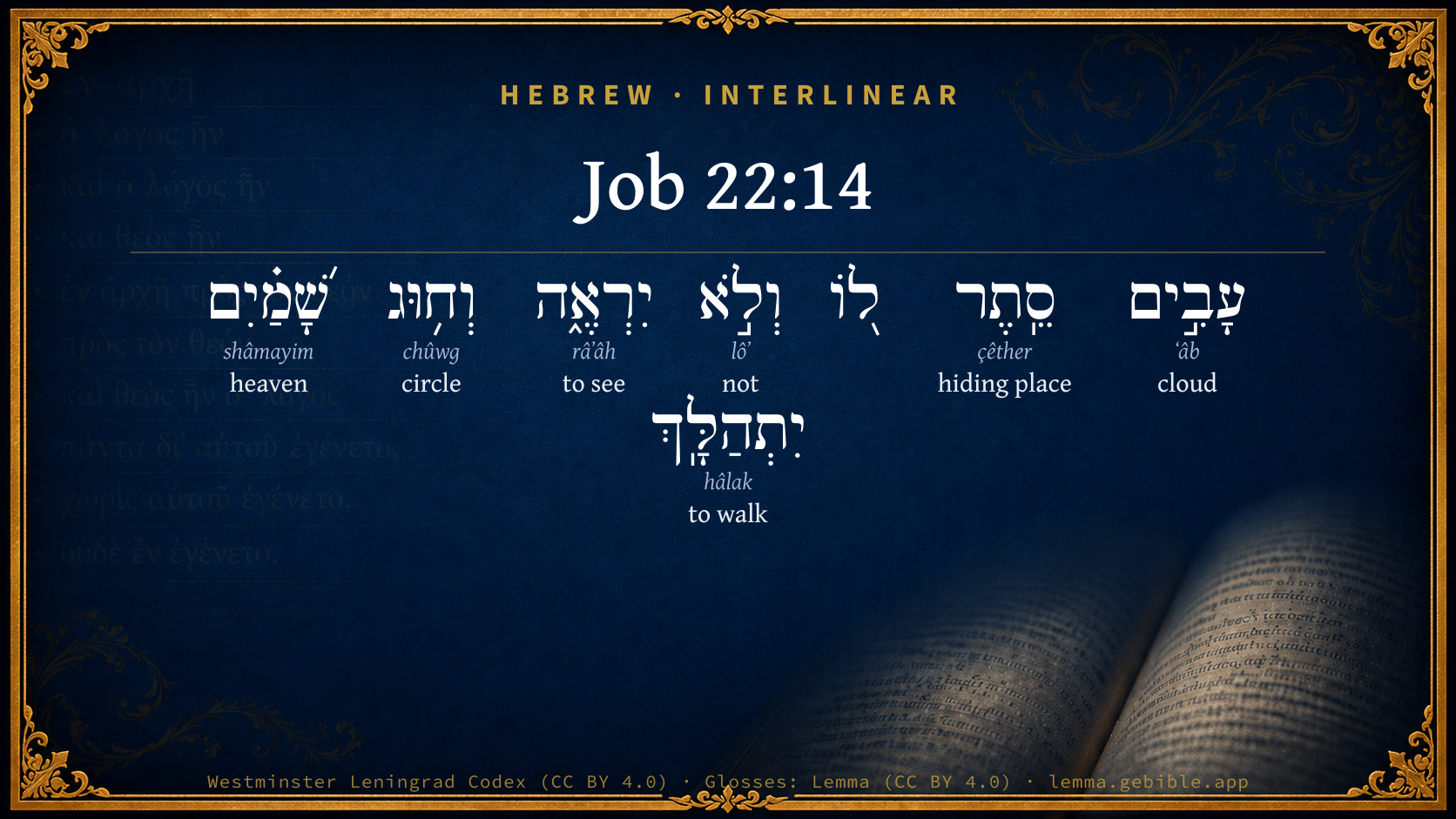
Job 22:14

Hebrew (Westminster Leningrad Codex) Job 22:14 appears in the Hebrew Old Testament. The text above is from the Westminster Leningrad Codex. Each word links to its Strong’s number, a concise gloss, and parsing drawn from the Open Scriptures Hebrew Bible morphology. Click any word for its full Brown-Driver-Briggs (BDB) entry.
Download image
Cite this verse

Job 22:14 (World English Bible). Public Domain. Lemma interlinear Bible study tool, https://lemma.gebible.app/v/job/22/14.

Show BibTeX & RIS
BibTeX
RIS
English Translation
Thick clouds are a covering to him, so that he doesn't see. He walks on the vault of the sky.'
World English Bible · Public Domain
Highlights
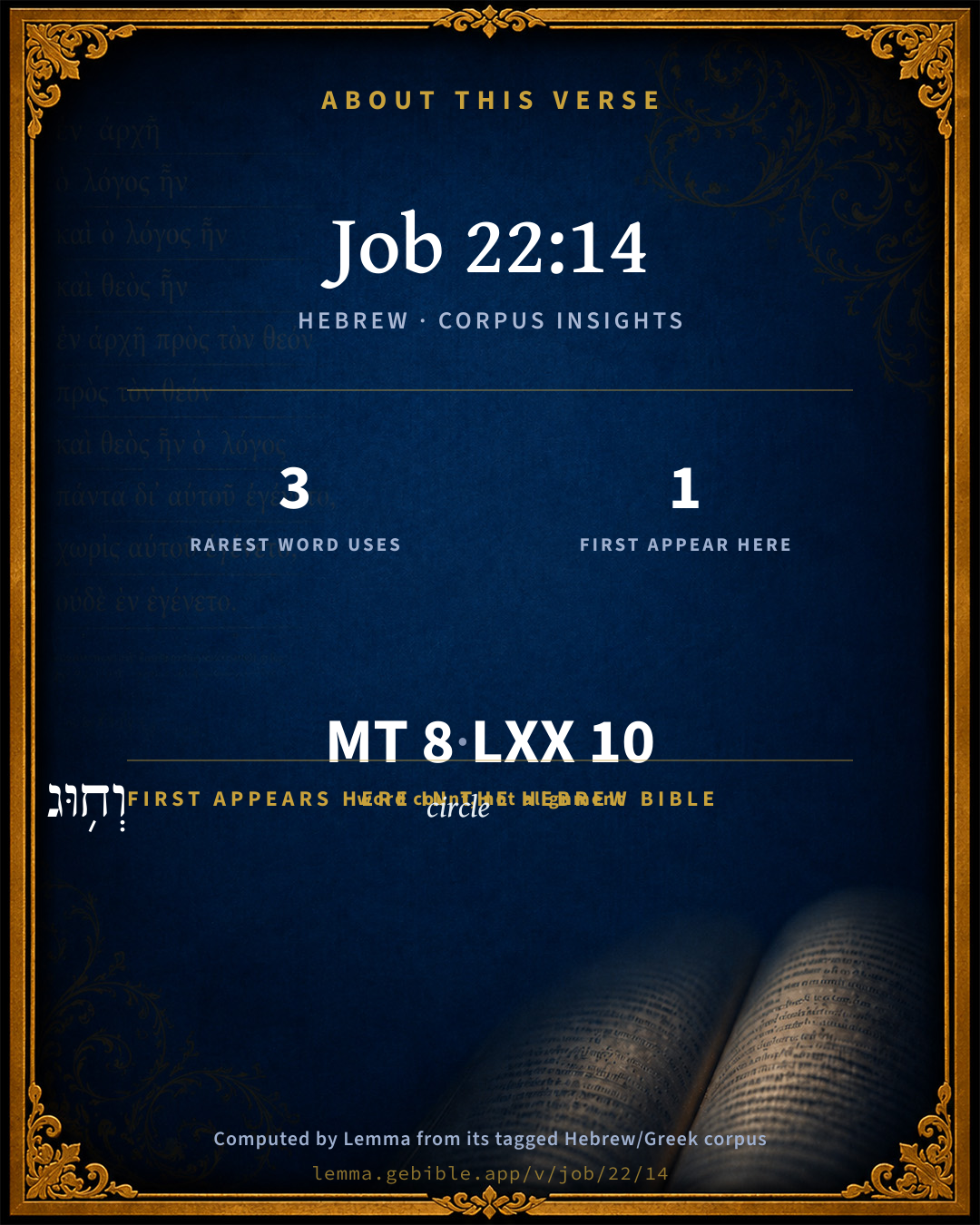
  • 1 first appearance in the Hebrew Bible
Full analysis ↓
Download a study sheet

One document with this verse’s original text, its word-by-word gloss line, the meaning frame, cross-references with their text, attributed commentary, and full source and license credits — printable, and it pastes into notes with its structure intact.

This verse Autodidact and up

Study sheet (.html) Plain text (.txt)

A passage Seminary Student

Up to 50 verses in one chapter. A passage sheet keeps up to 6 commentary sources and 12 cross-references per verse, in the order this page ranks them, and says so on the sheet whenever that leaves anything out. Ask for a single verse and you get the Autodidact verse sheet above.

Everything on this page stays free to read, with no account — the sheet is a download of what is already on screen, not access to it.

Want to remove ads? Support Godless Engineer
Compare translations 3

The same verse in 3 English versions, stacked beneath the original-language interlinear above. Click any original word for its lexicon entry.

Each is an independent rendering of the whole verse — the interlinear is not word-aligned to these translations.

Highlighted words mark where these versions differ — a whole-verse word diff, not a word-by-word alignment.

  • World English Bible Public Domain
    Thick clouds are a covering to him, so that he doesn't see. He walks on the vault of the sky.'
  • King James Version Public Domain
    Thick clouds are a covering to him, that he seeth not; and he walketh in the circuit of heaven.
  • unfoldingWord Literal Text CC BY-SA 4.0
    Clouds a covering to him and he does not see; indeed, he walks around on the dome of the heavens.’

unfoldingWord Literal Text — © unfoldingWord, licensed CC BY-SA 4.0. Word-aligned USFM3 via Door43 (git.door43.org/unfoldingWord/en_ult).

Versions to compare (up to 4)

3 of 4 selected

Show all 18 translations

Every available English version of this verse, each an independent rendering of the whole verse.

  • World English Bible Public Domain
    Thick clouds are a covering to him, so that he doesn't see. He walks on the vault of the sky.'
  • Berean Standard Bible Public Domain
    Thick clouds veil Him so He does not see us as He traverses the vault of heaven.’
  • Majority Standard Bible Public Domain
    Thick clouds veil Him so He does not see us as He traverses the vault of heaven.’
  • King James Version Public Domain
    Thick clouds are a covering to him, that he seeth not; and he walketh in the circuit of heaven.
  • American Standard Version (1901) Public Domain
    Thick clouds are a covering to him, so that he seeth not; And he walketh on the vault of heaven.
  • Revised Version (1885) Public Domain
    Thick clouds are a covering to him, that he seeth not; and he walketh in the circuit of heaven.
  • Geneva Bible (1599) Public Domain
    The cloudes hide him that he can not see, and he walketh in the circle of heauen.
  • Douay-Rheims (1899) Public Domain
    The clouds are his covert, and he doth not consider our things, and he walketh about the poles of heaven.
  • Young's Literal Translation Public Domain
    Thick clouds `are' a secret place to Him, And He doth not see;' And the circle of the heavens He walketh habitually,
  • Literal Standard Version CC BY-SA 4.0
    Thick clouds [are] a secret place to Him, || And He does not see, || And He habitually walks [above] the circle of the heavens.
  • Unlocked Literal Bible CC BY-SA 4.0
    Thick clouds are a covering to him, so that he does not see us; he walks on the vault of heaven.'
  • unfoldingWord Literal Text CC BY-SA 4.0
    Clouds a covering to him and he does not see; indeed, he walks around on the dome of the heavens.’
  • Darby Bible Public Domain
    Thick clouds are a covering to him, that he seeth not; and he walketh on the vault of the heavens.
  • World Messianic Bible Public Domain
    Thick clouds are a covering to him, so that he doesn’t see. He walks on the vault of the sky.’
  • Webster's Bible Public Domain
    Thick clouds are a covering to him, that he seeth not; and he walketh in the circuit of heaven.
  • Free Bible Version CC BY-SA 4.0
    Thick clouds cover him so he can't see anything as he walks around in heaven.’
  • Bible in Basic English Public Domain
    Thick clouds are covering him, so that he is unable to see; and he is walking on the arch of heaven.
  • JPS Tanakh (1917) Public Domain
    Thick clouds are a covering to Him, that He seeth not; and He walketh in the circuit of heaven.'

Literal Standard Version (2020), Covenant Press — licensed CC BY-SA 4.0. Text via the HelloAO Bible API (eBible.org). Unlocked Literal Bible (unfoldingWord) — licensed CC BY-SA 4.0. Text via the HelloAO Bible API (eBible.org). unfoldingWord Literal Text — © unfoldingWord, licensed CC BY-SA 4.0. Word-aligned USFM3 via Door43 (git.door43.org/unfoldingWord/en_ult). Free Bible Version, Dr. Jonathan Gallagher — licensed CC BY-SA 4.0. Text via the HelloAO Bible API (eBible.org).

Word by word

More ways to search: Search by grammar → Find every occurrence → Compare this word →

Practice this passage: Drill this verse → Learn its vocabulary →

About this verse

These counts appear in no published source. They are computed here, from the morphology-tagged text and Lemma’s own curated glosses. What Lemma adds →

8
words
7
distinct lemmas
Wisdom
section

Notable vocabulary

The rarest word here is וְח֥וּג circle H2329 — appearing just 3 times in the whole Hebrew Bible.

First appearance in Scripture

This word makes its first canonical appearance in the Hebrew Bible here:

  • וְח֥וּג circle H2329

Shared distinctive vocabulary

וְח֥וּג circle H2329 occurs in 3 verses of the Hebrew Bible. Also found in:

Grammatical profile

  • 2 verbs
  • 4 nouns
  • 1 preposition
  • 1 particle

Verb forms

  • יִרְאֶ֑ה Qal · Imperfect
  • יִתְהַלָּֽךְ Hithpael · Imperfect

Hebrew & Septuagint length

In English translation the verse runs 20 words from the Hebrew and 19 from the Septuagint (LXX English) — closely comparable.

A rough comparison of the two English renderings, which tokenize alike — not a word-level alignment.

Word counts can differ between the Hebrew and the Greek without any difference in meaning — e.g. the Hebrew direct-object marker אֵת has no separate Greek word, and Greek often adds the article ὁ.

In the original languages it is 8 Hebrew tokens and 10 Greek tokens — but the two are counted differently (Hebrew bundles its prefixes and suffixes into one token; the Greek is in lemma form), so that isn’t a like-for-like length.

Cross-references

8

Topical passages linked to Job 22:14 in the Treasury of Scripture Knowledge — connected by theme and wording, ordered by reader-vote popularity; previews shown in the World English Bible.

  • Psalms 97:2 Clouds and darkness are around him. Righteousness and justice are the foundation of his throne.
  • Psalms 33:14 From the place of his habitation he looks out on all the inhabitants of the earth,
  • Psalms 139:11–12 If I say, "Surely the darkness will overwhelm me; The light around me will be night;"
  • Job 26:9 He encloses the face of his throne, And spreads his cloud on it.
  • Job 34:22 There is no darkness, nor thick gloom, Where the workers of iniquity may hide themselves.
  • Psalms 139:1–2 Yahweh, you have searched me, And you know me.
  • Jeremiah 23:24 Can any hide himself in secret places so that I shall not see him? says Yahweh. Don't I fill heaven and earth? says Yahweh.
  • Luke 12:2–3 But there is nothing covered up, that will not be revealed, nor hidden, that will not be known.

Cross-references courtesy of OpenBible.info (CC BY 4.0).

Hebrew and Greek witnesses Masoretic Hebrew ↔ Greek Septuagint

The same verse in the two great witnesses to the Old Testament, shown verse-for-verse.

These are two independent witnesses, not word-aligned to each other, and the Septuagint is shown in lemma (dictionary) form.

Hebrew Job 22:14 Masoretic · Westminster Leningrad Codex

עָבִ֣ים סֵֽתֶר ל֭וֹ וְלֹ֣א יִרְאֶ֑ה וְח֥וּג שָׁ֝מַ֗יִם יִתְהַלָּֽךְ

Thick clouds are a covering to him, so that he doesn't see. He walks on the vault of the sky.'

World English Bible · Public Domain

Greek LXX Job 22:14 Septuagint · lemma form

νέφος ἀποκρυφή αὐτός καί οὐ ὁράω καί γῦρος οὐρανός διαπορεύομαι

A cloud is his hiding-place, and he shall not be seen; and he passes through the circle of heaven.

LXX2012 (modern English Septuagint) · Public Domain

On this verse, Haydock's Catholic Bible Commentary discusses the Septuagint’s reading. Read the note in Commentary ↓

Hebrew: Westminster Leningrad Codex (CC BY 4.0). Greek: Septuagint (public domain); English from LXX2012 (modern English Septuagint) (Public Domain). How the Septuagint differs from the Hebrew →

Commentary

Notes on Job 22:14 from classic Christian and Jewish commentators (each source and its license shown beneath its notes). The classic Christian expositions comment on the surrounding passage and are grouped to its opening verse, so a note may address several verses; the Jewish commentaries on the Tanakh (Rashi and others) are per-verse, so they appear only where the commentator wrote on this verse.

Lemma curates 59 commentaries, every one of them public domain or Creative Commons licensed, each selected and text-cleaned for this edition rather than reprinted as found. About our sources →

Trapp's Complete Commentary

John Trapp

Job 22:14 Thick clouds [are] a covering to him, that he seeth not; and he walketh in the circuit of heaven.

Ver. 14. Thick clouds are a covering to him] He lieth close hid among the clouds, and seeth nothing. But be the clouds never so thick, Christ’s eyes are a flaming fire, Rev 1:14. And the school of nature teacheth, that the fiery eye needeth no outward light, but seeth extra mittendo, by sending out a ray, &c. He will freely blot out the sins of his people as a cloud, and their transgressions as a thick cloud, Isa 44:22; Isa 43:25; but the clouds cannot hinder him from sight of their sins; for he is all eye, ολοφθαλμος, and darkness and light are both alike to him, Psa 139:12. A cloud may come between the body of the sun and us, and the whole hemisphere may be masked and overcast, as we call it, but nothing can keep God from eyeing and ordering all things.

And he walketh in the circuit of heaven] Where it seemeth thou thinkest he only manageth matters and beareth rule, and not below. So indeed the Peripatetics thought, and taught. Agreeably whereunto Lysippus made Alexander’s picture looking up to heaven, with this posy,

Iuppiter, asserni terram mihi, tu assere caelum.

With which picture Alexander was so delighted that he proclaimed that none should take his picture but Lysippus, Plin. l. 6, c. 16.

Augustus also heard with delight,

Divisum imperium cum Iove Caesar habet (Virgil. Vita).

Caesar has with Jupiter divided the empire. And the Great Turk, vexed at his great loss in the last assault of Scodra, most horribly blasphemed against God, saying, That it were enough for him to have care of heavenly things, and not to cross him in his worldly actions. The atheist here taketh it for granted that God hath enough to do to walk from place to place in heaven (as princes do in their progress), and to order those heavenly bodies how they shall affect these lower bodies, by their light, heat, and influence, &c. Fain they would confine him to that circuit or circle (the heavens are supposed to be spherical and circular), that he might meddle no further. Fain they would persuade themselves and others that God hath cast off the care of earthly business, and committed all to fate and fortune; that many might live far more comfortably if they were less conscientious; that it nothing concerneth God, whether men do or not do this or that, &c. Such dust heaps as these may be easily found in every corner; for all places are full of them, and so is hell too. As for Job, the counsel of these wicked ones was far from him, Job 21:16, he was the worse to think of them, whatever Eliphaz (by mistake of his meaning, at the least) thought of him.

John Trapp, A Commentary or Exposition upon All the Books of the Old and New Testament (1647–1656) — public domain. Text from a community e-Sword module.

Joseph Benson's Commentary

Job 22:14. Thick clouds are a covering to him — He is surrounded, thou imaginest, with such thick clouds that they conceal us from his sight. And he walketh in the circuit of the heaven — His delight is in heaven, which is worthy of his care, but he will not burden himself with the care of earth; which was the opinion of many heathen philosophers, and, as his friends fancied, was Job’s opinion also.

Joseph Benson's Commentary on the Old and New Testaments (1811–1818) — public domain. Text from a community e-Sword module.

Jamieson, Fausset & Brown

Robert Jamieson, A. R. Fausset & David Brown

in the circuit of heaven--only, not taking any part in earthly affairs. Job is alleged as holding this Epicurean sentiment (Lam 3:44; Isa 29:15; Isa 40:27; Jer 23:24; Eze 8:12; Psa 139:12).

Jamieson, Fausset & Brown — Commentary Critical and Explanatory on the Whole Bible (1871) — public domain (CC PDM 1.0). Text via the HelloAO Bible API.

Adam Clarke's Commentary

Verse 14. He walketh in the circuit of heaven] He confines himself to those infinitely exalted regions and cares nothing for the inhabitants of the earth.

Adam Clarke's Commentary on the Bible (1810–1826) — public domain. Text from a community e-Sword/MySword module.

The Cambridge Bible for Schools and Colleges

gen. ed. J. J. S. Perowne

14. in the circuit of heaven] Rather, on the circle, i. e. the arch of heaven that overspans the earth, Isa_40:22.

The Cambridge Bible for Schools and Colleges (gen. ed. J. J. S. Perowne; Cambridge University Press, 1878–1918) — public domain. Text from a community e-Sword module.

John Gill's Exposition

Hast thou marked the old way which wicked men have trodden? The evil way that wicked men have walked in ever since man apostatized from God, the way of Cain and his descendants, who were of the wicked one, and lived wicked lives and conversations; "the way of the old world", as Mr. Broughton renders the phrase here, the imagination of the thoughts of whose hearts was evil, and that continually; who filled the earth with rapine and violence, and all flesh corrupted their way with all manner of impurity and wickedness, and indulged themselves in the gratification of their sensual lusts and pleasures; and were, as the Apostle Peter calls them, "the world of the ungodly"; and here, "men of wickedness", or "iniquity" (y); such who gave themselves up to it, and were immersed in it; these trod the paths of sin, and made it a beaten road; they frequented this way, they walked continually in it; their life was a series and course of iniquity, in which they obstinately persisted, and proceeded from evil to evil, to more and more ungodliness. Now Job is asked if he had "marked" this their way and course of life; the evil of their way should have been marked, in order to avoid it; it being an old way should not recommend it; and the end of it, which was sudden ruin and destruction, should be marked to deter from it: but it is suggested that Job kept in this way, and observed it himself, and walked in it; for the words may be rendered, "truly thou keepest the old way", or "the way of the world" (z); trod in the steps of wicked men, was a close follower of them, and companied with them; like manner is Job charged by Elihu, Job 34:7; and this sense agrees with what goes before.

(y) "viri iniquitatis", Montanus, Mercerus; so Drusius, Michaelis. (z) "profecto viam seculi servas", Schultens.

John Gill's Exposition of the Whole Bible (1746–1763) — public domain (CC PDM 1.0). Text via the HelloAO Bible API.

Albert Barnes' Notes on the Bible

Thick clouds are a covering to him - This is to be understood as expressing what Eliphaz regarded as the sentiment of Job - that so thick clouds intervened between him and man that he could not take cognizance of what was going forward on earth.

And he walketh in the circuit of heaven - Upon the arch of heaven, as it seems to be bent over our heads. He walks above that cerulean, so high, that he cannot see what occurs on earth, and to punish mortals. This was not an uncommon sentiment among the ancients, though it is here, with the greatest injustice, attributed to Job. A similar sentiment is expressed by Lucretius, as quoted by Rosenmuller and Noyes:

Omnis enim per se Divum natura necesse est

Immortali aevo summa cum pace fruatur,

Semota a nostris rebus, sejunctaque longe.

Nam privata dolore omni, privata periclis,

Ipsa suis pollens opibus, nihil in liga nostri,

Nec bene promeritus capitur, nec tangitur ira.

Compare Isa 29:15.

Albert Barnes' Notes on the Bible (1834–1885) — public domain. Text from a community e-Sword/MySword module.

Haydock's Catholic Bible Commentary

Doth. Hebrew, "seeth not." Septuagint, "is not seen." --- Poles, on which the whole machine seems to turn. (Calmet) --- "Hipparchus intimated that there would be a time when the hinges, or poles of heaven, would be moved out of their places." (Colum. i. 1.) Hebrew and Septuagint, (according to Origen’s edition, ver. 13 to 16) "he walketh about in the circuit of heaven." (Haydock) Immortali ævo summa cum pace fruatur

Semota a nostris rebus, sejunctaque longe. (Lucretius)

This was the error of the Egyptians, (Aristotle, Mun. 84.) which Eliphaz unjustly lays to the charge of Job, as heretics often impute condemned tenets to Catholics. (Worthington)

George Leo Haydock (1774–1849), Haydock's Catholic Family Bible and Commentary, 1859 edition — public domain. Excludes Psalms (Douay-Rheims chapter numbering differs from Protestant) and Deuterocanonical books (Catholic canon only).

Matthew Poole's English Annotations

His conversation and business and delight is in the higher and heavenly world, which is worthy of his care, but he will not disparage nor burden himself with the care of this contemptible spot of earth; which was the opinion of many heathen philosophers, and, as they fancied, was Job’s opinion also.

Matthew Poole's English Annotations on the Holy Bible (1683–1685) — public domain. Text from a community e-Sword/MySword module.

Whedon's Commentary on the Bible

Daniel D. Whedon

14. In the circuit of — On the vault of. God moves in an orbit so high that he does not care for what takes place on the earth. The sophistry of Eliphaz is plain. Job denies the just distribution of evil and good, (xxi,) therefore he rejects the doctrine of a Divine Providence. The reason for this must be either that God cannot know, or that he is too deeply engrossed in the higher departments of his universe to attend to the affairs of this world.

Daniel D. Whedon (gen. ed.), Commentary on the Old and New Testaments (1874–1909) — public domain. Text from a community e-Sword module.

The Pulpit Commentary

Thick clouds are a covering to him, that he seeth not (see the comment on the preceding verse); and he walketh in the circuit of heaven; or, on the circumference of the heavens. The heavens are regarded as a solid vault, outside which is the place where God dwells.

The Pulpit Commentary (1880–1919), ed. H.D.M. Spence-Jones & Joseph S. Exell — public domain. Text from a community e-Sword module.

John Wesley's Explanatory Notes

Walketh - His delight is in heaven, which is worthy of his care, but he will not burden himself with the care of earth: which was the opinion of many Heathen philosophers, and, as they fancied, was Job's opinion also.

John Wesley, Explanatory Notes Upon the Whole Bible (1754–1765) — public domain. Text via the GEBible commentary corpus.

Rashi

Rabbi Shlomo Yitzchaki (Rashi)

Thick clouds are a concealment before Him, and He cannot see.

and He walks on the circle of the heavens and does not know what is on the earth.

circle Heb. חוג, the circle of the compass of the heavens, like (Isa. 44:13), “and with a compass (ובמחוגה) he rounds it,” compas in French

Rashi on the Tanakh — English translations: “The Judaica Press complete Tanach with Rashi, translated by A. J. Rosenberg” (CC BY 4.0); “Pentateuch with Rashi's commentary by M. Rosenbaum and A.M. Silbermann, 1929-1934” (public domain); “The Metsudah Tanach series, Lakewood, N.J” (CC BY 4.0); and “The Book of Joshua, Metsudah Publications, 1997” (CC BY 4.0). Text via Sefaria.

Lesson kit

Teaching starters — assembled from the data on this page, not authored interpretation. Every prompt links to the verse data it draws on. Edit before teaching.

Job, in the Wisdom, opens this verse with 8 words (7 distinct Hebrew lemmas). Its most distinctive word is chûwg (“circle”). A historical commentator’s framing appears above. Read the whole chapter for the surrounding context.

Discussion questions

  1. The word chûwg carries the sense “circle.” How does it shape the verse?
  2. The word “circle” first appears here in Scripture. What is being introduced at this debut?
  3. Proverbs 8:27 shares the word «circle» with this verse. How do the two illuminate each other?
  4. The translations on this page render this verse differently — a whole-verse word diff, not a word-by-word alignment. What might account for the different wordings?
  5. The verb «יִרְאֶ֑ה» is Qal Imperfect. How does its form color the action?
  6. Reading how Trapp's Complete Commentary and Joseph Benson's Commentary read this verse, where do the two commentators agree and where do they part?

Things to notice

Reading settings

Reading text

Shown beneath each verse's original-language words.

Old Testament
Old Testament edition

Read the OT as the Masoretic Hebrew (MT) or the Greek Septuagint (LXX).

English shown for the Greek Septuagint (in the Hebrew ↔ Greek comparison).

Comparing translations? Open the Compare panel on any verse page to stack up to four side by side.