Proverbs 30:19

Hebrew (Westminster Leningrad Codex) Proverbs 30:19 appears in the Hebrew Old Testament. The text above is from the Westminster Leningrad Codex. Each word links to its Strong’s number, a concise gloss, and parsing drawn from the Open Scriptures Hebrew Bible morphology. Click any word for its full Brown-Driver-Briggs (BDB) entry.
Download image
Cite this verse

Proverbs 30:19 (World English Bible). Public Domain. Lemma interlinear Bible study tool, https://lemma.gebible.app/v/proverbs/30/19.

Show BibTeX & RIS
BibTeX
RIS
English Translation
The way of an eagle in the air; The way of a serpent on a rock; The way of a ship in the midst of the sea; And the way of a man with a maiden.
World English Bible · Public Domain
Download a study sheet

One document with this verse’s original text, its word-by-word gloss line, the meaning frame, cross-references with their text, attributed commentary, and full source and license credits — printable, and it pastes into notes with its structure intact.

This verse Autodidact and up

Study sheet (.html) Plain text (.txt)

A passage Seminary Student

Up to 50 verses in one chapter. A passage sheet keeps up to 6 commentary sources and 12 cross-references per verse, in the order this page ranks them, and says so on the sheet whenever that leaves anything out. Ask for a single verse and you get the Autodidact verse sheet above.

Everything on this page stays free to read, with no account — the sheet is a download of what is already on screen, not access to it.

Want to remove ads? Support Godless Engineer
Compare translations 3

The same verse in 3 English versions, stacked beneath the original-language interlinear above. Click any original word for its lexicon entry.

Each is an independent rendering of the whole verse — the interlinear is not word-aligned to these translations.

Highlighted words mark where these versions differ — a whole-verse word diff, not a word-by-word alignment.

  • World English Bible Public Domain
    The way of an eagle in the air; The way of a serpent on a rock; The way of a ship in the midst of the sea; And the way of a man with a maiden.
  • King James Version Public Domain
    The way of an eagle in the air; the way of a serpent upon a rock; the way of a ship in the midst of the sea; and the way of a man with a maid.
  • unfoldingWord Literal Text CC BY-SA 4.0
    the way of the eagle in the sky, the way of a snake on a rock, the way of a ship in the heart of the sea, and the way of a young man with a young woman.

unfoldingWord Literal Text — © unfoldingWord, licensed CC BY-SA 4.0. Word-aligned USFM3 via Door43 (git.door43.org/unfoldingWord/en_ult).

Versions to compare (up to 4)

3 of 4 selected

Show all 18 translations

Every available English version of this verse, each an independent rendering of the whole verse.

  • World English Bible Public Domain
    The way of an eagle in the air; The way of a serpent on a rock; The way of a ship in the midst of the sea; And the way of a man with a maiden.
  • Berean Standard Bible Public Domain
    the way of an eagle in the sky, the way of a snake on a rock, the way of a ship at sea, and the way of a man with a maiden.
  • Majority Standard Bible Public Domain
    the way of an eagle in the sky, the way of a snake on a rock, the way of a ship at sea, and the way of a man with a maiden.
  • King James Version Public Domain
    The way of an eagle in the air; the way of a serpent upon a rock; the way of a ship in the midst of the sea; and the way of a man with a maid.
  • American Standard Version (1901) Public Domain
    The way of an eagle in the air; The way of a serpent upon a rock; The way of a ship in the midst of the sea; And the way of a man with a maiden.
  • Revised Version (1885) Public Domain
    The way of an eagle in the air; the way of a serpent upon a rock; the way of a ship in the midst of the sea; and the way of a man with a maid.
  • Geneva Bible (1599) Public Domain
    The way of an eagle in the aire, the way of a serpent vpon a stone, ye way of a ship in ye middes of the sea, and the way of a man with a maide.
  • Douay-Rheims (1899) Public Domain
    The way of an eagle in the air, the way of a serpent upon a rock, the way of a ship in the midst of the sea, and the way of a man in youth.
  • Young's Literal Translation Public Domain
    The way of the eagle in the heavens, The way of a serpent on a rock, The way of a ship in the heart of the sea, And the way of a man in youth.
  • Literal Standard Version CC BY-SA 4.0
    The way of the eagle in the heavens, || The way of a serpent on a rock, || The way of a ship in the heart of the sea, || And the way of a man in youth.
  • Unlocked Literal Bible CC BY-SA 4.0
    the way of an eagle in the sky; the way of a snake on a rock; the way of a ship in the heart of the sea; and the way of a man with a young woman.
  • unfoldingWord Literal Text CC BY-SA 4.0
    the way of the eagle in the sky, the way of a snake on a rock, the way of a ship in the heart of the sea, and the way of a young man with a young woman.
  • Darby Bible Public Domain
    The way of an eagle in the heavens, the way of a serpent upon a rock, the way of a ship in the midst of the sea, and the way of a man with a maid.
  • World Messianic Bible Public Domain
    The way of an eagle in the air, the way of a serpent on a rock, the way of a ship in the middle of the sea, and the way of a man with a maiden.
  • Webster's Bible Public Domain
    The way of an eagle in the air; the way of a serpent upon a rock; the way of a ship in the midst of the sea; and the way of a man with a maid.
  • Free Bible Version CC BY-SA 4.0
    The way an eagle soars in the sky, the way a snake slides over a rock, the way a ship sails across the sea, the way a man and a woman fall in love.
  • Bible in Basic English Public Domain
    The way of an eagle in the air; the way of a snake on a rock; the way of a ship in the heart of the sea; and the way of a man with a girl.
  • JPS Tanakh (1917) Public Domain
    The way of an eagle in the air; the way of a serpent upon a rock; the way of a ship in the midst of the sea; and the way of a man with a young woman.

Literal Standard Version (2020), Covenant Press — licensed CC BY-SA 4.0. Text via the HelloAO Bible API (eBible.org). Unlocked Literal Bible (unfoldingWord) — licensed CC BY-SA 4.0. Text via the HelloAO Bible API (eBible.org). unfoldingWord Literal Text — © unfoldingWord, licensed CC BY-SA 4.0. Word-aligned USFM3 via Door43 (git.door43.org/unfoldingWord/en_ult). Free Bible Version, Dr. Jonathan Gallagher — licensed CC BY-SA 4.0. Text via the HelloAO Bible API (eBible.org).

Word by word

More ways to search: Search by grammar → Find every occurrence → Compare this word →

Practice this passage: Drill this verse → Learn its vocabulary →

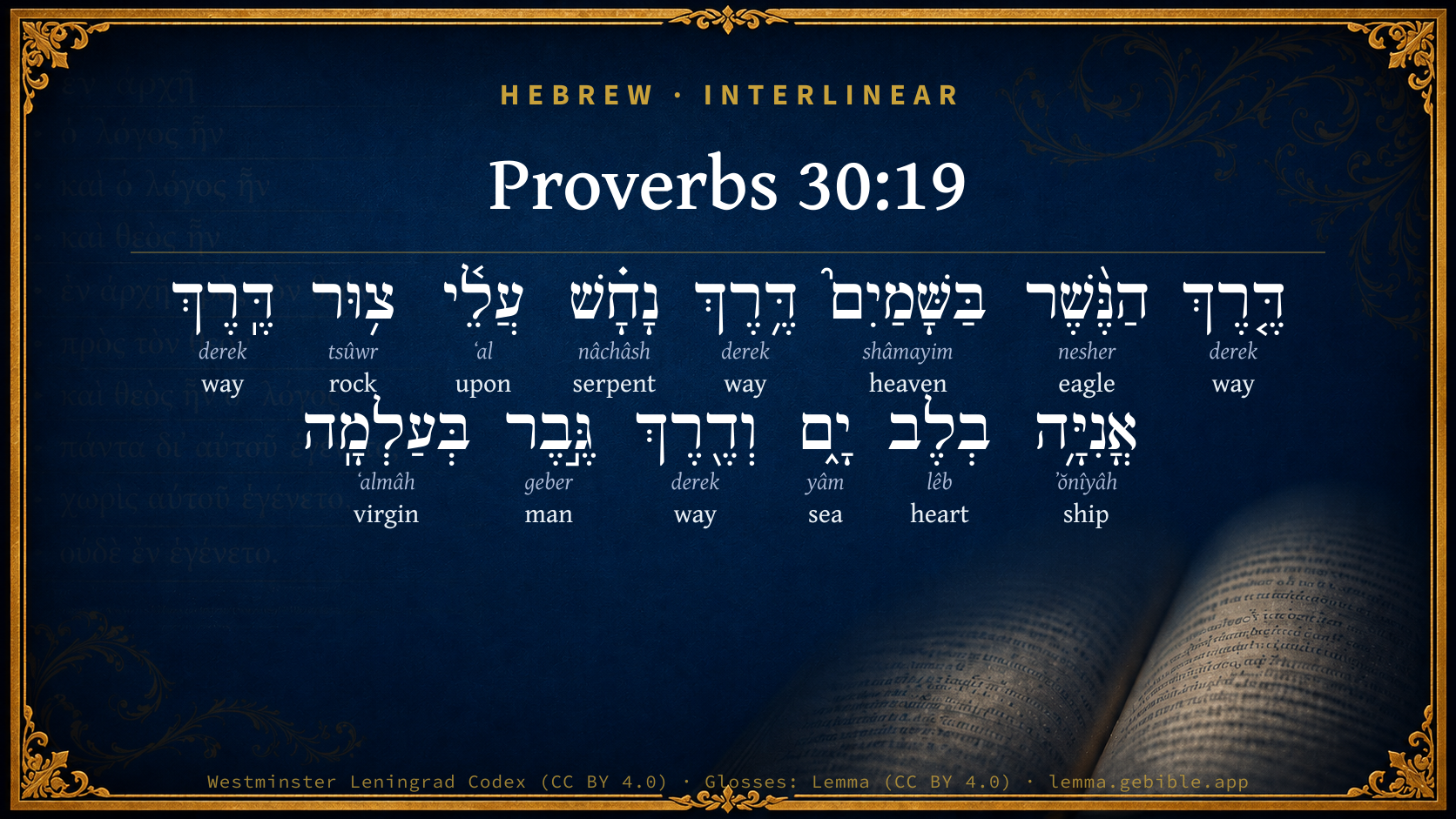
בְּעַלְמָֽה
ʻalmâh
H5959
“in/at · virgin”
Preposition + Noun, Common, Feminine, Singular, Absolute
Part of Speech
Preposition + Noun
Type
Common
Gender
Feminine
Number
Singular
State
Absolute
Full BDB Definition

Origin: from H5958

TWOT: 1630b

virgin, young woman - of marriageable age - maid or newly married
  1. דֶּ֤רֶךְ derek H1870 “way of” Noun, Common, Both, Singular, Construct
  2. הַנֶּ֨שֶׁר nesher H5404 “the · eagle” Particle, Definite Article + Noun, Common, Masculine, Singular, Absolute
  3. בַּשָּׁמַיִם֮ shâmayim H8064 “in/at the · heaven(s)” Preposition, Determined + Noun, Common, Masculine, Plural, Absolute
  4. דֶּ֥רֶךְ derek H1870 “way of” Noun, Common, Both, Singular, Construct
  5. נָחָ֗שׁ nâchâsh H5175 “serpent” Noun, Common, Masculine, Singular, Absolute
  6. עֲלֵ֫י ʻal H5921 “upon” Preposition
  7. צ֥וּר tsûwr H6697 “rock” Noun, Common, Masculine, Singular, Absolute
  8. דֶּֽרֶךְ derek H1870 “way of” Noun, Common, Both, Singular, Construct
  9. אֳנִיָּ֥ה ʼŏnîyâh H591 “ship” Noun, Common, Feminine, Singular, Absolute
  10. בְלֶב lêb H3820 “in/at · heart of” Preposition + Noun, Common, Masculine, Singular, Construct
  11. יָ֑ם yâm H3220 “sea” Noun, Common, Masculine, Singular, Absolute
  12. וְדֶ֖רֶךְ derek H1870 “and · way of” Conjunction + Noun, Common, Both, Singular, Construct
  13. גֶּ֣בֶר geber H1397 “man” Noun, Common, Masculine, Singular, Absolute

About this verse

These counts appear in no published source. They are computed here, from the morphology-tagged text and Lemma’s own curated glosses. What Lemma adds →

14
words
11
distinct lemmas
Wisdom
section

Notable vocabulary

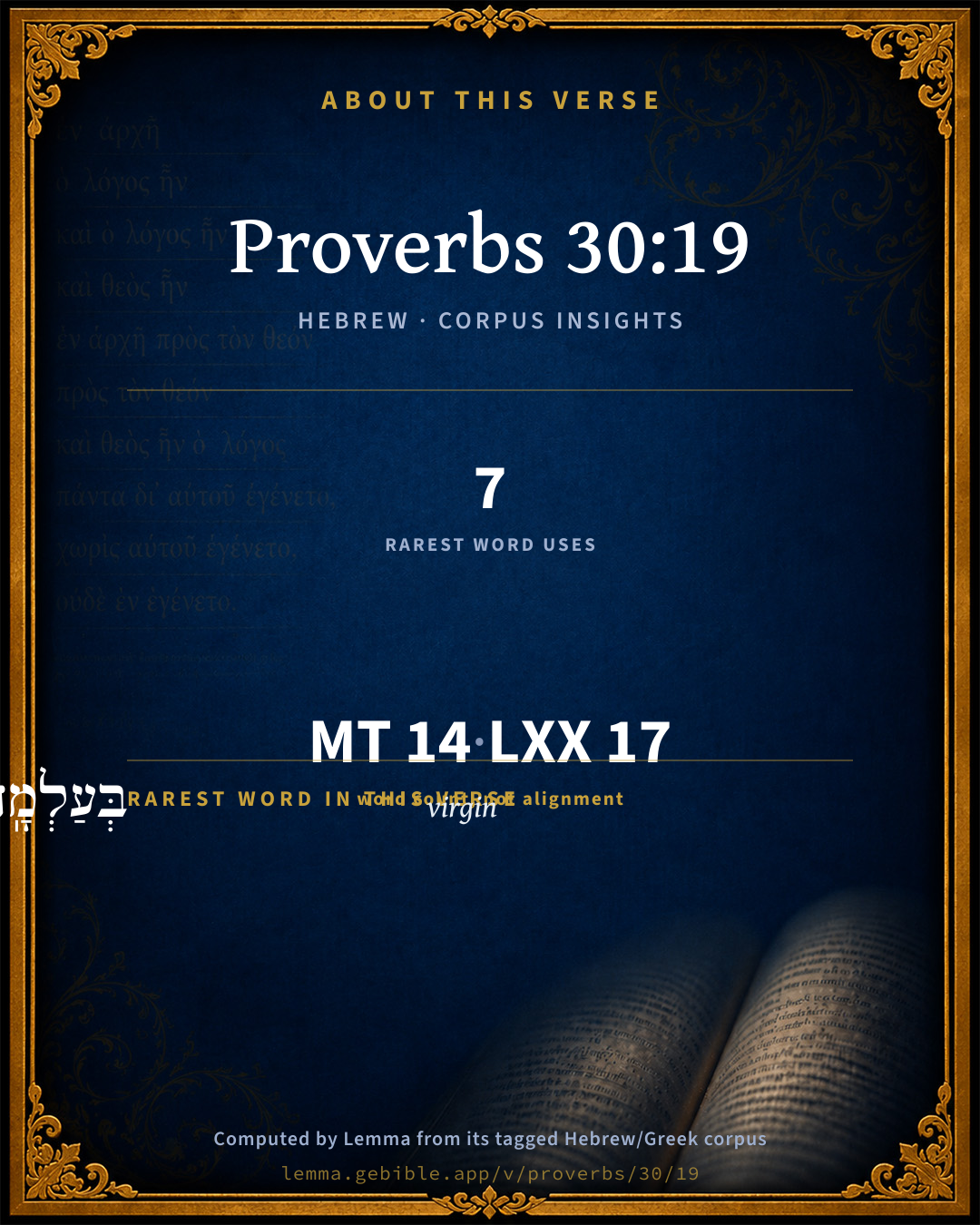
The rarest word here is בְּעַלְמָֽה virgin H5959 — appearing just 7 times in the whole Hebrew Bible.

Shared distinctive vocabulary

בְּעַלְמָֽה virgin H5959 occurs in 7 verses of the Hebrew Bible. Also found in:

Grammatical profile

  • 13 nouns
  • 1 preposition

Repetition

A word recurs within this verse — often emphatic in Hebrew:

  • דֶּ֤רֶךְ way H1870 ×4

Hebrew & Septuagint length

In English translation the verse runs 36 words from the Hebrew and 33 from the Septuagint (LXX English) — closely comparable.

A rough comparison of the two English renderings, which tokenize alike — not a word-level alignment.

Word counts can differ between the Hebrew and the Greek without any difference in meaning — e.g. the Hebrew direct-object marker אֵת has no separate Greek word, and Greek often adds the article ὁ.

In the original languages it is 14 Hebrew tokens and 17 Greek tokens — but the two are counted differently (Hebrew bundles its prefixes and suffixes into one token; the Greek is in lemma form), so that isn’t a like-for-like length.

Hebrew and Greek witnesses Masoretic Hebrew ↔ Greek Septuagint

The same verse in the two great witnesses to the Old Testament, shown verse-for-verse.

These are two independent witnesses, not word-aligned to each other, and the Septuagint is shown in lemma (dictionary) form.

Hebrew Proverbs 30:19 Masoretic · Westminster Leningrad Codex

דֶּ֤רֶךְ הַנֶּ֨שֶׁר בַּשָּׁמַיִם֮ דֶּ֥רֶךְ נָחָ֗שׁ עֲלֵ֫י צ֥וּר דֶּֽרֶךְ אֳנִיָּ֥ה בְלֶב יָ֑ם וְדֶ֖רֶךְ גֶּ֣בֶר בְּעַלְמָֽה

The way of an eagle in the air; The way of a serpent on a rock; The way of a ship in the midst of the sea; And the way of a man with a maiden.

World English Bible · Public Domain

Greek LXX Proverbs 30:19 Septuagint · lemma form

ἴσνος ἀετός πέτομαι καί ὁδός ὄφις ἐπί πέτρα καί τρίβος ναῦς ποντοπορέω καί ὁδός ἀνήρ ἐν νεότης

the track of a flying eagle; and the ways of a serpent on a rock; and the paths of a ship passing through the sea; and the ways of a man in youth.

LXX2012 (modern English Septuagint) · Public Domain

On this verse, Adam Clarke's Commentary discusses the Septuagint’s reading. Read the note in Commentary ↓

Hebrew: Westminster Leningrad Codex (CC BY 4.0). Greek: Septuagint (public domain); English from LXX2012 (modern English Septuagint) (Public Domain). How the Septuagint differs from the Hebrew →

Commentary

Notes on Proverbs 30:19 from classic Christian and Jewish commentators (each source and its license shown beneath its notes). The classic Christian expositions comment on the surrounding passage and are grouped to its opening verse, so a note may address several verses; the Jewish commentaries on the Tanakh (Rashi and others) are per-verse, so they appear only where the commentator wrote on this verse.

Lemma curates 59 commentaries, every one of them public domain or Creative Commons licensed, each selected and text-cleaned for this edition rather than reprinted as found. About our sources →

Adam Clarke's Commentary

Verse 19. The way of an eagle] I borrow, with thanks, the very sensible note of the Rev. Mr. Holden on this passage.

"The particle כן ken plainly shows that Pr 30:19-20 are to be taken in connection; consequently, it is a comparison between the way of an adulterous woman, and the way of the things here described.

"The adulterous woman goes about in search of her deluded victim, like as the eagle takes its flight into the air to spy out its prey. She uses every species of blandishment and insinuation to allure and beguile, as the serpent employs its windings and sinuous motions to pass along the rocks; she pursues a course surrounded with danger, as a ship in the midst of the sea is continually exposed to the fury of the tempest, and the hazard of shipwreck; and she tries every means, and exercises all her sagacity, to prevent the discovery of her illicit enjoyments, as a man attempts to conceal his clandestine intercourse with a maid. Such is the conduct of a lewd woman, marked by specious dissimulation and traitorous blandishment; she eateth and wipeth her mouth-she indulges her adulterous lust, yet artfully endeavours to conceal it, and with unblushing countenance asserts her innocence, exclaiming, I have done no wickedness."

CHAUCER'S January and May is an excellent comment on such wiles and protestations.

The way of a man with a maid.] בעלמה bealmah, with, or in a maid; but one of De Rossi's MSS. has בעלמיו bealmaiv, in his youth; and with this the SEPTUAGINT, εςνεοτητι, the VULGATE, in adolescentia, the SYRIAC and the ARABIC agree; and so also my own MS. Bible:-The weie of a man in his waxing youthe. Dr. Kennicott, in a sermon preached at Oxford, 1765, p. 46, has defended the reading of the versions, corroborating it by two MSS., one in the Harleian, and the other in the Bodleian library, besides that mentioned by De Rossi. See De Rossi's Var. Lect. Certainly the way of a man in his youth contains too many intricacies for human wisdom to explore. He only who searches the heart knows fully its various corrupt principles, and their productions. The common reading may refer to the formation of a child in the womb. But some have understood it of the immaculate conception. See Clarke on Mt 1:23, where the subject is largely considered.

If we take the four things which Agur says were too wonderful for him, in their obvious sense, there is little difficulty in them.

1. The passage which a bird makes through the air;

2. That which is made by a serpent on a rock; and,

3. That made by a ship through the sea, are such as cannot be ascertained: for who can possibly show the track in which either of them has passed?

And as to the fourth, if it refer to the suspected incontinence of one reputed a virgin, the signs are so equivocal, as to be absolutely unascertainable. The existence of the hymen has been denied by the ablest anatomists; and the signs of continence or incontinence, except in the most recent cases, are such as neither man nor woman can swear to, even to the present day; and they were certainly not less difficult to Agur and his contemporaries. I shall carry this matter no farther.

Adam Clarke's Commentary on the Bible (1810–1826) — public domain. Text from a community e-Sword/MySword module.

Trapp's Complete Commentary

John Trapp

Pro 30:19 The way of an eagle in the air; the way of a serpent upon a rock; the way of a ship in the midst of the sea; and the way of a man with a maid.

Ver. 19. And the way of a man with a maid.] That is, Either with a close and chaste virgin, that is kept close from the access of strangers, and goes covered with a veil; or else with a maid that, though deflowered, yet would pass for a pure virgin, and is so taken to be till her lewdness is discovered. It is expressly noted of Rebecca, to her commendation, that though fair to look upon, yet she was a virgin, neither had any man known her. {Gen 24:16} There are those who pass for virgins, and yet it cannot be said of them that man never knew them.

“ Thesaurum cure virgo tuum vas fictile servet,

Ut fugias quae sunt noxia, tuta time. ”

John Trapp, A Commentary or Exposition upon All the Books of the Old and New Testament (1647–1656) — public domain. Text from a community e-Sword module.

John Gill's Exposition

The way of an eagle in the air,.... And so of any other bird; but this is mentioned, because it flies swiftest, and soars highest: but the way in which it goes is not known, nor can it be seen with the eye; it cuts the air, and passes through it, but leaves no track behind it which may be pointed to, and it may be said, that is the way the eagle took and flew towards heaven out of sight;

the way of a serpent upon a rock; a smooth hard rock; and wonderful it is that it should creep up it without legs; and where it leaves no impression, no footsteps by which it can be traced, as it may in soft and sandy places;

the way of a ship in the midst of the sea; it is marvellous that such a vessel should be supported upon the sea; that it should weather the storms and tempests of it; that it should be steered through the trackless ocean to distant countries; and, particularly, though it makes furrows in the waters, and divides the waves; yet these quickly close again, and there is no path to be seen in which it goes; there is no beaten road made by it, nor by the vast numbers which go the same way, which a man can see with his eyes or follow;

and the way of a man with a maid; or "to a maid" (x); the many artful ways and methods he uses to get into her company, who is kept recluse; and to convey the sentiments and affections of his heart unto her, to gain her love to him, and obtain her in an honourable way of marriage; or to decoy and deceive her, and draw her into impure and unlawful embraces: it may design the private and secret way of committing fornication with her; which sense seems to be confirmed by Pro 30:20. Some of the ancients, particularly Ambrose (y), interpreted the whole of this verse of Christ: "the way of an eagle in the air", of his ascension to heaven, with men his prey, taken out of the jaws of the enemy; and which is such as is beyond the comprehension of men, that one of so great majesty should vouchsafe to come down from heaven, or ascend thither: "the way of a serpent upon a rock" he understands of the temptations of Satan, the old serpent, with which he attacked Christ, the Rock; but could imprint no footsteps of his malice and wickedness on him; could find nothing in him to work upon, nor leave any sign behind him, as upon Adam: "the way of a ship in the midst of the sea" he interprets of the church; which though distressed with storms and tempests of persecution and false doctrine, yet cannot suffer shipwreck, Christ being in it: and the last clause he renders as the Vulgate Latin version does, "and the way of a man in youth"; which he explains of the journeys which Christ took, and the ways of virtue he pursued, to do good to the bodies and souls of men, which are so many as not to be numbered. But it may be better interpreted of the wonderful incarnation of Christ, his conception and birth of a virgin; which was a new and unheard of thing, and the way and manner of it quite inscrutable, and more hard and difficult to be understood than any of the rest; for the words may be rendered, "the way of a man in a maid" or "virgin"; that is, the conception of Geber, the mighty man, in the virgin; see Jer 31:22. Gussetius (z) gives the mystical sense of the whole, as referring to the ascension of Christ; his coming out of the stony grave; his conversation among the people, like the tumultuous waves; and his incarnation of a virgin.

(x) "ad virginem", Glassius, Gejerus, Noldius, p. 144. No. 678. (y) De Salomone, c. 2, 3, 4, 5. (z) Ebr. Comment. p. 195.

John Gill's Exposition of the Whole Bible (1746–1763) — public domain (CC PDM 1.0). Text via the HelloAO Bible API.

Haydock's Catholic Bible Commentary

Youth. Hebrew, "a virgin." The "conception of a mighty man (the Messias; Haydock) in a virgin," is fitly compared to the flight of an eagle in the air, which leaves no trace behind, and is the most difficult to comprehend. See Jeremias xxxi. 22.; Univ. Hist. iii. p. 144, note. Isaiah vii. 14.; Parkhurst in alm. (Haydock) --- Some of the Jews have admitted this explanation. (Cornelius a Lapide) --- Others understand that the marks of virginity are equivocal; (Bossuet, &c.) or, if we stick to the Vulgate and Septuagint, the difference betwixt a child and a young man is extremely great, and almost incomprehensible. (Calmet) --- Young people who follow their carnal appetite, can no more give an account of their actions than of the course of an eagle, &c. (Worthington) --- His wanderings are manifold. The Hebrew seems to contain a prophecy of Christ’s conception.

George Leo Haydock (1774–1849), Haydock's Catholic Family Bible and Commentary, 1859 edition — public domain. Excludes Psalms (Douay-Rheims chapter numbering differs from Protestant) and Deuterocanonical books (Catholic canon only).

Matthew Poole's English Annotations

The way of an eagle in the air; either,

1. The manner of her flight, which is exceeding high, and swift, and strong. Or rather,

2. The way or part of the air through which she passeth, without leaving any print or sign in it, which though it be true of all birds, yet is here attributed to the eagle, of whom this is more true, because she flies out of sight, where neither her body nor any sign of it can be discerned.

The way of a serpent upon a rock; where she leaves no impression, nor slime, nor token where she was, as she doth in softer bodies, and as birds leave their feathers there.

The way of a ship in the midst of the sea; which though at present it make a furrow, yet is speedily closed again. The way of a man with a maid; either,

1. The various methods and artifices which young men use to entice or persuade young virgins, either to honest love and marriage, or to unlawful lust and uncleanness. Or rather,

2. The impure conversation of a man with one who goeth under the name of a maid, but is not so in truth, which is managed with so much secrecy and cunning that it can very hardly be discovered; which exposition agrees best with the foregoing. similitudes referred to it, and with the following verse.

Matthew Poole's English Annotations on the Holy Bible (1683–1685) — public domain. Text from a community e-Sword/MySword module.

The Pulpit Commentary

The way of an eagle in the air. You cannot by any outward sign know that an eagle has passed this or that way. RAPC Wis 5:11, "As when a bird hath flown through the air, there is no token of her way to be found," etc. The way of a serpent upon a rock. The snake"s mode of progression by the lever-like motion of its ribs might well awake surprise, but the point is still the tracklessness of its course. On sand or soft ground its movements might be traced by the impression made. but this could not be done on hard rock; it could push itself along on such a surface without leaving any track. The way of a ship in the midst (heart) of the sea; i.e. in the open sea. You can trace a ship"s course while she is near land or within sight, but when she reaches the open sea, you can follow her furrow no longer. RAPC Wis 5:10, "As a ship that passeth over the waves of the water, which when it is gone by, the trace thereof cannot be found, neither the pathway of the keel in the waves." The way of a man (geber) with a maid (hmlB); Septuagint, "The ways of a man in youth (en neothti ).

So Vulgate, Viam viri in adolescentia. But this is feeble, and almah is without doubt rightly rendered "maid," "virgin." The proverb says that the sinful act to which it alludes leaves no outward sign by which it can generally be recognized; it escapes man"s knowledge. This is exemplified and confirmed in the following verse. It is not sufficient to refer the saying to the insidious arts of the seducer, by which he saps the principles and inflames the passions of his victim. The sin of unchastity is signified, which demands st.crecy and affords no token of its commission. Two of the above parallels, says Cheyne, are given in a quatrain of a Vedic hymn to Varuna"The path of ships across the sea, The soaring eagle"s flight he knows.

Some of the Fathers and earlier commentators, and among moderns, Bishop Wordsworth, have not been content with the literal sense of this gnonic, but have found in it, as in the others, deep spiritual mysteries. Christ is the great Eagle, (Rev_12:14) who ascended beyond human ken; the serpent is the devil, who works his wily way in secret, and who tried to pass into the mind of Christ, who is the Rock; the ship is the Church, which preserves its course amid the waves of this troublesome world, though we cannot mark its strength or whither it is guided; and the fourth mystery is the incarnation of Jesus Christ our Lord, when "the virgin (almah) conceived and bare a son", (Isa_7:14) when "a woman encompassed a man (geber)". (Jer_31:22) We can see the greater or less appropriateness of such accommodation, but the proverb must have been received by contemporaries only in its literal sense, whatever were the inner mysteries which the Holy Spirit wished to communicate thereby.

The Pulpit Commentary (1880–1919), ed. H.D.M. Spence-Jones & Joseph S. Exell — public domain. Text from a community e-Sword module.

Lesson kit

Teaching starters — assembled from the data on this page, not authored interpretation. Every prompt links to the verse data it draws on. Edit before teaching.

Proverbs, in the Wisdom, opens this verse with 14 words (11 distinct Hebrew lemmas). Its most distinctive word is ʻalmâh (“virgin”). A historical commentator’s framing appears above. Read the whole chapter for the surrounding context.

Discussion questions

  1. How does “virgin” (ʻalmâh) shape what this verse is saying?
  2. Genesis 24:43 shares the word «virgin» with this verse. How do the two illuminate each other?
  3. “way” occurs 4× in this one verse. What is the effect of the repetition?
  4. The translations on this page render this verse differently — a whole-verse word diff, not a word-by-word alignment. What might account for the different wordings?
  5. Reading how Adam Clarke's Commentary and Trapp's Complete Commentary read this verse, where do the two commentators agree and where do they part?

Things to notice

Reading settings

Reading text

Shown beneath each verse's original-language words.

Old Testament
Old Testament edition

Read the OT as the Masoretic Hebrew (MT) or the Greek Septuagint (LXX).

English shown for the Greek Septuagint (in the Hebrew ↔ Greek comparison).

Comparing translations? Open the Compare panel on any verse page to stack up to four side by side.