
Amos 9:6

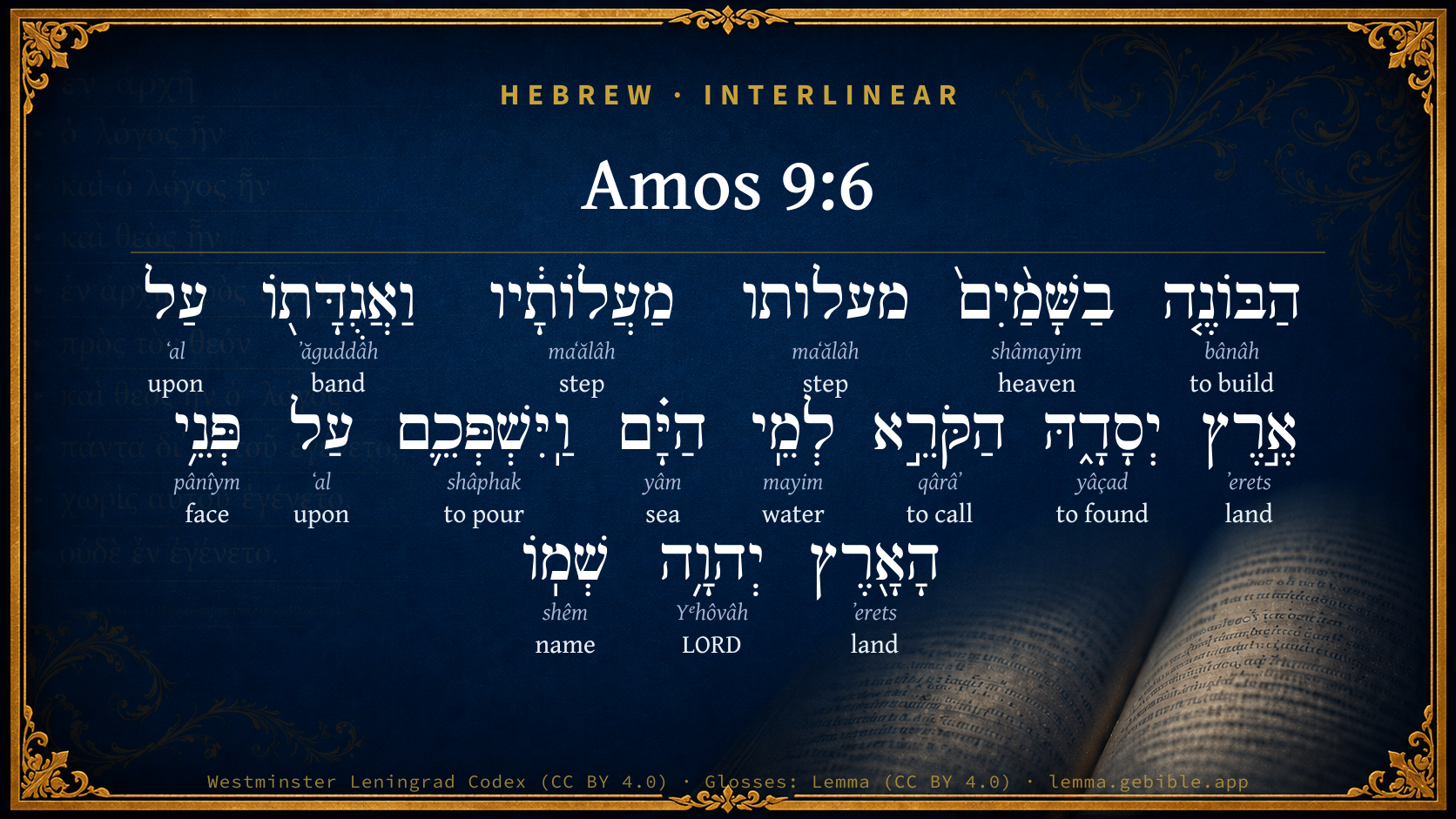
Hebrew (Westminster Leningrad Codex) Amos 9:6 appears in the Hebrew Old Testament. The text above is from the Westminster Leningrad Codex. Each word links to its Strong’s number, a concise gloss, and parsing drawn from the Open Scriptures Hebrew Bible morphology. Click any word for its full Brown-Driver-Briggs (BDB) entry.
Download image
Cite this verse

Amos 9:6 (World English Bible). Public Domain. Lemma interlinear Bible study tool, https://lemma.gebible.app/v/amos/9/6.

Show BibTeX & RIS
BibTeX
RIS
English Translation
It is he who builds his chambers in the heavens, and has founded his vault on the earth; he who calls for the waters of the sea, and pours them out on the surface of the earth; Yahweh is his name.
World English Bible · Public Domain
Download a study sheet

One document with this verse’s original text, its word-by-word gloss line, the meaning frame, cross-references with their text, attributed commentary, and full source and license credits — printable, and it pastes into notes with its structure intact.

This verse Autodidact and up

Study sheet (.html) Plain text (.txt)

A passage Seminary Student

Up to 50 verses in one chapter. A passage sheet keeps up to 6 commentary sources and 12 cross-references per verse, in the order this page ranks them, and says so on the sheet whenever that leaves anything out. Ask for a single verse and you get the Autodidact verse sheet above.

Everything on this page stays free to read, with no account — the sheet is a download of what is already on screen, not access to it.

Want to remove ads? Support Godless Engineer
Compare translations 3

The same verse in 3 English versions, stacked beneath the original-language interlinear above. Click any original word for its lexicon entry.

Each is an independent rendering of the whole verse — the interlinear is not word-aligned to these translations.

Highlighted words mark where these versions differ — a whole-verse word diff, not a word-by-word alignment.

  • World English Bible Public Domain
    It is he who builds his chambers in the heavens, and has founded his vault on the earth; he who calls for the waters of the sea, and pours them out on the surface of the earth; Yahweh is his name.
  • King James Version Public Domain
    It is he that buildeth his stories in the heaven, and hath founded his troop in the earth; he that calleth for the waters of the sea, and poureth them out upon the face of the earth: The LORD is his name.
  • unfoldingWord Literal Text CC BY-SA 4.0
    It is he who builds his steps in the heavens, and has established his vault over the earth. He calls for the waters of the sea, and pours them out on the surface of the earth, Yahweh is his name.

unfoldingWord Literal Text — © unfoldingWord, licensed CC BY-SA 4.0. Word-aligned USFM3 via Door43 (git.door43.org/unfoldingWord/en_ult).

Versions to compare (up to 4)

3 of 4 selected

Show all 18 translations

Every available English version of this verse, each an independent rendering of the whole verse.

  • World English Bible Public Domain
    It is he who builds his chambers in the heavens, and has founded his vault on the earth; he who calls for the waters of the sea, and pours them out on the surface of the earth; Yahweh is his name.
  • Berean Standard Bible Public Domain
    He builds His upper rooms in the heavens and founds His vault upon the earth. He summons the waters of the sea and pours them over the face of the earth. The LORD is His name.
  • Majority Standard Bible Public Domain
    He builds His upper rooms in the heavens and founds His vault upon the earth. He summons the waters of the sea and pours them over the face of the earth. The LORD is His name.
  • King James Version Public Domain
    It is he that buildeth his stories in the heaven, and hath founded his troop in the earth; he that calleth for the waters of the sea, and poureth them out upon the face of the earth: The LORD is his name.
  • American Standard Version (1901) Public Domain
    `it is' he that buildeth his chambers in the heavens, and hath founded his vault upon the earth; he that calleth for the waters of the sea, and poureth them out upon the face of the earth; Jehovah is his name.
  • Revised Version (1885) Public Domain
    it is he that buildeth his chambers in the heaven, and hath founded his vault upon the earth; he that calleth for the waters of the sea and poureth them out upon the face of the earth; the LORD is his name.
  • Geneva Bible (1599) Public Domain
    He buildeth his spheres in the heauen, and hath laide the foundation of his globe of elements in the earth: hee calleth the waters of the sea, and powreth them out vpon the open earth: the Lord is his Name.
  • Douay-Rheims (1899) Public Domain
    He that buildeth his ascension in heaven, and hath founded his bundle upon the earth: who calleth the waters of the sea, and poureth them out upon the face of the earth, the Lord is his name.
  • Young's Literal Translation Public Domain
    Who is building in the heavens His upper chambers; As to His troop, Upon earth He hath founded it, Who is calling for the waters of the sea, And poureth them out on the face of the land, Jehovah `is' His name.
  • Literal Standard Version CC BY-SA 4.0
    Who is building His upper chambers in the heavens; As for His troop, || On earth He has founded it, || Who is calling for the waters of the sea, || And pours them out on the face of the land, || YHWH [is] His Name.
  • Unlocked Literal Bible CC BY-SA 4.0
    It is he who builds his steps in the heavens, and has established his vault over the earth. He calls for the waters of the sea, and pours them out on the surface of the earth, Yahweh is his name.
  • unfoldingWord Literal Text CC BY-SA 4.0
    It is he who builds his steps in the heavens, and has established his vault over the earth. He calls for the waters of the sea, and pours them out on the surface of the earth, Yahweh is his name.
  • Darby Bible Public Domain
    It is he that buildeth his upper chambers in the heavens, and hath founded his vault upon the earth; he that calleth for the waters of the sea, and poureth them out upon the face of the earth: Jehovah is his name.
  • World Messianic Bible Public Domain
    It is he who builds his rooms in the heavens, and has founded his vault on the earth; he who calls for the waters of the sea, and pours them out on the surface of the earth—the LORD is his name.
  • Webster's Bible Public Domain
    It is he that buildeth his stories in the heaven, and hath founded his troop in the earth; he that calleth for the waters of the sea, and poureth them out upon the face of the earth: the LORD is his name.
  • Free Bible Version CC BY-SA 4.0
    The Lord builds his upper rooms in heaven, and places the foundations on the earth. He calls for the water of the seas, and pours it down as rain upon the earth—the Lord is his name!
  • Bible in Basic English Public Domain
    It is he who makes his rooms in the heaven, basing his arch on the earth; whose voice goes out to the waters of the sea, and sends them flowing over the face of the earth; the Lord is his name.
  • JPS Tanakh (1917) Public Domain
    It is He that buildeth His upper chambers in the heaven, and hath founded His vault upon the earth; He that calleth for the waters of the sea, and poureth them out upon the face of the earth; The LORD is His name.

Literal Standard Version (2020), Covenant Press — licensed CC BY-SA 4.0. Text via the HelloAO Bible API (eBible.org). Unlocked Literal Bible (unfoldingWord) — licensed CC BY-SA 4.0. Text via the HelloAO Bible API (eBible.org). unfoldingWord Literal Text — © unfoldingWord, licensed CC BY-SA 4.0. Word-aligned USFM3 via Door43 (git.door43.org/unfoldingWord/en_ult). Free Bible Version, Dr. Jonathan Gallagher — licensed CC BY-SA 4.0. Text via the HelloAO Bible API (eBible.org).

Word by word

More ways to search: Search by grammar → Find every occurrence → Compare this word →

Practice this passage: Drill this verse → Learn its vocabulary →

וַאֲגֻדָּת֖וֹ
ʼăguddâh
H92
“and · band · his”
Conjunction + Noun, Common, Feminine, Singular, Construct + Suffix, Personal, 3rd Person, Masculine, Singular
Part of Speech
Conjunction + Noun
Type
Common
Gender
Feminine
Number
Singular
State
Construct
Full BDB Definition

Origin: f passive participle of an unused root (meaning to bind)

TWOT: 15a

band, binding - cords, bands, thongs (metaphorical of slavery) - bunch of hyssop - band of men, troops - vault (of the heavens), firmament (binding earth to the heavens)
  1. הַבּוֹנֶ֤ה bânâh H1129 “the · building” Particle, Definite Article + Verb, Qal, Participle Active, Masculine, Singular, Absolute
  2. בַשָּׁמַ֨יִם֙ shâmayim H8064 “in/at the · heaven(s)” Preposition, Determined + Noun, Common, Masculine, Dual, Absolute
  3. מעלותו maʻălâh H4609 “steps · his” Noun, Common, Feminine, Plural, Construct + Suffix, Personal, 3rd Person, Masculine, Singular
  4. מַעֲלוֹתָ֔יו maʻălâh H4609 “steps · his” Noun, Common, Feminine, Plural, Construct + Suffix, Personal, 3rd Person, Masculine, Singular
  5. עַל ʻal H5921 “upon” Preposition
  6. אֶ֣רֶץ ʼerets H776 “land” Noun, Common, Both, Singular, Absolute
  7. יְסָדָ֑הּ yâçad H3245 “to found · her” Verb, Qal, Perfect, 3rd Person, Masculine, Singular + Suffix, Personal, 3rd Person, Feminine, Singular
  8. הַקֹּרֵ֣א qârâʼ H7121 “the · calling” Particle, Definite Article + Verb, Qal, Participle Active, Masculine, Singular, Absolute
  9. לְמֵֽי mayim H4325 “to/for · water(s) of” Preposition + Noun, Common, Masculine, Plural, Construct
  10. הַיָּ֗ם yâm H3220 “the · sea” Particle, Definite Article + Noun, Common, Masculine, Singular, Absolute
  11. וַֽיִּשְׁפְּכֵ֛ם shâphak H8210 “and · to pour · them” Conjunction + Verb, Qal, Sequential Imperfect, 3rd Person, Masculine, Singular + Suffix, Personal, 3rd Person, Masculine, Plural
  12. עַל ʻal H5921 “upon” Preposition
  13. פְּנֵ֥י pânîym H6440 “face(s) of” Noun, Common, Both, Plural, Construct
  14. הָאָ֖רֶץ ʼerets H776 “the · land” Particle, Definite Article + Noun, Common, Both, Singular, Absolute
  15. יְהוָ֥ה Yᵉhôvâh H3068 “LORD” Noun, Proper
  16. שְׁמֽוֹ shêm H8034 “name · his” Noun, Common, Masculine, Singular, Construct + Suffix, Personal, 3rd Person, Masculine, Singular

About this verse

These counts appear in no published source. They are computed here, from the morphology-tagged text and Lemma’s own curated glosses. What Lemma adds →

17
words
14
distinct lemmas
Prophets
section

Notable vocabulary

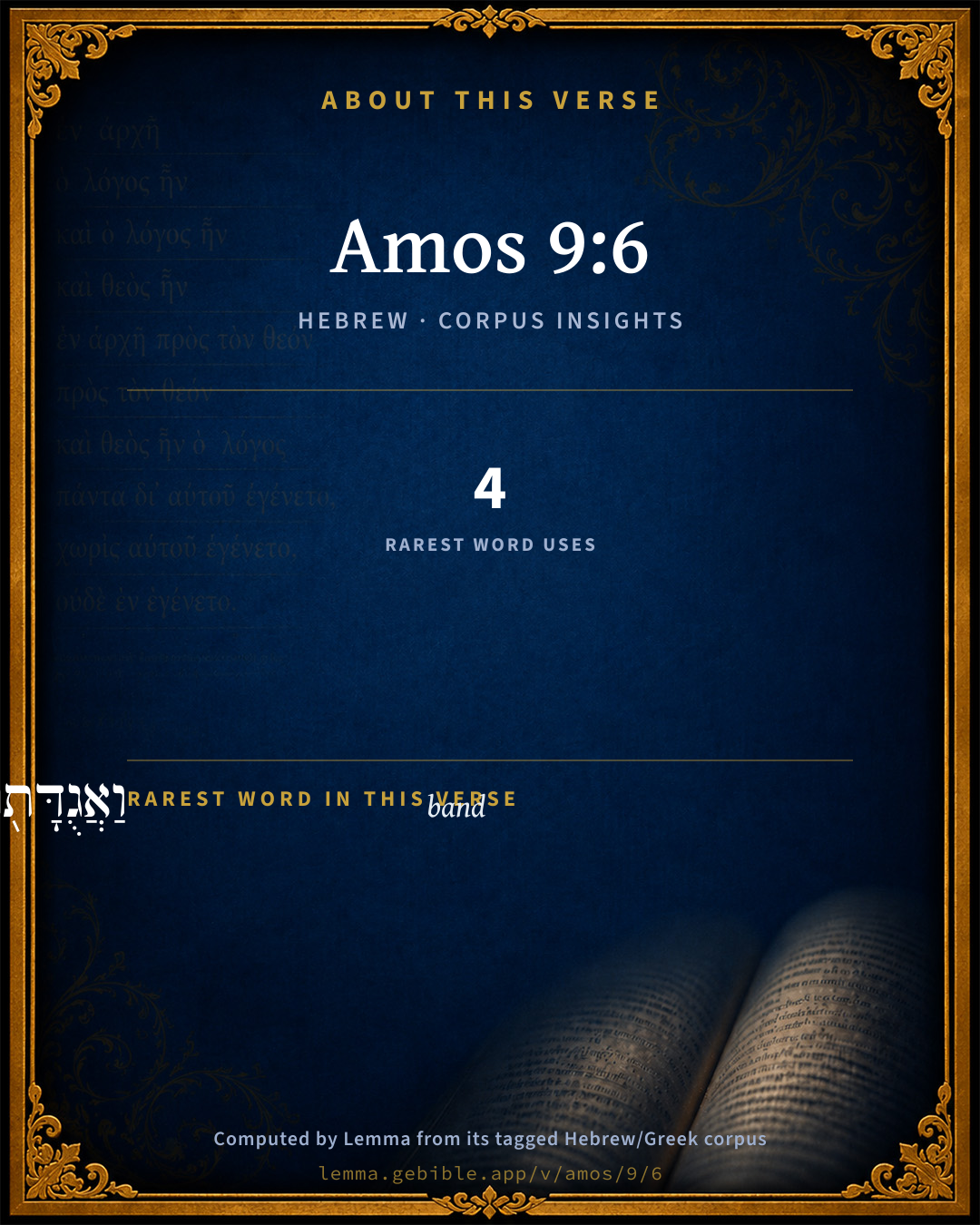
The rarest word here is וַאֲגֻדָּת֖וֹ band H92 — appearing just 4 times in the whole Hebrew Bible.

Shared distinctive vocabulary

וַאֲגֻדָּת֖וֹ band H92 occurs in 4 verses of the Hebrew Bible. Also found in:

Grammatical profile

  • 4 verbs
  • 11 nouns
  • 2 prepositions

Verb forms

  • הַבּוֹנֶ֤ה Qal · Participle Active
  • יְסָדָ֑הּ Qal · Perfect
  • הַקֹּרֵ֣א Qal · Participle Active
  • וַֽיִּשְׁפְּכֵ֛ם Qal · Sequential Imperfect

Repetition

Words recur within this verse — often emphatic in Hebrew:

  • מעלותו step H4609 ×2
  • עַל upon H5921 ×2
  • אֶ֣רֶץ land H776 ×2

Hebrew & Septuagint length

In English translation the verse runs 41 words from the Hebrew and 41 from the Septuagint (LXX English) — the same length.

A rough comparison of the two English renderings, which tokenize alike — not a word-level alignment.

Word counts can differ between the Hebrew and the Greek without any difference in meaning — e.g. the Hebrew direct-object marker אֵת has no separate Greek word, and Greek often adds the article ὁ.

Cross-references

9

Topical passages linked to Amos 9:6 in the Treasury of Scripture Knowledge — connected by theme and wording, ordered by reader-vote popularity; previews shown in the World English Bible.

  • Psalms 104:3 He lays the beams of his chambers in the waters. He makes the clouds his chariot. He walks on the wings of the wind.
  • Amos 5:8 Seek him who made the Pleiades and Orion, And turns the shadow of death into the morning, And makes the day dark with night; Who calls for the waters of the sea, And pours them out on the surface of the earth, Yahweh is his name,
  • Amos 4:13 For, behold, he who forms the mountains, And creates the wind, And declares to man what is his thought; Who makes the morning darkness, And treads on the high places of the Earth: Yahweh, the God of hosts, is his name."
  • Psalms 104:13 He waters the mountains from his chambers. The earth is filled with the fruit of your works.
  • Jeremiah 5:22 Don't you fear me? says Yahweh: won't you tremble at my presence, who have placed the sand for the bound of the sea, by a perpetual decree, that it can't pass it? and though the waves of it toss themselves, yet they can't prevail; though they roar, yet they can't pass over it.
  • Genesis 2:1 The heavens and the earth were finished, and all the host of them.
  • Genesis 7:11–19 In the six hundredth year of Noah's life, in the second month, on the seventeenth day of the month, on the same day all the fountains of the great deep were burst open, and the sky's windows were opened.
  • Exodus 3:14–15 God said to Moses, "I AM WHO I AM," and he said, "You shall tell the children of Israel this: "I AM has sent me to you."
  • Psalms 104:5–6 He laid the foundations of the earth, That it should not be moved forever.

Cross-references courtesy of OpenBible.info (CC BY 4.0).

Hebrew and Greek witnesses Masoretic Hebrew ↔ Greek Septuagint

The same verse in the two great witnesses to the Old Testament, shown verse-for-verse.

These are two independent witnesses, not word-aligned to each other, and the Septuagint is shown in lemma (dictionary) form.

Hebrew Amos 9:6 Masoretic · Westminster Leningrad Codex

הַבּוֹנֶ֤ה בַשָּׁמַ֨יִם֙ מעלותו מַעֲלוֹתָ֔יו וַאֲגֻדָּת֖וֹ עַל אֶ֣רֶץ יְסָדָ֑הּ הַקֹּרֵ֣א לְמֵֽי הַיָּ֗ם וַֽיִּשְׁפְּכֵ֛ם עַל פְּנֵ֥י הָאָ֖רֶץ יְהוָ֥ה שְׁמֽוֹ

It is he who builds his chambers in the heavens, and has founded his vault on the earth; he who calls for the waters of the sea, and pours them out on the surface of the earth; Yahweh is his name.

World English Bible · Public Domain

Greek LXX Amos 9:6 Septuagint · lemma form

ὁ οἰκοδομέω εἰς ὁ οὐρανός ἀνάβασις αὐτός καί ὁ ἐπαγγελία αὐτός ἐπί ὁ γῆ θεμελιόω ὁ προςκαλέω ὁ ὕδωρ ὁ θάλασσα καί ἐκχέω αὐτός ἐπί πρόσωπον ὁ γῆ κύριος ὁ θεός ὁ παντοκράτωρ ὄνομα αὐτός

It is he that builds his ascent up to the sky, and establishes his promise on the earth; who calls the water of the sea, and pours it out on the face of the earth; the Lord Almighty is his name.

LXX2012 (modern English Septuagint) · Public Domain

On this verse, Haydock's Catholic Bible Commentary discusses the Septuagint’s reading. Read the note in Commentary ↓

Hebrew: Westminster Leningrad Codex (CC BY 4.0). Greek: Septuagint (public domain); English from LXX2012 (modern English Septuagint) (Public Domain). How the Septuagint differs from the Hebrew →

Targum (Aramaic paraphrase)

1

The Targum is the ancient Jewish Aramaic paraphrase of the Hebrew Scriptures — an interpretive translation, not the Hebrew text itself. Onkelos (literal) and Pseudo-Jonathan (expansive) render the Torah, and Jonathan the Prophets. Coverage is partial: where no permissively-licensed English translation exists for a verse, only the Aramaic is shown. This is verse-level text, not a word-by-word alignment to the Hebrew.

  1. Targum Jonathan Prophets (Joshua–Malachi)
    דִי אַשְׁרֵי בִּתְקוֹף רוּמָא שְׁכִינַת יְקָרֵיהּ וּכְנִשְׁתֵּיהּ עַל אַרְעָא קִשְׁטָהּ דִי אֲמַר לְכַנָשָׁא מַשִׁרְיָן דְסַגִיאִין כְּמֵי נַהֲרָא וּמְבַדַר לְהוֹן עַל אַפֵּי אַרְעָא יְיָ שְׁמֵיהּ:

    (no public-domain English translation for this verse)

    Targum Jonathan — Aramaic: “Mikraot Gedolot” (public domain). English: “Sefaria Community Translation” (CC0 1.0 (public-domain dedication)); “London "Chaldee Paraphrase," 1871” (public domain). Text via Sefaria.

Commentary

Notes on Amos 9:6 from classic Christian and Jewish commentators (each source and its license shown beneath its notes). The classic Christian expositions comment on the surrounding passage and are grouped to its opening verse, so a note may address several verses; the Jewish commentaries on the Tanakh (Rashi and others) are per-verse, so they appear only where the commentator wrote on this verse.

Lemma curates 59 commentaries, every one of them public domain or Creative Commons licensed, each selected and text-cleaned for this edition rather than reprinted as found. About our sources →

Trapp's Complete Commentary

John Trapp

Amo 9:6 [It is] he that buildeth his stories in the heaven, and hath founded his troop in the earth; he that calleth for the waters of the sea, and poureth them out upon the face of the earth: The LORD [is] his name.

Ver. 6. It is he that buildeth his stories (or spheres) in the heaven] Surgit hic oratio. The prophet here riseth in his discourse; and as Chrysostom said of St Paul, Tricubitalis est, et coelos transcendit; Low though he were, and little, yet he got up into the third heaven; so may we of Amos, though but a plain spoken and illiterate herdsman, yet, in setting forth the power of God, he mounts from earth to heaven, and shows himself to be Virum bonum, dicendi peritum, an exquisite orator, according to Quintilian’s character. God, this great architect and public workman, δημιουργος (as the apostle after Plato, whom he seemeth to have read, calleth him, Heb 11:10), hath, without tool or toil, Isa 40:28, builded his stories in the heaven, which is three stories high, 2Co 12:2, wherein, as in a theatre, or molten looking glass, Job 37:18, his majesty most clearly shineth, Amo 4:13; Amo 5:8 Psa 104:3; every sphere and star twinkling at us, and as it were, beckoning to us, to remember his omnipotence (whereof that rare fabric is a notable work and witness), and not to think to escape his judgments if we go on in sin. For although he be higher than the heavens, Job 35:5, yet "his eyes behold, his eyelids try, the children of men," Psa 11:4; Psa 11:6, "Upon the wicked he shall rain down snares, fire and brimstone," &c.

And hath founded his troop (or bundle) in the earth] That is, the other three elements, say some: the sea, which, together with the earth, maketh one globe, say others: the universe (saith Mr Diodati), which is like the fabric of a building; of which the earth, being the lower part, and only unmoveable, hath some resemblance of a foundation.

He that calleth for the waters of the sea, and poureth them out, &c.] {See Trapp on "Amo 5:8"}

John Trapp, A Commentary or Exposition upon All the Books of the Old and New Testament (1647–1656) — public domain. Text from a community e-Sword module.

Geneva Bible (1599)

Geneva Bible translators

He declareth by the wonderful power of God, by the making of the heavens and the elements, that it is not possible for man to escape his judgments when he punisheth.

Geneva Bible (1599) marginal notes — public domain. Text via Bolls.life.

Jamieson, Fausset & Brown

Robert Jamieson, A. R. Fausset & David Brown

stories--literally, "ascents," that is, upper chambers, to which the ascent is by steps [MAURER]; evidently referring to the words in Psa 104:3, Psa 104:13. GROTIUS explains it, God's royal throne, expressed in language drawn from Solomon's throne, to which the ascent was by steps (compare Kg1 10:18-19).

founded his troop--namely, all animate creatures, which are God's troop, or host (Gen 2:1), doing His will (Psa 103:20-21; Joe 2:11). MAURER translates, "His vault," that is, the vaulted sky, which seems to rest on the earth supported by the horizon.

Jamieson, Fausset & Brown — Commentary Critical and Explanatory on the Whole Bible (1871) — public domain (CC PDM 1.0). Text via the HelloAO Bible API.

Adam Clarke's Commentary

Verse 6. Buildeth his stories in the heaven] There is here an allusion to large houses, where there are cellars, or places dug in the ground as repositories for corn; middle apartments, or stories, for the families to live in; and the house-top for persons to take the air upon. There may be here a reference to the various systems which God has formed in illimitable space, transcending each other, as the planets do in our solar system: and thus we find Solomon speaking when addressing the Most High: "The heavens and the heaven of heavens cannot contain thee, השמים ושמי השמים hashshamayim ushemey hashshamayim, 1Kg 8:27. SIX heavens are necessarily implied in these three words. According to the points, the first and third are in the dual number, and the second is the contracted form of the plural. But how many more spheres may be intended who can tell? There may be millions of millions of stellar systems in unlimited space; and then what are all these to the VAST IMMENSITY of God!

Hath founded his troop in the earth] אגדיו aguddatho, from אגד agad, to bind or gather together, possibly meaning the seas and other collections of waters which he has gathered together and bound by his perpetual decree, that they cannot pass; yet when he calleth for these very waters, as in the general deluge, he "poureth them out upon the face of the earth."

The Lord is his name.] This points out his infinite essence. But what is that essence? and what is his nature? and what his immensity and eternity? What archangel can tell?

Adam Clarke's Commentary on the Bible (1810–1826) — public domain. Text from a community e-Sword/MySword module.

John Calvin's Commentaries

The Prophet describes now in general terms the power of God, that he might the more impress his hearers, and that they might not heedlessly reject what he had previously threatened respecting their approaching ruin; for he had said, ‘Lo, God will smite the land, and it shall tremble.’ This was special. Now as men received with deaf ears those threatening, and thought that God in a manner trifled with them, the Prophet added, by way of confirmation, a striking description of the power of God; as though he said, “Ye do hear what God denounces: now, as he has clothed me with his own authority, and commanded me to terrify you by setting before you your punishment, know ye that you have to do with God himself, whose majesty ought to make you all, and all that you are, to tremble: for what sort of Being is this God, whose word is regarded by you with contempt? God is he who builds for himself chambers in the heavens, who founds his jointings (some render it bundles) in the earth, who calls the waters of the sea, and pours them on the face of the earth”; in a word, He is Jehovah, whose being is in himself alone: and ye exist only through his powers and whenever he pleases, he can with-draw his Spirits and then vanish must this whole world, of which ye are but the smallest particles. Since then He alone is God, and there is in you but a momentary strength, and since this great power of God, the evidences of which he affords you through the whole order of nature, is so conspicuous to you, how is it that ye are so heedless?” We now perceive why the Prophet exalts in so striking a manner the power of God.

First, in saying that God builds for himself his ascendings (ascensiones) in the heavens, he alludes no doubt, to the very structure of the heavens; for the element of air, we know, rises upwards, on account of its being light; and then the element of fire comes nearer to what heaven is; then follow the spheres as then the whole world above the earth is much more favorable to motion, this is the reason why the Prophet says that God has his ascents in the heavens. God indeed stands in no need of the heavens or of the air as an habitation, for he is contained in no place, being one who cannot be contained: but it is said, for the sake of men, that God is above all heavens: he is then located in his own elevated throne. But he says that he founds for himself his jointing on the earth, for this part of the world is more solid, the element of earth being grosser and denser, and therefore more firm. So also the waters, though lighter than the earth, approach it nearest. God then builds in the heavens. It is a mechanism which is in itself wonderful: when one raises to heaven his eyes, and then looks on the earth, is he not constrained to stand amazed? The Prophet then exhibits here before our eyes the inconceivable power of God, that we may be impressed by his words, and know with whom we have to do, when he denounces punishment.

He further says, Who calls the waters of the sea, and pours them on the face of the earth This change is in itself astonishing; God in a short time covers the whole heaven: there is a clear brightness, in a moment clouds supervene, which darken the whole heaven, and thick waters are suspended over our heads. Who could say that the whole sky could be so suddenly changed? God by his own command and bidding does all this alone. He calls then the waters of the sea, and pours them down Though rains, we know, are formed in great measure by vapors from the earth, yet we also know that these vapors arise from the sea, and that the sea chiefly supplies the dense abundance of moisture. The Prophet then, by taking a part for the whole, includes here all the vapors, by which rain is formed. He calls them the waters of the sea; God by his own power alone creates the rain, by raising vapors from the waters; and then he causes them to descend on the whole face of the earth. Since then the Lord works so wonderfully through the whole order of nature, what do we think will take place, when he puts forth the infinite power of his hand to destroy men, having resolved to execute the extreme judgment which he has decreed?

John Calvin's Commentaries (1540-1563) — public domain. Text from the Calvin Translation Society English edition (1840s-50s) via the Christian Classics Ethereal Library (ccel.org). Calvin's coverage is partial (roughly two-thirds of the Bible); uncommented books and verses are honest gaps, never fabricated. The 19th-century editor's footnotes and remarks are omitted so the notes are faithfully Calvin's own voice.

The Cambridge Bible for Schools and Colleges

gen. ed. J. J. S. Perowne

6. That buildeth his upper chambers in the heaven, and hath founded his vault upon the earth] The Hebrews pictured the sky as a solid vault (firmamentum), resting at its extremities upon the earth (Job_26:11): in this vault the heavenly bodies were imagined to revolve: “in front of it” (i.e. in the open air below its lower surface) the birds flew (Gen_1:20): above it were reservoirs in which rain was stored (as also snow and hail); and above these “waters above the firmament” Jehovah sat enthroned. The words are thus intended to illustrate Jehovah’s power by pointing to the palace which He has constructed for Himself on high, and firmly secured, by resting its foundations upon the solid earth. The word rendered upper chambers elsewhere means ascent, steps (hence A.V. stories, i.e. successive heights), which has been adopted by some commentators here (as though the reference were to the ascent or steps by which Jehovah’s heavenly palace was to be reached). But most authorities treat ma‘ãlâh here as a synonym of ‘ãliyyâh in Psa_104:3, “Who layeth the beams of his upper chambers in the waters,” cf. Amo_9:14 “Who watereth the mountains from his upper chambers.”

vault] lit. band,—properly, it is probable, like the Arab.’ijâd, an arch, as something firmly held together. The word (which is a rare one) is used elsewhere of a bunch of hyssop (Exo_12:22), of the bands of a yoke (Isa_58:6), and of a band of men (2Sa_2:25). Here it denotes what is usually called the râḳîa‘(lit. something beaten or spread out)[199], the (στερέωμα, or “firmament,” the vast hemi-spherical vault which, to the eye innocent of the truths of astronomy, seems to rest as a huge cupola upon the earth.

[199] Comp. the cognate verb, as applied to metals, Exo_39:3; Num_16:39 : Jer_10:9; Isa_40:19 (R.V. spreadeth over).

that calleth for the waters of the sea, &c.] repeated from Amo_5:8 b (where see note). The violent, and long-continued rains, occurring in Eastern climates, are another proof of Jehovah’s power over nature.

The Cambridge Bible for Schools and Colleges (gen. ed. J. J. S. Perowne; Cambridge University Press, 1878–1918) — public domain. Text from a community e-Sword module.

John Gill's Exposition

It is he that buildeth his stories in the heaven,.... The three elements, according to Aben Ezra, fire, air, and water; the orbs, as Kimchi, one above another; a word near akin to this is rendered "his chambers", which are the clouds, Psa 104:3; perhaps the heaven, and the heaven of heavens, which are three stories high, may be meant; we read of the third heaven, Co2 12:2; and particularly the throne of God is in the highest heaven; and the "ascents" (y) to it, as it may be rendered. The Targum is,

"who causeth to dwell in a high fortress the Shechinah of his glory:''

and hath founded his troop in the earth; this Kimchi interprets of the three above elements. So the words are translated in the Bishops' Bible in Queen Elizabeth's time,

"he buildeth his spheres in the heaven, and hath laid the foundation of his globe of elements in the earth.''

Aben Ezra interprets it of animals; it may take in the whole compass of created beings on earth; so Jarchi explains it of the collection of his creatures; though he takes notice of another sense given, a collection of the righteous, which are the foundation of the earth, and for whose sake all things stand. Abarbinel interprets it of the whole of the tribe of Israel; and so the Targum paraphrases it of his congregation or church on earth: he beautifies his elect, which are "his bundle" (z), as it may be rendered; who are bound up in the bundle of life with the Lord their God, and are closely knit and united, as to God and Christ, so to one another; and perhaps is the best sense of the words (a):

he that calleth for the waters of the sea, and poureth them out upon the face of the earth, the Lord is his name; either to drown it, as at the general deluge; or to water and refresh it, as he does by exhaling water from the sea, and then letting it down in plentiful showers upon the earth; See Gill on Amo 5:8; now all these things are observed to show the power of God, and that therefore there can be no hope of escaping out of his hands.

(y) "ascensiones suus", Pagninus, Montanus, Munster, Tigurine version, "gradus suo", Vatablus, Drusius, Cocceius. (z) "fasciculum suum", Montanus, Munster, Mercerus, Vatablus, Drusius, Burkius. (a) Schultens in Observ. ad Genesin, p. 197, 198, observes, that "agad", with the Arabs, signifies primarily to "bind", and is by them transferred to a building firmly bound, and compact together; and so may intend here in Amos the Lord's building, the church, which he hath founded in the earth; and so with Golius and Castellus is a building firmly compacted together. is used for a bunch of hyssop, Exod. xii. 27. and in the Misnic language for a handful or bundle of anything; see Buxtorf. Lex. Talmud. rad.

John Gill's Exposition of the Whole Bible (1746–1763) — public domain (CC PDM 1.0). Text via the HelloAO Bible API.

Albert Barnes' Notes on the Bible

He that buildeth His stories - The word commonly means “steps,” nor is there any reason to alter it. We read of “the third heavens 2Co 12:2, the heavens of heavens Deu 10:14; 1Ki 8:27; Psa 148:4; that is, heavens to which this heaven is as earth. They are different ways of expressing the vast unseen space which God has created, divided, as we know, through the distance of the fixed stars, into countless portions, of which the lower, or further removed, are but as “steps” to the presence of the Great King, where, “above all heavens” Eph 4:10, Christ sitteth at the Right Hand of God. It comes to the same, if we suppose the word to mean “upper chambers.” The metaphor would still signify heavens above our heavens.

And hath founded His troop - (literally, band in the earth Probably, “founded His arch upon the earth,” that is, His visible heaven, which seems, like an arch, to span the earth. The whole then describes” all things visible and invisible;” all of this our solar system, and all beyond it, the many gradations to the Throne of God. : “He daily “buildeth His stories in the heavens,” when He raiseth up His saints from things below to heavenly places, presiding over them, ascending in them. In devout wayfarers too, whose “conversation is in heaven Phi 3:20, He ascendeth, sublimely and mercifully indwelling their hearts. In those who have the fruition of Himself in those heavens, He ascendeth by the glory of beatitude and the loftiest contemplation, as He walketh in those who walk, and resteth in those who rest in Him.”

To this description of His power, Amos, as before Amo 5:8, adds that signal instance of its exercise on the ungodly, the flood, the pattern and type of judgments which no sinner escapes. God then hath the power to do this. Why should He not?

Albert Barnes' Notes on the Bible (1834–1885) — public domain. Text from a community e-Sword/MySword module.

Haydock's Catholic Bible Commentary

Ascension, or his high throne. (Challoner) --- Septuagint, "the ascent, and hath founded the declarations (Haydock) or promise upon," &c., which must be explained in a moral sense. (Calmet) --- Bundle. That is, his Church, bound up together by the bands of one faith and communion, (Challoner) which God will protect, and punish sinners. (Worthington) --- Hebrew, "his apartments in heaven, and his assembly (or footstool) on earth." --- Sea, by floods, or rather by rain, chap. v. 8. (Calmet)

George Leo Haydock (1774–1849), Haydock's Catholic Family Bible and Commentary, 1859 edition — public domain. Excludes Psalms (Douay-Rheims chapter numbering differs from Protestant) and Deuterocanonical books (Catholic canon only).

Matthew Poole's English Annotations

It is he that buildeth his stories in the heaven; he that threatens and will execute his just severities on you is that mighty, glorious King, whose palace inconceivably surpasseth all the royal palaces of the mightiest monarchs on earth; his chambers, as Psa 104:3, are in the heavens: he by a word of his mouth prepared and garnished those rooms of state, where is glory that ravisheth the mighty angels; how easily can he demolish and ruin your cells, and with the breath of his nostrils, by one command, blow away and scatter your little dust heaps, which you call cities, fortresses, and impregnable munitions!

And hath founded his troop in the earth; he laid the foundations of this lower world, and can as easily shake or overturn as at first he laid them. All that is below the royal pavilions of God is but as a little bundle which he can soon untie and scatter about, nor are the things tied up of such worth and value that he should lose by doing it; how much more easy is it for him to destroy (as he hath spoken) your land and cities, which are a very small thing compared with the whole world, and this as a point compared with the unmeasurable greatness of the heavens! You set a value on yourselves, and are proud, and think that God will not lose, such jewels; as if a king in his royalty should fear to lose a pin’s head, or one atom of dust that lieth on his footstool.

Calleth; the easiest way a man can take to get any thing done; nothing so easy for man to do, as it is easy for God to drown a sinful nation or world: possibly God by this may mind them what seeming impossibility he did when he called for the waters of the sea to drown the old world, and would hereby make them see that he can now do the like.

For the waters of the sea; either by wholesale in judgment to drown, or by retail by vapours in mercy to give rain.

And poureth them out, in storms and violence, or in gentler showers, to punish or refresh.

Upon the face of the earth; either a particular nation, or the whole world.

The Lord is his name; eternal, unchangeable, almighty, and just: see Amo 5:8.

Matthew Poole's English Annotations on the Holy Bible (1683–1685) — public domain. Text from a community e-Sword/MySword module.

The Pulpit Commentary

Stories; ajnabasin (Septuagint); ascensionem (Vulgate); upper chambers, or the stages by which is the ascent to the highest heavens (Deu_10:14; 1Ki_8:27; Psa_104:3) His troop ( aguddah); vault. The word is used for "the bonds" of the yoke in Isa_58:6; for "the bunch" of hyssop in Exo_12:22. So the Vulgate here renders fasciculum suum, with the notion that the stories or chambers just mentioned are bound together to connect heaven and earth. But the clause means, God hath founded the vault or firmament of heaven upon (not in) the earth, where his throne is placed, and whence he sends the rain. The Septuagint renders, than aujtou, "his promise." So the Syriac. The waters of the sea. The reference is to the Deluge (Amo_5:8; Gen_7:4, Gen_7:11)

The Pulpit Commentary (1880–1919), ed. H.D.M. Spence-Jones & Joseph S. Exell — public domain. Text from a community e-Sword module.

John Wesley's Explanatory Notes

His stories - The celestial orbs one over another, as so many stories in an high and stately palace. And he hath founded his troop in the earth: all the creatures, which are one army, one body; so closely are they connected, and so harmoniously do they all act for the accomplishing of their creator's purposes. Calleth for the waters - Either in judgment to drown, or in mercy to give rain.

John Wesley, Explanatory Notes Upon the Whole Bible (1754–1765) — public domain. Text via the GEBible commentary corpus.

Rashi

Rabbi Shlomo Yitzchaki (Rashi)

and... His company—The company of His creatures. Another explanation: The company of the righteous was the foundation of the earth and the ceiling [other editions: and the benefit] of the heavens, for whose sake everything exists.

Who calls the water of the sea—Who says to gather camps as numerous as the waters of the sea. [from Jonathan]

Rashi on the Tanakh — English translations: “The Judaica Press complete Tanach with Rashi, translated by A. J. Rosenberg” (CC BY 4.0); “Pentateuch with Rashi's commentary by M. Rosenbaum and A.M. Silbermann, 1929-1934” (public domain); “The Metsudah Tanach series, Lakewood, N.J” (CC BY 4.0); and “The Book of Joshua, Metsudah Publications, 1997” (CC BY 4.0). Text via Sefaria.

Lesson kit

Teaching starters — assembled from the data on this page, not authored interpretation. Every prompt links to the verse data it draws on. Edit before teaching.

Amos, in the Prophets, opens this verse with 17 words (14 distinct Hebrew lemmas). Its most distinctive word is ʼăguddâh (“band”). A historical commentator’s framing appears above. Read the whole chapter for the surrounding context.

Discussion questions

  1. What does “band” (ʼăguddâh) contribute to the verse as a whole?
  2. How does Exodus 12:22, which shares the word «band», read alongside this verse?
  3. What does the repetition of “step” (2× in this one verse) do in this verse?
  4. These translations render this verse differently. What is at stake in choosing one wording over another?
  5. «הַבּוֹנֶ֤ה» is a Qal Participle Active verb. How does that grammatical form shape the action described?
  6. Compare how Trapp's Complete Commentary and Geneva Bible (1599) read this verse. Where do they agree or differ?

Things to notice

Reading settings

Reading text

Shown beneath each verse's original-language words.

Old Testament
Old Testament edition

Read the OT as the Masoretic Hebrew (MT) or the Greek Septuagint (LXX).

English shown for the Greek Septuagint (in the Hebrew ↔ Greek comparison).

Comparing translations? Open the Compare panel on any verse page to stack up to four side by side.