
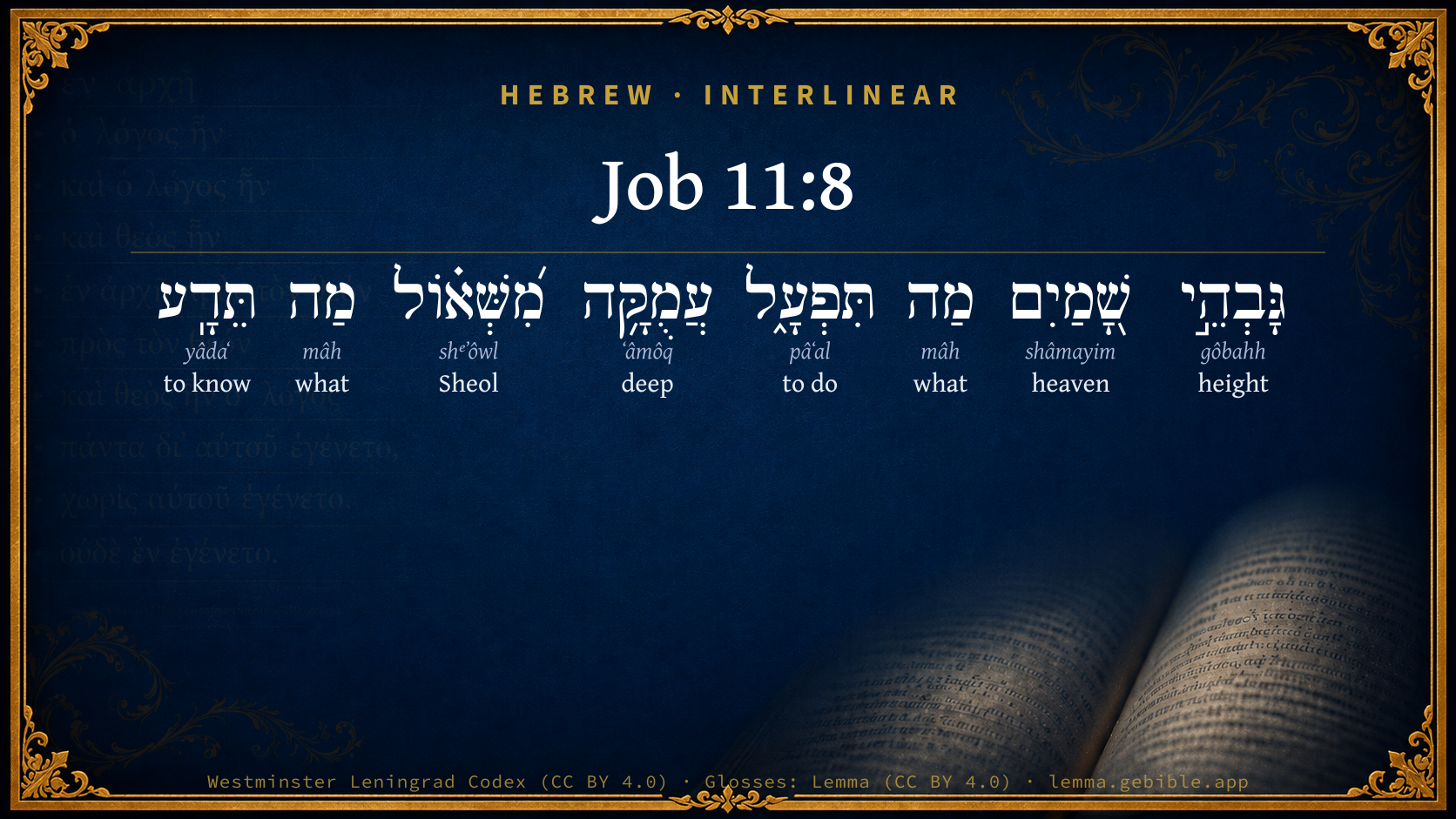
Job 11:8

Hebrew (Westminster Leningrad Codex) Job 11:8 appears in the Hebrew Old Testament. The text above is from the Westminster Leningrad Codex. Each word links to its Strong’s number, a concise gloss, and parsing drawn from the Open Scriptures Hebrew Bible morphology. Click any word for its full Brown-Driver-Briggs (BDB) entry.
Download image
Cite this verse

Job 11:8 (World English Bible). Public Domain. Lemma interlinear Bible study tool, https://lemma.gebible.app/v/job/11/8.

Show BibTeX & RIS
BibTeX
RIS
English Translation
They are high as heaven. What can you do? Deeper than Sheol: what can you know?
World English Bible · Public Domain
Download a study sheet

One document with this verse’s original text, its word-by-word gloss line, the meaning frame, cross-references with their text, attributed commentary, and full source and license credits — printable, and it pastes into notes with its structure intact.

This verse Autodidact and up

Study sheet (.html) Plain text (.txt)

A passage Seminary Student

Up to 50 verses in one chapter. A passage sheet keeps up to 6 commentary sources and 12 cross-references per verse, in the order this page ranks them, and says so on the sheet whenever that leaves anything out. Ask for a single verse and you get the Autodidact verse sheet above.

Everything on this page stays free to read, with no account — the sheet is a download of what is already on screen, not access to it.

Want to remove ads? Support Godless Engineer
Compare translations 3

The same verse in 3 English versions, stacked beneath the original-language interlinear above. Click any original word for its lexicon entry.

Each is an independent rendering of the whole verse — the interlinear is not word-aligned to these translations.

Highlighted words mark where these versions differ — a whole-verse word diff, not a word-by-word alignment.

  • World English Bible Public Domain
    They are high as heaven. What can you do? Deeper than Sheol: what can you know?
  • King James Version Public Domain
    It is as high as heaven; what canst thou do? deeper than hell; what canst thou know?
  • unfoldingWord Literal Text CC BY-SA 4.0
    The height of the heavens! What will you do? Deeper than Sheol! What will you know?

unfoldingWord Literal Text — © unfoldingWord, licensed CC BY-SA 4.0. Word-aligned USFM3 via Door43 (git.door43.org/unfoldingWord/en_ult).

Versions to compare (up to 4)

3 of 4 selected

Show all 18 translations

Every available English version of this verse, each an independent rendering of the whole verse.

  • World English Bible Public Domain
    They are high as heaven. What can you do? Deeper than Sheol: what can you know?
  • Berean Standard Bible Public Domain
    They are higher than the heavens—what can you do? They are deeper than Sheol—what can you know?
  • Majority Standard Bible Public Domain
    They are higher than the heavens—what can you do? They are deeper than Sheol—what can you know?
  • King James Version Public Domain
    It is as high as heaven; what canst thou do? deeper than hell; what canst thou know?
  • American Standard Version (1901) Public Domain
    It is high as heaven; what canst thou do? Deeper than Sheol; what canst thou know?
  • Revised Version (1885) Public Domain
    It is high as heaven; what canst thou do? deeper than Sheol; what canst thou know?
  • Geneva Bible (1599) Public Domain
    The heauens are hie, what canst thou doe? it is deeper then the hell, how canst thou know it?
  • Douay-Rheims (1899) Public Domain
    He is higher than heaven, and what wilt thou do? he is deeper than hell, and how wilt thou know?
  • Young's Literal Translation Public Domain
    Heights of the heavens! -- what dost thou? Deeper than Sheol! -- what knowest thou?
  • Literal Standard Version CC BY-SA 4.0
    Heights of the heavens—what [can] you do? Deeper than Sheol—what [can] you know?
  • Unlocked Literal Bible CC BY-SA 4.0
    The matter is as high as heaven; what can you do? It is deeper than Sheol; what can you know?
  • unfoldingWord Literal Text CC BY-SA 4.0
    The height of the heavens! What will you do? Deeper than Sheol! What will you know?
  • Darby Bible Public Domain
    [It is as] the heights of heaven; what wilt thou do? deeper than Sheol; what canst thou know?
  • World Messianic Bible Public Domain
    They are high as heaven. What can you do? They are deeper than Sheol. What can you know?
  • Webster's Bible Public Domain
    It is as high as heaven; what canst thou do? deeper than hell; what canst thou know?
  • Free Bible Version CC BY-SA 4.0
    It is greater than the heavens—what can you do? It is deeper than Sheol —what can you know?
  • Bible in Basic English Public Domain
    They are higher than heaven; what is there for you to do? deeper than the underworld, and outside your knowledge;
  • JPS Tanakh (1917) Public Domain
    It is high as heaven; what canst thou do? Deeper than the nether-world; what canst thou know?

Literal Standard Version (2020), Covenant Press — licensed CC BY-SA 4.0. Text via the HelloAO Bible API (eBible.org). Unlocked Literal Bible (unfoldingWord) — licensed CC BY-SA 4.0. Text via the HelloAO Bible API (eBible.org). unfoldingWord Literal Text — © unfoldingWord, licensed CC BY-SA 4.0. Word-aligned USFM3 via Door43 (git.door43.org/unfoldingWord/en_ult). Free Bible Version, Dr. Jonathan Gallagher — licensed CC BY-SA 4.0. Text via the HelloAO Bible API (eBible.org).

Word by word

More ways to search: Search by grammar → Find every occurrence → Compare this word →

Practice this passage: Drill this verse → Learn its vocabulary →

About this verse

These counts appear in no published source. They are computed here, from the morphology-tagged text and Lemma’s own curated glosses. What Lemma adds →

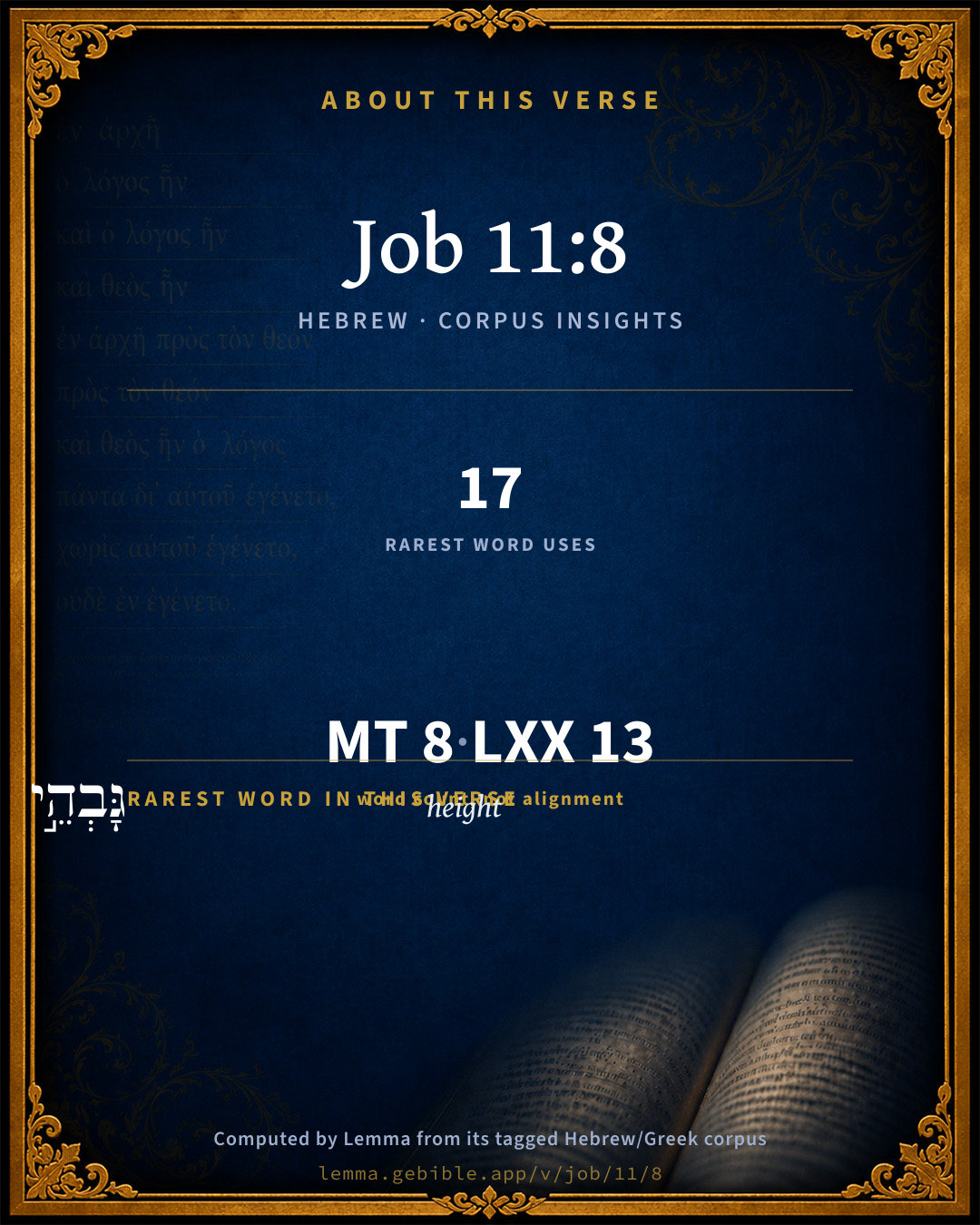
8
words
7
distinct lemmas
Wisdom
section

Notable vocabulary

The rarest word here is גָּבְהֵ֣י height H1363 — appearing just 17 times in the whole Hebrew Bible.

Shared distinctive vocabulary

גָּבְהֵ֣י height H1363 occurs in 16 verses of the Hebrew Bible. Also found in:

Grammatical profile

  • 2 verbs
  • 3 nouns
  • 1 adjective
  • 2 particles

Verb forms

  • תִּפְעָ֑ל Qal · Imperfect
  • תֵּדָֽע Qal · Imperfect

Repetition

A word recurs within this verse — often emphatic in Hebrew:

Hebrew & Septuagint length

In English translation the verse runs 16 words from the Hebrew and 21 from the Septuagint (LXX English) — closely comparable.

A rough comparison of the two English renderings, which tokenize alike — not a word-level alignment.

Word counts can differ between the Hebrew and the Greek without any difference in meaning — e.g. the Hebrew direct-object marker אֵת has no separate Greek word, and Greek often adds the article ὁ.

In the original languages it is 8 Hebrew tokens and 13 Greek tokens — but the two are counted differently (Hebrew bundles its prefixes and suffixes into one token; the Greek is in lemma form), so that isn’t a like-for-like length.

Cross-references

11

Topical passages linked to Job 11:8 in the Treasury of Scripture Knowledge — connected by theme and wording, ordered by reader-vote popularity; previews shown in the World English Bible.

  • Job 22:12 "Isn't God in the heights of heaven? See the height of the stars, how high they are!
  • Psalms 139:6–8 This knowledge is beyond me. It's lofty. I can't attain it.
  • Isaiah 55:9 For as the heavens are higher than the earth, so are my ways higher than your ways, and my thoughts than your thoughts.
  • Job 26:6 Sheol is naked before God, And Abaddon has no covering.
  • Job 35:5 Look to the heavens, and see. See the skies, which are higher than you.
  • Psalms 148:13 Let them praise the name of Yahweh, For his name alone is exalted. His glory is above the earth and the heavens.
  • Amos 9:2 Though they dig into Sheol, there my hand will take them; and though they climb up to heaven, there I will bring them down.
  • 2 Chronicles 6:18 But will God in very deed dwell with men on the earth? behold, heaven and the heaven of heavens can't contain you; how much less this house which I have built!
  • Psalms 103:11 For as the heavens are high above the earth, So great is his loving kindness toward those who fear him.
  • Proverbs 25:2–3 It is the glory of God to conceal a thing, But the glory of kings is to search out a matter.
  • Ephesians 3:18–19 may be strengthened to comprehend with all the saints what is the breadth and length and height and depth,

Cross-references courtesy of OpenBible.info (CC BY 4.0).

Hebrew and Greek witnesses Masoretic Hebrew ↔ Greek Septuagint

The same verse in the two great witnesses to the Old Testament, shown verse-for-verse.

These are two independent witnesses, not word-aligned to each other, and the Septuagint is shown in lemma (dictionary) form.

Hebrew Job 11:8 Masoretic · Westminster Leningrad Codex

גָּבְהֵ֣י שָׁ֭מַיִם מַה תִּפְעָ֑ל עֲמֻקָּ֥ה מִ֝שְּׁא֗וֹל מַה תֵּדָֽע

They are high as heaven. What can you do? Deeper than Sheol: what can you know?

World English Bible · Public Domain

Greek LXX Job 11:8 Septuagint · lemma form

ὑψηλός ὁ οὐρανός καί τίς ποιέω βαθύς δέ ὁ ἐν ἅδης τίς οἶδα

Heaven is high; and what will you do? and there are deeper things than those in hell; what do you know?

LXX2012 (modern English Septuagint) · Public Domain

On this verse, Albert Barnes' Notes on the Bible discusses the Septuagint’s reading. Read the note in Commentary ↓

Hebrew: Westminster Leningrad Codex (CC BY 4.0). Greek: Septuagint (public domain); English from LXX2012 (modern English Septuagint) (Public Domain). How the Septuagint differs from the Hebrew →

Commentary

Notes on Job 11:8 from classic Christian and Jewish commentators (each source and its license shown beneath its notes). The classic Christian expositions comment on the surrounding passage and are grouped to its opening verse, so a note may address several verses; the Jewish commentaries on the Tanakh (Rashi and others) are per-verse, so they appear only where the commentator wrote on this verse.

Lemma curates 59 commentaries, every one of them public domain or Creative Commons licensed, each selected and text-cleaned for this edition rather than reprinted as found. About our sources →

Trapp's Complete Commentary

John Trapp

Job 11:8 [It is] as high as heaven; what canst thou do? deeper than hell; what canst thou know?

Ver. 8. It is as high as heaven; what canst thou do?] And much higher; it is as the highnesses of heaven (so the Hebrew hath it), which is so high that one would wonder we should be able to behold the starry sky (which yet is but as the marble wall round about the palace), and the very eye not be tired in the way. {See Trapp on "Pro 25:3"} How high that second heaven is may hereby be gathered, in that the stars (whereof those of the first magnitude are said to be every one above 107 times as large again as the whole earth) do yet seem to us but as so many small sparks or spangles; but how high the third heaven is above them cannot be conjectured, Eph 4:10. And yet the wisdom of the Almighty is far above that. But what meaneth Zophar by these cutted questions of his, What canst thou do? and what canst thou know? He thought, belike, that either Job considered not what he had said when he so set forth God’s wisdom, and his own shallowness; or else that he contradicted himself when he nevertheless stood so much upon his own integrity, and complained so greatly of his misery, as of an injury.

Deeper than hell] Which, wherever it is, appeareth, by this and other texts of Scripture, as Rev 14:11 Deu 32:22 Psa 55:15 Pro 15:24, &c., to be below, Ubi sit, sentient, qui curiosius quaerunt, saith one; where it is they shall find one day who too curiously inquire. The word here rendered hell signifieth the lower and more remote parts of the earth; and David telleth us that the wicked shall be turned into hell, into the lowest part of it, as the He locale there implieth, Psa 9:17.

John Trapp, A Commentary or Exposition upon All the Books of the Old and New Testament (1647–1656) — public domain. Text from a community e-Sword module.

Geneva Bible (1599)

Geneva Bible translators

That is, this perfection of God, and if man be not able to comprehend the height of the heaven, the depth of hell, the length of the earth, the breadth of the Sea, which are but creatures: how can he attain to the perfection of the Creator?

Geneva Bible (1599) marginal notes — public domain. Text via Bolls.life.

Jamieson, Fausset & Brown

Robert Jamieson, A. R. Fausset & David Brown

It--the "wisdom" of God (Job 11:6). The abruptness of the Hebrew is forcible: "The heights of heaven! What canst thou do" (as to attaining to them with thy gaze, Psa 139:8)?

know--namely, of His perfections.

Jamieson, Fausset & Brown — Commentary Critical and Explanatory on the Whole Bible (1871) — public domain (CC PDM 1.0). Text via the HelloAO Bible API.

Adam Clarke's Commentary

Verse 8. It is as high as heaven] High as the heavens, what canst thou work? Deep below sheol, (the invisible world,) what canst thou know? Long beyond the earth, and broad beyond the sea, is its measure. These are instances in the immensity of created things, and all out of the reach of human power and knowledge; and if these things are so, how incomprehensible must he be, who designed, created, preserves, and governs the whole!

We find the same thought in Milton: -

"These are thy glorious works, Parent of good!

Almighty! Thine this universal frame:

How wondrous fair! Thyself how wondrous then!"

Adam Clarke's Commentary on the Bible (1810–1826) — public domain. Text from a community e-Sword/MySword module.

Ellicott's Commentary for English Readers

(8) It is as high as heaven.—Literally, The heights of heaven; what canst thou do? it is deeper than the grave; what canst thou know?

A Bible Commentary for English Readers, edited by Charles John Ellicott (1878–1897) — public domain. Text from a community e-Sword module.

The Cambridge Bible for Schools and Colleges

gen. ed. J. J. S. Perowne

8. His wisdom is immeasurable, unfathomable. The words are an exclamation: heights of heaven! what canst thou do?—thou art impotent before it, to scale it or reach it.

deeper than hell] i. e. than Sheol, the place of the dead—canst thou fathom it, penetrate with thy knowledge to it?

The Cambridge Bible for Schools and Colleges (gen. ed. J. J. S. Perowne; Cambridge University Press, 1878–1918) — public domain. Text from a community e-Sword module.

John Gill's Exposition

It is as high as heaven; what canst thou do?.... Or, "is higher than the heavens" (i); either the wisdom of God and the secrets of it; the perfection of his wisdom, by which he has made the heavens; or evangelical wisdom, hid in his heart, and which the highest of creatures, the angels, come at the knowledge of only by revelation; and therefore, what can man do to find it out, unless God reveals it? or wisdom displayed in dark providences, which can never be accounted for until the judgments of God are made manifest: or else, "he that is God", as the Vulgate Latin version, is "higher than the heavens"; the heaven is his throne on which he sits, and therefore he must be higher than that; the heavens, and heaven of heavens, cannot contain him; he fills up the infinite space beyond them; how is it possible therefore to find him out, to comprehend him?

deeper than hell; what canst thou know? meaning, neither the grave nor the place of the damned, for both which "Sheol" is sometimes used, but the centre or lowest part of the earth; there is a depth in God, in his essence, in his thoughts, in his wisdom, displayed in nature, providence, and grace, that is unfathomable; we can know nothing of it but what he is pleased to make known; see Psa 92:5; the Targum of the verse is,"in the height of heaven, what canst thou do? in the law, which is deeper than hell, what canst thou know?''

(i) "altior est altissimis coelis", Junius & Tremellius.

John Gill's Exposition of the Whole Bible (1746–1763) — public domain (CC PDM 1.0). Text via the HelloAO Bible API.

Albert Barnes' Notes on the Bible

It is as high as heaven - That is, the knowledge of God; or the subject is as high as heaven. The idea is, that man is incompetent to examine, with accuracy, an object that is as far off as the heavens; and that as the knowledge of God must be of that character, it is vain for him to attempt to investigate it fully. There is an energy in the Hebrew which is lost in our common translation. The Hebrew is abrupt and very emphatic: “The heights of the heavens!” It is the language of one looking up with astonishment at the high heavens, and over-powered with the thought that the knowledge of God must be higher even than those distant skies. Who can hope to understand it? Who can be qualified to make the investigation? It is a matter of simple but sublime truth, that God must be higher than these heavens; and when we take into view the amazing distances of many of the heavenly bodies, as now known by the aid of modern astronomy, we may ask with deeper emphasis by far than Zophar did. “Can we, by searching, find out God?”

Deeper than hell - Hebrew “Than Sheol” - משׁאול meshe'ôl. The Septuagint renders this, “the heaven is high, what canst thou do? And there are things deeper than in Hades - βαθύτερα τῶν ἐν ᾃδου bathutera tōn en Hadou - what dost thou know?” On the meaning of the word Sheol, see Isa 5:14, note; Isa 14:9, note. It seems to have been supposed to be as deep as the heavens are high; and the idea here is, that it would be impossible for man to investigate a subject that was as profound as Sheol was deep. The idea is not that God was in Sheol, but that the subject was as profound as the abode of departed spirits was deep and remote. It is possible that the Psalmist may have had this passage in his eye in the similar expression, occurring in Ps. 139:

If I ascend into heaven, thou art there;

If I make my bed in hell, behold thou art there.

Albert Barnes' Notes on the Bible (1834–1885) — public domain. Text from a community e-Sword/MySword module.

Matthew Poole's English Annotations

Thou canst not measure the heights of the visible heavens, much less of the Divine perfections.

What canst thou do, to wit, to find him out?

What canst thou know, concerning him and his ways, which are far out of thy sight and reach?

Matthew Poole's English Annotations on the Holy Bible (1683–1685) — public domain. Text from a community e-Sword/MySword module.

Whedon's Commentary on the Bible

Daniel D. Whedon

8. High as heaven — Literally, the heights of heaven! The wisdom of God towers above the heavens; penetrates beneath the depths of sheol, (the underworld;) in length and breadth it surpasses earth and ocean. The apostle in like manner describes the perfection of love by giving the four dimensions “breadth, length, depth, and height,” (Eph_3:18,) the dimensions of a cube, which in the apocalypse stands as the symbol of perfection; Rev_21:16. “The Pythagoreans represent the divine nature and every kind of perfection and completeness by a square.” — Heyne. The Fathers saw in this description of wisdom the similitude of the cross. Their idea J.F. Meyer thus reproduces: “Its head uplifts itself to the throne of God, and its root reaches down to hell. Its arms stretch from the rising of the sun to the going down of the same, and from pole to pole. In it heaven and earth are united, in it appeased.”

Daniel D. Whedon (gen. ed.), Commentary on the Old and New Testaments (1874–1909) — public domain. Text from a community e-Sword module.

The Pulpit Commentary

It is as high as heaven; what canst thou do? literally, heights of the heavens; what canst thou do? But the meaning is probably that expressed in the Authorized Version. God"s perfectness is unattainable by man"s thought, as the heights of the heavens are by his feet. Deeper than hell; literally, than Sheol, or the receptacle of the dead. (see the comment Job_10:21) St. Paul speaks of the "deep things," or rather, "the depths" (ta bayh ) of God. (see 1Co_2:10) What canst thou know? How small a part of the Divine nature can any man thoroughly comprehend and know!

The Pulpit Commentary (1880–1919), ed. H.D.M. Spence-Jones & Joseph S. Exell — public domain. Text from a community e-Sword module.

Rashi

Rabbi Shlomo Yitzchaki (Rashi)

[In] the heights of heaven [About] something that is as high as the heights of heaven, what can you do? And the wisdom is deeper than the grave.

Rashi on the Tanakh — English translations: “The Judaica Press complete Tanach with Rashi, translated by A. J. Rosenberg” (CC BY 4.0); “Pentateuch with Rashi's commentary by M. Rosenbaum and A.M. Silbermann, 1929-1934” (public domain); “The Metsudah Tanach series, Lakewood, N.J” (CC BY 4.0); and “The Book of Joshua, Metsudah Publications, 1997” (CC BY 4.0). Text via Sefaria.

Lesson kit

Teaching starters — assembled from the data on this page, not authored interpretation. Every prompt links to the verse data it draws on. Edit before teaching.

Job, in the Wisdom, opens this verse with 8 words (7 distinct Hebrew lemmas). Its most distinctive word is gôbahh (“height”). A historical commentator’s framing appears above. Read the whole chapter for the surrounding context.

Discussion questions

  1. The word gôbahh carries the sense “height.” How does it shape the verse?
  2. How does 1 Samuel 17:4, which shares the word «height», read alongside this verse?
  3. What does the repetition of “what” (2× in this one verse) do in this verse?
  4. These translations render this verse differently. What is at stake in choosing one wording over another?
  5. «תִּפְעָ֑ל» is a Qal Imperfect verb. How does that grammatical form shape the action described?
  6. Compare how Trapp's Complete Commentary and Geneva Bible (1599) read this verse. Where do they agree or differ?

Things to notice

Reading settings

Reading text

Shown beneath each verse's original-language words.

Old Testament
Old Testament edition

Read the OT as the Masoretic Hebrew (MT) or the Greek Septuagint (LXX).

English shown for the Greek Septuagint (in the Hebrew ↔ Greek comparison).

Comparing translations? Open the Compare panel on any verse page to stack up to four side by side.