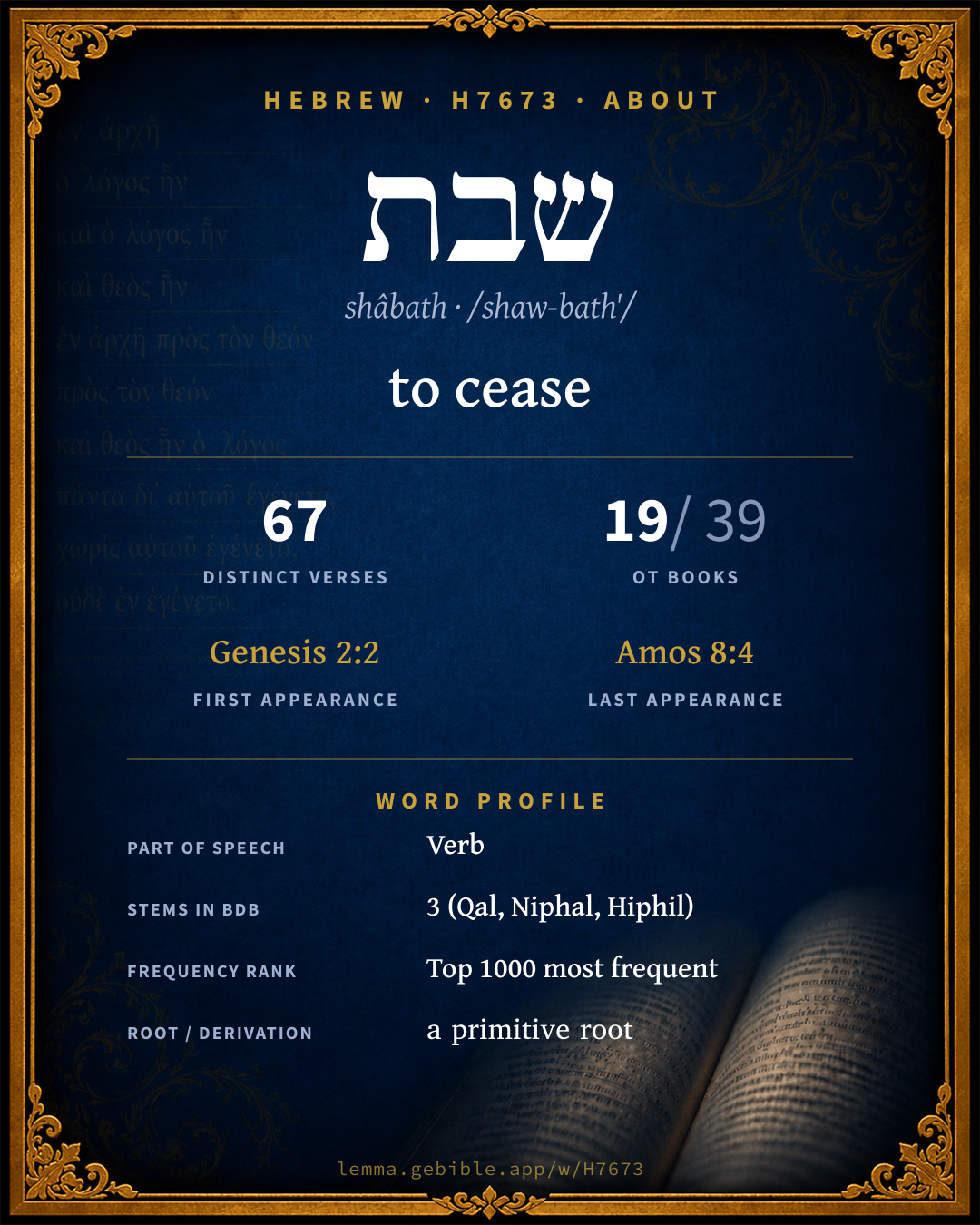
שָׁבַת
to cease
also: desist, rest fuller range ↓
Full lexicon entry — Brown-Driver-Briggs (BDB)
From Brown-Driver-Briggs (BDB)
Where this word appears
See every Hiphil verb in the Hebrew Bible →
Grammar key — what these labels mean
Part of speech
- Verb
- An action or state-of-being word.
Stem
- Hiphil
- The causative active stem (“he caused / brought about”). Here: ‘cause to cease’
- Qal
- The basic, simple active stem — the plain form of the verb (“he wrote”). Here: ‘cease’
- Niphal
- Usually the simple passive or reflexive of the Qal (“he was written”).
Form
- Sequential Perfect
- A perfect with prefixed waw continuing a preceding imperfect or command (waw-consecutive perfect).
- Perfect
- A completed action or state — Hebrew marks aspect (completeness) more than strict tense (“he wrote”).
- Imperfect
- An incomplete, ongoing, or future action (“he will / would write”).
- Sequential Imperfect
- An imperfect with prefixed waw — the standard past-narrative form (waw-consecutive imperfect).
- Participle Active
- A verbal adjective expressing ongoing or characteristic action (“writing / one who writes”).
- Infinitive Construct
- A bound verbal noun, frequently with prepositions (“to write / in writing”).
- Cohortative
- A first-person volitional form expressing wish or resolve (“let me / let us write”).
- Imperative
- A direct command (“write!”).
State
- Absolute
- The independent form of a noun, not bound to a following word.
Person
- 1st Person
- The speaker (“I / we”).
- 3rd Person
- The one spoken about (“he / she / it / they”).
- 2nd Person
- The one addressed (“you”).
Gender
- Common
- Either gender — not distinguished for this form.
- Masculine
- Grammatically masculine.
- Feminine
- Grammatically feminine.
Number
- Singular
- One.
- Plural
- More than one (in Hebrew, generally three or more).
Grammatical forms 29 distinct
- Verb, Hiphil, Sequential Perfect, 1st Person, Common, Singular 15 times (21%)
- Verb, Qal, Perfect, 3rd Person, Masculine, Singular 7 times (10%)
- Verb, Hiphil, Perfect, 1st Person, Common, Singular 4 times (6%)
- Verb, Niphal, Sequential Perfect, 3rd Person, Masculine, Singular 3 times (4%)
- Verb, Qal, Imperfect, 2nd Person, Masculine, Singular 3 times (4%)
- Verb, Qal, Imperfect, 3rd Person, Feminine, Singular 3 times (4%)
- Verb, Qal, Perfect, 3rd Person, Feminine, Singular 3 times (4%)
- Verb, Hiphil, Sequential Perfect, 3rd Person, Masculine, Singular 2 times (3%)
+21 more forms (31 occurrences)
Parsed forms decoded from the imported morphology (morphhb / Westminster Leningrad Codex — WLC text public domain, morphhb tagging CC BY 4.0), counted across 71 parsed occurrences — not distinct verses.
Every verse where H7673 appears — 67 distinct verses across 19 books. Click any verse to open its interlinear word-by-word view. Verse text shown in the World English Bible for context — . Each verse’s Hebrew form is shown with its reference; the English is not keyword-highlighted, since the data carries no word-level English alignment. Use “Compare translations” on any verse to read it across multiple English versions. This concordance covers the Hebrew Bible; Septuagint (Greek Old Testament) occurrences are not indexed here.
Genesis 3 verses
- Genesis 2:2 וַ/יִּשְׁבֹּת֙ conj + Qal wimpf 3ms On the seventh day God finished his work which he had made; and he rested on the seventh day from all his work which he had made.
- Genesis 2:3 שָׁבַת֙ Qal pf 3ms God blessed the seventh day, and made it holy, because he rested in it from all his work which he had created and made.
- Genesis 8:22 יִשְׁבֹּֽתוּ Qal impf 3mp While the earth remains, seed time and harvest, and cold and heat, and summer and winter, and day and night shall not cease."
Exodus 6 verses
- Exodus 5:5 וְ/הִשְׁבַּתֶּ֥ם conj + Hiphil pf 2mp Pharaoh said, "Behold, the people of the land are now many, and you make them rest from their burdens."
- Exodus 12:15 תַּשְׁבִּ֥יתוּ Hiphil impf 2mp Seven days shall you eat unleavened bread; even the first day you shall put away yeast out of your houses, for whoever eats leavened bread from the first day until the seventh day, that soul shall be cut off from Israel.
- Exodus 16:30 וַ/יִּשְׁבְּת֥וּ conj + Qal wimpf 3mp So the people rested on the seventh day.
- Exodus 23:12 תִּשְׁבֹּ֑ת Qal impf 2ms "Six days you shall do your work, and on the seventh day you shall rest, that your ox and your donkey may have rest, and the son of your handmaid, and the alien may be refreshed.
- Exodus 31:17 שָׁבַ֖ת Qal pf 3ms It is a sign between me and the children of Israel forever; for in six days Yahweh made heaven and earth, and on the seventh day he rested, and was refreshed.'"
- Exodus 34:21 תִּשְׁבֹּ֑ת תִּשְׁבֹּֽת Qal impf 2ms Qal impf 2ms Six days you shall work, but on the seventh day you shall rest: in plowing time and in harvest you shall rest.
Leviticus 6 verses
- Leviticus 2:13 תַשְׁבִּ֗ית Hiphil impf 2ms Every offering of your meal offering you shall season with salt; neither shall you allow the salt of the covenant of your God to be lacking from your meal offering. With all your offerings you shall offer salt.
- Leviticus 23:32 תִּשְׁבְּת֖וּ Qal impf 2mp It shall be a Sabbath of solemn rest for you, and you shall deny yourselves. In the ninth day of the month at evening, from evening to evening, you shall keep your Sabbath."
- Leviticus 25:2 וְ/שָׁבְתָ֣ה conj + Qal wpf 3fs "Speak to the children of Israel, and tell them, 'When you come into the land which I give you, then the land shall keep a Sabbath to Yahweh.
- Leviticus 26:6 וְ/הִשְׁבַּתִּ֞י conj + Hiphil wpf 1cs "'I will give peace in the land, and you shall lie down, and no one will make you afraid; and I will remove evil animals out of the land, neither shall the sword go through your land.
- Leviticus 26:34 תִּשְׁבַּ֣ת Qal impf 3fs Then the land will enjoy its sabbaths as long as it lies desolate and you are in your enemies' land. Even then the land will rest and enjoy its sabbaths.
- Leviticus 26:35 תִּשְׁבֹּ֑ת שָׁבְתָ֛ה Qal impf 3fs Qal pf 3fs As long as it lies desolate it shall have rest, even the rest which it didn't have in your sabbaths, when you lived on it.
Deuteronomy 1 verse
Joshua 2 verses
- Joshua 5:12 וַ/יִּשְׁבֹּ֨ת conj + Qal wimpf 3ms The manna ceased on the next day, after they had eaten of the produce of the land; neither had the children of Israel manna any more; but they ate of the fruit of the land of Canaan that year.
- Joshua 22:25 וְ/הִשְׁבִּ֤יתוּ conj + Hiphil pf 3cp for Yahweh has made the Jordan a border between us and you, you children of Reuben and children of Gad; you have no portion in Yahweh: so might your children make our children cease from fearing Yahweh.
Ruth 1 verse
2 Kings 2 verses
- 2 Kings 23:5 וְ/הִשְׁבִּ֣ית conj + Hiphil pf 3ms He put down the idolatrous priests, whom the kings of Judah had ordained to burn incense in the high places in the cities of Judah, and in the places round about Jerusalem; those also who burned incense to Baal, to the sun, and to the moon, and to the planets, and to all the host of the sky.
- 2 Kings 23:11 וַ/יַּשְׁבֵּ֣ת conj + Hiphil wimpf 3ms He took away the horses that the kings of Judah had given to the sun, at the entrance of the house of Yahweh, by the chamber of Nathan-melech the chamberlain, which was in the precincts; and he burned the chariots of the sun with fire.
2 Chronicles 2 verses
- 2 Chronicles 16:5 וַ/יַּשְׁבֵּ֖ת conj + Hiphil wimpf 3ms It happened, when Baasha heard of it, that he left off building Ramah, and let his work cease.
- 2 Chronicles 36:21 שָׁבָ֔תָה Qal pf 3fs to fulfill the word of Yahweh by the mouth of Jeremiah, until the land had enjoyed its Sabbaths: [for] as long as it lay desolate it kept Sabbath, to fulfill seventy years.
Nehemiah 2 verses
- Nehemiah 4:11 וְ/הִשְׁבַּ֖תְנוּ conj + Hiphil wpf 1cp Our adversaries said, They shall not know, neither see, until we come into the midst of them, and kill them, and cause the work to cease.
- Nehemiah 6:3 תִשְׁבַּ֤ת Qal impf 3fs I sent messengers to them, saying, I am doing a great work, so that I can't come down: why should the work cease, while I leave it, and come down to you?
Job 1 verse
Psalms 4 verses
- Psalms 8:2 לְ/הַשְׁבִּ֥ית prep + Hiphil inf.cs From the lips of babes and infants you have established strength, Because of your adversaries, that you might silence the enemy and the avenger.
- Psalms 46:9 מַשְׁבִּ֥ית Hiphil ptcp.act ms He makes wars cease to the end of the earth. He breaks the bow, and shatters the spear. He burns the chariots in the fire.
- Psalms 89:44 הִשְׁבַּ֥תָּ Hiphil pf 2ms You have ended his splendor, And thrown his throne down to the ground.
- Psalms 119:119 הִשְׁבַּ֥תָּ Hiphil pf 2ms You put away all the wicked of the earth like dross. Therefore I love your testimonies.
Proverbs 2 verses
Isaiah 8 verses
- Isaiah 13:11 וְ/הִשְׁבַּתִּי֙ conj + Hiphil wpf 1cs I will punish the world for [their] evil, and the wicked for their iniquity: and I will cause the arrogance of the proud to cease, and will lay low the haughtiness of the terrible.
- Isaiah 14:4 שָׁבַ֣ת שָׁבְתָ֖ה Qal pf 3ms Qal pf 3fs that you shall take up this parable against the king of Babylon, and say, How has the oppressor ceased! the golden city ceased!
- Isaiah 16:10 הִשְׁבַּֽתִּי Hiphil pf 1cs Gladness is taken away, and joy out of the fruitful field; and in the vineyards there shall be no singing, neither joyful noise: nobody shall tread out wine in the presses; I have made the [vintage] shout to cease.
- Isaiah 17:3 וְ/נִשְׁבַּ֤ת conj + Niphal wpf 3ms The fortress shall cease from Ephraim, and the kingdom from Damascus, and the remnant of Syria; they shall be as the glory of the children of Israel, says Yahweh of Hosts.
- Isaiah 21:2 הִשְׁבַּֽתִּי Hiphil pf 1cs A grievous vision is declared to me; the treacherous man deals treacherously, and the destroyer destroys. Go up, Elam; besiege, Media; all the sighing of it have I made to cease.
- Isaiah 24:8 שָׁבַת֙ שָׁבַ֖ת Qal pf 3ms Qal pf 3ms The mirth of tambourines ceases, the noise of those who rejoice ends, the joy of the harp ceases.
- Isaiah 30:11 הַשְׁבִּ֥יתוּ Hiphil impv 2mp get out of the way, turn aside out of the path, cause the Holy One of Israel to cease from before us."
- Isaiah 33:8 שָׁבַ֖ת Qal pf 3ms The highways lie waste, the wayfaring man ceases: [the enemy] has broken the covenant, he has despised the cities, he doesn't regard man.
Jeremiah 6 verses
- Jeremiah 7:34 וְ/הִשְׁבַּתִּ֣י conj + Hiphil wpf 1cs Then will I cause to cease from the cities of Judah, and from the streets of Jerusalem, the voice of mirth and the voice of gladness, the voice of the bridegroom and the voice of the bride; for the land shall become a waste.
- Jeremiah 16:9 מַשְׁבִּ֜ית Hiphil ptcp.act ms For thus says Yahweh of Hosts, the God of Israel: Behold, I will cause to cease out of this place, before your eyes and in your days, the voice of mirth and the voice of gladness, the voice of the bridegroom and the voice of the bride.
- Jeremiah 31:36 יִשְׁבְּת֗וּ Qal impf 3mp If these ordinances depart from before me, says Yahweh, then the seed of Israel also shall cease from being a nation before me forever.
- Jeremiah 36:29 וְ/הִשְׁבִּ֥ית conj + Hiphil wpf 3ms Concerning Jehoiakim king of Judah you shall say, Thus says Yahweh: You have burned this scroll, saying, Why have you written therein, saying, The king of Babylon shall certainly come and destroy this land, and shall cause to cease from there man and animal?
- Jeremiah 48:33 הִשְׁבַּ֔תִּי Hiphil pf 1cs Gladness and joy is taken away from the fruitful field and from the land of Moab; and I have caused wine to cease from the wine presses: none shall tread with shouting; the shouting shall be no shouting.
- Jeremiah 48:35 וְ/הִשְׁבַּתִּ֥י conj + Hiphil wpf 1cs Moreover I will cause to cease in Moab, says Yahweh, him who offers in the high place, and him who burns incense to his gods.
Lamentations 2 verses
Ezekiel 13 verses
- Ezekiel 6:6 וְ/נִשְׁבְּתוּ֙ conj + Niphal wpf 3cp In all your dwelling-places the cities shall be laid waste, and the high places shall be desolate; that your altars may be laid waste and made desolate, and your idols may be broken and cease, and your sun-images may be hewn down, and your works may be abolished.
- Ezekiel 7:24 וְ/הִשְׁבַּתִּי֙ conj + Hiphil wpf 1cs Therefore I will bring the worst of the nations, and they shall possess their houses: I will also make the pride of the strong to cease; and their holy places shall be profaned.
- Ezekiel 12:23 הִשְׁבַּ֨תִּי֙ Hiphil pf 1cs Tell them therefore, Thus says the Lord Yahweh: I will make this proverb to cease, and they shall no more use it as a proverb in Israel; but tell them, The days are at hand, and the fulfillment of every vision.
- Ezekiel 16:41 וְ/הִשְׁבַּתִּי/ךְ֙ conj + Hiphil wpf 1cs + sfx pers 2fs They shall burn your houses with fire, and execute judgments on you in the sight of many women; and I will cause you to cease from playing the prostitute, and you shall also give no hire any more.
- Ezekiel 23:27 וְ/הִשְׁבַּתִּ֤י conj + Hiphil wpf 1cs Thus will I make your lewdness to cease from you, and your prostitution [brought] from the land of Egypt; so that you shall not lift up your eyes to them, nor remember Egypt any more.
- Ezekiel 23:48 וְ/הִשְׁבַּתִּ֥י conj + Hiphil wpf 1cs Thus will I cause lewdness to cease out of the land, that all women may be taught not to do after your lewdness.
- Ezekiel 26:13 וְ/הִשְׁבַּתִּ֖י conj + Hiphil wpf 1cs I will cause the noise of your songs to cease; and the sound of your harps shall be no more heard.
- Ezekiel 30:10 וְ/הִשְׁבַּתִּי֙ conj + Hiphil wpf 1cs Thus says the Lord Yahweh: I will also make the multitude of Egypt to cease, by the hand of Nebuchadrezzar king of Babylon.
- Ezekiel 30:13 וְ/הִשְׁבַּתִּ֤י conj + Hiphil wpf 1cs Thus says the Lord Yahweh: I will also destroy the idols, and I will cause the images to cease from Memphis; and there shall be no more a prince from the land of Egypt: and I will put a fear in the land of Egypt.
- Ezekiel 30:18 וְ/נִשְׁבַּת conj + Niphal wpf 3ms At Tehaphnehes also the day shall withdraw itself, when I shall break there the yokes of Egypt, and the pride of her power shall cease in her: as for her, a cloud shall cover her, and her daughters shall go into captivity.
- Ezekiel 33:28 וְ/נִשְׁבַּ֖ת conj + Niphal wpf 3ms I will make the land a desolation and an astonishment; and the pride of her power shall cease; and the mountains of Israel shall be desolate, so that none shall pass through.
- Ezekiel 34:10 וְ/הִשְׁבַּתִּי/ם֙ conj + Hiphil wpf 1cs + sfx pers 3mp Thus says the Lord Yahweh: Behold, I am against the shepherds; and I will require my sheep at their hand, and cause them to cease from feeding the sheep; neither shall the shepherds feed themselves any more; and I will deliver my sheep from their mouth, that they may not be food for them.
- Ezekiel 34:25 וְ/הִשְׁבַּתִּ֥י conj + Hiphil wpf 1cs I will make with them a covenant of peace, and will cause evil animals to cease out of the land; and they shall dwell securely in the wilderness, and sleep in the woods.
Daniel 2 verses
- Daniel 9:27 יַשְׁבִּ֣ית Hiphil impf 3ms He shall make a firm covenant with many for one week: and in the midst of the week he shall cause the sacrifice and the offering to cease; and on the wing of abominations [shall come] one who makes desolate; and even to the full end, and that determined, shall [wrath] be poured out on the desolate.
- Daniel 11:18 וְ/הִשְׁבִּ֨ית conj + Hiphil wpf 3ms After this shall he turn his face to the isles, and shall take many: but a prince shall cause the reproach offered by him to cease; yes, moreover, he shall cause his reproach to turn on him.
Hosea 3 verses
- Hosea 1:4 וְ/הִ֨שְׁבַּתִּ֔י conj + Hiphil wpf 1cs Yahweh said to him, "Call his name Jezreel; for yet a little while, and I will avenge the blood of Jezreel on the house of Jehu, and will cause the kingdom of the house of Israel to cease.
- Hosea 2:11 וְ/הִשְׁבַּתִּי֙ conj + Hiphil wpf 1cs I will also cause all her celebrations to cease: Her feasts, her new moons, her Sabbaths, and all her solemn assemblies.
- Hosea 7:4 יִשְׁבּ֣וֹת Qal impf 3ms They are all adulterers. They are burning like an oven that the baker stops stirring, From the kneading of the dough, until it is leavened.
Amos 1 verse
About this entry
At a glance — auto-summarized from this page’s data, not written by a person. Every figure links to its source below. This summary describes the numbers; it doesn’t interpret them.
שבת — transliterated shâbath — is a Hebrew verb carrying the sense “to cease.” Translators differ — “cease” in the King James Version, then “i will put an end” (Berean Standard Bible), as the renderings breakdown shows. With 67 verses in 19 books, it is a moderately common word in the Hebrew Bible. It first appears in Genesis 2:2. Different stems carry different senses — BDB groups them under 3 stems, among them Qal and Niphal. See the sense tree, 67-verse concordance, and the renderings breakdown below.
Gloss history
Strong's 1890 vs modern scholarship
About this word
Strong's H7673 catalogs a Hebrew word from the Hebrew Old Testament.
These counts are not copied from any lexicon or concordance. They are computed here, from the morphology-tagged Hebrew Old Testament. What Lemma adds →
- 67
- distinct verses
- The word appears in 67 distinct verses.
- 19 / 39
- OT books
- The word appears in 19 of 39 Old Testament books.
- #558
- by frequency
- Top 1000 most frequent Hebrew words (rank 558 of 8,640 Hebrew words by occurrence).
View all 67 occurrences in the concordance →
By section of the Old Testament
By traditional corpus
Conventional, traditional groupings — biblical authorship is debated, so this is a traditional corpus grouping, not an authorship claim. Each share is this word’s portion of its verses in that division of the Hebrew canon. Each figure is a share of the word’s 67 distinct verses.
- Prophets (Nevi'im) 35 verses · 52%
- Torah (Pentateuch) 16 verses · 24%
- Writings (Ketuvim) 16 verses · 24%
How translations render this word
Counts come from each version’s own published word-to-Strong’s tagging or interlinear alignment — an approximate guide to how each version renders this word, not a word-level alignment the data otherwise carries. Because each total is that version’s own tagged count, the per-version totals vary from one another and need not match the appearance or distinct-verse counts above. These counts may also differ from a printed concordance because Lemma counts each distinctly tagged rendering and does not collapse phrase taggings into a single head-word total. This is a fixed set of word-tagged versions (KJV, ASV, BSB, ULT) and does not change with the reading translation you choose elsewhere. Each version’s license is shown beside its name below (and on Sources).
BDB lists this Strong’s number as 2 distinct words (homographs). Each count above pools all of them and is not split by sense — see the Senses section below. A low-frequency rendering may belong to a different one of those words, not the primary meaning.
- King James Version†: Cease 22×, Shall cease 5×, Ceased 4×
- American Standard Version†: Cease 24×, Ceased 4×, Shall cease 4×
- Berean Standard Bible†: I will put an end 8×, Cease 3×, He rested 3×
- unfoldingWord Literal Text†: Cease 10×, And 6×, Has ceased 4×
King James Version Public Domain
Renders H7673 across 73† tagged occurrences — most commonly:
Plus 29 renderings that appear only once — usually multi-word phrases or single function words the recovered tagging swept in, not distinct renderings.
American Standard Version Public Domain
Renders H7673 across 73† tagged occurrences — most commonly:
Plus 30 renderings that appear only once — usually multi-word phrases or single function words the recovered tagging swept in, not distinct renderings.
Berean Standard Bible Public Domain
Renders H7673 across 71† tagged occurrences — most commonly:
Plus 49 renderings that appear only once — usually multi-word phrases or single function words the recovered tagging swept in, not distinct renderings.
unfoldingWord Literal Text CC BY-SA 4.0
Renders H7673 across 94† tagged occurrences — most commonly:
Plus other, less common renderings. Plus 46 renderings that appear only once — usually multi-word phrases or single function words the recovered tagging swept in, not distinct renderings.
14 senses and sub-senses in the full BDB
Hebrew verbs can shift meaning by stem (binyan): Qal is the basic action, Niphal is often passive or reflexive, Piel often intensifies or makes it factitive, and Hiphil is typically causative. The senses below are grouped under the stem BDB assigns to each.
What do BDB’s symbols mean?
BDB uses these scholarly abbreviations:
| Symbol | Meaning |
|---|---|
| 𝔊 | the Septuagint (the ancient Greek translation, LXX) |
| 𝔙 | the Vulgate (the Latin translation) |
| 𝔖 | the Syriac version (the Peshitta) |
| 𝔗 | the Targum (the Aramaic translation) |
| ψ | the Psalms |
| √ | root (the underlying root or stem) |
| ‖ | parallel passage (a synonymous or contrasted parallel) |
| † | the dagger: every passage where the word occurs is cited |
The 14 senses and sub-senses the full Brown-Driver-Briggs lexicon distinguishes for this word, in lexicon order (not ranked by frequency), with BDB’s own verbatim wording and sub-sense lettering. Shown in Hebrew script with BDB’s own scholarly abbreviations. The condensed entry is in the Lexicon Entry tab. See also the Forms in the corpus table below.
שבת I cease, desist, rest (Assyrian šabâtu, prob. cease, be completed DlWB ZimKAT3. 593 (JenZA iv (1889), 277 f. is sceptical)
Qal
- Pf. 3 ms. שׁ׳ Gn 2:3 +; 3 pl. שָׁבָ֑תוּ La 5:14, etc.; Impf. 3 ms. יִשְׁבּוֹת Ho 7:4; יִשְׁבֹּת Pr 22:10 + 2 times; 3 fs. תִּשְׁבֹּת Lv 26:35; תִּשְׁבַּת v 34 Ne 6:3 +, etc.;— e.g. Genesis 2:3
- 1. cease: (abs. 13 times) of seasons Gn 8:22 (J); manna Jos 5:12 (P), etc., Is 14:4(×2) Ne 6:3 +; c. מִן Ho 7:4 + 3 times e.g. Genesis 8:22
- 2. desist from labour, rest:
- a. c. מִן (of God) Gn 2:2, 3 (P) e.g. Genesis 2:2
- b. מִן om., ב temp. Ex 23:12 (E), 16:30; 34:21 (J), 31:17 (P); בֶּחָרִישׁ וּבַקָּצִיר שׁ׳ 34:21 (J.; i.e., even in these busy seasons). e.g. Exodus 23:12
- c. land in 7th year Lv 26:34, 35(×2) (H), 2 Ch 36:21.—Lv 23:32; 25:2 v. [שָׁבַת] vb. denom. Infr. e.g. Leviticus 26:34
Niphal
- Pf. 3 ms. נִשְׁבַּת Is 17:3 + 2 times; pl. נִשְׁבְּתוּ Ez 6:6;—cease: abs. Ez 6:6; 30:18; 33:28; c. מִן Is 17:3. e.g. Isaiah 17:3
Hiphil
- Pf. 3 ms. הִשְׁבִּית Ru 4:14 +; 2 ms. הִשְּׁבַּתָּ ψ 89:45; 119:119, etc.; Impf. 3 ms. יַשְׁבִּית Pr 18:18 Dn 9:27; וַיַּשְׁבֵּת 2 K 23:11 2 Ch 16:5, etc.; Inf. cstr. הַשְׁבִּית ψ 8:3; לַשְׁבִּית Am 8:4 (Ges§ 53 q); Imv. mpl. הַשְׁבִּ֫יתוּ Is 30:11; Pt. מַשְׁבִּית Je 16:9 ψ 46:10;— e.g. Ruth 4:14
- 1. cause to cease, put an end to: c. acc. mirth Ho 2:13, work 2 Ch 16:5; Ne 4:5; sacrifice Dn 9:27; war ψ 46:10, cf. Is 13:11; Ez 7:24; Pr 18:18 + 6 times, + הִשׁ׳ קוֹל שָׂשׂוֹן מִן Je 7:34; 16:9, cf. 48:33. e.g. Hosea 2:13
- 2. = exterminate, destroy: c. acc. 2 K 23:5, 11; Am 8:4 (Now conj. העשׁקים), Ho 1:4 ψ 8:3; 119:119; c. acc. + מִן, Je 36:29, מִן הָאָרֶץ Lv 26:6 (H), Ez 34:25; אלילים 30:13; Dt 32:26. e.g. 2 Kings 23:5
- 3. cause to desist from: c. מִן Ez 16:41; 34:10; Ex 5:5 (E = give rest from); לְבִלְתִּי inf. Jos 22:25 (P). e.g. Ezekiel 16:41
- 4. remove (= הֵסִיר מִן: c. מִן Ez 23:27, 48 ψ 89:45 (text dub.: read הִשְׁבַּתּוֹ [3] 𝔊 Du; מַטֵּה הֹדוֹ Herz Che, v. also sub מֳהָר); leaven מבתים Ex 12:15 (P); הַשׁ׳ אֶח־ק׳ ישׂר׳ מִפָּנֵינוּ Is 30:11. e.g. Ezekiel 23:27
- 5. cause to fail, let be lacking: salt מֵעַל מִנְחָתֶ֑ךָ Lv 2:13 (P); acc. pers. + ל pers. Je 48:35; Ru 4:14. I. שֶׁבֶת v. ישׁב. e.g. Leviticus 2:13
שבת II denom. keep, observe (sabbath)
Qal
- , c. acc. cogn.; Pf. 3 fs. וְשָֽׁבְתָה הָאָרֶץ שַׁבָּת לי׳ Lv 25:2, cf. 2 Ch 36:21; 2 mpl. מֵעֶרֶב עַד־ עֶרֶב תִּשְׁבְּתוּ שַׁבַּתְּכֶ֑ם Lv 23:32 (P). e.g. Leviticus 25:2
Senses from the full Brown-Driver-Briggs lexicon (Brown, Driver, Briggs; Oxford 1906 — public domain), digitized via Sefaria, supplemented by the OpenScriptures HebrewLexicon (CC BY 4.0). Full attribution on Sources.
Word origin
I. vb. cease, desist, rest (Assyrian šabâtu, prob. cease, be completed DlWB ZimKAT3. 593 (JenZA iv (1889), 277 f. is sceptical); Arabic سَبَتَ cut off, interrupt; NH has שֶׁבֶת neglect, etc., Aramaic שִׁבְתָּא cost of neglect);—
II. vb.denom. keep, observe (sabbath);—
— Brown-Driver-Briggs (Oxford 1906, public domain), digitized via Sefaria, supplemented by the OpenScriptures HebrewLexicon (CC BY 4.0). See Sources.
Origin: a primitive root
Jastrow Dictionary
A second Hebrew/Aramaic lexicon for comparison, covering Aramaic and post-biblical (Talmudic, Targumic, Midrashic) usage that the biblical-Hebrew BDB does not. Matched by lemma rather than by Strong’s number, so a lemma may carry more than one Jastrow headword (shown separately below), and the entries cover usage well beyond the Bible.
שֶׁבֶת I
- c. (v. Löw Pfl., p. 373) dill. Ukts. III, 4 הש׳ משנתן טעמו וכ׳ (Ar. משנתנה טעמה) the dill stalk after having given its taste to a dish; Ber. 39ᵃ. Maasr. IV, 5 הש׳ מתעשרת וכ׳ dill must be tithed as seed &c., v. עָשַׂר; a. fr.
שֶׁבֶת II
- 1. seat. Esth. R. to I, 2 מקום הש׳ the place of the throne. Ib. כדי שיהא המלך יושב בש׳ וכ׳ so that the king might be seated in the chair with the crown &c. Nidd. 16ᵇ, v. מָרוֹם; a. e.
- 2. sitting idle, indemnity for loss of time (Ex. XXI, 19). B. Kam. VIII, 1 ש׳ רואין אותו וכ׳ to estimate indemnity for loss of time, we consider the person concerned, as if he were a watchman in a cucumber field. Ib. 85ᵃ דמי שִׁבְתּוֹ indemnity for his enforced idleness. Ib. שבתו ורפואתו כל שחייב בש׳ וכ׳ the text places on parallel lines indemnity for loss of time and healing expenses: whenever one is bound to pay for loss of time, one is bound to pay for healing. Ib. 86ᵃ ש׳ גדולה וש׳ קטנה the larger indemnity (for the permanent incapacitation, e.g. the value of the earning capacity of a maimed hand), and the smaller indemnity (for the time of sickness); Gitt. 42ᵃ; a. fr.—Pl. (ch.) שִׁבְּתִּין. Y. B. Kam. VIII, 6ᵇ bot. תרין ש׳ אינון there are two kinds of indemnity for incapacitation (the larger and the smaller, v. supra). e.g. Exodus 21:19
שָׁבַת
- (b. h.)
- 1. to rest, cease; esp. to observe the Sabbath, Lam. R. to V, 14 (expl. מנגינתם, ib.) מזמריהון שָׁבְתוּ they ceased from their songs. Ib. to I, 7 (ref. to משבתיה, ib.) זה … שש׳ מתוכה this refers to R. J. b. Z. who ceased from staying within her (who left Jerusalem during the siege). Snh. 58ᵇ נכרי שש׳ וכ׳ a gentile that rests from work (on any day) deserves death. Y. Ber. IV, 7ᶜ bot. כבר ש׳ וכ׳ R. Ḥ. has already begun the Sabbath observance in his town. Y. Sabb. XV, 15ᵃ bot. שבת לה׳ שְׁבוֹת כה׳ מה הקב"ה ש׳ ממאמר אף את שבות ממאמר ‘a Sabbath unto the Lord’ (Ex. XX, 10), rest like the Lord, as God rested from speech, so do thou rest from speech (planning work). Ned. III, 10 הנודר משׁוֹבְתֵי שבת וכ׳ he who forswears benefit at the hands of those who rest on the Sabbath, is forbidden to receive benefits from Jews and from Samaritans; a. fr.—Pes. 54ᵃ אור שש׳ a light which burned during the entire Sabbath (having been kindled on the Sabbath eve). Men. 21ᵃ (ref. to תשבית, Lev. II, 13) מלח שאינה שׁוֹבֶתֶת וכ׳ Ms. M. (ed. שובתה) a kind of salt which has no Sabbath (is generated at all times), which is Sodom salt (v. מֶלַח). e.g. Exodus 20:10
- 2. to stay over the Sabbath; (of scholars) to deliver the Sabbath lecture. Peah VIII, 7 ש׳ נותנין לו מזון וכ׳ where the transient poor makes his Sabbath station, you must give him food for three meals; Sabb. 118ᵃ; B. Bath. 9ᵃ. Mekh. Bo, s. 16 כבר שָׂבְתוּ … ולא ש׳ וכ׳ once the disciples made their Sabbath station at Jabneh, but R. J. did not stay there. Ib. ומי ש׳ שם and who lectured there?; אפשר שש׳ ר׳ וכ׳ is it possible that R. El. b. Az. lectured without sayîng something novel?; Y. Ḥag. I, beg. 75ᵈ; Y. Sot. III, 18ᵈ bot.; a. fr.
- 3. (v. שְׁבִיתָה) to appoint a Sabbath camp as the center for Sabbath movements. Pes. III, 7 (49ᵃ) ההולך … לִשְׁבּוֹת שביתת הרשות if a person goes away from home … in order to transfer his Sabbath camp for some secular (social) purpose. Erub. 51ᵃ לשׁוֹבְתֵי שבת for those who appoint a Sabbath camp (when on the road near the beginning of the Sabbath), v. פֵּאָה; a. fr.—Part. pass. שָׁבוּת allowed to rest, abandoned. Sifra B’har, Par. 1, ch. I (ref. to שבת הארץ, Lev. XXV, 6) מן הש׳ בארץ … מן השמור thou mayest (in the Sabbatical year) eat of what is abandoned in the earth (that which grows without special cultivation, manuring &c.), but not of what is watched in the earth (of a field more than ordinarily ploughed); Yalk. Lev. 659. e.g. Leviticus 25:6
- to cause to cease, remove. Y. Ber. IV, 7ᵈ bot. שתשבור ותַשְׁבִּית עולו וכ׳ that thou mayest break and remove the yoke of the evil inclination &c.; ib. שתַּשְׁבִּיתֵהוּ מעלינו וכ׳ that thou mayest remove it (the leaven of evil) from within us &c.—V. הַשְׁבָּתָה.
שְׁבַת
- , to rest; to observe the Sabbath. Targ. Ex. XXXI, 17. Targ. O. ib. XVI, 30 ed. Berl. (oth. ed. נחו). Targ. Y. Lev. XXIII, 32.—Y. Maas. Sh. V, 56ᵃ top ונחית שָׁבֵית בבייתיה and went down to observe the Sabbath in his own house; ib. הוו סלקון שַׁבְתוּן וכ׳ went up and celebrated the Sabbath at the Temple; Lam. R. to III, 9 ושבחן (read: ושַׁבְתָן).—[Y. Maas. Sh. l. c. סליק ש׳, read: שבח, v. שְׁבַח I.]
שַׁבָּת
- preced.)
- 1. day of rest, Sabbath.—שַׁבַּת בראשית, v. בְּרֵאשִׁית. Sabb. I, 1 יציאות הש׳ the laws concerning the carrying of objects from one territory (רָשׁוּת) to another on the Sabbath, v. הוֹצָאָה. Ib. 2ᵇ הכא דעיקר ש׳ הוא here where the Sabbath law is the main subject. Ib. 10ᵇ מתנה … וש׳ שמה I have a precious gift in my treasury, its name is Sabbath. Ib. 119ᵃ תבלין … וש׳ שמו וכ׳ we (Jews) have a certain spice, its name is Sabbath, which we put into it (the Sabbath dish), and its flavor spreads, Ib. 117ᵇ בש׳ חייב אדם לבצוע וכ׳ on the Sabbath one must break bread (say the blessing) over two loaves. Ib. לעולם … להוצאת ש׳ one should always be early in making the purchases for the Sabbath. Ib. 118ᵃ עשה שַׁבַּתְּךָ וכ׳, v. צָרַךְ. Ib. 119ᵃ בואו … ש׳ המלכה come ye, and let us go forth to meet queen Sabbath. Ib.ᵇ שני … בערב ש׳ מבית וכ׳ two ministering angels escort man on the Sabbath eve from the synagogue to his house; מלאך … שתהא לש׳ אחרת כך וכ׳ the good angel says, may it be thus the next Sabbath, and the evil angel says Amen against his will. Ib. לא חרבה … את הש׳ Jerusalem was destroyed for no other reason than because they desecrated the Sabbath there. Mekh. Ki Thissa לכם ש׳ מסורה וכ׳, v. מָסַר. R. Hash. IV, 1 שחל להיות בש׳ which falls on a Sabbath day; a. v. fr.—Ber. 28ᵃ, a. e. ש׳ של מי היתה whose Sabbath was it, i.e. whose turn to preach was it?—Pl. שַׁבָּתוֹת. Sabb. l. c. אילמלי … שתי ש׳ וכ׳ if Israel were to observe two Sabbaths properly, they would at once be redeemed. Yeb. 93ᵃ ש׳ וימים טובים Sabbaths and festivals; Keth. 110ᵇ; a. v. fr.
- 2. week. Ned. VIII, 1 ש׳ זו אסור בכל הש׳ וש׳ שעברה (if one says on a Sabbath day, ‘I vow abstinence from wine) this Sabbath’, he is forbidden to drink wine the whole (incoming) week and the week just expiring. Men. 65ᵇ באמצע ש׳ during the week, opp. בשבת on the Sabbath day; a. fr.—Pl. as ab. Is. 66ᵃ אימתי … שבע ש׳ תמימות וכ׳ when do you find seven complete weeks (between Passover and Shabuoth)? When you begin to count from the evening. Pesik. Haʿom., p. 69ᵇ באלו שבע ש׳ וכ׳ during those seven weeks between Passover &c.; a. fr.—שַׁבָּת Sabbath, name of a treatise, of the Order of Moʿed, of the Mishnah, Tosefta, Talmud Babli and Y’rushalmi.
A Dictionary of the Targumim, the Talmud Babli and Yerushalmi, and the Midrashic Literature (Marcus Jastrow; London, Luzac, 1903) — Public Domain. Digitized via Sefaria. Digitized via Sefaria. Full attribution on Sources.
Forms in the corpus
The 56 distinct written forms H7673 takes in the Hebrew Bible, most frequent first — each parse links to that stem’s occurrences in the concordance. Hebrew forms include their vowel points and cantillation, so a single lemma takes many written forms.
Same root — word family
Other BDB entries built from the same root as H7673, grouped by Strong’s listed origin. These share a root / origin per the lexicon — not necessarily a shared meaning. Each links to that word’s own entry.
Derived from this word
Proper names from this root
People and places named from this root — a name, not an additional meaning of the word.
Compare all same-root words → 1 of the same-root words is a proper name (a person or place). They share a root, not necessarily a meaning.
Septuagint verse parallels
This word appears in 60 verses that also exist in the Greek Old Testament (Septuagint), out of the 67 Hebrew verses it occurs in. You can read those verses in Greek by switching the Old Testament edition to the Septuagint.
Read these verses in the Septuagint
- Genesis 2:2
- Exodus 5:5
- Leviticus 2:13
- Deuteronomy 32:26
- Joshua 5:12
- Ruth 4:14
- 2 Kings 23:5
- 2 Chronicles 16:5
- Job 32:1
- Psalms 8:2
- Proverbs 18:18
- Isaiah 13:11
This is a verse-level parallel only — the same verses exist in both the Hebrew and Greek Old Testaments. No word-level Hebrew↔Greek correspondence is claimed: the data carries no such alignment, so no Greek word is shown as this Hebrew word’s translation. Coverage is not total — the Septuagint omits the deuterocanon and renumbers the Psalms, so some Hebrew verses have no direct Greek parallel.