
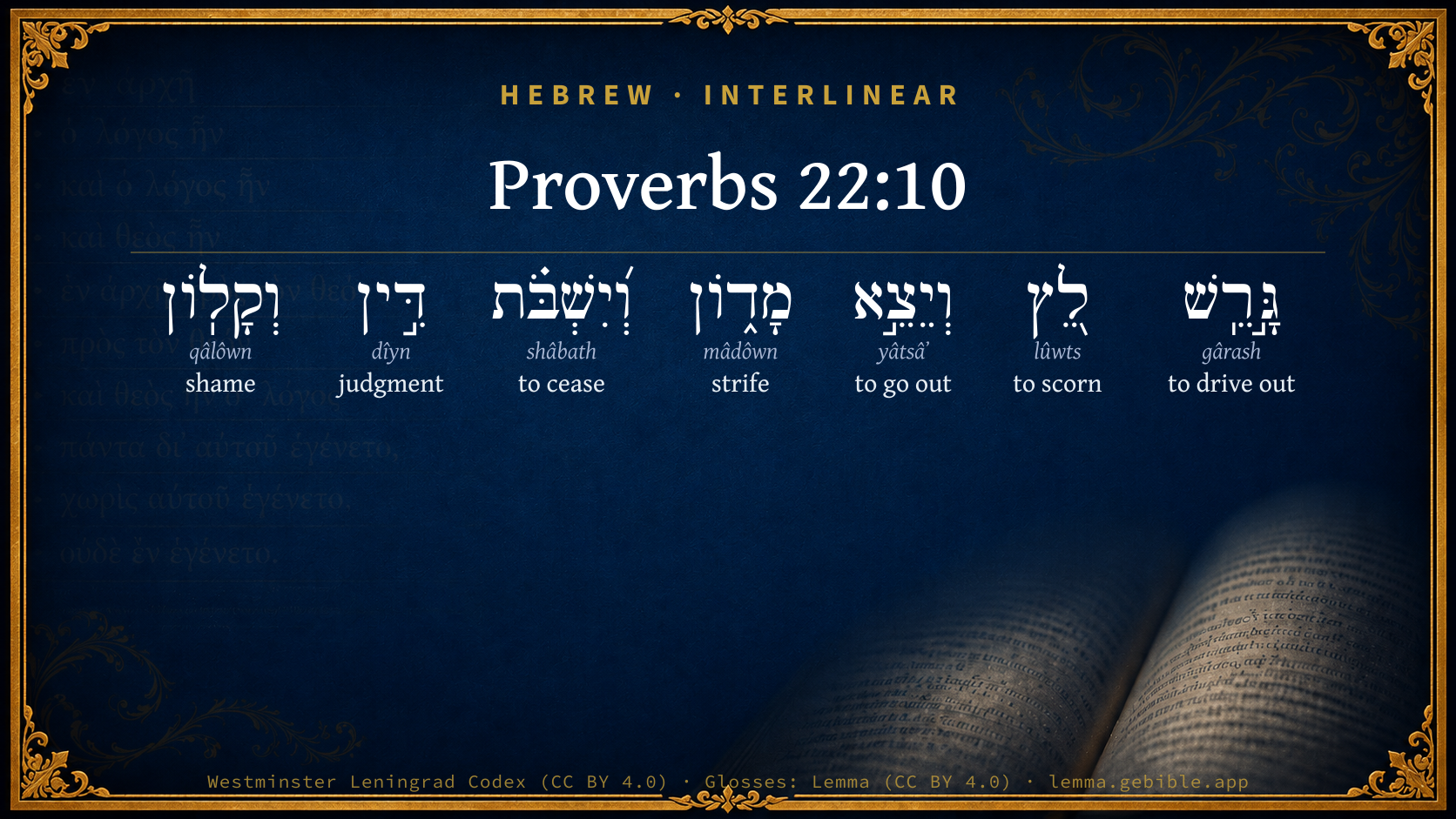
Proverbs 22:10

Hebrew (Westminster Leningrad Codex) Proverbs 22:10 appears in the Hebrew Old Testament. The text above is from the Westminster Leningrad Codex. Each word links to its Strong’s number, a concise gloss, and parsing drawn from the Open Scriptures Hebrew Bible morphology. Click any word for its full Brown-Driver-Briggs (BDB) entry.
Download image
Cite this verse

Proverbs 22:10 (World English Bible). Public Domain. Lemma interlinear Bible study tool, https://lemma.gebible.app/v/proverbs/22/10.

Show BibTeX & RIS
BibTeX
RIS
English Translation
Drive out the mocker, and strife will go out; Yes, quarrels and insults will stop.
World English Bible · Public Domain
Download a study sheet

One document with this verse’s original text, its word-by-word gloss line, the meaning frame, cross-references with their text, attributed commentary, and full source and license credits — printable, and it pastes into notes with its structure intact.

This verse Autodidact and up

Study sheet (.html) Plain text (.txt)

A passage Seminary Student

Up to 50 verses in one chapter. A passage sheet keeps up to 6 commentary sources and 12 cross-references per verse, in the order this page ranks them, and says so on the sheet whenever that leaves anything out. Ask for a single verse and you get the Autodidact verse sheet above.

Everything on this page stays free to read, with no account — the sheet is a download of what is already on screen, not access to it.

Want to remove ads? Support Godless Engineer
Compare translations 3

The same verse in 3 English versions, stacked beneath the original-language interlinear above. Click any original word for its lexicon entry.

Each is an independent rendering of the whole verse — the interlinear is not word-aligned to these translations.

Highlighted words mark where these versions differ — a whole-verse word diff, not a word-by-word alignment.

  • World English Bible Public Domain
    Drive out the mocker, and strife will go out; Yes, quarrels and insults will stop.
  • King James Version Public Domain
    Cast out the scorner, and contention shall go out; yea, strife and reproach shall cease.
  • unfoldingWord Literal Text CC BY-SA 4.0
    Drive out a mocker and strife will go out, and judgment and dishonor will cease.

unfoldingWord Literal Text — © unfoldingWord, licensed CC BY-SA 4.0. Word-aligned USFM3 via Door43 (git.door43.org/unfoldingWord/en_ult).

Versions to compare (up to 4)

3 of 4 selected

Show all 18 translations

Every available English version of this verse, each an independent rendering of the whole verse.

  • World English Bible Public Domain
    Drive out the mocker, and strife will go out; Yes, quarrels and insults will stop.
  • Berean Standard Bible Public Domain
    Drive out the mocker, and conflict will depart; even quarreling and insults will cease.
  • Majority Standard Bible Public Domain
    Drive out the mocker, and conflict will depart; even quarreling and insults will cease.
  • King James Version Public Domain
    Cast out the scorner, and contention shall go out; yea, strife and reproach shall cease.
  • American Standard Version (1901) Public Domain
    Cast out the scoffer, and contention will go out; Yea, strife and ignominy will cease.
  • Revised Version (1885) Public Domain
    Cast out the scorner, and contention shall go out; yea, strife and ignominy shall cease.
  • Geneva Bible (1599) Public Domain
    Cast out the scorner, and strife shall go out: so contention and reproche shall cease.
  • Douay-Rheims (1899) Public Domain
    Cast out the scoffer, and contention shall go out with him, and quarrels and reproaches shall cease.
  • Young's Literal Translation Public Domain
    Cast out a scorner -- and contention goeth out, And strife and shame cease.
  • Literal Standard Version CC BY-SA 4.0
    Cast out a scorner—and contention goes out, || And strife and shame cease.
  • Unlocked Literal Bible CC BY-SA 4.0
    Drive away the mocker, and out goes strife; disputes and insults will cease.
  • unfoldingWord Literal Text CC BY-SA 4.0
    Drive out a mocker and strife will go out, and judgment and dishonor will cease.
  • Darby Bible Public Domain
    Cast out the scorner, and contention will depart, and strife and ignominy shall cease.
  • World Messianic Bible Public Domain
    Drive out the mocker, and strife will go out; yes, quarrels and insults will stop.
  • Webster's Bible Public Domain
    Cast out the scorner, and contention shall end; yes, strife and reproach shall cease.
  • Free Bible Version CC BY-SA 4.0
    Get rid of the scornful, and you'll get rid of conflict too—no more arguments or insults!
  • Bible in Basic English Public Domain
    Send away the man of pride, and argument will go out; truly fighting and shame will come to an end.
  • JPS Tanakh (1917) Public Domain
    Cast out the scorner, and contention will go out; yea, strife and shame will cease.

Literal Standard Version (2020), Covenant Press — licensed CC BY-SA 4.0. Text via the HelloAO Bible API (eBible.org). Unlocked Literal Bible (unfoldingWord) — licensed CC BY-SA 4.0. Text via the HelloAO Bible API (eBible.org). unfoldingWord Literal Text — © unfoldingWord, licensed CC BY-SA 4.0. Word-aligned USFM3 via Door43 (git.door43.org/unfoldingWord/en_ult). Free Bible Version, Dr. Jonathan Gallagher — licensed CC BY-SA 4.0. Text via the HelloAO Bible API (eBible.org).

Word by word

More ways to search: Search by grammar → Find every occurrence → Compare this word →

Practice this passage: Drill this verse → Learn its vocabulary →

About this verse

These counts appear in no published source. They are computed here, from the morphology-tagged text and Lemma’s own curated glosses. What Lemma adds →

7
words
7
distinct lemmas
Wisdom
section

Notable vocabulary

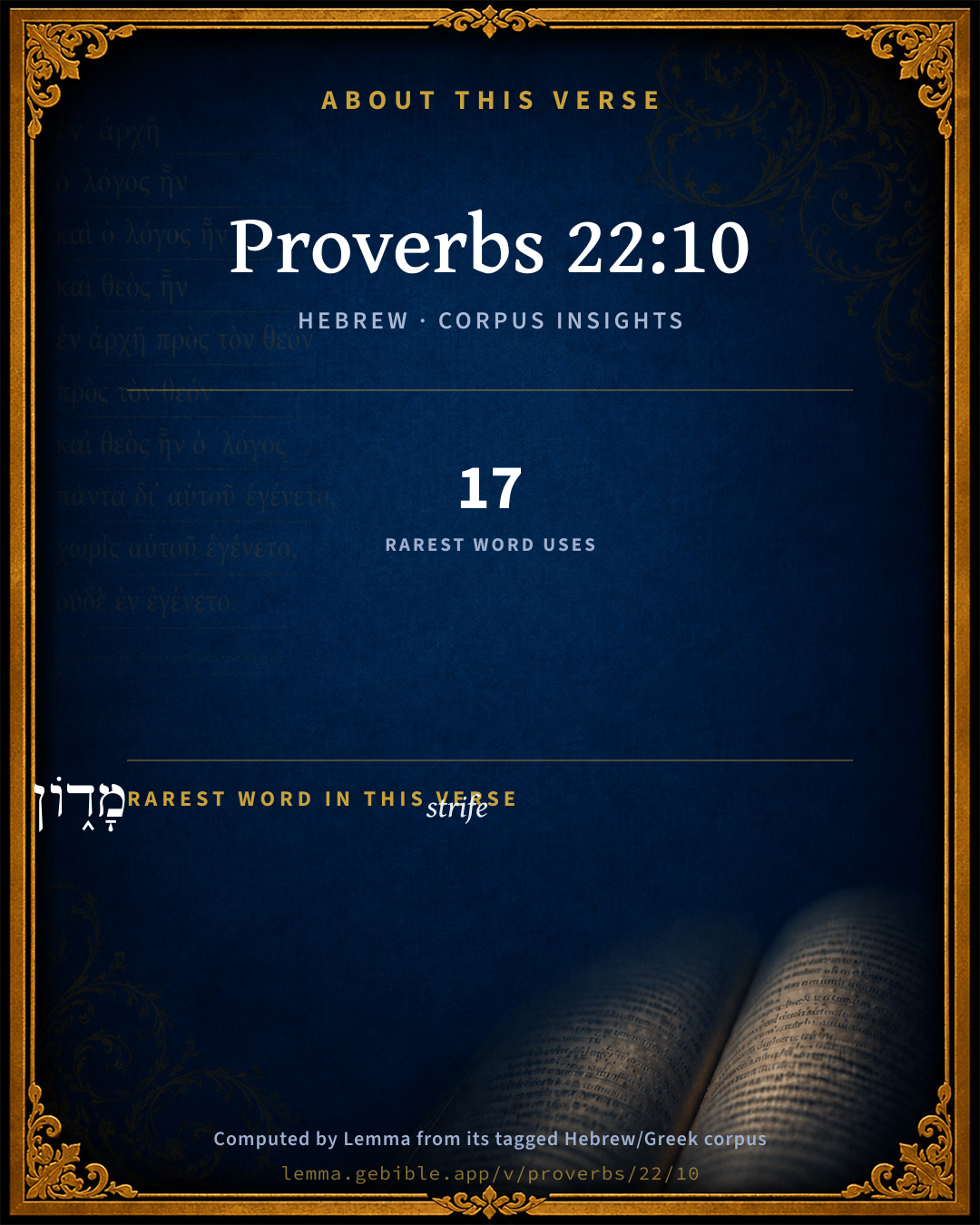
The rarest word here is מָד֑וֹן strife H4066 — appearing just 17 times in the whole Hebrew Bible.

Shared distinctive vocabulary

מָד֑וֹן strife H4066 occurs in 17 verses of the Hebrew Bible. Also found in:

Grammatical profile

  • 3 verbs
  • 3 nouns
  • 1 adjective

Verb forms

  • גָּ֣רֵֽשׁ Piel · Imperative
  • וְיֵצֵ֣א Qal · Imperfect
  • וְ֝יִשְׁבֹּ֗ת Qal · Imperfect

Hebrew & Septuagint length

In English translation the verse runs 15 words from the Hebrew and 25 from the Septuagint (LXX English) — the Septuagint runs noticeably longer here. See the side-by-side →

A rough comparison of the two English renderings, which tokenize alike — not a word-level alignment.

Word counts can differ between the Hebrew and the Greek without any difference in meaning — e.g. the Hebrew direct-object marker אֵת has no separate Greek word, and Greek often adds the article ὁ.

Cross-references

10

Topical passages linked to Proverbs 22:10 in the Treasury of Scripture Knowledge — connected by theme and wording, ordered by reader-vote popularity; previews shown in the World English Bible.

  • Proverbs 26:20–21 For lack of wood a fire goes out; Without gossip, a quarrel dies down.
  • 1 Corinthians 5:5–6 are to deliver such a one to Satan for the destruction of the flesh, that the spirit may be saved in the day of the Lord Jesus.
  • 1 Corinthians 5:13 But those who are outside, God judges. "Put away the wicked man from among yourselves."
  • Genesis 21:9–10 Sarah saw the son of Hagar the Egyptian, whom she had borne to Abraham, mocking.
  • Nehemiah 13:28 One of the sons of Joiada, the son of Eliashib the high priest, was son-in-law to Sanballat the Horonite: therefore I chased him from me.
  • Psalms 101:5 I will silence whoever secretly slanders his neighbor. I won't tolerate one who is haughty and conceited.
  • Proverbs 18:6 A fool's lips come into strife, And his mouth invites beatings.
  • Proverbs 21:24 The proud and haughty man, "scoffer" is his name; He works in the arrogance of pride.
  • Matthew 18:17 If he refuses to listen to them, tell it to the assembly. If he refuses to hear the assembly also, let him be to you as a Gentile or a tax collector.
  • Nehemiah 4:1–3 But it happened that when Sanballat heard that we were building the wall, he was angry, and took great indignation, and mocked the Jews.

Cross-references courtesy of OpenBible.info (CC BY 4.0).

Hebrew and Greek witnesses Masoretic Hebrew ↔ Greek Septuagint

The same verse in the two great witnesses to the Old Testament, shown verse-for-verse.

Here the Septuagint runs noticeably longer than the Hebrew — LXX2012 (modern English Septuagint) 25 words vs World English Bible 15. A rough length comparison of the two English translations, not a word-level alignment — read both below.

These are two independent witnesses, not word-aligned to each other, and the Septuagint is shown in lemma (dictionary) form.

Hebrew Proverbs 22:10 Masoretic · Westminster Leningrad Codex

גָּ֣רֵֽשׁ לֵ֭ץ וְיֵצֵ֣א מָד֑וֹן וְ֝יִשְׁבֹּ֗ת דִּ֣ין וְקָלֽוֹן

Drive out the mocker, and strife will go out; Yes, quarrels and insults will stop.

World English Bible · Public Domain

Greek LXX Proverbs 22:10 Septuagint · lemma form

ἐκβάλλω ἐκ συνέδριον λοιμός καί συν ἐκἔρχομαι αὐτός νεῖκος ὅταν γάρ καταἵζω ἐν συνέδριον πᾶς ἀτιμάζω

Cast out a pestilent person from the council, and strife shall go out with him; for when he sits in the council he dishonors all.

LXX2012 (modern English Septuagint) · Public Domain

On this verse, The Cambridge Bible for Schools and Colleges discusses the Septuagint’s reading. Read the note in Commentary ↓

Hebrew: Westminster Leningrad Codex (CC BY 4.0). Greek: Septuagint (public domain); English from LXX2012 (modern English Septuagint) (Public Domain). How the Septuagint differs from the Hebrew →

Commentary

Notes on Proverbs 22:10 from classic Christian and Jewish commentators (each source and its license shown beneath its notes). The classic Christian expositions comment on the surrounding passage and are grouped to its opening verse, so a note may address several verses; the Jewish commentaries on the Tanakh (Rashi and others) are per-verse, so they appear only where the commentator wrote on this verse.

Lemma curates 59 commentaries, every one of them public domain or Creative Commons licensed, each selected and text-cleaned for this edition rather than reprinted as found. About our sources →

Trapp's Complete Commentary

John Trapp

Pro 22:10 Cast out the scorner, and contention shall go out; yea, strife and reproach shall cease.

Ver. 10. Cast out the scorner.] Or, The evil interpreter, that construes everything to the worst, and so sows dissension. This is an evil instrument, and must be cashiered good company; the place where such a trouble town lives, longs for a vomit to spew him out. There is nothing that may not be taken with either hand. It is a spiritual unmannerliness to take it with the left, as that proud Pharisee did, {Luk 7:34} and to cast it as an apple of contention among others. They that do thus are the pests of families, and other societies, and must therefore be carefully cast out with scoffing Ishmael, as ever we desire to avoid strife, suits at law, reproach, and many more mischiefs.

John Trapp, A Commentary or Exposition upon All the Books of the Old and New Testament (1647–1656) — public domain. Text from a community e-Sword module.

The Biblical Illustrator

Joseph S. Exell

Pro_22:10

Cast out the scorner, and contention shall go out; yea, strife and reproach shall cease.

The scorner

The scorner is a character which Solomon has frequently called our attention to in preceding chapters. Few characters in society are more despicable in spirit or pernicious in influence.

I. As A social disturber. Cast out the scorner, and contention shall cease.

1. He is a disturber in the family.

2. He is a disturber in the Church.

3. He is a disturber in the nation.

II. As a social outcast. Cast out the scorner. Excommunication is his righteous doom. If he has gained great influence as a politician, governments sometimes, instead of casting him out, take him into office, and bribe him by voting him a princely income. The duty, however, of society towards the scorner is to expel him. He should be treated as a social pest. (Homilist.)

The Biblical Illustrator, edited by Joseph S. Exell (c. 1880s–1900s) — public domain. Text from a community e-Sword module.

Joseph Benson's Commentary

Pro 22:10. Cast out the scorner — Avoid all society and conversation with him who neither fears God nor reverences man, but scorns all admonitions, and minds only the pleasing of himself, and the gratifying of his own lusts, which is the chief cause of most contentions; and strife and reproach shall cease — The strife and reproach wherewith he is wont to load those that either oppose or admonish him.

Joseph Benson's Commentary on the Old and New Testaments (1811–1818) — public domain. Text from a community e-Sword module.

The Preacher's Complete Homiletical Commentary

Joseph S. Exell (gen. ed.)

MAIN HOMILETICS OF Pro_22:10

A MAN WHO OUGHT TO DWELL ALONE

I. The scorner should be dismissed from social bodies for his own sake. It is better for the man himself that his power to do evil should be as limited as possible. If we could know beforehand that a man intends to commit a great crime, and so render himself liable to heavy punishment, and bring guilt upon his conscience, the kindest thing that we could do for him would be to deprive him of the power of doing as he intends. We should thereby save him from the misery of becoming a greater transgressor. If the other disciples of Our Lord could have foreseen what was passing in the mind of Judas, and could have prevented his becoming the betrayer of his Master, how great a blessing would they have conferred upon that unhappy man! Whatever might have been his other sins, he would have not been stung with that agony of remorse at having betrayed innocent blood. But many sins are of such a nature that it is impossible to hinder men from their committal—the steps which lead to them are hidden from those around, and no one suspects that the guilty one has any such intention. The scoffer, however, is not a sinner of this kind—his transgression is not a single act, but a habit of life; it is not a secret purpose hidden in his heart until the moment of its accomplishment, but is manifested in his words. Men can therefore, to some extent, hinder him from increasing his own guilt by depriving him of the opportunities of indulging in his sin—if they “cast him out”—if they shun his society, and dismiss him from their midst, he will have fewer opportunities and temptations to indulge in scoffing, and so will be kept from going to such great lengths in sinning. A man who loves to turn into ridicule all pure and holy things, uses to his own condemnation and degradation influences which were intended to bless and elevate him, and it is better for himself that they should be placed beyond his reach than that he should so abuse them and increase his own guilt.

II. He should be cast out for the sake of his fellow-creatures. There are certain diseases of the human body which are not only most dangerous for the patient himself, but expose to a like danger all who come in contact with him. The leper is not only a great sufferer himself, but he is a centre of a deadly disease which will spread itself to those with whom he dwells. It is therefore necessary to remove him from the society of other men—so long as he is a leper he must dwell alone, must be denied the privilege of citizenship and the joys of social life. So it ought to be with the scorner—the habit of scoffing is one which is very infectious—very easily communicated by one man to another; and seeing that it is so soul-destructive, those who indulge in it ought not to have the opportunity of communicating the moral pestilence. But there is another aspect of leprosy which renders it necessary to isolate as far as possible those who are suffering from it from the abodes of other men. Even if it were not so infectious, it is most loathsome; and this alone would render some separation necessary. Now, there are societies of men in which the words of the scoffer would be quite powerless to do harm—there are those whose love of that which is true and holy is strong enough to withstand all such evil influence. But to such men a scorner is a most repugnant character—they loathe his irreverent treatment of what is to them most sacred. It is not required that they expose themselves to the pain of his society—they are at liberty to cast him out of their midst.

OUTLINES AND SUGGESTIVE COMMENTS

There is no cure but “casting out.” Such men are the Jonahs of churches, and of the coteries of social life. As long as they are there, there will be nothing but the bluster and commotion of the storm—“toiling in rowing,” incessant distress, vain exertion, and no progress. The sea cannot “cease from its raging,” till they are thrown overboard.—Wardlaw.

This thought occurs also in the Psalms. (Psa_68:6.) Only the rebellious, says the Psalmist, shall come to mischief. There are, it is true, great mountains of wickedness; but take away this one element of scorn—that is, make a man submissive and the causes of strife have flown. Christ manages afterwards. Take away the rebelliousness of the heart, and great monstrous sins will slowly be corrected and disappear.… Scorning is not itself the cause of the quarrel, and therefore ceasing to scorn does not remove it directly. Christ must remove the cause. Scorning expels Christ. Ceasing to scorn admits Christ. And, therefore, it is literally true—“Cast out the scorner (it may be thine own scornful heart), and the cause of quarrel passes away, and strife and shame cease.”—Miller.

It is always the disposition of the scorner, that wheresoever he is, he scorneth to stay, and it is always the best usage towards a scorner to cast him out, and not suffer him to stay. For whosoever keepeth him shall be sure to keep strife and contention with him, and where they are, reproach and shame are the attendants of them. If any good be done a scorner he disdains that it is so little; if any wrong be done him he complains that it is very great. If he be used in anything, he disdains to be a servant; if he is not used he complains that he is neglected. Still he is discontented, and still his discontent breeds quarrelling and debate. But cast out the firebrand and the fire goes out; cast out Jonah and the storm shall cease. Cast out the scorner from thy house, cast out scorning from thy heart, and then thou shalt be quiet. For whence are all suits of contention. Whence is all strife, but because the heart scorns to bear this, scorns to take that, scorns to let it go?—Jermin.

The Preacher's Complete Homiletical Commentary (gen. ed. Joseph S. Exell; Funk & Wagnalls, c. 1892) — public domain (pre-1929). A full-Bible homiletical/sermon-outline anthology covering 65 of 66 books (2 John is absent from the source module). Text from a community e-Sword module.

Matthew Henry's Commentary

See here, 1. What the scorner does. It is implied that he sows discord and makes mischief wherever he comes. Much of the strife and contention which disturb the peace of all societies is owing to the evil interpreter (as some read it), that construes every thing into the worst, to those that despise and deride every one that comes in their way and take a pride in bantering and abusing all mankind. 2. What is to be done with the scorner that will not be reclaimed: Cast him out of your society, as Ishmael, when he mocked Isaac, was thrust out of Abraham's family. Those that would secure the peace must exclude the scorner.

Matthew Henry's Commentary on the Whole Bible (1708–1710) — public domain (CC PDM 1.0). Text via the HelloAO Bible API.

Jamieson, Fausset & Brown

Robert Jamieson, A. R. Fausset & David Brown

Cast out--or drive away. Scorners foster strife by taunts and revilings.

Jamieson, Fausset & Brown — Commentary Critical and Explanatory on the Whole Bible (1871) — public domain (CC PDM 1.0). Text via the HelloAO Bible API.

Ellicott's Commentary for English Readers

(10) The scorner.—See above on Pro_1:22.

A Bible Commentary for English Readers, edited by Charles John Ellicott (1878–1897) — public domain. Text from a community e-Sword module.

The Cambridge Bible for Schools and Colleges

gen. ed. J. J. S. Perowne

10. Cast out] The gloss of the LXX. illustrates the meaning of the proverb:

“Cast out of the assembly the scorner, and strife will go out with him,

For while he remains in the assembly he insults every one,”

and fills the assembly, we may add, with mutual abuse and recrimination.

The Cambridge Bible for Schools and Colleges (gen. ed. J. J. S. Perowne; Cambridge University Press, 1878–1918) — public domain. Text from a community e-Sword module.

John Gill's Exposition

Cast out the scorner,.... That makes a mock at sin, a jest at religion, and scoffs at all good men, and everything serious and spiritual; cast such an one out of all company and conversation; out of the family, as mocking Ishmael was cast out of Abraham's family; and out of the church, and all religious societies. Jarchi interprets it of the evil imagination or corruption of nature; but this will continue with a man as long as he lives, and, though it may be weakened and subdued, it is not cast out;

and contention shall go out; yea, strife and reproach shall cease; which are caused by the scorner, who stirs up contention and strife in all company where he is, in families, and churches; and is continually casting reproach on good men and things; but, when he is cast out, everything of this nature ceases, and peace and love take place.

John Gill's Exposition of the Whole Bible (1746–1763) — public domain (CC PDM 1.0). Text via the HelloAO Bible API.

Matthew Poole's English Annotations

Cast out of your society, avoid conversation with, the scorner; who neither fears God, nor reverences man, but scorns all admonitions, and minds only the pleasing of himself, and the gratifying of his own lusts, which is the chief cause of most contentions.

Strife and reproach; wherewith he loads those that either oppose or admonish him.

Matthew Poole's English Annotations on the Holy Bible (1683–1685) — public domain. Text from a community e-Sword/MySword module.

Whedon's Commentary on the Bible

Daniel D. Whedon

10. Cast out the scorner — לצ, (lets,) scorner, or scoffer. It means a very bad man, (see note on Pro_21:11;) a man who laughs at legal and virtuous restraint, treats virtue and religion with derision, and is in no wise disposed to submit to law, order, or good government. Cast such a one out of society, and a large proportion of evil will go with him. If we could go a step further, and banish intemperance, we would have a civil and social millennium. Compare Pro_24:9.

Daniel D. Whedon (gen. ed.), Commentary on the Old and New Testaments (1874–1909) — public domain. Text from a community e-Sword module.

The Pulpit Commentary

Cast out the scorner, and contention shall go out; Septuagint, ekbale ek sunedriou loimon , "Cast out of the company a pestilent fellow" Chase away the scorner, (Pro_1:22) the man who has no respect for things human or Divine, and the disputes and ill feeling which he caused will be ended; for "where no wood is, the fire goeth out". (Pro_26:20) Yea, strife and reproach shall cease. The reproach and ignominy (wOlq, kalon) are those which the presence and words of the scorner bring with them; to have such a one in the company is a disgrace to all good men. Thus Ishmael and his mother were driven from Abraham"s dwelling, (Gen_21:9, etc.) and the apostle quotes, (Gal_4:30) "Cast out (ekbale ) the bondwoman and her son." Septuagint, "For when he sits in the company he dishonours all." The next verse gives a happy contrast.

The Pulpit Commentary (1880–1919), ed. H.D.M. Spence-Jones & Joseph S. Exell — public domain. Text from a community e-Sword module.

Keil & Delitzsch

C. F. Keil & F. Delitzsch

10 Chase away the scorner, and contention goeth out,

And strife and reproach rest.

If in a company, a circle of friends, a society (lxx ἔκβαλε ἐκ συνεδρίου), a wicked man is found who (vid., the definition of לץ, Pro 21:24) treats religious questions without respect, moral questions in a frivolous way, serious things jestingly, and in his scornful spirit, his passion for witticism, his love of anecdote, places himself above the duty of showing reverence, veneration, and respect, there will arise ceaseless contentions and conflicts. Such a man one ought to chase away; then there will immediately go forth along with him dispeace (מדון), there will then be rest from strife and disgrace, viz., of the strife which such a one draws forth, and the disgrace which it brings on the society, and continually prepares for it. קלון is commonly understood of the injury, abuse, which others have to suffer from the scoffer, or also (thus Fleischer, Hitzig) of the opprobria of the contentious against one another. But קלון is not so used; it means always disgrace, as something that happens, an experience, vid., at Pro 18:3. The praise of one who is the direct contrast of a לץ is celebrated in the next verse.

Keil & Delitzsch — Biblical Commentary on the Old Testament (1861–1891) — public domain (CC PDM 1.0). Text via the HelloAO Bible API. (Old Testament only.)

Bridges on Proverbs

Charles Bridges

This is a word to rulers. The scorner is a firebrand of contention in the church. (3Jn 1:10 .) He must be restrained.†1 If restraint be ineffectual, he must, if possible, be cast out.†2 If "his seat" be allowed in the family,†3 strife and reproach must be the issue. A jeer or biting taunt is more provoking than a blow. If therefore "peace is to the house," and "the love of peace is to abide there,"†4 — cast out the scorner, and the contention will cease.†5 He must not be argued with.†6 We must keep no terms with him. We must meet him with bold and open rebuke, lest his influence should overthrow the faith of the simple.†7 If God "scorneth the scorner,"†8 what less can we do, than banish him from our society?†9 Yet if we cast him out, cast him not off. Pray for him. Remember "such were some of you." (1Co 6:11 .) While we abhor the sin, pity the sinner.

But what if we should not be able to cast him out? He may be a husband or a child. At least give a protest. Shew that you stand not on the same ground. Turn away from his scorning. This will mortify, if not silence. Turn from him to your God.†10 This will bring peace. Dwell with him sighing, as David in Mesech.†11 One greater than David teaches us by his example. Honor your Divine Master by "enduring," as he did, year after year, "the contradiction of sinners." (Heb 12:3 .) And who knoweth, but this meek and silent endurance, with a loving, bleeding heart, may have power to cast out the scorning, and to mold the scorner into the lowliness of the cross? Then who would be a more welcome member of the church or of the family? Strife and reproach would cease in both, should the persecutor of the faith become a monument of grace (1Ti 1:13-16 ), a shining witness to the truth. (Gal 1:23-24 .)

Footnotes:

†1 2Ti 3:8-9 .

†2 1Ti 1:20 . Tit 3:10-11 .

†3 Psa 1:1.

†4 Luk 10:5-6.

†5 Gen 21:9-10. Compare Pro 15:18 ; Pro 16:28 .

†6 Pro 26:4. 2Ki 18:36 .

†7 2Ti 3:1-7 .

†8 Pro 3:34.

†9 Psa 119:115. Compare Neh 13:28 .

†10 Psa 35:21-24; Psa 69:11-13 .

†11 Psa 120:5-7.

Charles Bridges, An Exposition of the Book of Proverbs (1846) — public domain. Text from a community e-Sword module.

Kretzmann's Popular Commentary

Paul E. Kretzmann

v. 10. Cast out the scorner, the one whose mockery is directed against godliness in every form, and contention shall go out, for blasphemous taunts engender quarrels; yea, strife and reproach shall cease, with the removal of the blasphemer.

Paul E. Kretzmann, Popular Commentary of the Bible (1921–1924) — public domain. Text from a community e-Sword module.

Rashi

Rabbi Shlomo Yitzchaki (Rashi)

Banish a scorner The evil inclination.

Rashi on the Tanakh — English translations: “The Judaica Press complete Tanach with Rashi, translated by A. J. Rosenberg” (CC BY 4.0); “Pentateuch with Rashi's commentary by M. Rosenbaum and A.M. Silbermann, 1929-1934” (public domain); “The Metsudah Tanach series, Lakewood, N.J” (CC BY 4.0); and “The Book of Joshua, Metsudah Publications, 1997” (CC BY 4.0). Text via Sefaria.

Lesson kit

Teaching starters — assembled from the data on this page, not authored interpretation. Every prompt links to the verse data it draws on. Edit before teaching.

Proverbs, in the Wisdom, opens this verse with 7 words (7 distinct Hebrew lemmas). Its most distinctive word is mâdôwn (“strife”). The Greek Septuagint runs longer here. A historical commentator’s framing appears above. Read the whole chapter for the surrounding context.

Discussion questions

  1. What does “strife” (mâdôwn) contribute to the verse as a whole?
  2. Psalms 80:6 shares the word «strife» with this verse. How do the two illuminate each other?
  3. Compared with the Hebrew, the Septuagint runs longer here. What questions does that raise?
  4. The translations on this page render this verse differently — a whole-verse word diff, not a word-by-word alignment. What might account for the different wordings?
  5. The verb «גָּ֣רֵֽשׁ» is Piel Imperative. How does its form color the action?
  6. Reading how Trapp's Complete Commentary and The Biblical Illustrator read this verse, where do the two commentators agree and where do they part?

Things to notice

Reading settings

Reading text

Shown beneath each verse's original-language words.

Old Testament
Old Testament edition

Read the OT as the Masoretic Hebrew (MT) or the Greek Septuagint (LXX).

English shown for the Greek Septuagint (in the Hebrew ↔ Greek comparison).

Comparing translations? Open the Compare panel on any verse page to stack up to four side by side.