
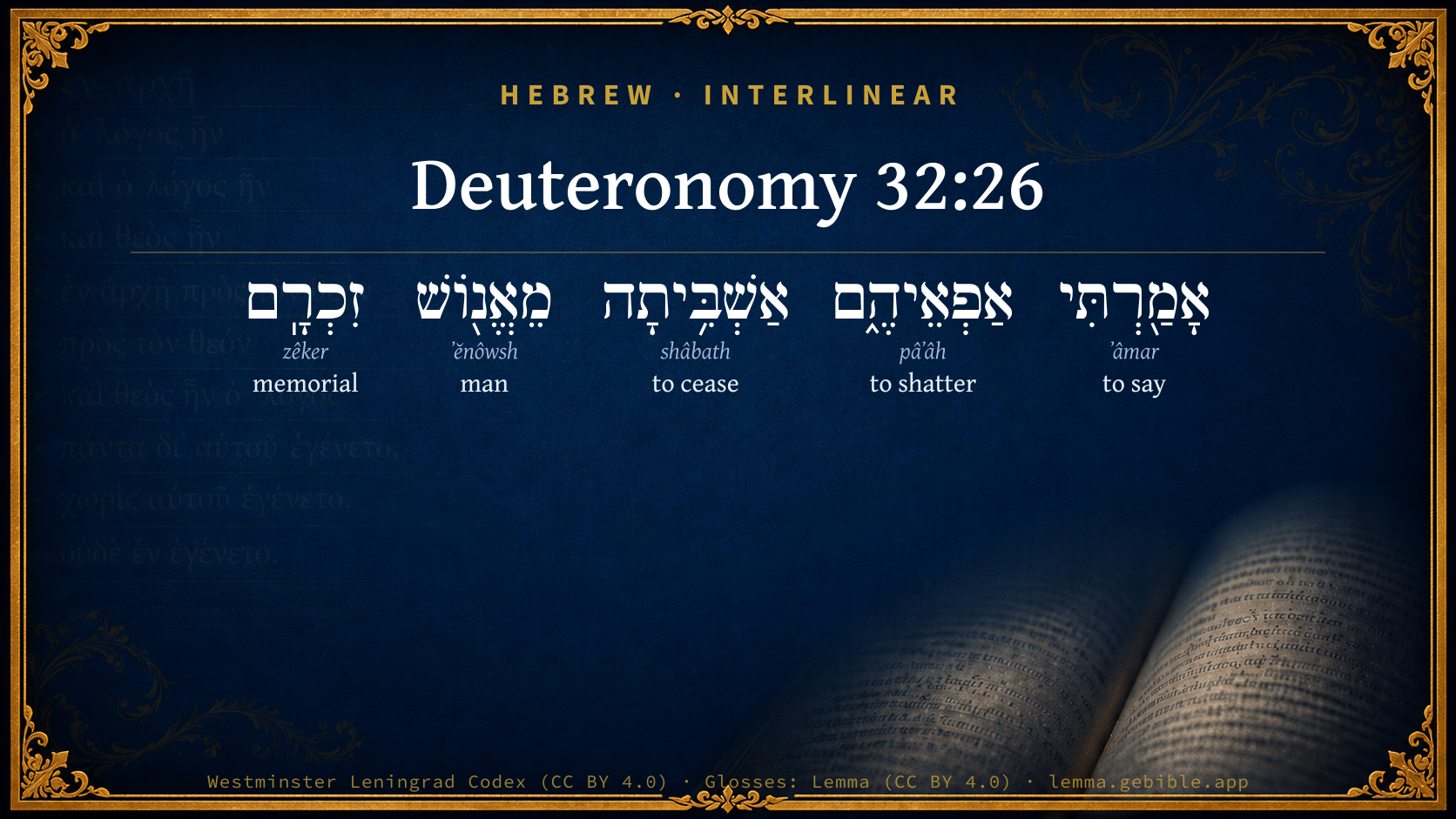
Deuteronomy 32:26

Hebrew (Westminster Leningrad Codex) Deuteronomy 32:26 appears in the Hebrew Old Testament. The text above is from the Westminster Leningrad Codex. Each word links to its Strong’s number, a concise gloss, and parsing drawn from the Open Scriptures Hebrew Bible morphology. Click any word for its full Brown-Driver-Briggs (BDB) entry.
Download image
Cite this verse

Deuteronomy 32:26 (World English Bible). Public Domain. Lemma interlinear Bible study tool, https://lemma.gebible.app/v/deuteronomy/32/26.

Show BibTeX & RIS
BibTeX
RIS
English Translation
I said, I would scatter them afar, I would make the memory of them to cease from among men;
World English Bible · Public Domain
Highlights
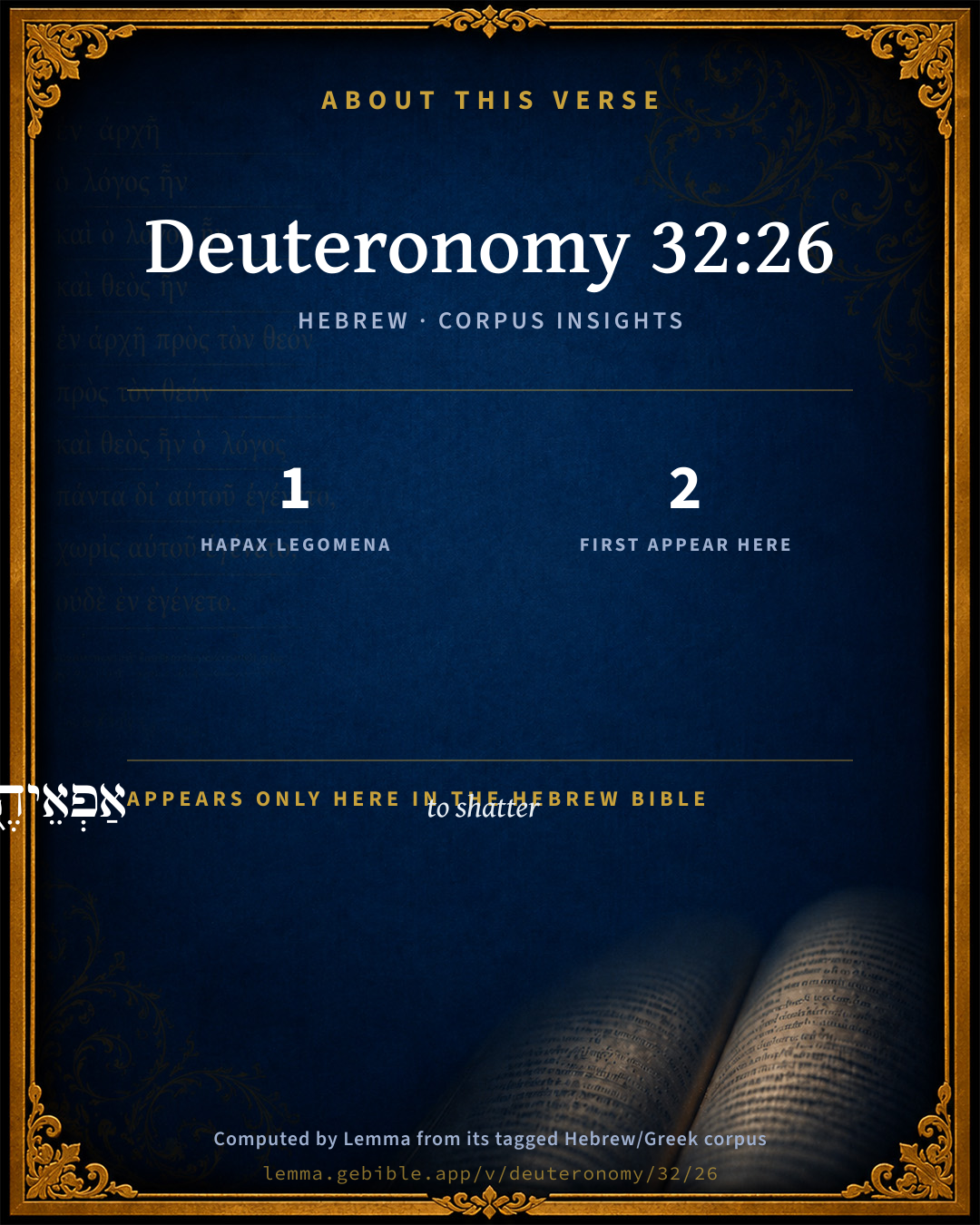
  • 1 hapax legomenon — only here in the Hebrew Bible
  • 2 first appearances in the Hebrew Bible
Full analysis ↓
Download a study sheet

One document with this verse’s original text, its word-by-word gloss line, the meaning frame, cross-references with their text, attributed commentary, and full source and license credits — printable, and it pastes into notes with its structure intact.

This verse Autodidact and up

Study sheet (.html) Plain text (.txt)

A passage Seminary Student

Up to 50 verses in one chapter. A passage sheet keeps up to 6 commentary sources and 12 cross-references per verse, in the order this page ranks them, and says so on the sheet whenever that leaves anything out. Ask for a single verse and you get the Autodidact verse sheet above.

Everything on this page stays free to read, with no account — the sheet is a download of what is already on screen, not access to it.

Want to remove ads? Support Godless Engineer
Compare translations 3

The same verse in 3 English versions, stacked beneath the original-language interlinear above. Click any original word for its lexicon entry.

Each is an independent rendering of the whole verse — the interlinear is not word-aligned to these translations.

Highlighted words mark where these versions differ — a whole-verse word diff, not a word-by-word alignment.

  • World English Bible Public Domain
    I said, I would scatter them afar, I would make the memory of them to cease from among men;
  • King James Version Public Domain
    I said, I would scatter them into corners, I would make the remembrance of them to cease from among men:
  • unfoldingWord Literal Text CC BY-SA 4.0
    I said I would wipe them out. I would remove from mankind their memory

unfoldingWord Literal Text — © unfoldingWord, licensed CC BY-SA 4.0. Word-aligned USFM3 via Door43 (git.door43.org/unfoldingWord/en_ult).

Versions to compare (up to 4)

3 of 4 selected

Show all 18 translations

Every available English version of this verse, each an independent rendering of the whole verse.

  • World English Bible Public Domain
    I said, I would scatter them afar, I would make the memory of them to cease from among men;
  • Berean Standard Bible Public Domain
    I would have said that I would cut them to pieces and blot out their memory from mankind,
  • Majority Standard Bible Public Domain
    I would have said that I would cut them to pieces and blot out their memory from mankind,
  • King James Version Public Domain
    I said, I would scatter them into corners, I would make the remembrance of them to cease from among men:
  • American Standard Version (1901) Public Domain
    I said, I would scatter them afar, I would make the remembrance of them to cease from among men;
  • Revised Version (1885) Public Domain
    I said, I would scatter them afar, I would make the remembrance of them to cease from among men:
  • Geneva Bible (1599) Public Domain
    I haue said, I would scatter them abroade: I would make their remembrance to cease from among men,
  • Douay-Rheims (1899) Public Domain
    I said: Where are they? I will make the memory of them to cease from among men.
  • Young's Literal Translation Public Domain
    I have said: I blow them away, I cause their remembrance to cease from man;
  • Literal Standard Version CC BY-SA 4.0
    I have said: I blow them away, || I cause their remembrance to cease from man;
  • Unlocked Literal Bible CC BY-SA 4.0
    I said that I would scatter them far away, that I would make the memory of them to cease from among mankind.
  • unfoldingWord Literal Text CC BY-SA 4.0
    I said I would wipe them out. I would remove from mankind their memory
  • Darby Bible Public Domain
    I would say, I will scatter, I will make the remembrance of them to cease from among men,
  • World Messianic Bible Public Domain
    I said that I would scatter them afar. I would make their memory to cease from among men;
  • Webster's Bible Public Domain
    I said, I would scatter them into corners, I would make the remembrance of them to cease from among men;
  • Free Bible Version CC BY-SA 4.0
    I would have told them I was going to cut them to pieces and wipe out even the memory of them;
  • Bible in Basic English Public Domain
    I said I would send them wandering far away, I would make all memory of them go from the minds of men:
  • JPS Tanakh (1917) Public Domain
    I thought I would make an end of them, I would make their memory cease from among men;

Literal Standard Version (2020), Covenant Press — licensed CC BY-SA 4.0. Text via the HelloAO Bible API (eBible.org). Unlocked Literal Bible (unfoldingWord) — licensed CC BY-SA 4.0. Text via the HelloAO Bible API (eBible.org). unfoldingWord Literal Text — © unfoldingWord, licensed CC BY-SA 4.0. Word-aligned USFM3 via Door43 (git.door43.org/unfoldingWord/en_ult). Free Bible Version, Dr. Jonathan Gallagher — licensed CC BY-SA 4.0. Text via the HelloAO Bible API (eBible.org).

Word by word

More ways to search: Search by grammar → Find every occurrence → Compare this word →

Practice this passage: Drill this verse → Learn its vocabulary →

About this verse

These counts appear in no published source. They are computed here, from the morphology-tagged text and Lemma’s own curated glosses. What Lemma adds →

5
words
5
distinct lemmas
Pentateuch
section

Notable vocabulary

1 hapax legomenon — a word that appears only here in the entire Hebrew Bible:

  • אַפְאֵיהֶ֑ם to shatter H6284

First appearance in Scripture

These words make their first canonical appearance in the Hebrew Bible here:

  • אַפְאֵיהֶ֑ם to shatter H6284
  • מֵאֱנ֖וֹשׁ man H582

Shared distinctive vocabulary

זִכְרָֽם memorial H2143 occurs in 23 verses of the Hebrew Bible. Also found in:

Grammatical profile

  • 3 verbs
  • 2 nouns

Verb forms

  • אָמַ֖רְתִּי Qal · Perfect
  • אַפְאֵיהֶ֑ם Hiphil · Cohortative
  • אַשְׁבִּ֥יתָה Hiphil · Cohortative

Hebrew & Septuagint length

In English translation the verse runs 19 words from the Hebrew and 17 from the Septuagint (LXX English) — closely comparable.

A rough comparison of the two English renderings, which tokenize alike — not a word-level alignment.

Word counts can differ between the Hebrew and the Greek without any difference in meaning — e.g. the Hebrew direct-object marker אֵת has no separate Greek word, and Greek often adds the article ὁ.

Cross-references

9

Topical passages linked to Deuteronomy 32:26 in the Treasury of Scripture Knowledge — connected by theme and wording, ordered by reader-vote popularity; previews shown in the World English Bible.

  • Deuteronomy 28:64 Yahweh will scatter you among all peoples, from the one end of the earth even to the other end of the earth; and there you shall serve other gods, which you have not known, you nor your fathers, even wood and stone.
  • Isaiah 63:16 For you are our Father, though Abraham doesn't know us, and Israel does not acknowledge us: you, Yahweh, are our Father; our Redeemer from everlasting is your name.
  • Leviticus 26:33 I will scatter you among the nations, and I will draw out the sword after you: and your land will be a desolation, and your cities shall be a waste.
  • Leviticus 26:38 You will perish among the nations, and the land of your enemies will eat you up.
  • Deuteronomy 4:27 Yahweh will scatter you among the peoples, and you shall be left few in number among the nations, where Yahweh shall lead you away.
  • Deuteronomy 28:25 Yahweh will cause you to be struck before your enemies; you shall go out one way against them, and shall flee seven ways before them: and you shall be tossed back and forth among all the kingdoms of the earth.
  • Deuteronomy 28:37 You shall become an astonishment, a proverb, and a byword, among all the peoples where Yahweh shall lead you away.
  • Psalms 34:16 Yahweh's face is against those who do evil, To cut off the memory of them from the earth.
  • Luke 21:24 They will fall by the edge of the sword, and will be led captive into all the nations. Jerusalem will be trampled down by the Gentiles, until the times of the Gentiles are fulfilled.

Cross-references courtesy of OpenBible.info (CC BY 4.0).

Hebrew and Greek witnesses Masoretic Hebrew ↔ Greek Septuagint

The same verse in the two great witnesses to the Old Testament, shown verse-for-verse.

These are two independent witnesses, not word-aligned to each other, and the Septuagint is shown in lemma (dictionary) form.

Hebrew Deuteronomy 32:26 Masoretic · Westminster Leningrad Codex

אָמַ֖רְתִּי אַפְאֵיהֶ֑ם אַשְׁבִּ֥יתָה מֵאֱנ֖וֹשׁ זִכְרָֽם

I said, I would scatter them afar, I would make the memory of them to cease from among men;

World English Bible · Public Domain

Greek LXX Deuteronomy 32:26 Septuagint · lemma form

εἶπον διασπείρω αὐτός παύω δή ἐκ ἄνθρωπος ὁ μνημόσυνον αὐτός

I said, I will scatter them, and I will cause their memorial to cease from among men.

LXX2012 (modern English Septuagint) · Public Domain

On this verse, The Cambridge Bible for Schools and Colleges discusses the Septuagint’s reading. Read the note in Commentary ↓

Hebrew: Westminster Leningrad Codex (CC BY 4.0). Greek: Septuagint (public domain); English from LXX2012 (modern English Septuagint) (Public Domain). How the Septuagint differs from the Hebrew →

Targum (Aramaic paraphrase)

2

The Targum is the ancient Jewish Aramaic paraphrase of the Hebrew Scriptures — an interpretive translation, not the Hebrew text itself. Onkelos (literal) and Pseudo-Jonathan (expansive) render the Torah, and Jonathan the Prophets. Coverage is partial: where no permissively-licensed English translation exists for a verse, only the Aramaic is shown. This is verse-level text, not a word-by-word alignment to the Hebrew.

  1. Targum Onkelos Torah (Genesis–Deuteronomy)
    אֲמָרִית יֵחוֹל רוּגְזִי עֲלֵיהוֹן וֶאֱשֵׁצִנוּן אֱבַטַל מִבְּנֵי אֲנָשָׁא דוּכְרָנֵיהוֹן

    (no public-domain English translation for this verse)

    Targum Onkelos — Aramaic: “Onkelos Genesis” (public domain); “Onkelos Exodus” (public domain); “Onkelos Leviticus” (public domain); “Onkelos Numbers” (public domain); “Onkelos Deuteronomy” (public domain). English: “Sefaria Community Translation” (CC0 1.0 (public-domain dedication)); “J.W. Etheridge. The Targums of Onkelos and Jonathan Ben Uzziel on the Pentateuch. London: Longmans, Green, 1862” (public domain). Text via Sefaria.

  2. Targum Pseudo-Jonathan Torah (Genesis–Deuteronomy)
    אֲמָרִית בְּמֵימְרִי לְמֵיכְלֵי מִנְהוֹן רוּחַ קוּדְשִׁי אֲשַׁיֵיר בְּהוֹן קָלִיל כִּגְבַר דְחָצִיד חַקְלֵיהּ וּמְשַׁיֵיר אַרְעָא חֲדָא אַבְטוֹל מִסְפָּר יֵיחוּס אֱנוֹשׁ דוּכְרָנֵהוֹן

    I have spoken in My Word to withhold from them My Holy Spirit; I will make them weak; as a man who reaps his field leaveth but one upon the ground, so will I abolish their memory from the book of the genealogy of mankind;

    Targum Pseudo-Jonathan — Aramaic: “Targum Jonathan on Genesis” (public domain); “Targum Jonathan on Exodus” (public domain); “Targum Jonathan on Leviticus” (public domain); “Targum Jonathan on Numbers” (public domain); “Targum Jonathan on Deuteronomy” (public domain). English: “The Targum of Jonathan ben Uzziel, trans. J. W. Etheridge, London, 1862” (public domain). Text via Sefaria.

Commentary

Notes on Deuteronomy 32:26 from classic Christian and Jewish commentators (each source and its license shown beneath its notes). The classic Christian expositions comment on the surrounding passage and are grouped to its opening verse, so a note may address several verses; the Jewish commentaries on the Tanakh (Rashi and others) are per-verse, so they appear only where the commentator wrote on this verse.

Lemma curates 59 commentaries, every one of them public domain or Creative Commons licensed, each selected and text-cleaned for this edition rather than reprinted as found. About our sources →

Matthew Henry's Commentary

After many terrible threatenings of deserved wrath and vengeance, we have here surprising intimations of mercy, undeserved mercy, which rejoices against judgment, and by which it appears that God has no pleasure in the death of sinners, but would rather they should turn and live.

I. In jealousy for his own honour, he will not make a full end of them, Deu 32:26-28. 1. It cannot be denied but that they deserved to be utterly ruined, and that their remembrance should be made to cease from among men, so that the name of an Israelite should never be known but in history; for they were a nation void of counsel (v, 28), the most sottish inconsiderate people that ever were, that would not believe the gory of God, though they saw it, nor understand his loving kindness, though they tasted it and lived upon it. Of those who could cast off such a God, such a law, such a covenant, for vain and dunghill-deities, it might truly be said, There is no understanding in them. 2. It would have been an easy thing with God to ruin them and blot out the remembrance of them; when the greatest part of them were cut off by the sword, it was but scattering the remnant into some remote obscure corners of the earth, where they should never have been heard of any more, and the thing had been done. See Eze 5:12. God can destroy those that are most strongly fortified, disperse those that are most closely united, and bury those names in perpetual oblivion that have been most celebrated. 3. Justice demanded it: I said I would scatter them. It is fit those should be cut off from the earth that have cut themselves off from their God; why should they not be dealt with according to their deserts? 4. Wisdom considered the pride and insolence of the enemy, which would take occasion from the ruin of a people that had been so dear to God, and for whom he had done such great things, to reflect upon God and to imagine that because they had got the better of Israel they had carried the day against the God of Israel: The adversaries will say, Our hand is high, high indeed, when it has been too high for those whom God himself fought for; nor will they consider that the Lord has done all this, but will dream that they have done it in despite of him, as if the God of Israel were as weak and impotent, and as easily run down, as the pretended deities of other nations. 5. In consideration of this, Mercy prevails for the sparing of a remnant and the saving of that unworthy people from utter ruin: I feared the wrath of the enemy. It is an expression after the manner of men; it is certain that God fears no man's wrath, but he acted in this matter as if he had feared it. Those few good people in Israel that had a concern for the honour of God's name feared the wrath of the enemy in this instance more than in any other, as Joshua (Jos 7:9), and David often; and, because they feared it, God himself is said to fear it. He needed not Moses to plead it with him, but reminded himself of it: What will the Egyptians say? Let all those whose hearts tremble for the ark of God and his Israel comfort themselves with this, that God will work for his own name, and will not suffer it to be profaned and polluted: how much soever we deserve to be disgraced, God will never disgrace the throne of his glory.

II. In concern for their welfare, he earnestly desires their conversion; and, in order to that, their serious consideration of their latter end, Deu 32:29. Observe, 1. Though God had pronounced them a foolish people and of no understanding, yet he wishes they were wise, as Deu 5:29, O that there were such a heart in them! and Psa 94:8, You fools, when will you be wise? God delights not to see sinners ruin themselves, but desires they will help themselves; and, if they will, he is ready to help them. 2. It is a great piece of wisdom, and will contribute much to the return of sinners to God, seriously to consider the latter end, or the future state. It is here meant particularly of that which God by Moses had foretold concerning this people in the latter days: but it may be applied more generally. We ought to understand and consider, (1.) The latter end of life, and the future state of the soul. To think of death as our removal from a world of sense to a world of spirits, the final period of our state of trial and probation, and our entrance upon an unchangeable state of recompence and retribution. (2.) The latter end of sin, and the future state of those that live and die in it. O that men would consider the happiness they will lose, and the misery they will certainly plunge themselves into, if they go on still in their trespasses, what will be in the end thereof, Jer 5:31. Jerusalem forgot this, and therefore came down wonderfully, Lam 1:9.

III. He calls to mind the great things he had done for them formerly, as a reason why he should not quite cast them off. This seems to be the meaning of that (Deu 32:30, Deu 32:31), "How should one Israelite have been too hard for a thousand Canaanites, as they have been many a time, but that God, who is greater than all gods, fought for them!" And so it corresponds with that, Isa 63:10, Isa 63:11. When he was turned to be their enemy, as here, and fought against them for their sins, then he remembered the days of old, saying, Where is he that brought them out of the sea? So here, his arm begins to awake as in the days of old against the wrath of the enemy, Psa 138:7. there was a time when the enemies of Israel were sold by their own rock, that is, their own idol-gods, who could not help them, but betrayed them, because Jehovah, the God of Israel, had shut them up as sheep for the slaughter. For the enemies themselves must own that their gods were a very unequal match for the God of Israel. For their vine is of the vine of Sodom, Deu 32:32, Deu 32:33. This must be meant of the enemies of Israel, who fell so easily before the sword of Israel because they were ripe for ruin, and the measure of their iniquity was full. Yet these verses may be understood of the strange prevalency of the enemies of Israel against them, when God made use of them as the rod of his anger, Isa 10:5, Isa 10:6. "How should one Canaanite chase a thousand Israelites" (as it is threatened against those that trust to Egypt for help, Isa 30:17, One thousand shall flee at the rebuke of one) "unless Israel's rock had deserted them and given them up." For otherwise, however they may impute their power to their gods (Hab 1:11), as the Philistines imputed their victory to Dagon, it is certain the enemies' rock could not have prevailed against the rock of Israel; God would soon have subdued their enemies (Psa 81:14), but that the wickedness of Israel delivered them into their hands. For their vine, that is, Israel's, is of the vine of Sodom, Deu 32:32, Deu 32:33. They were planted a choice vine, wholly a right seed, but by sin had become the degenerate plant of a strange vine (Jer 2:21), and not only transcribed the iniquity of Sodom, but outdid it, Eze 16:48. God called them his vineyard, his pleasant plant, Isa 5:7. But their fruits were, 1. Very offensive, and displeasing to God, bitter as gall. 2 Very malignant, and pernicious one to another, like the cruel venom of asps. Some understand this of their punishment; their sin would be bitterness in the latter end (Sa2 2:26), it would bite like a serpent and sting like an adder, Job 20:14, Pro 23:32.

IV. He resolves upon the destruction of those at last that had been their persecutors and oppressors. When the cup of trembling goes round, the king of Babel shall pledge it at last, Jer 25:26, and see Isa 51:22, Isa 51:23. The day is coming when the judgment that began at the house of God shall end with the sinner and ungodly, Pe1 4:17, Pe1 4:18. God will in due time bring down the church's enemies.

1. In displeasure against their wickedness, which he takes notice of, and keeps an account of, Deu 32:34, Deu 32:35. "Is not this implacable fury of theirs against Israel laid up in store with me, to be reckoned for hereafter, when it shall be made to appear that to me belongs vengeance?" Some understand it of the sin of Israel, especially their persecuting the prophets, which was laid up in store against them from the blood of righteous Abel, Mat 23:35. However it teaches us that the wickedness of the wicked is all laid up in store with God. (1.) He observes it, Psa 90:8. He knows both what the vine is and what the grapes are, what is the temper of the mind and what are the actions of life. (21.) He keeps a record of it both in his own omniscience and in the sinner's conscience; and this is sealed up among his treasures, which denotes both safety and secresy: these books cannot be lost, nor will they be opened till the great day. See Hos 13:12. (3.) He often delays the punishment of sin for a great while; it is laid up in store, till the measure be full, and the day of divine patience has expired. See Job 21:28-30. (4.) There is a day of reckoning coming, when all the treasures of guilt and wrath will be broken up, and the sin of sinners shall surely find them out. [1.] The thing itself will certainly be done, for the Lord is a God to whom vengeance belongs, and therefore he will repay, Isa 59:18. This is quoted by the apostle to show the severity of God's wrath against those that revolt from the faith of Christ, Heb 10:30. [2.] It will be done in due time, in the best time; nay, it will be done in a short time. The day of their calamity is at hand; and, though it may seem to tarry, it lingers not, it slumbers not, but makes haste. In one hour, shall the judgment of Babylon come.

2. He will do it in compassion to his own people, who, though they had greatly provoked him, yet stood in relation to him, and their misery appealed to his mercy (Deu 32:36): The Lord shall judge his people,. that is, judge for them against their enemies, plead their cause, and break the yoke of oppression under which they had long groaned, repenting himself for his servants; not changing his mind, but changing his way, and fighting for them, as he had fought against them, when he sees that their power is gone. This plainly points at the deliverances God wrought for Israel by the judges out of the hands of those to whom he had sold them for their sins (see Jdg 2:11-18), and how his soul was grieved for the misery of Israel (Jdg 10:16), and this when they were reduced to the last extremity. God helped them when they could not help themselves; for there was none shut up or left; that is, none that dwelt either in cities or walled towns, in which they were shut up, nor any that dwelt in scattered houses in the country, in which they were left at a distance from neighbours. Note, God's time to appear for the deliverance of his people is when things are at the worst with them. God tries his people's faith, and stirs up prayer, by letting things go to the worst, and then magnifies his own power, and fills the faces of his enemies with shame and the hearts of his people with so much the greater joy, by rescuing them out of extremity as brands out of the burning.

3. He will do it in contempt and to the reproach of idol-gods, Deu 32:37, Deu 32:38. Where are their gods? Two ways it may be understood: (1.) That God would do that for his people which the idols they had served could not do for them. They had forsaken God, and been very liberal in their sacrifices to idols, had brought to their altars the fat of their sacrifices and the wine of their drink-offerings, which they supposed their deities to feed upon and on which they feasted with them. "Now," says God, "will these gods you have made your court to, at so great an expense, help you in your distress, and so repay you for all your charges in their service? Go get you to the gods you have served, and let them deliver you, Jdg 10:14. This is intended to convince them of their folly in forsaking a God that could help them for gods that could not, and so to bring them to repentance and qualify them for deliverance. When the adulteress shall follow after her lovers and not overtake them, pray to her idols and receive no kindness from them, then she shall say, I will go and return to my first husband, Hos 2:7. See Isa 16:12; Jer 2:27, Jer 2:28. Or, (2.) That God would do that against his enemies which the idols they had served could not save them from, Sennacherib and Nebuchadnezzar boldly challenged the God of Israel to deliver his worshippers (Isa 37:10; Dan 3:15), and he did deliver them, to the confusion of their enemies. But the God of Israel challenged Bel and Nebo to deliver their worshippers, to rise up and help them, and to be their protection (Isa 47:12, Isa 47:13); but they were so far from helping them that they themselves, that is, their images, which was all that was of them, went into captivity, Isa 46:1, Isa 46:2. Note, Those who trust to any rock but God will find it sand in the day of their distress; it will fail them when they most need it.

Matthew Henry's Commentary on the Whole Bible (1708–1710) — public domain (CC PDM 1.0). Text via the HelloAO Bible API.

Trapp's Complete Commentary

John Trapp

Deu 32:26 I said, I would scatter them into corners, I would make the remembrance of them to cease from among men:

Ver. 26. I said I will scatter them.] See a like text, Eze 20:8-9. We are sometimes safe by our enemies’ insolences, and as much beholden to their blasphemies as to our own prayers.

John Trapp, A Commentary or Exposition upon All the Books of the Old and New Testament (1647–1656) — public domain. Text from a community e-Sword module.

Ellicott's Commentary for English Readers

(26, 27) The argument of these verses is such as no man would dare to put into the mouth of the Most High. Moses had pleaded it (in Num_14:13-16; Exo_32:12), but none but Jehovah Himself would say for Himself, “I feared the wrath of the enemy.”

A Bible Commentary for English Readers, edited by Charles John Ellicott (1878–1897) — public domain. Text from a community e-Sword module.

The Cambridge Bible for Schools and Colleges

gen. ed. J. J. S. Perowne

26. I would have said, I will] The meaning of the ensuing vb pa’ah is uncertain: cleave them in pieces (Dri. and the Oxf. Heb. Lex.) is hardly justified by the Ar. fa‘a, which means only to split; A.V., scatter them into corners, is founded on a doubtful etymology; R.V., scatter them afar, is due to the LXX διασπερῶ, which probably read another vb. The meaning adopted since Gesenius by most moderns, will blow them away, is, in view of the parallel line, the most probable.

26–33. The Stay of God’s Vengeance

26 ‘I had said, “I will blow them away (?)

And still among men their remembrance,”

27 Had I feared not the taunt of the foe,

Lest their enemies misconstrue,

And should say, “Our hand was high,

Nor was this the work of Jehovah!”

28 For a rede-lorn people are they,

And among them insight is not.

29 Were they wise this would they ken,

See through to their fate at the last.’

30 How could one have chased a thousand,

Or two put ten thousand to flight,

Were it not that their Rock had sold them

And the Lord had given them up!

The Cambridge Bible for Schools and Colleges (gen. ed. J. J. S. Perowne; Cambridge University Press, 1878–1918) — public domain. Text from a community e-Sword module.

John Gill's Exposition

Were it not that I feared the wrath of the enemy,.... Satan, the enemy of mankind in general, of the people of God in particular, and especially of the Messiah, the seed of the woman, and of God himself, whom he would dethrone, or at least place himself on an equality with him; this enemy is full of wrath, enmity, and blasphemy, against God, and stirs up all of this kind in the hearts of men, and instigates them to persecute the people of God; and does all he can to obscure the glory of God, and lessens his own "grief", as the word signifies, occasioned by it: and now though God has nothing to fear, either from the power and policy of the devil, being infinitely mightier and wiser than he; yet as Moses expressed his concern, if God should cut off the people of Israel as one man, that the Egyptians would say he brought them out of Egypt for mischief, or that he was not able to bring them into the land of Canaan, Exo 32:12; so the Lord, speaking after the manner of men, as Aben Ezra observes, expresses his fears of the wrath of the enemy; not properly, but it denotes his precaution, provision, and preparation he made to put a check upon it, and a stop to it, that he might not have the opportunity of instilling it into the minds of men, that God was cruel to his people, or had not ability to save them from their enemies, or was unfaithful to his promises; and therefore he did not entirely cut them off, as he could and might have done, but made a reserve of them, as a standing proof to the contrary:

lest their adversaries; the Romans, who fought against them, took them, and carried them captive:

should behave themselves strangely; alienate the glory of God from him, and give it to their strange gods; which the Romans were wont to do, when they obtained victories, and did do something of this kind to Jupiter Capitolinus, when they carried the Jews captive, and their trophies in triumph to Rome: yet there was such an apparent hand of God in this affair, that the Heathens were obliged to own it. Titus the conqueror himself confessed that it was God that favoured him, and that it was he that brought the Jews out of the fortresses and fastnesses in which they were; and that no hands of men, or machines, were anything against such towers as they had (g): and when some neighbouring nations would have crowned him because of his victories over the Jews, he refused it, saying, he was unworthy of it, he had not done this of himself, but had only lent an hand to God that was angry with them (h). Cicero also observes (i) the hand of God in the conquest, captivity, and servitude of the Jewish nation; moreover, a remnant was preserved to be to the Romans, as the Canaanites were to the Israelites, thorns in their sides, and pricks in their eyes; to be a burden to them, a dead weight upon them, and to check their ovations and triumphs over them; for, that people conquered gave them great trouble, raised commotions and insurrections in many places, which obliged the emperors in succeeding reigns to come from distant parts, and quell them, and were the occasion of vast quantities of blood being shed; insomuch that one of their poets (k) wishes Judea had never been subdued by them: likewise a number of them was preserved to prevent the growth and spread of idolatry, and that they might be a standing example and caution to Christians among the Gentiles not to give into it, when they should observe what they suffered on the account of it, as their prophecies, extant in their sacred books preserved, abundantly testified and declared:

and lest they should say, our hand is high, and the Lord hath not done all this; lest anyone should say among the Gentiles, as particularly deists, lest they should lift up their horn on high, and speak with a stiff neck, and deny that ever any such things were done for this people the Scriptures speak of, as the miracles in the land of Egypt, at the Red sea, and in the wilderness; and confidently affirm there never was any such people, and defy Christians to show them a Jew if they could: now here was a reserve made of them, to be a standing proof of the truth of divine revelation against such infidels; as also that they might be a check unto all false teachers, and leave them inexcusable who embrace the same errors that have been condemned in them, and God has shown his displeasure at, and which they still retain; such as the doctrines of freewill, of justification by a man's own righteousness, of salvation not being wholly by the Messiah, and of his being non-Jehovah, or only a mere creature; for the words may be rendered, "non-Jehovah hath done all this" (l); or he that is not Jehovah hath done all that is done for the people of the Jews; and say, all that the Messiah hath done, with respect to salvation, is done by him that is not Jehovah, or God, but a creature. These were the doctrines of the Jews in Christ's time; the Pharisees, the prevailing sect among them, were freewillers, as Josephus relates (m); and the whole nation were self-justiciaries, as the Apostle Paul assures us, and sought for righteousness not by faith, but as it were by the works of the law, Rom 9:31; and such they are to this day, as well as Unitarians to a man; now Arians, Socinians, Pelagians, and Arminians, may look upon these people, who are continued, as having imbibed the same errors; and may read theirs in them, and God's displeasure at them.

(g) Joseph. de Bello Jud. l. 6. c. 9. sect. 1. (h) Philostrat. Vit. Apolion. l. 6. c. 14. (i) Orat. 24. pro Flacco. (k) "Atque utinam nunquam Judaea subacta fuisset", Rutilius. (l) "et non Jehovah operatus est omne hoc", Cocceius; so Van Till, Vitringa. (m) Antiqu. l. 18. c. 1. sect. 3.

John Gill's Exposition of the Whole Bible (1746–1763) — public domain (CC PDM 1.0). Text via the HelloAO Bible API.

Haydock's Catholic Bible Commentary

CHAPTER XXXII.

Men. Hebrew, "I said I will disperse or exterminate them." Samaritan, "my fury shall consume them." We may translate, "I had resolved to destroy them; (Ver. 27.) But," &c., (Calmet) or Protestants, "I said I would scatter them into corners, and would....were it not that I feared the wrath of the enemy," &c. --- Where are they? in the mouth of God, shews an utter destruction, so that no vestiges of them remain. Their memory is perished. (Haydock) --- God sometimes defers punishing the sinner for just reasons. (Worthington)

George Leo Haydock (1774–1849), Haydock's Catholic Family Bible and Commentary, 1859 edition — public domain. Excludes Psalms (Douay-Rheims chapter numbering differs from Protestant) and Deuterocanonical books (Catholic canon only).

Whedon's Commentary on the Bible

Daniel D. Whedon

26. I said, I would scatter them into corners — The word which our translators render scatter into corners rather means, I will blow them away, so as to effectually disperse them.

Daniel D. Whedon (gen. ed.), Commentary on the Old and New Testaments (1874–1909) — public domain. Text from a community e-Sword module.

The Pulpit Commentary

Vers. 26, 27. Israel"s desert was to be utterly destroyed, but God refrained from this for his own Name"s sake. I said, I would scatter them into corners; rather, I should say, I trill blow them away, i.e . disperse them as by a mighty wind. The verb here is the Hiph, of hap to breathe, to blow, and is found only here. The rabbins make it a denominative from ha; pe, a corner, and this the Authorized Version follows; others trace it to an Arabic root, aap, amputavit, excidit, and render, "will cut them off.

The idea intended to be conveyed is obviously that of entire destruction, and this is not satisfied by the representation of their being scared or driven into corners. Were it not that I feared the wrath of the enemy. Various renderings and interpretations of this passage have been given.

1. Were it not that I feared the provocation of the enemy, i.e. that I should be provoked to wrath by the enemy ascribing the destruction of Israel to their own prowess.

2. Were it not that I feared a wrath upon the enemy, with much the same meaning.

3. Were it not that I feared the fury of the enemy, i.e. against Israel feared lest the enemy should be encouraged to rise up against Israel and ascribe their destruction to their own valor. Of these that most generally approved is the first. (On this reason for sparing Israel, see Deu_9:28; Exo_32:12; Num_14:13, etc.; Isa_10:5, etc.; Eze_20:13, Eze_20:14) Should behave themselves strangely; rather, should mistake or falsely pretend. The verb is the Piel of rkn; to look upon, to mark, and conveys the idea of looking on askance or prejudicially, hence being ignorant of, mistaking, feigning, or falsely pretending. Our hand is high; rather, was high, i.e. was mighty in power.

The Pulpit Commentary (1880–1919), ed. H.D.M. Spence-Jones & Joseph S. Exell — public domain. Text from a community e-Sword module.

Rashi

Rabbi Shlomo Yitzchaki (Rashi)

אמרתי אפאיהם means, I said in my heart, “I will אפאה them”. One may explain אפאיהם to mean: I would make them as פאה, i.e. “as grain left in the corner of the field”, to cast them away from Me as something free to all. We find a similar idea to this in Ezra (Nehemiah 9:22), “And thou gavest them kingdoms and nations and didst set them aside as a corner (פאה)” — i.e., as free to all. Thus (under this meaning) did Menachem ben Seruk classify it. Others expound it as the Targum does: My wrath (אף) will fall upon them. This is, however, not correct, for if it were so (i.e., if אפאיהם were connected with אף) it ought to have written אֲאַפְאֵיהֶם with two Alephs, the one as a servile letter (a prefix) and the other as a root letter, just as in (Isaiah 45:5) אאזרך, “I girded thee”, and (Job 16:5) “I would strengthen you (אאמצכם) with my mouth” (in both these cases the first letter of the root is א as it is in אף), and the middle א (that after the פ) would not be proper to be in it at all. Onkelos, however (in connecting the word with אף, anger), rendered it according to the explanation of a Baraitha taught in Sifrei Devarim 322:1 which divides this word into three words, אמרתי אף אי הם, which means, I said in My anger (אף) I will make them as though they were not existent, i.e., that those who are looking for them would ask about them, “Where are they (אי הם)?".

Rashi on the Tanakh — English translations: “The Judaica Press complete Tanach with Rashi, translated by A. J. Rosenberg” (CC BY 4.0); “Pentateuch with Rashi's commentary by M. Rosenbaum and A.M. Silbermann, 1929-1934” (public domain); “The Metsudah Tanach series, Lakewood, N.J” (CC BY 4.0); and “The Book of Joshua, Metsudah Publications, 1997” (CC BY 4.0). Text via Sefaria.

Ramban (Nachmanides)

Rabbi Moshe ben Nachman (Ramban / Nachmanides)

[‘AMARTI’ (I SAID)] ‘APHEIHEM.’ Grammarians. See also Ibn Ezra. explained it as meaning: “I will disperse them into every ‘corner.’” And if so, the word amarti means that it was the Will before Him by the attribute of justice that they be so scattered forever in every corner, and that their memory cease forever from among men — were it not that I was in dread of the wrath from the enemy. And in my opinion the word apheihem is a composite word, as is mentioned in the Sifre, 322. that it consists of these three words: aph ei heim [“I said in My ‘anger’ that I will banish them so that it will be said of them ‘where are they?’ “]. The meaning thereof is that I will put them in such a place and in such a manner that it will also be said of them “Where are they?” signifying that there will be no name or remnant left of them among the nations, and their place will not be known where they are. He thus alludes to the exile of the ten tribes that were banished to the river Gozan, this being the river which the Sages call “Sabbatyon.” The name “Gozan” is of the expressions: ‘vayagaz’ (and it brought over) quails from the sea; Thou art ‘gozi’ (He that took me out) of my mother’s womb, because those who remain behind [that river] are “divested” of any contacts with other people. It is called “Sabbatyon” because of its rest on the Sabbath-day, for the Sabbath-day in that language, as in Arabic, is called Sabbat, and they add adjectivial suffixes of ‘yon’ to certain nouns, such as: eizoviyon (Greek hyssop), churyon (another),. mulyon (a mule), and many others.

I WOULD MAKE THEIR MEMORY CEASE FROM AMONG MEN. This is a reference to our exiles among the nations — we, Judah and Benjamin, who have no significance among the nations and we are not considered a people or nation at all. Thus Scripture states that according to the attribute of justice we should remain in this condition of exile forever were it not that I was in dread of the wrath from the enemy. This teaches that, in our present exile, [the protecting influence of] the merits of the patriarchs have ceased and we have no deliverance from the hands of the nations except for the sake of His Great Name, similar to what He stated in the Book of Ezekiel, when I bring you out from the peoples, and gather you out of the countries wherein ye have been scattered; and I will be sanctified in you in the sight of the nations. And ye shall know that I am the Eternal, when I have wrought with you for My Name’s sake, not according to your evil ways, nor according to your corrupt doings, O ye house of Israel., Verse 44. And so also it is further stated, But I wrought for My Name’s sake, that it should not be profaned in the sight of the nations etc., Verse 9. Therefore Moses mentioned in his prayer, then the nations which have heard the fame of Thee will speak, saying etc. and G-d, blessed be He, acknowledged him in this, And the Eternal said: ‘I have pardoned according to thy word.’, Verse 20.This plea is not meant to demonstrate His power among His enemies, for All the nations are as nothing before Him; they are accounted by Him as things of nought, and vanity. Rather, [the explanation thereof is as follows:] G-d created man among the lower creatures in order that he acknowledge his Creator and be thankful to His Name, and He placed in his hand the choice to do evil or good. But when people sinned willingly and they all denied Him, only this people [Israel] remained devoted to His Name, and so He made known through them by means of signs and wonders that He is G-d of gods, and Lord of lords, and this became known to all nations. Now, if He were to reconsider and their memory [i.e., of Israel] be lost, the nations will forget His wonders and His deeds and they will no longer recount them. And if a person should mention them, they will think that it was [done by] one of the powers of the constellations which is overflowing as he passeth through, and thus the purpose of the creation of man will be annulled completely, for no one will be left among them who knows his Creator — only those who provoke Him. Therefore, it is appropriate as a consequence of the [Divine] Will which existed at the creation of the world to establish for Himself a people for all time, who are nearer to Him and who know Him more than all the [other] peoples. And the meaning of the verse For the Eternal will judge His people, and for His servants He will reconsider is, that G-d will remember in mercy that they are His people of old, and He will remember that they are His servants, for they stood by Him in their exile like servants to suffer the troubles and the bondage, similar to what is stated, For He said: ‘Surely, they are My people, children that will not deal falsely.’ I have already suggested that in the creation of man there is a sublime and recondite secret which requires that we be His people and He be our G-d, similar to what is stated, Every one that is called by My Name, and whom I have created for My glory, I have formed him, yea, I have made him.

Ramban (Nachmanides) on the Tanakh — English translation: “Commentary on the Torah by Ramban (Nachmanides). Translated and annotated by Charles B. Chavel. New York, Shilo Pub. House, 1971-1976” (CC BY 4.0). Text via Sefaria.

Lesson kit

Teaching starters — assembled from the data on this page, not authored interpretation. Every prompt links to the verse data it draws on. Edit before teaching.

Deuteronomy, in the Pentateuch, opens this verse with 5 words (5 distinct Hebrew lemmas). Its most distinctive word is pâʼâh (“to shatter”). A historical commentator’s framing appears above. Read the whole chapter for the surrounding context.

Discussion questions

  1. What does “to shatter” (pâʼâh) contribute to the verse as a whole?
  2. This verse holds 1 word here found nowhere else in the Hebrew Bible. What might the rare word draw attention to?
  3. 2 words here appear for the first time in Scripture. What is being introduced at this debut?
  4. Exodus 3:15 shares the word «memorial» with this verse. How do the two illuminate each other?
  5. The translations on this page render this verse differently — a whole-verse word diff, not a word-by-word alignment. What might account for the different wordings?
  6. The verb «אָמַ֖רְתִּי» is Qal Perfect. How does its form color the action?
  7. Reading how Matthew Henry's Commentary and Trapp's Complete Commentary read this verse, where do the two commentators agree and where do they part?

Things to notice

  • 1 word in this verse appears nowhere else in the Hebrew Bible.
  • 2 words make their first canonical appearance in Scripture here.
  • These translations choose different wording for 14 words in this verse.
  • 5 distinct Hebrew lemmas span 5 words in this verse.

Reading settings

Reading text

Shown beneath each verse's original-language words.

Old Testament
Old Testament edition

Read the OT as the Masoretic Hebrew (MT) or the Greek Septuagint (LXX).

English shown for the Greek Septuagint (in the Hebrew ↔ Greek comparison).

Comparing translations? Open the Compare panel on any verse page to stack up to four side by side.