Jeremiah 31:36

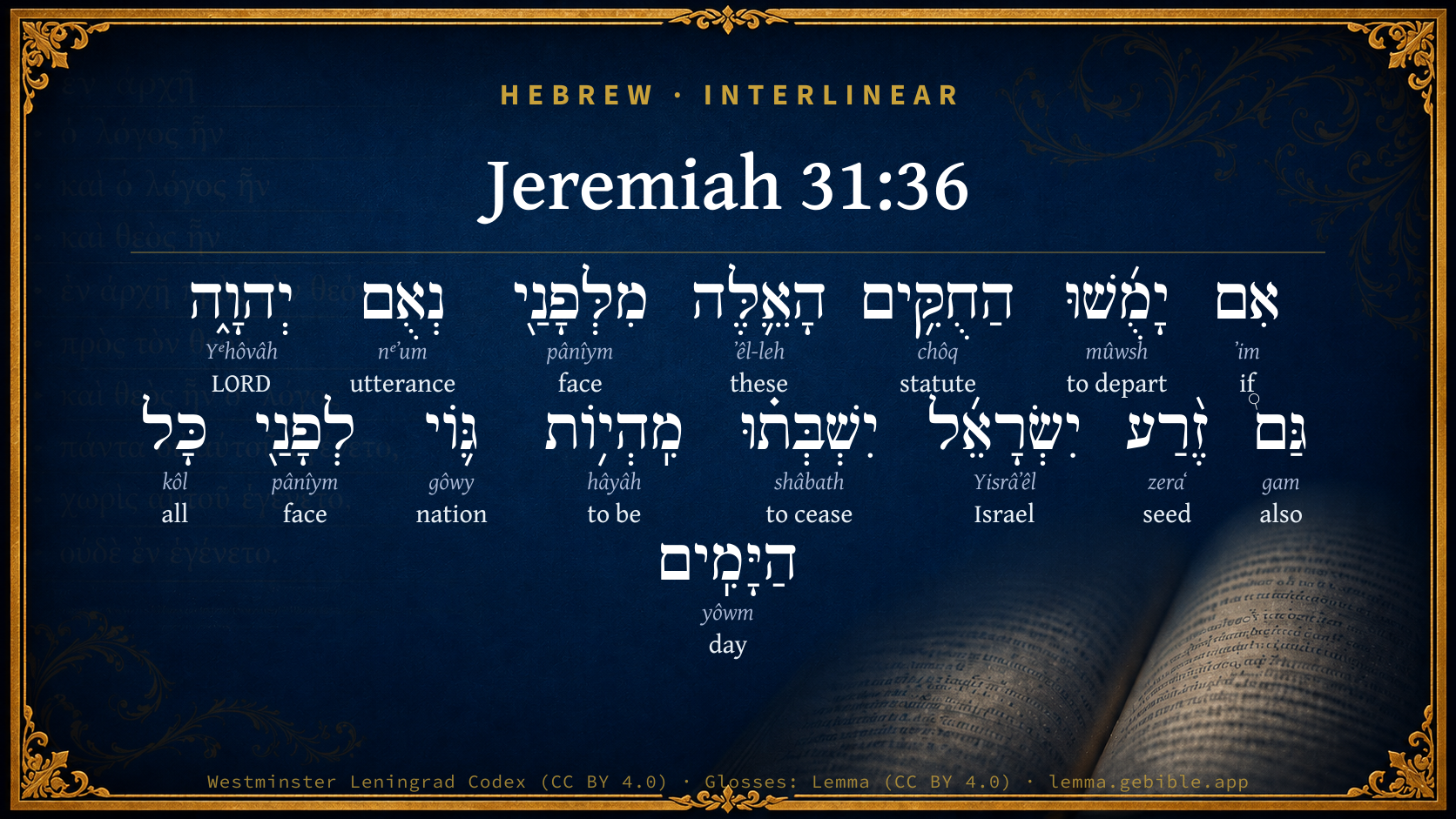
Hebrew (Westminster Leningrad Codex) Jeremiah 31:36 appears in the Hebrew Old Testament. The text above is from the Westminster Leningrad Codex. Each word links to its Strong’s number, a concise gloss, and parsing drawn from the Open Scriptures Hebrew Bible morphology. Click any word for its full Brown-Driver-Briggs (BDB) entry.
Download image
Cite this verse

Jeremiah 31:36 (World English Bible). Public Domain. Lemma interlinear Bible study tool, https://lemma.gebible.app/v/jeremiah/31/36.

Show BibTeX & RIS
BibTeX
RIS
English Translation
If these ordinances depart from before me, says Yahweh, then the seed of Israel also shall cease from being a nation before me forever.
World English Bible · Public Domain
Download a study sheet

One document with this verse’s original text, its word-by-word gloss line, the meaning frame, cross-references with their text, attributed commentary, and full source and license credits — printable, and it pastes into notes with its structure intact.

This verse Autodidact and up

Study sheet (.html) Plain text (.txt)

A passage Seminary Student

Up to 50 verses in one chapter. A passage sheet keeps up to 6 commentary sources and 12 cross-references per verse, in the order this page ranks them, and says so on the sheet whenever that leaves anything out. Ask for a single verse and you get the Autodidact verse sheet above.

Everything on this page stays free to read, with no account — the sheet is a download of what is already on screen, not access to it.

Want to remove ads? Support Godless Engineer
Compare translations 3

The same verse in 3 English versions, stacked beneath the original-language interlinear above. Click any original word for its lexicon entry.

Each is an independent rendering of the whole verse — the interlinear is not word-aligned to these translations.

Highlighted words mark where these versions differ — a whole-verse word diff, not a word-by-word alignment.

  • World English Bible Public Domain
    If these ordinances depart from before me, says Yahweh, then the seed of Israel also shall cease from being a nation before me forever.
  • King James Version Public Domain
    If those ordinances depart from before me, saith the LORD, then the seed of Israel also shall cease from being a nation before me for ever.
  • unfoldingWord Literal Text CC BY-SA 4.0
    “Only if these permanent things vanish from my sight—this is Yahweh’s declaration— will Israel’s descendants ever stop from forever being a nation before me.”

unfoldingWord Literal Text — © unfoldingWord, licensed CC BY-SA 4.0. Word-aligned USFM3 via Door43 (git.door43.org/unfoldingWord/en_ult).

Versions to compare (up to 4)

3 of 4 selected

Show all 18 translations

Every available English version of this verse, each an independent rendering of the whole verse.

  • World English Bible Public Domain
    If these ordinances depart from before me, says Yahweh, then the seed of Israel also shall cease from being a nation before me forever.
  • Berean Standard Bible Public Domain
    “Only if this fixed order departed from My presence, declares the LORD, would Israel’s descendants ever cease to be a nation before Me.”
  • Majority Standard Bible Public Domain
    “Only if this fixed order departed from My presence, declares the LORD, would Israel’s descendants ever cease to be a nation before Me.”
  • King James Version Public Domain
    If those ordinances depart from before me, saith the LORD, then the seed of Israel also shall cease from being a nation before me for ever.
  • American Standard Version (1901) Public Domain
    If these ordinances depart from before me, saith Jehovah, then the seed of Israel also shall cease from being a nation before me for ever.
  • Revised Version (1885) Public Domain
    If these ordinances depart from before me, saith the LORD, then the seed of Israel also shall cease from being a nation before me for ever.
  • Geneva Bible (1599) Public Domain
    If these ordinances depart out of my sight, saith the Lord, then shall the seede of Israel cease from being a nation before me, for euer.
  • Douay-Rheims (1899) Public Domain
    And they shall teach no more every man his neighbour, and every man his brother, saying: Know the Lord: for all shall know me from the least of them even to the greatest, saith the Lord: for I will forgive their iniquity, and I will remember their sin no more.
  • Young's Literal Translation Public Domain
    If these statutes depart from before Me, An affirmation of Jehovah, Even the seed of Israel doth cease From being a nation before Me all the days.
  • Literal Standard Version CC BY-SA 4.0
    “If these statutes depart from before Me,” || A declaration of YHWH, || “Even the seed of Israel ceases || From being a nation before Me [for] all the days.”
  • Unlocked Literal Bible CC BY-SA 4.0
    “Only if these permanent things vanish from my sight—this is Yahweh's declaration— will Israel's descendants ever stop from forever being a nation before me.”
  • unfoldingWord Literal Text CC BY-SA 4.0
    “Only if these permanent things vanish from my sight—this is Yahweh’s declaration— will Israel’s descendants ever stop from forever being a nation before me.”
  • Darby Bible Public Domain
    If those ordinances depart from before me, saith Jehovah, the seed of Israel also shall cease from being a nation before me for ever.
  • World Messianic Bible Public Domain
    “If these ordinances depart from before me,” says the LORD, “then the offspring of Israel also will cease from being a nation before me forever.”
  • Webster's Bible Public Domain
    If those ordinances depart from before me, saith the LORD, then the seed of Israel also shall cease from being a nation before me for ever.
  • Free Bible Version CC BY-SA 4.0
    Only if these natural laws disappeared before my eyes would Israel's descendants stop being my people, declares the Lord.
  • Bible in Basic English Public Domain
    If the order of these things before me is ever broken, says the Lord, then will the seed of Israel come to an end as a nation before me for ever.
  • JPS Tanakh (1917) Public Domain
    If these ordinances depart from before Me, saith the LORD, then the seed of Israel also shall cease from being a nation before Me for ever.

Literal Standard Version (2020), Covenant Press — licensed CC BY-SA 4.0. Text via the HelloAO Bible API (eBible.org). Unlocked Literal Bible (unfoldingWord) — licensed CC BY-SA 4.0. Text via the HelloAO Bible API (eBible.org). unfoldingWord Literal Text — © unfoldingWord, licensed CC BY-SA 4.0. Word-aligned USFM3 via Door43 (git.door43.org/unfoldingWord/en_ult). Free Bible Version, Dr. Jonathan Gallagher — licensed CC BY-SA 4.0. Text via the HelloAO Bible API (eBible.org).

Word by word

More ways to search: Search by grammar → Find every occurrence → Compare this word →

Practice this passage: Drill this verse → Learn its vocabulary →

יָמֻ֜שׁוּ
mûwsh
H4185
“to depart”
Verb, Qal, Imperfect, 3rd Person, Masculine, Plural
Part of Speech
Verb
Stem
Qal
Form
Imperfect
Person
3rd Person
Gender
Masculine
Number
Plural
Full BDB Definition

Origin: a primitive root [perhaps rather the same as H4184 through the idea of receding by contact]

TWOT: 1167

to depart, remove - (Qal) - to depart - to remove - to be removed (of inanimate objects) - (Hiphil) to remove, depart
  1. אִם ʼim H518 “if” Conjunction
  2. הַחֻקִּ֥ים chôq H2706 “the · statutes” Particle, Definite Article + Noun, Common, Masculine, Plural, Absolute
  3. הָאֵ֛לֶּה ʼêl-leh H428 “the · these” Particle, Definite Article + Pronoun, Demonstrative, Common, Plural
  4. מִלְּפָנַ֖י pânîym H6440 “from · to/for · face(s) · my” Preposition + Preposition + Noun, Common, Both, Plural, Construct + Suffix, Personal, 1st Person, Common, Singular
  5. נְאֻם nᵉʼum H5002 “utterance of” Noun, Common, Masculine, Singular, Construct
  6. יְהוָ֑ה Yᵉhôvâh H3068 “LORD” Noun, Proper
  7. גַּם֩ gam H1571 “also” Particle, Accusative
  8. זֶ֨רַע zeraʻ H2233 “seed of” Noun, Common, Masculine, Singular, Construct
  9. יִשְׂרָאֵ֜ל Yisrâʼêl H3478 “Israel” Noun, Proper
  10. יִשְׁבְּת֗וּ shâbath H7673 “to cease” Verb, Qal, Imperfect, 3rd Person, Masculine, Plural
  11. מִֽהְי֥וֹת hâyâh H1961 “from · to be” Preposition + Verb, Qal, Infinitive Construct
  12. גּ֛וֹי gôwy H1471 “nation” Noun, Common, Masculine, Singular, Absolute
  13. לְפָנַ֖י pânîym H6440 “to/for · face(s) · my” Preposition + Noun, Common, Both, Plural, Construct + Suffix, Personal, 1st Person, Common, Singular
  14. כָּל kôl H3605 “all of” Noun, Common, Masculine, Singular, Construct
  15. הַיָּמִֽים yôwm H3117 “the · days” Particle, Definite Article + Noun, Common, Masculine, Plural, Absolute

About this verse

These counts appear in no published source. They are computed here, from the morphology-tagged text and Lemma’s own curated glosses. What Lemma adds →

16
words
15
distinct lemmas
Prophets
section

Notable vocabulary

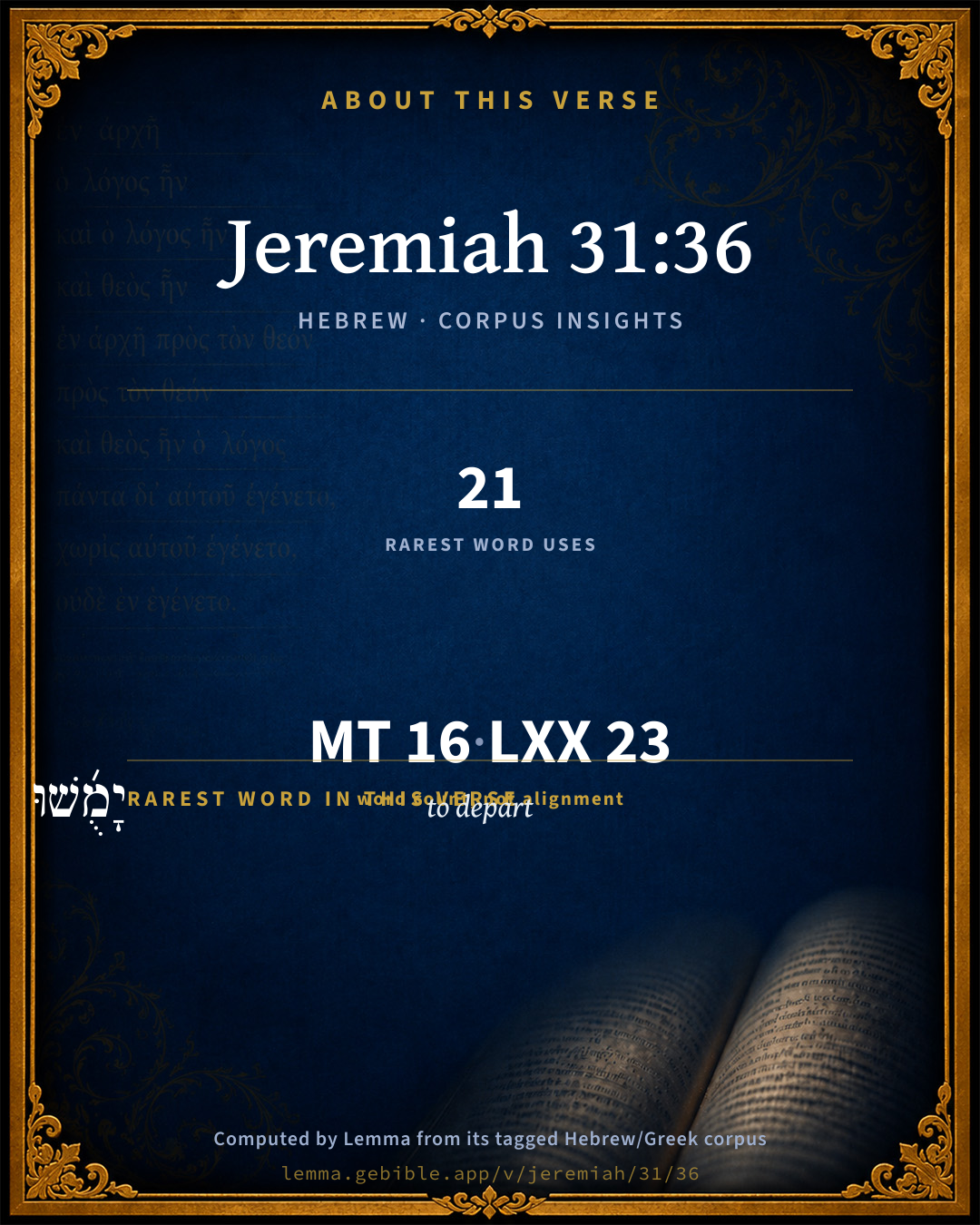
The rarest word here is יָמֻ֜שׁוּ to depart H4185 — appearing just 21 times in the whole Hebrew Bible.

Shared distinctive vocabulary

יָמֻ֜שׁוּ to depart H4185 occurs in 19 verses of the Hebrew Bible. Also found in:

Grammatical profile

  • 3 verbs
  • 10 nouns
  • 1 pronoun
  • 1 conjunction
  • 1 particle

Verb forms

  • יָמֻ֜שׁוּ Qal · Imperfect
  • יִשְׁבְּת֗וּ Qal · Imperfect
  • מִֽהְי֥וֹת Qal · Infinitive Construct

Repetition

A word recurs within this verse — often emphatic in Hebrew:

  • מִלְּפָנַ֖י face H6440 ×2

Hebrew & Septuagint length

In the original languages it is 16 Hebrew tokens and 23 Greek tokens — but the two are counted differently (Hebrew bundles its prefixes and suffixes into one token; the Greek is in lemma form), so that isn’t a like-for-like length.

Cross-references

11

Topical passages linked to Jeremiah 31:36 in the Treasury of Scripture Knowledge — connected by theme and wording, ordered by reader-vote popularity; previews shown in the World English Bible.

  • Psalms 89:36–37 His seed will endure forever, His throne like the sun before me.
  • Isaiah 54:9–10 For this is [as] the waters of Noah to me; for as I have sworn that the waters of Noah shall no more go over the earth, so have I sworn that I will not be angry with you, nor rebuke you.
  • Jeremiah 33:20–26 Thus says Yahweh: If you can break my covenant of the day, and my covenant of the night, so that there shall not be day and night in their season;
  • Psalms 148:6 He has also established them forever and ever. He has made a decree which will not pass away.
  • Deuteronomy 32:26 I said, I would scatter them afar, I would make the memory of them to cease from among men;
  • Psalms 72:5 They shall fear you while the sun endures; And as long as the moon, throughout all generations.
  • Psalms 72:17 His name endures forever. His name continues as long as the sun. Men shall be blessed by him. All nations will call him blessed.
  • Psalms 102:28 The children of your servants will continue. Their seed will be established before you."
  • Psalms 119:89 Yahweh, your word is settled in heaven forever.
  • Jeremiah 46:28 Don't be afraid you, O Jacob my servant, says Yahweh; for I am with you: for I will make a full end of all the nations where I have driven you; but I will not make a full end of you, but I will correct you in measure, and will in no way leave you unpunished.
  • Amos 9:8–9 Behold, the eyes of the Lord Yahweh are on the sinful kingdom, and I will destroy it from off the surface of the earth; except that I will not utterly destroy the house of Jacob," says Yahweh.

Cross-references courtesy of OpenBible.info (CC BY 4.0).

Hebrew and Greek witnesses Masoretic Hebrew ↔ Greek Septuagint

The same verse in the two great witnesses to the Old Testament, shown verse-for-verse.

These are two independent witnesses, not word-aligned to each other, and the Septuagint is shown in lemma (dictionary) form.

Hebrew Jeremiah 31:36 Masoretic · Westminster Leningrad Codex

אִם יָמֻ֜שׁוּ הַחֻקִּ֥ים הָאֵ֛לֶּה מִלְּפָנַ֖י נְאֻם יְהוָ֑ה גַּם֩ זֶ֨רַע יִשְׂרָאֵ֜ל יִשְׁבְּת֗וּ מִֽהְי֥וֹת גּ֛וֹי לְפָנַ֖י כָּל הַיָּמִֽים

If these ordinances depart from before me, says Yahweh, then the seed of Israel also shall cease from being a nation before me forever.

World English Bible · Public Domain

Greek LXX Structure differs

In the Septuagint, Jeremiah is about an eighth shorter than the Hebrew and arranges its material differently — the Oracles Against the Nations (Hebrew chapters 46–51) appear in the middle of the Greek book, after 25:13. Because the chapter and verse boundaries do not line up, a verse-for-verse comparison with the Hebrew is not shown.

A verse-for-verse comparison isn’t shown here because the chapters and verses don’t line up. Switch to the LXX edition with the MT / LXX toggle above to read the Greek directly.

Hebrew: Westminster Leningrad Codex (CC BY 4.0). Greek: Septuagint (public domain); English from a public-domain English Septuagint. How the Septuagint differs from the Hebrew →

Targum (Aramaic paraphrase)

1

The Targum is the ancient Jewish Aramaic paraphrase of the Hebrew Scriptures — an interpretive translation, not the Hebrew text itself. Onkelos (literal) and Pseudo-Jonathan (expansive) render the Torah, and Jonathan the Prophets. Coverage is partial: where no permissively-licensed English translation exists for a verse, only the Aramaic is shown. This is verse-level text, not a word-by-word alignment to the Hebrew.

  1. Targum Jonathan Prophets (Joshua–Malachi)
    כְּמָה דְלֵית אֶפְשַׁר דִיעִידוּן קְיָמַיָא הָאִלֵין מִן קָדָמַי אֲמַר יְיָ אַף זַרְעָא דְיִשְׂרָאֵל לָא יִבַטְלוּן מִלְמֶהֱוֵי עַם מְשַׁמֵשׁ קָדָמַי כָּל יוֹמַיָא:

    Just as it is impossible for these laws to cease to exist before Me, says the Lord, so too the offspring of Israel will never cease to be a nation before Me, serving Me every day.

    Targum Jonathan — Aramaic: “Mikraot Gedolot” (public domain). English: “Sefaria Community Translation” (CC0 1.0 (public-domain dedication)); “London "Chaldee Paraphrase," 1871” (public domain). Text via Sefaria.

Commentary

Notes on Jeremiah 31:36 from classic Christian and Jewish commentators (each source and its license shown beneath its notes). The classic Christian expositions comment on the surrounding passage and are grouped to its opening verse, so a note may address several verses; the Jewish commentaries on the Tanakh (Rashi and others) are per-verse, so they appear only where the commentator wrote on this verse.

Lemma curates 59 commentaries, every one of them public domain or Creative Commons licensed, each selected and text-cleaned for this edition rather than reprinted as found. About our sources →

Trapp's Complete Commentary

John Trapp

Jer 31:36 If those ordinances depart from before me, saith the LORD, [then] the seed of Israel also shall cease from being a nation before me for ever.

Ver. 36. If those ordinances depart from before me.] If they alter their constant course.

Then shall the seed of Israel cease.] Then shall the faithful fail, and the Israelitish nation be utterly abolished.

John Trapp, A Commentary or Exposition upon All the Books of the Old and New Testament (1647–1656) — public domain. Text from a community e-Sword module.

MacLaren's Expositions of Holy Scripture

Alexander MacLaren

Jeremiah

WHAT THE STABLE CREATION TEACHES

Jer 31:36.

This is the seal of the new covenant, which is to be made in days future to the prophet and his contemporaries, with the house of Israel and of Judah. That new covenant is referred to in Hebrews as the fundamental law of Christ’s kingdom. Therefore we have the right to take to ourselves the promises which it contains, and to think of ‘the house of Israel’ and ‘the seed of Jacob’ as including us, ‘though Abraham be ignorant of us.’

The covenant and its pledge are equally grand. The very idea of a covenant as applied to God is wonderful. It is meant to teach us that, from all the infinite modes of action possible to Him, He has chosen One; that He has, as it were, marked out a path for Himself, and confined the freedom of His will and the manifold omnipotences of His power to prescribed limits, that He has determined the course of His future action. It is meant to teach us, too, the other grand thought that He has declared to us what that course is, not leaving us to learn it piecemeal by slow building up of conclusions about His mind from His actions as they come forth, but inversely telling us His mind and purpose in articulate and authentic words by which we are to interpret each successive work of His. He makes known His purposes. ‘Before they spring forth I tell you of them.’

It is meant to teach us, too, that He regards Himself as bound by the declaration which He has made, so that we may rest secure on this strong foundation of His faithfulness and His truth, and for all doubts and fears find the sufficient cure in His own declaration: ‘My covenant will I not break nor alter the thing that is gone out of My lips.’ No wonder that the dying king found the strength of his failing heart in the thought, ‘He hath made with me an everlasting covenant, ordered in all things and sure.’

The weighty promises of this solemn bond of God’s cover the whole ground of our spiritual necessities-forgiveness of sins, true, personal, direct acquaintance with God, an intercommunion of mutual possession between Him who is ours and us who are His, and an inward sanctification by which His precepts shall coincide with our desires. These are the blessings which He binds Himself to bestow.

And of this transcendent pact, the seal and guarantee is worthy. God descends to ratify a bond with man. By it He binds Himself to give all possible good for the soul. And to confirm it heaven and earth are called in. He points us to all that is august, stable, immense, inscrutable in the works of His hands, and bids us see there His pledge that He will be a faithful, covenant-keeping God. Sun, moon and stars, heaven, earth and sea-’ye are My witnesses,’ saith the Lord.

God’s unchangeable love is the true lesson from the stable regularity of the universe. The tone in which Scripture speaks of external nature in all its parts is very remarkable, altogether peculiar. It does not take the aesthetic or the scientific, but the purely religious point of view.

I. The facts. All nature is directly the effect of God’s will and power. ‘He giveth,’ ‘He divideth’ {Jer 31:35}.

The physical universe presents a spectacle of stable regularity.

This regularity is the consequence of sovereign, divine will. These ordinances are not laws of nature, but of God.

II. The use commonly made of the facts.

Ordinary unthinking worldliness sees nothing noticeable in them because they come uniformly. Earthquakes startle, but the firmness of the solid earth attracts no observation. God is thought to speak in the extraordinary, but most men do not hear His voice in the normal.

Scientific godlessness formularises this tendency into a system, and proclaims that laws are everything and God a mere algebraical x.

III. The lesson which they are meant to teach.

God’s works are a revelation of God.

There is nothing in effect which is not in cause, and the stability of these ordinances carries our thoughts back to an unchanging Ordainer.

They witness to His constancy of purpose or will. His acts do not come from caprice, nor are done as experiments, but are the stable expression of uniform and unchanging will.

They witness to His unfailing energy of power, which ‘operates unspent’ and is to-day as fresh as at creation’s birth.

They witness to a single end pursued through all changes, and by all varieties of means. Darkness and light, sun rising and setting, storm and sunshine, summer and winter, all serve one end. As a horizontal thrust may give rise to opposite circular motions which all issue in working out an onward progress, so the various dealings of Providence with us are all adapted to ‘work together,’ and that ‘for good.’

They witness that life, joy, beauty, flow from obedience.

Thus, then, these ordinances in their stability are witnesses. But they are inferior witnesses. The noblest revelation of the divine faithfulness and unchangeable purpose of good is in Jesus. And these witnesses will one day pass. Even now they have their changes, slow and unmarked by a short-lived man. Stars burn out, there have been violent convulsions, shocks and shatterings in the heavens, and a time comes, as even physical science predicts, when ‘the heavens shall vanish away like smoke, and the earth shall wax old like a garment,’ but that to which they witnessed shall endure, ‘My salvation shall be for ever, and My righteousness shall not be abolished.’ The created lights grow dim and die out, but in ‘the Father of lights’ is ‘no variableness, neither shadow that is cast by turning.’

Hence we see what our confidence should be. It should stand firm and changeless as the Covenant, and we should move in our orbits as the stars and hearken to the voice of His word as do they. Let us see to it that we have faith to match His faithfulness, and that our confidence shall be firmer than the mountains, more stable than the stars.

Alexander MacLaren, Expositions of Holy Scripture (1904–1910) — public domain. Text from a community e-Sword module.

Jamieson, Fausset & Brown

Robert Jamieson, A. R. Fausset & David Brown

a nation--Israel's national polity has been broken up by the Romans. But their preservation as a distinct people amidst violent persecutions, though scattered among all nations for eighteen centuries, unamalgamated, whereas all other peoples under such circumstances have become incorporated with the nations in which they have been dispersed, is a perpetual standing miracle (compare Jer 33:20; Psa 148:6; Isa 54:9-10).

Jamieson, Fausset & Brown — Commentary Critical and Explanatory on the Whole Bible (1871) — public domain (CC PDM 1.0). Text via the HelloAO Bible API.

Adam Clarke's Commentary

Verse 36. If those ordinances] As sure as the sun shall give light to the day, and the moon to the night, so surely shall the Jews continue to be a distinct people. The same thing is expressed in other words in the next verse. Hitherto this prophecy has been literally fulfilled; the Jews are still a distinct people from all the dwellers upon earth. Every attempt that has been made in any country to naturalize and unite them with the people of that country, has proved abortive. The well-circumstanced attempt made this year (1830) in England, when the strongest interest was excited in their behalf, has also utterly failed. And why? Because of God's purpose expressed in Jer 31:35-37 of the BOOK of the Prophet JEREMIAH.

Adam Clarke's Commentary on the Bible (1810–1826) — public domain. Text from a community e-Sword/MySword module.

John Calvin's Commentaries

He confirms the promises which we have been considering; for it was difficult to believe that the people would not only recover what they had lost, but also be made much more happy; for the Church was then wholly in a desponding state. It was not then an easy matter to raise, as it were, from the lowest depths a miserable people, and to comfort them so that they might overcome their dreadful trial; for the disorder of the Church was such, that had it been raised a hundred times from the dead, it might again be a hundred times crushed into death, for there still remained for it most grievous evils in future. This is then the reason why the Prophet dwells at large on proving the same thing.

He says in the person of God, “I am he who created the sun, the moon, and the stars; the regular order of things in creation still continues, for the sun performs its course, and so does the moon.” He speaks, indeed, of their diurnal course, for we know that the Prophets spoke popularly, and according to the common notions. Had they philosophized, as astrologers do, and spoken of the monthly course of the moon, and of the annual course of the sun, they could not have been understood by the common people. They were, therefore, satisfied to state things which even children could comprehend, even that the sun made its circuit daily round the world, that the moon did the same, and that the stars in their turns followed; so that the moon holds the first place in the night among the stars, and that the sun rules during the day. “I am the Lord,” he says, “who have fixed this order of things which still remains:” I cut or divide the sea, he says, that is, I stir it up with tempests, and make a noise, or roar, do its waves.”

He mentions things which are contrary, but not inconsistent, though different. For the course of the sun, moon, and stars is regular and fixed, and so he calls their courses חקת cheket, and החקים echekim, that is, decrees, which are not changeable. Then in the heavens we find an order so arranged and regulated, that nothing deviates from its appointed course. But in storms and tempests God seems as though he would shake the world and overturn what appears otherwise immovable; for even the very rocks, as it were, tremble when the sea is violently stirred up; and yet God calms the very sea, and thus puts an end to storms and tempests, so that there ever appears to be a stability and a perpetuity in nature. He then adds, If removed shall these laws be from my presence, the seed of Israel shall also fail; that is, “As certain as is the stability of the order of nature, seen in the course of the sun and the moon, and in the turbulent sea, so certain will be the deliverance of ray Church, nor can it ever be destroyed.” The tempest on the sea seems to shake the world, and yet the world remains fixed. The sun and moon, when they rise, might overwhelm the whole earth; for we know that the sun is much larger than the earth. While so large a body, and almost immeasurable, hangs over our heads, and rolls on so swiftly, who ought not to be afraid? Yet the sun proceeds in its course, and the earth remains firm, because it so pleases God. There is, therefore, no reason to fear that the safety of the Church should ever fail, for the laws or decrees of nature shall never cease; that is, God, who has from the beginning governed the world, will not disregard the welfare of his Church, for whose sake the world has been created.

Nor, indeed, is it a matter of wonder, that the safety of the Church is here shewn to be so secure, for it may justly be preferred even to the fixed course of the sun and of the moon, and to other institutions of nature. But God deemed it enough in this place to use this comparison, according to what is said in the Psalms, where the sun and the moon are called his faithful witnesses in heaven. (Psalm 89:36, 37) But there also the covenant is spoken of, which God was about to make with his people through his only-begotten Son. He mentions the moon as his witness in heaven; but as I have already said elsewhere, he raises us far above the world and above all the elements, yea, above the sun and the moon, when he treats of the certainty of our salvation; and, doubtless, the condition of the Church does not depend on the state of the world; for it is said in another place,

“They shall grow old, but thou wilt remain for ever.” (Psalm 102:26-28)

And the Prophet there compares the heavens to garments, which wear out by use, and at length become useless; but the condition of the Church, he says, is far different. He does not, indeed, express these words; but after having said, “Thou, O God, art the same from eternity,” he comes to the eternity of the Church, “Thy children’s children shall endure.” We now see that the Church has the preference over the whole world. But God had a regard in this place to the weakness of his people, when he said that his grace to his people would be as sure and certain as the institutions of nature. Some refer the last clause in verse 35 (Jeremiah 31:35) to the Red Sea; because God divided the Red Sea; but this is wholly foreign to the meaning of the Prophet, nor does it require any confutation; but I have pointed it out that no one may be led astray.

John Calvin's Commentaries (1540-1563) — public domain. Text from the Calvin Translation Society English edition (1840s-50s) via the Christian Classics Ethereal Library (ccel.org). Calvin's coverage is partial (roughly two-thirds of the Bible); uncommented books and verses are honest gaps, never fabricated. The 19th-century editor's footnotes and remarks are omitted so the notes are faithfully Calvin's own voice.

The Cambridge Bible for Schools and Colleges

gen. ed. J. J. S. Perowne

36. As soon shall the Divine decrees which regulate the course of nature be dissolved, as Israel be utterly rejected from its status as the people of Jehovah.

The Cambridge Bible for Schools and Colleges (gen. ed. J. J. S. Perowne; Cambridge University Press, 1878–1918) — public domain. Text from a community e-Sword module.

John Gill's Exposition

If those ordinances depart from before me, saith the Lord,.... Of the sun, moon, and stars; should these leave their proper course, and not perform their several functions, or do the service appointed for them; should they desert their master, or disobey his orders, turn away from him, and pay no regard to the laws and rules he has set them:

then the seed of Israel shall also cease from being a nation before me for ever; but, as the former is impossible, so is the latter, The Jews ceased not from being a nation through their captivity in Babylon, nor through their destruction by the Romans; they continue a distinct nation and people to this day, though scattered throughout the nations of the world: though this rather refers to the spiritual Israel, the holy nation and peculiar people; Christ will have a seed to serve him as long as the sun and moon endure; his church shall continue to the end of the world; it is built on a rock; and the gates of hell cannot prevail against it.

John Gill's Exposition of the Whole Bible (1746–1763) — public domain (CC PDM 1.0). Text via the HelloAO Bible API.

Albert Barnes' Notes on the Bible

If those - If these. From the uniformity of God’s operations in the material world, the prophet deduces the certainty of a similar uniformity in God’s dealings with man in things spiritual.

A nation - A people. Israel has long ceased to be a nation, but it still exists as a numerous, influential, and distinct people. In Mat 28:19-20 Jeremiah’s prophecy receives its Christian application, and Israel becomes the Church, with the promise of perpetual existence. It has no national existence, but its members ought to be a strongly marked people, refusing to be merged in the world, while everywhere they pervade and influence it.

Albert Barnes' Notes on the Bible (1834–1885) — public domain. Text from a community e-Sword/MySword module.

Haydock's Catholic Bible Commentary

Ever. Like the Chanaanites and Ephraim during the captivity, Isaias vii. 8. God restored the latter. Yet they are again dispersed from above 17 centuries, so that this perpetuity, which shall equal the world’s duration, belongs to the Church. (Calmet) --- Israel remains, not in the incredulous Jews, but in those who with the apostles embraced and propagated the faith of Christ. (St. Jerome) (Worthington)

George Leo Haydock (1774–1849), Haydock's Catholic Family Bible and Commentary, 1859 edition — public domain. Excludes Psalms (Douay-Rheims chapter numbering differs from Protestant) and Deuterocanonical books (Catholic canon only).

Matthew Poole's English Annotations

There are ordinances of worship, which are God’s laws relating to his worship; and ordinances of justice, which are God’s laws for the executing civil justice; and ordinances of nature, which are God’s establishments for the working of natural causes in their order; these are those here spoken of, which shall hold and continue to the dissolution of the world, the continuance of which God pawneth as a pledge of the continuance of Israel as a nation all the days, (so it is in the Hebrew,) that is, many days, or all the days they shall keep close with him, or which he hath appointed. If we interpret it (as in our version)

for ever, it must be understood not of Israel according to the flesh, but of the church, the true Israel of God, which shall never fail.

Matthew Poole's English Annotations on the Holy Bible (1683–1685) — public domain. Text from a community e-Sword/MySword module.

Whedon's Commentary on the Bible

Daniel D. Whedon

36. If those ordinances depart — The appeal is to the unchangeableness of nature’s laws as a type and a pledge of the new covenant. Revelation does not begin by casting down nature or arraying itself against it; it postulates nature, and proceeds from it to what is higher and more glorious.

A nation — Rather, a people.

Daniel D. Whedon (gen. ed.), Commentary on the Old and New Testaments (1874–1909) — public domain. Text from a community e-Sword module.

John Wesley's Explanatory Notes

Those ordinances - The ordinances of nature, which are God's establishments for the working of natural causes in their order.

John Wesley, Explanatory Notes Upon the Whole Bible (1754–1765) — public domain. Text via the GEBible commentary corpus.

Rashi

Rabbi Shlomo Yitzchaki (Rashi)

depart “He would not move away (יָמִיש)” (Exod. 13:22).

Rashi on the Tanakh — English translations: “The Judaica Press complete Tanach with Rashi, translated by A. J. Rosenberg” (CC BY 4.0); “Pentateuch with Rashi's commentary by M. Rosenbaum and A.M. Silbermann, 1929-1934” (public domain); “The Metsudah Tanach series, Lakewood, N.J” (CC BY 4.0); and “The Book of Joshua, Metsudah Publications, 1997” (CC BY 4.0). Text via Sefaria.

Lesson kit

Teaching starters — assembled from the data on this page, not authored interpretation. Every prompt links to the verse data it draws on. Edit before teaching.

Jeremiah, in the Prophets, opens this verse with 16 words (15 distinct Hebrew lemmas). Its most distinctive word is mûwsh (“to depart”). A historical commentator’s framing appears above. Read the whole chapter for the surrounding context.

Discussion questions

  1. The word mûwsh carries the sense “to depart.” How does it shape the verse?
  2. Exodus 13:22 shares the word «to depart» with this verse. How do the two illuminate each other?
  3. “face” occurs 2× in this one verse. What is the effect of the repetition?
  4. These translations render this verse differently. What is at stake in choosing one wording over another?
  5. The verb «יָמֻ֜שׁוּ» is Qal Imperfect. How does its form color the action?
  6. Reading how Trapp's Complete Commentary and MacLaren's Expositions of Holy Scripture read this verse, where do the two commentators agree and where do they part?

Things to notice

Reading settings

Reading text

Shown beneath each verse's original-language words.

Old Testament
Old Testament edition

Read the OT as the Masoretic Hebrew (MT) or the Greek Septuagint (LXX).

English shown for the Greek Septuagint (in the Hebrew ↔ Greek comparison).

Comparing translations? Open the Compare panel on any verse page to stack up to four side by side.