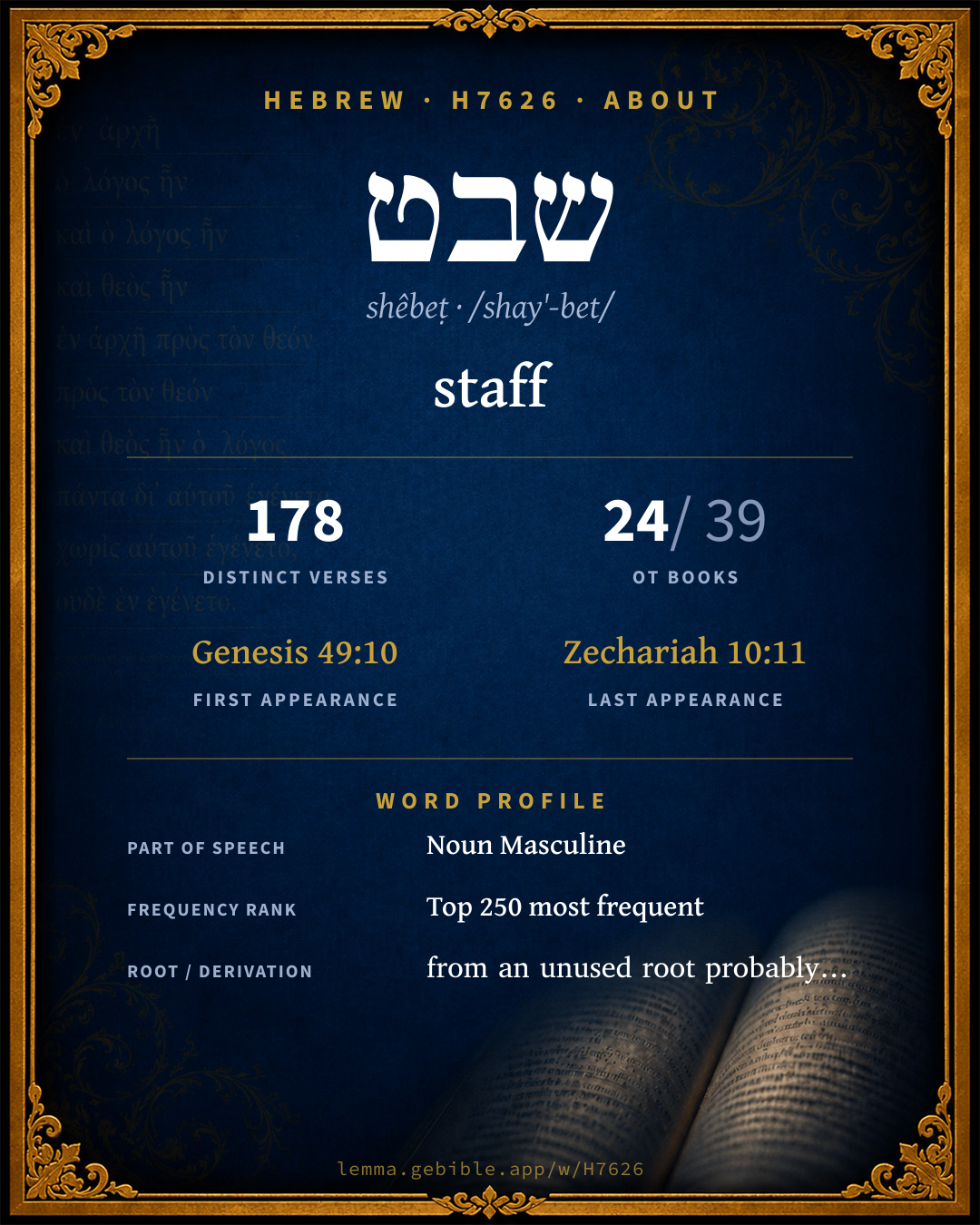
שֵׁ֫בֶט
staff
also: rod, branch, offshoot, club fuller range ↓
Full lexicon entry — Brown-Driver-Briggs (BDB)
From Brown-Driver-Briggs (BDB)
Where this word appears
See every Construct-state word in the Hebrew Bible →
Grammar key — what these labels mean
Part of speech
- Noun
- A naming word — a person, place, thing, or idea.
Noun type
- Common
- A common noun — a general class of person, place, or thing (“king,” “city,” “water”), not a specific name.
State
- Construct
- A noun bound to a following noun in a possessive / “of” relationship (the construct chain).
- Absolute
- The independent form of a noun, not bound to a following word.
Gender
- Masculine
- Grammatically masculine.
Number
- Plural
- More than one (in Hebrew, generally three or more).
- Singular
- One.
4 verses where H7626 appears in the Absolute state in the Book of Judges. Filtered view — show all forms. Click any verse to open its interlinear word-by-word view. Verse text shown in the World English Bible for context — . Each verse’s Hebrew form is shown with its reference; the English is not keyword-highlighted, since the data carries no word-level English alignment. Use “Compare translations” on any verse to read it across multiple English versions. This concordance covers the Hebrew Bible; Septuagint (Greek Old Testament) occurrences are not indexed here.
Judges
- Judges 18:19 לְ/שֵׁ֥בֶט prep + n c ms They said to him, Hold your peace, lay your hand on your mouth, and go with us, and be to us a father and a priest: is it better for you to be priest to the house of one man, or to be priest to a tribe and a family in Israel?
- Judges 21:3 שֵׁ֥בֶט n c ms They said, Yahweh, the God of Israel, why has this happened in Israel, that there should be today one tribe lacking in Israel?
- Judges 21:6 שֵׁ֥בֶט n c ms The children of Israel repented them for Benjamin their brother, and said, There is one tribe cut off from Israel this day.
- Judges 21:17 שֵׁ֖בֶט n c ms They said, There must be an inheritance for those who are escaped of Benjamin, that a tribe not be blotted out from Israel.
About this entry
At a glance — auto-summarized from this page’s data, not written by a person. Every figure links to its source below. This summary describes the numbers; it doesn’t interpret them.
שבט — transliterated shêbeṭ — is a Hebrew noun carrying the sense “staff.” Its English rendering has broadened — “tribe” classically, “tribes of” (unfoldingWord Literal Text) in modern versions; see the renderings breakdown. The Hebrew Bible uses it across 178 verses — common. It first appears in Genesis 49:10. It also covers “rod”, “branch”, and “offshoot”, alongside “staff” — see its full sense range. See the sense tree, 178-verse concordance, and the renderings breakdown below.
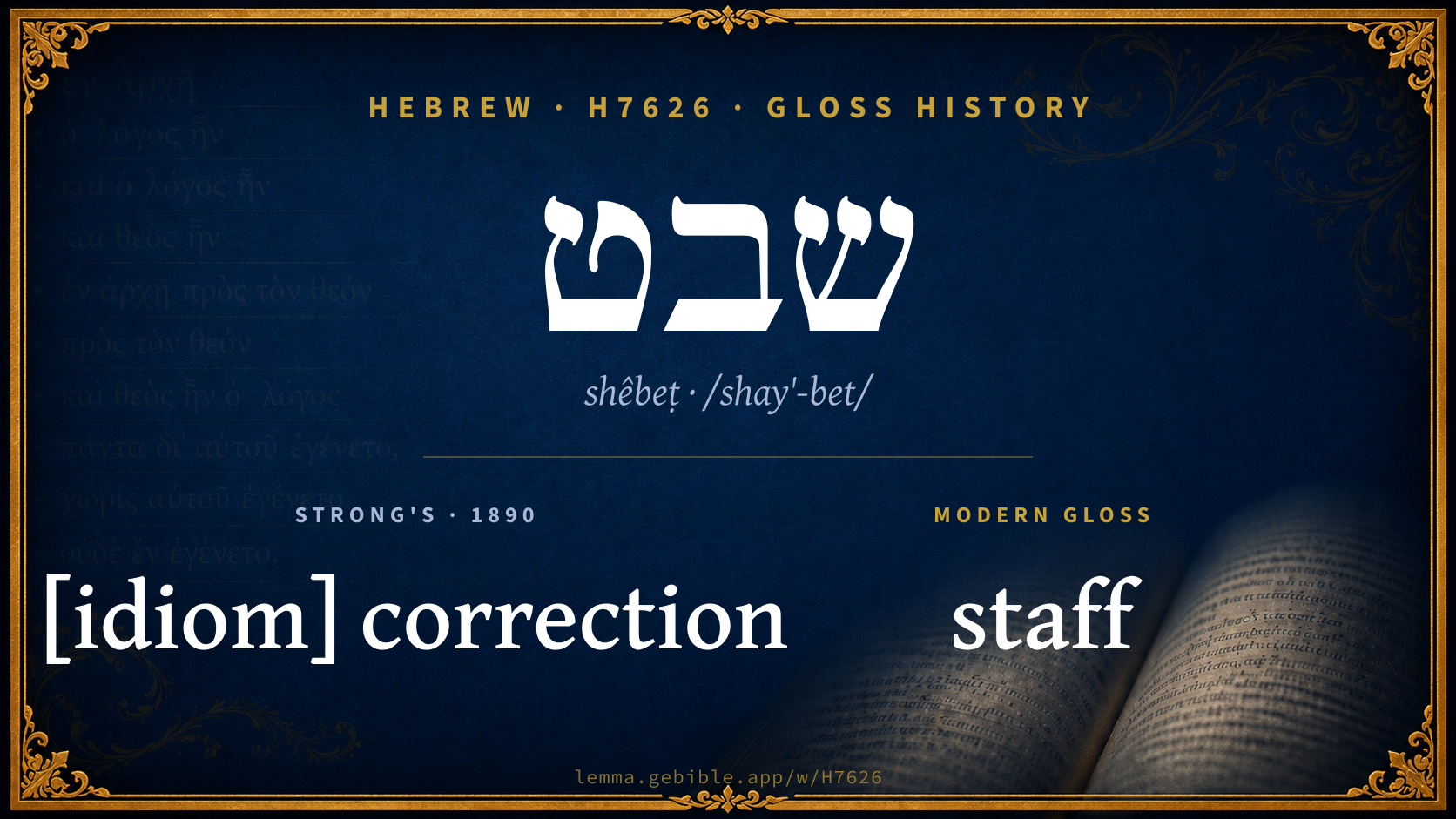
Gloss history
Strong's 1890 vs modern scholarship
About this word
Strong's H7626 catalogs a Hebrew word from the Hebrew Old Testament.
These counts are not copied from any lexicon or concordance. They are computed here, from the morphology-tagged Hebrew Old Testament. What Lemma adds →
- 178
- distinct verses
- The word appears in 178 distinct verses.
- 24 / 39
- OT books
- The word appears in 24 of 39 Old Testament books.
- #245
- by frequency
- Top 250 most frequent Hebrew words (rank 245 of 8,640 Hebrew words by occurrence).
View all 178 occurrences in the concordance →
Most concentrated in
- Joshua 29 verses 16%
- Deuteronomy 17 verses 10%
- Ezekiel 16 verses 9%
By section of the Old Testament
By traditional corpus
Conventional, traditional groupings — biblical authorship is debated, so this is a traditional corpus grouping, not an authorship claim. Each share is this word’s portion of its verses in that division of the Hebrew canon. Each figure is a share of the word’s 178 distinct verses.
- Prophets (Nevi'im) 108 verses · 61%
- Writings (Ketuvim) 39 verses · 22%
- Torah (Pentateuch) 31 verses · 17%
How translations render this word
Counts come from each version’s own published word-to-Strong’s tagging or interlinear alignment — an approximate guide to how each version renders this word, not a word-level alignment the data otherwise carries. Because each total is that version’s own tagged count, the per-version totals vary from one another and need not match the appearance or distinct-verse counts above. These counts may also differ from a printed concordance because Lemma counts each distinctly tagged rendering and does not collapse phrase taggings into a single head-word total. This is a fixed set of word-tagged versions (KJV, ASV, BSB, ULT) and does not change with the reading translation you choose elsewhere. Each version’s license is shown beside its name below (and on Sources).
- King James Version: Tribe 48×, Tribes 45×, Rod 27×
- American Standard Version: Tribes 40×, Tribe 24×, Rod 23×
- Berean Standard Bible: Tribes 66×, Tribe 37×, Rod 20×
- unfoldingWord Literal Text: Tribes of 45×, Tribe of 40×, Tribes 35×
King James Version Public Domain
Renders H7626 across 189 tagged occurrences — most commonly:
Plus 37 renderings that appear only once — usually multi-word phrases or single function words the recovered tagging swept in, not distinct renderings. Not rendered by a distinct English word in 1 further occurrence.
American Standard Version Public Domain
Renders H7626 across 184 tagged occurrences — most commonly:
Plus 45 renderings that appear only once — usually multi-word phrases or single function words the recovered tagging swept in, not distinct renderings.
Berean Standard Bible Public Domain
Renders H7626 across 168 tagged occurrences — most commonly:
Plus 20 renderings that appear only once — usually multi-word phrases or single function words the recovered tagging swept in, not distinct renderings. Not rendered by a distinct English word in 22 further occurrences.
unfoldingWord Literal Text CC BY-SA 4.0
Renders H7626 across 196 tagged occurrences — most commonly:
Plus 15 renderings that appear only once — usually multi-word phrases or single function words the recovered tagging swept in, not distinct renderings.
8 senses and sub-senses in the full BDB
What do BDB’s symbols mean?
BDB uses these scholarly abbreviations:
| Symbol | Meaning |
|---|---|
| 𝔊 | the Septuagint (the ancient Greek translation, LXX) |
| 𝔙 | the Vulgate (the Latin translation) |
| 𝔖 | the Syriac version (the Peshitta) |
| 𝔗 | the Targum (the Aramaic translation) |
| ψ | the Psalms |
| √ | root (the underlying root or stem) |
| ‖ | parallel passage (a synonymous or contrasted parallel) |
| † | the dagger: every passage where the word occurs is cited |
The 8 senses and sub-senses the full Brown-Driver-Briggs lexicon distinguishes for this word, in lexicon order (not ranked by frequency), with BDB’s own verbatim wording and sub-sense lettering. Shown in Hebrew script with BDB’s own scholarly abbreviations. The condensed entry is in the Lexicon Entry tab. See also the Forms in the corpus table below.
- 1.
- a. rod, staff (evidently common article), for smiting (especially הִכָּה בַשּׁ׳) Ex 21:20 (E), Mi 4:14; Is 10:15 (in sim.; ‖ מַטֶּה), Pr 10:13 +; שׁ׳ מוּסָר 22:15, cf. 29:15; for beating (חָבַט) cummin Is 28:27 (‖ מַטֶּה); as (inferior) weapon (opp. חֲנִית 2 S 23:21 = 1 Ch 11:23 (cf. מַקֵּל 1 S 17:40, 43); fig. of י׳’s chastisement: national Is 10:24; 30:31 (both ‖ מַטֶּה), 14:29, שׁ׳ אַפִּי 10:5, שׁ׳ עֶבְרָתוֹ La 3:1; individual Jb 9:34; 21:9 (שׁ׳ אֱלוֹהַּ), 37:13, 2 S 7:14 (שׁ׳ אֲנָשִׁים, i.e. not in-human), ψ 89:33 (both ‖ נְנָעִים). e.g. Exodus 21:20
- b. shaft, i.e. spear, dart, 2 S 18:14, but שְׁלָתִים, 𝔊 βέλη, Th We Kit HPS Bu. e.g. 2 Samuel 18:14
- c. shepherd’s implement, club, ψ 23:4 (‖ מִשְׁעֶנֶת), רֶעֵה בְשׁ׳ Mi 7:14 (both fig. of י׳); used in mustering or counting sheep Ez 20:37 (fig.), Lv 27:32 (cf. Je 33:13), v. MackieHast.DB rod. e.g. Psalms 23:4
- d. truncheon, sceptre, mark of authority, שׁ׳ סֹפֵר Ju 5:14, שׁ׳ מֹשְׁלִים Is 14:5 (‖ מַטֶּה), Gn 49:10 (poem in J; ‖ מְחֹקֵק), Zc 10:11 ψ 45:7(×2) Ez 19:11, 14 (made from a branch, מַטֶּה); a ruler is תּוֹמֵךְ שׁ׳ Am 1:5, 8; as symbol of conquest Nu 24:17 (JE); שׁ׳ בַּרְזֶל ψ 2:9 (of Mess. king); שׁ׳ הָרֶשַׁע 125:3; שׁ׳ עֶבְרָתוֹ Pr 22:8 (si vera l., cf. Frankenb. Toy).—Vid. מַטֶּה, מַקֵּל, מִשְׁעֶנֶת. e.g. Judges 5:14
- 2. tribe (syn. מַטֶּה q.v. 3, p. 641b), especially
- a. of (12) tribes of Israel, Gn 49:16, 28 (poem in J), Dt 33:5 (poem), Ex 24:4 (E), + often [JE 13 times, D 28 times (מַטֶּה not JED), P 9 times (cf. Gray Nu 4:18; מ׳ 150 times + in P); Ju 15 times (never מ׳) S 14 times (never מ׳), K 13 times (מ׳ 2 times), Chr 15 times (מ׳ 23 times), ψψ 7 times (never מ׳), proph. 16 times (מ׳ †Hb 3:9, very dub.)]; Ju 20:12; 1 S 9:21 read שֵׁבֶט (or שִׁבְטִי Ges§ 90 1, We Sta§ 343 e Dr, for שִׁבְטֵי), Vrss (GFM Ju); שִׁבְטֵי־יָהּ ψ 122:4; שִׁבְטֵי נַחֲלָתֶ֑ךָ Is 63:17. e.g. Genesis 49:16
- b. sg. of people (of Judah, late) ψ 74:2, but Je 10:16 = 51:9 del. שׁ׳ נ׳ Gf Gie Du e.g. Psalms 74:2
- c. of subdivision of tribe, שׁ׳ מִשְׁפְּחוֹת וגו׳ Nu 4:18 (P).—2 S 7:7 read שֹׁפְטֵי (cf. v 11, ‖ 1 Ch 17:6, Ew Th We Dr HPS Bu al.). e.g. Numbers 4:18
Senses from the full Brown-Driver-Briggs lexicon (Brown, Driver, Briggs; Oxford 1906 — public domain), digitized via Sefaria, supplemented by the OpenScriptures HebrewLexicon (CC BY 4.0). Full attribution on Sources.
Word origin
n.m. Nu 24:17 (f. Ez 21:15, 18 but corrupt): 1. rod, staff, club, sceptre. 2. tribe;—שׁ׳ abs. Gn 49:10 +, cstr. 1 S 10:20 +; שָׁ֑בֶט Dt 1:23 +; sf. שִׁבְטוֹ Ju 21:24 +, etc.; pl. שְׁבָטִים 1 K 11:31 +, cstr. שִׁבְטֵי Gn 49:16 +, sf. שְׁבָטֶיךָ Dt 12:14 +, etc.;—
— Brown-Driver-Briggs (Oxford 1906, public domain), digitized via Sefaria, supplemented by the OpenScriptures HebrewLexicon (CC BY 4.0). See Sources.
Origin: from an unused root probably meaning to branch off
Jastrow Dictionary
A second Hebrew/Aramaic lexicon for comparison, covering Aramaic and post-biblical (Talmudic, Targumic, Midrashic) usage that the biblical-Hebrew BDB does not. Matched by lemma rather than by Strong’s number, so a lemma may carry more than one Jastrow headword (shown separately below), and the entries cover usage well beyond the Bible.
שָׁבַט
- (denom. of שׁבֶט, cmp. σπαθάω fr. σπάθη) to press the weaving rod, to make the web close (v. Sm. Ant. s. v. Tela). Tosef. Sabb. VIII (IX), 2; Sabb. 75ᵇ; 97ᵇ השׁוֹבֵט, contrad. to דִּקְדֵּק. Y. ib. XII, 13ᶜ bot., a. e., v. קָטַט. Bab. ib. 92ᵇ … שנים … בכרכר ושׁוֹבְטִין if two persons take hold of the shuttle and press; a. e.
שְׁבַט I
- (v. preced.) to strike with the rod, to beat. Targ. Y. I Deut. XXIV, 20.
שֵׁבֶט
- a. deriv.)
- 1. rod, staff. Snh. 5ᵃ (ref. to Gen. XLIX, 10) הכא ש׳ והתם מחוקק here (in Babylonia) the rod (the Resh Galutha’s office), there the legislator (the Nasi); ib. אלו ראשי … בש׳ those are the Resh-Galuthas who chastise Israel with the rod; Hor. 11ᵇ התם ש׳ וכ׳ there (in Babylonia) the rod &c.; a. e.—[Tanḥ. B’midb. 16 הש׳ אינו מספיק, read: השָׂרָף.] e.g. Genesis 49:10
- 2. (cmp. מַטֶּה) tribe. Tanḥ. l. c. למוד הוא הש׳ הזה וכ׳ this tribe (of Levi) is wont to be counted &c. Num. R. s. 5, beg. (ref. to Ps. XXXIII, 18) זה שִׁבְטוֹ של לוי וכ׳ this means the tribe of Levi whose members sit hoping &c.; ib. אלו כ"ד … לש׳ לוי those are the twenty-four gifts assigned to the tribe of Levi. Y. Ter. I, 40ᵈ top מפני גזל הש׳ because it is an injustice to the tribe (of Levi, giving them unnecessary trouble). Pes. 80ᵃ ש׳ אחד איקרי קהל one tribe is called a community, v. קָהָל; ib. אפי׳ ש׳ אחד טמא וכ׳ even if one tribe is unclean (and prevented from offering the Passover sacrifice) &c. Y. ib. VII, 34ᶜ ש׳ אחד גורר וכ׳, v. גָּרַר I; a. v. fr.—Pl. שְׁבָטִים. Gen. R. s. 98; s. 99 end, v. יָחַד. B. Bath. 117ᵇ דילמא לש׳ קאמר לה perhaps the text (Num. XXVI, 55) means a distribution by tribes (as they were on entering the land)? Sabb. 146ᵃ יעקב הוליד י֞ב ש׳ וכ׳ Jacob begat twelve tribes (sons) in whom there was no blemish. Ib. 147ᵇ עשרת הש׳ the ten tribes (the kingdom of Israel). Snh. X, 3 (110ᵇ) עשרת הש׳ אינן וכ׳ the ten tribes (carried into exile) are not destined to return; a. fr. e.g. Psalms 33:18
שְׁבַט
- 1. rod, staff. Targ. Prov. XXII, 8. Ib. X, 13 (Ar. a. Levita שׁוּפְטָא). Ib. XXVI, 3; a. fr.—Y. Shek. IV, 48ᵇ bot., v. כַּרְכָּרָא.
- 2. tribe. Targ. I Chr. XXVI, 32. Targ. Num. I, 4; a. fr.—B. Bath. 115ᵇ גמירי … ש׳ there is a tradition that no tribe shall ever be extinct; a. e.—Pl. שִׁבְטִין, שִׁבְטַיָּא, שִׁי׳. Targ. Num. I, 16. Targ. Gen. XLIX, 28, a. fr.
שְׁבָט
- Assyr. šabaṭu) Shebat, the eleventh month of the Jewish calendar, of thirty days, beginning between the first and the thirtieth of January, and ending between the thirtieth of January and the twenty-eighth of February. Targ. Zech. I, 7; a. e.—R. Hash. I, 1; a. fr.
A Dictionary of the Targumim, the Talmud Babli and Yerushalmi, and the Midrashic Literature (Marcus Jastrow; London, Luzac, 1903) — Public Domain. Digitized via Sefaria. Digitized via Sefaria. Full attribution on Sources.
Forms in the corpus
The 80 distinct written forms H7626 takes in the Hebrew Bible, most frequent first — each parse links to that state’s occurrences in the concordance. Hebrew forms include their vowel points and cantillation, so a single lemma takes many written forms.
The 60 most common forms are shown; 20 rarer forms follow in the full concordance.
Same root — word family
Other BDB entries built from the same root as H7626, grouped by Strong’s listed origin. These share a root / origin per the lexicon — not necessarily a shared meaning. Each links to that word’s own entry.
Derived from this word
Compare all same-root words → They share a root, not necessarily a meaning.
Septuagint verse parallels
This word appears in 172 verses that also exist in the Greek Old Testament (Septuagint), out of the 178 Hebrew verses it occurs in. You can read those verses in Greek by switching the Old Testament edition to the Septuagint.
Read these verses in the Septuagint
- Genesis 49:10
- Exodus 21:20
- Leviticus 27:32
- Numbers 4:18
- Deuteronomy 1:13
- Joshua 1:12
- Judges 5:14
- 1 Samuel 2:28
- 2 Samuel 5:1
- 1 Kings 8:16
- 2 Kings 17:18
- 1 Chronicles 5:18
This is a verse-level parallel only — the same verses exist in both the Hebrew and Greek Old Testaments. No word-level Hebrew↔Greek correspondence is claimed: the data carries no such alignment, so no Greek word is shown as this Hebrew word’s translation. Coverage is not total — the Septuagint omits the deuterocanon and renumbers the Psalms, so some Hebrew verses have no direct Greek parallel.