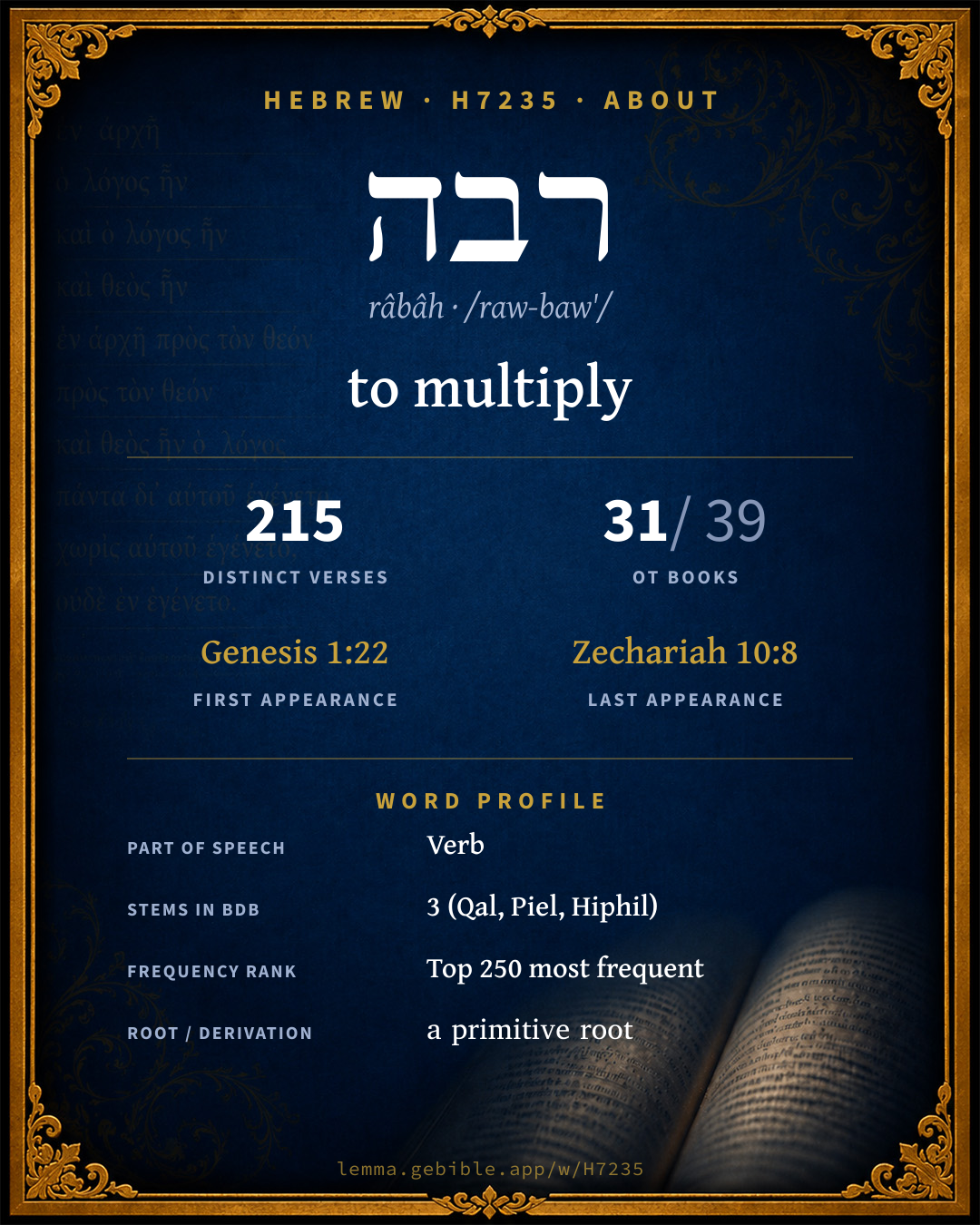
רָבָה
to multiply
‘to multiply’ is one of 2 main senses fuller range ↓
Full lexicon entry — Brown-Driver-Briggs (BDB)
From Brown-Driver-Briggs (BDB)
Where this word appears
See every Hiphil verb in the Hebrew Bible →
Grammar key — what these labels mean
Part of speech
- Verb
- An action or state-of-being word.
Stem
- Hiphil
- The causative active stem (“he caused / brought about”). Here: ‘make much or many’
- Qal
- The basic, simple active stem — the plain form of the verb (“he wrote”). Here: ‘become many’
- Piel
- An intensive or resultative active stem.
Form
- Infinitive Absolute
- An unbound verbal noun, often intensifying or standing in for a finite verb.
- Sequential Perfect
- A perfect with prefixed waw continuing a preceding imperfect or command (waw-consecutive perfect).
- Imperfect
- An incomplete, ongoing, or future action (“he will / would write”).
- Perfect
- A completed action or state — Hebrew marks aspect (completeness) more than strict tense (“he wrote”).
- Sequential Imperfect
- An imperfect with prefixed waw — the standard past-narrative form (waw-consecutive imperfect).
- Imperative
- A direct command (“write!”).
- Infinitive Construct
- A bound verbal noun, frequently with prepositions (“to write / in writing”).
- Participle Active
- A verbal adjective expressing ongoing or characteristic action (“writing / one who writes”).
- Cohortative
- A first-person volitional form expressing wish or resolve (“let me / let us write”).
- Jussive
- A third- or second-person volitional form expressing wish or command (“let him write”).
State
- Absolute
- The independent form of a noun, not bound to a following word.
- Construct
- A noun bound to a following noun in a possessive / “of” relationship (the construct chain).
Person
- 1st Person
- The speaker (“I / we”).
- 3rd Person
- The one spoken about (“he / she / it / they”).
- 2nd Person
- The one addressed (“you”).
Gender
- Common
- Either gender — not distinguished for this form.
- Masculine
- Grammatically masculine.
- Feminine
- Grammatically feminine.
Number
- Singular
- One.
- Plural
- More than one (in Hebrew, generally three or more).
8 verses where H7235 appears in the Hiphil stem in the Book of Isaiah. Filtered view — show all forms. Click any verse to open its interlinear word-by-word view. Verse text shown in the World English Bible for context — . Each verse’s Hebrew form is shown with its reference; the English is not keyword-highlighted, since the data carries no word-level English alignment. Use “Compare translations” on any verse to read it across multiple English versions. This concordance covers the Hebrew Bible; Septuagint (Greek Old Testament) occurrences are not indexed here.
Isaiah
- Isaiah 1:15 תַרְבּ֥וּ Hiphil impf 2mp When you spread forth your hands, I will hide my eyes from you; Yes, when you make many prayers, I will not hear. Your hands are full of blood.
- Isaiah 9:3 הִרְבִּ֣יתָ Hiphil pf 2ms You have multiplied the nation, you have increased their joy: they joy before you according to the joy in harvest, as men rejoice when they divide the spoil.
- Isaiah 23:16 הַרְבִּי Hiphil impv 2fs Take a harp, go about the city, you prostitute that has been forgotten; make sweet melody, sing many songs, that you may be remembered.
- Isaiah 30:33 הַרְבֵּ֔ה Hiphil inf.abs For a Topheth is prepared of old; yes, for the king it is made ready; he has made it deep and large; the pile of it is fire and much wood; the breath of Yahweh, like a stream of sulfur, does kindle it.
- Isaiah 40:29 יַרְבֶּֽה Hiphil impf 3ms He gives power to the faint; and to him who has no might he increases strength.
- Isaiah 51:2 וְ/אַרְבֵּֽ/הוּ conj + Hiphil impf 1cs + sfx pers 3ms Look to Abraham your father, and to Sarah who bore you; for when he was but one I called him, and I blessed him, and made him many.
- Isaiah 55:7 יַרְבֶּ֥ה Hiphil impf 3ms let the wicked forsake his way, and the unrighteous man his thoughts; and let him return to Yahweh, and he will have mercy on him; and to our God, for he will abundantly pardon.
- Isaiah 57:9 וַ/תַּרְבִּ֖י conj + Hiphil wimpf 2fs You went to the king with oil, and did increase your perfumes, and did send your ambassadors far off, and did debase yourself even to Sheol.
About this entry
At a glance — auto-summarized from this page’s data, not written by a person. Every figure links to its source below. This summary describes the numbers; it doesn’t interpret them.
The Hebrew verb רבה centers on the idea of “to multiply.” Its earliest occurrence is Genesis 1:22. It appears 215 verses across 31 books of the Hebrew Bible, among its common vocabulary. Read the stem: it spans 3 stems, including Qal and Piel. It clusters with ארבה, מרבה and מרבה under a shared root. Dig into 215-verse concordance and the renderings breakdown below.
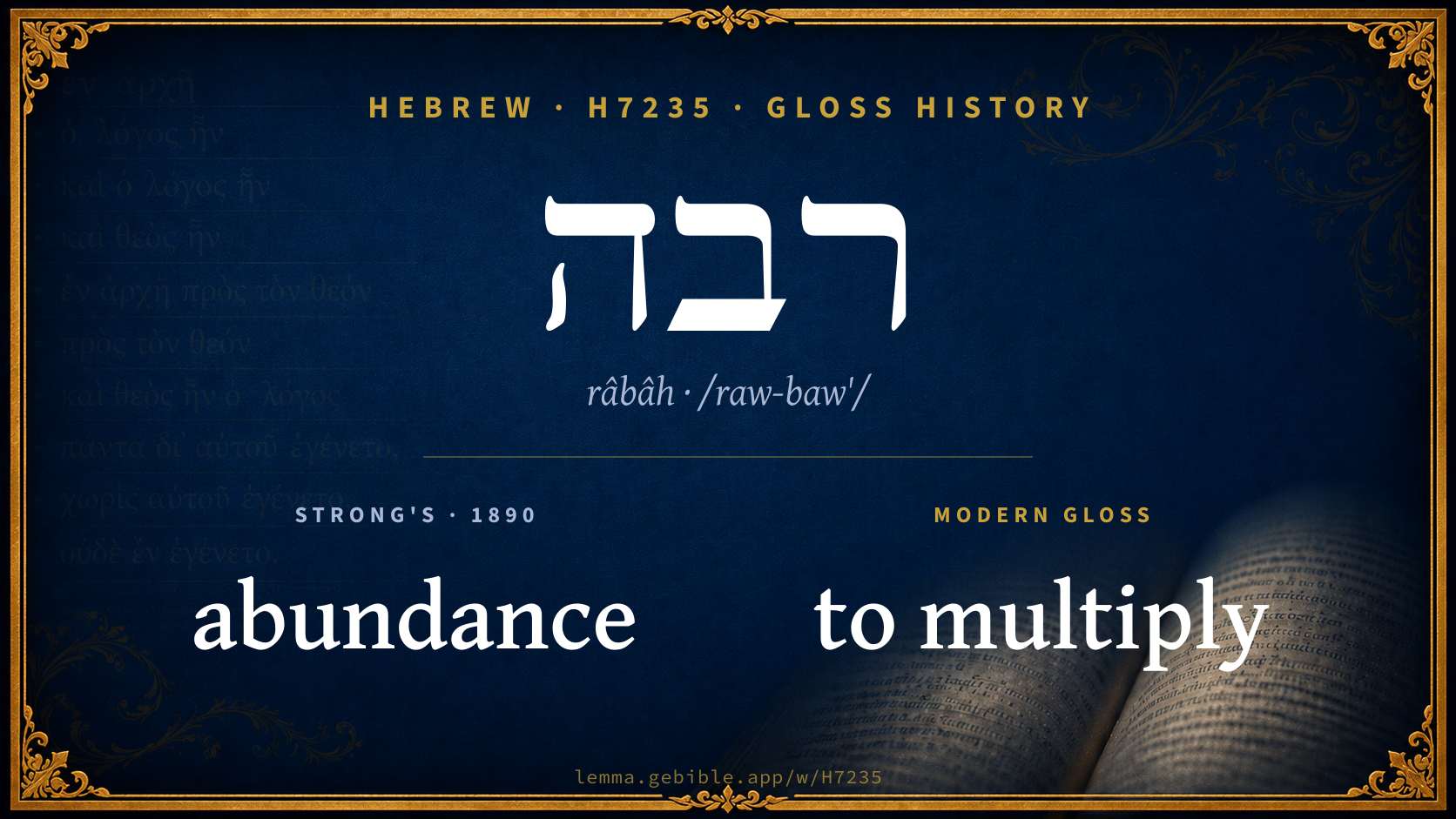
Gloss history
Strong's 1890 vs modern scholarship
About this word
Strong's H7235 catalogs a Hebrew word from the Hebrew Old Testament.
These counts are not copied from any lexicon or concordance. They are computed here, from the morphology-tagged Hebrew Old Testament. What Lemma adds →
- 215
- distinct verses
- The word appears in 215 distinct verses.
- 31 / 39
- OT books
- The word appears in 31 of 39 Old Testament books.
- #200
- by frequency
- Top 250 most frequent Hebrew words (rank 200 of 8,640 Hebrew words by occurrence).
View all 215 occurrences in the concordance →
Most concentrated in
- Genesis 24 verses 11%
- Ezekiel 19 verses 9%
- Deuteronomy 16 verses 7%
By section of the Old Testament
By traditional corpus
Conventional, traditional groupings — biblical authorship is debated, so this is a traditional corpus grouping, not an authorship claim. Each share is this word’s portion of its verses in that division of the Hebrew canon. Each figure is a share of the word’s 215 distinct verses.
- Prophets (Nevi'im) 80 verses · 37%
- Writings (Ketuvim) 78 verses · 36%
- Torah (Pentateuch) 57 verses · 27%
How translations render this word
Counts come from each version’s own published word-to-Strong’s tagging or interlinear alignment — an approximate guide to how each version renders this word, not a word-level alignment the data otherwise carries. Because each total is that version’s own tagged count, the per-version totals vary from one another and need not match the appearance or distinct-verse counts above. These counts may also differ from a printed concordance because Lemma counts each distinctly tagged rendering and does not collapse phrase taggings into a single head-word total. This is a fixed set of word-tagged versions (KJV, ASV, BSB, ULT) and does not change with the reading translation you choose elsewhere. Each version’s license is shown beside its name below (and on Sources).
BDB lists this Strong’s number as 2 distinct words (homographs). Each count above pools all of them and is not split by sense — see the Senses section below. A low-frequency rendering may belong to a different one of those words, not the primary meaning.
- King James Version†: Multiply 23×, Much 20×, Many 13×
- American Standard Version†: Much 20×, Multiply 14×, Many 13×
- Berean Standard Bible†: Multiply 21×, Many 8×, More 8×
- unfoldingWord Literal Text†: Multiply 32×, Much 23×, Many 15×
King James Version Public Domain
Renders H7235 across 227† tagged occurrences — most commonly:
Plus other, less common renderings. Plus 114 renderings that appear only once — usually multi-word phrases or single function words the recovered tagging swept in, not distinct renderings.
American Standard Version Public Domain
Renders H7235 across 224† tagged occurrences — most commonly:
Plus other, less common renderings. Plus 124 renderings that appear only once — usually multi-word phrases or single function words the recovered tagging swept in, not distinct renderings.
Berean Standard Bible Public Domain
Renders H7235 across 219† tagged occurrences — most commonly:
Plus other, less common renderings. Plus 107 renderings that appear only once — usually multi-word phrases or single function words the recovered tagging swept in, not distinct renderings. Not rendered by a distinct English word in 7 further occurrences.
unfoldingWord Literal Text CC BY-SA 4.0
Renders H7235 across 256† tagged occurrences — most commonly:
Plus other, less common renderings. Plus 70 renderings that appear only once — usually multi-word phrases or single function words the recovered tagging swept in, not distinct renderings.
6 senses and sub-senses in the full BDB
Hebrew verbs can shift meaning by stem (binyan): Qal is the basic action, Niphal is often passive or reflexive, Piel often intensifies or makes it factitive, and Hiphil is typically causative. The senses below are grouped under the stem BDB assigns to each.
What do BDB’s symbols mean?
BDB uses these scholarly abbreviations:
| Symbol | Meaning |
|---|---|
| 𝔊 | the Septuagint (the ancient Greek translation, LXX) |
| 𝔙 | the Vulgate (the Latin translation) |
| 𝔖 | the Syriac version (the Peshitta) |
| 𝔗 | the Targum (the Aramaic translation) |
| ψ | the Psalms |
| √ | root (the underlying root or stem) |
| ‖ | parallel passage (a synonymous or contrasted parallel) |
| † | the dagger: every passage where the word occurs is cited |
The 6 senses and sub-senses the full Brown-Driver-Briggs lexicon distinguishes for this word, in lexicon order (not ranked by frequency), with BDB’s own verbatim wording and sub-sense lettering. Shown in Hebrew script with BDB’s own scholarly abbreviations. The condensed entry is in the Lexicon Entry tab. See also the Forms in the corpus table below.
רבה I be, become, much, many, great
Qal
- 1. become many, numerous
- 2.
- a. be great
- b. grow great (Aramaism)
Piel
- . 4 make large, increase
Hiphil
- 1. make much or many
- 2. make great, obj. pers.
רבה II shoot
Senses from the full Brown-Driver-Briggs lexicon (Brown, Driver, Briggs; Oxford 1906 — public domain), digitized via Sefaria, supplemented by the OpenScriptures HebrewLexicon (CC BY 4.0). Full attribution on Sources.
Word origin
I. [ רָבָה ] 225 vb. be, or become, much, many, great
II. [ רָבָה ] vb. shoot;—only Qal Gn 21:20
— Brown-Driver-Briggs (Oxford 1906, public domain), digitized via Sefaria, supplemented by the OpenScriptures HebrewLexicon (CC BY 4.0). See Sources.
Origin: a primitive root
Jastrow Dictionary
A second Hebrew/Aramaic lexicon for comparison, covering Aramaic and post-biblical (Talmudic, Targumic, Midrashic) usage that the biblical-Hebrew BDB does not. Matched by lemma rather than by Strong’s number, so a lemma may carry more than one Jastrow headword (shown separately below), and the entries cover usage well beyond the Bible.
רַבָּה II
- (= רַב אַבָּה) Rabbah, name of several Amoraim, esp. a) R. bar Naḥmani, chief of the college of Pumb’ditha (v. Grætz, Gesch. d. Jud.1 IV, p. 400 sq.) Gitt. 3ᵃ. Hor. 14ᵃ ר׳ עוקר הרים R. uproots mountains (is ingenious, v. הַר). B. Mets. 86ᵃ; a. v. fr.—b) R. Zuṭi (Junior). B. Bath. 120ᵃ. Men. 31ᵇ; a. e.—c) R. bar Ḥanah. Snh. 5ᵃ.—d) R. bar bar Ḥanah, known for his fables. B. Bath. 73ᵇ; a. fr. [Y. Ber. II, 4ᵇ אבא בר בר ח׳.]—e) R. bar Abbuha (Abbahu, v. Fr. M’bo, p. 60ᵃ). Bekh. 34ᵃ. B. Kam. 46ᵇ; a. e.—f) R. bar Matt’nah. Hor. l. c.; a. e.; a. others.
רָבָה
- , v. רבי
רָבֶה
- 1. (= רָוָה) moist, saturated with liquid, opp. עבה thick and pulpy. Y. Pes. X, 37ᵈ top צריכה שתהא ר׳ וכ׳ (not צבריה) it (the חֲרוֹסֶת) must be saturated (with wine), which means that it is to remind of blood.—V. רוֹבֶה II.
- 2. pers. of רָבָה, v. רבי
רַבָּה I
- = רַבָּא
- 1. large, great; senior. בִּדְרַ׳ מיניה, v. קִים.—אַדְּרַ׳, v. אַדְּרַבָּא.—Y. Shebi. VII, end. 37ᶜ ודמיא היא כל ר׳ is this case altogether the same?; Y. Orl. I, 61ᵇ bot. ורמיה היא לכל רביה (corr. acc.).—דְּרַבָּה, v. רוּבָּה II.—Midr. Till. to Ps. XVII (ref. to רב, II Sam. XXIV, 16) ר׳ הוא משכונא גבך ed. Bub. (oth. ed. ר׳ היא משכונתך, corr. acc.) the pledge thou hast taken (with the death of Abishai) is large enough. Ber. 19ᵇ גברא ר׳ אמר וכ׳ a great man (scholar) has said something, laugh not at it; Gitt. 55ᵇ; Nidd. 50ᵇ. Sabb. 59ᵇ גברא ר׳ וכ׳ (some ed. רבא), v. אָרֵיכָא; Keth. 103ᵇ. Yeb. 21ᵇ הא … מגברא ר׳ וכ׳ I have heard this from a great scholar. Ib. אבא ר׳ grandfather. Gen. R. s. 1, beg. ר׳ הושעיה ר׳ R. Ḥ. senior (contrad. to זעירא). Y. Yeb. IV, 6ᵃ ר׳ חייא ר׳ R. Ḥ. senior; a. v. fr.—מדרש ר׳ (pl. רַבּוֹת), v. מִדְרָשׁ. e.g. 2 Samuel 24:16
- 2. teacher. Y. l. c. 6ᵇ top הידינו ר׳ ר׳ דמתניתא ר׳ דאולפנא what teacher do you mean? a teacher of the Mishnah (a Tannai), or a teacher of tradition? Lev. R. s. 22 ואיפשר כן ר׳ שאל וכ׳ can that be? did the teacher ask his pupil? B. Mets. 101ᵃ כגון דא צריכה ר׳ a thing like this requires a teacher (to say it)!; a. fr.—Pl. רַבְוָותָא. Snh. 102ᵇ נפתח בר׳ (Ms. F. ברברבתא) let us open our meeting with (speaking of our) teachers (opp. to חברין).—Fem. רַבְּתָא, q. v.; רַבָּתִי. Yeb. 21ᵇ אימא ר׳ grandmother.—אבל ר׳ (מסכת), v. אֵבֶל.
רַבָּה III
- f., v. רַב I, II.
רבי
- (b. h.) to be much, many; to grow, increase. Yoma 87ᵇ עונותינו רָבוּ וכ׳ our sins are too many to be counted. Gen. R. s. 34 אצא ואהי פרה ורָבֶה וכ׳ I may go out (of the ark) and be multiplying and increasing for curse. Bekh. 44ᵇ דם ר׳ שחין ר׳ if the blood is allowed to increase (if bleeding is neglected), skin disease will develop; מי רגלים רָּבִין וכ׳ if one allows the urine to increase (through neglect) &c. Sabb. 33ᵇ בעון … צרות רָבוֹת וכ׳ for the sin of obscene talk troubles increase, and new evil decrees come &c. Num. R. s. 11, v. פָּרָה II. Gen. R. s. 48 הכתב ר׳ וכ׳, v. כְּתָב. Sot. 47ᵇ משרבו … בדין ר׳ וכ׳ when the whisperers in court (secret influences) increased, the anger (of God) against Israel increased. Snh. 97ᵃ העזות תִּרְבֶּה impudence shall be large. Y. Yeb. IV, 6ᵃ bot., v. אל"ף; a. fr.—Gen. R. s. 98 (play on בן פרת, Gen. XLIX, 22) בן פירות רָבִיתָה ‘a child of fruits’ (through interpreting Pharaoh’s dream about the ears of corn) thou didst grow (to high office); בן פרות רביתה יוסף ‘a child of cows’ (through interpreting the dream about cows) thou didst grow; בן פורת (יוסף) רָבִיתָ יוסף ‘a child of growth’, thou didst grow tall (so as to protect Rachel from Esau’s sight; v. Gen. R. s. 78); Yalk. ib. 133 [read:] בן פורת יוסף פָּרִיתָ רבית יוסף. e.g. Genesis 49:22
- 1. to increase, do much, do more. Gen. R. s. 34 ר׳ בטהורים יותר וכ׳ ordered a larger number of the clean animals to be taken into the ark than of the unclean. Tosef. Dem. IV, 12 ר׳ בעיר ולא ר׳ במדינה if one offers a large quantity for sale, while none is offered in the country. Ib. 13 כל שר׳ לו מותר wherever one has a large quantity for sale, it is permitted (to buy of him); a. fr.—Men. 89ᵃ ר׳ שמן וכ׳, v. רְבִיכָה.
- 2. (hermeneutics) to use an additional word for the purpose of intimating something not otherwise included; to argue from an additional word or from a generalization in the Biblical text; to widen the scope of a law; to include. Ib. אם אתה מְרַבֶּה וכ׳ if thou wert to argue an entire day on the intimation of an increase lying in the words bashshemen (Lev. VI, 14; VII, 12), I should not listen to thee; Zeb. 82ᵃ; Nidd. 72ᵇ. Shebu. 26ᵃ, v. מָעַט. Ib. 27ᵃ מדאצטריך או לְרַבּוֹת וכ׳ as the word אוֹ (Lev. V, 4) is needed for the inclusion of vows for the benefit of others. Pes. 22ᵇ, v. אֵת. Snh. 60ᵇ יכול שאני מְרַבֶּה וכ׳ you might think that I must include &c.; a. v. fr.—[Yalk. Ex. 348 ר׳ כל וכ׳, v. רִיקֵן.]—Gen. R. s. 85 (ref. to Gen. XXXVIII, 29) זה רִבָּה על כל הפריצים ממך יעמודו (not יעמוד) this event implies (the prophecy) that all conquerors shall rise from thee (Perez); Yalk. ib. 145. e.g. Leviticus 6:14
- 3. to lend or borrow on usury (רִבִּית); to make a profit. Sifra B’har, ch. VI, Par. 5; B. Mets. V, 1 (expl. תַּרְבִּית) המְרַבֶּה בפירות he who makes a profit on lending provisions. Tosef. ib. IV, 2 מְרַבִּין על השכר ואין מרבין וכ׳ you may make a profit on renting (lending money to the money-changer merely for exhibition), but you dare not make a profit on a sale (of land as security for a loan). B. Mets. V, 2 מרבין … ואין מרבין וכ׳ you may make a profit by a reduction of rent on account of payment in advance, but you dare not make a profit by increasing the price of an object sold on account of postponed payment; a. e.
- to cause increase; to strengthen; to do much. Ber. 17ᵃ, v. מָעַט. Ab. I, 17 וכל המַרְבֶּה דברים וכ׳ he that talks much brings about sin. Ib. II, 7 מרבה בשר וכ׳ making much flesh (indulging in eating) makes much food for worms; מרבה צדקה וכ׳ he that does much charity, does much for peace. Ber. 40ᵃ מפרין ומרבין, v. פָּרָה II. Ib. 64ᵃ ת"ח מַרְבִּים וכ׳ scholars advance peace in the world; a. fr.—B. Bath. 11ᵇ בני מבוי … שמרבה עליהן את הדרך the neighbors may prevent him, because he increases the use of the way too much for them (causes many people to step upon their ground); Tosef. ib. I, 4; Y. ib. II, 13ᵇ bot. דו יכיל מימר … והן מרבין עלינו וכ׳ he may say to him, they go and come, ask for thee and cannot find thee, and thus they use the way too frequently for us.
- to be increased; with בגדים, to be clothed with the larger number of garments designated for the high priest, v. מְרוּבֶּה. Yoma 5ᵃ נ׳ שבעה if he wore the high priestly garments during the entire week of inauguration; נ׳ יום אחד if he wore them only one day.
A Dictionary of the Targumim, the Talmud Babli and Yerushalmi, and the Midrashic Literature (Marcus Jastrow; London, Luzac, 1903) — Public Domain. Digitized via Sefaria. Digitized via Sefaria. Full attribution on Sources.
Forms in the corpus
The 169 distinct written forms H7235 takes in the Hebrew Bible, most frequent first — each parse links to that stem’s occurrences in the concordance. Hebrew forms include their vowel points and cantillation, so a single lemma takes many written forms.
The 60 most common forms are shown; 109 rarer forms follow in the full concordance.
Same root — word family
Other BDB entries built from the same root as H7235, grouped by Strong’s listed origin. These share a root / origin per the lexicon — not necessarily a shared meaning. Each links to that word’s own entry.
Derived from this word
- ארבה ʼarbeh H697 locust
- מרבה marbeh H4766 abundance
- מרבה mirbâh H4767 much
- מרבית marbîyth H4768 multitude
- רבה rᵉbâh H7236 to grow great
- רבו rᵉbûw H7238 greatness
- תרבות tarbûwth H8635 offspring
- תרבית tarbîyth H8636 interest
Compare all same-root words → Showing 4 of 9 — not the complete family. They share a root, not necessarily a meaning.
Septuagint verse parallels
This word appears in 196 verses that also exist in the Greek Old Testament (Septuagint), out of the 215 Hebrew verses it occurs in. You can read those verses in Greek by switching the Old Testament edition to the Septuagint.
Read these verses in the Septuagint
- Genesis 1:22
- Exodus 1:7
- Leviticus 11:42
- Numbers 26:54
- Deuteronomy 1:10
- Joshua 13:1
- Judges 9:29
- 1 Samuel 1:12
- 2 Samuel 1:4
- 1 Kings 10:10
- 2 Kings 10:18
- 1 Chronicles 4:10
This is a verse-level parallel only — the same verses exist in both the Hebrew and Greek Old Testaments. No word-level Hebrew↔Greek correspondence is claimed: the data carries no such alignment, so no Greek word is shown as this Hebrew word’s translation. Coverage is not total — the Septuagint omits the deuterocanon and renumbers the Psalms, so some Hebrew verses have no direct Greek parallel.