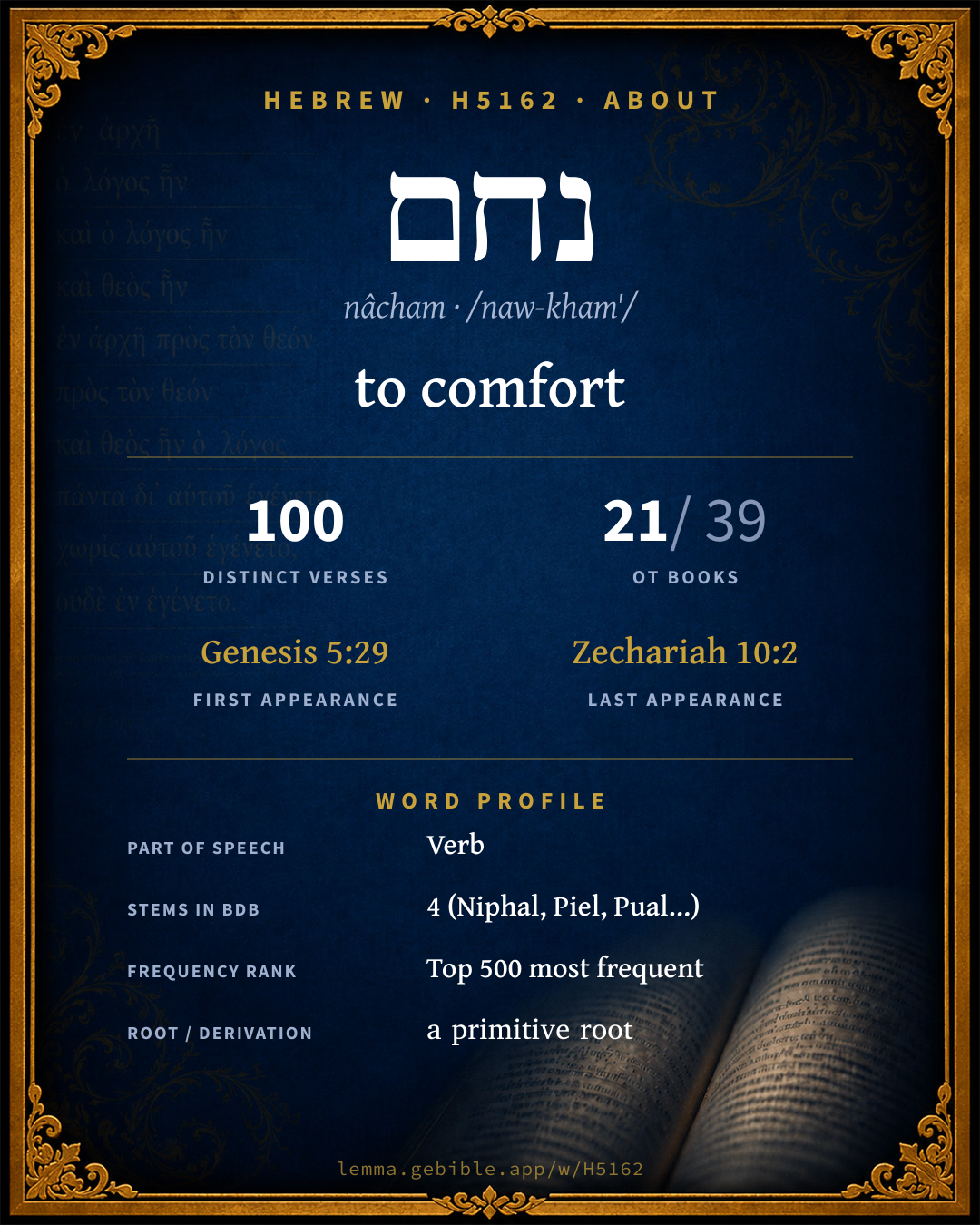
נָחַם
to comfort
‘to comfort’ is one of 3 main senses fuller range ↓
Full lexicon entry — Brown-Driver-Briggs (BDB)
From Brown-Driver-Briggs (BDB)
Where this word appears
See every Piel verb in the Hebrew Bible →
Grammar key — what these labels mean
Part of speech
- Verb
- An action or state-of-being word.
Stem
- Niphal
- Usually the simple passive or reflexive of the Qal (“he was written”). Here: ‘be sorry’
- Piel
- An intensive or resultative active stem. Here: ‘comfort’
- Hithpael
- The reflexive or reciprocal stem (the subject acts on itself).
- Pual
- The passive counterpart of the Piel.
Form
- Sequential Imperfect
- An imperfect with prefixed waw — the standard past-narrative form (waw-consecutive imperfect).
- Participle Active
- A verbal adjective expressing ongoing or characteristic action (“writing / one who writes”).
- Infinitive Construct
- A bound verbal noun, frequently with prepositions (“to write / in writing”).
- Perfect
- A completed action or state — Hebrew marks aspect (completeness) more than strict tense (“he wrote”).
- Sequential Perfect
- A perfect with prefixed waw continuing a preceding imperfect or command (waw-consecutive perfect).
- Imperfect
- An incomplete, ongoing, or future action (“he will / would write”).
- Imperative
- A direct command (“write!”).
- Participle Passive
- A verbal adjective expressing action received (“written”).
State
- Absolute
- The independent form of a noun, not bound to a following word.
- Construct
- A noun bound to a following noun in a possessive / “of” relationship (the construct chain).
Person
- 3rd Person
- The one spoken about (“he / she / it / they”).
- 1st Person
- The speaker (“I / we”).
- 2nd Person
- The one addressed (“you”).
Gender
- Masculine
- Grammatically masculine.
- Common
- Either gender — not distinguished for this form.
- Feminine
- Grammatically feminine.
Number
- Singular
- One.
- Plural
- More than one (in Hebrew, generally three or more).
4 verses where H5162 appears in the Niphal stem in the Book of Psalms. Filtered view — show all forms. Click any verse to open its interlinear word-by-word view. Verse text shown in the World English Bible for context — . Each verse’s Hebrew form is shown with its reference; the English is not keyword-highlighted, since the data carries no word-level English alignment. Use “Compare translations” on any verse to read it across multiple English versions. This concordance covers the Hebrew Bible; Septuagint (Greek Old Testament) occurrences are not indexed here.
Psalms
- Psalms 77:2 הִנָּחֵ֣ם Niphal inf.cs In the day of my trouble I sought the Lord. My hand was stretched out in the night, and didn't get tired. My soul refused to be comforted.
- Psalms 90:13 וְ֝/הִנָּחֵ֗ם conj + Niphal impv 2ms Relent, Yahweh! How long? Have compassion on your servants!
- Psalms 106:45 וַ֝/יִּנָּחֵ֗ם conj + Niphal wimpf 3ms He remembered for them his covenant, And repented according to the multitude of his loving kindnesses.
- Psalms 110:4 יִנָּחֵ֗ם Niphal impf 3ms Yahweh has sworn, and will not change his mind: "You are a priest forever in the order of Melchizedek."
About this entry
At a glance — auto-summarized from this page’s data, not written by a person. Every figure links to its source below. This summary describes the numbers; it doesn’t interpret them.
נחם (nâcham) is a Hebrew verb most often rendered “to comfort.” Its English rendering has broadened — “repented” classically, “and” (unfoldingWord Literal Text) in modern versions; see the renderings breakdown. The Hebrew Bible uses it across 100 verses — moderately common. It first appears in Genesis 5:29. As a verb its force shifts by stem, across 4 stems (Niphal, Piel, and more). The sections below give every sense, occurrence, and version rendering.
Gloss history
Strong's 1890 vs modern scholarship
About this word
Strong's H5162 catalogs a Hebrew word from the Hebrew Old Testament.
These counts are not copied from any lexicon or concordance. They are computed here, from the morphology-tagged Hebrew Old Testament. What Lemma adds →
- 100
- distinct verses
- The word appears in 100 distinct verses.
- 21 / 39
- OT books
- The word appears in 21 of 39 Old Testament books.
- #401
- by frequency
- Top 500 most frequent Hebrew words (rank 401 of 8,640 Hebrew words by occurrence).
View all 100 occurrences in the concordance →
By section of the Old Testament
By traditional corpus
Conventional, traditional groupings — biblical authorship is debated, so this is a traditional corpus grouping, not an authorship claim. Each share is this word’s portion of its verses in that division of the Hebrew canon. Each figure is a share of the word’s 100 distinct verses.
- Prophets (Nevi'im) 56 verses · 56%
- Writings (Ketuvim) 31 verses · 31%
- Torah (Pentateuch) 13 verses · 13%
How translations render this word
Counts come from each version’s own published word-to-Strong’s tagging or interlinear alignment — an approximate guide to how each version renders this word, not a word-level alignment the data otherwise carries. Because each total is that version’s own tagged count, the per-version totals vary from one another and need not match the appearance or distinct-verse counts above. These counts may also differ from a printed concordance because Lemma counts each distinctly tagged rendering and does not collapse phrase taggings into a single head-word total. This is a fixed set of word-tagged versions (KJV, ASV, BSB, ULT) and does not change with the reading translation you choose elsewhere. Each version’s license is shown beside its name below (and on Sources).
- King James Version: Repented 14×, Comfort 11×, Repent 6×
- American Standard Version: Repented 12×, Comfort 7×, Repent 7×
- Berean Standard Bible: Comfort 8×, Relented 7×, Relent 6×
- unfoldingWord Literal Text: And 6×, Relented 6×, Comfort 5×
King James Version Public Domain
Renders H5162 across 108 tagged occurrences — most commonly:
Plus other, less common renderings. Plus 41 renderings that appear only once — usually multi-word phrases or single function words the recovered tagging swept in, not distinct renderings.
American Standard Version Public Domain
Renders H5162 across 108 tagged occurrences — most commonly:
Plus other, less common renderings. Plus 58 renderings that appear only once — usually multi-word phrases or single function words the recovered tagging swept in, not distinct renderings.
Berean Standard Bible Public Domain
Renders H5162 across 107 tagged occurrences — most commonly:
Plus other, less common renderings. Plus 50 renderings that appear only once — usually multi-word phrases or single function words the recovered tagging swept in, not distinct renderings. Not rendered by a distinct English word in 1 further occurrence.
unfoldingWord Literal Text CC BY-SA 4.0
Renders H5162 across 122 tagged occurrences — most commonly:
Plus other, less common renderings. Plus 51 renderings that appear only once — usually multi-word phrases or single function words the recovered tagging swept in, not distinct renderings.
10 senses and sub-senses in the full BDB
Hebrew verbs can shift meaning by stem (binyan): Qal is the basic action, Niphal is often passive or reflexive, Piel often intensifies or makes it factitive, and Hiphil is typically causative. The senses below are grouped under the stem BDB assigns to each. This entry also uses Pual (the passive of Piel) and Hithpaal (the reflexive or passive Aramaic stem).
What do BDB’s symbols mean?
BDB uses these scholarly abbreviations:
| Symbol | Meaning |
|---|---|
| 𝔊 | the Septuagint (the ancient Greek translation, LXX) |
| 𝔙 | the Vulgate (the Latin translation) |
| 𝔖 | the Syriac version (the Peshitta) |
| 𝔗 | the Targum (the Aramaic translation) |
| ψ | the Psalms |
| √ | root (the underlying root or stem) |
| ‖ | parallel passage (a synonymous or contrasted parallel) |
| † | the dagger: every passage where the word occurs is cited |
The 10 senses and sub-senses the full Brown-Driver-Briggs lexicon distinguishes for this word, in lexicon order (not ranked by frequency), with BDB’s own verbatim wording and sub-sense lettering. Shown in Hebrew script with BDB’s own scholarly abbreviations. The condensed entry is in the Lexicon Entry tab. See also the Forms in the corpus table below.
Niphal
- 1. be sorry, moved to pity, have compassion, for others
- 2. be sorry, rue, suffer grief, repent, of one’s own doings
- 3. comfort oneself, be comforted
- 4. comfort oneself, ease oneself, by taking vengeance
Piel
- —comfort, console
Pual
- ; be comforted, consoled
Hithpaal
- 1. be sorry, have compassion
- 2. rue, repent of
- 3. comfort oneself, be comforted
- 4. ease oneself, by taking vengeance
Senses from the full Brown-Driver-Briggs lexicon (Brown, Driver, Briggs; Oxford 1906 — public domain), digitized via Sefaria, supplemented by the OpenScriptures HebrewLexicon (CC BY 4.0). Full attribution on Sources.
Word origin
[ נחם ] vb. Niph. be sorry, console oneself, etc.
— Brown-Driver-Briggs (Oxford 1906, public domain), digitized via Sefaria, supplemented by the OpenScriptures HebrewLexicon (CC BY 4.0). See Sources.
Origin: a primitive root
Jastrow Dictionary
A second Hebrew/Aramaic lexicon for comparison, covering Aramaic and post-biblical (Talmudic, Targumic, Midrashic) usage that the biblical-Hebrew BDB does not. Matched by lemma rather than by Strong’s number, so a lemma may carry more than one Jastrow headword (shown separately below), and the entries cover usage well beyond the Bible.
חָמַם
- (b. h.) to be warm, hot; [(of color) to be dark, red; (of taste) to be pungent, sour, bitter]. Part. חָם, q. v.
- to heat, warm, boil. Y. Ned. IV, 38ᶜ bot. לחַמֵּם בו את ידיו to warm his hands against it (the bread). Gen. R. s. 14, end מְחַמֶּמֶת הגוף keeps the body warm. Sabb. 40ᵇ ומְחַמַּמְתָּהּ וכ׳ and warms it (her hand) before the fire; a. fr.
- same. Bets. II, 5 לא יֵחֵם וכ׳ one must not prepare warm water for &c. Sabb. 40ᵃ התחילו … להָחֵם בשבת the bathers began to heat (the water) on the Sabbath; a. fr.—Part. מֵיחֵם, מֵחֵם, pl. מְחַמִּין. Ib.ᵇ; Tosef. ib. III (IV), 7 מיחם אדם וכ׳ (ed. Zuck. מייחם, read: מֵיחֵים), v. אְלוּנְטִית I; [Y. ib. XIX, 17ᵃ bot. מחמין הוא אדם (read as ib. IX, 12ᵃ bot. מְחַמֵּם הוא וכ׳].—Ib. אם מפני הסכנה מְחַמִּין לו וכ׳ if it is for the sake of averting danger to life, may we not even boil water on the Sabbath?—Bets. 22ᵃ; a. v. fr.
- to be warmed. Sabb. III, 5 (41ᵃ) בשביל שיֵחַמּוּ that they become warm; Sabb. 41ᵇ שיֵחוֹמּוּ; Tosef. ib. III (IV), 5 שׁיֵיחַמּוּ; a. e.
- same. Sabb. 134ᵇ שהוּחַמּוּ, v. חָם II. Y. Bets. II, 61ᶜ; a. fr.—B. Mets. VI, 3 הוּחַמָּה the animal was overtaken by the heat.
- to warm one’s self; to become heated. Bets. II, 5; Tosef. Sabb. l. c. Tam. I, 1. Ab. II, 10 הוי מִתְחַמֵּם וכ׳ warm thyself by the fire of the scholars (try to associate with them); a. fr.—Y. Sot. I, 16ᶜ bot. נתח׳ was heated (had pollution). Gen. R. s. 24 מִתְחַמְּמִים, מִתְחַמְּמוֹת conceived
נָחַם
- to be at ease. Ex. R. s. 20 (homiletic interpret. of נָחָם, Ex. XIII, 17) אמר הקב"ה איני מתנחם וכ׳ the Lord said, I shall not be contented, until &c., for we read ולא נָחַם (perhaps meant for נִחַם Nif.). e.g. Exodus 13:17
- to comfort, console. Pesik. Naḥ., p. 128ᵃ א"ל הקב"ה אני ואתם נלך ונְנַחֲמֶנָּה the Lord said to them (the prophets), Myself and you, let us go and comfort her (Jerusalem); ib. נַחֲמוּהָ עמי וכ׳ comfort her, O my people; comfort her, you on high (angels) &c. Ib. הקב"ה שלחני אצלך לנַחֲמֵךְ the Lord sent me to thee (Jerusalem) to comfort thee. Ib.ᵇ נַחֲמוּנִי נחמוני עמי comfort me, comfort me, O my people. Pesik. R. s. 30 ונכנסו חביריו לנַחֲמוֹ and his friends came in to comfort him; אם על אשתו מְנַחֲמִים לו וכ׳ if it is for the loss of his wife that they seek to console him, and he refuses to be consoled &c. Midd. II, 2 השוכן בבית הזה יְנַחֶמְךָ may He who resides in this house console thee. Y. Gitt. V, 47ᶜ top; Y. Dem. IV, 24ᵃ bot. ומְנַחֲמִין אבילי וכ׳ and you must comfort the gentile mourners (of your place) as well as the Jewish mourners; Y. Ab. Zar. I, 39ᶜ bot. ניחמים (corr. acc.); Tosef. Gitt. V (III), 5; a. fr.—מְנַחֵם the consoling friend of the mourner. Yalk. Prov. 947 בבית האבל בחול פריס מנ׳ ויהיב לאבל … יש לה מנ׳ פריס מנ׳ וכ׳ in the house of the mourner, on week days, the comforter breaks the bread and gives it to the mourner, as it is written (Lam. I, 17), ‘Zion breaks (the bread) with her own hands, she has no comforter’, but if she had a comforter, the comforter would break it &c.—Pl. מְנַחֲמִים, מְנַחֲמִין. M. Kat. 27ᵃ בית המנ׳ the room where the comforters meet. Ib. 27ᵇ כיון שניענע … אין מנ׳ וכ׳ as soon as the mourner nods with his head (indicating that he accepts their consolations), the friends are no longer permitted to sit with him; a. fr.—Sabb. 152ᵃ מת שאין לו מנ׳ a deceased person that leaves no direct relations to be comforted. e.g. Lamentations 1:17
- , Nithpa. נִתְנַחֵם
- 1. to be comforted, accept consolation. Pesik. l. c. מי צריך להִנָּחֵם which of them is in need of being comforted?; ib. להִתְנַחֵם. Snh. 19ᵃ תִּתְנֶחָמוּ be comforted. Ib. מִתְנַחֵם מאחרים receiving consolations from others. Pesik. R. l. c. ואינו מתנחם, v. supra. Gen. R. s. 84 מִתְנַחֲמִים על המתים וכ׳ people accept consolation for dead persons but not for living ones (that have disappeared); a. fr.—Gen. R. s. 27 (expl. וינחם, Gen. VI, 6) מתנ׳ אני שבראתי וכ׳ I have that consolation that I created him (man) to live on earth below &c. e.g. Genesis 6:6
- 2. to seek comfort; to be sorry, regret, reconsider. Ib. מתנ׳ אני שעשיתו וכ׳ I regret that I made him, and that he was placed on earth. Ex. R. s. 45, beg. ואני מתנ׳ עליו and I am sorry for him (reconsider my judgment). Num. R. s. 23 (ref. to Num. XXIII, 19) לא בן עמרם עשה אותו להִנָּחֵם did not the son of Amram cause him (God) to reconsider (Ex. XXXII, 14); ib. להִתְנַחֵם; Y. Taan. I, 65ᵇ bot. שעשה לאל שיִתְנֶחָם; a. fr. e.g. Numbers 23:19
נְחַם
- [Targ. Y. II, Gen. XXXV, 9 נְחִימַת some ed., read: נַחֵימַת Pa.; v. גְּרַם II.]
- to comfort. Targ. Gen. L, 21 נָחַם ed. Berl. (v. Berl. Targ. O. II, p. 18). Targ. Is. LXI, 2; a. fr.—Targ. Job II, 11 לנַחֲמוּתֵיה to comfort him.—Part. מְנַחֵם, pl. מְנַחֲמִין, v. preced. Targ. II Sam. X, 3.—Keth. 8ᵇ אתא לנַחוּמֵי צעורי וכ׳ he came to console, and he grieved him? Y. Shek. V, 48ᵈ bot., a. e. בעי מְנַחַמְתֵּיה desired to comfort him. Snh. 19ᵃ כי מְנַחֲמֵי אחריני וכ׳ when others comfort him; a. fr.
- as preced. Nif. Targ. Job XLII, 6; a. fr.—Y. l. c. ולא קביל עלוי מִתְנַחֲמָה and would not allow himself to be comforted; a. e.
A Dictionary of the Targumim, the Talmud Babli and Yerushalmi, and the Midrashic Literature (Marcus Jastrow; London, Luzac, 1903) — Public Domain. Digitized via Sefaria. Digitized via Sefaria. Full attribution on Sources.
Forms in the corpus
The 90 distinct written forms H5162 takes in the Hebrew Bible, most frequent first — each parse links to that stem’s occurrences in the concordance. Hebrew forms include their vowel points and cantillation, so a single lemma takes many written forms.
The 60 most common forms are shown; 30 rarer forms follow in the full concordance.
Same root — word family
Other BDB entries built from the same root as H5162, grouped by Strong’s listed origin. These share a root / origin per the lexicon — not necessarily a shared meaning. Each links to that word’s own entry.
Derived from this word
- נחום nichûwm H5150 comfort
- נחם nôcham H5164 repentance
- נחמה nechâmâh H5165 comfort
- תנחום tanchûwm H8575 consolation
Proper names from this root
People and places named from this root — a name, not an additional meaning of the word.
- מנחם Mᵉnachêm H4505 Menahem
- נחום Nᵉchûwm H5149 Nehum
- נחום Nachûwm H5151 Nahum
- נחם Nacham H5163 Naham
- נחמיה Nᵉchemyâh H5166 Nehemiah
- נחמני Nachămânîy H5167 Nahamani
Compare all same-root words → Showing 4 of 11 — not the complete family. 6 of the same-root words are proper names (people or places). They share a root, not necessarily a meaning.
Septuagint verse parallels
This word appears in 92 verses that also exist in the Greek Old Testament (Septuagint), out of the 100 Hebrew verses it occurs in. You can read those verses in Greek by switching the Old Testament edition to the Septuagint.
Read these verses in the Septuagint
- Genesis 5:29
- Exodus 13:17
- Numbers 23:19
- Deuteronomy 32:36
- Judges 2:18
- Ruth 2:13
- 1 Samuel 15:11
- 2 Samuel 10:2
- 1 Chronicles 7:22
- Job 2:11
- Psalms 23:4
- Ecclesiastes 4:1
This is a verse-level parallel only — the same verses exist in both the Hebrew and Greek Old Testaments. No word-level Hebrew↔Greek correspondence is claimed: the data carries no such alignment, so no Greek word is shown as this Hebrew word’s translation. Coverage is not total — the Septuagint omits the deuterocanon and renumbers the Psalms, so some Hebrew verses have no direct Greek parallel.