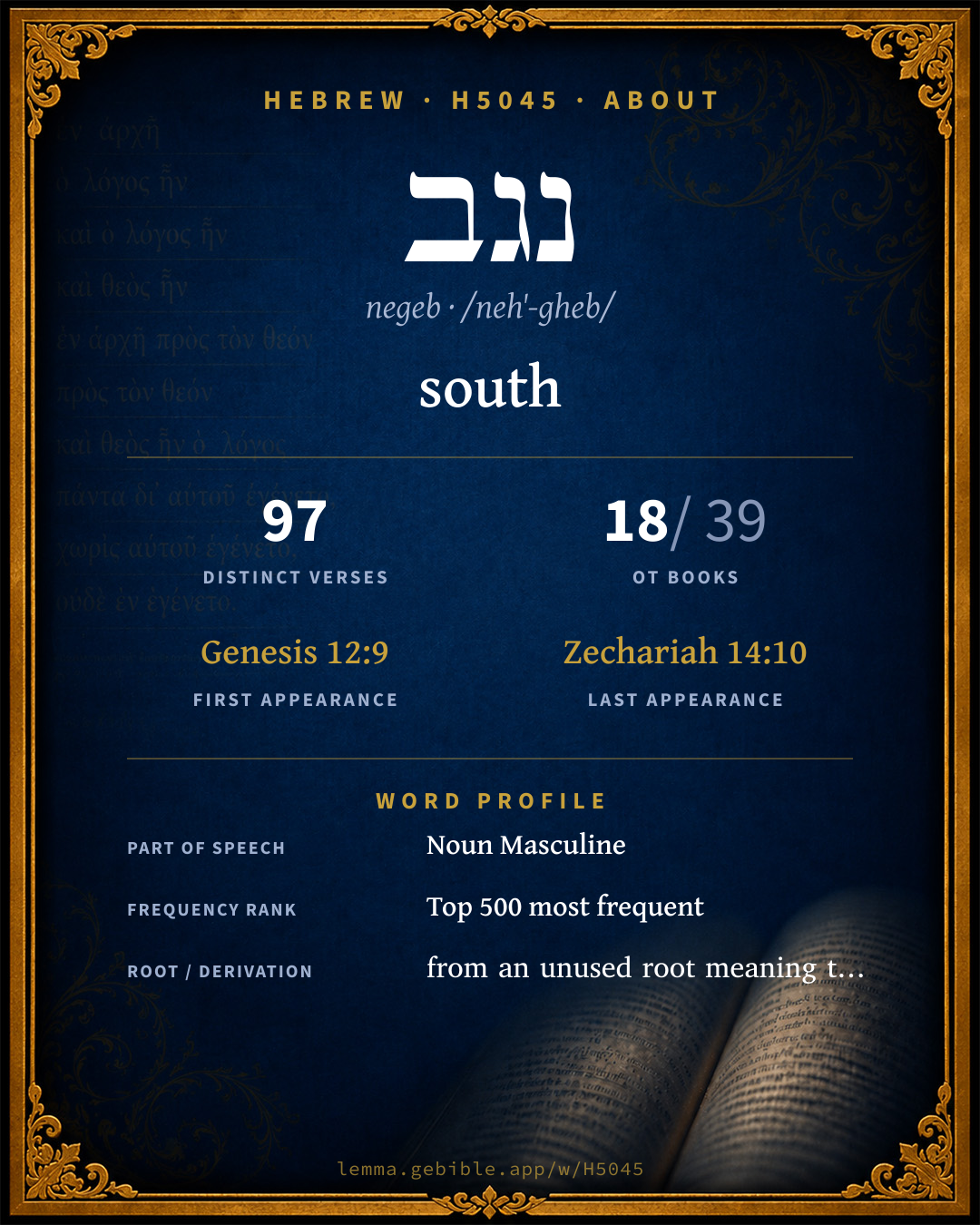
נֶ֫גֶב
south
also: south-country, Nekeb fuller range ↓
Full lexicon entry — Brown-Driver-Briggs (BDB)
From Brown-Driver-Briggs (BDB)
Where this word appears
See every Absolute-state word in the Hebrew Bible →
Grammar key — what these labels mean
Part of speech
- Noun
- A naming word — a person, place, thing, or idea.
Noun type
- Common
- A common noun — a general class of person, place, or thing (“king,” “city,” “water”), not a specific name.
- Proper
- A name of a specific person, place, or people (e.g. Abraham, Zion, Israel).
State
- Absolute
- The independent form of a noun, not bound to a following word.
- Construct
- A noun bound to a following noun in a possessive / “of” relationship (the construct chain).
Gender
- Masculine
- Grammatically masculine.
Number
- Singular
- One.
Every verse where H5045 appears in the Book of Joshua — 22 distinct verses. Click any verse to open its interlinear word-by-word view. Verse text shown in the World English Bible for context — . Each verse’s Hebrew form is shown with its reference; the English is not keyword-highlighted, since the data carries no word-level English alignment. Use “Compare translations” on any verse to read it across multiple English versions. This concordance covers the Hebrew Bible; Septuagint (Greek Old Testament) occurrences are not indexed here.
Joshua
- Joshua 10:40 וְ/הַ/נֶּ֨גֶב conj + ptcl def.art + n c ms So Joshua struck all the land, the hill-country, and the South, and the lowland, and the slopes, and all their kings: he left none remaining, but he utterly destroyed all that breathed, as Yahweh, the God of Israel, commanded.
- Joshua 11:2 נֶ֥גֶב n c ms cs and to the kings who were on the north, in the hill-country, and in the Arabah south of Chinneroth, and in the lowland, and in the heights of Dor on the west,
- Joshua 11:16 הַ/נֶּ֨גֶב֙ ptcl def.art + n c ms So Joshua took all that land, the hill-country, and all the South, and all the land of Goshen, and the lowland, and the Arabah, and the hill-country of Israel, and the lowland of the same;
- Joshua 12:8 וּ/בַ/נֶּ֑גֶב conj + prep det + n c ms in the hill-country, and in the lowland, and in the Arabah, and in the slopes, and in the wilderness, and in the South; the Hittite, the Amorite, and the Canaanite, the Perizzite, the Hivite, and the Jebusite:
- Joshua 15:1 נֶ֖גְבָּ/ה n c ms + sfx dem The lot for the tribe of the children of Judah according to their families was to the border of Edom, even to the wilderness of Zin southward, at the uttermost part of the south.
- Joshua 15:2 נֶ֔גֶב נֶֽגְבָּ/ה n c ms n c ms + sfx dem Their south border was from the uttermost part of the Salt Sea, from the bay that looks southward;
- Joshua 15:3 מִ/נֶּ֜גֶב מִ/נֶּ֖גֶב prep + n c ms prep + n c ms and it went out southward of the ascent of Akrabbim, and passed along to Zin, and went up by the south of Kadesh-barnea, and passed along by Hezron, and went up to Addar, and turned about to Karka;
- Joshua 15:4 נֶֽגֶב n c ms and it passed along to Azmon, and went out at the brook of Egypt; and the goings out of the border were at the sea: this shall be your south border.
- Joshua 15:7 מִ/נֶּ֖גֶב prep + n c ms and the border went up to Debir from the valley of Achor, and so northward, looking toward Gilgal, that is over against the ascent of Adummim, which is on the south side of the river; and the border passed along to the waters of En Shemesh, and the goings out of it were at En Rogel;
- Joshua 15:8 מִ/נֶּ֔גֶב prep + n c ms and the border went up by the valley of the son of Hinnom to the side of the Jebusite southward (the same is Jerusalem); and the border went up to the top of the mountain that lies before the valley of Hinnom westward, which is at the uttermost part of the valley of Rephaim northward;
- Joshua 15:19 הַ/נֶּ֨גֶב֙ ptcl def.art + n c ms She said, Give me a blessing; for that you have set me in the land of the South, give me also springs of water. He gave her the upper springs and the lower springs.
- Joshua 15:21 בַּ/נֶּ֑גְבָּ/ה prep det + n c ms + sfx dem The uttermost cities of the tribe of the children of Judah toward the border of Edom in the South were Kabzeel, and Eder, and Jagur,
- Joshua 17:9 נֶ֣גְבָּ/ה n c ms + sfx dem The border went down to the brook of Kanah, southward of the brook: these cities belonged to Ephraim among the cities of Manasseh: and the border of Manasseh was on the north side of the brook, and the goings out of it were at the sea:
- Joshua 17:10 נֶ֣גְבָּ/ה n c ms + sfx dem southward it was Ephraim's, and northward it was Manasseh's, and the sea was his border; and they reached to Asher on the north, and to Issachar on the east.
- Joshua 18:5 מִ/נֶּ֔גֶב prep + n c ms They shall divide it into seven portions: Judah shall abide in his border on the south, and the house of Joseph shall abide in their border on the north.
- Joshua 18:13 נֶ֔גְבָּ/ה מִ/נֶּ֥גֶב n c ms + sfx dem prep + n c ms The border passed along from there to Luz, to the side of Luz (the same is Bethel), southward; and the border went down to Ataroth Addar, by the mountain that lies on the south of Beth Horon the lower.
- Joshua 18:14 נֶ֗גְבָּ/ה נֶגְבָּ/ה֒ n c ms + sfx dem n c ms + sfx dem The border extended [there], and turned about on the west quarter southward, from the mountain that lies before Beth Horon southward; and the goings out of it were at Kiriath Baal (the same is Kiriath Jearim), a city of the children of Judah: this was the west quarter.
- Joshua 18:15 נֶ֕גְבָּ/ה n c ms + sfx dem The south quarter was from the uttermost part of Kiriath Jearim; and the border went out westward, and went out to the spring of the waters of Nephtoah;
- Joshua 18:16 נֶ֔גְבָּ/ה n c ms + sfx dem and the border went down to the uttermost part of the mountain that lies before the valley of the son of Hinnom, which is in the valley of Rephaim northward; and it went down to the valley of Hinnom, to the side of the Jebusite southward, and went down to En Rogel;
- Joshua 18:19 נֶ֑גְבָּ/ה נֶֽגֶב n c ms + sfx dem n c ms and the border passed along to the side of Beth Hoglah northward; and the goings out of the border were at the north bay of the Salt Sea, at the south end of the Jordan: this was the south border.
- Joshua 19:8 נֶ֑גֶב n c ms and all the villages that were round about these cities to Baalath Beer, Ramah of the South. This is the inheritance of the tribe of the children of Simeon according to their families.
- Joshua 19:34 מִ/נֶּ֗גֶב prep + n c ms and the border turned westward to Aznoth Tabor, and went out from there to Hukkok; and it reached to Zebulun on the south, and reached to Asher on the west, and to Judah at the Jordan toward the sunrise.
About this entry
At a glance — auto-summarized from this page’s data, not written by a person. Every figure links to its source below. This summary describes the numbers; it doesn’t interpret them.
“south” is the headline sense of the Hebrew noun נגב (negeb). Scripture first uses it in Genesis 12:9. With 97 verses in 18 books, it is a moderately common word in the Hebrew Bible. Not a single-sense word: its full sense range also takes in “south-country” and “Nekeb”. The sections below give every sense, occurrence, and version rendering.
Gloss history
Strong's 1890 vs modern scholarship
About this word
Strong's H5045 catalogs a Hebrew word from the Hebrew Old Testament.
These counts are not copied from any lexicon or concordance. They are computed here, from the morphology-tagged Hebrew Old Testament. What Lemma adds →
- 97
- distinct verses
- The word appears in 97 distinct verses.
- 18 / 39
- OT books
- The word appears in 18 of 39 Old Testament books.
- #390
- by frequency
- Top 500 most frequent Hebrew words (rank 390 of 8,640 Hebrew words by occurrence).
View all 97 occurrences in the concordance →
By section of the Old Testament
By traditional corpus
Conventional, traditional groupings — biblical authorship is debated, so this is a traditional corpus grouping, not an authorship claim. Each share is this word’s portion of its verses in that division of the Hebrew canon. Each figure is a share of the word’s 97 distinct verses.
- Prophets (Nevi'im) 57 verses · 59%
- Torah (Pentateuch) 22 verses · 23%
- Writings (Ketuvim) 18 verses · 19%
How translations render this word
Counts come from each version’s own published word-to-Strong’s tagging or interlinear alignment — an approximate guide to how each version renders this word, not a word-level alignment the data otherwise carries. Because each total is that version’s own tagged count, the per-version totals vary from one another and need not match the appearance or distinct-verse counts above. These counts may also differ from a printed concordance because Lemma counts each distinctly tagged rendering and does not collapse phrase taggings into a single head-word total. This is a fixed set of word-tagged versions (KJV, ASV, BSB, ULT) and does not change with the reading translation you choose elsewhere. Each version’s license is shown beside its name below (and on Sources).
- King James Version: South 71×, Southward 15×, Toward the south 8×
- American Standard Version: South 74×, Southward 15×, Toward the south 7×
- Berean Standard Bible: South 49×, Negev 39×, Southern 9×
- unfoldingWord Literal Text: South 44×, Negev 31×, Southward 14×
King James Version Public Domain
Renders H5045 across 112 tagged occurrences — most commonly:
Plus 12 renderings that appear only once — usually multi-word phrases or single function words the recovered tagging swept in, not distinct renderings.
American Standard Version Public Domain
Renders H5045 across 113 tagged occurrences — most commonly:
Plus 14 renderings that appear only once — usually multi-word phrases or single function words the recovered tagging swept in, not distinct renderings.
Berean Standard Bible Public Domain
Renders H5045 across 108 tagged occurrences — most commonly:
Plus 6 renderings that appear only once — usually multi-word phrases or single function words the recovered tagging swept in, not distinct renderings. Not rendered by a distinct English word in 3 further occurrences.
unfoldingWord Literal Text CC BY-SA 4.0
Renders H5045 across 114 tagged occurrences — most commonly:
Plus 11 renderings that appear only once — usually multi-word phrases or single function words the recovered tagging swept in, not distinct renderings.
Senses in the full BDB
What do BDB’s symbols mean?
BDB uses these scholarly abbreviations:
| Symbol | Meaning |
|---|---|
| 𝔊 | the Septuagint (the ancient Greek translation, LXX) |
| 𝔙 | the Vulgate (the Latin translation) |
| 𝔖 | the Syriac version (the Peshitta) |
| 𝔗 | the Targum (the Aramaic translation) |
| ψ | the Psalms |
| √ | root (the underlying root or stem) |
| ‖ | parallel passage (a synonymous or contrasted parallel) |
| † | the dagger: every passage where the word occurs is cited |
The 5 senses and sub-senses the full Brown-Driver-Briggs lexicon distinguishes for this word, in lexicon order (not ranked by frequency), with BDB’s own verbatim wording and sub-sense lettering. Shown in Hebrew script with BDB’s own scholarly abbreviations. The condensed entry is in the Lexicon Entry tab. See also the Forms in the corpus table below.
- 1. south-country, i.e.
- a. specif. the region S. of Judah, boundaries not exactly defined (see cities in it Jos 15:21–32), but c. from hills S. of Hebron to Ḳadesh, אֶרֶץ הַנּ׳ Gn 20:1 (E), 24:62 (J), Nu 13:29 (JE), Ju 1:15 Jos 15:19; alm. = n.pr. הַנּ׳, הַנֶּ֫גְבָּה, Gn 12:9; 13:1 Nu 13:17, 22; 21:1 (all J), Dt 34:3 (JE), Dt 1:7 Jos 10:40; 11:16; 12:8 (all D), Nu 33:40 Jos 15:21 (both P), Ju 1:9 1 S 20:41 (but read הָאַרְגָּב, i.e. the mound 𝔊 (ἀργαβ) Th We Klo Dr Kit Bu HPS), Je 13:19; 17:26; 32:44; 33:13 Zc 7:7 Ob 20 ψ 126:4 (sim.), Ez 21:3a (= Judah); נ׳ (no art.) Gn 13:3 (J), 1 S 30:1, Is 30:6 (cf. Di); of particular districts in the Negeb: נ׳ עֲרָד Ju 1:16 (cf. GFM), נ׳ יהוּדָה etc. 1 S 27:10(×3) (cf. Dr), 30:14(×2) 2 S 24:7 2 Ch 28:18; v. also Zc 14:10; רָמַת נ׳ Jos 19:8, רָמוֹת נ׳ 1 S 30:27; coll. c. pl. vb. = people of south-land Ob 19. e.g. Joshua 15:21
- b. land S. of Babylon Is 21:1 (cf. Di). e.g. Isaiah 21:1
- c. = Egypt Dn 11:5, 6, 9, 11, 14, 15, 25(×2), 29, 40 (v. Meinh Bev Behrm, cf. v 43). e.g. Daniel 11:5
- 2. hence south (opp. N., E., W.) Gn 13:14; 28:14 (both J), Jos 17:10 (P), 1 K 7:25 = 2 Ch 4:4, 1 Ch 9:24; 26:15, 17 (cf. v 14, 16, 18), Ez 21:3b, 9 Dn 8:4, 9, further 1 K 7:39 Zc 14:4; פְּאַת נֶ֫גְבָּה תֵּימָ֫נָה Ex 26:18, cf. 27:9; 36:23; 38:9; 40:24 (of S. side of tabernacle); שַׁ֫עַר נ׳ Ez 46:9(×2); פְּאַת נ׳ south side or border Nu 34:3; 35:5 Jos 18:15 (all P), Ez 47:19, cf. v 19 48:16, 28, 33; גְּבוּל נ׳ south boundary Nu 34:3 Jos 15:2, 4; 18:19 (all P), cf. מִנֶּ֫גֶב לְ (הַגְּבוּל) on the south of Nu 34:4(×2) Jos 15:3 (אֶל־מִנּ׳ לְ), v 3, 7; 18:13 (all P), Ju 21:19; מִנּ׳ abs. on the south Jos 18:5 (JE), 19:34 (P), 1 S 14:5 Ez 40:2; כֶּ֫תֶף הַיְבוּסִי מִנּ׳ Jos 15:8, cf. 18:13, 16 (all P); נֶ֫גְבָּה 15:1, 2; 18:14(×2), 19 (all P), 2 Ch 4:10 Ez 21:2 (Co; ℌ נגב), 48:10, 17; נֶ֫גְבָּה לְ Jos 17:9 (P).—For נ׳ כִּנְּרוֹת 11:2 read נֶגֶד (𝔊 Di). e.g. Genesis 13:14
Senses from the full Brown-Driver-Briggs lexicon (Brown, Driver, Briggs; Oxford 1906 — public domain), digitized via Sefaria, supplemented by the OpenScriptures HebrewLexicon (CC BY 4.0). Full attribution on Sources.
Word origin
n.[m.] south-country, Negeb, south (cf. LagBN 78);—נ׳ abs. Gn 20:1 +; cstr. Jos 11:2 +; נֶ֫גְבָּה Gn 13:14 +;—
— Brown-Driver-Briggs (Oxford 1906, public domain), digitized via Sefaria, supplemented by the OpenScriptures HebrewLexicon (CC BY 4.0). See Sources.
Origin: from an unused root meaning to be parched
Jastrow Dictionary
A second Hebrew/Aramaic lexicon for comparison, covering Aramaic and post-biblical (Talmudic, Targumic, Midrashic) usage that the biblical-Hebrew BDB does not. Matched by lemma rather than by Strong’s number, so a lemma may carry more than one Jastrow headword (shown separately below), and the entries cover usage well beyond the Bible.
נֶגֶב
- v. next w.)
- 1. dry soil. Tosef. B. Kam. VIII, 19.
- 2. south (in Talm. דָּרוֹם).).
- 3. pr. n. pl. Negeb, in the district of Ascalon. Tosef. Ohol. XVIII, 15 (Var. גנב).
נָגַב
- (cmp. גַּב) [to have a crust,] to be dry. Ab. Zar. V, 3 (69ᵃ) כדי שישתום … ויִגּוֹב as much time as would be required for a person to bore a hole (uncork), and close it up, and (for the sealing clay) to get dry; ib. כדי שיפתח (את החבית) … ותִיגּוֹב to open the jug and close it up again, and (for the clay) to dry; a. e.—Part. pass. נָגוּב; f. נְגוּבָה; pl. נְגוּבִים, נְגוּבִין; נְגוּבוֹת dry. Ḥag. III, 3 אוכלים נ׳ dry eatables (which have not come in contact with liquids and are, therefore, insusceptible of levitical uncleanness, v. הֶכְשֵׁר); Tosef. ib. III, 11. Ib. 12 וכי יש נגובים לקדש are the exemptions in favor of dry objects applicable to sacred matter?; Ḥag. 24ᵇ וכי יש נגובה וכ׳ (Ms. M. נְגִיבָה). Ib.ᵃ, sq. יד נ׳ מטמאה וכ׳ one dry hand (which has become unclean) makes the other hand unclean; a. e.
- to dry, wipe, scour. Ib. III, 1 (20ᵇ) מתיר ומְנַגֵּב ומטביל (Bab. ed. ומַנְגִּיב, v. Rabb. D. S. a. l. note 3; Y. ed. מתיר ומטביל) he must open (the knots of the garment) and wipe it dry and smooth and then immerse. Lev. R. s. 28, beg. עד שלא יְנַגְּבָהּ before he gets it (the garment) dry and glossy; ib. ומְנַגֵּב את הארץ and makes the earth dry; Koh. R. to I, 3 ומכבסן ומבשלן ומְנַגְּבָן and washes them (the plants) and ripens and glosses them. Ab. Zar. V, 11 מְנַגְּבָהּ he scours it; ib. 74ᵇ במה מְנַגְּבָן וכ׳ wherewith does he scour them? … with ashes, … with water. Ib. 75ᵃ; a. fr.—Part. pass. מְנוּגָּב dry, parched, sapless, bare of. Tem. 16ᵃ (play on הנגב Josh. XV, 19) בית שמנ׳ מכל וכ׳ a household bare of all that is good; Yalk. Josh. 27 אדם המנ׳ וכ׳ a man bare &c. e.g. Joshua 15:19
- 1. same, v. supra.—2) (denom. of נֶגֶב) to go south. Erub. 53ᵇ (in an enigmatic speech) וה׳ למפיבשת and went south to the great scholar (v. מְפִיבשֶׁת).
- to be dried up. Sifra B’ḥuck. ch. I ונִתְנַגְּבָה הארץ the ground was dried up; Lev. R. s. 35.
נְגֵב
- , to be dry, to dry out. Targ. Gen. VIII, 13; a. e.—Y. Sabb. V, beg. 7ᵇ כדו נגיב אינון וכ׳ when it is dry, they name it Egyptian bean; Y. Kil. VIII, 31ᶜ.—Y. Gitt. VII, end, 49ᵃ ונ׳ נהרא the canal dried up. Ib. דיִיגַּב וכ׳ that the canal may dry up; a. e.
- to dry, wipe. B. Mets. 24ᵃ ונ׳ בגלימא וכ׳ wiped (his hands) on his neighbor’s cloak; a. e.—Part. pass. מְנַגַּב; f. מְנַגְּבָא parched. Targ. Y. Num. XI, 6.
- to be dried up. Targ. Y. Gen. I, 9. Targ. Ps. CVI, 9; a. e.
A Dictionary of the Targumim, the Talmud Babli and Yerushalmi, and the Midrashic Literature (Marcus Jastrow; London, Luzac, 1903) — Public Domain. Digitized via Sefaria. Digitized via Sefaria. Full attribution on Sources.
Forms in the corpus
The 60 distinct written forms H5045 takes in the Hebrew Bible, most frequent first — each parse links to that state’s occurrences in the concordance. Hebrew forms include their vowel points and cantillation, so a single lemma takes many written forms.
Septuagint verse parallels
This word appears in 94 verses that also exist in the Greek Old Testament (Septuagint), out of the 97 Hebrew verses it occurs in. You can read those verses in Greek by switching the Old Testament edition to the Septuagint.
Read these verses in the Septuagint
- Genesis 12:9
- Exodus 26:18
- Numbers 13:17
- Deuteronomy 1:7
- Joshua 10:40
- Judges 1:9
- 1 Samuel 14:5
- 2 Samuel 24:7
- 1 Kings 7:25
- 1 Chronicles 9:24
- 2 Chronicles 4:4
- Psalms 126:4
This is a verse-level parallel only — the same verses exist in both the Hebrew and Greek Old Testaments. No word-level Hebrew↔Greek correspondence is claimed: the data carries no such alignment, so no Greek word is shown as this Hebrew word’s translation. Coverage is not total — the Septuagint omits the deuterocanon and renumbers the Psalms, so some Hebrew verses have no direct Greek parallel.