
Joshua 15:19

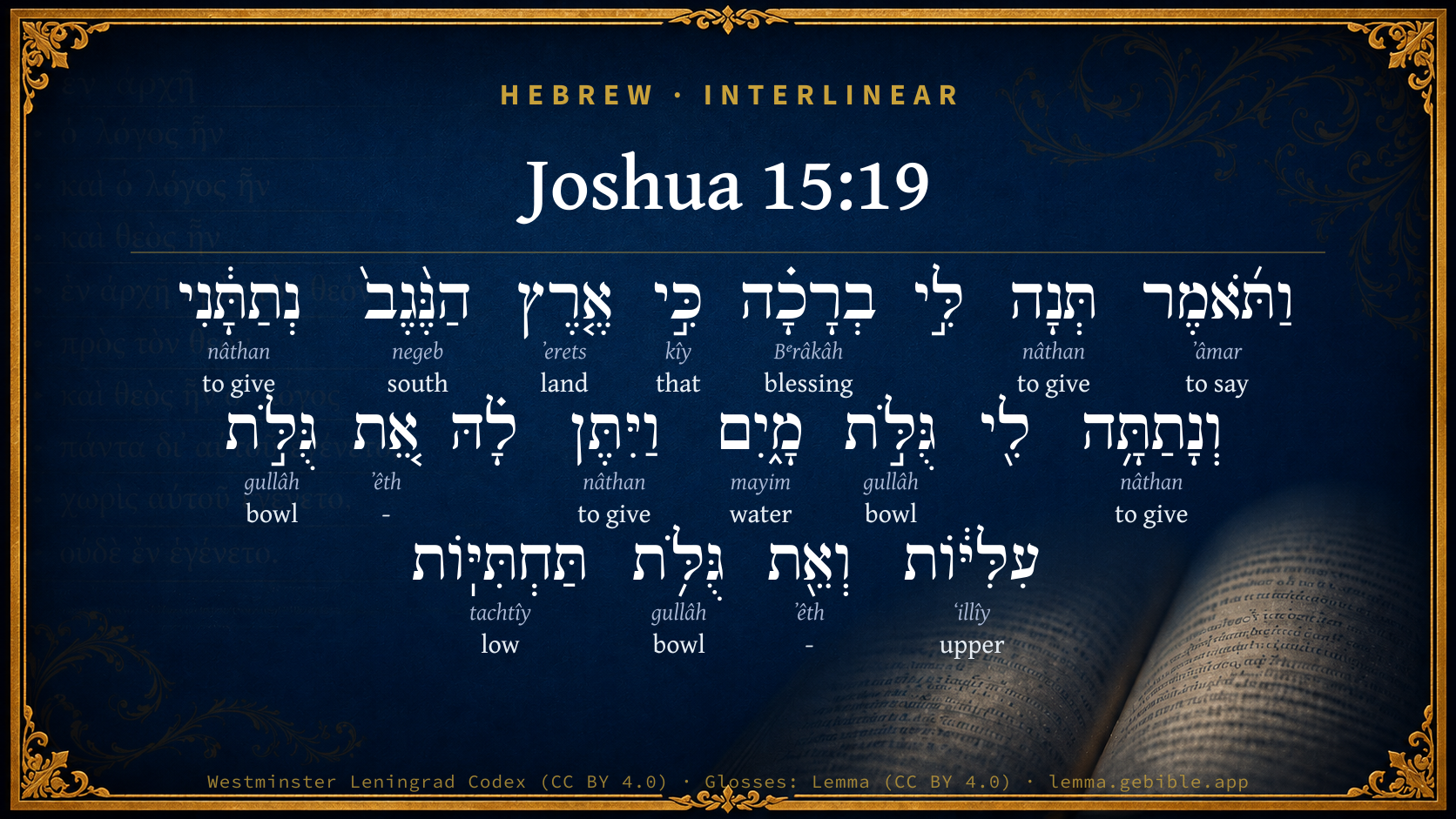
Hebrew (Westminster Leningrad Codex) Joshua 15:19 appears in the Hebrew Old Testament. The text above is from the Westminster Leningrad Codex. Each word links to its Strong’s number, a concise gloss, and parsing drawn from the Open Scriptures Hebrew Bible morphology. Click any word for its full Brown-Driver-Briggs (BDB) entry.
Download image
Cite this verse

Joshua 15:19 (World English Bible). Public Domain. Lemma interlinear Bible study tool, https://lemma.gebible.app/v/joshua/15/19.

Show BibTeX & RIS
BibTeX
RIS
English Translation
She said, Give me a blessing; for that you have set me in the land of the South, give me also springs of water. He gave her the upper springs and the lower springs.
World English Bible · Public Domain
Highlights
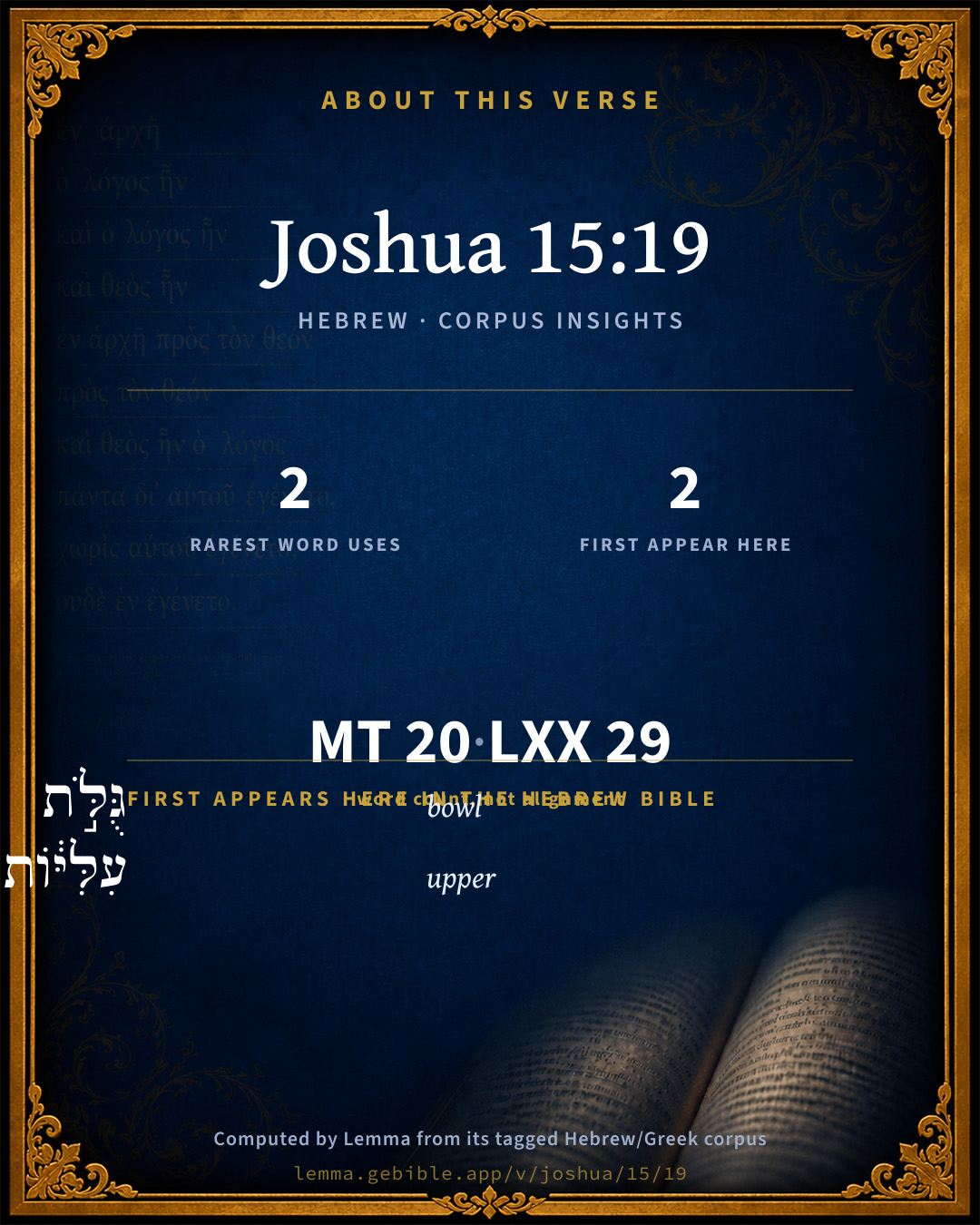
  • 2 first appearances in the Hebrew Bible
Full analysis ↓
Download a study sheet

One document with this verse’s original text, its word-by-word gloss line, the meaning frame, cross-references with their text, attributed commentary, and full source and license credits — printable, and it pastes into notes with its structure intact.

This verse Autodidact and up

Study sheet (.html) Plain text (.txt)

A passage Seminary Student

Up to 50 verses in one chapter. A passage sheet keeps up to 6 commentary sources and 12 cross-references per verse, in the order this page ranks them, and says so on the sheet whenever that leaves anything out. Ask for a single verse and you get the Autodidact verse sheet above.

Everything on this page stays free to read, with no account — the sheet is a download of what is already on screen, not access to it.

Want to remove ads? Support Godless Engineer
Compare translations 3

The same verse in 3 English versions, stacked beneath the original-language interlinear above. Click any original word for its lexicon entry.

Each is an independent rendering of the whole verse — the interlinear is not word-aligned to these translations.

Highlighted words mark where these versions differ — a whole-verse word diff, not a word-by-word alignment.

  • World English Bible Public Domain
    She said, Give me a blessing; for that you have set me in the land of the South, give me also springs of water. He gave her the upper springs and the lower springs.
  • King James Version Public Domain
    Who answered, Give me a blessing; for thou hast given me a south land; give me also springs of water. And he gave her the upper springs, and the nether springs.
  • unfoldingWord Literal Text CC BY-SA 4.0
    And she said, “Give to me a blessing. Since you have given me land of the Negev, you shall also give to me springs of waters.” So he gave to her the upper springs and the lower springs.

unfoldingWord Literal Text — © unfoldingWord, licensed CC BY-SA 4.0. Word-aligned USFM3 via Door43 (git.door43.org/unfoldingWord/en_ult).

Versions to compare (up to 4)

3 of 4 selected

Show all 18 translations

Every available English version of this verse, each an independent rendering of the whole verse.

  • World English Bible Public Domain
    She said, Give me a blessing; for that you have set me in the land of the South, give me also springs of water. He gave her the upper springs and the lower springs.
  • Berean Standard Bible Public Domain
    “Give me a blessing,” she answered. “Since you have given me land in the Negev, give me springs of water as well.” So Caleb gave her both the upper and lower springs.
  • Majority Standard Bible Public Domain
    “Give me a blessing,” she answered. “Since you have given me land in the Negev, give me springs of water as well.” So Caleb gave her both the upper and lower springs.
  • King James Version Public Domain
    Who answered, Give me a blessing; for thou hast given me a south land; give me also springs of water. And he gave her the upper springs, and the nether springs.
  • American Standard Version (1901) Public Domain
    And she said, Give me a blessing; for that thou hast set me in the land of the South, give me also springs of water. And he gave her the upper springs and the nether springs.
  • Revised Version (1885) Public Domain
    And she said, Give me a blessing; for that thou hast set me in the land of the South, give me also springs of water. And he gave her the upper springs and the nether springs.
  • Geneva Bible (1599) Public Domain
    Then she answered, Giue me a blessing: for thou hast giuen mee the South countrey: giue me also springs of water. And hee gaue her the springs aboue and the springs beneath.
  • Douay-Rheims (1899) Public Domain
    But she answered: Give me a blessing: thou hast given me a southern and dry land, give me also a land that is watered. And Caleb gave her the upper and the nether watery ground.
  • Young's Literal Translation Public Domain
    And she saith, `Give to me a blessing; when the land of the south thou hast given me, then thou hast given to me springs of waters;' and he giveth to her the upper springs and the lower springs.
  • Literal Standard Version CC BY-SA 4.0
    And she says, “Give a blessing to me; when you have given me the land of the south, then you have given springs of waters to me”; and he gives the upper springs and the lower springs to her.
  • Unlocked Literal Bible CC BY-SA 4.0
    Aksah replied, “Do me a special favor, since you have given me the land of the Negev: Also give me some springs of water.” Then Caleb gave her the upper springs and lower springs.
  • unfoldingWord Literal Text CC BY-SA 4.0
    And she said, “Give to me a blessing. Since you have given me land of the Negev, you shall also give to me springs of waters.” So he gave to her the upper springs and the lower springs.
  • Darby Bible Public Domain
    And she said, Give me a blessing; for thou hast given me a southern land; give me also springs of water. Then he gave her the upper springs and the lower springs.
  • World Messianic Bible Public Domain
    She said, “Give me a blessing. Because you have set me in the land of the South, give me also springs of water.” So he gave her the upper springs and the lower springs.
  • Webster's Bible Public Domain
    Who answered, Give me a blessing; for thou hast given me a south land, give me also springs of water. And he gave her the upper springs, and the nether springs.
  • Free Bible Version CC BY-SA 4.0
    She replied, “Please give me a blessing. Since you have already given me land that's like the desert, please give me springs of water as well.” So he gave her both the upper and the lower springs.
  • Bible in Basic English Public Domain
    And she said, Give me a blessing; because you have put me in dry south-land, now give me springs of water. So he gave her the higher spring and the lower spring.
  • JPS Tanakh (1917) Public Domain
    And she said: 'Give me a blessing; for that thou hast set me in the Southland, give me therefore springs of water.' And he gave her the Upper Springs and the Nether Springs.

Literal Standard Version (2020), Covenant Press — licensed CC BY-SA 4.0. Text via the HelloAO Bible API (eBible.org). Unlocked Literal Bible (unfoldingWord) — licensed CC BY-SA 4.0. Text via the HelloAO Bible API (eBible.org). unfoldingWord Literal Text — © unfoldingWord, licensed CC BY-SA 4.0. Word-aligned USFM3 via Door43 (git.door43.org/unfoldingWord/en_ult). Free Bible Version, Dr. Jonathan Gallagher — licensed CC BY-SA 4.0. Text via the HelloAO Bible API (eBible.org).

Word by word

More ways to search: Search by grammar → Find every occurrence → Compare this word →

Practice this passage: Drill this verse → Learn its vocabulary →

עִלִּיּ֔וֹת
ʻillîy
H5942
“upper”
Adjective, Adjective, Feminine, Plural, Absolute
Part of Speech
Adjective
Type
Adjective
Gender
Feminine
Number
Plural
State
Absolute
Full BDB Definition

Origin: from H5927

TWOT: 1624e

upper
  1. וַתֹּ֜אמֶר ʼâmar H559 “and · to say” Conjunction + Verb, Qal, Sequential Imperfect, 3rd Person, Feminine, Singular
  2. תְּנָה nâthan H5414 “give” Verb, Qal, Imperative, 2nd Person, Masculine, Singular + Suffix, h
  3. בְרָכָ֗ה Bᵉrâkâh H1293 “blessing” Noun, Common, Feminine, Singular, Absolute
  4. כִּ֣י kîy H3588 “that” Conjunction
  5. אֶ֤רֶץ ʼerets H776 “land of” Noun, Common, Both, Singular, Construct
  6. הַנֶּ֨גֶב֙ negeb H5045 “the · south” Particle, Definite Article + Noun, Common, Masculine, Singular, Absolute
  7. נְתַתָּ֔נִי nâthan H5414 “to give · me” Verb, Qal, Perfect, 2nd Person, Masculine, Singular + Suffix, Personal, 1st Person, Common, Singular
  8. וְנָתַתָּ֥ה nâthan H5414 “and · to give” Conjunction + Verb, Qal, Sequential Perfect, 2nd Person, Masculine, Singular
  9. גֻּלֹּ֣ת gullâh H1543 “bowls of” Noun, Common, Feminine, Plural, Construct
  10. מָ֑יִם mayim H4325 “water(s)” Noun, Common, Masculine, Plural, Absolute
  11. וַיִּתֶּן nâthan H5414 “and · to give” Conjunction + Verb, Qal, Sequential Imperfect, 3rd Person, Masculine, Singular
  12. אֵ֚ת ʼêth H853 “-” Particle, Direct Object
  13. גֻּלֹּ֣ת gullâh H1543 “bowls” Noun, Common, Feminine, Plural, Absolute
  14. וְאֵ֖ת ʼêth H853 “and · -” Conjunction + Particle, Direct Object
  15. גֻּלֹּ֥ת gullâh H1543 “bowls” Noun, Common, Feminine, Plural, Absolute
  16. תַּחְתִּיּֽוֹת tachtîy H8482 “low” Adjective, Adjective, Feminine, Plural, Absolute

About this verse

These counts appear in no published source. They are computed here, from the morphology-tagged text and Lemma’s own curated glosses. What Lemma adds →

20
words
11
distinct lemmas
Historical
section

Notable vocabulary

The rarest word here is עִלִּיּ֔וֹת upper H5942 — appearing just 2 times in the whole Hebrew Bible.

First appearance in Scripture

These words make their first canonical appearance in the Hebrew Bible here:

  • גֻּלֹּ֣ת bowl H1543
  • עִלִּיּ֔וֹת upper H5942

Shared distinctive vocabulary

עִלִּיּ֔וֹת upper H5942 occurs in 2 verses of the Hebrew Bible. Also found in:

Grammatical profile

  • 5 verbs
  • 7 nouns
  • 2 adjectives
  • 3 prepositions
  • 1 conjunction
  • 2 particles

Verb forms

  • וַתֹּ֜אמֶר Qal · Sequential Imperfect
  • תְּנָה Qal · Imperative
  • נְתַתָּ֔נִי Qal · Perfect
  • וְנָתַתָּ֥ה Qal · Sequential Perfect
  • וַיִּתֶּן Qal · Sequential Imperfect

Repetition

Words recur within this verse — often emphatic in Hebrew:

  • תְּנָה to give H5414 ×4
  • גֻּלֹּ֣ת bowl H1543 ×3

Hebrew & Septuagint length

In English translation the verse runs 34 words from the Hebrew and 33 from the Septuagint (LXX English) — closely comparable.

A rough comparison of the two English renderings, which tokenize alike — not a word-level alignment.

Word counts can differ between the Hebrew and the Greek without any difference in meaning — e.g. the Hebrew direct-object marker אֵת has no separate Greek word, and Greek often adds the article ὁ.

In the original languages it is 20 Hebrew tokens and 29 Greek tokens — but the two are counted differently (Hebrew bundles its prefixes and suffixes into one token; the Greek is in lemma form), so that isn’t a like-for-like length.

Cross-references

5

Topical passages linked to Joshua 15:19 in the Treasury of Scripture Knowledge — connected by theme and wording, ordered by reader-vote popularity; previews shown in the World English Bible.

  • Judges 1:14–15 It happened, when she came [to him], that she moved him to ask of her father a field: and she alighted from off her donkey; and Caleb said to her, What would you?
  • 2 Corinthians 9:5 I thought it necessary therefore to entreat the brothers that they would go before to you, and arrange ahead of time the generous gift that you promised before, that the same might be ready as a matter of generosity, and not of greediness.
  • Genesis 33:11 Please take the gift that I brought to you; because God has dealt graciously with me, and because I have enough." He urged him, and he took it.
  • Deuteronomy 33:7 This is [the blessing] of Judah: and he said, Hear, Yahweh, the voice of Judah, Bring him in to his people. With his hands he contended for himself; You shall be a help against his adversaries.
  • 1 Samuel 25:27 Now this present which your servant has brought to my lord, let it be given to the young men who follow my lord.

Cross-references courtesy of OpenBible.info (CC BY 4.0).

Hebrew and Greek witnesses Masoretic Hebrew ↔ Greek Septuagint

The same verse in the two great witnesses to the Old Testament, shown verse-for-verse.

These are two independent witnesses, not word-aligned to each other, and the Septuagint is shown in lemma (dictionary) form.

Hebrew Joshua 15:19 Masoretic · Westminster Leningrad Codex

וַתֹּ֜אמֶר תְּנָה לִּ֣י בְרָכָ֗ה כִּ֣י אֶ֤רֶץ הַנֶּ֨גֶב֙ נְתַתָּ֔נִי וְנָתַתָּ֥ה לִ֖י גֻּלֹּ֣ת מָ֑יִם וַיִּתֶּן לָ֗הּ אֵ֚ת גֻּלֹּ֣ת עִלִּיּ֔וֹת וְאֵ֖ת גֻּלֹּ֥ת תַּחְתִּיּֽוֹת

She said, Give me a blessing; for that you have set me in the land of the South, give me also springs of water. He gave her the upper springs and the lower springs.

World English Bible · Public Domain

Greek LXX Joshua 15:19 Septuagint · lemma form

καί εἶπον αὐτός δίδωμι ἐγώ εὐλογία ὅτι εἰς γῆ ναγεβ δίδωμι ἐγώ δίδωμι ἐγώ ὁ γολαθμαιν καί δίδωμι αὐτός χαλεβ ὁ γολαθμαιν ὁ ἄνω καί ὁ γολαθμαιν ὁ κάτω

And she said to him, Give me a blessing, for you have set me in the land of Nageb; give me Botthanis: and he gave her Gonaethla the upper, and Gonaethla the lower.

LXX2012 (modern English Septuagint) · Public Domain

On this verse, Albert Barnes' Notes on the Bible discusses the Septuagint’s reading. Read the note in Commentary ↓

Hebrew: Westminster Leningrad Codex (CC BY 4.0). Greek: Septuagint (public domain); English from LXX2012 (modern English Septuagint) (Public Domain). How the Septuagint differs from the Hebrew →

Targum (Aramaic paraphrase)

1

The Targum is the ancient Jewish Aramaic paraphrase of the Hebrew Scriptures — an interpretive translation, not the Hebrew text itself. Onkelos (literal) and Pseudo-Jonathan (expansive) render the Torah, and Jonathan the Prophets. Coverage is partial: where no permissively-licensed English translation exists for a verse, only the Aramaic is shown. This is verse-level text, not a word-by-word alignment to the Hebrew.

  1. Targum Jonathan Prophets (Joshua–Malachi)
    וַאֲמַרַת הַב לִי אַחְסַנְתָּא אֲרֵי לְאַרַע דָרוֹמָא יְהַבְתַּנִי וְתִתֶּן לִי אֲתַר בֵּית שַׁקְיָא דְמַיָא וִיהַב לָהּ יַת בֵּית שַׁקְיָא עִילָאָה וְיַת בֵּית שַׁקְיָא תַּחְתָּאָה:

    (no public-domain English translation for this verse)

    Targum Jonathan — Aramaic: “Mikraot Gedolot” (public domain). English: “Sefaria Community Translation” (CC0 1.0 (public-domain dedication)); “London "Chaldee Paraphrase," 1871” (public domain). Text via Sefaria.

Commentary

Notes on Joshua 15:19 from classic Christian and Jewish commentators (each source and its license shown beneath its notes). The classic Christian expositions comment on the surrounding passage and are grouped to its opening verse, so a note may address several verses; the Jewish commentaries on the Tanakh (Rashi and others) are per-verse, so they appear only where the commentator wrote on this verse.

Lemma curates 59 commentaries, every one of them public domain or Creative Commons licensed, each selected and text-cleaned for this edition rather than reprinted as found. About our sources →

Trapp's Complete Commentary

John Trapp

Jos 15:19 Who answered, Give me a blessing; for thou hast given me a south land; give me also springs of water. And he gave her the upper springs, and the nether springs.

Ver. 19. Give me also springs of water,] i.e., Other lands well watered, whence we may derive water to the rest.

And he gave her the upper springs, and the nether springs.] What can a kind father deny his child? And shall not God give his dear children "upper and nether springs," blessings of both lives, bona throni et bona scabelli? and are they not worthily miserable that will not make themselves happy by asking? How confidently came Esau to his father for a blessing, and the prodigal for a child’s part! Now if men which are evil do give good things to their children that ask them: how much more will your heavenly Father? &c. See what he saith, {Isa 45:11} "Ask me of things to come concerning" (or on the behalf of) "my sons, and concerning the work of my hands command ye me." Oh that we did but understand the latitude of this royal charter!

John Trapp, A Commentary or Exposition upon All the Books of the Old and New Testament (1647–1656) — public domain. Text from a community e-Sword module.

Joseph Benson's Commentary

Jos 15:19. A blessing — That is, a gift, as that word signifies, Gen 33:11. A south land — That is, a dry land, which was much exposed to the south wind, which, in those parts, was very hot and drying, as coming from the deserts of Arabia. Springs of water — That is, a field wherein are springs of water, which in that country were of great price. Upper and nether springs — Of two fields, one above and the other below that south and dry ground which she complained of, that by this means it might be watered on both sides.

Joseph Benson's Commentary on the Old and New Testaments (1811–1818) — public domain. Text from a community e-Sword module.

Geneva Bible (1599)

Geneva Bible translators

Or, grant me this petition.

Because her country was barren, she desired of her father a field that had springs, Judg. 1:14, 15.

Geneva Bible (1599) marginal notes — public domain. Text via Bolls.life.

Adam Clarke's Commentary

Verse 19. Give me a blessing] Do me an act of kindness. Grant me a particular request.

Thou hast given me a south land] Which was probably dry, or very ill, watered.

Give me also springs of water.] Let me have some fields in which there are brooks or wells already digged.

The upper springs, and the nether springs.] He gave her even more than she requested; he gave her a district among the mountains and another in the plains well situated and well watered. There are several difficulties in this account, with which I shall not trouble the reader. What is mentioned above appears to be the sense.

Adam Clarke's Commentary on the Bible (1810–1826) — public domain. Text from a community e-Sword/MySword module.

The Cambridge Bible for Schools and Colleges

gen. ed. J. J. S. Perowne

19. Give me a blessing] Comp. the words of Jacob to Esau, Gen_33:11, “Take, I pray thee, my blessing that is brought to thee;” Jos_14:13, “And Joshua blessed him, and gave unto Caleb … Hebron for an inheritance;” and the words of Naaman to Elisha, “Now therefore, I pray thee, take a blessing of thy servant.” 2Ki_5:15.

a south land] He had given it to her, inasmuch as he had given her as a wife to the conqueror of Debir. The words are used in a double sense. “The south country” = “the barren and dry land,” “terram australem et torrentem dedisti mihi,” Vulgate; “the south loond and drye,” Wyclif.

springs of water] The word here used, “gulloth,” = “waves” or “bubblings.” “Underneath the hill on which Debir stood is a deep valley, rich with verdure from a copious rivulet, which, rising at the crest of the glen, falls, with a continuity unusual in the Judæan hills, down to its lowest depth. On the possession of these upper and lower ‘bubblings,’ so contiguous to her lover’s prize, Achsah had set her heart. The scene of this incident was first discovered by Dr Rosen, and under his guidance I saw it in 1862.” Stanley’s Lectures, i. 264.

the upper springs, and the nether springs] Caleb responded to her wish, and gave her the higher and lower fields watered by these springs. Nether adj. = lower. Comp. Exo_19:17, “And Moses brought forth the people … and they stood at the nether part of the mount;” Deu_24:6, “No man shall take the nether or the upper millstone to pledge;” 1Ki_9:17, “And Solomon built Gezer, and Beth-horon the nether;” Job_41:24, “His heart is as firm as a stone, yea as hard as a piece of the nether millstone.” A. S. nyðera, or nyðera. Comp. “the Netherlands” = “the Lowlands;” “a foolish hanging of thy nether lip.” Shakespeare, I. Henry IV. ii. 4.

The Cambridge Bible for Schools and Colleges (gen. ed. J. J. S. Perowne; Cambridge University Press, 1878–1918) — public domain. Text from a community e-Sword module.

John Gill's Exposition

Who answered, give me a blessing,.... By which she meant not a paternal benediction, or that he would wish and pray for a blessing on her; nor food, or a maintenance, as Jarchi, that her husband would provide for her; but rather an inheritance or possession, as the Targum; or a gift, as Abendana, a present, or something over and above what he had already given her; or an addition to her portion, as Kimchi: the word is sometimes used for a fish pool, as well as a blessing, and so glances at what she had in view, pools of water, or a well watered land:

for thou hast given me a south land; a dry land, as the Jewish writers (a) generally interpret this word, otherwise all the land belonging to the tribe of Judah was south land, and Caleb could give her no other; but Debir, as Hebron was, was in the hill country, was mountainous and so dry, and wanted watering:

give me also springs of water; she means land in which there were springs of water; for unless she was possessed of the land in which they were, she would have no command of the springs, and so have little or no use of them:

and he gave her the upper springs, and the nether springs; such as were in the higher grounds, and such as were in the lower ones, that she might have a sufficiency to water all her lands and fields; or as she moved her husband to ask a field, and he put her on doing the same, Caleb gave her a field, in the upper part of which were springs, and also in the lower part; though he seems to have given more than she requested.

(a) So Jarchi and Kimchi in loc. R. Sol. Urbin. Ohel Moed, fol. 34. 1.

John Gill's Exposition of the Whole Bible (1746–1763) — public domain (CC PDM 1.0). Text via the HelloAO Bible API.

Albert Barnes' Notes on the Bible

A south land - This term (“negeb”) which is often equivalent to a proper name Jos 15:21, importing the well-defined district which formed the south of the promised land (Num 13:17 note), seems here used in its more general sense Psa 126:4, for a dry or barren land. The rendering of this passage adopted by Septuagint, several versions, and Commentators, etc., “thou hast given me into a south land,” i. e. “hast given me in marriage into a south land” is forced; the construction of the verb “to give,” with two accusatives, is natural and common to many languages.

Springs of water - The Hebrew words מים גלה gûllâh mayı̂m are found only here and in the parallel passage, Jdg 1:15. Hence, some take it as a proper name, “Gulloth-maim,” which like Beth-horon Jos 16:3, Jos 16:5, was applied to two distinct but adjoining places - distinguished as “the upper” and “the lower.” The tract in question was no doubt a mountain slope which had springs both on its higher and lower ground; possibly the modern “Kurmul”.

Albert Barnes' Notes on the Bible (1834–1885) — public domain. Text from a community e-Sword/MySword module.

Haydock's Catholic Bible Commentary

Blessing, or "favour, present," &c., 1 Kings xxv. 27. (Calmet) --- And dry. This is a farther explanation of southern; as the lands in that situation being exposed to the sun-beams, in Palestine, are often destitute of sufficient moisture, which is the cause of the sterility of Mount Hebal, &c. --- Watery ground. Hebrew, "springs of water, and he gave her the upper springs and the lower springs." Aquila leaves springs untranslated. (Haydock) --- Golgot. Septuagint, "Golathmaim, and the upper Golath," &c. Symmachus translates "possession on the high places," Judges i. (Calmet) --- Caleb had probably given his daughter a part of the mountain. He now grants her also some field that lay lower down, and was better supplied with water on all sides (Haydock) by springs above, and cisterns below.

George Leo Haydock (1774–1849), Haydock's Catholic Family Bible and Commentary, 1859 edition — public domain. Excludes Psalms (Douay-Rheims chapter numbering differs from Protestant) and Deuterocanonical books (Catholic canon only).

Matthew Poole's English Annotations

Give me a blessing, i.e. a gift, as that word signifies, Gen 33:11.

A south land, i.e. a dry land, which was much exposed to the south wind, which in those parts was very hot and drying, as coming from the deserts of Arabia.

Springs of water, i.e. a.field, as she desired, Jos 15:18, wherein are springs of water, which in that country were of great price; for it is not probable that he would give her the springs, and give to another the grounds in which the springs were, who could thereby at their pleasure deprive her of the use and benefit of her springs: so she begs a well-moistened field, which also might give some relief to that which was dry and barren.

The upper springs, and the nether springs, i.e. springs both in the higher and in the lower grounds; or two fields, one in high, another in low grounds; or rather, one above, and the other below, that south and dry ground which she complained of, that by this means it might be watered on both sides.

Matthew Poole's English Annotations on the Holy Bible (1683–1685) — public domain. Text from a community e-Sword/MySword module.

Whedon's Commentary on the Bible

Daniel D. Whedon

19. A blessing — A special favour, a gift.

Springs of water — As her portion was a field having a southern exposure to blazing suns and sultry winds, she argues the eminent propriety of supplementing the gift by adding a well-watered adjoining tract. He gave her the upper springs and the nether, a tract of hill and dale abounding in water.

The cities of Judah are grouped in four divisions corresponding to the physical geography of Judah’s lot: the NEGEB, or south country, Jos_15:21-32; the SHEPHELAH, or valley, Jos_15:33-47; the MOUNTAIN, Jos_15:48-60; and the WILDERNESS, Jos_15:61-62. The cities of the Shephelah and the Mountain are enumerated by groups. These cities are nearly all unknown. For an elaborate attempt to identify them, see Wilton’s Negeb, Part III, page 70. In the following notes nothing is said on the names of those places of which no modern trace has been certainly discovered.

Daniel D. Whedon (gen. ed.), Commentary on the Old and New Testaments (1874–1909) — public domain. Text from a community e-Sword module.

The Pulpit Commentary

A southland. Hebrew, the southland. The word Negeb signifies dry. (see note on Negeb, Jos_10:40) It must be remembered that it became the word for south, because the south of Palestine was an arid tract. Therefore Achsah must be understood as saying, "Thou hast given me a dry country, give me also a reservoir of water." The Vulgate translates Negeb twice over, "australem et arentem". (arentem only Jud_1:15) The LXX translates both Negeb and Gulloth as proper names. But in the parallel passage in Judges Negeb is translated "south," and Gulloth appears as lutrwsin , as if from hlg to remove. Nothing can more clearly show that the LXX translation is the work of Springs of water. tLGu different hands. akin to our well and the German quelle, and derived from llg to roll, from the circular motion observable in springs, as also from the rolling of waves. The Chaldee renders the house of irrigation (ayqv Tybe). Knobel translates Reservoirs. the upper springs and the lower springs. (see note on Debit, Jos_10:38)

The Pulpit Commentary (1880–1919), ed. H.D.M. Spence-Jones & Joseph S. Exell — public domain. Text from a community e-Sword module.

John Wesley's Explanatory Notes

A blessing - That is, a gift, as that word signifies, Gen. xxxiii, 11. A south land - That is, a dry land, much exposed to the south wind, which in those parts was very hot and drying, as coming from the deserts of Arabia. Springs of water - That is, a field, wherein are springs of water, which in that country were of great price; she begs a well moistened field, which also might give some relief to that which was dry and barren. Upper and nether springs - Or two fields, one above and the other below that south and dry ground which she complained of, that by this means it might be watered on both sides.

John Wesley, Explanatory Notes Upon the Whole Bible (1754–1765) — public domain. Text via the GEBible commentary corpus.

unfoldingWord translationNotes

Door43 World Missions Community

the upper springs and lower springs

The words "upper" and "lower" likely refer to the geographical altitude of the water springs.

translationWords

Negev

fountain

unfoldingWord translationNotes — © Distant Shores Media and the Door43 World Missions Community, licensed CC BY-SA 4.0. Source: git.door43.org/Door43/en_tn.

Rashi

Rabbi Shlomo Yitzchaki (Rashi)

Give me a blessing. Give me sustenance.

Dry land. חַרֵבָה —dry, land. Rashi therefore explains why it can be translated also as a dry land. which is similar to “The surface of the ground had dried,” and there Onkelos translates חָרְבוּ as נְגִיבוּ. In French it is rendered sec. [Achsoh said to Caleiv, “You gave me dry land”] I.e., a house that is “dry” of all good, a man who desires only Torah.

You have given me. The word נְתַתָּנִי is the same as נָתַתָּ לִי, as in: (the preposition לִי is missing and seems to be like a direct object. Rashi will offer similar examples of this structure.) They could not speak speak to him peacefully. ‘My children have gone away from me.’ ‘He cooked for them.’

גֻלת—springs.

Rashi on the Tanakh — English translations: “The Judaica Press complete Tanach with Rashi, translated by A. J. Rosenberg” (CC BY 4.0); “Pentateuch with Rashi's commentary by M. Rosenbaum and A.M. Silbermann, 1929-1934” (public domain); “The Metsudah Tanach series, Lakewood, N.J” (CC BY 4.0); and “The Book of Joshua, Metsudah Publications, 1997” (CC BY 4.0). Text via Sefaria.

Lesson kit

Teaching starters — assembled from the data on this page, not authored interpretation. Every prompt links to the verse data it draws on. Edit before teaching.

Joshua, in the Historical, opens this verse with 20 words (11 distinct Hebrew lemmas). Its most distinctive word is ʻillîy (“upper”). A historical commentator’s framing appears above. Read the whole chapter for the surrounding context.

Discussion questions

  1. The word ʻillîy carries the sense “upper.” How does it shape the verse?
  2. 2 words here appear for the first time in Scripture. What is being introduced at this debut?
  3. Judges 1:15 shares the word «upper» with this verse. How do the two illuminate each other?
  4. “to give” occurs 4× in this one verse. What is the effect of the repetition?
  5. The translations on this page render this verse differently — a whole-verse word diff, not a word-by-word alignment. What might account for the different wordings?
  6. The verb «וַתֹּ֜אמֶר» is Qal Sequential Imperfect. How does its form color the action?
  7. Reading how Trapp's Complete Commentary and Joseph Benson's Commentary read this verse, where do the two commentators agree and where do they part?

Things to notice

Reading settings

Reading text

Shown beneath each verse's original-language words.

Old Testament
Old Testament edition

Read the OT as the Masoretic Hebrew (MT) or the Greek Septuagint (LXX).

English shown for the Greek Septuagint (in the Hebrew ↔ Greek comparison).

Comparing translations? Open the Compare panel on any verse page to stack up to four side by side.