
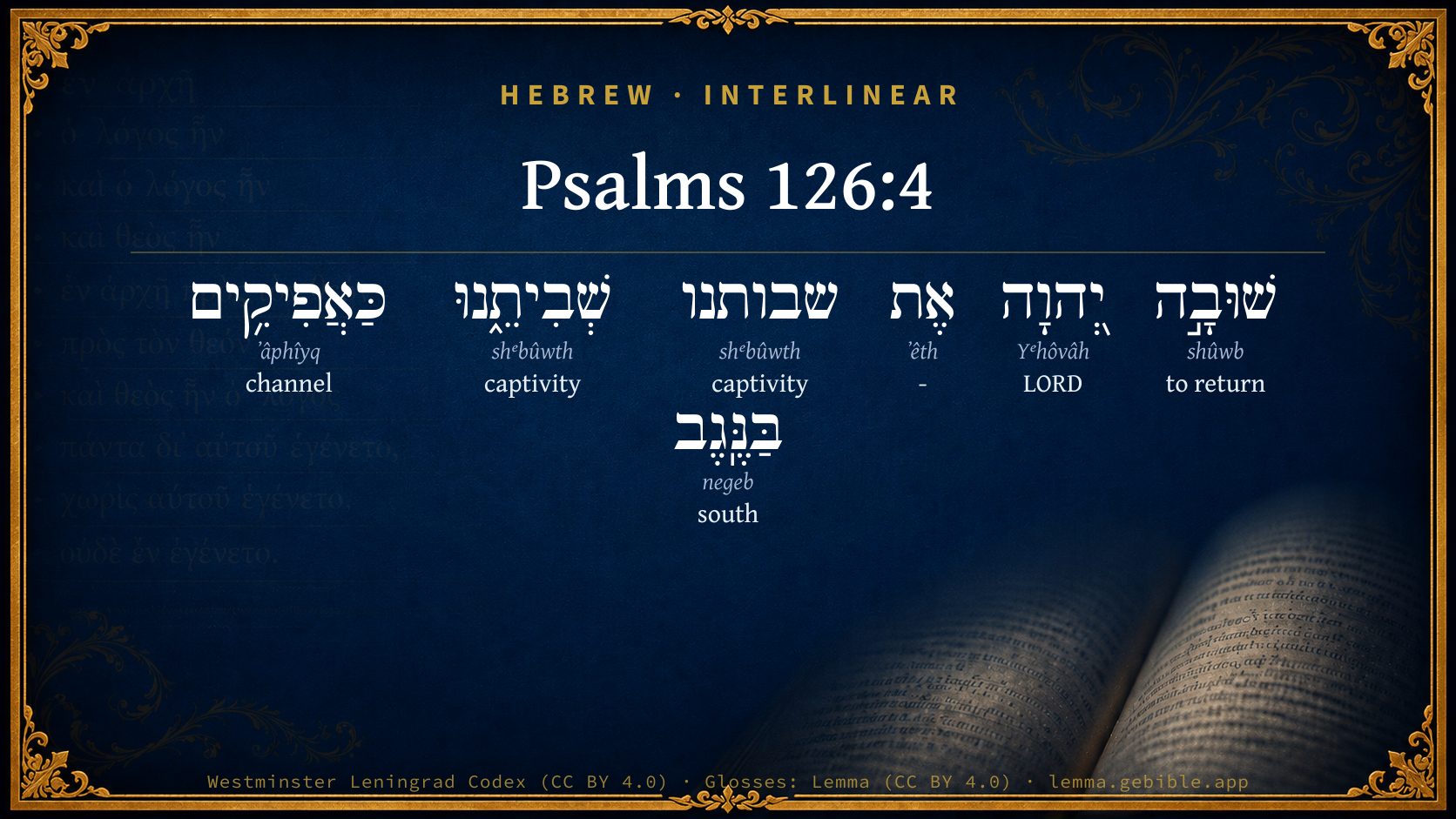
Psalms 126:4

Hebrew (Westminster Leningrad Codex) Psalms 126:4 appears in the Hebrew Old Testament. The text above is from the Westminster Leningrad Codex. Each word links to its Strong’s number, a concise gloss, and parsing drawn from the Open Scriptures Hebrew Bible morphology. Click any word for its full Brown-Driver-Briggs (BDB) entry.
Download image
Cite this verse

Psalms 126:4 (World English Bible). Public Domain. Lemma interlinear Bible study tool, https://lemma.gebible.app/v/psalms/126/4.

Show BibTeX & RIS
BibTeX
RIS
English Translation
Restore our fortunes again, Yahweh, Like the streams in the Negev.
World English Bible · Public Domain
Download a study sheet

One document with this verse’s original text, its word-by-word gloss line, the meaning frame, cross-references with their text, attributed commentary, and full source and license credits — printable, and it pastes into notes with its structure intact.

This verse Autodidact and up

Study sheet (.html) Plain text (.txt)

A passage Seminary Student

Up to 50 verses in one chapter. A passage sheet keeps up to 6 commentary sources and 12 cross-references per verse, in the order this page ranks them, and says so on the sheet whenever that leaves anything out. Ask for a single verse and you get the Autodidact verse sheet above.

Everything on this page stays free to read, with no account — the sheet is a download of what is already on screen, not access to it.

Want to remove ads? Support Godless Engineer
Compare translations 3

The same verse in 3 English versions, stacked beneath the original-language interlinear above. Click any original word for its lexicon entry.

Each is an independent rendering of the whole verse — the interlinear is not word-aligned to these translations.

Highlighted words mark where these versions differ — a whole-verse word diff, not a word-by-word alignment.

  • World English Bible Public Domain
    Restore our fortunes again, Yahweh, Like the streams in the Negev.
  • King James Version Public Domain
    Turn again our captivity, O LORD, as the streams in the south.
  • unfoldingWord Literal Text CC BY-SA 4.0
    Return, Yahweh, our captivity, like the streams in the Negev.

unfoldingWord Literal Text — © unfoldingWord, licensed CC BY-SA 4.0. Word-aligned USFM3 via Door43 (git.door43.org/unfoldingWord/en_ult).

Versions to compare (up to 4)

3 of 4 selected

Show all 18 translations

Every available English version of this verse, each an independent rendering of the whole verse.

  • World English Bible Public Domain
    Restore our fortunes again, Yahweh, Like the streams in the Negev.
  • Berean Standard Bible Public Domain
    Restore our captives, O LORD, like streams in the Negev.
  • Majority Standard Bible Public Domain
    Restore our captives, O LORD, like streams in the Negev.
  • King James Version Public Domain
    Turn again our captivity, O LORD, as the streams in the south.
  • American Standard Version (1901) Public Domain
    Turn again our captivity, O Jehovah, As the streams in the South.
  • Revised Version (1885) Public Domain
    Turn again our captivity, O LORD, as the streams in the South.
  • Geneva Bible (1599) Public Domain
    O Lord, bring againe our captiuitie, as the riuers in the South.
  • Douay-Rheims (1899) Public Domain
    Do good, O Lord, to those that are good, and to the upright of heart.
  • Young's Literal Translation Public Domain
    Turn again, O Jehovah, `to' our captivity, As streams in the south.
  • Literal Standard Version CC BY-SA 4.0
    Turn again, O YHWH, [to] our captivity, || As streams in the south.
  • Unlocked Literal Bible CC BY-SA 4.0
    Restore our fortunes, Yahweh, like the streams in the Negev.
  • unfoldingWord Literal Text CC BY-SA 4.0
    Return, Yahweh, our captivity, like the streams in the Negev.
  • Darby Bible Public Domain
    Turn our captivity, O Jehovah, as the streams in the south.
  • World Messianic Bible Public Domain
    Restore our fortunes again, LORD, like the streams in the Negev.
  • Webster's Bible Public Domain
    Turn again our captivity, O LORD, as the streams in the south.
  • Free Bible Version CC BY-SA 4.0
    Please return and help us again, Lord. Renew us like streams of water that renew the Negev desert.
  • Bible in Basic English Public Domain
    Let our fate be changed, O Lord, like the streams in the South.
  • JPS Tanakh (1917) Public Domain
    Turn our captivity, O LORD, as the streams in the dry land.

Literal Standard Version (2020), Covenant Press — licensed CC BY-SA 4.0. Text via the HelloAO Bible API (eBible.org). Unlocked Literal Bible (unfoldingWord) — licensed CC BY-SA 4.0. Text via the HelloAO Bible API (eBible.org). unfoldingWord Literal Text — © unfoldingWord, licensed CC BY-SA 4.0. Word-aligned USFM3 via Door43 (git.door43.org/unfoldingWord/en_ult). Free Bible Version, Dr. Jonathan Gallagher — licensed CC BY-SA 4.0. Text via the HelloAO Bible API (eBible.org).

Word by word

More ways to search: Search by grammar → Find every occurrence → Compare this word →

Practice this passage: Drill this verse → Learn its vocabulary →

About this verse

These counts appear in no published source. They are computed here, from the morphology-tagged text and Lemma’s own curated glosses. What Lemma adds →

7
words
6
distinct lemmas
Wisdom
section

Notable vocabulary

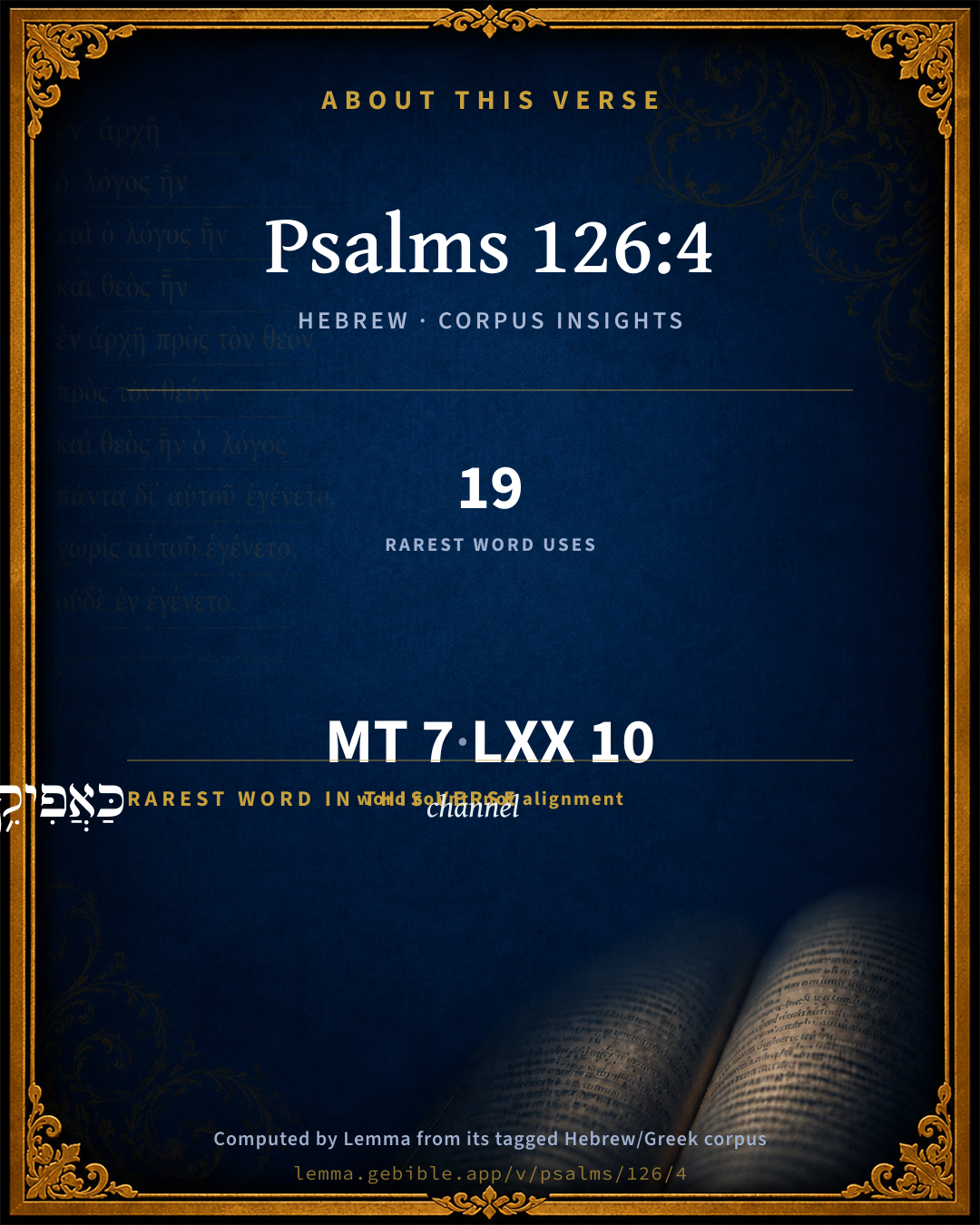
The rarest word here is כַּאֲפִיקִ֥ים channel H650 — appearing just 19 times in the whole Hebrew Bible.

Shared distinctive vocabulary

כַּאֲפִיקִ֥ים channel H650 occurs in 19 verses of the Hebrew Bible. Also found in:

Grammatical profile

  • 1 verb
  • 5 nouns
  • 1 particle

Verb forms

  • שׁוּבָ֣ה Qal · Imperative

Repetition

A word recurs within this verse — often emphatic in Hebrew:

  • שבותנו captivity H7622 ×2

Hebrew & Septuagint length

In English translation the verse runs 11 words from the Hebrew and 11 from the Septuagint (LXX English) — the same length.

A rough comparison of the two English renderings, which tokenize alike — not a word-level alignment.

Word counts can differ between the Hebrew and the Greek without any difference in meaning — e.g. the Hebrew direct-object marker אֵת has no separate Greek word, and Greek often adds the article ὁ.

In the original languages it is 7 Hebrew tokens and 10 Greek tokens — but the two are counted differently (Hebrew bundles its prefixes and suffixes into one token; the Greek is in lemma form), so that isn’t a like-for-like length.

Cross-references

7

Topical passages linked to Psalms 126:4 in the Treasury of Scripture Knowledge — connected by theme and wording, ordered by reader-vote popularity; previews shown in the World English Bible.

  • Psalms 85:4 Turn us, God of our salvation, And cause your indignation toward us to cease.
  • Joshua 3:16 that the waters which came down from above stood, and rose up in one heap, a great way off, at Adam, the city that is beside Zarethan; and those that went down toward the sea of the Arabah, even the Salt Sea, were wholly cut off: and the people passed over right against Jericho.
  • Psalms 126:1 When Yahweh brought back those who returned to Zion, We were like those who dream.
  • Isaiah 35:6 Then shall the lame man leap as a hart, and the tongue of the mute shall sing; for in the wilderness shall waters break out, and streams in the desert.
  • Isaiah 41:18 I will open rivers on the bare heights, and springs in the midst of the valleys; I will make the wilderness a pool of water, and the dry land springs of water.
  • Isaiah 43:19 Behold, I will do a new thing; now shall it spring forth; shall you not know it? I will even make a way in the wilderness, and rivers in the desert.
  • Hosea 1:11 The children of Judah and the children of Israel will be gathered together, and they will appoint themselves one head, and will go up from the land; for great will be the day of Jezreel.

Cross-references courtesy of OpenBible.info (CC BY 4.0).

Hebrew and Greek witnesses Masoretic Hebrew ↔ Greek Septuagint

The same verse in the two great witnesses to the Old Testament, shown verse-for-verse.

You’re reading Greek Psalm 125 (Hebrew Psalm 126). The Septuagint counts the superscription, so verse numbers can differ from the Hebrew — chapter-level alignment, not verse-by-verse. Numbering follows Rahlfs.

These are two independent witnesses, not word-aligned to each other, and the Septuagint is shown in lemma (dictionary) form.

Hebrew Psalms 126:4 Masoretic · Westminster Leningrad Codex

שׁוּבָ֣ה יְ֭הוָה אֶת שבותנו שְׁבִיתֵ֑נוּ כַּאֲפִיקִ֥ים בַּנֶּֽגֶב

Restore our fortunes again, Yahweh, Like the streams in the Negev.

World English Bible · Public Domain

Greek LXX Greek Psalm 125:4 Septuagint · lemma form

ἐπιστρέφω κύριος ὁ αἰχμαλωσία ἐγώ ὡς χειμάρρους ἐν ὁ νότος

Turn, O Lord, our captivity, as the streams in the south.

LXX2012 (modern English Septuagint) · Public Domain

On this verse, Ellicott's Commentary for English Readers discusses the Septuagint’s reading. Read the note in Commentary ↓

Hebrew: Westminster Leningrad Codex (CC BY 4.0). Greek: Septuagint (public domain); English from LXX2012 (modern English Septuagint) (Public Domain). How the Septuagint differs from the Hebrew →

Commentary

Notes on Psalms 126:4 from classic Christian and Jewish commentators (each source and its license shown beneath its notes). The classic Christian expositions comment on the surrounding passage and are grouped to its opening verse, so a note may address several verses; the Jewish commentaries on the Tanakh (Rashi and others) are per-verse, so they appear only where the commentator wrote on this verse.

Lemma curates 59 commentaries, every one of them public domain or Creative Commons licensed, each selected and text-cleaned for this edition rather than reprinted as found. About our sources →

Matthew Henry's Commentary

These verses look forward to the mercies that were yet wanted. Those that had come out of captivity were still in distress, even in their own land (Neh 1:3), and many yet remained in Babylon; and therefore they rejoiced with trembling, and bore upon their hearts the grievances that were yet to be redressed. We have here, 1. A prayer for the perfecting of their deliverance (Psa 126:4): "Turn again our captivity. Let those that have returned to their own land be eased of the burdens which they are yet groaning under. Let those that remain in Babylon have their hearts stirred up, as ours were, to take the benefit of the liberty granted." The beginnings of mercy are encouragements to us to pray for the completing of it. And while we are here in this world there will still be matter for prayer, even when we are most furnished with matter for praise. And, when we are free and in prosperity ourselves, we must not be unmindful of our brethren that are in trouble and under restraint. The bringing of those that were yet in captivity to join with their brethren that had returned would be as welcome to both sides as streams of water in those countries, which, lying far south, were parched and dry. As cold water to a thirsty soul, so would this good news be from that far country, Pro 25:25. 2. A promise for their encouragement to wait for it, assuring them that, though they had now a sorrowful time, yet it would end well. But the promise is expressed generally, that all the saints may comfort themselves with this confidence, that their seedness of tears will certainly end in a harvest of joy at last, Psa 126:5, Psa 126:6. (1.) Suffering saints have a seedness of tears. They are in tears often; they share in the calamities of human life, and commonly have a greater share in them than others. But they sow in tears; they do the duty of an afflicted state and so answer the intentions of the providences they are under. Weeping must not hinder sowing; when we suffer ill we must be doing well. Nay, as the ground is by the rain prepared for the seed, and the husbandman sometimes chooses to sow in the wet, so we must improve times of affliction, as disposing us to repentance, and prayer, and humiliation. Nay, there are tears which are themselves the seed that we must sow, tears of sorrow for sin, our own and others, tears of sympathy with the afflicted church, and the tears of tenderness in prayer and under the word. These are precious seed, such as the husbandman sows when corn is dear and he has but little for his family, and therefore weeps to part with it, yet buries it under ground, in expectation of receiving it again with advantage. Thus does a good man sow in tears. (2.) They shall have a harvest of joy. The troubles of the saints will not last always, but, when they have done their work, shall have a happy period. The captives in Babylon were long sowing in tears, but at length they were brought forth with joy, and then they reaped the benefit of their patient suffering, and brought their sheaves with them to their own land, in their experiences of the goodness of God to them. Job, and Joseph, and David, and many others, had harvests of joy after a sorrowful seedness. Those that sow in the tears of godly sorrow shall reap in the joy of a sealed pardon and a settled peace. Those that sow to the spirit, in this vale of tears, shall of the spirit reap life everlasting, and that will be a joyful harvest indeed. Blessed are those that mourn, for they shall be for ever comforted.

Matthew Henry's Commentary on the Whole Bible (1708–1710) — public domain (CC PDM 1.0). Text via the HelloAO Bible API.

Trapp's Complete Commentary

John Trapp

Psa 126:4 Turn again our captivity, O LORD, as the streams in the south.

Ver. 4. Turn again our captivity, O Lord] Perfect what thou hast so happily begun for us.

As the streams in the south] i.e. Miraculously, say some, as if thou shouldest cause rivers to run in dry and desert places; or comfortably, as if thou shouldest refresh such hot parts with plenty of water. Or, suddenly. The south is a dry country, where are few springs, but oft land floods, caused by the showers of heaven. The Jews at this day pray for a speedy rebuilding of their temple. They cry all together, Templum tuum brevi, valde cito, valde cito, in diebus nostris citissime nunc aedifica, Templum tuum brevi, that is, Build thy temple quickly, very quickly, in our days, &c. Should not we be as earnest for the mystical temple (Buxt. de Synag. Jud. cap. 13).

John Trapp, A Commentary or Exposition upon All the Books of the Old and New Testament (1647–1656) — public domain. Text from a community e-Sword module.

The Biblical Illustrator

Joseph S. Exell

Psa_126:4

Turn again our captivity, O Lord.

The thankful pray

For they have proved the use of prayer. As prayer found cause for praise, gratitude sees reason for renewed supplication. The Lord turned Himself to the turning of Zion. God returns to His people when they return to Him (Deu_4:30-31; Deu_30:1-3; Deu_30:9-10; Neh_1:9; Job_42:10; Psa_145:18-19; Isa_10:21-22; Isa_55:7; Isa_59:20; Jer_31:8-9; Jam_4:8). He liberated the exiles when they repented and offered supplication. If they have reached Mount Zion, there is still need for them to pray. Jehovahs gracious hand has so lifted them a degree higher on the footsteps of His throne, that they may be nearer His inclined ear with their petitions. Let them say to Him, in the language of humble dependence, Turn again our captivity, O Lord, as the streams in the south. Thou art to the soul like rain and fountains to the fields. Drought disappears before Thy breath; and the touch of Thy merciful feet clothes earth with beauty and plenty. And, from their past experience, from the constancy with which God has kept His word, from His demonstrated and eternal unchangeableness, they expect that for which they pray. Faith pleads the promises of Him who cannot lie (Gen_8:22; Psa_85:1-13.). Thou art the same Lord, whose property is always to have mercy. Thy sure mercy we look for. A praying and praising heart is ready for showers of blessing (Joe_2:21). (E. J. Robinson.)

As the streams in the south.--

The streams in the south

In the East the rivers in the dry seasons are little more than fleeting streams, and sometimes they are entirely evaporated by the powerful action of the suns rays. The rainy season comes, and the beds, forsaken of the ancient river, begin to receive their annual tribute from the fruitful clouds, and the mountain-torrent, rolling in its accustomed channel, causes the streams to return again, changing the sandy waste into the majestic river, raising the sewers hopes, replenishing this parched land with the long-desired verdure, and man and beast again rejoice in the earths abundance. Thus prayed the pious psalmist:--Turn again our captivity, O Lord, as the streams in the south: that as the inhabitants of these sultry regions rejoice in the return of the reviving streams, so we, restored to our beloved country and temple, may rejoice in the long-expected deliverance. (W. Brown.)

The Biblical Illustrator, edited by Joseph S. Exell (c. 1880s–1900s) — public domain. Text from a community e-Sword module.

Joseph Benson's Commentary

Psa 126:4. Turn again our captivity, O Lord — Perfect what thou hast begun, and as thou hast brought us home, bring home also the rest of our brethren, who still remain captives in Babylon, or are dispersed in that country, or in any other parts of the world; as the streams in the south — Which would be as welcome to this desolate country as streams of water to the dry and thirsty grounds. Or, that we may refresh and cultivate thy holy land, as the rivers of the south gladden, fructify, and replenish their dry and thirsty soil. The Hebrew word נגב, negeb, here rendered, the south, signifies, says Dr. Hammond, “a dry and parched soil; and, by a figure, is very well used to signify the south, as the soil of the southern countries is very hot, dry, and burned up with the sun. This particularly is the case in Egypt, where they would never have any crops at all, were it not for the annual overflowing of their rivers; so that the psalmist here prays that he would turn their captivity, as he doth the rivers of the south, or of Egypt, to gladden and replenish the otherwise parched and barren earth.” Bishop Lowth, however, and some others, think the image is taken from the torrents in the deserts to the south of Judea; in Idumea, Arabia Petræa, &c., a mountainous country; which torrents were constantly dried up in the summer, and as constantly returned after the rainy season, and filled again their deserted channels: see Job 6:17-18. Thus the Jews had left their country desolate, but now flowed into it again.

Joseph Benson's Commentary on the Old and New Testaments (1811–1818) — public domain. Text from a community e-Sword module.

J. A. Alexander on Psalms

Joseph Addison Alexander

4. (Psa 126:4) Turn, O Jehovah, to our captivity, like the streams in the south. The prayer is that God will return to, or revisit his people in their bondage or distress, and by necessary implication set them free from it. See above, on Psa 126:1 where we have a studied variation of this favourite expression. According to the usual interpretation (bring back our captivity), this verse is either inconsistent with the first, or a proof that the restoration is not mentioned there as past already. Like the streams in the south, as the temporary torrents in the dry southern district of Palestine reappear in the rainy season, after having ceased to flow in the preceding drought.

Joseph Addison Alexander, The Psalms Translated and Explained (1850) — public domain. Text from a community e-Sword module.

Tyndale Open Study Notes

Tyndale Open Resources

126:4-6 The prophets had spoken of the restoration as a time when the wilderness would change into the Garden of Eden (Isa 51:3; Ezek 47); the reality fell far short of paradise. Here the restoration community prays for full redemption (see Hag 2:19). • as streams renew the desert: The seasonal rains filled the dry river beds (wadis), and the land turned green again. The prayer looks for a similar transformation of Israel’s fortunes, a fulfillment of the imagery of the “Second Exodus” in Isaiah (see “The Promise of a Second Exodus” Theme Note). • The harvest represents God’s full restoration.

Tyndale Open Study Notes — © Tyndale Open Resources, licensed CC BY-SA 4.0. Text via the HelloAO Bible API.

Geneva Bible (1599)

Geneva Bible translators

It is no more impossible to God to deliver his people, than to cause the rivers to run in the wilderness and barren places.

Geneva Bible (1599) marginal notes — public domain. Text via Bolls.life.

Adam Clarke's Commentary

Verse 4. Turn again our captivity] This is either a recital of the prayer they had used before their deliverance; or it is a prayer for those who still remained in the provinces beyond the Euphrates. The Jewish captives did not all return at once; they came back at different times, and under different leaders, Ezra, Nehemiah, Zerubbabel, c.

As the streams in the south.] Probably the Nile is meant. It is now pretty well known that the Nile has its origin in the kingdom of Damot and runs from south to north through different countries, till, passing through Egypt, it empties itself into the Mediterranean Sea. It is possible, however, that they might have had in view some rapid rivers that either rose in the south, or had a southern direction; and they desired that their return might be as rapid and as abundant as the waters of those rivers. But we know that the Nile proceeds from the south, divides itself into several streams as it passes through Egypt, and falls by seven mouths into the Mediterranean.

Adam Clarke's Commentary on the Bible (1810–1826) — public domain. Text from a community e-Sword/MySword module.

John Calvin's Commentaries

4. O Jehovah! bring back our captivity. The second part of the Psalm, as I have said, contains a prayer that God would gather together the residue of the captives. The Holy Spirit endited this form of prayer for the Jews who were already come home to their own country, that they might not forget their poor brethren who were still in exile. All the Jews, no doubt, had a door opened to them, and perfect liberty granted them, to come out of the land of their captivity, but the number of those who partook of this benefit was small when compared with the vast multitude of the people. Some were kept from returning by fear, and others by sloth and want of courage, on seeing such perils at hand as they apprehended they had not power to overcome, choosing rather to lie torpid in their own filthiness, than to undertake the hardship of the journey. It is probable also that many of them preferred their present ease and comfort to eternal salvation. What the Prophet Isaiah had foretold was no doubt fulfilled, (Isaiah 10:22,). That although the people were in number as the sand of the sea, yet only a remnant of them should be saved. Since, then, many openly refused the benefit when it was offered them, and as there were not; wanting many difficulties and impediments to be encountered by those who availed themselves of this liberty granted them by the good pleasure of the king, “Precaria libertas.” — Lat. “Ceste liberte obtenue d’eux par le bon plaisir du Roy.” — Fr.

As to the similitude which follows, many think the sense to be, that the bringing back of their captivity prayed for would be as grateful to them as if water should flow through a desert. Walford reads, “like the streams of the south.” — “In the southern districts of Palestine and Arabia,” says he, “the heat is so vehement during some seasons as to dry up the rivers completely, and parch the soil. When rains come, the torrents again flow, and the soil is refreshed and verdant; — a delightful image of the joy experienced by captives on returning to their native land.”

John Calvin's Commentaries (1540-1563) — public domain. Text from the Calvin Translation Society English edition (1840s-50s) via the Christian Classics Ethereal Library (ccel.org). Calvin's coverage is partial (roughly two-thirds of the Bible); uncommented books and verses are honest gaps, never fabricated. The 19th-century editor's footnotes and remarks are omitted so the notes are faithfully Calvin's own voice.

Ellicott's Commentary for English Readers

(4) Captivity.—Here there is a change. The joy of the great Return was too great not to last on through many vicissitudes. But the poet now thinks of the many exiles still dispersed among the nations, and prays for another manifestation of Divine favour and power.

The streams in the south.—Rather, the channels in the south. The allusion is to the sudden filling of the dry torrent-beds of the southern district of Palestine in the rainy season. So the poet prays that torrents of the returned may pour into the desolate and deserted country. (Comp. Isa_49:18 for the same feeling, but under a different figure.) The LXX. have “in the south wind,” evidently thinking of the melting of a frozen stream, instead of the filling of a dry river-bed.

A Bible Commentary for English Readers, edited by Charles John Ellicott (1878–1897) — public domain. Text from a community e-Sword module.

The Cambridge Bible for Schools and Colleges

gen. ed. J. J. S. Perowne

4. Turn again our captivity] Or, Restore our fortunes.

as the streams in the South] The Negeb, or ‘South’ country, literally ‘the dry region,’ was the arid waterless district to the south of Judah (Jdg_1:15), where in summer all the brooks dry up, and are only filled by the autumn rains. Thus far the restoration of Israel has been only as it were a scanty thread of water trickling among the stones, but as in the due season Jehovah refills those stony stream-beds with abundance of sparkling rushing water, so He can re-animate the feeble community of Israel with fresh and vigorous life, and multiply its scanty numbers into the crowds which the prophet’s vision saw streaming to Jerusalem (Isa_49:18).

4–6. Prayer for fuller blessing, and the expression of confident faith that efforts however feeble must bear fruit. These verses evidently imply a background of disappointed hopes and anxious struggles.

The Cambridge Bible for Schools and Colleges (gen. ed. J. J. S. Perowne; Cambridge University Press, 1878–1918) — public domain. Text from a community e-Sword module.

John Gill's Exposition

Turn again our captivity, O Lord,.... This prayer for the return of the captivity shows that it was not as yet: though some think that this is a petition of those that were returned from captivity, for those of their brethren that stayed behind; who, enjoying the sweets of their liberty, pray for their brethren to come and share with them, that so the mercy and blessing might be completed. This may very well be considered as a petition; either for the coming of the Redeemer, and redemption by him from the captivity of sin and Satan, and the law; or for the conversion of the Jews in the latter day. Either of which would be

as the streams in the south; as great and wonderful a work as causing rivers to be in dry places, and as grateful and acceptable as brooks and streams of water in southern countries: or like streams produced by the south wind, which brings rain, and melts the snow from the hills; which, running into the valleys, cause flows of water in great abundance: and so may denote the abundance of those that should share in the blessings of conversion, redemption, and salvation; as well as the wonderfulness and acceptableness of them; see Isa 41:18. The Targum seems to understand it of the change made upon them, like that made on the earth by those; paraphrasing the words,

"as the land is turned, when streams of water flow out in a time of drought.''

The allusion seems to be to Judea, lying south of Babylon; and to the southern parts of Judea, which were dry; see Jos 15:19.

John Gill's Exposition of the Whole Bible (1746–1763) — public domain (CC PDM 1.0). Text via the HelloAO Bible API.

Albert Barnes' Notes on the Bible

Turn again our captivity, O Lord - literally, “Turn our captivity.” The word “again” is inserted by the translators, and conveys an idea which is not necessarily in the original. It is simply a prayer that God would “turn” their captivity; that is, looking upon the captivity as not wholly ended, or as, in some sense, still continuing, that it might please him wholly to turn it, or to end it. The language would be applicable, if there was a new “captivity” similar to the one from which they had been delivered, or if the one mainly referred to was not complete; that is, if a part of the people still remained in bondage. The latter is probably the idea, that while a considerable part of the nation had been restored, and while an order had been issued for the restoration of all the captives to their native land, it was still true that a portion of them remained in exile; and the prayer is, that God would interfere in their behalf, and complete the work. A portion of the exiles, in fact, returned under Cyrus; a part under Darius; a part under Xerxes and his successors. The return was by no means accomplished at once, but occupied a succession of years.

As the streams in the south - In the southern parts of Palestine, or in the regions bordering it on the south - Idumea and Arabia. That is, As those streams when dried up by the summer heat are swelled by autumnal and winter rains, so let the streams of the returning people, which seem now to be diminished, be swelled by augmenting numbers coming again to their own land. Let the companies of returning emigrants be kept full, like swollen streams, until all shall have been brought back.

Albert Barnes' Notes on the Bible (1834–1885) — public domain. Text from a community e-Sword/MySword module.

Matthew Poole's English Annotations

Turn again our captivity; as thou hast brought us home, bring home also the rest of our brethren, who, are dispersed and yet remain captives in Babylon, or in any other parts oft he world. As the streams in the south; as thou art eased sometimes to send floods of water into dry and barren grounds, such as the southern parts of Canaan and the parts adjacent were; which is an act of thy great power and goodness; and no less will this reduction of thy people be, and no less shall we rejoice in it, and bless God for it.

Matthew Poole's English Annotations on the Holy Bible (1683–1685) — public domain. Text from a community e-Sword/MySword module.

The Treasury of David

Charles H. Spurgeon

Ver. 4. Turn again our captivity, O LORD. Remembering the former joy of a past rescue they cry to Jehovah for a repetition of it. When we pray for the turning of our captivity, it is wise to recall former instances thereof: nothing strengthens faith more effectually than the memory of a previous experience. "The Lord hath done" harmonizes well with the prayer, "Turn again." The text shows us how wise it is to resort anew to the Lord, who in former times has been so good to us. Where else should we go but to him who has done such great things for us? Who can turn again our captivity but he who turned it before?

As the streams in the south. Even as the Lord sends floods down on the dry beds of southern torrents after long droughts, so can he fill our wasted and wearied spirits with floods of holy delight. This the Lord can do for any of us, and he can do it at once, for nothing is too hard for the Lord. It is well for us thus to pray, and to bring our suit before him who is able to bless us exceeding abundantly. Do not let us forget the past, but in the presence of our present difficulty let us resort unto the Lord, and beseech him to do that for us which we cannot possibly do for ourselves, that which no other power can perform on our behalf. Israel did return from the captivity in Babylon, and it was even as though a flood of people hastened to Zion. Suddenly and plenteously the people filled again the temple courts. In streams they shall also in the latter days return to their own land, and replenish it yet again. Like mighty torrents shall the nations flow unto the Lord in the day of his grace. May the Lord hasten it in his own time.

Ver. 4. Turn again our captivity, O LORD. A prayer for the perfecting of their deliverance. Let those that are returned to their own land be eased of their burdens which they are yet groaning under. Let those that remain in Babylon have their hearts stirred up, as ours were, to take the benefit of the liberty granted. The beginnings of mercy are encouragements to us to pray for the completing of it. While we are here in this world, there will still be matter for prayer, even when we are most furnished with matter for praise. When we are free, and in prosperity ourselves, we must not be unmindful of our brethren that are in trouble and under restraint. Matthew Henry.

Ver. 4. Turn again our captivity. As Israel of old prayed that he would bring all their brethren scattered abroad in captivity back to their own land in one full stream, multitudinous, joyous, mighty, like the waters of Nile or Euphrates pouring over the parching fields of the south in the hot, dry summertime; so now should the members of Christ's church ever pray that all that profess and call themselves Christians may be led into the way of truth, and hold the faith in unity of spirit, in the bond of peace, and in righteousness of life. J. W. Burgon, in "A Plain Commentary", 1859.

Ver. 4. The Psalmist cries

"Turn our captivity, O Jehovah,

As aqueducts in the Negeb."

This Negeb, or South Country, the region stretching below Hebron, being comparatively dry and without water, was doubtless irrigated by a system of small artificial channels. The words of the Psalmist imply that it is as easy for God to turn Israel back from Babylonian bondage to their own land, as for the horticulturist to direct the waters of the spring to any part of the land he chooses along the channels of the aqueducts. James Neil.

Ver. 4. As the streams in the south. Then shall our captivity be perfectly changed, even as the rivers or waters in the south, which by the mighty work of God were dried up and utterly consumed. Whether ye understand here the Red Sea, or else the river of Jordan, it matters little. The similitude is this: Like as by the mighty hand thou broughtest to pass miraculously that the waters were dried up and consumed, so dry up, O Lord, and bring to nothing all our captivity. Some do interpret this verse otherwise; that is, Turn our captivity, O Lord, as the rivers in the south, which in the summer are dried up in the desert places by the heat of the sun, but in the winter are filled up again with plenty of water. Martin Luther.

Ver. 4. Streams. The Hebrew word for "streams" means strictly a river's bed, the channel which holds water when water is there, but is often dry. Naturally there is joy for the husbandman when those valley beds are filled again with flowing waters. So, the prayer is, let thy people return joyfully to their fatherland. Henry Cowles.

Ver. 4. As the streams in the south. Some render it, As the mighty waters in the south. Why would they have their captivity turned like those mighty floods in the south? The reason is this, because the south is a dry country, where there are few springs, scarce a fountain to be found in a whole desert. What, then, are the waters they have in the south, in those parched countries? They are these mighty strong torrents, which are caused by the showers of heaven: so the meaning of that prayer in the psalm is, that God would suddenly turn their captivity. Rivers come suddenly in the south: where no spring appears, nor any sign of a river, yet in an hour the water is up and the streams overflow. As when Elijah sent his servant toward the sea, in the time of Ahab, he went and looked, and said, "there is nothing"; that is, no show of rain, not the least cloud to be seen; yet presently the heavens grew black, and there was a great rain: 1Ki 18:44. Thus let our captivity be turned thus speedily and suddenly, though there be no appearance of salvation, no more than there is of a fountain in the sandy desert, or of rain in the clearest of heavens, yet bring salvation for us. We use to say of things beyond our supply, Have we a spring of them? or can we fetch them out of the clouds? So though no ground appears whence such rivers should flow, yet let our salvation be as rivers in the south, as rivers fetched out of the clouds, and dropped in an instant immediately from the heavens. Joseph Caryl, 1602-1673.

Ver. 4-6. The saints are oft feeding their hopes on the carcases of their slain fears. The time which God chose and the instrument he used to give the captive Jews their gaol delivery and liberty to return home were so incredible to them when it came to pass (like Peter whom the angel had carried out of prison, Ac 12:1-25), it was some time before they could come to themselves and resolve whether it was a real truth, or but a pleasing dream. Now see, what effect this strange disappointment of their fears had upon their hope for afterward. It sends them to the throne of grace for the accomplishment of what was so marvellously begun. "The Lord hath done great things for us; whereof we are glad. Turn again our captivity, O Lord": Ps 126:3-4. They have got a handhold by this experiment of his power and mercy, and they will not now let him go till they have more; yea, their hope is raised to such a pitch of confidence, that they draw a general conclusion from this particular experience for the comfort of themselves or others in any future distress: "They that sow in tears shall reap in joy", etc., Ps 126:5-6. William Gumall, 1617-1679.

Ver. 4. Believers, rejoicing in their own deliverance, solicitous for a flood of prosperity to overflow the church. See the connection, Ps 126:1-3. Remark,

1. The doubting and despondent are too concerned about themselves, and too busy seeking comfort, to have either solicitude or energy to spare for the church's welfare; but the joyful heart is free to be earnest for the church's good.

2. Joyful believers, other things being equal, know more of the constraining power of Christ's love, which makes them anxious for his glory and the success of his cause.

3. The joyful can appreciate more fully the contrast of their condition to that of the undelivered, and for their sake cannot fail to be anxious for the church through whose ministry their deliverance comes.

4. The joyful are, in general, the most believing and the most hopeful; their expectation of success leads them to prayer, and impels them to effort. J. F.

Ver. 4.

1. The dried up Christian.

2. His unhappy condition.

3. His one hope.

4. Result when realized.

Psalms 126:5*

Charles H. Spurgeon's The Treasury of David (1869–1885) — public domain. Psalms only. Text from a community e-Sword/MySword module.

Whedon's Commentary on the Bible

Daniel D. Whedon

4. Turn again our captivity—The work of returning to their native land from all the parts whither they had been scattered was not accomplished at once. It had now begun gloriously, but was not completed. It was nearly a hundred years from the return of the first caravan, under Zerubbabel, (Ezr_2:1-2,) till that under Nehemiah. Neh_2:5-11.

As the streams in the south—As the brooks in the Negeb, or parched country— the country of Arabia Petrea, called also “the South,” (Isa_21:1,) and often. Here the streams, which dry up in summer, (Job_6:15-20,) rise rapidly in the rainy season. In the region of Sinai, says Palmer, “a single thunderstorm, with a heavy shower of rain falling on the naked granite mountains, will be sufficient to convert a dry and level valley into a roaring river in a few short hours.” Thus the pious Jew prayed that the return of the exiles might be immediate, copious, and refreshing. “The poet proceeds from the idea that the Holy Land yearns after an abundant, re-animating influx of population, as the Negeb thirsts for the rain-water streams.”— Delitzsch.

Daniel D. Whedon (gen. ed.), Commentary on the Old and New Testaments (1874–1909) — public domain. Text from a community e-Sword module.

The Pulpit Commentary

Turn again our captivity, O Lord. The work is not half done not half the nation has returned. We, who occupy the land, are but "a remnant". (Ezr_9:8 Neh_1:3) Bring back, we pray thee, the rest of the captives. As the streams in the south. As thou bringest back, after the autumn rains, ample streams to the dry water-courses of the Negeb, or south country.

A plea for renewed joyous experiences.

In renewing prayer for the "turning again of captivity," the psalmist may but put into a figure his desire that God"s full work of redemption may be completed, and some form of present limitation or peril may be likened to the old captivity, and even seem to be a sort of relic of it. There is a sense in which we may always be praying, "Turn again our captivity." But the figure may be one giving force to prayer for an immediate and unexpected Divine deliverance, such as the return from captivity had been. "O Jehovah, relieve our misery suddenly, and, as it may well be said, miraculously; as streams in the wilderness, which one moment are dead and dry, and then suddenly become flowing rivers." It may be that in the mind of the psalmist was the fact that only a small portion of the nation had responded to the edict of Cyrus. And his prayer may be that the rest of Israel might be induced to flood the still desolate land. "Restore our captive compatriots, just as water is restored by heavy rains to the water-courses of the parched district south of Palestine, to the delight of the inhabitants". (comp. Isa_49:18, where the land, like a bereaved mother, waits for her children, whose return will fill her heart with joy)

I THE PAST OF GOD"S BLESSING MAY BE JOYFULLY RECOGNIZED. It should be. Israel loved to hear the story of God"s ways with the fathers told over and over. We should never tire of going over our early experiences of delivering and redeeming mercy.

II THE PAST OF GOD"S BLESSING OUGHT NEVER TO SATISFY US. It is past and gone; it is but a memory. "Things won are done." We continue, and we cannot rest without the assurance that God is doing for us what he has done. The restored exiles cannot rest with God"s turning their captivity, and restoring a few of their number; they must ask for a renewal of the blessing. "Turn again our captivity." From God"s grace in the past we "draw a plea, to ask him still for more." We cannot be satisfied save with renewals of joyful experiences.

III THE PAST OF GOD"S BLESSING IS THE PLEDGE OF GREATER BLESSING. God never exhausts himself in any good he does. Instead, by a present blessing, he opens the way for, and prepares us to receive, a larger blessing. Giving, he does but make possible his giving still more. R.T.

The Pulpit Commentary (1880–1919), ed. H.D.M. Spence-Jones & Joseph S. Exell — public domain. Text from a community e-Sword module.

John Wesley's Explanatory Notes

Turn - As thou hast brought us home, bring also the rest of our brethren. As - As thou art pleased sometimes to send floods of water into dry and barren grounds, such as the southern parts of Canaan were.

John Wesley, Explanatory Notes Upon the Whole Bible (1754–1765) — public domain. Text via the GEBible commentary corpus.

Keil & Delitzsch

C. F. Keil & F. Delitzsch

But still the work so mightily and graciously begun is not completed. Those who up to the present time have returned, out of whose heart this Psalm is, as it were, composed, are only like a small vanguard in relation to the whole nation. Instead of שׁבותנו the Kerמ here reads שׁביתנוּ, from שׁבית, Num 21:29, after the form בכית in Gen 50:4. As we read elsewhere that Jerusalem yearns after her children, and Jahve solemnly assures her, "thou shalt put them all on as jewels and gird thyself like a bride" (Isa 49:18), so here the poet proceeds from the idea that the holy land yearns after an abundant, reanimating influx of population, as the Negeb (i.e., the Judaean south country, Gen 20:1, and in general the south country lying towards the desert of Sinai) thirsts for the rain-water streams, which disappear in the summer season and regularly return in the winter season. Concerning אפיק, "a water-holding channel," vid., on Psa 18:16. If we translate converte captivitatem nostram (as Jerome does, following the lxx), we shall not know what to do with the figure, whereas in connection with the rendering reduc captivos nostros it is just as beautifully adapted to the object as to the governing verb. If we have rightly referred negeb not to the land of the Exile but to the Land of Promise, whose appearance at this time is still so unlike the promise, we shall now also understand by those who sow in tears not the exiles, but those who have already returned home, who are again sowing the old soil of their native land, and that with tears, because the ground is so parched that there is little hope of the seed springing up. But this tearful sowing will be followed by a joyful harvest. One is reminded here of the drought and failure of the crops with which the new colony was visited in the time of Haggai, and of the coming blessing promised by the prophet with a view to the work of the building of the Temple being vigorously carried forward. Here, however, the tearful sowing is only an emblem of the new foundation-laying, which really took place not without many tears (Ezr 3:12), amidst sorrowful and depressed circumstances; but in its general sense the language of the Psalm coincides with the language of the Preacher on the Mount, Mat 5:4 : Blessed are those who mourn, for they shall be comforted. The subject to Psa 126:6 is the husbandman, and without a figure, every member of the ecclesia pressa. The gerundial construction in Psa 126:6 (as in Sa2 3:16; Jer 50:4, cf. the more Indo-Germanic style of expression in Sa2 15:30) depicts the continual passing along, here the going to and fro of the sorrowfully pensive man; and Psa 126:6 the undoubted coming and sure appearing of him who is highly blessed beyond expectation. The former bears משׁך הזּרע, the seed-draught, i.e., the handful of seed taken from the rest for casting out (for משׁך הזּרע in Amo 9:13 signifies to cast forth the seed along the furrows); the latter his sheaves, the produce (תּבוּאה), such as puts him to the blush, of his, as it appeared to him, forlorn sowing. As by the sowing we are to understand everything that each individual contributes towards the building up of the kingdom of God, so by the sheaves, the wholesome fruit which, by God bestowing His blessing upon it beyond our prayer and comprehension, springs up from it.

Keil & Delitzsch — Biblical Commentary on the Old Testament (1861–1891) — public domain (CC PDM 1.0). Text via the HelloAO Bible API. (Old Testament only.)

unfoldingWord translationNotes

Door43 World Missions Community

Those who sow in tears ... He who goes out weeping ... bringing his bundles of grain with him

These two verses parallel each other. The second sentence has the same meaning as first sentence, but it gives more details. (See: Parallelism)

Those who sow in tears

"Those who sow with tears"

translationWords

restore

Negev

plant

joy

unfoldingWord translationNotes — © Distant Shores Media and the Door43 World Missions Community, licensed CC BY-SA 4.0. Source: git.door43.org/Door43/en_tn.

Rashi

Rabbi Shlomo Yitzchaki (Rashi)

like rivulets in arid land Like rivulets in arid land, which moisten it, so shall we be moistened [freshened] when You return [us from] our captivity, for those who sow in an arid land, with tears, worrying that it will not grow, reap with song through the rivulets of water, when they are directed into it [that land].

Rashi on the Tanakh — English translations: “The Judaica Press complete Tanach with Rashi, translated by A. J. Rosenberg” (CC BY 4.0); “Pentateuch with Rashi's commentary by M. Rosenbaum and A.M. Silbermann, 1929-1934” (public domain); “The Metsudah Tanach series, Lakewood, N.J” (CC BY 4.0); and “The Book of Joshua, Metsudah Publications, 1997” (CC BY 4.0). Text via Sefaria.

Lesson kit

Teaching starters — assembled from the data on this page, not authored interpretation. Every prompt links to the verse data it draws on. Edit before teaching.

Psalms, in the Wisdom, opens this verse with 7 words (6 distinct Hebrew lemmas). Its most distinctive word is ʼâphîyq (“channel”). A historical commentator’s framing appears above. Read the whole chapter for the surrounding context.

Discussion questions

  1. How does “channel” (ʼâphîyq) shape what this verse is saying?
  2. How does 2 Samuel 22:16, which shares the word «channel», read alongside this verse?
  3. What does the repetition of “captivity” (2× in this one verse) do in this verse?
  4. These translations render this verse differently; the difference is in the English rendering, not the original. What questions does that raise?
  5. «שׁוּבָ֣ה» is a Qal Imperative verb. How does that grammatical form shape the action described?
  6. Compare how Matthew Henry's Commentary and Trapp's Complete Commentary read this verse. Where do they agree or differ?

Things to notice

Reading settings

Reading text

Shown beneath each verse's original-language words.

Old Testament
Old Testament edition

Read the OT as the Masoretic Hebrew (MT) or the Greek Septuagint (LXX).

English shown for the Greek Septuagint (in the Hebrew ↔ Greek comparison).

Comparing translations? Open the Compare panel on any verse page to stack up to four side by side.