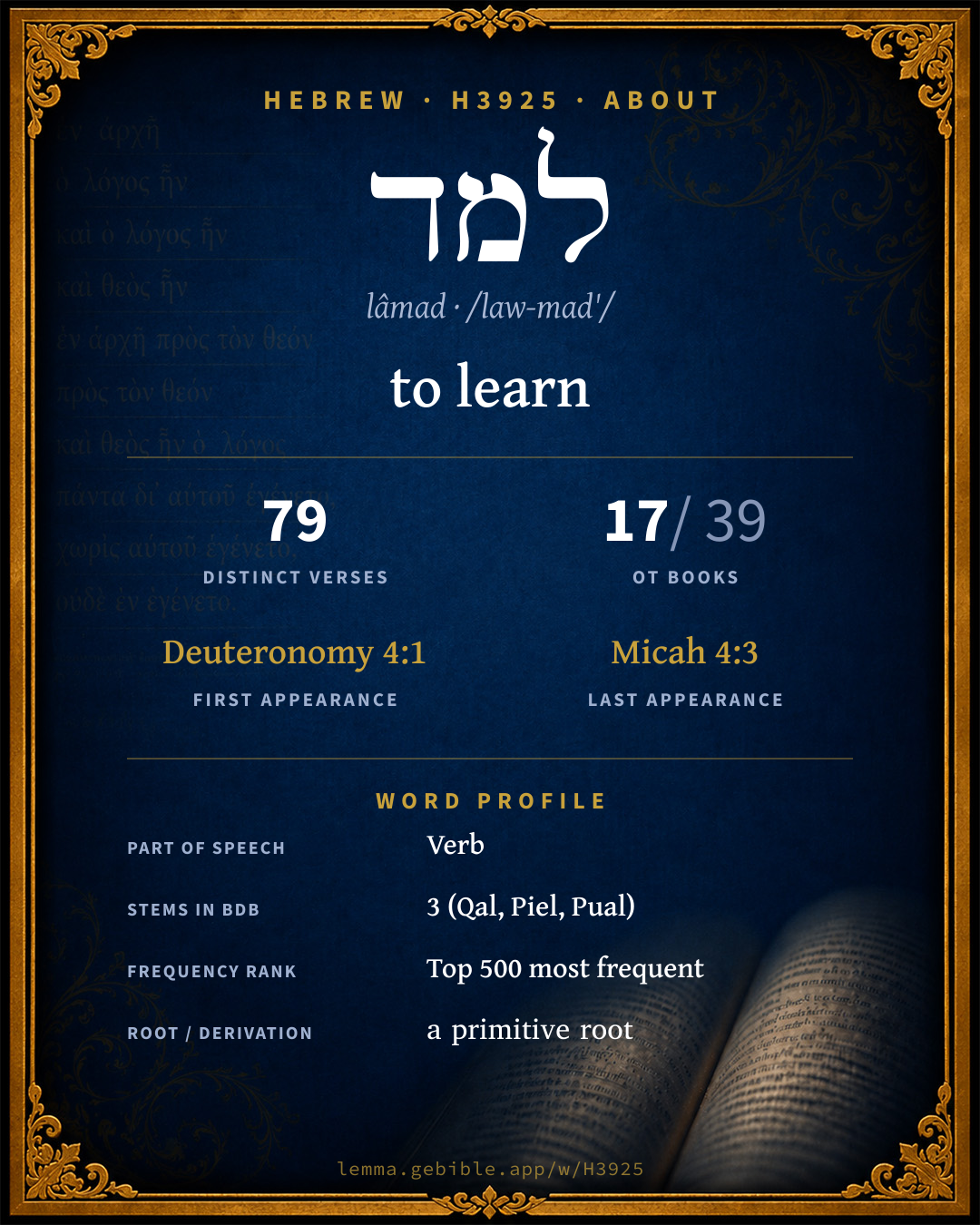
לָמַד
to learn
‘to learn’ is one of 4 main senses fuller range ↓
Full lexicon entry — Brown-Driver-Briggs (BDB)
From Brown-Driver-Briggs (BDB)
Where this word appears
See every Piel verb in the Hebrew Bible →
Grammar key — what these labels mean
Part of speech
- Verb
- An action or state-of-being word.
Stem
- Piel
- An intensive or resultative active stem.
- Qal
- The basic, simple active stem — the plain form of the verb (“he wrote”).
- Pual
- The passive counterpart of the Piel.
Form
- Imperative
- A direct command (“write!”).
- Infinitive Construct
- A bound verbal noun, frequently with prepositions (“to write / in writing”).
- Imperfect
- An incomplete, ongoing, or future action (“he will / would write”).
- Perfect
- A completed action or state — Hebrew marks aspect (completeness) more than strict tense (“he wrote”).
- Participle Active
- A verbal adjective expressing ongoing or characteristic action (“writing / one who writes”).
- Infinitive Absolute
- An unbound verbal noun, often intensifying or standing in for a finite verb.
- Sequential Imperfect
- An imperfect with prefixed waw — the standard past-narrative form (waw-consecutive imperfect).
- Participle Passive
- A verbal adjective expressing action received (“written”).
- Sequential Perfect
- A perfect with prefixed waw continuing a preceding imperfect or command (waw-consecutive perfect).
- Cohortative
- A first-person volitional form expressing wish or resolve (“let me / let us write”).
- Jussive
- A third- or second-person volitional form expressing wish or command (“let him write”).
State
- Absolute
- The independent form of a noun, not bound to a following word.
- Construct
- A noun bound to a following noun in a possessive / “of” relationship (the construct chain).
Person
- 2nd Person
- The one addressed (“you”).
- 3rd Person
- The one spoken about (“he / she / it / they”).
- 1st Person
- The speaker (“I / we”).
Gender
- Masculine
- Grammatically masculine.
- Common
- Either gender — not distinguished for this form.
- Feminine
- Grammatically feminine.
Number
- Singular
- One.
- Plural
- More than one (in Hebrew, generally three or more).
Grammatical forms 41 distinct
- Verb, Piel, Imperative, 2nd Person, Masculine, Singular 12 times (14%)
- Verb, Piel, Infinitive Construct 7 times (8%)
- Verb, Qal, Imperfect, 3rd Person, Masculine, Plural 6 times (7%)
- Verb, Piel, Participle Active, Masculine, Singular, Absolute 5 times (6%)
- Verb, Piel, Perfect, 1st Person, Common, Singular 3 times (3%)
- Verb, Piel, Sequential Imperfect, 3rd Person, Masculine, Singular 3 times (3%)
- Verb, Piel, Imperfect, 3rd Person, Masculine, Plural 3 times (3%)
- Verb, Piel, Perfect, 3rd Person, Common, Plural 3 times (3%)
+33 more forms (44 occurrences)
Parsed forms decoded from the imported morphology (morphhb / Westminster Leningrad Codex — WLC text public domain, morphhb tagging CC BY 4.0), counted across 86 parsed occurrences — not distinct verses.
Every verse where H3925 appears — 79 distinct verses across 17 books. Click any verse to open its interlinear word-by-word view. Verse text shown in the World English Bible for context — . Each verse’s Hebrew form is shown with its reference; the English is not keyword-highlighted, since the data carries no word-level English alignment. Use “Compare translations” on any verse to read it across multiple English versions. This concordance covers the Hebrew Bible; Septuagint (Greek Old Testament) occurrences are not indexed here.
Deuteronomy 16 verses
- Deuteronomy 4:1 מְלַמֵּ֥ד Piel ptcp.act ms Now, Israel, listen to the statutes and to the ordinances, which I teach you, to do them; that you may live, and go in and possess the land which Yahweh, the God of your fathers, gives you.
- Deuteronomy 4:5 לִמַּ֣דְתִּי Piel pf 1cs Behold, I have taught you statutes and ordinances, even as Yahweh my God commanded me, that you should do so in the midst of the land where you go in to possess it.
- Deuteronomy 4:10 יִלְמְד֜וּ/ן יְלַמֵּדֽוּ/ן Qal impf 3mp + sfx n Piel impf 3mp + sfx n the day that you stood before Yahweh your God in Horeb, when Yahweh said to me, Assemble me the people, and I will make them hear my words, that they may learn to fear me all the days that they live on the earth, and that they may teach their children.
- Deuteronomy 4:14 לְ/לַמֵּ֣ד prep + Piel inf.cs Yahweh commanded me at that time to teach you statutes and ordinances, that you might do them in the land where you go over to possess it.
- Deuteronomy 5:1 וּ/לְמַדְתֶּ֣ם conj + Qal wpf 2mp Moses called to all Israel, and said to them, Hear, Israel, the statutes and the ordinances which I speak in your ears this day, that you may learn them, and observe to do them.
- Deuteronomy 5:31 תְּלַמְּדֵ֑/ם Piel impf 2ms + sfx pers 3mp But as for you, stand you here by me, and I will speak to you all the commandment, and the statutes, and the ordinances, which you shall teach them, that they may do them in the land which I give them to possess it.
- Deuteronomy 6:1 לְ/לַמֵּ֣ד prep + Piel inf.cs Now this is the commandment, the statutes, and the ordinances, which Yahweh your God commanded to teach you, that you might do them in the land where you go over to possess it;
- Deuteronomy 11:19 וְ/לִמַּדְתֶּ֥ם conj + Piel wpf 2mp You shall teach them your children, talking of them, when you sit in your house, and when you walk by the way, and when you lie down, and when you rise up.
- Deuteronomy 14:23 תִּלְמַ֗ד Qal impf 2ms You shall eat before Yahweh your God, in the place which he shall choose, to cause his name to dwell there, the tithe of your grain, of your new wine, and of your oil, and the firstborn of your herd and of your flock; that you may learn to fear Yahweh your God always.
- Deuteronomy 17:19 יִלְמַ֗ד Qal impf 3ms and it shall be with him, and he shall read therein all the days of his life; that he may learn to fear Yahweh his God, to keep all the words of this law and these statutes, to do them;
- Deuteronomy 18:9 תִלְמַ֣ד Qal impf 2ms When you are come into the land which Yahweh your God gives you, you shall not learn to do after the abominations of those nations.
- Deuteronomy 20:18 יְלַמְּד֤וּ Piel impf 3mp that they not teach you to do after all their abominations, which they have done to their gods; so would you sin against Yahweh your God.
- Deuteronomy 31:12 יִלְמְד֗וּ Qal impf 3mp Assemble the people, the men and the women and the little ones, and your foreigner who is within your gates, that they may hear, and that they may learn, and fear Yahweh your God, and observe to do all the words of this law;
- Deuteronomy 31:13 וְ/לָ֣מְד֔וּ conj + Qal wpf 3cp and that their children, who have not known, may hear, and learn to fear Yahweh your God, as long as you live in the land where you go over the Jordan to possess it.
- Deuteronomy 31:19 וְ/לַמְּדָ֥/הּ conj + Piel impv 2ms + sfx pers 3fs Now therefore write you this song for you, and teach you it the children of Israel: put it in their mouths, that this song may be a witness for me against the children of Israel.
- Deuteronomy 31:22 וַֽ/יְלַמְּדָ֖/הּ conj + Piel wimpf 3ms + sfx pers 3fs So Moses wrote this song the same day, and taught it the children of Israel.
Judges 1 verse
2 Samuel 2 verses
1 Chronicles 2 verses
- 1 Chronicles 5:18 וּ/לְמוּדֵ֖י conj + Qal ptcp.pass mp cs The sons of Reuben, and the Gadites, and the half-tribe of Manasseh, of valiant men, men able to bear buckler and sword, and to shoot with bow, and skillful in war, were forty-four thousand seven hundred and sixty, that were able to go forth to war.
- 1 Chronicles 25:7 מְלֻמְּדֵי Pual ptcp.pass mp cs The number of them, with their brothers who were instructed in singing to Yahweh, even all who were skillful, was two hundred eighty-eight.
2 Chronicles 2 verses
- 2 Chronicles 17:7 לְ/לַמֵּ֖ד prep + Piel inf.cs Also in the third year of his reign he sent his princes, even Ben Hail, and Obadiah, and Zechariah, and Nethanel, and Micaiah, to teach in the cities of Judah;
- 2 Chronicles 17:9 וַֽ/יְלַמְּדוּ֙ וַֽ/יְלַמְּד֖וּ conj + Piel wimpf 3mp conj + Piel wimpf 3mp They taught in Judah, having the book of the law of Yahweh with them; and they went about throughout all the cities of Judah, and taught among the people.
Ezra 1 verse
Job 1 verse
Psalms 26 verses
- Psalms 18:34 מְלַמֵּ֣ד Piel ptcp.act ms He teaches my hands to war; So that my arms bend a bow of bronze.
- Psalms 25:4 לַמְּדֵֽ/נִי Piel impv 2ms + sfx pers 1cs Show me your ways, Yahweh. Teach me your paths.
- Psalms 25:5 וְֽ/לַמְּדֵ֗/נִי conj + Piel impv 2ms + sfx pers 1cs Guide me in your truth, and teach me, For you are the God of my salvation, I wait for you all day long.
- Psalms 25:9 וִֽ/ילַמֵּ֖ד conj + Piel impf 3ms He will guide the humble in justice. He will teach the humble his way.
- Psalms 34:11 אֲלַמֶּדְ/כֶֽם Piel impf 1cs + sfx pers 2mp Come, you children, listen to me. I will teach you the fear of Yahweh.
- Psalms 51:13 אֲלַמְּדָ֣ה Piel coh 1cs Then I will teach transgressors your ways. Sinners shall be converted to you.
- Psalms 71:17 לִמַּדְתַּ֥/נִי Piel pf 2ms + sfx pers 1cs God, you have taught me from my youth. Until now, I have declared your wondrous works.
- Psalms 94:10 הַֽ/מְלַמֵּ֖ד ptcl def.art + Piel ptcp.act ms He who disciplines the nations, won't he punish? He who teaches man knows.
- Psalms 94:12 תְלַמְּדֶֽ/נּוּ Piel impf 2ms + sfx pers 3ms Blessed is the man whom you discipline, Yah, And teach out of your law;
- Psalms 106:35 וַֽ֝/יִּלְמְד֗וּ conj + Qal wimpf 3mp But mixed themselves with the nations, And learned their works.
- Psalms 119:7 בְּ֝/לָמְדִ֗/י prep + Qal inf.cs + sfx pers 1cs I will give thanks to you with uprightness of heart, When I learn your righteous judgments.
- Psalms 119:12 לַמְּדֵ֥/נִי Piel impv 2ms + sfx pers 1cs Blessed are you, Yahweh. Teach me your statutes.
- Psalms 119:26 לַמְּדֵ֥/נִי Piel impv 2ms + sfx pers 1cs I declared my ways, and you answered me. Teach me your statutes.
- Psalms 119:64 לַמְּדֵֽ/נִי Piel impv 2ms + sfx pers 1cs The earth is full of your loving kindness, Yahweh. Teach me your statutes.
- Psalms 119:66 לַמְּדֵ֑/נִי Piel impv 2ms + sfx pers 1cs Teach me good judgment and knowledge, For I believe in your commandments.
- Psalms 119:68 לַמְּדֵ֥/נִי Piel impv 2ms + sfx pers 1cs You are good, and do good. Teach me your statutes.
- Psalms 119:71 אֶלְמַ֥ד Qal impf 1cs It is good for me that I have been afflicted, That I may learn your statutes.
- Psalms 119:73 וְ/אֶלְמְדָ֥ה conj + Qal coh 1cs Your hands have made me and formed me. Give me understanding, that I may learn your commandments.
- Psalms 119:99 מְלַמְּדַ֥/י Piel ptcp.act mp cs + sfx pers 1cs I have more understanding than all my teachers, For your testimonies are my meditation.
- Psalms 119:108 לַמְּדֵֽ/נִי Piel impv 2ms + sfx pers 1cs Accept, I beg you, the willing offerings of my mouth. Yahweh, teach me your ordinances.
- Psalms 119:124 לַמְּדֵֽ/נִי Piel impv 2ms + sfx pers 1cs Deal with your servant according to your loving kindness. Teach me your statutes.
- Psalms 119:135 וְ֝/לַמְּדֵ֗/נִי conj + Piel impv 2ms + sfx pers 1cs Make your face shine on your servant. Teach me your statutes.
- Psalms 119:171 תְלַמְּדֵ֣/נִי Piel impf 2ms + sfx pers 1cs Let my lips utter praise, For you teach me your statutes.
- Psalms 132:12 אֲלַ֫מְּדֵ֥/ם Piel impf 1cs + sfx pers 3mp If your children will keep my covenant, My testimony that I will teach them, Their children also will sit on your throne forevermore."
- Psalms 143:10 לַמְּדֵ֤/נִי Piel impv 2ms + sfx pers 1cs Teach me to do your will, For you are my God. Your Spirit is good. Lead me in the land of uprightness.
- Psalms 144:1 הַֽ/מְלַמֵּ֣ד ptcl def.art + Piel ptcp.act ms Blessed be Yahweh, my rock, Who teaches my hands to war, And my fingers to battle:
Proverbs 2 verses
Ecclesiastes 1 verse
Song of Solomon 2 verses
- Song of Solomon 3:8 מְלֻמְּדֵ֖י Pual ptcp.pass mp cs They all handle the sword, and are expert in war. Every man has his sword on his thigh, Because of fear in the night.
- Song of Solomon 8:2 תְּלַמְּדֵ֑/נִי Piel impf 3fs + sfx pers 1cs I would lead you, bringing you into my mother's house, Who would instruct me. I would have you drink spiced wine, Of the juice of my pomegranate.
Isaiah 8 verses
- Isaiah 1:17 לִמְד֥וּ Qal impv 2mp Learn to do well. Seek justice, Relieve the oppressed, Judge the fatherless, Plead for the widow."
- Isaiah 2:4 יִלְמְד֥וּ Qal impf 3mp He will judge between the nations, And will decide concerning many peoples; And they shall beat their swords into plowshares, And their spears into pruning-hooks. Nation shall not lift up sword against nation, Neither shall they learn war any more.
- Isaiah 26:9 לָמְד֖וּ Qal pf 3cp With my soul have I desired you in the night; yes, with my spirit within me will I seek you earnestly: for when your judgments are in the earth, the inhabitants of the world learn righteousness.
- Isaiah 26:10 לָמַ֣ד Qal pf 3ms Let favor be shown to the wicked, yet will he not learn righteousness; in the land of uprightness will he deal wrongfully, and will not see the majesty of Yahweh.
- Isaiah 29:13 מְלֻמָּדָֽה Pual ptcp.pass fs The Lord said, Because this people draw near [to me], and with their mouth and with their lips to honor me, but have removed their heart far from me, and their fear of me is a commandment of men which has been taught [them];
- Isaiah 29:24 יִלְמְדוּ Qal impf 3mp They also who err in spirit shall come to understanding, and those who murmur shall receive instruction.
- Isaiah 40:14 וַֽ/יְלַמְּדֵ֖/הוּ וַ/יְלַמְּדֵ֣/הוּ conj + Piel wimpf 3ms + sfx pers 3ms conj + Piel wimpf 3ms + sfx pers 3ms With whom took he counsel, and who instructed him, and taught him in the path of justice, and taught him knowledge, and shown to him the way of understanding?
- Isaiah 48:17 מְלַמֶּדְ/ךָ֣ Piel ptcp.act ms cs + sfx pers 2ms Thus says Yahweh, your Redeemer, the Holy One of Israel: I am Yahweh your God, who teaches you to profit, who leads you by the way that you should go.
Jeremiah 10 verses
- Jeremiah 2:33 למדתי לִמַּ֖דְתְּ Piel pf 1cs Piel pf 1cs How trimmest you your way to seek love! therefore even the wicked women have you taught your ways.
- Jeremiah 9:5 לִמְּד֧וּ Piel pf 3cp They will deceive everyone his neighbor, and will not speak the truth: they have taught their tongue to speak lies; they weary themselves to commit iniquity.
- Jeremiah 9:14 לִמְּד֖וּ/ם Piel pf 3cp + sfx pers 3mp but have walked after the stubbornness of their own heart, and after the Baals, which their fathers taught them;
- Jeremiah 9:20 וְ/לַמֵּ֤דְנָה conj + Piel impv 2fp Yet hear the word of Yahweh, you women, and let your ear receive the word of his mouth; and teach your daughters wailing, and everyone her neighbor lamentation.
- Jeremiah 10:2 תִּלְמָ֔דוּ Qal juss 2mp Thus says Yahweh, "Don't learn the way of the nations, and don't be dismayed at the signs of the sky; for the nations are dismayed at them.
- Jeremiah 12:16 לָמֹ֣ד יִלְמְדוּ֩ לִמְּדוּ֙ Qal inf.abs Qal impf 3mp Piel pf 3cp It shall happen, if they will diligently learn the ways of my people, to swear by my name, As Yahweh lives; even as they taught my people to swear by Baal; then shall they be built up in the midst of my people.
- Jeremiah 13:21 לִמַּ֨דְתְּ Piel pf 2fs What will you say, when he shall set over you as head those whom you have yourself taught to be friends to you? shall not sorrows take hold of you, as of a woman in travail?
- Jeremiah 31:18 לֻמָּ֑ד Pual pf 3ms I have surely heard Ephraim bemoaning himself [thus], You have chastised me, and I was chastised, as a calf unaccustomed [to the yoke]: turn you me, and I shall be turned; for you are Yahweh my God.
- Jeremiah 31:34 יְלַמְּד֣וּ Piel impf 3mp and they shall teach no more every man his neighbor, and every man his brother, saying, Know Yahweh; for they shall all know me, from the least of them to the greatest of them, says Yahweh: for I will forgive their iniquity, and their sin will I remember no more.
- Jeremiah 32:33 וְ/לַמֵּ֤ד וְ/לַמֵּ֔ד conj + Piel inf.abs conj + Piel inf.abs They have turned to me the back, and not the face: and though I taught them, rising up early and teaching them, yet they have not listened to receive instruction.
Ezekiel 2 verses
- Ezekiel 19:3 וַ/יִּלְמַ֥ד conj + Qal wimpf 3ms She brought up one of her cubs: he became a young lion, and he learned to catch the prey; he devoured men.
- Ezekiel 19:6 וַ/יִּלְמַ֥ד conj + Qal wimpf 3ms He went up and down among the lions; he became a young lion, and he learned to catch the prey; he devoured men.
Daniel 1 verse
Hosea 1 verse
Micah 1 verse
About this entry
At a glance — auto-summarized from this page’s data, not written by a person. Every figure links to its source below. This summary describes the numbers; it doesn’t interpret them.
At its core, למד (lâmad) means “to learn.” Scripture first uses it in Deuteronomy 4:1. With 79 verses in 17 books, it is a moderately common word in the Hebrew Bible. Its uses concentrate in Psalms (33% of all occurrences). Different stems carry different senses — BDB groups them under 3 stems, among them Qal and Piel. Dig into 79-verse concordance and the renderings breakdown below.
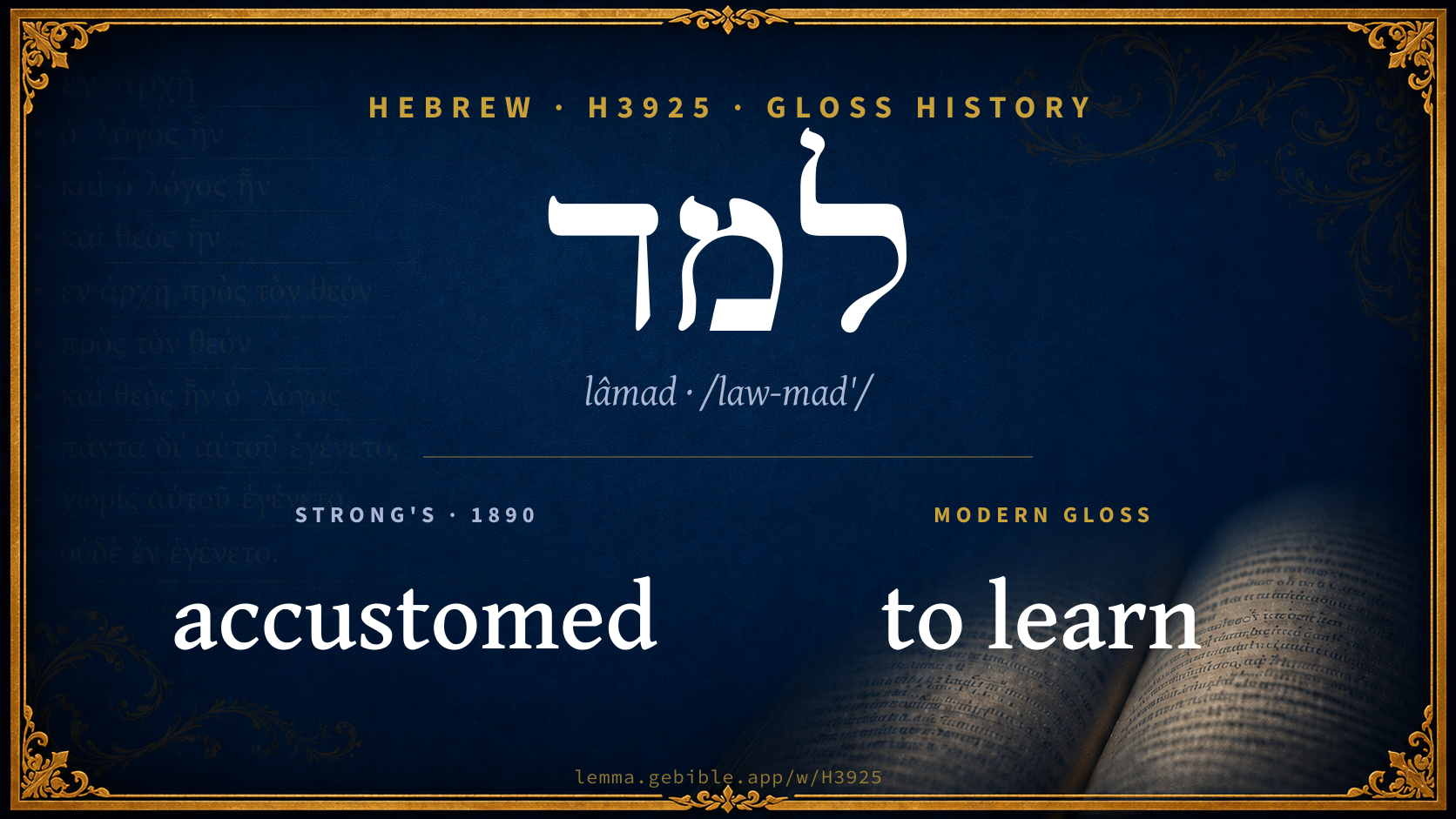
Gloss history
Strong's 1890 vs modern scholarship
About this word
Strong's H3925 catalogs a Hebrew word from the Hebrew Old Testament.
These counts are not copied from any lexicon or concordance. They are computed here, from the morphology-tagged Hebrew Old Testament. What Lemma adds →
- 79
- distinct verses
- The word appears in 79 distinct verses.
- 17 / 39
- OT books
- The word appears in 17 of 39 Old Testament books.
- #475
- by frequency
- Top 500 most frequent Hebrew words (rank 475 of 8,640 Hebrew words by occurrence).
View all 79 occurrences in the concordance →
Most concentrated in
- Psalms 26 verses 33%
- Deuteronomy 16 verses 20%
- Jeremiah 10 verses 13%
By section of the Old Testament
By traditional corpus
Conventional, traditional groupings — biblical authorship is debated, so this is a traditional corpus grouping, not an authorship claim. Each share is this word’s portion of its verses in that division of the Hebrew canon. Each figure is a share of the word’s 79 distinct verses.
- Writings (Ketuvim) 38 verses · 48%
- Prophets (Nevi'im) 25 verses · 32%
- Torah (Pentateuch) 16 verses · 20%
How translations render this word
Counts come from each version’s own published word-to-Strong’s tagging or interlinear alignment — an approximate guide to how each version renders this word, not a word-level alignment the data otherwise carries. Because each total is that version’s own tagged count, the per-version totals vary from one another and need not match the appearance or distinct-verse counts above. These counts may also differ from a printed concordance because Lemma counts each distinctly tagged rendering and does not collapse phrase taggings into a single head-word total. This is a fixed set of word-tagged versions (KJV, ASV, BSB, ULT) and does not change with the reading translation you choose elsewhere. Each version’s license is shown beside its name below (and on Sources).
- King James Version: Teach 19×, Learn 5×, Taught 5×
- American Standard Version: Teach 15×, Learn 5×, Taught 3×
- Berean Standard Bible: Teach 11×, Teach me 10×, Learn 8×
- unfoldingWord Literal Text: Teach 9×, Teach me 9×, Learn 7×
King James Version Public Domain
Renders H3925 across 85 tagged occurrences — most commonly:
Plus 41 renderings that appear only once — usually multi-word phrases or single function words the recovered tagging swept in, not distinct renderings. Not rendered by a distinct English word in 1 further occurrence.
American Standard Version Public Domain
Renders H3925 across 85 tagged occurrences — most commonly:
Plus 48 renderings that appear only once — usually multi-word phrases or single function words the recovered tagging swept in, not distinct renderings.
Berean Standard Bible Public Domain
Renders H3925 across 82 tagged occurrences — most commonly:
Plus 40 renderings that appear only once — usually multi-word phrases or single function words the recovered tagging swept in, not distinct renderings. Not rendered by a distinct English word in 4 further occurrences.
unfoldingWord Literal Text CC BY-SA 4.0
Renders H3925 across 95 tagged occurrences — most commonly:
Plus other, less common renderings. Plus 49 renderings that appear only once — usually multi-word phrases or single function words the recovered tagging swept in, not distinct renderings.
Senses in the full BDB
Hebrew verbs can shift meaning by stem (binyan): Qal is the basic action, Niphal is often passive or reflexive, Piel often intensifies or makes it factitive, and Hiphil is typically causative. The senses below are grouped under the stem BDB assigns to each. This entry also uses Pual (the passive of Piel).
What do BDB’s symbols mean?
BDB uses these scholarly abbreviations:
| Symbol | Meaning |
|---|---|
| 𝔊 | the Septuagint (the ancient Greek translation, LXX) |
| 𝔙 | the Vulgate (the Latin translation) |
| 𝔖 | the Syriac version (the Peshitta) |
| 𝔗 | the Targum (the Aramaic translation) |
| ψ | the Psalms |
| √ | root (the underlying root or stem) |
| ‖ | parallel passage (a synonymous or contrasted parallel) |
| † | the dagger: every passage where the word occurs is cited |
The 3 senses and sub-senses the full Brown-Driver-Briggs lexicon distinguishes for this word, in lexicon order (not ranked by frequency), with BDB’s own verbatim wording and sub-sense lettering. Shown in Hebrew script with BDB’s own scholarly abbreviations. The condensed entry is in the Lexicon Entry tab. See also the Forms in the corpus table below.
Qal
- Pf. 3 ms. ל׳ Is 26:10; 1 s. לָמַדְתִּי Pr 30:3 + 3 times Pf.; Impf. 3 ms. יִלְמַד Dt 17:19; 1 s. אֶלְמְדָה ψ 119:73; 3 pl. יִלְמְדוּן Dt 4:10 + 12 times Impf.; Imv. לִמְדוּ Is 1:17; Inf. abs. לָמֹד Je 12:16; cstr. sf. לָמְדִי ψ 119:7; Pt. pass. cstr. לְמוּדֵי 1 Ch 5:18;—learn something, c. acc. Dt 5:1 ψ 119:7, 71, 73; 106:35 Pr 30:3 Is 2:4; 26:9, 10; 29:24 Je 12:16(×2) Mi 4:3; c. אֶל Je 10:2; c. inf. Dt 18:9 Is 1:17 Ez 19:3, 6; לְיִרְאָה Dt 4:10; 14:23; 17:19; 31:13; וְיָֽרְאוּ Dt 31:12; לְמוּדֵי מִלְחָמָה trained to war 1 Ch 5:18. e.g. Isaiah 26:10
Piel
- Pf. 3 ms. לִמַּד Ec 12:9; 2 m. sf. לִמַּדְתָּנִי ψ 71:17 + 7 times Pf.; Impf. יְלַמֵּד ψ 25:9; יְלַמֶּד־ Jb 21:22; 2 ms. sf. תְּלַמְּדֶנּוּ ψ 94:12; 1 s. אֲלַמְּדָה ψ 51:15; 3 mpl. יְלַמֵּד֑וּן Dt 4:10 + 12 times Impf.; Imv. sf. לַמְּדֵנִי ψ 25:4 + 12 times Imv.; Inf. לַמֵּד Je 32:33 + 9 times; Pt. מְלַמֵּד Dt 4:1 + 7 times Pt.;—teach, abs. 2 Ch 17:7, 9(×2) ψ 60:1; teach some one something, c. double acc. Dt 4:5, 14; 5:28; 11:19; 31:19, 22 Ju 3:2 2 S 1:18 (?), ψ 25:4, 9; 34:12; 51:15; 94:10; 119:12, 26, 64, 66, 68, 108, 124, 135, 171; 132:12 Ec 12:9 Is 40:14 Je 2:33; 9:13, 19; 13:21 Dn 1:4; c. acc. pers. Dt 4:10 ψ 25:5; 71:17 Ct 8:2 Is 48:17 Je 31:34; 32:33(×2) Ezr 7:10; acc. rei Jb 21:22; acc. pers. ל rei 2 S 22:35 = ψ 18:35, ψ 144:1; acc. rei ל pers. Jb 21:22; acc. pers. מִן rei ψ 94:12; acc. pers. בְּ rei Is 40:14; acc. pers. inf. rei Dt 4:1; 6:1; 20:18 ψ 143:10 Je 9:4; 12:16; מְלַמְּדַי my teachers ψ 119:99 Pr 5:13. e.g. Ecclesiastes 12:9
Pual
- Pf. 3 ms. לֻמָּ֑ד Je 31:18; Pt. pl. cstr. מְלֻמְּדֵי 1 Ch 25:7 Ct 3:8; f. מְלֻמָּדָה Is 29:13 Ho 10:11;—trained, as soldiers Ct 3:8; singers 1 Ch 25:7; a bullock to the yoke Ho 10:11; taught, of a human command Is 29:13. e.g. Jeremiah 31:18
Senses from the full Brown-Driver-Briggs lexicon (Brown, Driver, Briggs; Oxford 1906 — public domain), digitized via Sefaria, supplemented by the OpenScriptures HebrewLexicon (CC BY 4.0). Full attribution on Sources.
Word origin
vb. exercise in, learn (NH id., be accustomed to, learn; Aramaic לְמַד (rare) learn; Syriac ܠܡܰܕ Pa. accustom, combine; Ettaph. be taught, etc.; Assyrian lamâdu, learn, DlProl 29);—
— Brown-Driver-Briggs (Oxford 1906, public domain), digitized via Sefaria, supplemented by the OpenScriptures HebrewLexicon (CC BY 4.0). See Sources.
Origin: a primitive root
Jastrow Dictionary
A second Hebrew/Aramaic lexicon for comparison, covering Aramaic and post-biblical (Talmudic, Targumic, Midrashic) usage that the biblical-Hebrew BDB does not. Matched by lemma rather than by Strong’s number, so a lemma may carry more than one Jastrow headword (shown separately below), and the entries cover usage well beyond the Bible.
לָמֵד I
- (b. h.)
- 1. to be joined, affixed to, v. Pi.
- to accustom, train. Part. pass. לָמוּד, f. לְמוּדָה; pl. לְמוּדִים, לְמוּדִין; לְמוּדוֹת. Y. Ter. IV, 42ᵈ כמות שהוא ל׳ according to what he is used to. Lev. R. s. 4 אינה ל׳ מבית וכ׳ she is not used (to handle T’rumah) from her father’s house. Dem. IV, 4 ואם … ל׳ וכ׳ but if a priest or the poor are habitual guests at his table. Sifra K’dosh. Par. 3, ch. VI, v. לִימּוּד; a. fr.—3) to learn, study. Ab. II, 5 לא הביישן לָמֵד וכ׳ he who is bashful will not learn, nor can the hot-tempered teach, v. בַּיְישָׁן. Ib. IV, 1 הלוֹמֵד מכל אדם he who learns from everybody. Ib. 20 הל׳ ילד he who studies at an early age; הל׳ זקן who begins to study at an advanced age. Ib. I, 9 שמא … יִלְמְדוּ לשקר lest through them (your intricate cross-examinations) they may be led to tell a lie. Taan. 7ᵃ; Macc. 10ᵃ הרבה לָמַדְתִּי וכ׳ I have learned much from my teachers, more from my colleagues, and most from my pupils; a. v. fr.—B. Mets. 71ᵃ, a. fr. הא לָמַדְתָּ here you learn, i.e. this proves. [Targ. Esth. I, 1 מכאן אתה לָמֵד from this you will learn.]
- 1. to join; to arrange. Sabb. 125ᵇ צאו ולַמְּדוּם go out and place them (the building stones) in order (for sitting thereon the next day).—V. לִימּוּדִים.
- 2. to train, accustom. Hor. 13ᵇ יְלַמֵּד אדם עצמו וכ׳ man should train his body (to relieve his bowels) early in the morning &c. Nidd. 66ᵇ לעולם ילמד אדם בתוך וכ׳ man should make it a rule in his house; a. fr.—Part. pass. מְלוּמָּד, f. מְלוּמֶּדֶת; pl. מְלוּמָּדִים, מְלוּמָּדִין; מְלוּמָּדוֹת trained, experienced. Snh. 109ᵃ top (in Chald. dict.) דמל׳ בניסין הוא for he has experience in miracles. Taan. 25ᵃ. Succ. 29ᵃ מפני שמל׳ במכות הן (not במכותיהן; Ms. M. שרגילין) because they (the Jews) have experience in afflictions; a. e.
- 3. to teach, instruct; to argue. Keth. 50ᵃ הלומד … ומְלַמְּדָהּ he who studies the Law and teaches it. Pes. 112ᵃ לַמְּדֵנִי תורה teach me the Law; איני מְלַמֶּדְךָ I will not teach thee. Ib. כשאתה מְלַמֵּד … לַמְּדֵהוּ וכ׳ when thou teachest thy son, teach him from a revised (correct) copy. Snh. 19ᵇ אהרן ילד ומשה לי׳ וכ׳ Aaron begot (his sons), but Moses taught them, therefore they are recorded under his name; a. v. fr.—מְלַמֵּד תינוקות primary teacher. Ib. 17ᵇ. B. Bath. 21ᵃ מְלַמְּדֵי ת׳ teachers.—ל׳ זכות על to argue in favor of, to plead for; ל׳ חובה to plead against. Sabb. 32ᵃ ואפי׳ … מְלַמְּדִים … ואחד מלמד עליו זכות ניצול and even if nine hundred … plead against him, and one (good deed) for him, he will be saved; a. v. fr.—Esp. (in textual interpret.) to lead, hint, throw light on. Sifra Emor Par. 4, ch. IV הייתי אומר תושב … בא שכיר ולי׳ על התושב וכ׳ I might have thought toshab (Lev. XXII, 10) meant one hired for a limited period; therefore sakhir (ibid.) comes in to throw light on toshab that it means one bought for life; Kidd. 4ᵃ; Yeb. 70ᵃ.—Sifra introd. יצא מן הכלל לְלַמֵּד is specified for the sake of illustration, v. כְּלָל. Meïl. 11ᵇ, a. fr. שני כתובים … אין מְלַמְּדִין two verses which coincide (teach the same), prove nothing, cannot serve as an illustration for similar cases; a. fr. e.g. Leviticus 22:10
- to practice. Gitt. 24ᵇ; Zeb. 2ᵇ בסופרים העשויים להִתְלַמֵּד וכ׳ it treats of scribes who are in the habit of writing documents merely for practice. Gitt. 60ᵃ לכתוב … להתל׳ בה to write one portion of the Pentateuch for a child for practicing purposes; a. fr.
לָמֵד II
- 1. accustomed. Tanḥ. Noah 2 (מה של׳) מה שהיה ל׳ what each was used to eat (ed. Bub. ib. לָמוּד).
- 2. (of persons) learning, arguing.—Pl. לְמֵדִין, לְמֵי׳. Nidd. 22ᵇ כל ג"ש … אין ל׳ הימנה from an analogy of textual words (v. גְּזֵרָה) which are not free for interpretation (being necessary to the subject proper), you cannot derive any general rule; ib. ל׳ ומשיבין we may derive a rule, but it is open to argument; a. fr.—הל׳ לפני חכמים those who were permitted to argue before the scholars (e. g. Levi before Rabbi). Meïl. 9ᵇ; Snh. 17ᵇ (v. Rabb. D. S. a. l. note 3). Men. 80ᵇ ל׳ לפני רבי.
- 3. (of subjects) having light thrown upon, defined. Pes. 25ᵇ, a. e. הרי זה בא לְלַמֵּד ונמצא לָמֵד (a proverbial phrase: behold this one comes as a teacher and turns out a learner) this is intended to throw light (on the case of a violated betrothed) and is at the same time receiving light.—Sifra introd. דבר הל׳ מעניינו something which is clearly understood from the context; a. fr.—Y. Kidd. I, 59ᵃ עבריה למידה מבת חורין ועברי ל׳ מעבריה the case of the Ibriya (that a Hebrew handmaid can be acquired by a written deed) is learned from that of a free woman, and that of the Ibri (the Hebrew bondsman) from the Ibriya; נמצא לָ׳ מלָּ׳ consequently a case may be illustrated by one itself defined (only indirectly) by analogy; a. fr.
A Dictionary of the Targumim, the Talmud Babli and Yerushalmi, and the Midrashic Literature (Marcus Jastrow; London, Luzac, 1903) — Public Domain. Digitized via Sefaria. Digitized via Sefaria. Full attribution on Sources.
Forms in the corpus
The 78 distinct written forms H3925 takes in the Hebrew Bible, most frequent first — each parse links to that stem’s occurrences in the concordance. Hebrew forms include their vowel points and cantillation, so a single lemma takes many written forms.
The 60 most common forms are shown; 18 rarer forms follow in the full concordance.
Same root — word family
Other BDB entries built from the same root as H3925, grouped by Strong’s listed origin. These share a root / origin per the lexicon — not necessarily a shared meaning. Each links to that word’s own entry.
Derived from this word
Compare all same-root words → They share a root, not necessarily a meaning.
Septuagint verse parallels
This word appears in 62 verses that also exist in the Greek Old Testament (Septuagint), out of the 79 Hebrew verses it occurs in. You can read those verses in Greek by switching the Old Testament edition to the Septuagint.
Read these verses in the Septuagint
- Deuteronomy 4:1
- Judges 3:2
- 2 Samuel 1:18
- 1 Chronicles 5:18
- 2 Chronicles 17:7
- Ezra 7:10
- Job 21:22
- Psalms 25:4
- Proverbs 5:13
- Ecclesiastes 12:9
- Song of Solomon 3:8
- Isaiah 1:17
This is a verse-level parallel only — the same verses exist in both the Hebrew and Greek Old Testaments. No word-level Hebrew↔Greek correspondence is claimed: the data carries no such alignment, so no Greek word is shown as this Hebrew word’s translation. Coverage is not total — the Septuagint omits the deuterocanon and renumbers the Psalms, so some Hebrew verses have no direct Greek parallel.