
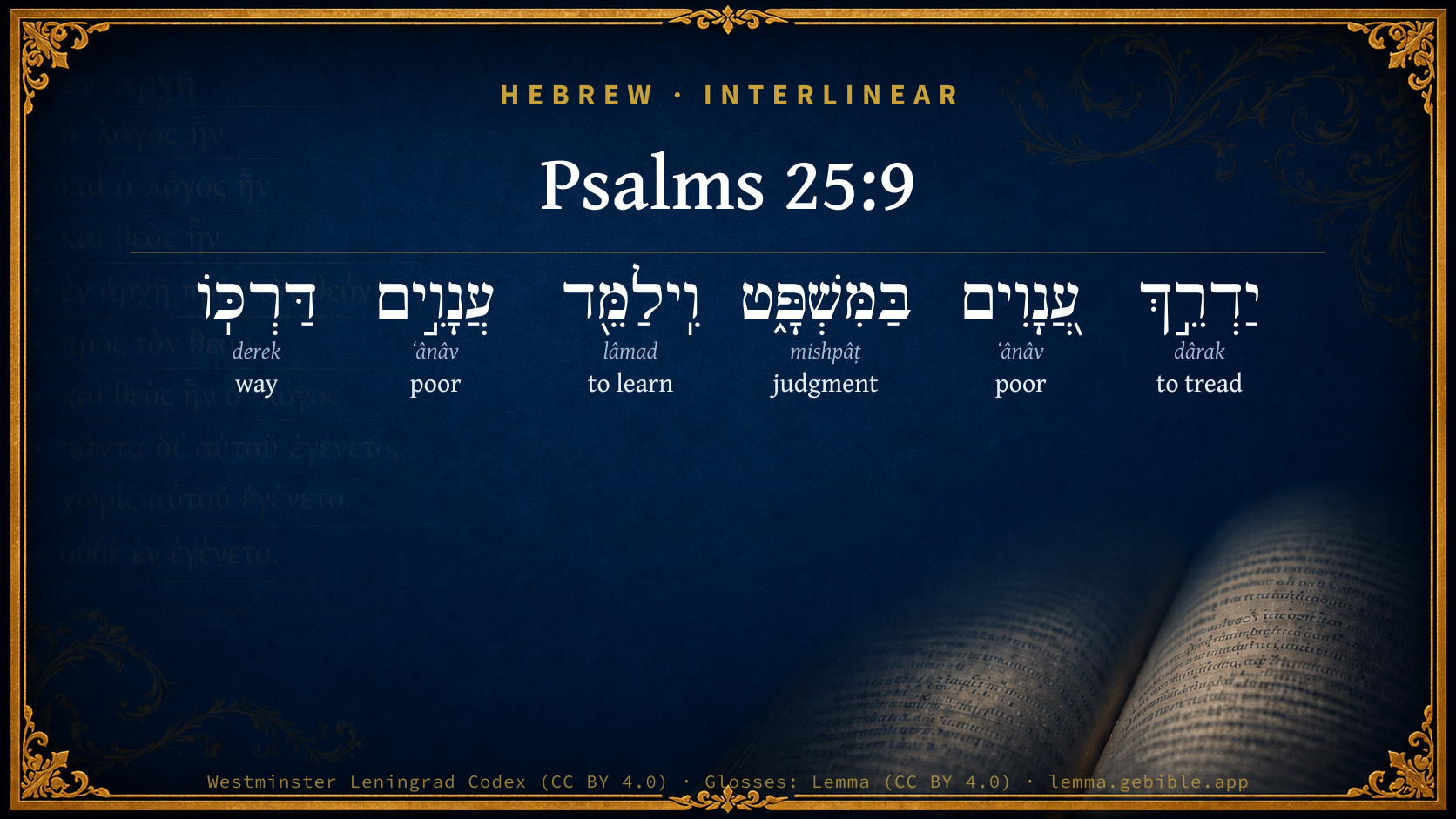
Psalms 25:9

Hebrew (Westminster Leningrad Codex) Psalms 25:9 appears in the Hebrew Old Testament. The text above is from the Westminster Leningrad Codex. Each word links to its Strong’s number, a concise gloss, and parsing drawn from the Open Scriptures Hebrew Bible morphology. Click any word for its full Brown-Driver-Briggs (BDB) entry.
Download image
Cite this verse

Psalms 25:9 (World English Bible). Public Domain. Lemma interlinear Bible study tool, https://lemma.gebible.app/v/psalms/25/9.

Show BibTeX & RIS
BibTeX
RIS
English Translation
He will guide the humble in justice. He will teach the humble his way.
World English Bible · Public Domain
Download a study sheet

One document with this verse’s original text, its word-by-word gloss line, the meaning frame, cross-references with their text, attributed commentary, and full source and license credits — printable, and it pastes into notes with its structure intact.

This verse Autodidact and up

Study sheet (.html) Plain text (.txt)

A passage Seminary Student

Up to 50 verses in one chapter. A passage sheet keeps up to 6 commentary sources and 12 cross-references per verse, in the order this page ranks them, and says so on the sheet whenever that leaves anything out. Ask for a single verse and you get the Autodidact verse sheet above.

Everything on this page stays free to read, with no account — the sheet is a download of what is already on screen, not access to it.

Want to remove ads? Support Godless Engineer
Compare translations 3

The same verse in 3 English versions, stacked beneath the original-language interlinear above. Click any original word for its lexicon entry.

Each is an independent rendering of the whole verse — the interlinear is not word-aligned to these translations.

Highlighted words mark where these versions differ — a whole-verse word diff, not a word-by-word alignment.

  • World English Bible Public Domain
    He will guide the humble in justice. He will teach the humble his way.
  • King James Version Public Domain
    The meek will he guide in judgment: and the meek will he teach his way.
  • unfoldingWord Literal Text CC BY-SA 4.0
    He leads the humble in justice, and he teaches the humble his way.

unfoldingWord Literal Text — © unfoldingWord, licensed CC BY-SA 4.0. Word-aligned USFM3 via Door43 (git.door43.org/unfoldingWord/en_ult).

Versions to compare (up to 4)

3 of 4 selected

Show all 18 translations

Every available English version of this verse, each an independent rendering of the whole verse.

  • World English Bible Public Domain
    He will guide the humble in justice. He will teach the humble his way.
  • Berean Standard Bible Public Domain
    He guides the humble in what is right and teaches them His way.
  • Majority Standard Bible Public Domain
    He guides the humble in what is right and teaches them His way.
  • King James Version Public Domain
    The meek will he guide in judgment: and the meek will he teach his way.
  • American Standard Version (1901) Public Domain
    The meek will he guide in justice; And the meek will he teach his way.
  • Revised Version (1885) Public Domain
    The meek will he guide in judgment: and the meek will he teach his way.
  • Geneva Bible (1599) Public Domain
    Them that be meeke, will hee guide in iudgement, and teach the humble his way.
  • Douay-Rheims (1899) Public Domain
    He will guide the mild in judgment: he will teach the meek his ways.
  • Young's Literal Translation Public Domain
    He causeth the humble to tread in judgment, And teacheth the humble His way.
  • Literal Standard Version CC BY-SA 4.0
    He causes the humble to tread in judgment, || And teaches the humble His way.
  • Unlocked Literal Bible CC BY-SA 4.0
    He guides the humble in what is right and he teaches them his way.
  • unfoldingWord Literal Text CC BY-SA 4.0
    He leads the humble in justice, and he teaches the humble his way.
  • Darby Bible Public Domain
    The meek will he guide in judgment, and the meek will he teach his way.
  • World Messianic Bible Public Domain
    He will guide the humble in justice. He will teach the humble his way.
  • Webster's Bible Public Domain
    The meek will he guide in judgment: and the meek will he teach his way.
  • Free Bible Version CC BY-SA 4.0
    He leads those who are humble in doing what's right, teaching them his way.
  • Bible in Basic English Public Domain
    He will be an upright guide to the poor in spirit: he will make his way clear to them.
  • JPS Tanakh (1917) Public Domain
    He guideth The humble in justice; and He teacheth the humble His way.

Literal Standard Version (2020), Covenant Press — licensed CC BY-SA 4.0. Text via the HelloAO Bible API (eBible.org). Unlocked Literal Bible (unfoldingWord) — licensed CC BY-SA 4.0. Text via the HelloAO Bible API (eBible.org). unfoldingWord Literal Text — © unfoldingWord, licensed CC BY-SA 4.0. Word-aligned USFM3 via Door43 (git.door43.org/unfoldingWord/en_ult). Free Bible Version, Dr. Jonathan Gallagher — licensed CC BY-SA 4.0. Text via the HelloAO Bible API (eBible.org).

Word by word

More ways to search: Search by grammar → Find every occurrence → Compare this word →

Practice this passage: Drill this verse → Learn its vocabulary →

About this verse

These counts appear in no published source. They are computed here, from the morphology-tagged text and Lemma’s own curated glosses. What Lemma adds →

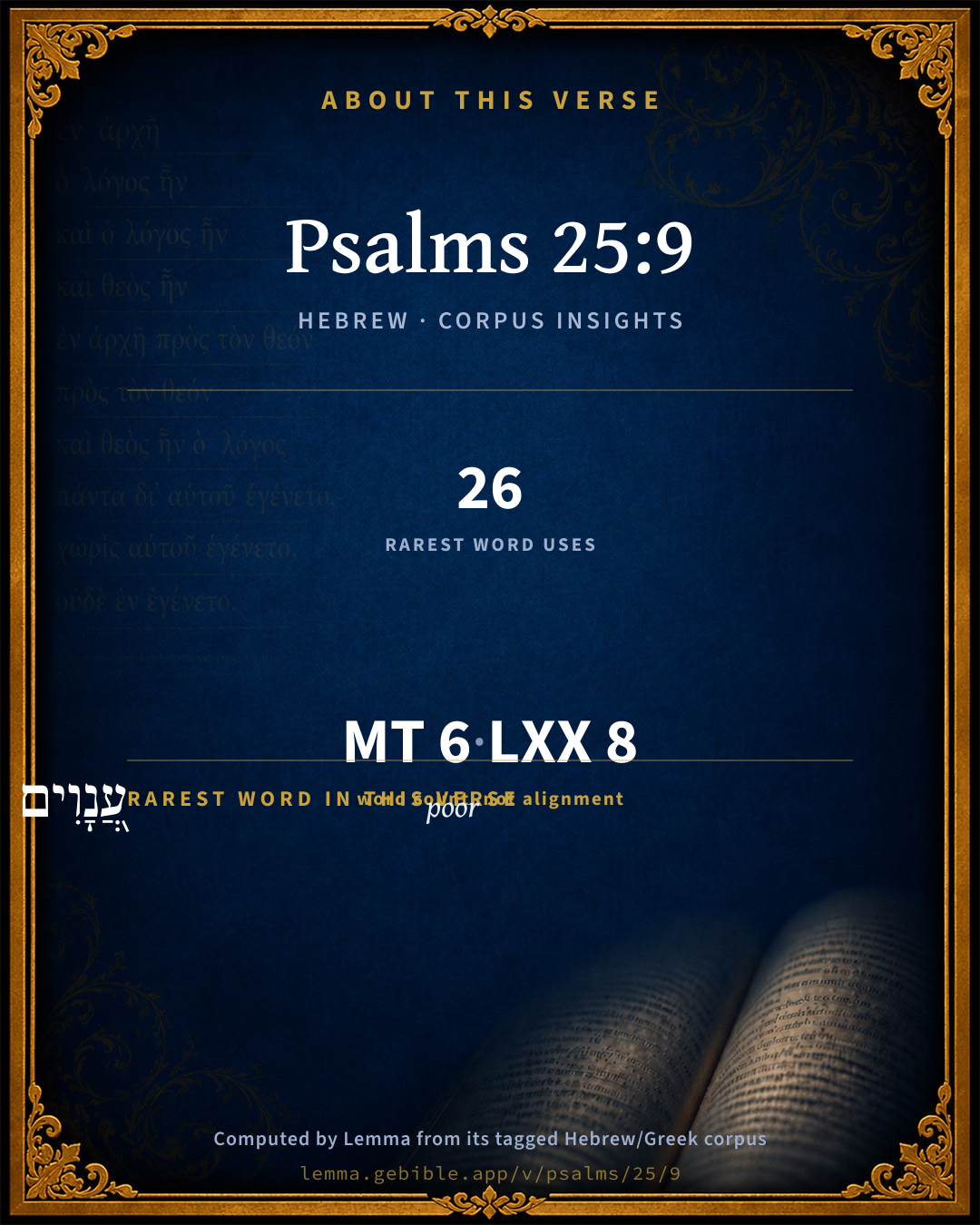
6
words
5
distinct lemmas
Wisdom
section

Shared distinctive vocabulary

עֲ֭נָוִים poor H6035 occurs in 24 verses of the Hebrew Bible. Also found in:

Grammatical profile

  • 2 verbs
  • 2 nouns
  • 2 adjectives

Verb forms

  • יַדְרֵ֣ךְ Hiphil · Imperfect
  • וִֽילַמֵּ֖ד Piel · Imperfect

Repetition

A word recurs within this verse — often emphatic in Hebrew:

  • עֲ֭נָוִים poor H6035 ×2

Hebrew & Septuagint length

In English translation the verse runs 14 words from the Hebrew and 14 from the Septuagint (LXX English) — the same length.

A rough comparison of the two English renderings, which tokenize alike — not a word-level alignment.

Word counts can differ between the Hebrew and the Greek without any difference in meaning — e.g. the Hebrew direct-object marker אֵת has no separate Greek word, and Greek often adds the article ὁ.

In the original languages it is 6 Hebrew tokens and 8 Greek tokens — but the two are counted differently (Hebrew bundles its prefixes and suffixes into one token; the Greek is in lemma form), so that isn’t a like-for-like length.

Cross-references

28

Topical passages linked to Psalms 25:9 in the Treasury of Scripture Knowledge — connected by theme and wording, ordered by reader-vote popularity; previews shown in the World English Bible.

  • Proverbs 3:5–6 Trust in Yahweh with all your heart, And don't lean on your own understanding.
  • Psalms 23:3 He restores my soul. He guides me in the paths of righteousness for his name's sake.
  • Matthew 5:5 Blessed are the gentle, For they shall inherit the earth.
  • John 14:6 Jesus said to him, "I am the way, the truth, and the life. No one comes to the Father, except through me.
  • Galatians 5:23 gentleness, and self-control. Against such things there is no law.
  • 1 Peter 3:15 But sanctify the Lord God in your hearts; and always be ready to give an answer to everyone who asks you a reason concerning the hope that is in you, with humility and fear:
  • Psalms 149:4 For Yahweh takes pleasure in his people. He crowns the humble with salvation.
  • Ezekiel 36:27 I will put my Spirit within you, and cause you to walk in my statutes, and you shall keep my ordinances, and do them.
  • Zephaniah 2:3 Seek Yahweh, all you humble of the land, who have kept his ordinances. Seek righteousness. Seek humility. It may be that you will be hidden in the day of Yahweh's anger.
  • Psalms 119:66 Teach me good judgment and knowledge, For I believe in your commandments.
  • Psalms 143:10 Teach me to do your will, For you are my God. Your Spirit is good. Lead me in the land of uprightness.
  • Psalms 147:6 Yahweh upholds the humble. He brings the wicked down to the ground.
  • Ezekiel 11:19–20 I will give them one heart, and I will put a new spirit within you; and I will take the stony heart out of their flesh, and will give them a heart of flesh;
  • Isaiah 42:1–3 Behold, my servant, whom I uphold; my chosen, in whom my soul delights: I have put my Spirit on him; he will bring forth justice to the Gentiles.
  • James 1:21 Therefore, putting away all filthiness and overflowing of wickedness, receive with humility the implanted word, which is able to save your souls.
  • 1 Peter 3:4 but in the hidden person of the heart, in the incorruptible adornment of a gentle and quiet spirit, which is in the sight of God very precious.
  • Psalms 22:26 The humble shall eat and be satisfied. They shall praise Yahweh who seek after him. Let your hearts live forever.
  • Psalms 27:11 Teach me your way, Yahweh. Lead me in a straight path, because of my enemies.
  • Psalms 32:8–9 I will instruct you and teach you in the way which you shall go. I will counsel you with my eye on you.
  • Psalms 73:24 You will guide me with your counsel, And afterward receive me to glory.
  • Psalms 76:9 When God arose to judgment, To save all the afflicted ones of the earth. Selah.
  • Psalms 119:35 Direct me in the path of your commandments, For I delight in them.
  • Proverbs 8:20 I walk in the way of righteousness, In the midst of the paths of justice;
  • Isaiah 11:4 but with righteousness shall he judge the poor, and decide with equity for the humble of the earth; and he shall strike the earth with the rod of his mouth; and with the breath of his lips shall he kill the wicked.
  • Isaiah 61:1 The Spirit of the Lord Yahweh is on me; because Yahweh has anointed me to preach good news to the humble; he has sent me to bind up the broken-hearted, to proclaim liberty to the captives, and the opening [of the prison] to those who are bound;
  • Hebrews 10:20 by the way which he dedicated for us, a new and living way, through the veil, that is to say, his flesh;
  • Acts 13:10 and said, "Full of all deceit and all cunning, you son of the devil, you enemy of all righteousness, will you not cease to pervert the right ways of the Lord?
  • Acts 9:2 and asked for letters from him to the synagogues of Damascus, that if he found any who were of the Way, whether men or women, he might bring them bound to Jerusalem.

Cross-references courtesy of OpenBible.info (CC BY 4.0).

Hebrew and Greek witnesses Masoretic Hebrew ↔ Greek Septuagint

The same verse in the two great witnesses to the Old Testament, shown verse-for-verse.

You’re reading Greek Psalm 24 (Hebrew Psalm 25). The Septuagint counts the superscription, so verse numbers can differ from the Hebrew — chapter-level alignment, not verse-by-verse. Numbering follows Rahlfs.

These are two independent witnesses, not word-aligned to each other, and the Septuagint is shown in lemma (dictionary) form.

Hebrew Psalms 25:9 Masoretic · Westminster Leningrad Codex

יַדְרֵ֣ךְ עֲ֭נָוִים בַּמִּשְׁפָּ֑ט וִֽילַמֵּ֖ד עֲנָוִ֣ים דַּרְכּֽוֹ

He will guide the humble in justice. He will teach the humble his way.

World English Bible · Public Domain

Greek LXX Greek Psalm 24:9 Septuagint · lemma form

ὁδηγέω πραΰς ἐν κρίσις διδάσκω πραΰς ὁδός αὐτός

The meek will he guide in judgment: the meek will he teach his ways.

LXX2012 (modern English Septuagint) · Public Domain

Hebrew: Westminster Leningrad Codex (CC BY 4.0). Greek: Septuagint (public domain); English from LXX2012 (modern English Septuagint) (Public Domain). How the Septuagint differs from the Hebrew →

Commentary

Notes on Psalms 25:9 from classic Christian and Jewish commentators (each source and its license shown beneath its notes). The classic Christian expositions comment on the surrounding passage and are grouped to its opening verse, so a note may address several verses; the Jewish commentaries on the Tanakh (Rashi and others) are per-verse, so they appear only where the commentator wrote on this verse.

Lemma curates 59 commentaries, every one of them public domain or Creative Commons licensed, each selected and text-cleaned for this edition rather than reprinted as found. About our sources →

Trapp's Complete Commentary

John Trapp

Psa 25:9 The meek will he guide in judgment: and the meek will he teach his way.

Ver. 9. The meek will he guide in judgment] Or, the poor (viz. in spirit) will he make to tread in judgment; to foot it aright, to walk judiciously, to behave themselves wisely, as David did, 1Sa 10:14, so that Saul feared him, 1Sa 23:22. Natural conscience cannot but stoop to the image of God, shining in the hearts and lives of the really religious.

And the meek will he teach his way] Such as lie at his feet, and say, Speak, Lord, for thy servant heareth; such as whose hearts are supple and soluble, tractable and teachable, so as that a little child may lead them, Isa 11:6. Austin was such a one, En adsum senex, saith he, a iuvene coepiscopo episcopus tot annorum, a collega nondum anniculo paratus sum discere, i.e. I am here an old man, ready to learn of a young man, my coadjutor in the ministry, who hath scarce been one year in the service (Aug. Epist. 75, ad Arvil. Epis.).

John Trapp, A Commentary or Exposition upon All the Books of the Old and New Testament (1647–1656) — public domain. Text from a community e-Sword module.

The Biblical Illustrator

Joseph S. Exell

Psa_25:9

The meek will He teach His way.

The humble

The heathen moralists give many admirable counsels, but always forget humility. They had not, indeed, the word for it. The term humility before Christianity meant what is base, despicable, vile. Humility can only come with the knowledge of ones self, and man did not truly know himself until he had made a study of himself in the light of the holy God. Comparing himself only with his fellow men, he would never learn humility. There is something still more efficacious than the sight of the perfection of Jesus Christ to produce humility, it is the sight of His love. It is at the foot of the Cross humility is born. Christian humility should penetrate our entire being. Our intelligence must be humble. We are in danger of forgetting this in this age of criticism and discussion. Only that intelligence which humbles itself before God can readily teach. Our heart must be humble. We can submit our intelligence entirely to God, sacrifice our reason to Him, boast of a blind faith, and shelter in our hearts a whole world of pride. So far as humility has not yet reached and conquered our heart, it is but a theory. It happens, in the Church, that the men to whom God has dispensed the finest gifts advance in humility in the same measure as they advance in age and experience. Consider the promises which God makes to the humble. The meek will He teach His way. Unless man be taught he will never find Gods way. Today mans intelligence has assumed an immense and superb confidence in itself. It has faith in its powers; it thinks that it has come to an end of all problems, that it will surmount every obstacle. It is not in the power of ignorance and mediocrity to produce humility; very often they nourish pride. Let intelligence grow, but let it never forget its dependence on God. People talk of the benefits of trial. Yes, when it is accepted in humbleness of heart: otherwise it will rather harden. It is a marvellous thing that God has never wanted to be served by the strong, but always by the humble. Pass in review all those who have served His designs, all those by whom He has taught and saved men, you will see that they all have been formed in the school of humility. Let, then, those who work for God lay hold on the thought that to humble souls alone has God taught the way of success. (E. Bersier, D. D.)

The humble taught the Lords way

The righteous Lord will teach sinners His way; but the sinners, in order to be thus divinely taught, must be humble. Men are comparatively little attracted by the more quiet and passive virtues of life, and among these the virtue of humility is one of the least popular. The truth is, that we are still under the influence of pagan notions about it. The philosophers of the past never understood it. Christianity has transformed and ennobled the despised word by giving us the thing itself. In Christ we see that humility makes no man contemptible. The words before us present this virtue of humility under one special aspect. Man has something to learn, and God has something to teach, and humility is teachableness. Humility is the result of self-knowledge, and this cannot be obtained until man has learned to know himself in the light of Gods wisdom and holiness. So long as he compares himself with his fellow creatures around him, it may seem to him that there is no necessity for such an element of character as this. God teaches us humility in another way. He shows us His love in Christ. How can we be proud when we know that God has loved us, and that Christ has died for us? The very faith which accepts the Gospel has its root in lowliness of mind. All our Christian life, in one aspect of it, is a growth in humility. This beautiful virtue affects our whole being, rescuing for God all that has been usurped by sin. Our reason must be humble. Our heart must be humble. Our conduct must be humble. Gods promise to teach His way applies to our knowledge of Divine truth; the everyday dispensations of life; our bearing towards others; and to our Christian work. (Clement Bailhache.)

The Biblical Illustrator, edited by Joseph S. Exell (c. 1880s–1900s) — public domain. Text from a community e-Sword module.

Keil & Delitzsch

C. F. Keil & F. Delitzsch

The shortened form of the future stands here, according to Ges. ֗128, 2, rem., instead of the full form (which, viz., ידרך, is perhaps meant); for the connection which treats of general facts, does not admit of its being taken as optative. The ב (cf. Psa 25:5, Psa 107:7; Psa 119:35) denotes the sphere of the guidance. משׁפּט is the right so far as it is traversed, i.e., practised or carried out. In this course of right He leads the ענוים, and teaches them the way that is pleasing to Himself. ענוים is the one word for the gentle, mansueti, and the humble, modesti. Jerome uses these words alternately in Psa 25:9 and Psa 25:9; but the poet designedly repeats the one word - the cardinal virtue of ענוה - here with the preponderating notion of lowliness. Upon the self-righteous and self-sufficient He would be obliged to force Himself even against their will. He wants disciples eager to learn; and how richly He rewards those who guard what they have learnt!

Keil & Delitzsch — Biblical Commentary on the Old Testament (1861–1891) — public domain (CC PDM 1.0). Text via the HelloAO Bible API. (Old Testament only.)

Geneva Bible (1599)

Geneva Bible translators

He will govern and comfort them that are truly humbled for their sins.

Geneva Bible (1599) marginal notes — public domain. Text via Bolls.life.

Jamieson, Fausset & Brown

Robert Jamieson, A. R. Fausset & David Brown

in judgment--rightly.

Jamieson, Fausset & Brown — Commentary Critical and Explanatory on the Whole Bible (1871) — public domain (CC PDM 1.0). Text via the HelloAO Bible API.

Adam Clarke's Commentary

Verse 9. The meek will he guide] ענוים anavim, the poor, the distressed; he will lead in judgment - he will direct them in their cause, and bring it to a happy issue, for he will show them the way in which they should go.

Adam Clarke's Commentary on the Bible (1810–1826) — public domain. Text from a community e-Sword/MySword module.

John Calvin's Commentaries

9. He will guide the poor in judgment. The Psalmist here specifies the second manifestation of his grace which God makes towards those who, being subdued by his power, and brought under his yoke, bear it willingly, and submit themselves to his government. But never will this docility be found in any man, until the heart, which is naturally elated and filled with pride, has been humbled and subdued. As the Hebrew word ענוים, anavim, denotes the poor or afflicted, and is employed in a metaphorical sense, to denote the meek and humble, it is probable that David, under this term, includes the afflictions which serve to restrain and subdue the frowardness of the flesh, as well as the grace of humility itself; as if he had said, When God has first humbled them, then he kindly stretches forth his hand to them, and leads and guides them throughout the whole course of their life. Moreover, some understand these terms, judgment and way of the Lord, as denoting a righteous and well ordered manner of life. Others refer them to the providence of God, an interpretation which seems more correct, and more agreeable to the context, for it is immediately added, All the ways of Jehovah are mercy and truth. The meaning therefore is, that those who are truly humbled in their hearts, and brought to place their confidence in God, shall experience how much care he has for his children, “Quel soin il ha de ses enfans.” — Fr.

John Calvin's Commentaries (1540-1563) — public domain. Text from the Calvin Translation Society English edition (1840s-50s) via the Christian Classics Ethereal Library (ccel.org). Calvin's coverage is partial (roughly two-thirds of the Bible); uncommented books and verses are honest gaps, never fabricated. The 19th-century editor's footnotes and remarks are omitted so the notes are faithfully Calvin's own voice.

The Cambridge Bible for Schools and Colleges

gen. ed. J. J. S. Perowne

9. The meek] The humble-minded. See note on Psa_9:12. Humility is indispensable for God’s scholars. Cp. 1Pe_5:5.

in judgment] The practice of right; often coupled with righteousness and equity; e.g. Pro_1:3.

The Cambridge Bible for Schools and Colleges (gen. ed. J. J. S. Perowne; Cambridge University Press, 1878–1918) — public domain. Text from a community e-Sword module.

John Gill's Exposition

The meek will he guide in judgment,.... Or "the miserable" (z) and afflicted; such as see themselves to be wretched and miserable, lost and undone; and cry out, What shall we do to be saved? and who are meek and lowly, are humbled under a sense of their sins, are poor in spirit, and of broken and contrite hearts; these the Lord will guide by his Spirit into the truth, as it is in Jesus; even the great truth of salvation by him; and in the way of his judgments, statutes, and ordinances; and will give them a true judgment and a right discerning of things that differ; and he will lead them on in judgment, or gently; see Jer 10:24; into every truth of the Gospel by degrees, and as they are able to bear them;

and the meek will he teach his way; of justifying sinners by the righteousness of his son; for such who are humble and confess their sins and unworthiness, and throw themselves on the mercy of God in Christ, are declaratively justified by the Lord, when the proud boasting Pharisee is an abomination to him.

(z) "miseros", Gejerus, Michaelis.

John Gill's Exposition of the Whole Bible (1746–1763) — public domain (CC PDM 1.0). Text via the HelloAO Bible API.

Albert Barnes' Notes on the Bible

The meek will he guide - The humble, the teachable, the prayerful, the gentle of spirit - those who are willing to learn. A proud person who supposes that he already knows enough cannot be taught; a haughty person who has no respect for others, cannot learn of them; a person who is willing to believe nothing cannot be instructed. The first requisite, therefore, in the work of religion, as in respect to all kinds of knowledge, is a meek and docile spirit. See Mat 18:3.

In judgment - In a right judgment or estimate of things. It is not merely in the administration of justice, or in doing “right,” but it is in judging of truth; of duty; of the value of objects; of the right way to live; of all upon which the mind can be called to exercise judgment, or to come to a decision.

And the meek will he teach his way - The way in which he would have them to go. The “methods” by which God does this are:

(1) By His word or law,

(a) laying down there the principles which are to guide human conduct, and

(b) in numerous cases furnishing specific rules for directing our conduct in the relations of life;

(2) by His Spirit,

(a) disposing the mind to candor,

(b) enlightening it to see the truth, and

(c) making it honest and sincere in its inquiries;

(3) by His providence - often indicating, in an unexpected manner, to those who are sincere in their inquiries after truth and duty, what He would have them to do; and

(4) by the advice and counsel of those who have experience - the aged and the wise - those who have themselves been placed in similar circumstances, or who have passed through the same perplexities and embarrassments.

By all these methods a peson who goes to God in humble prayer, and with a proper sense of dependence, may trust that he will be guided aright; and it is not probable that a case could occur in which one who should honestly seek for guidance by these helps, might not feel assured that God would lead him aright. Having used these means, a peson may feel assured that God will not leave him to error.

Albert Barnes' Notes on the Bible (1834–1885) — public domain. Text from a community e-Sword/MySword module.

Matthew Poole's English Annotations

The meek, i.e. the humble and lowly, such as meekly submit themselves to God’s hand and word, and are willing and desirous to be directed and governed by him.

In judgment, i.e. in the paths of judgment; or in the right way wherein they should walk, as the next clause explains this; or by the rule of his word, which is oft called his judgment, or judgments. Or, with judgment, i.e. with a wise and provident care, and a due regard to all their circumstances. See Jer 10:24; 1Co 10:13.

His way; either God’s way, which God prescribes; or his own way, in which he ought to walk.

Matthew Poole's English Annotations on the Holy Bible (1683–1685) — public domain. Text from a community e-Sword/MySword module.

The Treasury of David

Charles H. Spurgeon

Ver. 9. The meek will he guide in judgment: and the meek will he teach his way, i.e., those that submit their neck to his yoke, those that are not conceited that they can guide themselves; in necessary, great and weighty matters they shall not err. Samuel Annesley, D.D. (1620-1696), in "Morning Exercises at Cripplegate."

Ver. 9. The meek will he guide in judgment. Meek spirits are in high favour with the Father of the meek and lowly Jesus, for he sees in them the image of his only begotten Son. They know their need of guidance, and are willing to submit their own understandings to the divine will, and therefore the Lord condescends to be their guide. Humble spirits are in this verse endowed with a rich inheritance; let them be of good cheer. Trouble puts gentle spirits to their wit's ends, and drives them to act without discretion, but grace comes to the rescue, enlightens their minds to follow that which is just, and helps them to discern the way in which the Lord would have them to go. Proud of their own wisdom fools will not learn, and therefore miss their road to heaven, but lowly hearts sit at Jesu's feet, and find the gate of glory, for the meek will he teach his way. Blessed teacher! Favoured scholar! Divine lesson! My soul, be thou familiar with the whole.

Ver. 9. The meek will he guide in judgment; or the poor (namely, in spirit), will he make to tread in judgment, to foot it aright, to walk judiciously, to behave themselves wisely, as David did 1Sa 24:1-22, so that Saul feared him. Natural conscience cannot but stoop to the image of God, shining in the hearts and lives of the really religious. John Trapp.

Ver. 9. The meek will he guide in judgment. They have been made meek i.e., desirous of being taught, and praying to be so; but, being now sensible of unworthiness, they are afraid that God will not teach them. This may be done to other sinners but not to them. Therefore they are told who may expect teaching, even they who desire and pray for teaching. John Berridge, 1716-1793.

Ver. 9. He will guide the poor in judgment. Never will this docility be found in any man, until the heart, which is naturally elated and filled with pride, has been humbled and subdued. As the Hebrew word denotes the poor or afflicted, and is employed in a metaphorical sense, to denote the meek and humble, it is probable that David, under this term, includes the afflictions which serve to restrain and subdue the frowardness of the flesh, as well as the grace of humility itself; as if he had said, When God has first humbled them, then he kindly stretches forth his hand to them, and leads and guides them throughout the whole course of their life. John Calvin.

Ver. 9. The meek, etc. Pride and anger have no place in the school of Christ. The Master himself is "meek and lowly of heart; " much more, surely, ought the scholars to be so. He who hath no sense of his ignorance, can have no desire, or capability of knowledge, human or divine. George Horne.

Ver. 9. (last clause). The Lord will teach the humble his secrets, he will not teach proud scholars. Thomas Goodwin.

Ver. 9. (last clause). Such as lie at his feet and say, "Speak, Lord, for thy servant heareth, "such whose hearts are supple and soluble, tractable, and teachable, so that a little child may lead them. Isa 11:6. Austin was such an one. Saith he, "I am here an old man ready to learn of a young man, my coadjutor in the ministry, who hath scarce been one year in the service." John Trapp.

Ver. 9. The meek. Who are they? What are their privileges? How to be like them?

Ver. 9 (first clause). Moral purity needful to a well balanced judgment.

Psalms 25:10*

Charles H. Spurgeon's The Treasury of David (1869–1885) — public domain. Psalms only. Text from a community e-Sword/MySword module.

Whedon's Commentary on the Bible

Daniel D. Whedon

9. The meek—Or, humble. The idea is, that of a teachable, submissive spirit. As God will “teach sinners in the way,” (Psa_25:8,) it would seem to be spoken for their encouragement.

Daniel D. Whedon (gen. ed.), Commentary on the Old and New Testaments (1874–1909) — public domain. Text from a community e-Sword module.

The Pulpit Commentary

The meek will he guide in judgment. It is only such sinners as are "meeki.e.. humble, submissive, contrite, teachable that God will take in hand and teach. The proud and perverse he will leave to their own devices, but the meek he will guide in the paths of righteousness, and the meek will he teach his way.

The Pulpit Commentary (1880–1919), ed. H.D.M. Spence-Jones & Joseph S. Exell — public domain. Text from a community e-Sword module.

John Wesley's Explanatory Notes

The meek - Such as meekly submit themselves to God, and are desirous to be directed and governed by him. Judgment - In the paths of judgment, in the right way.

John Wesley, Explanatory Notes Upon the Whole Bible (1754–1765) — public domain. Text via the GEBible commentary corpus.

J. A. Alexander on Psalms

Joseph Addison Alexander

9. He will guide humble (sinners) in justice, and teach humble (sinners) his way. The common version of Myvnf, meek, is too restricted and descriptive of inere temper. The Hebrew word is the nearest equivalent to humble in its strong religious sense. The omission of the article may be explained as a poetic licence, and the word translated the humble, so as to include the whole class. But the intimate connection between this verse and the one before it, makes it more natural to the description of the sinners mentioned in ver. 8, who are then of course to be regarded as penitent believing sinners, i.e. as true converts. In justice, i.e. in the exercise of justice, as before explained. The way and the teaching are the same as in the foregoing context, namely, those of Providence.

Joseph Addison Alexander, The Psalms Translated and Explained (1850) — public domain. Text from a community e-Sword module.

Lesson kit

Teaching starters — assembled from the data on this page, not authored interpretation. Every prompt links to the verse data it draws on. Edit before teaching.

Psalms, in the Wisdom, opens this verse with 6 words (5 distinct Hebrew lemmas). Its most distinctive word is ʻânâv (“poor”). A historical commentator’s framing appears above. Read the whole chapter for the surrounding context.

Discussion questions

  1. The word ʻânâv carries the sense “poor.” How does it shape the verse?
  2. Numbers 12:3 shares the word «poor» with this verse. How do the two illuminate each other?
  3. “poor” occurs 2× in this one verse. What is the effect of the repetition?
  4. The translations on this page render this verse differently — a whole-verse word diff, not a word-by-word alignment. What might account for the different wordings?
  5. The verb «יַדְרֵ֣ךְ» is Hiphil Imperfect. How does its form color the action?
  6. Reading how Trapp's Complete Commentary and The Biblical Illustrator read this verse, where do the two commentators agree and where do they part?

Things to notice

Reading settings

Reading text

Shown beneath each verse's original-language words.

Old Testament
Old Testament edition

Read the OT as the Masoretic Hebrew (MT) or the Greek Septuagint (LXX).

English shown for the Greek Septuagint (in the Hebrew ↔ Greek comparison).

Comparing translations? Open the Compare panel on any verse page to stack up to four side by side.