Jeremiah 9:14

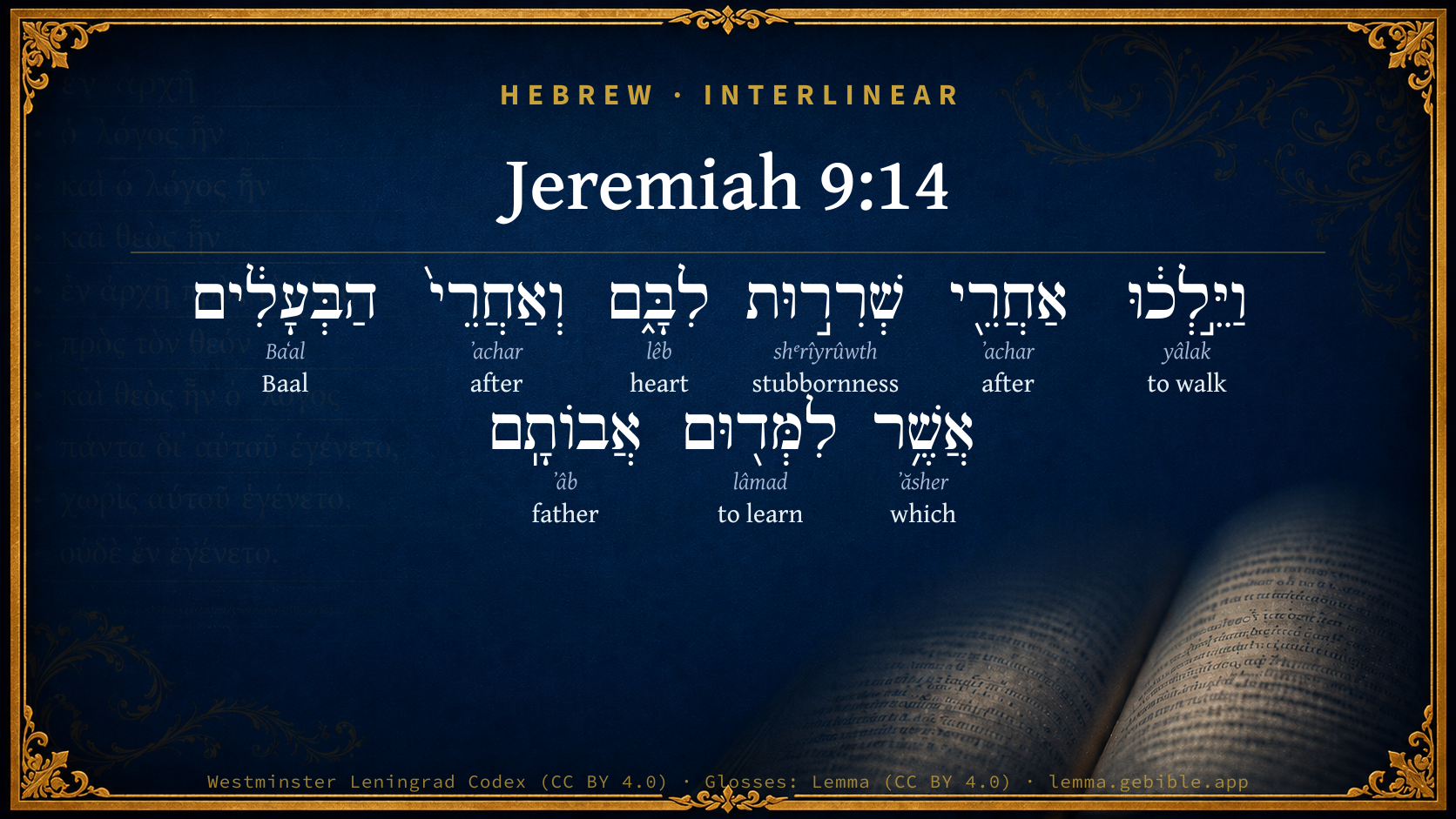
Hebrew (Westminster Leningrad Codex) Jeremiah 9:14 appears in the Hebrew Old Testament. The text above is from the Westminster Leningrad Codex. Each word links to its Strong’s number, a concise gloss, and parsing drawn from the Open Scriptures Hebrew Bible morphology. Click any word for its full Brown-Driver-Briggs (BDB) entry.
Download image
Cite this verse

Jeremiah 9:14 (World English Bible). Public Domain. Lemma interlinear Bible study tool, https://lemma.gebible.app/v/jeremiah/9/14.

Show BibTeX & RIS
BibTeX
RIS
English Translation
but have walked after the stubbornness of their own heart, and after the Baals, which their fathers taught them;
World English Bible · Public Domain
Download a study sheet

One document with this verse’s original text, its word-by-word gloss line, the meaning frame, cross-references with their text, attributed commentary, and full source and license credits — printable, and it pastes into notes with its structure intact.

This verse Autodidact and up

Study sheet (.html) Plain text (.txt)

A passage Seminary Student

Up to 50 verses in one chapter. A passage sheet keeps up to 6 commentary sources and 12 cross-references per verse, in the order this page ranks them, and says so on the sheet whenever that leaves anything out. Ask for a single verse and you get the Autodidact verse sheet above.

Everything on this page stays free to read, with no account — the sheet is a download of what is already on screen, not access to it.

Want to remove ads? Support Godless Engineer
Compare translations 3

The same verse in 3 English versions, stacked beneath the original-language interlinear above. Click any original word for its lexicon entry.

Each is an independent rendering of the whole verse — the interlinear is not word-aligned to these translations.

Highlighted words mark where these versions differ — a whole-verse word diff, not a word-by-word alignment.

  • World English Bible Public Domain
    but have walked after the stubbornness of their own heart, and after the Baals, which their fathers taught them;
  • King James Version Public Domain
    But have walked after the imagination of their own heart, and after Baalim, which their fathers taught them:
  • unfoldingWord Literal Text CC BY-SA 4.0
    But they have walked after the stubbornness of their hearts and after the Baals, which their fathers taught them.

unfoldingWord Literal Text — © unfoldingWord, licensed CC BY-SA 4.0. Word-aligned USFM3 via Door43 (git.door43.org/unfoldingWord/en_ult).

Versions to compare (up to 4)

3 of 4 selected

Show all 18 translations

Every available English version of this verse, each an independent rendering of the whole verse.

  • World English Bible Public Domain
    but have walked after the stubbornness of their own heart, and after the Baals, which their fathers taught them;
  • Berean Standard Bible Public Domain
    Instead, they have followed the stubbornness of their hearts and gone after the Baals, as their fathers taught them.”
  • Majority Standard Bible Public Domain
    Instead, they have followed the stubbornness of their hearts and gone after the Baals, as their fathers taught them.”
  • King James Version Public Domain
    But have walked after the imagination of their own heart, and after Baalim, which their fathers taught them:
  • American Standard Version (1901) Public Domain
    but have walked after the stubbornness of their own heart, and after the Baalim, which their fathers taught them;
  • Revised Version (1885) Public Domain
    but have walked after the stubbornness of their own heart, and after the Baalim, which their fathers taught them:
  • Geneva Bible (1599) Public Domain
    But haue walked after the stubbernesse of their owne heart, and after Baalims, which their fathers taught them,
  • Douay-Rheims (1899) Public Domain
    But they have gone after the perverseness of their own heart, and after Baalim, which their fathers taught them.
  • Young's Literal Translation Public Domain
    And they walk after the stubbornness of their heart, And after the Baalim, that their fathers taught them,
  • Literal Standard Version CC BY-SA 4.0
    And they walk after the stubbornness of their heart, || And after the Ba‘alim, || That their fathers taught them,”
  • Unlocked Literal Bible CC BY-SA 4.0
    It is because they have walked by their stubborn hearts and have followed the Baals as their fathers taught them to do.
  • unfoldingWord Literal Text CC BY-SA 4.0
    But they have walked after the stubbornness of their hearts and after the Baals, which their fathers taught them.
  • Darby Bible Public Domain
    but have walked after the stubbornness of their own heart, and after the Baals, as their fathers taught them;
  • World Messianic Bible Public Domain
    but have walked after the stubbornness of their own heart and after the Baals, which their fathers taught them.”
  • Webster's Bible Public Domain
    But have walked after the imagination of their own heart, and after Baalim, which their fathers taught them:
  • Free Bible Version CC BY-SA 4.0
    On the contrary, they have followed their own stubborn way of thinking, and went to worship the Baals, just as their forefathers taught them.
  • Bible in Basic English Public Domain
    But they have been walking in the pride of their hearts, going after the Baals, as their fathers gave them teaching.
  • JPS Tanakh (1917) Public Domain
    (9-13) But have walked after the stubbornness of their own heart, and after the Baalim, which their fathers taught them.

Literal Standard Version (2020), Covenant Press — licensed CC BY-SA 4.0. Text via the HelloAO Bible API (eBible.org). Unlocked Literal Bible (unfoldingWord) — licensed CC BY-SA 4.0. Text via the HelloAO Bible API (eBible.org). unfoldingWord Literal Text — © unfoldingWord, licensed CC BY-SA 4.0. Word-aligned USFM3 via Door43 (git.door43.org/unfoldingWord/en_ult). Free Bible Version, Dr. Jonathan Gallagher — licensed CC BY-SA 4.0. Text via the HelloAO Bible API (eBible.org).

Word by word

More ways to search: Search by grammar → Find every occurrence → Compare this word →

Practice this passage: Drill this verse → Learn its vocabulary →

שְׁרִר֣וּת
shᵉrîyrûwth
H8307
“stubbornness of”
Noun, Common, Feminine, Singular, Construct
Part of Speech
Noun
Type
Common
Gender
Feminine
Number
Singular
State
Construct
Full BDB Definition

Origin: from H8324 in the sense of twisted, i.e. firm

TWOT: 2469d

stubbornness, hardness, firmness
  1. וַיֵּ֣לְכ֔וּ yâlak H3212 “and · to walk” Conjunction + Verb, Qal, Sequential Imperfect, 3rd Person, Masculine, Plural
  2. אַחֲרֵ֖י ʼachar H310 “after” Preposition
  3. לִבָּ֑ם lêb H3820 “heart · their” Noun, Common, Masculine, Singular, Construct + Suffix, Personal, 3rd Person, Masculine, Plural
  4. וְאַחֲרֵי֙ ʼachar H310 “and · after” Conjunction + Preposition
  5. הַבְּעָלִ֔ים Baʻal H1168 “the · Baal” Particle, Definite Article + Noun, Proper
  6. אֲשֶׁ֥ר ʼăsher H834 “which” Particle, Relative
  7. לִמְּד֖וּם lâmad H3925 “to learn · them” Verb, Piel, Perfect, 3rd Person, Common, Plural + Suffix, Personal, 3rd Person, Masculine, Plural
  8. אֲבוֹתָֽם ʼâb H1 “fathers · their” Noun, Common, Masculine, Plural, Construct + Suffix, Personal, 3rd Person, Masculine, Plural

About this verse

These counts appear in no published source. They are computed here, from the morphology-tagged text and Lemma’s own curated glosses. What Lemma adds →

9
words
8
distinct lemmas
Prophets
section

Notable vocabulary

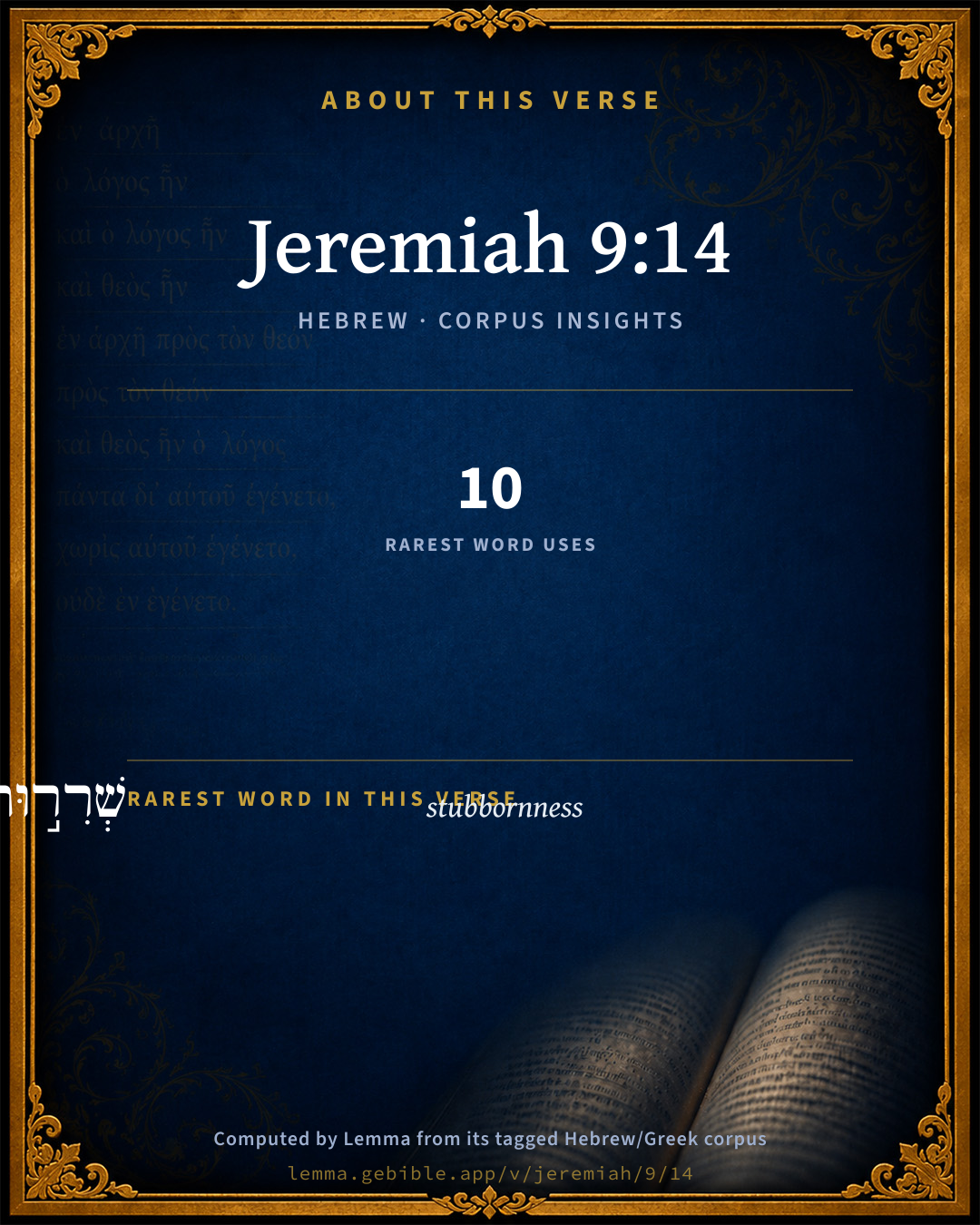
The rarest word here is שְׁרִר֣וּת stubbornness H8307 — appearing just 10 times in the whole Hebrew Bible.

Shared distinctive vocabulary

שְׁרִר֣וּת stubbornness H8307 occurs in 10 verses of the Hebrew Bible. Also found in:

Grammatical profile

  • 2 verbs
  • 4 nouns
  • 2 prepositions
  • 1 particle

Verb forms

  • וַיֵּ֣לְכ֔וּ Qal · Sequential Imperfect
  • לִמְּד֖וּם Piel · Perfect

Repetition

A word recurs within this verse — often emphatic in Hebrew:

  • אַחֲרֵ֖י after H310 ×2

Cross-references

12

Topical passages linked to Jeremiah 9:14 in the Treasury of Scripture Knowledge — connected by theme and wording, ordered by reader-vote popularity; previews shown in the World English Bible.

  • Jeremiah 3:17 At that time they shall call Jerusalem the throne of Yahweh; and all the nations shall be gathered to it, to the name of Yahweh, to Jerusalem: neither shall they walk any more after the stubbornness of their evil heart.
  • Jeremiah 7:24 But they didn't listen nor turn their ear, but walked in [their own] counsels [and] in the stubbornness of their evil heart, and went backward, and not forward.
  • Romans 1:21–24 Because, knowing God, they didn't glorify him as God, neither gave thanks, but became vain in their reasoning, and their senseless heart was darkened.
  • Galatians 1:14 I advanced in the Jews' religion beyond many of my own age among my countrymen, being more exceedingly zealous for the traditions of my fathers.
  • Ephesians 2:3 among whom we also all once lived in the lust of our flesh, doing the desires of the flesh and of the mind, and were by nature children of wrath, even as the rest.
  • 1 Peter 1:18 knowing that you were redeemed, not with corruptible things, with silver or gold, from the useless way of life handed down from your fathers,
  • Genesis 6:5 Yahweh saw that the wickedness of man was great in the earth, and that every imagination of the thoughts of his heart was only evil continually.
  • Jeremiah 2:8 The priests didn't say, Where is Yahweh? and those who handle the law didn't know me: the rulers also transgressed against me, and the prophets prophesied by Baal, and walked after things that do not profit.
  • Ephesians 4:17–19 This I say therefore, and testify in the Lord, that you no longer walk as the rest of the Gentiles also walk, in the futility of their mind,
  • Jeremiah 2:23 How can you say, I am not defiled, I have not gone after the Baals? see your way in the valley, know what you have done: [you are] a swift dromedary traversing her ways;
  • Jeremiah 44:17 But we will certainly perform every word that is gone forth out of our mouth, to burn incense to the queen of the sky, and to pour out drink-offerings to her, as we have done, we and our fathers, our kings and our princes, in the cities of Judah, and in the streets of Jerusalem; for then had we plenty of food, and were well, and saw no evil.
  • Zechariah 1:4–5 Don't you be like your fathers, to whom the former prophets proclaimed, saying: Thus says Yahweh of hosts, 'Return now from your evil ways, and from your evil doings;' but they did not hear, nor listen to me, says Yahweh.

Cross-references courtesy of OpenBible.info (CC BY 4.0).

Hebrew and Greek witnesses Masoretic Hebrew ↔ Greek Septuagint

The same verse in the two great witnesses to the Old Testament, shown verse-for-verse.

These are two independent witnesses, not word-aligned to each other, and the Septuagint is shown in lemma (dictionary) form.

Hebrew Jeremiah 9:14 Masoretic · Westminster Leningrad Codex

וַיֵּ֣לְכ֔וּ אַחֲרֵ֖י שְׁרִר֣וּת לִבָּ֑ם וְאַחֲרֵי֙ הַבְּעָלִ֔ים אֲשֶׁ֥ר לִמְּד֖וּם אֲבוֹתָֽם

but have walked after the stubbornness of their own heart, and after the Baals, which their fathers taught them;

World English Bible · Public Domain

Greek LXX Structure differs

In the Septuagint, Jeremiah is about an eighth shorter than the Hebrew and arranges its material differently — the Oracles Against the Nations (Hebrew chapters 46–51) appear in the middle of the Greek book, after 25:13. Because the chapter and verse boundaries do not line up, a verse-for-verse comparison with the Hebrew is not shown.

A verse-for-verse comparison isn’t shown here because the chapters and verses don’t line up. Switch to the LXX edition with the MT / LXX toggle above to read the Greek directly.

Hebrew: Westminster Leningrad Codex (CC BY 4.0). Greek: Septuagint (public domain); English from a public-domain English Septuagint. How the Septuagint differs from the Hebrew →

Targum (Aramaic paraphrase)

1

The Targum is the ancient Jewish Aramaic paraphrase of the Hebrew Scriptures — an interpretive translation, not the Hebrew text itself. Onkelos (literal) and Pseudo-Jonathan (expansive) render the Torah, and Jonathan the Prophets. Coverage is partial: where no permissively-licensed English translation exists for a verse, only the Aramaic is shown. This is verse-level text, not a word-by-word alignment to the Hebrew.

  1. Targum Jonathan Prophets (Joshua–Malachi)
    בְּכֵן כִּדְנַן אֲמַר יְיָ צְבָאוֹת אֱלָהָא דְיִשְׂרָאֵל הָא אֲנָא מַיְתֵי עָקָא עַל עַמָא הָדֵין מְרַר כְּגִידִין וְאַשְׁקִינוּן כָּס דִלְוָט בְּרֵישֵׁי חִיוְיָן:

    (no public-domain English translation for this verse)

    Targum Jonathan — Aramaic: “Mikraot Gedolot” (public domain). English: “Sefaria Community Translation” (CC0 1.0 (public-domain dedication)); “London "Chaldee Paraphrase," 1871” (public domain). Text via Sefaria.

Commentary

Notes on Jeremiah 9:14 from classic Christian and Jewish commentators (each source and its license shown beneath its notes). The classic Christian expositions comment on the surrounding passage and are grouped to its opening verse, so a note may address several verses; the Jewish commentaries on the Tanakh (Rashi and others) are per-verse, so they appear only where the commentator wrote on this verse.

Lemma curates 59 commentaries, every one of them public domain or Creative Commons licensed, each selected and text-cleaned for this edition rather than reprinted as found. About our sources →

Trapp's Complete Commentary

John Trapp

Jer 9:14 But have walked after the imagination of their own heart, and after Baalim, which their fathers taught them:

Ver. 14. But have walked after the imagination of their own heart.] Than the which they could not have chosen a worse guide, since it is evil, "only evil," and "continually" so. {Gen 6:5} {See Trapp on "Gen 6:5"}

Which their fathers taught them.] See Jer 7:18.

John Trapp, A Commentary or Exposition upon All the Books of the Old and New Testament (1647–1656) — public domain. Text from a community e-Sword module.

Geneva Bible (1599)

Geneva Bible translators

He showeth that the children cannot excuse themselves by their fathers: for both father and child if they be wicked shall perish.

Geneva Bible (1599) marginal notes — public domain. Text via Bolls.life.

Jamieson, Fausset & Brown

Robert Jamieson, A. R. Fausset & David Brown

(Jer 7:24).

Baalim--plural of Baal, to express his supposed manifold powers.

fathers taught them-- (Gal 1:14; Pe1 1:18). We are not to follow the errors of the fathers, but the authority of Scripture and of God [JEROME].

Jamieson, Fausset & Brown — Commentary Critical and Explanatory on the Whole Bible (1871) — public domain (CC PDM 1.0). Text via the HelloAO Bible API.

John Calvin's Commentaries

He then adds, And they have walked after the hardiness, or obstinacy, or imaginations, of their own heart He opposes the imaginations, or hardness of the heart, to the voice of God, as we find in other places, where contrary things are stilted, that is, what men’s minds devise, and what God shews by his word to be right; for there is no less contrariety between the rule of right living and the imaginations of men, than there is between fire and water. Let us therefore know, that our life cannot be rightly formed except we renounce our own imaginations, and simply obey the voice of God: for as soon as we yield the least to our own imaginations, we necessarily turn aside from the right way, which God has made known to us in his word. This contrast, then, between the law of God and the imaginations or the obduracy of men ought to be carefully noticed.

He then more clearly explains how they had sinned, and after Baalim The Prophet here adds nothing new; but by specifying one thing he shews how the Jews followed their own imaginations, by giving themselves up to profane superstitions. What indeed must happen to men, when they forsake God, and allow themselves to follow their own thoughts? what but error and superstition, yea, the abyss of all errors? In short, the Prophet in this clause intended to cut off every occasion for subterfuges; for the Jews, like hypocrites, who sophistically deal with God, might have made this evasion, and said, “Why dost thou object to us our imaginations? what are these imaginations?” Baalim, he says, “Ye have devised idols far yourselves in addition to the only true God; it is hence quite evident, that having forsaken God’s word, ye have followed your own imaginations.” He adds to Baalim, as their fathers have taught them: the relative אשר, asher, is to be taken for כ caph, as. I shall speak of this clause tomorrow.

John Calvin's Commentaries (1540-1563) — public domain. Text from the Calvin Translation Society English edition (1840s-50s) via the Christian Classics Ethereal Library (ccel.org). Calvin's coverage is partial (roughly two-thirds of the Bible); uncommented books and verses are honest gaps, never fabricated. The 19th-century editor's footnotes and remarks are omitted so the notes are faithfully Calvin's own voice.

Ellicott's Commentary for English Readers

(14) Imagination.—Stubbornness, as in Jer_3:17.

Baalim.—The generic name for false gods of all kinds, and therefore used in the plural. (Comp. Jer_2:8; Jer_2:23.)

A Bible Commentary for English Readers, edited by Charles John Ellicott (1878–1897) — public domain. Text from a community e-Sword module.

The Cambridge Bible for Schools and Colleges

gen. ed. J. J. S. Perowne

14. the Baalim] See on ch. Jer_2:8.

The Cambridge Bible for Schools and Colleges (gen. ed. J. J. S. Perowne; Cambridge University Press, 1878–1918) — public domain. Text from a community e-Sword module.

John Gill's Exposition

But have walked after the imagination of their own heart,.... What their own hearts devised, chose, and were best pleased with; See Gill on Jer 7:24,

and after Baalim; the idols of the Gentiles; these they served and worshipped, and not the true God:

which their fathers taught them; which was so far from excusing them, that it was an aggravation of their sin, that they had continued in their wicked ways and idolatrous practices, from age to age, from one generation to another. This then was the cause of their calamity and destruction; they had forsaken the law of the Lord, and had broken that; they had chose their own ways, and had been guilty of idolatrous practices time out of mind; wherefore the Lord had shown much longsuffering and patience with them, and would now no longer forbear he was just and righteous in his doings.

John Gill's Exposition of the Whole Bible (1746–1763) — public domain (CC PDM 1.0). Text via the HelloAO Bible API.

Matthew Poole's English Annotations

Imagination, or stubbornness and obstinacy: see Jer 7:24.

Baalim: see Jer 2:23. The prophet doth not charge them with new crimes, but with their tenacious sticking to their idolatry.

Which their fathers taught them: see Jer 7:18. It seems they might partly thank their education for it, as well as their own natural perverseness: hence we should learn to follow God’s counsel in the Scriptures, and not blindly follow our fathers’ counsel, precepts, or examples, or our own will, which is the worst guide.

Matthew Poole's English Annotations on the Holy Bible (1683–1685) — public domain. Text from a community e-Sword/MySword module.

The Pulpit Commentary

Imagination; rather, stubbornness. (see on Jer_3:17) Baalim. The Hebrew has "the Baalim;" practically equivalent to "the idol-gods". (see on Jer_2:8) Which their fathers taught them. "Which" refers to both clauses, i.e. to the obstinacy and the Baal-worship.

Hereditary sin real sin.

God here declares that he will punish those who have walked "after Baalim, which their fathers taught them." Therefore the fact of their having been trained in this sin by their fathers is not held to acquit them of guilt in what they do. Their sin, though hereditary, is real.

I THIS SEEMS UNJUST. It has often been objected to that because the fathers ate sour grapes the children"s teeth should be set on edge. (Eze_18:2) Why should I be punished for another"s man"s sin?

II BUT IT IS THE DIVINE LAW. The sins of the fathers are visited on the children. "By the offence of one all men were made sinners". (Ro 5) And in daily life how perpetually we see this law in ruthless operation! children punished in health, fortune, character, reputation, in mind, body, and soul, all through their fathers" sin. They walk in the ways of Baalim because their fathers taught them. And yet, unjust though their punishment may appear

III CONSCIENCE ENDORSES IT. Who knows how much of that strong passionate nature which led David into such dreadful sin may have been inherited? Indeed, he says, "Behold, I was shapen in iniquity," etc.. (Ps 51) But this does not hinder him from taking all the blame of his sin upon himself. All the way through we hear his confession sin," "my transgression," "mine iniquity." And never does the conscience awakened to a sense of sin think of palliating such sin by the plea of its being the result of inheritance. Thus conscience witnesses to the righteousness of the Divine Law.

IV AND SO DOES HUMAN LAW. What judge ever pardoned a criminal because he had a bad father? We execrate "bloody Queen Mary" notwithstanding she had a bloodthirsty father.

V THE EXPLANATION IS:

1. That hereditary sin does not destroy conscience. That speaks in all; it is "the light that lighteth every man that cometh into the world," the inward monitor which ever condemns crime and approves righteousness. (cf. Rom_2:14, Rom_2:15)

2. Nor does it destroy understanding. Teachers of righteousness are on every hand, from whom all may learn.

3. Nor does it destroy the power of will. It may weaken, but it does not destroy. Therefore, in spite of hereditary sin, every man knows, and can choose if he will, that which is right; and therefore he is held accountable before every tribunal that of God, of conscience, and of man.

4. But there is yet another reason given by St. Paul: "God hath concluded all in unbelief, that he may have mercy upon all". (Rom_11:32 Gal_3:22) A cruel Roman emperor wished that all Rome had but one neck, that he might kill it with one blow. God hath in his infinite grace gathered up all our humanity into one, even in Christ, so that, as sin had destroyed all by one stroke, (Ro 5) the grace of God in Christ might save all by the one righteousness of the One; so that "where sin did abound, grace," etc. That gathering up of humanity into one in Adam, which seems at first sight to have worked such injustice, is altogether met, and far more than met, by the again gathering up of all in One, even in Christ, which works such grace. But that ultimate redemption which is in Christ does not hinder, but that meanwhile, and for a Weary while, hereditary sin may work woeful sorrow and harm. Therefore

VI THIS FACT APPEALS:

1. To all parents. Seek to cut off the entail. We may have received such sad inheritance, but let us, as we may, reject it for ourselves, and in so doing refuse to hand it on to others. Again and again has God given grace to some one member of a godless house as to Josiah, son of that Amen of whom it is said, "But Amen sinned more and more who has for himself and those who come after him broken the bad succession and begun a new and blessed departure. When we have done our best, our children will have a sufficiently heavy burden to bear; let us not make that burden heavier, life more terrible, and holiness and heaven far less attainable for them, by handing down to them a legacy of evil example and of unhallowed habits and propensities inherited from ourselves. Do not let us sin so against our children. Yet many do.

2. To all children. Your fathers sin will not excuse yours. God has turned judgment away from many an evil son because he had a godly father, but never because he had an ungodly one. Therefore if yours be the sad and too frequent lot of those who inherit evil from their parents, reject that inheritance, and seek and gain from your heavenly Father, though you may not be helped herein by your earthly one, the better, the most blessed inheritance of the children of God. C.

The Pulpit Commentary (1880–1919), ed. H.D.M. Spence-Jones & Joseph S. Exell — public domain. Text from a community e-Sword module.

Rashi

Rabbi Shlomo Yitzchaki (Rashi)

with wormwood Bitter grass.

poisonous water Snake venom.

Rashi on the Tanakh — English translations: “The Judaica Press complete Tanach with Rashi, translated by A. J. Rosenberg” (CC BY 4.0); “Pentateuch with Rashi's commentary by M. Rosenbaum and A.M. Silbermann, 1929-1934” (public domain); “The Metsudah Tanach series, Lakewood, N.J” (CC BY 4.0); and “The Book of Joshua, Metsudah Publications, 1997” (CC BY 4.0). Text via Sefaria.

Lesson kit

Teaching starters — assembled from the data on this page, not authored interpretation. Every prompt links to the verse data it draws on. Edit before teaching.

Jeremiah, in the Prophets, opens this verse with 9 words (8 distinct Hebrew lemmas). Its most distinctive word is shᵉrîyrûwth (“stubbornness”). A historical commentator’s framing appears above. Read the whole chapter for the surrounding context.

Discussion questions

  1. How does “stubbornness” (shᵉrîyrûwth) shape what this verse is saying?
  2. How does Deuteronomy 29:19, which shares the word «stubbornness», read alongside this verse?
  3. What does the repetition of “after” (2× in this one verse) do in this verse?
  4. These translations render this verse differently; the difference is in the English rendering, not the original. What questions does that raise?
  5. «וַיֵּ֣לְכ֔וּ» is a Qal Sequential Imperfect verb. How does that grammatical form shape the action described?
  6. Compare how Trapp's Complete Commentary and Geneva Bible (1599) read this verse. Where do they agree or differ?

Things to notice

  • These translations choose different wording for 7 words in this verse.
  • “after” occurs 2× in this single verse.
  • 8 distinct Hebrew lemmas span 9 words in this verse.

Reading settings

Reading text

Shown beneath each verse's original-language words.

Old Testament
Old Testament edition

Read the OT as the Masoretic Hebrew (MT) or the Greek Septuagint (LXX).

English shown for the Greek Septuagint (in the Hebrew ↔ Greek comparison).

Comparing translations? Open the Compare panel on any verse page to stack up to four side by side.