
Ezekiel 19:3

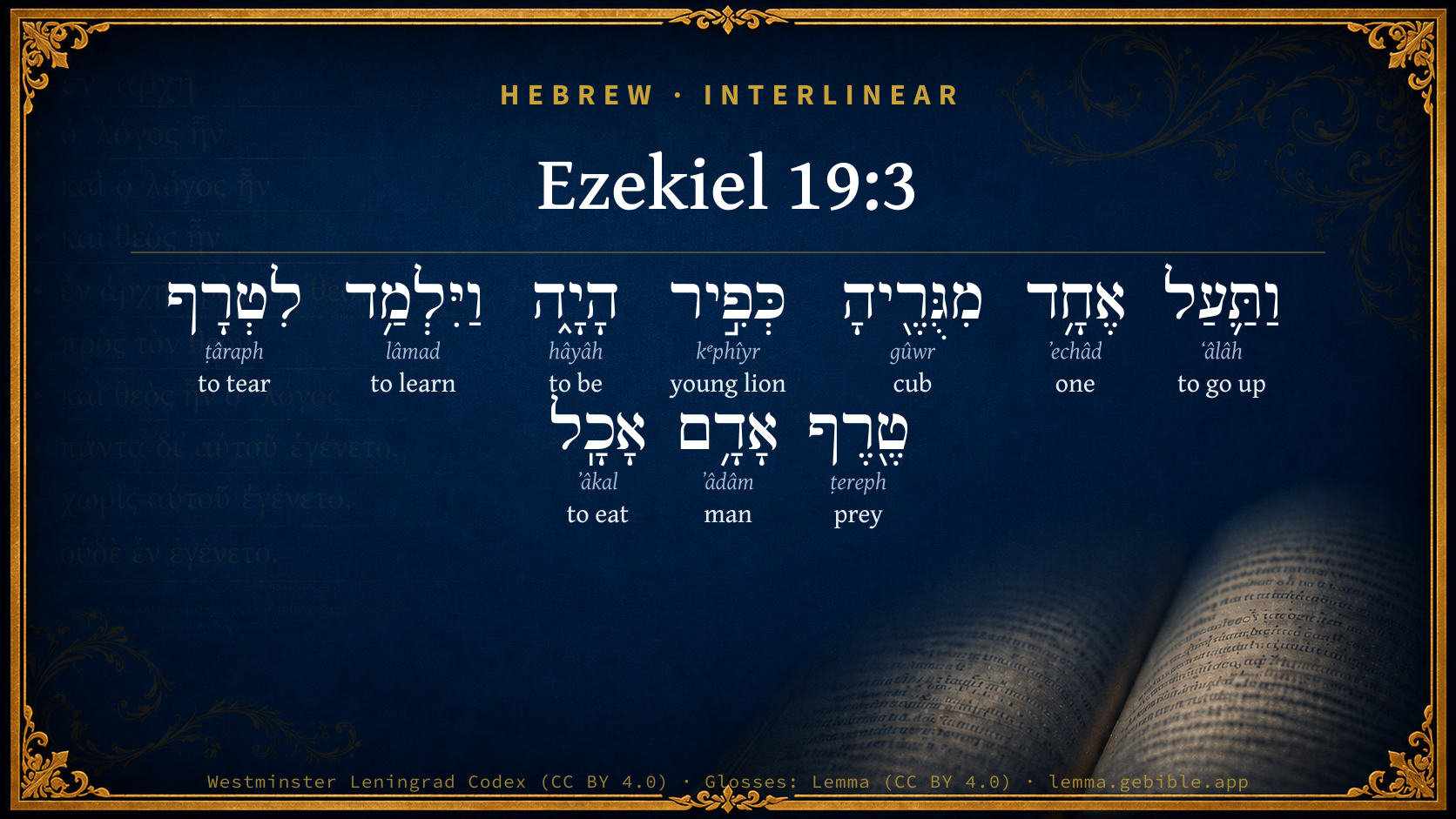
Hebrew (Westminster Leningrad Codex) Ezekiel 19:3 appears in the Hebrew Old Testament. The text above is from the Westminster Leningrad Codex. Each word links to its Strong’s number, a concise gloss, and parsing drawn from the Open Scriptures Hebrew Bible morphology. Click any word for its full Brown-Driver-Briggs (BDB) entry.
Download image
Cite this verse

Ezekiel 19:3 (World English Bible). Public Domain. Lemma interlinear Bible study tool, https://lemma.gebible.app/v/ezekiel/19/3.

Show BibTeX & RIS
BibTeX
RIS
English Translation
She brought up one of her cubs: he became a young lion, and he learned to catch the prey; he devoured men.
World English Bible · Public Domain
Download a study sheet

One document with this verse’s original text, its word-by-word gloss line, the meaning frame, cross-references with their text, attributed commentary, and full source and license credits — printable, and it pastes into notes with its structure intact.

This verse Autodidact and up

Study sheet (.html) Plain text (.txt)

A passage Seminary Student

Up to 50 verses in one chapter. A passage sheet keeps up to 6 commentary sources and 12 cross-references per verse, in the order this page ranks them, and says so on the sheet whenever that leaves anything out. Ask for a single verse and you get the Autodidact verse sheet above.

Everything on this page stays free to read, with no account — the sheet is a download of what is already on screen, not access to it.

Want to remove ads? Support Godless Engineer
Compare translations 3

The same verse in 3 English versions, stacked beneath the original-language interlinear above. Click any original word for its lexicon entry.

Each is an independent rendering of the whole verse — the interlinear is not word-aligned to these translations.

Highlighted words mark where these versions differ — a whole-verse word diff, not a word-by-word alignment.

  • World English Bible Public Domain
    She brought up one of her cubs: he became a young lion, and he learned to catch the prey; he devoured men.
  • King James Version Public Domain
    And she brought up one of her whelps: it became a young lion, and it learned to catch the prey; it devoured men.
  • unfoldingWord Literal Text CC BY-SA 4.0
    She is the one who raised up one of her cubs to become a young lion, a lion who learned to tear apart his victims, and then he devoured men.

unfoldingWord Literal Text — © unfoldingWord, licensed CC BY-SA 4.0. Word-aligned USFM3 via Door43 (git.door43.org/unfoldingWord/en_ult).

Versions to compare (up to 4)

3 of 4 selected

Show all 18 translations

Every available English version of this verse, each an independent rendering of the whole verse.

  • World English Bible Public Domain
    She brought up one of her cubs: he became a young lion, and he learned to catch the prey; he devoured men.
  • Berean Standard Bible Public Domain
    She brought up one of her cubs, and he became a young lion. After learning to tear his prey, he devoured men.
  • Majority Standard Bible Public Domain
    She brought up one of her cubs, and he became a young lion. After learning to tear his prey, he devoured men.
  • King James Version Public Domain
    And she brought up one of her whelps: it became a young lion, and it learned to catch the prey; it devoured men.
  • American Standard Version (1901) Public Domain
    And she brought up one of her whelps: he became a young lion, and he learned to catch the prey; he devoured men.
  • Revised Version (1885) Public Domain
    And she brought up one of her whelps; he became a young lion: and he learned to catch the prey, he devoured men.
  • Geneva Bible (1599) Public Domain
    And she brought vp one of her whelps, and it became a lyon, and it learned to catch the praye, and it deuoured men.
  • Douay-Rheims (1899) Public Domain
    And she brought out one of her whelps, and he became a lion: and he learned to catch the prey, and to devour men.
  • Young's Literal Translation Public Domain
    And she bringeth up one of her whelps, A young lion it hath been, And it learneth to tear prey, man it hath devoured.
  • Literal Standard Version CC BY-SA 4.0
    And she brings up one of her whelps, || He has been a young lion, || And he learns to tear prey, || He has devoured man.
  • Unlocked Literal Bible CC BY-SA 4.0
    She is the one who raised up one of her cubs to become a young lion, a lion who learned to tear apart his victims, and then he devoured men.
  • unfoldingWord Literal Text CC BY-SA 4.0
    She is the one who raised up one of her cubs to become a young lion, a lion who learned to tear apart his victims, and then he devoured men.
  • Darby Bible Public Domain
    And she brought up one of her whelps; it became a young lion, and he learned to catch the prey; he devoured men.
  • World Messianic Bible Public Domain
    She brought up one of her cubs. He became a young lion. He learned to catch the prey. He devoured men.
  • Webster's Bible Public Domain
    And she brought up one of her whelps: it became a young lion, and it learned to catch the prey; it devoured men.
  • Free Bible Version CC BY-SA 4.0
    She raised one of her cubs, and he grew up to be a young lion. Once he had learned how to tear up his prey, he started eating people.
  • Bible in Basic English Public Domain
    And one of her little ones came to growth under her care, and became a young lion, learning to go after beasts for his food; and he took men for his meat.
  • JPS Tanakh (1917) Public Domain
    And she brought up one of her whelps, he became a young lion; and he learned to catch the prey, he devoured men.

Literal Standard Version (2020), Covenant Press — licensed CC BY-SA 4.0. Text via the HelloAO Bible API (eBible.org). Unlocked Literal Bible (unfoldingWord) — licensed CC BY-SA 4.0. Text via the HelloAO Bible API (eBible.org). unfoldingWord Literal Text — © unfoldingWord, licensed CC BY-SA 4.0. Word-aligned USFM3 via Door43 (git.door43.org/unfoldingWord/en_ult). Free Bible Version, Dr. Jonathan Gallagher — licensed CC BY-SA 4.0. Text via the HelloAO Bible API (eBible.org).

Word by word

More ways to search: Search by grammar → Find every occurrence → Compare this word →

Practice this passage: Drill this verse → Learn its vocabulary →

מִגֻּרֶ֖יהָ
gûwr
H1482
“from · cubs · her”
Preposition + Noun, Common, Masculine, Plural, Construct + Suffix, Personal, 3rd Person, Feminine, Singular
Part of Speech
Preposition + Noun
Type
Common
Gender
Masculine
Number
Plural
State
Construct
Full BDB Definition

Origin: perhaps from H1481

TWOT: 331b

cub, whelp, young
  1. וַתַּ֛עַל ʻâlâh H5927 “and · to go up” Conjunction + Verb, Hiphil, Sequential Imperfect, 3rd Person, Feminine, Singular
  2. אֶחָ֥ד ʼechâd H259 “one” Adjective, Cardinal number, Masculine, Singular, Absolute
  3. כְּפִ֣יר kᵉphîyr H3715 “young lion” Noun, Common, Masculine, Singular, Absolute
  4. הָיָ֑ה hâyâh H1961 “to be” Verb, Qal, Perfect, 3rd Person, Masculine, Singular
  5. וַיִּלְמַ֥ד lâmad H3925 “and · to learn” Conjunction + Verb, Qal, Sequential Imperfect, 3rd Person, Masculine, Singular
  6. לִטְרָף ṭâraph H2963 “to tear” Preposition + Verb, Qal, Infinitive Construct
  7. טֶ֖רֶף ṭereph H2964 “prey” Noun, Common, Masculine, Singular, Absolute
  8. אָדָ֥ם ʼâdâm H120 “man” Noun, Common, Masculine, Singular, Absolute
  9. אָכָֽל ʼâkal H398 “to eat” Verb, Qal, Perfect, 3rd Person, Masculine, Singular

About this verse

These counts appear in no published source. They are computed here, from the morphology-tagged text and Lemma’s own curated glosses. What Lemma adds →

10
words
10
distinct lemmas
Prophets
section

Notable vocabulary

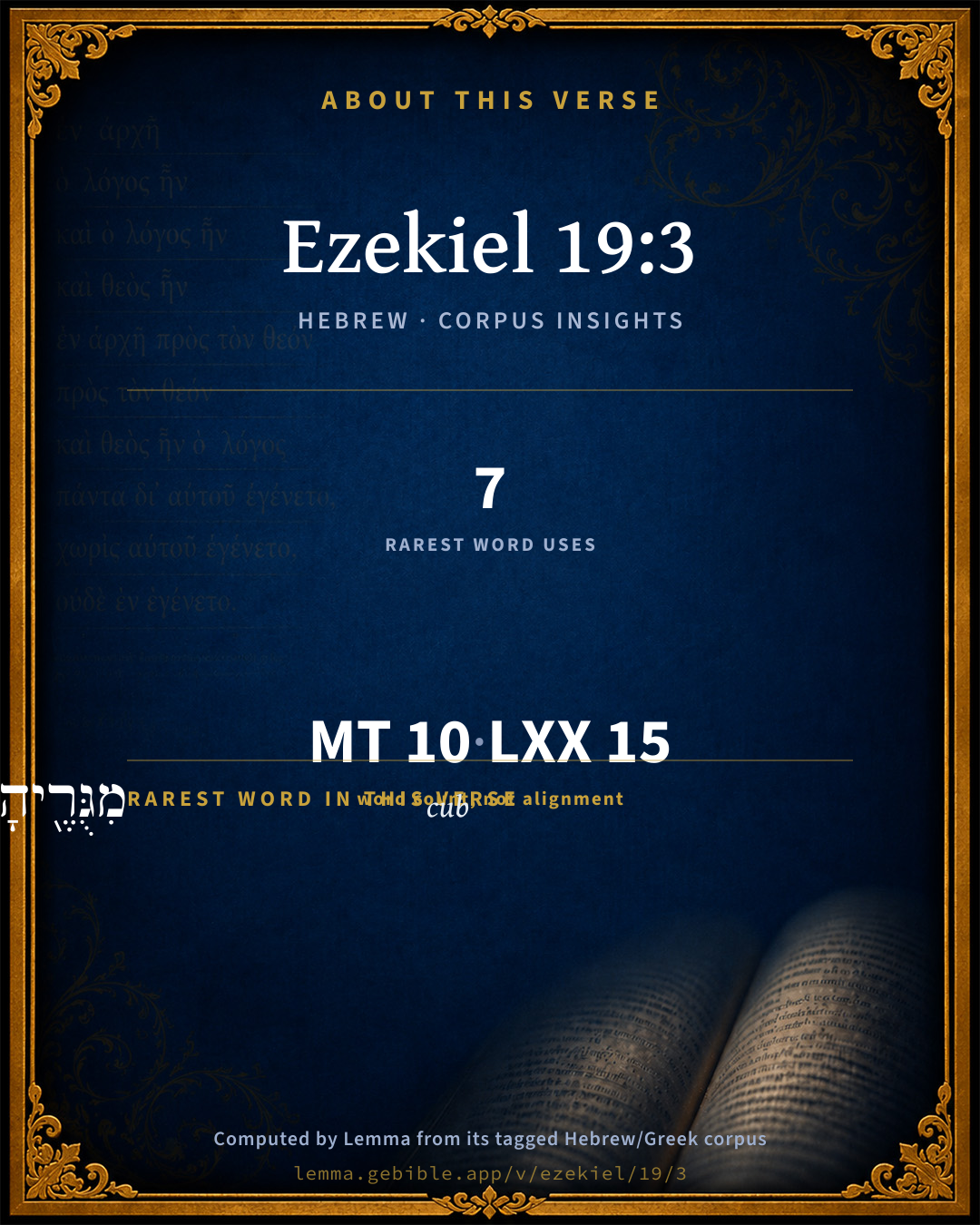
The rarest word here is מִגֻּרֶ֖יהָ cub H1482 — appearing just 7 times in the whole Hebrew Bible.

Shared distinctive vocabulary

מִגֻּרֶ֖יהָ cub H1482 occurs in 7 verses of the Hebrew Bible. Also found in:

Grammatical profile

  • 5 verbs
  • 4 nouns
  • 1 adjective

Verb forms

  • וַתַּ֛עַל Hiphil · Sequential Imperfect
  • הָיָ֑ה Qal · Perfect
  • וַיִּלְמַ֥ד Qal · Sequential Imperfect
  • לִטְרָף Qal · Infinitive Construct
  • אָכָֽל Qal · Perfect

Hebrew & Septuagint length

In English translation the verse runs 22 words from the Hebrew and 19 from the Septuagint (LXX English) — closely comparable.

A rough comparison of the two English renderings, which tokenize alike — not a word-level alignment.

Word counts can differ between the Hebrew and the Greek without any difference in meaning — e.g. the Hebrew direct-object marker אֵת has no separate Greek word, and Greek often adds the article ὁ.

In the original languages it is 10 Hebrew tokens and 15 Greek tokens — but the two are counted differently (Hebrew bundles its prefixes and suffixes into one token; the Greek is in lemma form), so that isn’t a like-for-like length.

Cross-references

4

Topical passages linked to Ezekiel 19:3 in the Treasury of Scripture Knowledge — connected by theme and wording, ordered by reader-vote popularity; previews shown in the World English Bible.

  • 2 Kings 23:31–32 Jehoahaz was twenty-three years old when he began to reign; and he reigned three months in Jerusalem: and his mother's name was Hamutal the daughter of Jeremiah of Libnah.
  • 2 Chronicles 36:1–2 Then the people of the land took Jehoahaz the son of Josiah, and made him king in his father's place in Jerusalem.
  • Ezekiel 19:6 He went up and down among the lions; he became a young lion, and he learned to catch the prey; he devoured men.
  • Ezekiel 22:25 There is a conspiracy of her prophets in the midst of it, like a roaring lion ravening the prey: they have devoured souls; they take treasure and precious things; they have made her widows many in the midst of it.

Cross-references courtesy of OpenBible.info (CC BY 4.0).

Hebrew and Greek witnesses Masoretic Hebrew ↔ Greek Septuagint

The same verse in the two great witnesses to the Old Testament, shown verse-for-verse.

These are two independent witnesses, not word-aligned to each other, and the Septuagint is shown in lemma (dictionary) form.

Hebrew Ezekiel 19:3 Masoretic · Westminster Leningrad Codex

וַתַּ֛עַל אֶחָ֥ד מִגֻּרֶ֖יהָ כְּפִ֣יר הָיָ֑ה וַיִּלְמַ֥ד לִטְרָף טֶ֖רֶף אָדָ֥ם אָכָֽל

She brought up one of her cubs: he became a young lion, and he learned to catch the prey; he devoured men.

World English Bible · Public Domain

Greek LXX Ezekiel 19:3 Septuagint · lemma form

καί ἀποπηδάω εἷς ὁ σκύμνος αὐτός λέων γίγνομαι καί μανθάνω ὁ ἁρπάζω ἅρπαγμα ἄνθρωπος ἐσθίω

And one of her whelps sprang forth; he became a lion, and learned to take prey, he devoured men.

LXX2012 (modern English Septuagint) · Public Domain

Hebrew: Westminster Leningrad Codex (CC BY 4.0). Greek: Septuagint (public domain); English from LXX2012 (modern English Septuagint) (Public Domain). How the Septuagint differs from the Hebrew →

Targum (Aramaic paraphrase)

1

The Targum is the ancient Jewish Aramaic paraphrase of the Hebrew Scriptures — an interpretive translation, not the Hebrew text itself. Onkelos (literal) and Pseudo-Jonathan (expansive) render the Torah, and Jonathan the Prophets. Coverage is partial: where no permissively-licensed English translation exists for a verse, only the Aramaic is shown. This is verse-level text, not a word-by-word alignment to the Hebrew.

  1. Targum Jonathan Prophets (Joshua–Malachi)
    וְרַבִּיאַת חַד מִבְּנָהָא מַלְכָּא הֲוָה וַאֲלִיף לְמִקְטַל קְטוֹל אֱנָשָׁא קְטַל:

    (no public-domain English translation for this verse)

    Targum Jonathan — Aramaic: “Mikraot Gedolot” (public domain). English: “Sefaria Community Translation” (CC0 1.0 (public-domain dedication)); “London "Chaldee Paraphrase," 1871” (public domain). Text via Sefaria.

Commentary

Notes on Ezekiel 19:3 from classic Christian and Jewish commentators (each source and its license shown beneath its notes). The classic Christian expositions comment on the surrounding passage and are grouped to its opening verse, so a note may address several verses; the Jewish commentaries on the Tanakh (Rashi and others) are per-verse, so they appear only where the commentator wrote on this verse.

Lemma curates 59 commentaries, every one of them public domain or Creative Commons licensed, each selected and text-cleaned for this edition rather than reprinted as found. About our sources →

Trapp's Complete Commentary

John Trapp

Eze 19:3 And she brought up one of her whelps: it became a young lion, and it learned to catch the prey; it devoured men.

Ver. 3. And she brought up one of her whelps.] This was Jehoahaz.

It became a young llon.] Cunning and cruel, and having never a good property, though the son of good Josiah; who might better have said than that pope did of his wicked son, Caesar Borgia, Haec vitia me non commonstratore dedicit, He never learned it of his father.

It devoured men.] He was a very cannibal to his subjects, and made no more conscience to undo a poor man, to seek and suck his blood, than to eat a meal’s meat when hungry. {Psa 14:4}

John Trapp, A Commentary or Exposition upon All the Books of the Old and New Testament (1647–1656) — public domain. Text from a community e-Sword module.

Matthew Poole's English Annotations

See Eze 19:3.

Brought up; not as a nurse, the word is of other import, but advanced, promoted, or caused him to take the throne after the slaughter of Josiah.

One of her whelps; this was Jehoahaz, the second son of Josiah, of whom it is said, 2Ki 23:30; 2Ch 36:1, the people made him king; for God had not made him so by primogeniture, and right of succession. They looked upon him as a warlike prince, fitter for sustaining the troubles of those martial times than his eldest. brother, and therefore strain a point of law and right.

It became a young lion; soon showed his fierce, haughty, cruel, and bloody disposition, as appears 2Ki 23:30-32, though he continued but three months, and some odd days, wherein to play his pranks.

Learned; had tutors and counsellors that showed him the method; and he, an apt scholar in an evil school, learnt apace.

To catch the prey; to seize first, and then to tear the prey, by frauds and violence to hunt, take, and devour that he took, as lions use.

Devoured; eat up, as the word notes, lived upon.

Men; man, Adam, the weaker sort; or it may be in those divided times Adam may imply such as were crushed because they were not of the tyrannizing faction: at that time Pharaoh had some that inclined to him, and perhaps these were used hardly by Jehoahaz.

Matthew Poole's English Annotations on the Holy Bible (1683–1685) — public domain. Text from a community e-Sword/MySword module.

Joseph Benson's Commentary

Eze 19:3-4. And she brought up one of her whelps — This seems to be spoken of Jehoahaz, who, we are told, followed not the good example of his father Josiah, but the evil practices of the wicked kings his predecessors; and though we have no further account of his acts, yet, from this, there is sufficient reason to suppose that he was rapacious and injurious to his neighbours, and tyrannical and cruel; which possibly was the reason why Pharaoh-necho deposed him after he had reigned only three months, and placed his brother on the throne in his room. The nations also heard of him — The king of Egypt, hearing of his character, and probably some of his subjects having been used ill by him, deprived him of his kingly office, put him in bands, and carried him into Egypt, 2Ki 23:32; 2Ki 23:34. He was taken in their pit — This expression alludes to those pit-falls and snares which are made to take wild beasts; and as Jehoahaz is spoken of here as a young lion, the expression was quite applicable to signify his being taken prisoner.

Joseph Benson's Commentary on the Old and New Testaments (1811–1818) — public domain. Text from a community e-Sword module.

Jamieson, Fausset & Brown

Robert Jamieson, A. R. Fausset & David Brown

young lion--Jehoahaz, son of Josiah, carried captive from Riblah to Egypt by Pharaoh-necho (Kg2 23:33).

Jamieson, Fausset & Brown — Commentary Critical and Explanatory on the Whole Bible (1871) — public domain (CC PDM 1.0). Text via the HelloAO Bible API.

Adam Clarke's Commentary

Verse 3. She brought up one of her whelps] Jehoahaz, son of Josiah, whose father was conquered and slain by Pharaoh-necho, king of Egypt.

It learned to catch the prey] His reign was a reign of oppression and cruelty. He made his subjects his prey, and devoured their substance.

Adam Clarke's Commentary on the Bible (1810–1826) — public domain. Text from a community e-Sword/MySword module.

Ellicott's Commentary for English Readers

(3) It became a young lion.—There can be no doubt (see Eze_19:4) of the reference of this to Jehoahaz. After the death of Josiah, “the people of the land took Jehoahaz, the son of Josiah . . . and made him king” (2Ki_23:30). In Eze_19:6 Jehoiachin is also spoken of particularly. These two are mentioned as examples of all the other kings after Josiah. Jehoiakim and Zedekiah are simply passed over, although it may be that the prophet looked upon them as creatures of Pharaoh and Nebuchadnezzar rather than as legitimate kings of Israel. Jehoiakim, moreover, died in Jerusalem, and Zedekiah was at this moment still upon the throne.

It devoured men.—This at once keeps up the figure, and has also its special justification in the evil courses of Jehoahaz (2Ki_23:32). He is represented as growing up and being like the heathen kings around. See also, in Eze_19:2, Israel as a whole is represented as going aside from her high calling as a theocracy, and making herself “like the nations round about.”

A Bible Commentary for English Readers, edited by Charles John Ellicott (1878–1897) — public domain. Text from a community e-Sword module.

John Gill's Exposition

And she brought up one of her whelps,.... Or sons, as the Targum: or, "made him to ascend" (t), as the word signifies; to mount the throne; this was Jehoahaz, whom the people of the land took and anointed him, and made him king in the stead of Josiah his father, Kg2 23:30;

it become a young lion; that is, a king, as the same Targum explains it, and a tyrannical and arbitrary one:

and it learned to catch the prey; being instructed by evil counsellors, he soon learned to oppress his subjects, to get their substance from them, and do many evil things, as he is said to do, Kg2 23:32;

it devoured men; or a man, Adam, the people of Israel, so called, Eze 34:31; as the Jews frequently observe; it ate up and destroyed their liberties, privileges, and property.

(t) "et ascendere fecit", Pagninus, Montanus, Tigurine version.

John Gill's Exposition of the Whole Bible (1746–1763) — public domain (CC PDM 1.0). Text via the HelloAO Bible API.

Albert Barnes' Notes on the Bible

Compare the marginal reference. The short reign of Jehoahaz was marked by violence and idolatry, and was closed by Pharaoh-Necho’s carrying him captive into Egypt.

Albert Barnes' Notes on the Bible (1834–1885) — public domain. Text from a community e-Sword/MySword module.

Haydock's Catholic Bible Commentary

Whelps; Joachaz, or Sellum, (Challoner) who reigned only three months, like his brother Jechonias. (Haydock) --- The four last kings were all cruel. (Worthington)

George Leo Haydock (1774–1849), Haydock's Catholic Family Bible and Commentary, 1859 edition — public domain. Excludes Psalms (Douay-Rheims chapter numbering differs from Protestant) and Deuterocanonical books (Catholic canon only).

The Pulpit Commentary

The whelp, as ver. 4 shows, is Jehoahaz, also known as Shallum, (Jer_22:11) who "did evil" in the sight of the Lord, (2Ki_23:32) the words that follow pointing to cruelty and oppression like that of Zedekiah. The passage finds a somewhat striking parallel in Aeschylus, "Agam.," 695-715.

The Pulpit Commentary (1880–1919), ed. H.D.M. Spence-Jones & Joseph S. Exell — public domain. Text from a community e-Sword module.

John Wesley's Explanatory Notes

Brought up - Advanced, caused him to take the throne after the slaughter of Josiah. One - Jehoahaz the second son of Josiah. Became - Soon shewed his fierce, cruel, and bloody disposition.

John Wesley, Explanatory Notes Upon the Whole Bible (1754–1765) — public domain. Text via the GEBible commentary corpus.

Rashi

Rabbi Shlomo Yitzchaki (Rashi)

And she raised up one of her cubs This lamentation was said regarding the sons of Josiah. The first is Jehoahaz.

he devoured men Heb. אָדָם. He robbed Israel, for Israel is called אָדָם, man, as is stated (below 34:31): “And you are My flock, the flock of My pasture; you are men,” and according to the allegory, any beast that tasted human flesh will always provoke humans.

Rashi on the Tanakh — English translations: “The Judaica Press complete Tanach with Rashi, translated by A. J. Rosenberg” (CC BY 4.0); “Pentateuch with Rashi's commentary by M. Rosenbaum and A.M. Silbermann, 1929-1934” (public domain); “The Metsudah Tanach series, Lakewood, N.J” (CC BY 4.0); and “The Book of Joshua, Metsudah Publications, 1997” (CC BY 4.0). Text via Sefaria.

Lesson kit

Teaching starters — assembled from the data on this page, not authored interpretation. Every prompt links to the verse data it draws on. Edit before teaching.

Ezekiel, in the Prophets, opens this verse with 10 words (10 distinct Hebrew lemmas). Its most distinctive word is gûwr (“cub”). A historical commentator’s framing appears above. Read the whole chapter for the surrounding context.

Discussion questions

  1. The word gûwr carries the sense “cub.” How does it shape the verse?
  2. Genesis 49:9 shares the word «cub» with this verse. How do the two illuminate each other?
  3. These translations render this verse differently. What is at stake in choosing one wording over another?
  4. The verb «וַתַּ֛עַל» is Hiphil Sequential Imperfect. How does its form color the action?
  5. Reading how Trapp's Complete Commentary and Matthew Poole's English Annotations read this verse, where do the two commentators agree and where do they part?

Things to notice

Reading settings

Reading text

Shown beneath each verse's original-language words.

Old Testament
Old Testament edition

Read the OT as the Masoretic Hebrew (MT) or the Greek Septuagint (LXX).

English shown for the Greek Septuagint (in the Hebrew ↔ Greek comparison).

Comparing translations? Open the Compare panel on any verse page to stack up to four side by side.