
Psalms 119:12

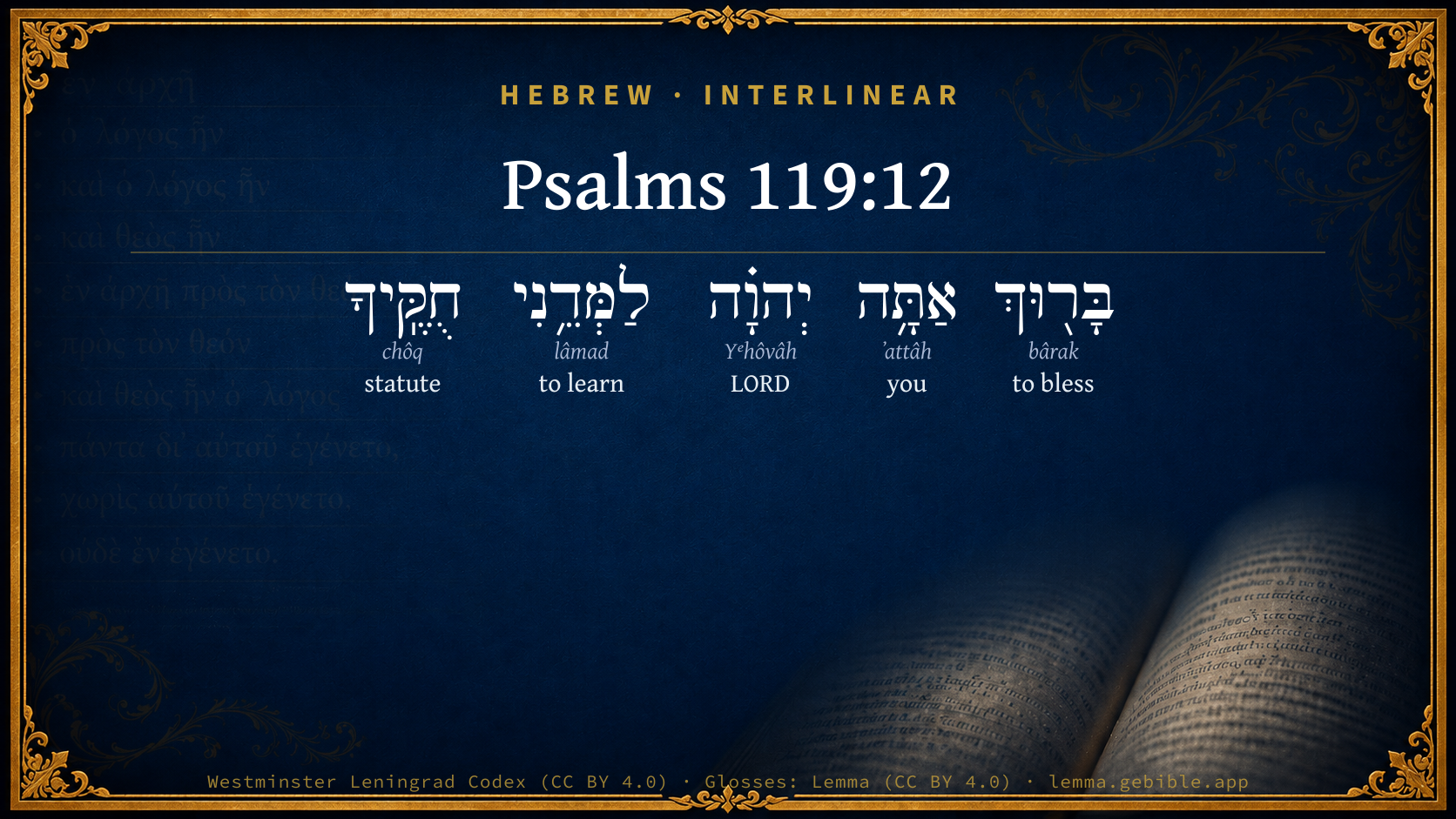
Hebrew (Westminster Leningrad Codex) Psalms 119:12 appears in the Hebrew Old Testament. The text above is from the Westminster Leningrad Codex. Each word links to its Strong’s number, a concise gloss, and parsing drawn from the Open Scriptures Hebrew Bible morphology. Click any word for its full Brown-Driver-Briggs (BDB) entry.
Download image
Cite this verse

Psalms 119:12 (World English Bible). Public Domain. Lemma interlinear Bible study tool, https://lemma.gebible.app/v/psalms/119/12.

Show BibTeX & RIS
BibTeX
RIS
English Translation
Blessed are you, Yahweh. Teach me your statutes.
World English Bible · Public Domain
Download a study sheet

One document with this verse’s original text, its word-by-word gloss line, the meaning frame, cross-references with their text, attributed commentary, and full source and license credits — printable, and it pastes into notes with its structure intact.

This verse Autodidact and up

Study sheet (.html) Plain text (.txt)

A passage Seminary Student

Up to 50 verses in one chapter. A passage sheet keeps up to 6 commentary sources and 12 cross-references per verse, in the order this page ranks them, and says so on the sheet whenever that leaves anything out. Ask for a single verse and you get the Autodidact verse sheet above.

Everything on this page stays free to read, with no account — the sheet is a download of what is already on screen, not access to it.

Want to remove ads? Support Godless Engineer
Compare translations 3

The same verse in 3 English versions, stacked beneath the original-language interlinear above. Click any original word for its lexicon entry.

Each is an independent rendering of the whole verse — the interlinear is not word-aligned to these translations.

Highlighted words mark where these versions differ — a whole-verse word diff, not a word-by-word alignment.

  • World English Bible Public Domain
    Blessed are you, Yahweh. Teach me your statutes.
  • King James Version Public Domain
    Blessed art thou, O LORD: teach me thy statutes.
  • unfoldingWord Literal Text CC BY-SA 4.0
    Blessed you, Yahweh; teach me your statutes.

unfoldingWord Literal Text — © unfoldingWord, licensed CC BY-SA 4.0. Word-aligned USFM3 via Door43 (git.door43.org/unfoldingWord/en_ult).

Versions to compare (up to 4)

3 of 4 selected

Show all 17 translations

Every available English version of this verse, each an independent rendering of the whole verse.

  • World English Bible Public Domain
    Blessed are you, Yahweh. Teach me your statutes.
  • Berean Standard Bible Public Domain
    Blessed are You, O LORD; teach me Your statutes.
  • Majority Standard Bible Public Domain
    Blessed are You, O LORD; teach me Your statutes.
  • King James Version Public Domain
    Blessed art thou, O LORD: teach me thy statutes.
  • American Standard Version (1901) Public Domain
    Blessed art thou, O Jehovah: Teach me thy statutes.
  • Revised Version (1885) Public Domain
    Blessed art thou, O LORD: teach me thy statutes.
  • Geneva Bible (1599) Public Domain
    Blessed art thou, O Lord: teache mee thy statutes.
  • Young's Literal Translation Public Domain
    Blessed `art' Thou, O Jehovah, teach me Thy statutes.
  • Literal Standard Version CC BY-SA 4.0
    Blessed [are] You, O YHWH, teach me Your statutes.
  • Unlocked Literal Bible CC BY-SA 4.0
    Blessed you are, Yahweh; teach me your statutes.
  • unfoldingWord Literal Text CC BY-SA 4.0
    Blessed you, Yahweh; teach me your statutes.
  • Darby Bible Public Domain
    Blessed art thou, Jehovah! teach me thy statutes.
  • World Messianic Bible Public Domain
    Blessed are you, LORD. Teach me your statutes.
  • Webster's Bible Public Domain
    Blessed art thou, O LORD: teach me thy statutes.
  • Free Bible Version CC BY-SA 4.0
    Thank you Lord! Teach me what to do!
  • Bible in Basic English Public Domain
    Praise be to you, O Lord: give me knowledge of your rules.
  • JPS Tanakh (1917) Public Domain
    Blessed art Thou, O LORD; teach me Thy statutes.

Literal Standard Version (2020), Covenant Press — licensed CC BY-SA 4.0. Text via the HelloAO Bible API (eBible.org). Unlocked Literal Bible (unfoldingWord) — licensed CC BY-SA 4.0. Text via the HelloAO Bible API (eBible.org). unfoldingWord Literal Text — © unfoldingWord, licensed CC BY-SA 4.0. Word-aligned USFM3 via Door43 (git.door43.org/unfoldingWord/en_ult). Free Bible Version, Dr. Jonathan Gallagher — licensed CC BY-SA 4.0. Text via the HelloAO Bible API (eBible.org).

Word by word

More ways to search: Search by grammar → Find every occurrence → Compare this word →

Practice this passage: Drill this verse → Learn its vocabulary →

About this verse

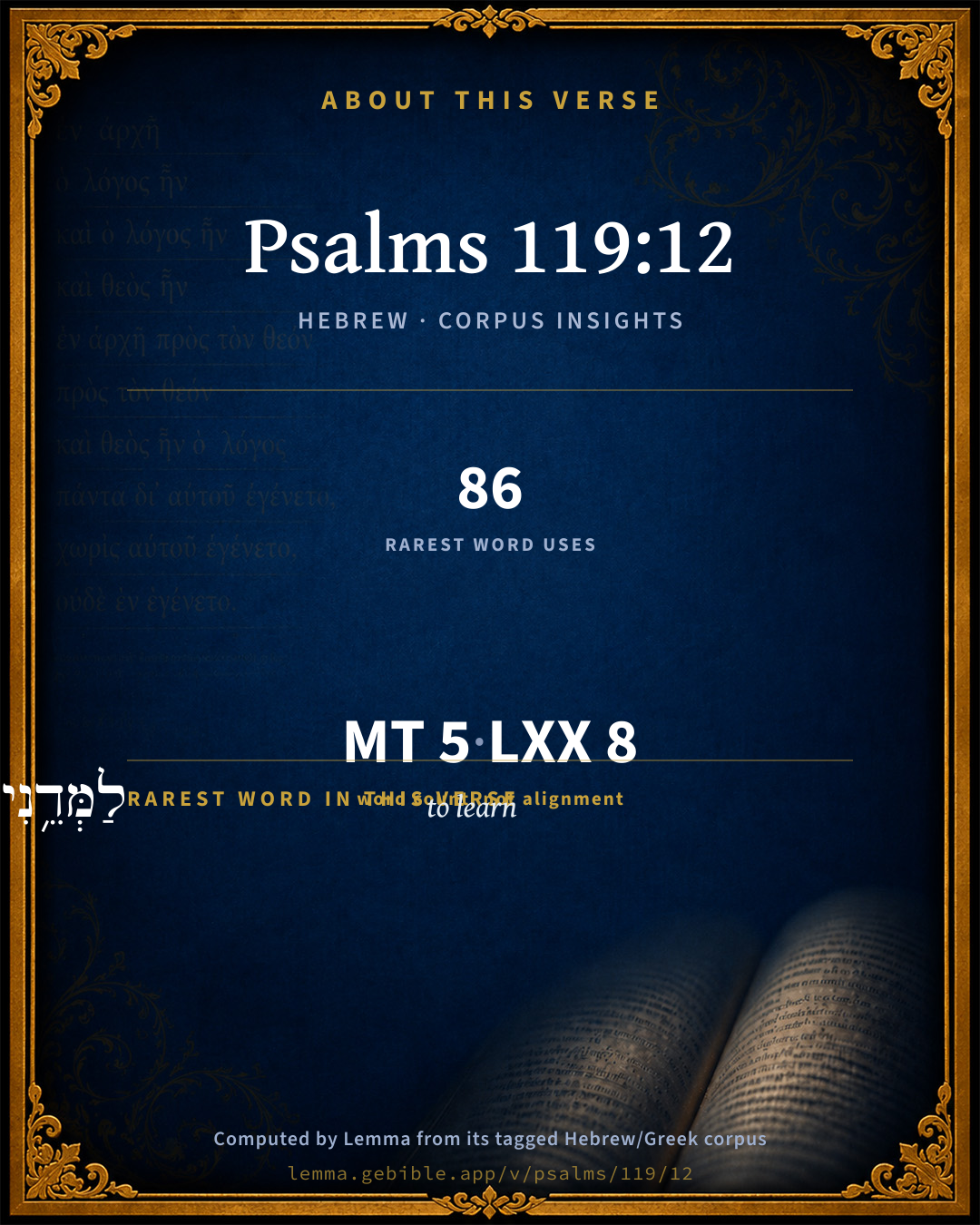
These counts appear in no published source. They are computed here, from the morphology-tagged text and Lemma’s own curated glosses. What Lemma adds →

5
words
5
distinct lemmas
Wisdom
section

Grammatical profile

  • 2 verbs
  • 2 nouns
  • 1 pronoun

Verb forms

  • בָּר֖וּךְ Qal · Participle Passive
  • לַמְּדֵ֥נִי Piel · Imperative

Hebrew & Septuagint length

In English translation the verse runs 8 words from the Hebrew and 9 from the Septuagint (LXX English) — closely comparable.

A rough comparison of the two English renderings, which tokenize alike — not a word-level alignment.

Word counts can differ between the Hebrew and the Greek without any difference in meaning — e.g. the Hebrew direct-object marker אֵת has no separate Greek word, and Greek often adds the article ὁ.

In the original languages it is 5 Hebrew tokens and 8 Greek tokens — but the two are counted differently (Hebrew bundles its prefixes and suffixes into one token; the Greek is in lemma form), so that isn’t a like-for-like length.

Cross-references

16

Topical passages linked to Psalms 119:12 in the Treasury of Scripture Knowledge — connected by theme and wording, ordered by reader-vote popularity; previews shown in the World English Bible.

  • Psalms 119:64 The earth is full of your loving kindness, Yahweh. Teach me your statutes.
  • Psalms 25:4–5 Show me your ways, Yahweh. Teach me your paths.
  • Luke 24:45 Then he opened their minds, that they might understand the Scriptures.
  • 1 John 2:27 As for you, the anointing which you received from him remains in you, and you don't need for anyone to teach you. But as his anointing teaches you concerning all things, and is true, and is no lie, and even as it taught you, you will remain in him.
  • Psalms 86:11 Teach me your way, Yahweh. I will walk in your truth. Make my heart undivided to fear your name.
  • Psalms 119:108 Accept, I beg you, the willing offerings of my mouth. Yahweh, teach me your ordinances.
  • Psalms 143:10 Teach me to do your will, For you are my God. Your Spirit is good. Lead me in the land of uprightness.
  • John 14:26 But the Counselor, the Holy Spirit, whom the Father will send in my name, he will teach you all things, and will remind you of all that I said to you.
  • Psalms 119:66 Teach me good judgment and knowledge, For I believe in your commandments.
  • Psalms 119:71–72 It is good for me that I have been afflicted, That I may learn your statutes.
  • 1 Timothy 1:11 according to the Gospel of the glory of the blessed God, which was committed to my trust.
  • 1 Timothy 6:15 which in its own times he will show, who is the blessed and only Ruler, the King of kings, and Lord of lords;
  • Psalms 119:26–27 I declared my ways, and you answered me. Teach me your statutes.
  • Psalms 119:124 Deal with your servant according to your loving kindness. Teach me your statutes.
  • Psalms 119:33 Teach me, Yahweh, the way of your statutes. I will keep them to the end.
  • Psalms 119:68 You are good, and do good. Teach me your statutes.

Cross-references courtesy of OpenBible.info (CC BY 4.0).

Hebrew and Greek witnesses Masoretic Hebrew ↔ Greek Septuagint

The same verse in the two great witnesses to the Old Testament, shown verse-for-verse.

You’re reading Greek Psalm 118 (Hebrew Psalm 119). The Septuagint counts the superscription, so verse numbers can differ from the Hebrew — chapter-level alignment, not verse-by-verse. Numbering follows Rahlfs.

These are two independent witnesses, not word-aligned to each other, and the Septuagint is shown in lemma (dictionary) form.

Hebrew Psalms 119:12 Masoretic · Westminster Leningrad Codex

בָּר֖וּךְ אַתָּ֥ה יְהוָ֗ה לַמְּדֵ֥נִי חֻקֶּֽיךָ

Blessed are you, Yahweh. Teach me your statutes.

World English Bible · Public Domain

Greek LXX Greek Psalm 118:12 Septuagint · lemma form

εὐλογητός εἰμί κύριος διδάσκω ἐγώ ὁ δικαίωμα σύ

Blessed are you, O Lord: teach me your ordinances.

LXX2012 (modern English Septuagint) · Public Domain

Hebrew: Westminster Leningrad Codex (CC BY 4.0). Greek: Septuagint (public domain); English from LXX2012 (modern English Septuagint) (Public Domain). How the Septuagint differs from the Hebrew →

Commentary

Notes on Psalms 119:12 from classic Christian and Jewish commentators (each source and its license shown beneath its notes). The classic Christian expositions comment on the surrounding passage and are grouped to its opening verse, so a note may address several verses; the Jewish commentaries on the Tanakh (Rashi and others) are per-verse, so they appear only where the commentator wrote on this verse.

Lemma curates 59 commentaries, every one of them public domain or Creative Commons licensed, each selected and text-cleaned for this edition rather than reprinted as found. About our sources →

Trapp's Complete Commentary

John Trapp

Psa 119:12 Blessed [art] thou, O LORD: teach me thy statutes.

Ver. 12. Blessed art thou (or be thou), O Lord] viz. For what thou hast already taught me of thy will, and my duty.

Teach me thy statutes] Gratiarum actio est ad plus dandum invitatio. David had never enough, but craveth more; "Teach me thy statutes," saith he, that I may bless thee better.

John Trapp, A Commentary or Exposition upon All the Books of the Old and New Testament (1647–1656) — public domain. Text from a community e-Sword module.

J. A. Alexander on Psalms

Joseph Addison Alexander

12. (Psa 119:12) Blessed (be) thou, Jehovah! Teach me thy statutes! The doxology seems designed to break the uniformity of this series of aphorisms, by an occasional expression of strong feeling. At the same time, it furnishes a kind of ground for the petition in the last clause. Since thou art the blessed and eternal God, have pity on my weakness, and instruct me in the knowledge of thy will.

Joseph Addison Alexander, The Psalms Translated and Explained (1850) — public domain. Text from a community e-Sword module.

Matthew Henry's Commentary

Here, 1. David gives glory to God: "Blessed art thou, O Lord! Thou art infinitely happy in the enjoyment of thyself and hast no need of me or my services; yet thou art pleased to reckon thyself honoured by them; assist me therefore, and then accept me." In all our prayers we should intermix praises. 2. He asks grace from God: "Teach me thy statutes; give me to know and do my duty in every thing. Thou art the fountain of all blessedness; O let me have this drop from that fountain, this blessing from that blessedness: Teach me thy statutes, that I may know how to bless thee, who art a blessed God, and that I may be blessed in thee."

Matthew Henry's Commentary on the Whole Bible (1708–1710) — public domain (CC PDM 1.0). Text via the HelloAO Bible API.

Adam Clarke's Commentary

Verse 12. Blessed art thou]

8. He must acknowledge the mercy of God, in so far preserving him from all the consequences of his sin.

9. He should beg of him to become his teacher, that his heart and conscience might be instructed in the spirituality of his statutes.

Adam Clarke's Commentary on the Bible (1810–1826) — public domain. Text from a community e-Sword/MySword module.

John Calvin's Commentaries

12. Blessed art thou, O Jehovah! Such had been the prophet’s proficiency, that he was not only one of ‘God’s disciples, but also a public teacher of the Church. Nevertheless, acknowledging himself and all the upright to be only one their journey till they arrive at the close of life, he fails not to ask for the spirit of understanding. This passage informs us generally, that if God do not enlighten us with the spirit of discernment, we are not competent to behold the light which shines forth from his law, though it be constantly before us. And thus it happens, that not a few are blind even when surrounded with the clear revelation of this doctrine, because, confident in their own perspicacity, they contemn the internal illumination of the Holy Spirit. Farther, let us learn from this passage, that none are possessed of such superiority of intellect as not to admit of constant increase. If the prophet, upon whom God had conferred so honorable an office as a teacher of the Church, confesses himself to be only a disciple or scholar, what madness is it for those who are, greatly behind him in point of attainments not to strain every nerve to rise to higher excellence? Nor does he depend upon his own merits for obtaining his requests; he beseeches God to grant them from a regard to his own glory. This appears from the phraseology by which he introduces his request, Blessed art thou, O Jehovah! intimating, that his confidence of success originated in God’s being fully entitled to all praise on account of his unbounded goodness, justice, and mercy.

John Calvin's Commentaries (1540-1563) — public domain. Text from the Calvin Translation Society English edition (1840s-50s) via the Christian Classics Ethereal Library (ccel.org). Calvin's coverage is partial (roughly two-thirds of the Bible); uncommented books and verses are honest gaps, never fabricated. The 19th-century editor's footnotes and remarks are omitted so the notes are faithfully Calvin's own voice.

The Cambridge Bible for Schools and Colleges

gen. ed. J. J. S. Perowne

12. The confession of Jehovah’s adorableness is a fitting preface to the prayer for further instruction. Cp. Psa_119:7.

The Cambridge Bible for Schools and Colleges (gen. ed. J. J. S. Perowne; Cambridge University Press, 1878–1918) — public domain. Text from a community e-Sword module.

John Gill's Exposition

With my lips have I declared all the judgments of thy mouth. Not the judgments of his hand, what he executes on an ungodly world; nor the intricate dispensations of his providence; those judgments of his now unsearchable, though before long will be manifest; these the psalmist could not declare: but the revelation of the will of God, what his mouth has uttered, doctrines and precepts of righteousness and truth; these, though David had them in his heart, he did not conceal them from men; but out of the abundant experience he had of them in his heart, his lips spake of them, of their nature and excellency, and usefulness unto others: and whereas he desired to be instructed more and more in them, it was in order to teach them, and declare them to others; even all of them, in the most sincere and impartial manner; see Act 20:27.

.

Psalms 119:14

psa 119:14

psa 119:14

psa 119:14I have rejoiced in the way of thy testimonies,.... The way which the Scriptures, that testify of God and Christ, direct unto; and the principal way is Christ himself, the only way of life and salvation; in which believers walk and go on rejoicing; rejoicing in his person, offices, grace, righteousness, and salvation: the lesser ways the Scriptures point unto are the ways of duty and paths of ordinances; in which truly gracious souls find a great deal of peace, pleasure, and delight;

as much as in all riches; or, "as above all riches" (r): the joy that believers have in the ways of God is superior to that which any natural or worldly man has in his substance of every sort, or be it ever so great; yea, they find such riches in the ways of God, as are vastly preferable to the riches of this world; they find Christ, the pearl of great price, and his unsearchable riches, the riches of grace, and the riches of glory; and even the word of God itself, those testimonies of his, are more desirable than thousands of gold and silver, and give a greater pleasure than the increase of corn and wine.

(r) "sicut super omnibus divitiis", Pagninus; so Junius & Tremellius, Michaelis, Ainsworth.

John Gill's Exposition of the Whole Bible (1746–1763) — public domain (CC PDM 1.0). Text via the HelloAO Bible API.

Albert Barnes' Notes on the Bible

Blessed art thou, O Lord - Blessed art thou as the author of such a law. This language of benediction or doxology is an outbreak of feeling or adoration in view of such a law - so good, so holy, so suited to direct and guide man. The mind is full of the subject; and the lips give vent to the feeling of gratitude and joy that such a law had been revealed to people.

Teach me thy statutes - Make me more and more acquainted with a law so pure, so rich, so valuable.

Albert Barnes' Notes on the Bible (1834–1885) — public domain. Text from a community e-Sword/MySword module.

Matthew Poole's English Annotations

Blessed art thou; thou art infinitely blessed, and most worthy of all blessing and praise, and therefore do thou bless me in teaching me, as it follows. Or, Blessed be thou. I bless and praise thee for that great blessing of thy word, Psa 119:11.

Teach me thy statutes, both to know and to practise them better.

Matthew Poole's English Annotations on the Holy Bible (1683–1685) — public domain. Text from a community e-Sword/MySword module.

The Treasury of David

Charles H. Spurgeon

Ver. 12. Blessed art thou, O LORD. These are words of adoration arising out of an intense admiration of the divine character, which the writer is humbly aiming to imitate. He blesses God for all that he has revealed to him, and wrought in him; he praises him with warmth of reverent love, and depth of holy wonder. These are also words of perception uttered from a remembrance of the great Jehovah's infinite happiness within himself. The Lord is and must be blessed, for he is the perfection of holiness; and this is probably the reason why this is used as a plea in this place. It is as if David had said I see that in conformity to thyself my way to happiness must lie, for thou art supremely blessed; and if I am made in my measure like to thee in holiness, I shall also partake in thy blessedness.

No sooner is the word in the heart than a desire arises to mark and learn it. When food is eaten, the next thing is to digest it; and when the word is received into the soul, the first prayer is Lord, teach me its meaning.

Teach me thy statutes; for thus only can I learn the way to be blessed. Thou art so blessed that I am sure thou wilt delight in blessing others, and this boon I crave of thee that. I may be instructed in thy commands. Happy men usually rejoice to make others happy, and surely the happy God will willingly impart the holiness which is the fountain of happiness. Faith prompted this prayer and based it, not upon anything in the praying man, but solely upon the perfection of the God to whom he made supplication. Lord, thou art blessed, therefore bless me by teaching me.

We need to be disciples or learners "teach me; "but what an honour to have God himself for a teacher: how bold is David to beg the blessed God to teach him! Yet the Lord put the desire into his heart when the sacred word was hidden there, and so we may be sure that he was not too bold in expressing it. Who would not wish to enter the school of such a Master to learn of him the art of holy living? To this Instructor we must submit ourselves if we would practically keep the statutes of righteousness. The King who ordained the statutes knows best their meaning, and as they are the outcome of his own nature he can best inspire us with their spirit. The petition commends itself to all who wish to cleanse their way, since it is most practical, and asks for teaching, not upon recondite lore, but upon statute law. If we know the Lord's statutes we have the most essential education.

Let us each one say, "Teach me thy statutes." This is a sweet prayer for everyday use. It is a step above that of Ps 119:10, "O let me not wander, "as that was a rise beyond that of Ps 119:8, "O forsake me not utterly." It finds its answer in Ps 119:98-100: "Thou through thy commandments hast made me wiser than mine enemies, " etc.: but not till it had been repeated even to the third time in the "Teach me" of Ps 119:33, 66, all of which I beg my reader to peruse. Even after this third pleading the prayer occurs again in so many words in Ps 119:124, 139, and the same longing conics out near the close of the Psalm in Ps 119:171 "My lips shall utter praise when thou hast taught me thy statutes."

Ver. 12. Blessed art thou, O Lord: teach me thy statutes. This verse contains a prayer, with the reason of the prayer. The prayer is, "Teach me thy statutes"; the reason, moving him to seek this, ariseth of a consideration of that infinite good which is in God. He is a blessed God, the fountain of all felicity, without whom no welfare or happiness can be to the creature. And for this cause David earnestly desiring to be in fellowship and communion with God, which he knows none can attain unto unless he be taught of God to know God's way and walk in it; therefore, I say, he prayeth the more earnestly that the Lord would teach him his statutes. Oh that we also could wisely consider this, that our felicity stands in fellowship with God. William Cowper.

Ver. 12. In this verse we have two things, 1. An acknowledgment of God's blessedness, Blessed art thou, O LORD; i.e., being possessed of all fulness, thou hast an infinite complacency in the enjoyment of thyself; and thou art he alone in the enjoyment of whom I can be blessed and happy; and thou art willing and ready to give out of thy fulness, so that thou art the fountain of blessedness to thy creatures. 2. A request or petition, Teach me thy statutes; q.d., seeing thou hast all fulness in thyself, and art sufficient to thy own blessedness; surely thou hast enough for me. There is enough to content thyself, therefore enough to satisfy me. This encourages me in my address.

Again, Teach me that I may know wherein to seek my blessedness and happiness, even in thy blessed self; and that I may know how to come by the enjoyment of thee, so that I may be blessed in thee. Further, Thou art blessed originally, the Fountain of all blessing; thy blessedness is an everlasting fountain, a full fountain; always pouring out blessedness: O, let me have this blessing from thee, this drop from the fountain. William Wisheart, in "Theologia, or, Discourses of God, "1716.

Ver. 12. Since God is blessed, we cannot but desire to learn his ways. If we see any earthly being happy, we have a great desire to learn out his course, as thinking by it we might be happy also. Every one would sail with that man's wind who prospereth; though in earthly things it holdeth not alway: yet a blessed God cannot by any way of his bring to other than blessedness. Thus, he who is blessedness itself, he will be ready to communicate his ways to other: the most excellent things are most communicative. Paul Bayne.

Ver. 12. Teach me. He had Nathan, he had priests to instruct him, himself was a prophet; but all their teaching was nothing without God's blessing, and therefore he prays, "Teach me." William Nicholson.

Ver. 12. Teach me. These words convey more than the simple imparting of knowledge, for he said before he had such, when he said he hid God's words in his heart; and in Ps 119:7 he said he "had learned the judgments of his justice": it includes grace to observe his law. Robert Bellarmine, 1542-1621.

Ver. 12. Teach me. If this were practised now, to join prayer with hearing, that when we offer ourselves to be taught of men, we would there with send up prayer to God, before preaching, in time of preaching and after preaching, we would soon prove more learned and religious than we are. William Cowper.

Ver. 12. Teach me thy statutes. Whoever reads this Psalm with attention must observe in it one great characteristic, and that is, how decisive are its statements that in keeping the commandments of God nothing can be done by human strength; but that it is he who must create the will for the performance of such duty. The Psalmist entreats the Lord to open his eyes that he may behold the wondrous things of the law, to teach him his statutes, to remove from him the way of lying, to incline his heart unto his testimonies, and not to covetousness, to turn away his eyes from beholding vanity, and not to take the word of truth utterly out of his mouth. Each of these petitions shows how deeply impressed he was of his entire helplessness as regarded himself, and how completely dependent upon God he felt himself for any advancement he could hope to make in the knowledge of the truth. All his studies in the divine law, all his aspirations after holiness of life, he was well assured could never meet with any measure of success, except by the grace of God preventing and cooperating, implanting in him a right desire, and acting as an infallible guide, whereby alone he would be enabled to arrive at the propel sense of Holy Scripture, as welt as to correct principles of action in his daily walk before God and man. George Phillips, 1846.

Ver. 12. Teach me thy statutes. If it be asked wily the Psalmist entreats to be taught, when he has just before been declaring his knowledge, the answer is that he seeks instruction as to the practical working of those principles which he has learnt theoretically. Michael Ayguan (1416), in Neale and Littledale.

Ver. 12. The blessedness of God, and the mode of entering into it.

Ver. 12.

1. David gives glory to God: "Blessed art thou, 0 LORD."

2. He asks grace from God. Matthew Henry.

Ver. 12.

1. What it is, or how God doth teach us.

(a) God doth teach us outwardly; by his ordinances, by the

ministry of men.

(b) Inwardly; by the inspiration and work of the Holy

Ghost.

2. The necessity of his teaching.

3. The benefit and utility of it. T. Manton.

Ver. 12. Desire for Divine Teaching excited by the Recognition of Divine Blessedness.

1. Unveil in some inadequate degree the happiness of the ever blessed God, arising from his purity, benevolence, love.

2. Show the way in which man may become partaker of that blessedness by conformity to his precepts.

3. Utter the prayer of the text. C.A.D.

Psalms 119:13*

Charles H. Spurgeon's The Treasury of David (1869–1885) — public domain. Psalms only. Text from a community e-Sword/MySword module.

The Pulpit Commentary

Blessed art thou, O Lord: teach me thy statutes. God"s statutes are really known to those only whom God teaches. By nature we have but a faint glimmer of their meaning. God must teach us by his Spirit ere we can apprehend them aright.

The Pulpit Commentary (1880–1919), ed. H.D.M. Spence-Jones & Joseph S. Exell — public domain. Text from a community e-Sword module.

Lesson kit

Teaching starters — assembled from the data on this page, not authored interpretation. Every prompt links to the verse data it draws on. Edit before teaching.

Psalms, in the Wisdom, opens this verse with 5 words (5 distinct Hebrew lemmas). Its most distinctive word is lâmad (“to learn”). A historical commentator’s framing appears above. Read the whole chapter for the surrounding context.

Discussion questions

  1. What does “to learn” (lâmad) contribute to the verse as a whole?
  2. Psalms 119:64 shares this passage’s theme. How do the two illuminate each other?
  3. These translations render this verse differently; the difference is in the English rendering, not the original. What questions does that raise?
  4. The verb «בָּר֖וּךְ» is Qal Participle Passive. How does its form color the action?
  5. Reading how Trapp's Complete Commentary and J. A. Alexander on Psalms read this verse, where do the two commentators agree and where do they part?

Things to notice

Reading settings

Reading text

Shown beneath each verse's original-language words.

Old Testament
Old Testament edition

Read the OT as the Masoretic Hebrew (MT) or the Greek Septuagint (LXX).

English shown for the Greek Septuagint (in the Hebrew ↔ Greek comparison).

Comparing translations? Open the Compare panel on any verse page to stack up to four side by side.