
Psalms 119:135

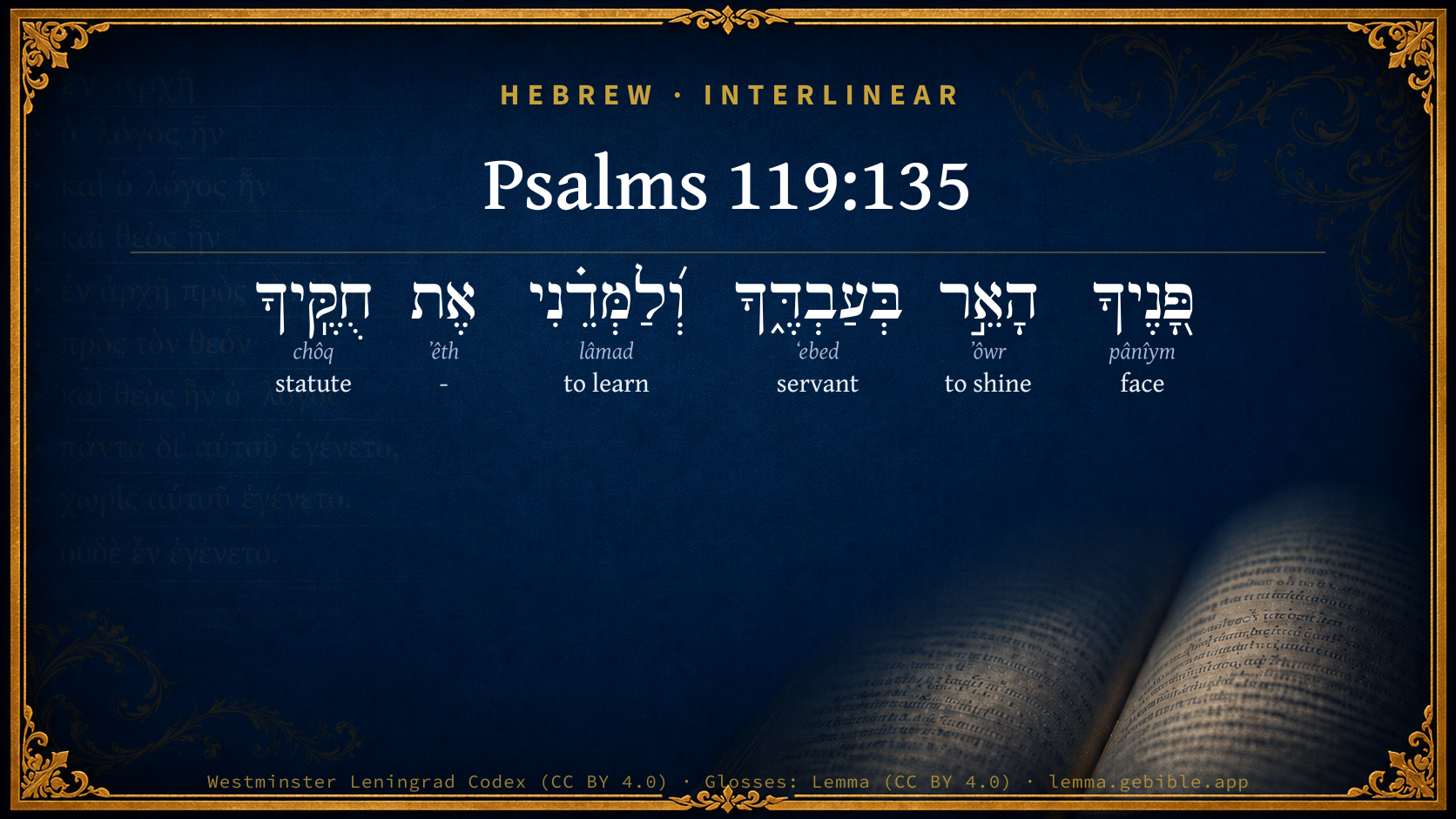
Hebrew (Westminster Leningrad Codex) Psalms 119:135 appears in the Hebrew Old Testament. The text above is from the Westminster Leningrad Codex. Each word links to its Strong’s number, a concise gloss, and parsing drawn from the Open Scriptures Hebrew Bible morphology. Click any word for its full Brown-Driver-Briggs (BDB) entry.
Download image
Cite this verse

Psalms 119:135 (World English Bible). Public Domain. Lemma interlinear Bible study tool, https://lemma.gebible.app/v/psalms/119/135.

Show BibTeX & RIS
BibTeX
RIS
English Translation
Make your face shine on your servant. Teach me your statutes.
World English Bible · Public Domain
Download a study sheet

One document with this verse’s original text, its word-by-word gloss line, the meaning frame, cross-references with their text, attributed commentary, and full source and license credits — printable, and it pastes into notes with its structure intact.

This verse Autodidact and up

Study sheet (.html) Plain text (.txt)

A passage Seminary Student

Up to 50 verses in one chapter. A passage sheet keeps up to 6 commentary sources and 12 cross-references per verse, in the order this page ranks them, and says so on the sheet whenever that leaves anything out. Ask for a single verse and you get the Autodidact verse sheet above.

Everything on this page stays free to read, with no account — the sheet is a download of what is already on screen, not access to it.

Want to remove ads? Support Godless Engineer
Compare translations 3

The same verse in 3 English versions, stacked beneath the original-language interlinear above. Click any original word for its lexicon entry.

Each is an independent rendering of the whole verse — the interlinear is not word-aligned to these translations.

Highlighted words mark where these versions differ — a whole-verse word diff, not a word-by-word alignment.

  • World English Bible Public Domain
    Make your face shine on your servant. Teach me your statutes.
  • King James Version Public Domain
    Make thy face to shine upon thy servant; and teach me thy statutes.
  • unfoldingWord Literal Text CC BY-SA 4.0
    Make your face shine on your servant, and teach me your statutes.

unfoldingWord Literal Text — © unfoldingWord, licensed CC BY-SA 4.0. Word-aligned USFM3 via Door43 (git.door43.org/unfoldingWord/en_ult).

Versions to compare (up to 4)

3 of 4 selected

Show all 17 translations

Every available English version of this verse, each an independent rendering of the whole verse.

  • World English Bible Public Domain
    Make your face shine on your servant. Teach me your statutes.
  • Berean Standard Bible Public Domain
    Make Your face shine upon Your servant, and teach me Your statutes.
  • Majority Standard Bible Public Domain
    Make Your face shine upon Your servant, and teach me Your statutes.
  • King James Version Public Domain
    Make thy face to shine upon thy servant; and teach me thy statutes.
  • American Standard Version (1901) Public Domain
    Make thy face to shine upon thy servant; And teach me thy statutes.
  • Revised Version (1885) Public Domain
    Make thy face to shine upon thy servant; and teach me thy statutes.
  • Geneva Bible (1599) Public Domain
    Shew the light of thy countenance vpon thy seruant, and teache me thy statutes.
  • Young's Literal Translation Public Domain
    Thy face cause to shine on Thy servant, And teach me Thy statutes.
  • Literal Standard Version CC BY-SA 4.0
    Cause Your face to shine on Your servant, || And teach me Your statutes.
  • Unlocked Literal Bible CC BY-SA 4.0
    Let your face shine on your servant, and teach me your statutes.
  • unfoldingWord Literal Text CC BY-SA 4.0
    Make your face shine on your servant, and teach me your statutes.
  • Darby Bible Public Domain
    Make thy face to shine upon thy servant, and teach me thy statutes.
  • World Messianic Bible Public Domain
    Make your face shine on your servant. Teach me your statutes.
  • Webster's Bible Public Domain
    Make thy face to shine upon thy servant: and teach me thy statutes.
  • Free Bible Version CC BY-SA 4.0
    Please look favorably on me, your servant, teach me what I should do.
  • Bible in Basic English Public Domain
    Let your servant see the shining of your face; give me knowledge of your rules.
  • JPS Tanakh (1917) Public Domain
    Make Thy face to shine upon Thy servant; and teach me Thy statutes.

Literal Standard Version (2020), Covenant Press — licensed CC BY-SA 4.0. Text via the HelloAO Bible API (eBible.org). Unlocked Literal Bible (unfoldingWord) — licensed CC BY-SA 4.0. Text via the HelloAO Bible API (eBible.org). unfoldingWord Literal Text — © unfoldingWord, licensed CC BY-SA 4.0. Word-aligned USFM3 via Door43 (git.door43.org/unfoldingWord/en_ult). Free Bible Version, Dr. Jonathan Gallagher — licensed CC BY-SA 4.0. Text via the HelloAO Bible API (eBible.org).

Word by word

More ways to search: Search by grammar → Find every occurrence → Compare this word →

Practice this passage: Drill this verse → Learn its vocabulary →

הָאֵ֣ר
ʼôwr
H215
“shine”
Verb, Hiphil, Imperative, 2nd Person, Masculine, Singular
Part of Speech
Verb
Stem
Hiphil
Form
Imperative
Person
2nd Person
Gender
Masculine
Number
Singular
Full BDB Definition

Origin: a primitive root

TWOT: 52

to be or become light, shine - (Qal) - to become light (day) - to shine (of the sun) - to become bright - (Niphal) - to be illuminated - to become lighted up - (Hiphil) - to give light, shine (of sun, moon, and stars) - to illumine, light up, cause to shine, shine - to kindle, light (candle, wood) - lighten (of the eyes, his law, etc) - to make shine (of the face)
  1. פָּ֭נֶיךָ pânîym H6440 “face(s) · your” Noun, Common, Both, Plural, Construct + Suffix, Personal, 2nd Person, Masculine, Singular
  2. בְּעַבְדֶּ֑ךָ ʻebed H5650 “in/at · servant · your” Preposition + Noun, Common, Masculine, Singular, Construct + Suffix, Personal, 2nd Person, Masculine, Singular
  3. וְ֝לַמְּדֵ֗נִי lâmad H3925 “and · learn · me” Conjunction + Verb, Piel, Imperative, 2nd Person, Masculine, Singular + Suffix, Personal, 1st Person, Common, Singular
  4. אֶת ʼêth H853 “-” Particle, Direct Object
  5. חֻקֶּֽיךָ chôq H2706 “statutes · your” Noun, Common, Masculine, Plural, Construct + Suffix, Personal, 2nd Person, Masculine, Singular

About this verse

These counts appear in no published source. They are computed here, from the morphology-tagged text and Lemma’s own curated glosses. What Lemma adds →

6
words
6
distinct lemmas
Wisdom
section

Shared distinctive vocabulary

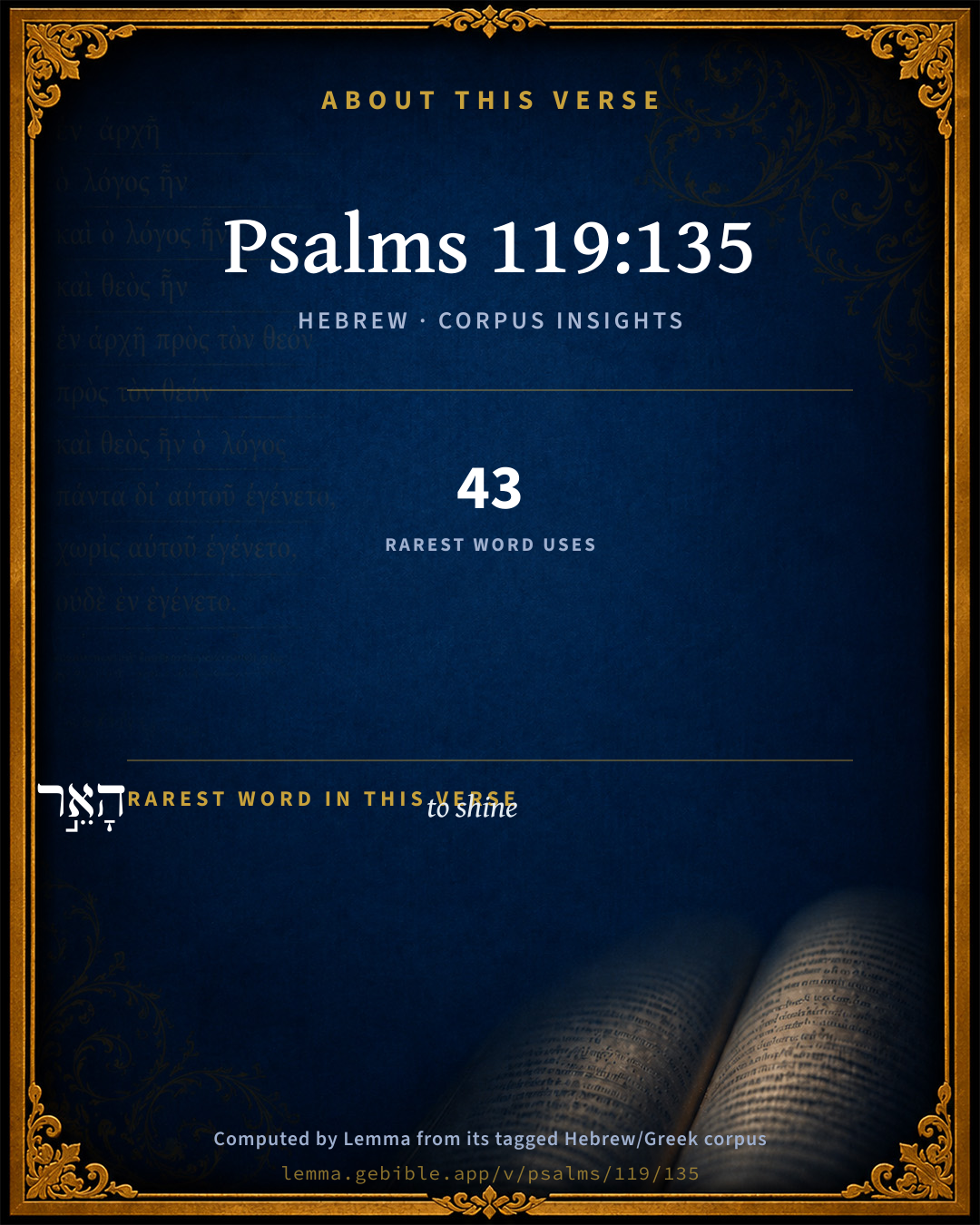
הָאֵ֣ר to shine H215 occurs in 43 verses of the Hebrew Bible. Also found in:

Grammatical profile

  • 2 verbs
  • 3 nouns
  • 1 particle

Verb forms

  • הָאֵ֣ר Hiphil · Imperative
  • וְ֝לַמְּדֵ֗נִי Piel · Imperative

Hebrew & Septuagint length

In English translation the verse runs 11 words from the Hebrew and 13 from the Septuagint (LXX English) — closely comparable.

A rough comparison of the two English renderings, which tokenize alike — not a word-level alignment.

Word counts can differ between the Hebrew and the Greek without any difference in meaning — e.g. the Hebrew direct-object marker אֵת has no separate Greek word, and Greek often adds the article ὁ.

Cross-references

14

Topical passages linked to Psalms 119:135 in the Treasury of Scripture Knowledge — connected by theme and wording, ordered by reader-vote popularity; previews shown in the World English Bible.

  • Numbers 6:25–26 Yahweh make his face to shine on you, And be gracious to you.
  • Psalms 4:6 Many say, "Who will show us any good?" Yahweh, let the light of your face shine on us.
  • Psalms 80:7 Turn us again, God of hosts. Cause your face to shine, And we will be saved.
  • Psalms 80:3 Turn us again, God. Cause your face to shine, And we will be saved.
  • Psalms 80:19 Turn us again, Yahweh God of hosts. Cause your face to shine, and we will be saved.
  • Luke 24:45 Then he opened their minds, that they might understand the Scriptures.
  • Job 36:22 Behold, God is exalted in his power. Who is a teacher like him?
  • Job 33:26 He prays to God, and he is favorable to him, So that he sees his face with joy: He restores to man his righteousness.
  • Job 34:32 Teach me that which I don't see. If I have done iniquity, I will do it no more'?
  • Job 35:11 Who teaches us more than the animals of the earth, And makes us wiser than the birds of the sky?'
  • Psalms 80:1 Hear us, Shepherd of Israel, You who lead Joseph like a flock, You who sit above the cherubim, shine forth.
  • Psalms 119:12 Blessed are you, Yahweh. Teach me your statutes.
  • Psalms 119:26 I declared my ways, and you answered me. Teach me your statutes.
  • Revelation 22:4–5 They will see his face, and his name will be on their foreheads.

Cross-references courtesy of OpenBible.info (CC BY 4.0).

Hebrew and Greek witnesses Masoretic Hebrew ↔ Greek Septuagint

The same verse in the two great witnesses to the Old Testament, shown verse-for-verse.

You’re reading Greek Psalm 118 (Hebrew Psalm 119). The Septuagint counts the superscription, so verse numbers can differ from the Hebrew — chapter-level alignment, not verse-by-verse. Numbering follows Rahlfs.

These are two independent witnesses, not word-aligned to each other, and the Septuagint is shown in lemma (dictionary) form.

Hebrew Psalms 119:135 Masoretic · Westminster Leningrad Codex

פָּ֭נֶיךָ הָאֵ֣ר בְּעַבְדֶּ֑ךָ וְ֝לַמְּדֵ֗נִי אֶת חֻקֶּֽיךָ

Make your face shine on your servant. Teach me your statutes.

World English Bible · Public Domain

Greek LXX Greek Psalm 118:135 Septuagint · lemma form

ὁ πρόσωπον σύ ἐπιφαίνω ἐπί ὁ δοῦλος σύ καί διδάσκω ἐγώ ὁ δικαίωμα σύ

Cause your face to shine upon your servant: and teach me your ordinances.

LXX2012 (modern English Septuagint) · Public Domain

Hebrew: Westminster Leningrad Codex (CC BY 4.0). Greek: Septuagint (public domain); English from LXX2012 (modern English Septuagint) (Public Domain). How the Septuagint differs from the Hebrew →

Commentary

Notes on Psalms 119:135 from classic Christian and Jewish commentators (each source and its license shown beneath its notes). The classic Christian expositions comment on the surrounding passage and are grouped to its opening verse, so a note may address several verses; the Jewish commentaries on the Tanakh (Rashi and others) are per-verse, so they appear only where the commentator wrote on this verse.

Lemma curates 59 commentaries, every one of them public domain or Creative Commons licensed, each selected and text-cleaned for this edition rather than reprinted as found. About our sources →

Trapp's Complete Commentary

John Trapp

Psa 119:135 Make thy face to shine upon thy servant; and teach me thy statutes.

Ver. 135. Make thy face to shine upon thy servant] David could not live out of God’s favour nor without his direction; he therefore here and elsewhere prayeth heartily for both.

John Trapp, A Commentary or Exposition upon All the Books of the Old and New Testament (1647–1656) — public domain. Text from a community e-Sword module.

The Biblical Illustrator

Joseph S. Exell

Psa_119:135

Make Thy face to shine upon Thy servant; and teach me Thy statutes.

Christian obedience and support

I. The character of the petitioner. The true servant of God is distinguished by--

1. Renunciation of the service of sin.

2. A rational and deliberate choice of that service in which he is invited to engage.

3. An entire devotedness to the Lords service.

4. All the activities of Christian obedience.

(1) Sincere.

(2) Cheerful.

(3) Universal.

(4) Persevering.

II. The import of the petitions.

1. Cause Thy face to shine upon me. He here prays for--

(1)Increasing discoveries of the Divine glory. Unsearchable wisdom, almighty power, unchangeable love, invariable truth.

(2) The enjoyment of the Divine favour.

2. Teach me Thy statutes. This implies--

(1) A fervent desire for an increasing knowledge of the important truths.

(2) A supplication for growing experience of its sanctifying power and rich consolations. (T. Chalmers, D. D.)

The Biblical Illustrator, edited by Joseph S. Exell (c. 1880s–1900s) — public domain. Text from a community e-Sword module.

J. A. Alexander on Psalms

Joseph Addison Alexander

135. (Psa 119:135) Let thy face shine upon thy servant, and teach me thy statutes. Theprayer of the first clause is the same as that which forms the burden of Psa 80:4; Psa 80:8; Psa 80:10. Thy servant, i.e. me who am thy servant; hence the first person is immediately resumed.

Joseph Addison Alexander, The Psalms Translated and Explained (1850) — public domain. Text from a community e-Sword module.

Matthew Henry's Commentary

David here, as often as elsewhere, writes himself God's servant, a title he gloried in, though he was a king; now here, as became a good servant, 1. He is very ambitious of his Master's favour, accounting that his happiness and chief good. He asks not for corn and wine, for silver and gold, but, "Make thy face to shine upon thy servant; let me be accepted of thee, and let me know that I am so. Comfort me with the light of thy countenance in every cloudy and dark day. If the world frown upon me, yet do thou smile." 2. He is very solicitous about his Master's work, accounting that his business and chief concern. This he would be instructed in, that he might do it, and do it well, so as to be accepted in the doing of it: Teach me thy statutes. Note, We must pray as earnestly for grace as for comfort. If God hides his face from us, it is because we have been careless in keeping his statutes; and therefore, that we may be qualified for the returns of his favour, we must pray for wisdom to do our duty.

Matthew Henry's Commentary on the Whole Bible (1708–1710) — public domain (CC PDM 1.0). Text via the HelloAO Bible API.

Adam Clarke's Commentary

Verse 135. Make thy face to shine] Give me a sense of thy approbation. Let me know, by the testimony of thy Spirit in my conscience, that thou art reconciled to me. The godly in all ages derived their happiness from a consciousness of the Divine favour. The witness of God's spirit in the souls of believers was an essential principle in religion from the foundation of the world.

Adam Clarke's Commentary on the Bible (1810–1826) — public domain. Text from a community e-Sword/MySword module.

John Calvin's Commentaries

135. Make thy face to shine upon thy servant. There is here the repetition of a prayer which we have several times met with before in this Psalm. The Prophet intimates, that he regarded nothing as of more importance than rightly to understand the divine law. When he beseeches God to make his face to shine upon his servant, he, in the first place, seeks to win the fatherly favor of God — for nothing is to be hoped for from Him unless we have an interest in his favor — but he at the same time, shows the greatness of the blessing. There is no testimony of the love of God, as if he had said, which I am more desirous to obtain than to be enabled to make progress in his law. Whence we gather, as I have lately observed, that he preferred divine truth to all the possessions of the world. Would to God that this affection were vigorous in our hearts! But that which the Prophet extols so highly, is neglected by the great proportion of mankind. If individuals are to be found stimulated by this desire, we see them presently falling back to the Measurements of the world, so that there are very few, indeed, who renouncing all other desires, seek earnestly with David to become acquainted with the doctrine of the law. Besides, as God vouchsafes this privilege only to those whom he has embraced with his fatherly love, it is proper for us to begin with this prayer, That he would make his face to shine upon us. This form of expression, however, conveys something more — it implies, that it is only when God illumines the minds of his believing people with the true knowledge of the law, that he delights them with the beams of his favor. It often happens that, even in regard to them, God’s countenance is overcast with clouds in this respect, namely, when he deprives them of tasting the sweetness of his word.

John Calvin's Commentaries (1540-1563) — public domain. Text from the Calvin Translation Society English edition (1840s-50s) via the Christian Classics Ethereal Library (ccel.org). Calvin's coverage is partial (roughly two-thirds of the Bible); uncommented books and verses are honest gaps, never fabricated. The 19th-century editor's footnotes and remarks are omitted so the notes are faithfully Calvin's own voice.

The Cambridge Bible for Schools and Colleges

gen. ed. J. J. S. Perowne

135. Make thy face to shine] Illuminate the darkness that surrounds me with the light of Thy favour. Cp. Psa_31:16.

and teach &c.] Cp. Psa_119:12 &c. He desires the restoration of prosperity not merely for its own sake, but as an opportunity for gaining further knowledge.

The Cambridge Bible for Schools and Colleges (gen. ed. J. J. S. Perowne; Cambridge University Press, 1878–1918) — public domain. Text from a community e-Sword module.

John Gill's Exposition

My zeal hath consumed me,.... Zeal for God and his glory, for his word and ordinances and worship; which is a fervour of the mind, burning love, and flaming affections for God, shown in a holy indignation against sin and sinners. This was a zeal according to knowledge, sincere and hearty, and what continued; and which was shown in embracing and defending the truths of the word, and resenting every indignity cast upon them; to such a degree, that it ate up his spirit, wore away his flesh, and almost consumed him; see Psa 69:9;

because mine enemies have forgotten thy words; not merely through an indifference to them, and inattention in hearing them; nor through want of an earnest heed to keep and retain them; nor through negligence in laying them up, and a carelessness in making use of proper means to recollect them; but through an aversion to them, an hatred of them, and a spiteful malicious contempt of them, casting them away and despising them; which stirred up the spirit of the psalmist, and raised such an emotion in him as was almost too much for him.

John Gill's Exposition of the Whole Bible (1746–1763) — public domain (CC PDM 1.0). Text via the HelloAO Bible API.

Albert Barnes' Notes on the Bible

Make thy face to shine upon thy servant - Hebrew, “Let thy face give light to thy servant.” See the notes at Psa 4:6.

And teach me thy statutes - See the notes at Psa 119:12.

Albert Barnes' Notes on the Bible (1834–1885) — public domain. Text from a community e-Sword/MySword module.

Matthew Poole's English Annotations

Look upon me with a pleased and favourable countenance. Compare Num 6:25; Pro 16:15.

Matthew Poole's English Annotations on the Holy Bible (1683–1685) — public domain. Text from a community e-Sword/MySword module.

The Treasury of David

Charles H. Spurgeon

Ver. 135. Make thy face to shine upon thy servant. Oppressors frown, but do thou smile. They darken my life, but do thou shine upon me, and all will be bright. The Psalmist again declares that he is God's servant, and he seeks for no favour from others, but only from his own Lord and Master.

And teach me thy statutes. This is the favour which he considers to be the shining of the face of God upon him. If the Lord will be exceeding gracious, and make him his favourite, he will ask no higher blessing than still to be taught the royal statutes. See how he craves after holiness; this is the choicest of all gems in his esteem. As we say among men that a good education is a great fortune, so to be taught of the Lord is a gift of special grace. The most favoured believer needs teaching; even when he walks in the light of God's countenance he has still to be taught the divine statutes or he will transgress.

Ver. 135. Make thy face to shine upon thy servant. The face of God shines upon us, when, in his providence, we are guided and upheld; also when we are made to share in the good things of his providence, and when we are placed in a position wherein we can do much good. Much more does the face of God shine upon us, when we are favoured with tokens of his gracious favour; for then we grow under the consciousness of a loving God, with rich supplies of his grace and Spirit. John Stephen.

Ver. 135. Make thy face to shine upon thy servant. Oftentimes the wrongful dealings of men, of others, and of ourselves, like a cloud of smoke arising from the earth and obscuring the face of the sun, hide from us for a while the light, of the countenance of God: but he soon clears it all away, and looks down upon us in loving mercy as before, lighting for us the path of obedience, and brightening our way unto himself. "Plain Commentary, "1859.

Ver. 135. Make thy face to shine upon thy servant. The believer's incessant cry is, Let me see "the King's face." This is a blessing worth praying for. It is his heart's desire, his present privilege, and what is infinitely better, his sure, everlasting prospect "They shall see his face." Re 22:4. Charles Bridges.

Ver. 135. Make thy face to shine... and teach me. Blessed is the man whom eternal Truth teacheth, not by obscure figures and transient sounds, but by direct and full communication. The perceptions of our senses are narrow and dull, and our reason on those perceptions frequently misleads us. He whom the eternal Word condescends to teach is disengaged at once from the labyrinth of human opinions. For "of one word are all things"; and all things without voice or language speak of him alone: he is that divine principle which speaketh in our hearts, and without which there can be neither just apprehension nor rectitude of judgment.

O God, who art the truth, make me one with thee in everlasting life! I am often weary of reading, and weary of hearing; in thee alone is the sum of my desire! Let all teachers be silent, let the whole creation be dumb before thee, and do thou only speak unto my soul!

Thy ministers can pronounce the words, but cannot impart the spirit; they may entertain the fancy with the charms of eloquence, but if thou art silent they do not inflame the heart. They administer the letter, but thou openest the sense; they utter the mystery, but you reveal its meaning; they point out the way of life, but you bestow strength to walk in it; they water, but thou givest the increase. Therefore do thou, O Lord, my God, Eternal Truth! speak to my soul! lest, being outwardly warmed, but not inwardly quickened, I die, and be found unfruitful. "Speak, Lord, for thy servant heareth." "Thou only hast the words of eternal life." Thomas a Kempis, 1380-1471.

Ver. 135. Make thy face to shine teach me, etc. God hath many ways of teaching; he teaches by book, he teaches by his fingers, he teaches by his rod; but his most comfortable and effectual teaching is by the light of his eye: "O send out thy light and thy truth; let them lead me: let them bring me unto thy holy hilt:" Ps 42:3. Richard Alleine (1611-1681), in "Heaven Opened."

Ver. 135. Make thy face to shine... teach me thy statutes. God's children, when they beg comfort, also beg grace to serve him acceptably. For by teaching God's statutes is not meant barely a giving speculative knowledge of God's will; for so David here; "Make thy face to shine"; and "Teach me thy statutes." Thomas Manton.

Ver. 135.

1. A choice position: "thy servant."

2. A choice delight: "thy face to shine."

3. A choice privilege: "teach me thy statutes."

Ver. 135.

1. God in the word: "Thy word."

2. God for the word: "Teach me, "etc.

3. God with the word: "Make thy face, "etc. G.R.

Ver. 135. Sunshine.

1. The light in which we can best learn our lessons God's favour shown in pardon, justification, adoption, assurance, etc.

2. The lessons we should learn in the light grace is productive of holiness. C.A.D.

Ver. 135.

1. A rich historic promise (Nu 6:25). Its sublime origin and associations.

2. The new prayer born of it.

(a) Looks up for the face Divine; the same in its majestic

sweetness that has watched generations decay since the

word was first spoken.

(b) Asks to know its shining. Light of fatherhood, etc.

3. The old prayer repeated: "Teach me thy statutes." Last time in the psalm.

(a) Our need of teaching oft repeated prayer.

(b) The intimate connection between obedience and the

shining of God's face. W.B.H.

Psalms 119:136*

Charles H. Spurgeon's The Treasury of David (1869–1885) — public domain. Psalms only. Text from a community e-Sword/MySword module.

The Pulpit Commentary

Make thy face to shine upon thy servant. (comp. Psa_4:6 Psa_44:3, etc.) And teach me thy statutes (see the comment on ver. 124).

The shining face.

The expression is clearly a figurative one, and the idea is suggested by life at court. The courtiers watch the expression on the countenance of their king. The sign of his favor and acceptance is given in his bright, smiling, "shining" face. If they are out of favor, they know it by the darkened look upon his face. It is a peculiarity of Eastern life that a master says as little as possible to his servant, and expects that servant to watch his every movement, and to interpret every change in his face, and do everything for him without his speaking a word. And Eastern servants gain a marvelous skill in thus comprehending their masters" wishes.

I GOD"S SHINING FACE IS THE SIGN OF DIVINE FAVOR. The face of God is constantly referred to in the Old Testament. To turn the back on a person is to show one"s self angry with him. To turn the face towards a person is to show one"s self favorable to him. "Thou didst hide thy face, and I was troubled;" "Lord, lift thou up the light of thy countenance upon us;" "No man hath seen God at any time." All man ever has had, or can have, is a spiritually realized presence. And if our spiritual senses are duly cultured, we do not need the help of bodily appearances. Soul-apprehensions become real and satisfying. And it comes to this with us God gives us the inward feeling, the assurance of his Divine favor and acceptance, and we want to express what we feel, and plain prosaic language does not satisfy us, so we call it "the shining of his face upon us." But what must we be if God"s face is to be ever shining on us?

II GOD"S SHINING FACE IS THE INSPIRATION TO NOBLE ENDEAVOR. There may be some who can never do right and good things unless they are kept up to duty by threatening and the whip. But the better-natured men respond to approval and encouragement. Their inspiration is their master"s smile. Kindly praise, the cheerful word, a loving approval, will draw out a man"s best. The good man will do anything for him who treats him kindly and trustingly. Let God"s shining face be on us, and it is our joy to do his will. R.T.

The Pulpit Commentary (1880–1919), ed. H.D.M. Spence-Jones & Joseph S. Exell — public domain. Text from a community e-Sword module.

unfoldingWord translationNotes

Door43 World Missions Community

Let your face shine on your servant

The writer speaks of Yahweh acting favorably towards him as if Yahweh's face shone a light on him. AT: "Act favorably towards your servant" (See: Metaphor)

Streams of tears

The writer speaks of his many tears as if they were streams of water. AT: "Many tears" (See: Metaphor)

observe your law

"obey your law"

translationWords

face

servant

statute

law

unfoldingWord translationNotes — © Distant Shores Media and the Door43 World Missions Community, licensed CC BY-SA 4.0. Source: git.door43.org/Door43/en_tn.

Lesson kit

Teaching starters — assembled from the data on this page, not authored interpretation. Every prompt links to the verse data it draws on. Edit before teaching.

Psalms, in the Wisdom, opens this verse with 6 words (6 distinct Hebrew lemmas). Its most distinctive word is ʼôwr (“to shine”). A historical commentator’s framing appears above. Read the whole chapter for the surrounding context.

Discussion questions

  1. What does “to shine” (ʼôwr) contribute to the verse as a whole?
  2. Genesis 1:15 shares the word «to shine» with this verse. How do the two illuminate each other?
  3. The translations on this page render this verse differently — a whole-verse word diff, not a word-by-word alignment. What might account for the different wordings?
  4. The verb «הָאֵ֣ר» is Hiphil Imperative. How does its form color the action?
  5. Reading how Trapp's Complete Commentary and The Biblical Illustrator read this verse, where do the two commentators agree and where do they part?

Things to notice

Reading settings

Reading text

Shown beneath each verse's original-language words.

Old Testament
Old Testament edition

Read the OT as the Masoretic Hebrew (MT) or the Greek Septuagint (LXX).

English shown for the Greek Septuagint (in the Hebrew ↔ Greek comparison).

Comparing translations? Open the Compare panel on any verse page to stack up to four side by side.