Song of Solomon 8:2

Hebrew (Westminster Leningrad Codex) Song of Solomon 8:2 appears in the Hebrew Old Testament. The text above is from the Westminster Leningrad Codex. Each word links to its Strong’s number, a concise gloss, and parsing drawn from the Open Scriptures Hebrew Bible morphology. Click any word for its full Brown-Driver-Briggs (BDB) entry.
Download image
Cite this verse

Song of Solomon 8:2 (World English Bible). Public Domain. Lemma interlinear Bible study tool, https://lemma.gebible.app/v/song-of-solomon/8/2.

Show BibTeX & RIS
BibTeX
RIS
English Translation
I would lead you, bringing you into my mother's house, Who would instruct me. I would have you drink spiced wine, Of the juice of my pomegranate.
World English Bible · Public Domain
Highlights
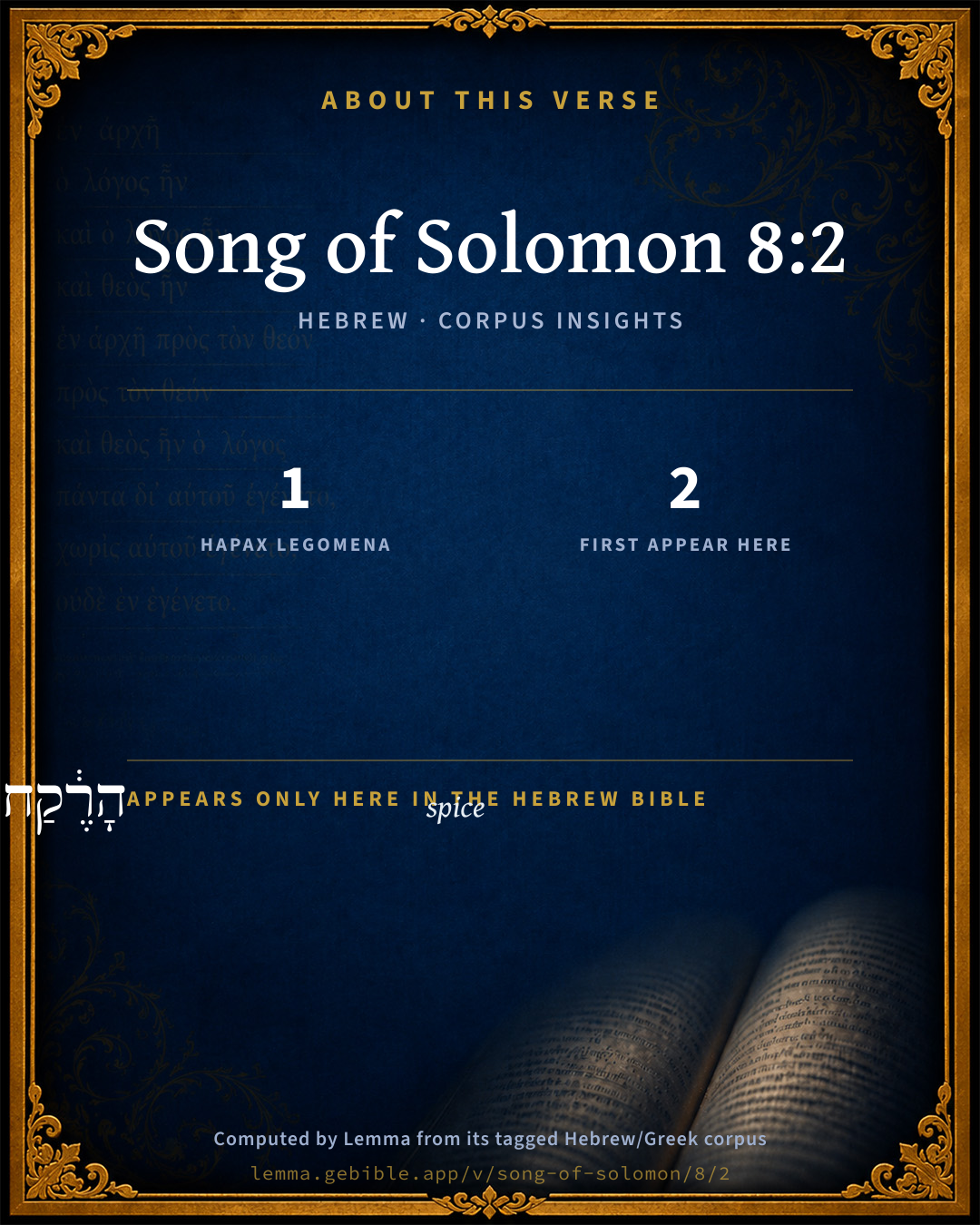
  • 1 hapax legomenon — only here in the Hebrew Bible
  • 2 first appearances in the Hebrew Bible
Full analysis ↓
Download a study sheet

One document with this verse’s original text, its word-by-word gloss line, the meaning frame, cross-references with their text, attributed commentary, and full source and license credits — printable, and it pastes into notes with its structure intact.

This verse Autodidact and up

Study sheet (.html) Plain text (.txt)

A passage Seminary Student

Up to 50 verses in one chapter. A passage sheet keeps up to 6 commentary sources and 12 cross-references per verse, in the order this page ranks them, and says so on the sheet whenever that leaves anything out. Ask for a single verse and you get the Autodidact verse sheet above.

Everything on this page stays free to read, with no account — the sheet is a download of what is already on screen, not access to it.

Want to remove ads? Support Godless Engineer
Compare translations 3

The same verse in 3 English versions, stacked beneath the original-language interlinear above. Click any original word for its lexicon entry.

Each is an independent rendering of the whole verse — the interlinear is not word-aligned to these translations.

Highlighted words mark where these versions differ — a whole-verse word diff, not a word-by-word alignment.

  • World English Bible Public Domain
    I would lead you, bringing you into my mother's house, Who would instruct me. I would have you drink spiced wine, Of the juice of my pomegranate.
  • King James Version Public Domain
    I would lead thee, and bring thee into my mother's house, who would instruct me: I would cause thee to drink of spiced wine of the juice of my pomegranate.
  • unfoldingWord Literal Text CC BY-SA 4.0
    I would lead you; I would bring you to the house of my mother, she taught me. I would make you drink from the wine of spice, from the juice of my pomegranate.

unfoldingWord Literal Text — © unfoldingWord, licensed CC BY-SA 4.0. Word-aligned USFM3 via Door43 (git.door43.org/unfoldingWord/en_ult).

Versions to compare (up to 4)

3 of 4 selected

Show all 18 translations

Every available English version of this verse, each an independent rendering of the whole verse.

  • World English Bible Public Domain
    I would lead you, bringing you into my mother's house, Who would instruct me. I would have you drink spiced wine, Of the juice of my pomegranate.
  • Berean Standard Bible Public Domain
    I would lead you and bring you to the house of my mother who taught me. I would give you spiced wine to drink, the nectar of my pomegranates.
  • Majority Standard Bible Public Domain
    I would lead you and bring you to the house of my mother who taught me. I would give you spiced wine to drink, the nectar of my pomegranates.
  • King James Version Public Domain
    I would lead thee, and bring thee into my mother's house, who would instruct me: I would cause thee to drink of spiced wine of the juice of my pomegranate.
  • American Standard Version (1901) Public Domain
    I would lead thee, `and' bring thee into my mother's house, Who would instruct me; I would cause thee to drink of spiced wine, Of the juice of my pomegranate.
  • Revised Version (1885) Public Domain
    I would lead thee, and bring thee into my mother’s house, who would instruct me; I would cause thee to drink of spiced wine, of the juice of my pomegranate.
  • Geneva Bible (1599) Public Domain
    I will leade thee and bring thee into my mothers house: there thou shalt teache me: and I will cause thee to drinke spiced wine, and newe wine of the pomegranate.
  • Douay-Rheims (1899) Public Domain
    I will take hold of thee, and bring thee Into my mother's house: there thou shalt teach me, and I will give thee a cup of spiced wine and new wine of my pomegranates.
  • Young's Literal Translation Public Domain
    I lead thee, I bring thee in unto my mother's house, She doth teach me, I cause thee to drink of the perfumed wine, Of the juice of my pomegranate,
  • Literal Standard Version CC BY-SA 4.0
    I lead you, I bring you into my mother’s house, || She teaches me, I cause you to drink of the spiced wine, || Of the juice of my pomegranate,
  • Unlocked Literal Bible CC BY-SA 4.0
    I would lead you and bring you into my mother's house— she who taught me. I would give you spiced wine to drink and some of the juice of my pomegranates.
  • unfoldingWord Literal Text CC BY-SA 4.0
    I would lead you; I would bring you to the house of my mother, she taught me. I would make you drink from the wine of spice, from the juice of my pomegranate.
  • Darby Bible Public Domain
    I would lead thee, bring thee into my mother's house; Thou wouldest instruct me: I would cause thee to drink of spiced wine, Of the juice of my pomegranate.
  • World Messianic Bible Public Domain
    I would lead you, bringing you into the house of my mother, who would instruct me. I would have you drink spiced wine, of the juice of my pomegranate.
  • Webster's Bible Public Domain
    I would lead thee, and bring thee into my mother's house, who would instruct me: I would cause thee to drink of spiced wine of the juice of my pomegranate.
  • Free Bible Version CC BY-SA 4.0
    Then I could take you home to my mother's house, where she used to teach me. I would give you spiced wine to drink from the juice of my pomegranate.
  • Bible in Basic English Public Domain
    I would take you by the hand into my mother's house, and she would be my teacher. I would give you drink of spiced wine, drink of the pomegranate.
  • JPS Tanakh (1917) Public Domain
    I would lead thee, and bring thee into my mother's house, that thou mightest instruct me; I would cause thee to drink of spiced wine, of the juice of my pomegranate.

Literal Standard Version (2020), Covenant Press — licensed CC BY-SA 4.0. Text via the HelloAO Bible API (eBible.org). Unlocked Literal Bible (unfoldingWord) — licensed CC BY-SA 4.0. Text via the HelloAO Bible API (eBible.org). unfoldingWord Literal Text — © unfoldingWord, licensed CC BY-SA 4.0. Word-aligned USFM3 via Door43 (git.door43.org/unfoldingWord/en_ult). Free Bible Version, Dr. Jonathan Gallagher — licensed CC BY-SA 4.0. Text via the HelloAO Bible API (eBible.org).

Word by word

More ways to search: Search by grammar → Find every occurrence → Compare this word →

Practice this passage: Drill this verse → Learn its vocabulary →

הָרֶ֔קַח
reqach
H7544
“the · spice”
Particle, Definite Article + Noun, Common, Masculine, Singular, Absolute
Part of Speech
Particle + Noun
Type
Common
Gender
Masculine
Number
Singular
State
Absolute
Full BDB Definition

Origin: from H7543

TWOT: 2215a

spice, spicery
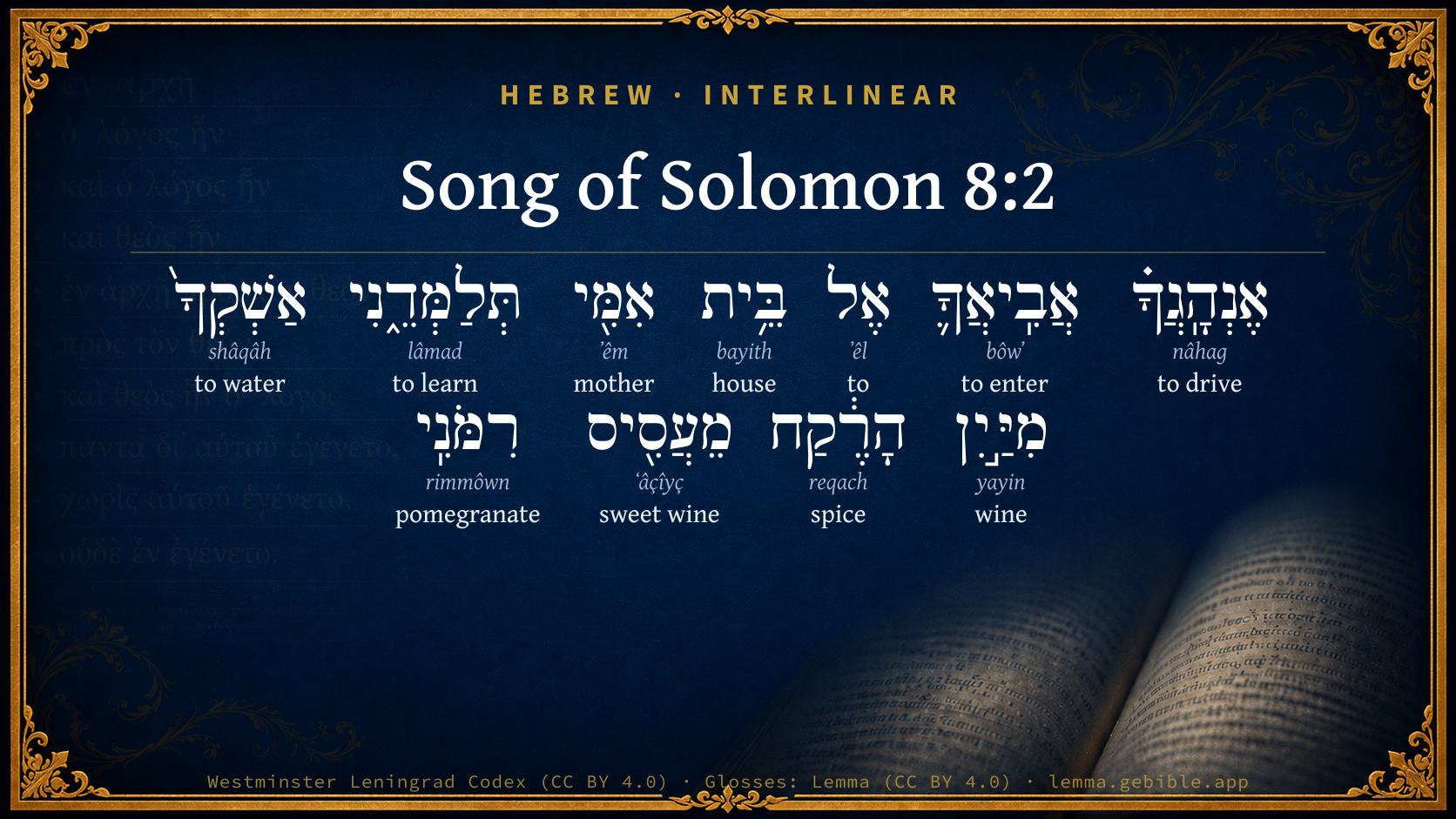
  1. אֶנְהָֽגֲךָ֗ nâhag H5090 “to drive · you” Verb, Qal, Imperfect, 1st Person, Common, Singular + Suffix, Personal, 2nd Person, Masculine, Singular
  2. אֲבִֽיאֲךָ֛ bôwʼ H935 “to enter · you” Verb, Hiphil, Imperfect, 1st Person, Common, Singular + Suffix, Personal, 2nd Person, Masculine, Singular
  3. אֶל ʼêl H413 “to” Preposition
  4. בֵּ֥ית bayith H1004 “house of” Noun, Common, Masculine, Singular, Construct
  5. אִמִּ֖י ʼêm H517 “mother · my” Noun, Common, Feminine, Singular, Construct + Suffix, Personal, 1st Person, Common, Singular
  6. תְּלַמְּדֵ֑נִי lâmad H3925 “to learn · me” Verb, Piel, Imperfect, 3rd Person, Feminine, Singular + Suffix, Personal, 1st Person, Common, Singular
  7. אַשְׁקְךָ֙ shâqâh H8248 “to water · you” Verb, Hiphil, Imperfect, 1st Person, Common, Singular + Suffix, Personal, 2nd Person, Masculine, Singular
  8. מִיַּ֣יִן yayin H3196 “from · wine” Preposition + Noun, Common, Masculine, Singular, Absolute
  9. מֵעֲסִ֖יס ʻâçîyç H6071 “from · sweet wine of” Preposition + Noun, Common, Masculine, Singular, Construct
  10. רִמֹּנִֽי rimmôwn H7416 “pomegranate · my” Noun, Common, Masculine, Singular, Construct + Suffix, Personal, 1st Person, Common, Singular

About this verse

These counts appear in no published source. They are computed here, from the morphology-tagged text and Lemma’s own curated glosses. What Lemma adds →

11
words
11
distinct lemmas
Wisdom
section

Notable vocabulary

1 hapax legomenon — a word that appears only here in the entire Hebrew Bible:

  • הָרֶ֔קַח spice H7544

First appearance in Scripture

These words make their first canonical appearance in the Hebrew Bible here:

  • הָרֶ֔קַח spice H7544
  • מֵעֲסִ֖יס sweet wine H6071

Shared distinctive vocabulary

מֵעֲסִ֖יס sweet wine H6071 occurs in 5 verses of the Hebrew Bible. Also found in:

Grammatical profile

  • 4 verbs
  • 6 nouns
  • 1 preposition

Verb forms

  • אֶנְהָֽגֲךָ֗ Qal · Imperfect
  • אֲבִֽיאֲךָ֛ Hiphil · Imperfect
  • תְּלַמְּדֵ֑נִי Piel · Imperfect
  • אַשְׁקְךָ֙ Hiphil · Imperfect

Hebrew & Septuagint length

In English translation the verse runs 27 words from the Hebrew and 36 from the Septuagint (LXX English) — closely comparable.

A rough comparison of the two English renderings, which tokenize alike — not a word-level alignment.

Word counts can differ between the Hebrew and the Greek without any difference in meaning — e.g. the Hebrew direct-object marker אֵת has no separate Greek word, and Greek often adds the article ὁ.

Cross-references

11

Topical passages linked to Song of Solomon 8:2 in the Treasury of Scripture Knowledge — connected by theme and wording, ordered by reader-vote popularity; previews shown in the World English Bible.

  • Song of Solomon 3:4 I had scarcely passed from them, When I found him whom my soul loves. I held him, and would not let him go, Until I had brought him into my mother's house, Into the chamber of her who conceived me.
  • Song of Solomon 4:10–5:1 How beautiful is your love, my sister, my bride! How much better is your love than wine! The fragrance of your perfumes than all manner of spices!
  • Song of Solomon 7:12 Let's go early up to the vineyards. Let's see whether the vine has budded, Its blossom is open, And the pomegranates are in flower. There I will give you my love.
  • Galatians 4:26 But the Jerusalem that is above is free, which is the mother of us all.
  • Proverbs 9:2 She has prepared her meat. She has mixed her wine. She has also set her table.
  • Song of Solomon 7:9 Your mouth like the best wine, That goes down smoothly for my beloved, Gliding through the lips of those who are asleep.
  • John 5:39 "You search the Scriptures, because you think that in them you have eternal life; and these are they which testify about me.
  • John 5:46–47 For if you believed Moses, you would believe me; for he wrote about me.
  • 2 Timothy 3:15 From infancy, you have known the sacred writings which are able to make you wise for salvation through faith, which is in Christ Jesus.
  • 1 Peter 1:10–12 Concerning this salvation, the prophets sought and searched diligently, who prophesied of the grace that would come to you,
  • Luke 16:29–31 "But Abraham said to him, 'They have Moses and the prophets. Let them listen to them.'

Cross-references courtesy of OpenBible.info (CC BY 4.0).

Hebrew and Greek witnesses Masoretic Hebrew ↔ Greek Septuagint

The same verse in the two great witnesses to the Old Testament, shown verse-for-verse.

These are two independent witnesses, not word-aligned to each other, and the Septuagint is shown in lemma (dictionary) form.

Hebrew Song of Solomon 8:2 Masoretic · Westminster Leningrad Codex

אֶנְהָֽגֲךָ֗ אֲבִֽיאֲךָ֛ אֶל בֵּ֥ית אִמִּ֖י תְּלַמְּדֵ֑נִי אַשְׁקְךָ֙ מִיַּ֣יִן הָרֶ֔קַח מֵעֲסִ֖יס רִמֹּנִֽי

I would lead you, bringing you into my mother's house, Who would instruct me. I would have you drink spiced wine, Of the juice of my pomegranate.

World English Bible · Public Domain

Greek LXX Song of Solomon 8:2 Septuagint · lemma form

παραλαμβάνω σύ εἰςἄγω σύ εἰς οἶκος μήτηρ ἐγώ καί εἰς ταμιεῖον ὁ συνλαμβάνω ἐγώ ποτίζω σύ ἀπό οἶνος ὁ μυρεψικός ἀπό νᾶμα ῥοά ἐγώ

I would take you, I would bring you into my mother's house, and into the chamber of her that conceived me; I would make you to drink of spiced wine, of the juice of my pomegranates.

LXX2012 (modern English Septuagint) · Public Domain

On this verse, The Cambridge Bible for Schools and Colleges discusses the Septuagint’s reading. Read the note in Commentary ↓

Hebrew: Westminster Leningrad Codex (CC BY 4.0). Greek: Septuagint (public domain); English from LXX2012 (modern English Septuagint) (Public Domain). How the Septuagint differs from the Hebrew →

Commentary

Notes on Song of Solomon 8:2 from classic Christian and Jewish commentators (each source and its license shown beneath its notes). The classic Christian expositions comment on the surrounding passage and are grouped to its opening verse, so a note may address several verses; the Jewish commentaries on the Tanakh (Rashi and others) are per-verse, so they appear only where the commentator wrote on this verse.

Lemma curates 59 commentaries, every one of them public domain or Creative Commons licensed, each selected and text-cleaned for this edition rather than reprinted as found. About our sources →

Trapp's Complete Commentary

John Trapp

Son 8:2 I would lead thee, [and] bring thee into my mother’s house, [who] would instruct me: I would cause thee to drink of spiced wine of the juice of my pomegranate.

Ver. 2. I would lead thee and bring thee.] With solemnity and joy. She speaks it twice, as fully resolved to do it; and hereby to bind herself more straitly to a performance, I would not only kiss thee at the door, but bring thee into the house. Many are strict abroad and in company, but much too loose at home and in their own houses; follow these stage players to their dressing rooms, where they disrobe themselves, and you shall soon see what they are. Heed must be taken, say the very heathen, Aedibus in propriis quae prava aut recta gerantur. Religion admits not of that distinction between a good man and a good governor. If you will be for the public, be good in private; bear your own fruit, work in your own hives, reform your own hearts and houses, man your own oars, and make good your own standing. Cato could say that he could pardon all men’s faults but his own. {a} And Augustus, going about to redress some abuses in the state, was upbraided with his own domestic disorders. Abraham had a well ordered family; so had Joshua, {Jos 24:15} David. {Psa 101:1-8} And although his house were not so with God, yet that was all his desire. {2Sa 23:5} And he well knew that it was the care, not the cure, of his charge that he stood charged with. {b} Noah may bring the Lord Christ into his house, and labour to set him up in the hearts of his children, speaking persuasively to that purpose; but when all is done, God must "persuade Japheth," and speak to his heart. Now this the Lord doth, Monendo potius quam minando, docendo quam ducendo. Hence the Church in the next words cries out,

Thou shalt instruct me.] For so the text is to be rendered. Thou who art the arch-prophet, a teacher sent from God, anointed and appointed for the purpose to put divine learning into us, "thou shalt instruct or learn us." Now, quando Christus magister, quam cito discitur quod docetar? saith Augustine. Christ is a quick teacher; and all his scholars are very forwardly. Nescit tarda molimina gratia Spiritus Sancti, saith Ambrose. God’s people must needs be well taught, because they are "all taught of God." {c}

I would cause thee to drink of spiced wine.] Such as we call Ipocras, which, besides the nature and strength of the wine itself, hath, by the mixture of many spices with it, great power and pleasantness, to the comforting of the heart, and satisfying of the smell. And this was the διδακτρον Minervale, recompense, that Christ should have for teaching her. She resolveth to testify her thankfulness by her obedience, rendering unto him such fruits of faith and holiness as should be sweetened and spicened with his own Spirit in her, and should exceedingly delight him. Contrary to these λιπαρα και λαμπρα, these "dainty and goodly fruits," {Rev 18:14} are those nasty and naughty ones, {Isa 5:4} that, besides their stench, are so offensive to the taste that they cannot be eaten, they are so naught. {Jer 24:2} Wicked men’s grapes are of gall, and their wine is venom; {Deu 32:32-33} both their natures and practices are abominable.

{a} Plut.; Dio.

{b} Curam exegeris, non curationem. - Bern.

{c} Yεοδιδακτοι. {Joh 6:45}

John Trapp, A Commentary or Exposition upon All the Books of the Old and New Testament (1647–1656) — public domain. Text from a community e-Sword module.

Albert Barnes' Notes on the Bible

Who would instruct me - Or, thou shouldest teach me Isa 54:13. Some allegorists make the whole passage Cant. 7:11–8:2 a prayer of the synagogue for the Incarnation of the Word, like Son 1:2 (see note). Others, a prayer of the Church under both covenants for that complete union with the Incarnate Godhead which is still future.

Albert Barnes' Notes on the Bible (1834–1885) — public domain. Text from a community e-Sword/MySword module.

Joseph Benson's Commentary

Son 8:2-3. I would lead and bring thee — With joy and triumph, as the bridegroom was usually brought to the bride’s house; into my mother’s house, who would instruct me — How I should behave myself toward thee: or, as the clause may be rendered, where she did instruct, or educate me. I would cause thee to drink of spiced wine, &c. — I would give thee the best entertainment the house affords. My gifts and graces should all be employed to serve and glorify thee. His left hand, &c. — The same expressions are used Son 2:6. The sense is, He would not despise me for my forwardness in my affection to him, but would kindly accept of my love, and return it.

Joseph Benson's Commentary on the Old and New Testaments (1811–1818) — public domain. Text from a community e-Sword module.

Tyndale Open Study Notes

Tyndale Open Resources

8:2-3 bring you to my childhood home (literally to my mother’s house): Cp. 3:4.

Tyndale Open Study Notes — © Tyndale Open Resources, licensed CC BY-SA 4.0. Text via the HelloAO Bible API.

Adam Clarke's Commentary

Verse 2. Would - bring thee into my mother's house, who would instruct me] She would teach me how to conduct myself towards thee, as she would how to nurse a young child.

To drink of spiced: wine] Wine rendered peculiarly strong and invigorating. The bride and bridegroom on the wedding day both drank out of the same cup, to show that they were to enjoy and equally bear together the comforts and adversities of life.

Adam Clarke's Commentary on the Bible (1810–1826) — public domain. Text from a community e-Sword/MySword module.

Ellicott's Commentary for English Readers

(2) Juice of my pomegranate.—“The Orientals,” says Dr. Kitto, “indulge largely in beverages made of fresh juice of various kinds of fruits. Among these, sherbet made of pomegranate juice is particularly esteemed; and from its agreeable and cooling acidity, the present writer was himself accustomed to prefer it to any other drink of this description.” The meaning of the verse is explained by Son_1:2; Son_5:1; Son_7:9.

A Bible Commentary for English Readers, edited by Charles John Ellicott (1878–1897) — public domain. Text from a community e-Sword module.

The Cambridge Bible for Schools and Colleges

gen. ed. J. J. S. Perowne

2. The bride thinks with delight of the close familiar intercourse she would in that case have had with him.

who would instruct me] The verb here may be either 3rd pers. sing. fem. as the A.V. takes it, or 2nd pers. sing. masc. as the Vulgate and Targum take it. In the latter case the translation would be, ‘thou wilt instruct me,’ or as R.V. margin, ‘that thou mightest instruct me.’ If we adopt the former view, the meaning must be that the Shulammite’s mother would instruct her how to play a maiden’s part to her betrothed lover; if the latter, that her lover would be able to impart to her his wisdom. But in both cases the wish that he had been her brother must be understood to have been given up, or lost sight of; and in the latter it may be doubted whether this exaltation of the wisdom of the beloved is an Eastern trait at all, unless the instruction is instruction in agriculture, as Oettli suggests, comparing Isa_28:23-28 and ch. Son_7:12. That is surely too prosaic. But in ch. Son_3:4 the clause “until I had brought him into my mother’s house” is followed by the words, “and into the chamber of her that conceived me,” and the LXX and the Syriac actually have these words here in place of who would instruct me. This reading would keep the whole clause in harmony with the wish in Son_8:1, and probably should be accepted.

of the juice of my pomegranate] Rather, my new pomegranate wine. Asîs is the juice of grapes or other fruit, trodden out in the wine-press and fermented quickly; cp. Isa_49:26, “As with ’âsîs they shall be drunk with their own blood”; Joe_1:5; Joe_3:18; Amo_9:13. Tristram (Nat. Hist. p. 388) says of the pomegranate, “The juice was and still is expressed for a cooling drink, or sherbet, and sometimes also fermented into a light wine. It is now commonly used in the East with sugar or spices, and then strained before being fermented. The wine of the pomegranate does not keep long and is very light.”

The Cambridge Bible for Schools and Colleges (gen. ed. J. J. S. Perowne; Cambridge University Press, 1878–1918) — public domain. Text from a community e-Sword module.

Haydock's Catholic Bible Commentary

Teach me economy, on which subject Xenophon represents the newly married entertaining themselves. --- Wine. Mark xv. 23., and Osee xiv. 8. Nectar was of this description, (Calmet) being composed of wine, honey, and odoriferous flowers. The best was made at Babylon. (Atheneus i. 25., and ii. 2.) --- These liquors intimate all the virtues, which Christ has taught; the practice of which affords him the greatest satisfaction, John xiv. 23. They are best learnt in retirement, (Calmet) and from our great teacher, Micheas iv. 2. (Menochius)

George Leo Haydock (1774–1849), Haydock's Catholic Family Bible and Commentary, 1859 edition — public domain. Excludes Psalms (Douay-Rheims chapter numbering differs from Protestant) and Deuterocanonical books (Catholic canon only).

Matthew Poole's English Annotations

Bring thee, with joy and triumph, as the bridegroom was usually brought to the bride’s house. See Psa 45:14,15.

Into my mother’s house; either,

1. My mother’s-inlaw, my husband’s mother, as the custom was, Gen 24:61; Jdg 12:9. Or,

2. My own mother’s, to show her extraordinary respect and affection to him. In the mystical sense both come to one; for the universal church was in some sort both his and her mother.

Who would instruct me, to wit, how I should behave myself towards thee. Or, where she did instruct or educate me.

I would cause thee to drink of spiced wine of the juice of my pomegranate; I would give thee the best entertainment which the house affords. My gifts and graces should all be employed to serve and glorify thee.

Matthew Poole's English Annotations on the Holy Bible (1683–1685) — public domain. Text from a community e-Sword/MySword module.

Whedon's Commentary on the Bible

Daniel D. Whedon

2. I would lead thee — That is, from the street.

Who would instruct me — Hebrew, Thou shouldst be my teacher. There should be a pause between spiced wine and of the juice of my pomegranate, as they refer to entirely distinct things.

Daniel D. Whedon (gen. ed.), Commentary on the Old and New Testaments (1874–1909) — public domain. Text from a community e-Sword module.

John Wesley's Explanatory Notes

Instruct me - Or, where she did instruct or educate me. I would - My gifts and graces should all be employed to serve and glorify thee.

John Wesley, Explanatory Notes Upon the Whole Bible (1754–1765) — public domain. Text via the GEBible commentary corpus.

unfoldingWord translationNotes

Door43 World Missions Community

General Information:

The young woman continues to speak to the man.

I would lead you and bring you into my mother's house

If the man were her brother, she could bring him to the family home. This was normal in that culture and is still today in some.

she who taught me

taught her how to make love (See: Assumed Knowledge and Implicit Information)

I would give you spiced wine to drink and some of the juice of my pomegranates

The woman uses these images to say that she will give herself to the man and make love with him. (See: Metaphor)

spiced wine

"wine with spices" or "wine that has spices in it." This represents the intoxicating power of lovemaking. (See: Metaphor)

His left hand ... embraces me

See how you translated this in Song of Songs 2:6.

left hand ... right hand

"left arm ... right arm"

embraces me

"holds me"

translationWords

teach

wine

pomegranate

unfoldingWord translationNotes — © Distant Shores Media and the Door43 World Missions Community, licensed CC BY-SA 4.0. Source: git.door43.org/Door43/en_tn.

Rashi

Rabbi Shlomo Yitzchaki (Rashi)

to the house of my mother the Temple.

who instructed me as You were accustomed to do in the Tent of Meeting.

I would give you to drink some spiced wine libations.

of the juice sweet wine.

Rashi on the Tanakh — English translations: “The Judaica Press complete Tanach with Rashi, translated by A. J. Rosenberg” (CC BY 4.0); “Pentateuch with Rashi's commentary by M. Rosenbaum and A.M. Silbermann, 1929-1934” (public domain); “The Metsudah Tanach series, Lakewood, N.J” (CC BY 4.0); and “The Book of Joshua, Metsudah Publications, 1997” (CC BY 4.0). Text via Sefaria.

Lesson kit

Teaching starters — assembled from the data on this page, not authored interpretation. Every prompt links to the verse data it draws on. Edit before teaching.

Song of Solomon, in the Wisdom, opens this verse with 11 words (11 distinct Hebrew lemmas). Its most distinctive word is reqach (“spice”). A historical commentator’s framing appears above. Read the whole chapter for the surrounding context.

Discussion questions

  1. How does “spice” (reqach) shape what this verse is saying?
  2. 1 word here appears nowhere else in the Hebrew Bible. Why might the author reach for such rare wording?
  3. 2 words make their first appearance in Scripture here. What does this debut establish?
  4. How does Isaiah 49:26, which shares the word «sweet wine», read alongside this verse?
  5. The translations on this page render this verse differently — a whole-verse word diff, not a word-by-word alignment. What might account for the different wordings?
  6. «אֶנְהָֽגֲךָ֗» is a Qal Imperfect verb. How does that grammatical form shape the action described?
  7. Compare how Trapp's Complete Commentary and Albert Barnes' Notes on the Bible read this verse. Where do they agree or differ?

Things to notice

  • 1 word in this verse appears nowhere else in the Hebrew Bible.
  • 2 words make their first canonical appearance in Scripture here.
  • These translations choose different wording for 14 words in this verse.
  • 11 distinct Hebrew lemmas span 11 words in this verse.

Reading settings

Reading text

Shown beneath each verse's original-language words.

Old Testament
Old Testament edition

Read the OT as the Masoretic Hebrew (MT) or the Greek Septuagint (LXX).

English shown for the Greek Septuagint (in the Hebrew ↔ Greek comparison).

Comparing translations? Open the Compare panel on any verse page to stack up to four side by side.