
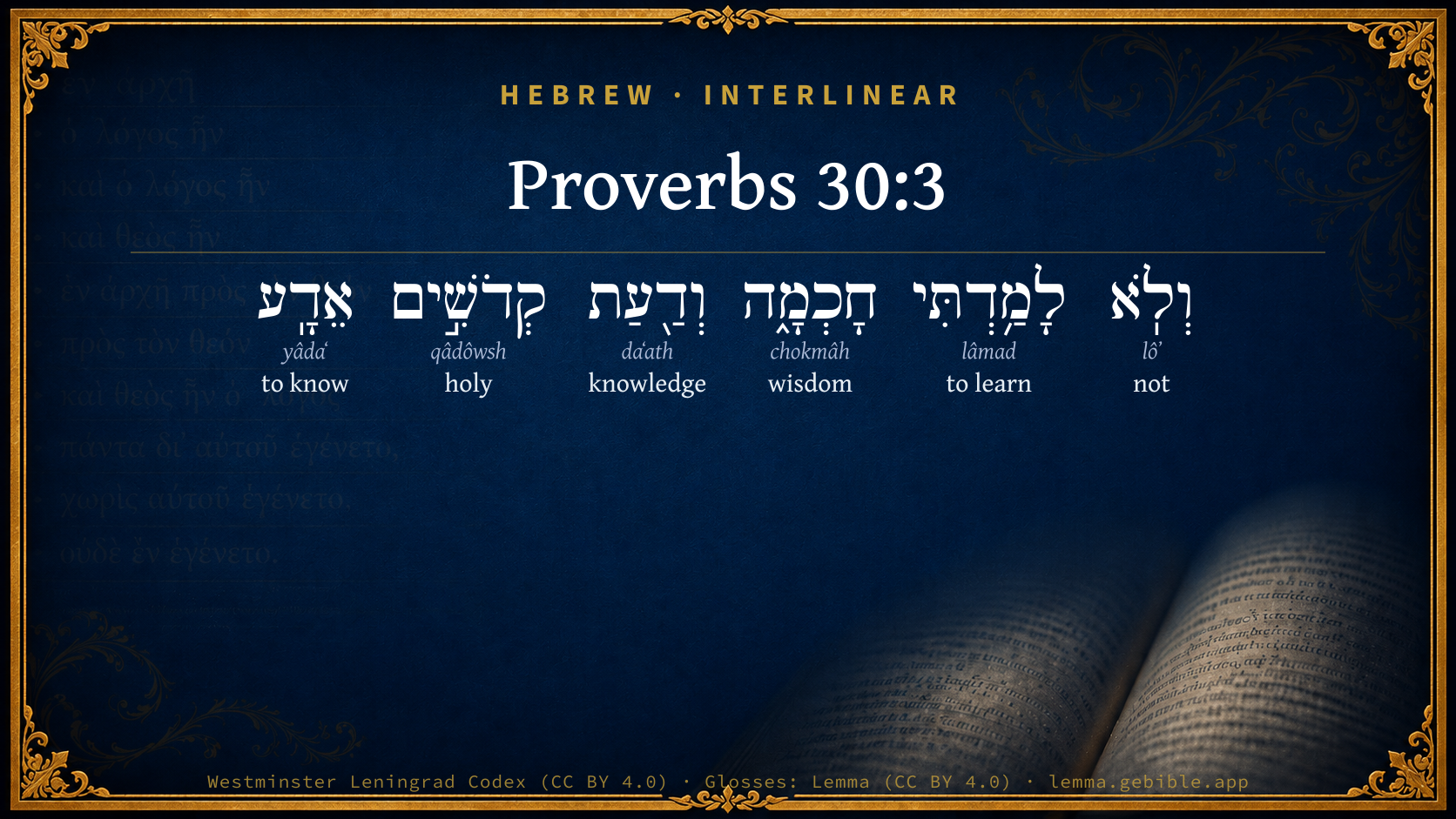
Proverbs 30:3

Hebrew (Westminster Leningrad Codex) Proverbs 30:3 appears in the Hebrew Old Testament. The text above is from the Westminster Leningrad Codex. Each word links to its Strong’s number, a concise gloss, and parsing drawn from the Open Scriptures Hebrew Bible morphology. Click any word for its full Brown-Driver-Briggs (BDB) entry.
Download image
Cite this verse

Proverbs 30:3 (World English Bible). Public Domain. Lemma interlinear Bible study tool, https://lemma.gebible.app/v/proverbs/30/3.

Show BibTeX & RIS
BibTeX
RIS
English Translation
I have not learned wisdom, Neither do I have the knowledge of the Holy One.
World English Bible · Public Domain
Download a study sheet

One document with this verse’s original text, its word-by-word gloss line, the meaning frame, cross-references with their text, attributed commentary, and full source and license credits — printable, and it pastes into notes with its structure intact.

This verse Autodidact and up

Study sheet (.html) Plain text (.txt)

A passage Seminary Student

Up to 50 verses in one chapter. A passage sheet keeps up to 6 commentary sources and 12 cross-references per verse, in the order this page ranks them, and says so on the sheet whenever that leaves anything out. Ask for a single verse and you get the Autodidact verse sheet above.

Everything on this page stays free to read, with no account — the sheet is a download of what is already on screen, not access to it.

Want to remove ads? Support Godless Engineer
Compare translations 3

The same verse in 3 English versions, stacked beneath the original-language interlinear above. Click any original word for its lexicon entry.

Each is an independent rendering of the whole verse — the interlinear is not word-aligned to these translations.

Highlighted words mark where these versions differ — a whole-verse word diff, not a word-by-word alignment.

  • World English Bible Public Domain
    I have not learned wisdom, Neither do I have the knowledge of the Holy One.
  • King James Version Public Domain
    I neither learned wisdom, nor have the knowledge of the holy.
  • unfoldingWord Literal Text CC BY-SA 4.0
    And I have not learned wisdom, nor the knowledge of holy ones do I know.

unfoldingWord Literal Text — © unfoldingWord, licensed CC BY-SA 4.0. Word-aligned USFM3 via Door43 (git.door43.org/unfoldingWord/en_ult).

Versions to compare (up to 4)

3 of 4 selected

Show all 18 translations

Every available English version of this verse, each an independent rendering of the whole verse.

  • World English Bible Public Domain
    I have not learned wisdom, Neither do I have the knowledge of the Holy One.
  • Berean Standard Bible Public Domain
    I have not learned wisdom, and I have no knowledge of the Holy One.
  • Majority Standard Bible Public Domain
    I have not learned wisdom, and I have no knowledge of the Holy One.
  • King James Version Public Domain
    I neither learned wisdom, nor have the knowledge of the holy.
  • American Standard Version (1901) Public Domain
    And I have not learned wisdom, Neither have I the knowledge of the Holy One.
  • Revised Version (1885) Public Domain
    And I have not learned wisdom, neither have I the knowledge of the Holy One.
  • Geneva Bible (1599) Public Domain
    For I haue not learned wisedome, nor atteined to the knowledge of holy things.
  • Douay-Rheims (1899) Public Domain
    I have not learned wisdom, and have not known the science of saints.
  • Young's Literal Translation Public Domain
    Nor have I learned wisdom, Yet the knowledge of Holy Ones I know.
  • Literal Standard Version CC BY-SA 4.0
    Nor have I learned wisdom, || Yet I know the knowledge of the Holy Ones.
  • Unlocked Literal Bible CC BY-SA 4.0
    I have not learned wisdom, nor do I have knowledge of the Holy One.
  • unfoldingWord Literal Text CC BY-SA 4.0
    And I have not learned wisdom, nor the knowledge of holy ones do I know.
  • Darby Bible Public Domain
    I have neither learned wisdom, nor have I the knowledge of the Holy.
  • World Messianic Bible Public Domain
    I have not learned wisdom, neither do I have the knowledge of the Holy One.
  • Webster's Bible Public Domain
    I neither learned wisdom, nor have the knowledge of the holy.
  • Free Bible Version CC BY-SA 4.0
    I have not learned wisdom; I have no knowledge of the Holy One.
  • Bible in Basic English Public Domain
    I have not got wisdom by teaching, so that I might have the knowledge of the Holy One.
  • JPS Tanakh (1917) Public Domain
    And I have not learned wisdom, that I should have the knowledge of the Holy One.

Literal Standard Version (2020), Covenant Press — licensed CC BY-SA 4.0. Text via the HelloAO Bible API (eBible.org). Unlocked Literal Bible (unfoldingWord) — licensed CC BY-SA 4.0. Text via the HelloAO Bible API (eBible.org). unfoldingWord Literal Text — © unfoldingWord, licensed CC BY-SA 4.0. Word-aligned USFM3 via Door43 (git.door43.org/unfoldingWord/en_ult). Free Bible Version, Dr. Jonathan Gallagher — licensed CC BY-SA 4.0. Text via the HelloAO Bible API (eBible.org).

Word by word

More ways to search: Search by grammar → Find every occurrence → Compare this word →

Practice this passage: Drill this verse → Learn its vocabulary →

About this verse

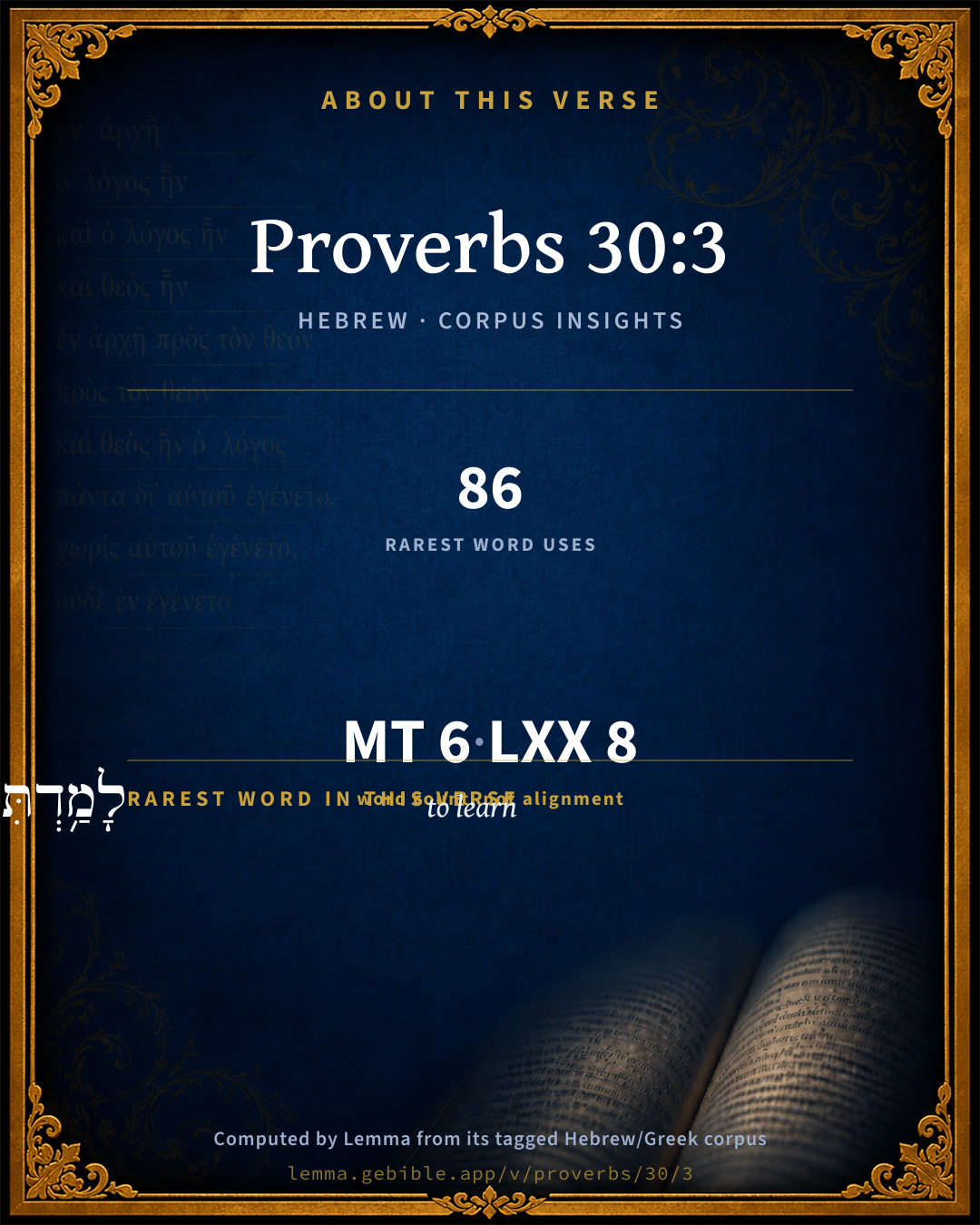
These counts appear in no published source. They are computed here, from the morphology-tagged text and Lemma’s own curated glosses. What Lemma adds →

6
words
6
distinct lemmas
Wisdom
section

Grammatical profile

  • 2 verbs
  • 2 nouns
  • 1 adjective
  • 1 particle

Verb forms

  • לָמַ֥דְתִּי Qal · Perfect
  • אֵדָֽע Qal · Imperfect

Hebrew & Septuagint length

In English translation the verse runs 15 words from the Hebrew and 13 from the Septuagint (LXX English) — closely comparable.

A rough comparison of the two English renderings, which tokenize alike — not a word-level alignment.

Word counts can differ between the Hebrew and the Greek without any difference in meaning — e.g. the Hebrew direct-object marker אֵת has no separate Greek word, and Greek often adds the article ὁ.

In the original languages it is 6 Hebrew tokens and 8 Greek tokens — but the two are counted differently (Hebrew bundles its prefixes and suffixes into one token; the Greek is in lemma form), so that isn’t a like-for-like length.

Cross-references

14

Topical passages linked to Proverbs 30:3 in the Treasury of Scripture Knowledge — connected by theme and wording, ordered by reader-vote popularity; previews shown in the World English Bible.

  • Proverbs 9:10 The fear of Yahweh is the beginning of wisdom. The knowledge of the Holy One is understanding.
  • Romans 11:33 Oh the depth of the riches both of the wisdom and the knowledge of God! How unsearchable are his judgments, and his ways past tracing out!
  • Ephesians 3:18–19 may be strengthened to comprehend with all the saints what is the breadth and length and height and depth,
  • Revelation 3:7 "To the angel of the assembly in Philadelphia write: "He who is holy, he who is true, he who has the key of David, he who opens and no one can shut, and who shuts and no one opens, says these things:
  • Job 11:7–9 "Can you fathom the mystery of God? Or can you probe the limits of the Almighty?
  • Isaiah 6:3 One called to another, and said, "Holy, holy, holy, is Yahweh of Hosts! The whole earth is full of his glory!"
  • Isaiah 6:10 Make the heart of this people fat; Make their ears heavy, and shut their eyes; Lest they see with their eyes, And hear with their ears, And understand with their heart, And turn again, and be healed."
  • Isaiah 30:11 get out of the way, turn aside out of the path, cause the Holy One of Israel to cease from before us."
  • Isaiah 57:15 For thus says the high and lofty One who inhabits eternity, whose name is Holy: I dwell in the high and holy place, with him also who is of a contrite and humble spirit, to revive the spirit of the humble, and to revive the heart of the contrite.
  • Amos 7:14–15 Then Amos answered Amaziah, "I was no prophet, neither was I a prophet's son; but I was a herdsman, and a farmer of sycamore trees;
  • Matthew 11:27 All things have been delivered to me by my Father. No one knows the Son, except the Father; neither does anyone know the Father, except the Son, and he to whom the Son desires to reveal him.
  • Matthew 16:17 Jesus answered him, "Blessed are you, Simon Bar Jonah, for flesh and blood has not revealed this to you, but my Father who is in heaven.
  • John 17:3 This is eternal life, that they should know you, the only true God, and him whom you sent, Jesus Christ.
  • Revelation 4:8 The four living creatures, each one of them having six wings, are full of eyes around about and within. They have no rest day and night, saying, "Holy, holy, holy, holy, holy, holy, holy, holy, holy is the Lord God, the Almighty, who was and who is and who is to come!"

Cross-references courtesy of OpenBible.info (CC BY 4.0).

Hebrew and Greek witnesses Masoretic Hebrew ↔ Greek Septuagint

The same verse in the two great witnesses to the Old Testament, shown verse-for-verse.

These are two independent witnesses, not word-aligned to each other, and the Septuagint is shown in lemma (dictionary) form.

Hebrew Proverbs 30:3 Masoretic · Westminster Leningrad Codex

וְלֹֽא לָמַ֥דְתִּי חָכְמָ֑ה וְדַ֖עַת קְדֹשִׁ֣ים אֵדָֽע

I have not learned wisdom, Neither do I have the knowledge of the Holy One.

World English Bible · Public Domain

Greek LXX Proverbs 30:3 Septuagint · lemma form

θεός διδάσκω ἐγώ σοφία καί γνῶσις ἅγιος γιγνώσκω

God has taught me wisdom, and I know the knowledge of the holy.

LXX2012 (modern English Septuagint) · Public Domain

On this verse, Adam Clarke's Commentary discusses the Septuagint’s reading. Read the note in Commentary ↓

Hebrew: Westminster Leningrad Codex (CC BY 4.0). Greek: Septuagint (public domain); English from LXX2012 (modern English Septuagint) (Public Domain). How the Septuagint differs from the Hebrew →

Commentary

Notes on Proverbs 30:3 from classic Christian and Jewish commentators (each source and its license shown beneath its notes). The classic Christian expositions comment on the surrounding passage and are grouped to its opening verse, so a note may address several verses; the Jewish commentaries on the Tanakh (Rashi and others) are per-verse, so they appear only where the commentator wrote on this verse.

Lemma curates 59 commentaries, every one of them public domain or Creative Commons licensed, each selected and text-cleaned for this edition rather than reprinted as found. About our sources →

Trapp's Complete Commentary

John Trapp

Pro 30:3 I neither learned wisdom, nor have the knowledge of the holy.

Ver. 3. I neither learned wisdom.] As he had it not by nature, {a} so neither had he attained unto it by any pains or skill of his own. "There is a spirit indeed in man" - a reasonable soul and a faculty of reasoning - "but the inspiration of the Almighty giveth understanding." {Job 32:8} Not that Agur neglected the means of knowledge, or put off the study of it (as Solomon’s fool, Pro 24:7), from a conceit of the impossibility of reaching to it. Neither yet was he of their mind of whom Augustine makes mention that they cast off the care of knowledge, because knowledge puffeth up; and so would be ignorant that they might be humble, and want knowledge that they might want pride. This was to do as the philosopher that plucked out his eyes to avoid the danger of uncleanness. Sed nihil aliud egit quam quod fatuitatem suam urbi manifestam fecit, saith Tertullian, {b} wherein he proclaimed his own folly to all the country. But holy Agur here assures us that flesh and blood never revealed these high things that follow unto him, but as Paul was an apostle, so was he a prophet "not of men, neither by man, but by Jesus Christ, and God the Father," {Gal 1:1} even "the Father of lights." {Jas 1:17} In nature’s school nothing is to be learned concerning Ithiel and Ucal. St Augustine, though much taken with Cicero’s "Hortensius," yet because he found not the name of Christ in it he could not so heartily affect it. {c} The philosophers much magnify the mind of man as full of divine light and perspicacy, when the truth tells us that it is

“ Mens oblita Dei, vitiorumque oblita caeno. ”

There is nothing great in the earth but man, nothing in man but his mind. Si eousque scandis, coelum transcendis, said Favorinus the philosopher; If you get up thither you ascend beyond heaven. But Agur "had not so learned Christ." He talks of natural blindness and other evils born with him. Erras si tecum vitia nasci putes; supervenere, ingesta sunt. You are out, Agur, saith Seneca, if you talk on that manner; blindness is not natural to you, but adventitious. Agur bewails his loss in Adam; this nature’s eye never saw, and therefore heart never rued. Those that were born in hell knew none other heaven, as the proverb is. Agur tells us here that he never learned true wisdom from any man, but must thank God for that measure thereof that he had attained to. On the contrary Cicero {d} tells us that, inasmuch as every man acquires to himself that virtue that he hath, no wise man ever yet gave God thanks for it. And Seneca saith, It is of the gods that we live, but of ourselves that we live well and honestly. {e} How different are the saints in Scripture from the world’s wizards!

Nor have the knowledge of the holy.] That is, Of the angels {Dan 4:13; Dan 4:17; Dan 8:13} whom Jacob saw ascending and descending. {Gen 28:12, compared with Pro 30:4 Joh 1:51} Moses made them looking intently into the mercy seat. {Exo 25:18-19} Peter sets them forth as stooping down to look wishtly and earnestly {f} into the mystery of Christ {1Pe 1:12} which was hid from them till the discovery, and ever since, that they are great students in it. {Eph 3:10} But how should Agur, or any man else that cannot tell the form and the quintessence of things, that cannot enter into the depth of the flower, or the grass he treads on, that cannot understand the nature and properties of so small a creature as an ant or bee - Pliny {g} tells of one that spent eight and fifty years in learning out the nature of the bee, and yet had not fully attained unto it - how is it possible, I say, that the wisest naturalist should have the wit to enter into the deep things of God? "Eye hath not seen, nor ear heard," &c. {1Co 2:9}

{a} Nemo nascitur artifex.

{b} In Apolog.

{c} Confess., lib. iii.

{d} Quia sibi quisque virtutem acquirit, neminem e sapientibus unquam de ea gratias Deo egisse. - Lib, iii. De Nat. Deor.

{e} Deorum quidem munus est quod vivimus, &c. - Sen.

{f} παρακυψαι

{g} Lib. xi. cap. 9.

John Trapp, A Commentary or Exposition upon All the Books of the Old and New Testament (1647–1656) — public domain. Text from a community e-Sword module.

Adam Clarke's Commentary

Verse 3. I neither learned wisdom] I have never been a scholar in any of those schools of the wise men, nor have the knowledge of the holy, קדשים kedoshim, of the saints or holy persons.

The Septuagint give this a different turn: θεος δεδιδαχε με σοφιαν και γνωσιν αγιων εγνωκα; "God hath taught me wisdom, and the knowledge of the saints I have known."

This may refer to the patriarchs, prophets, or holy men, that lived before the days of Solomon. That is, the translators might have had these in view.

Adam Clarke's Commentary on the Bible (1810–1826) — public domain. Text from a community e-Sword/MySword module.

Ellicott's Commentary for English Readers

(3) The knowledge of the holy—i.e., the Holy One, God. (Comp. Pro_9:10.)

A Bible Commentary for English Readers, edited by Charles John Ellicott (1878–1897) — public domain. Text from a community e-Sword module.

The Cambridge Bible for Schools and Colleges

gen. ed. J. J. S. Perowne

3. the holy] Rather, the Holy One. See Pro_9:10 note.

The Cambridge Bible for Schools and Colleges (gen. ed. J. J. S. Perowne; Cambridge University Press, 1878–1918) — public domain. Text from a community e-Sword module.

John Gill's Exposition

I neither learned wisdom,.... Natural wisdom or philosophy, so as to understand the nature of things, and reason about them in a philosophical manner; or political wisdom, so as to know how to govern states, and manage the affairs of kingdoms; or in a lower sphere to transact the affairs of life to any peculiar advantage; he had not a polite or liberal education: or spiritual and evangelical wisdom; that is, not of himself through the mere strength and force of his genius and natural capacity, or of others; he was not the son of a prophet, nor brought up in the schools of the prophets; he did not learn it, nor was he taught it by men; for this is not acquired by human teaching; it is what comes from above, from heaven, and by the revelation of God;

nor have the knowledge of the holy; or "holies" (s); either of holy persons, such knowledge as holy men of God had; or of the holy angels, not of their nature, capacities, influence and operations; nor such as they have: or rather of the holy Persons in the Trinity, Father, Son and Spirit; their nature modes of subsisting, perfections, purposes, and the like; at least not a full and comprehensive one: or of holy things, of the holy Scriptures, and the holy doctrines of them; however, not what is perfect and complete. It may be rendered, "but I have the knowledge of the holy" (t), though he had not the advantage of human literature, nor had ever been under the instructions of men on one account or another, and therefore what he knew, or was about to discourse of, was from God. Some understand this verse and Pro 30:2 of Ithiel, or Christ (u), as in the esteem of men, Co1 1:23.

(s) "sanctorum", V. L. Pagninus, Montanus, Vatablus, Junius & Tremellius, Piscator, Mercerus, Gejerus, Cocceius, Schultens. (t) "ad cognitionem sanctorum novi", Michaelis; "expers sum humanarnm artium, et divinarum guarus sum", Vatablus in Gejerus. (u) Teelman. Specimen. Explicat. Parabol. p. 391.

John Gill's Exposition of the Whole Bible (1746–1763) — public domain (CC PDM 1.0). Text via the HelloAO Bible API.

Albert Barnes' Notes on the Bible

He found, when he looked within, that all his learning was as nothing. He had heard of God only “by the hearing of the ear” Job 42:5, and now he discovered how little that availed.

The holy - The Holy One. Compare Pro 9:10.

Albert Barnes' Notes on the Bible (1834–1885) — public domain. Text from a community e-Sword/MySword module.

Matthew Poole's English Annotations

I neither learned wisdom; I have not been taught in the schools of wisdom, as the sons of prophets were, but must own myself to be an unlearned man, as the prophet Amos was, Amo 7:14,15. Or, I have not learned it, neither by my own understanding and study, nor by the help of other men.

Of the holy; either,

1. Of the holy angels, who are called holy by way of eminency, as Deu 33:2; Job 15:15 Dan 4:13,17,23; 8:13. But it was vain to deny that angelical knowledge to be in him, which no man imagined to be in him, and which was not in Adam fix the state of innocency. Or,

2. Of the holy prophets. So the sense is, I have not such Divine inspirations as prophets strictly so called have received, whereby I should be enabled to know or explain those great mysteries wherein you desire information from me. Or,

3. Of holy things, of the mind and will of God concerning man’s salvation, and the way which leads to it; not that he denieth that he had any knowledge of these things, but only a full, and comprehensive, and perfect knowledge, which they falsely supposed to be in him.

Matthew Poole's English Annotations on the Holy Bible (1683–1685) — public domain. Text from a community e-Sword/MySword module.

Whedon's Commentary on the Bible

Daniel D. Whedon

3. Knowledge of the holy — קדשׁים, (kedhoshim,) plural, holy ones, which is understood by some as meaning holy persons; saints or persons divinely illuminated, that is, inspired. Others take it as a plural of intensity, and translate Most Holy, that is, God. Comp. Pro_9:10. Pro_30:2-3 may be understood as expressing the author’s unaffected sense of his own deficiencies, intellectual and moral. We must, however, make allowance for the Oriental mode of expression, which is, perhaps, stronger than we would feel warranted to use.

Daniel D. Whedon (gen. ed.), Commentary on the Old and New Testaments (1874–1909) — public domain. Text from a community e-Sword module.

The Pulpit Commentary

I neither learned wisdom. With all my eager longing and striving I did not attain to such wisdom, that I should have the knowledge of the Holy One (Revised Version margin); k"doshim, plural of "excellence," like elohim. (Pro_9:10 Hos_12:1 (Hebrew) see note on Pro_1:20; and comp. Ecc_5:8 Ecc_12:1) The knowledge of the all holy God was beyond his grasp. (Job_11:7, etc.) Theology is a higher science than metaphysics, and cannot be reached by that ladder. The LXX gives an affirmative sense to this verse, "God hath taught me wisdom, and I know the knowledge of the holy (agiwn )."

The Pulpit Commentary (1880–1919), ed. H.D.M. Spence-Jones & Joseph S. Exell — public domain. Text from a community e-Sword module.

John Wesley's Explanatory Notes

I neither learned - I have not been taught in the schools of wisdom. Of the holy - Of the holy prophets. I have not such Divine inspirations as prophets strictly so called have received.

John Wesley, Explanatory Notes Upon the Whole Bible (1754–1765) — public domain. Text via the GEBible commentary corpus.

Rashi

Rabbi Shlomo Yitzchaki (Rashi)

Neither have I learned wisdom nor do I know the knowledge of the holy ones, for I subtracted or added to the words of Moses.

Rashi on the Tanakh — English translations: “The Judaica Press complete Tanach with Rashi, translated by A. J. Rosenberg” (CC BY 4.0); “Pentateuch with Rashi's commentary by M. Rosenbaum and A.M. Silbermann, 1929-1934” (public domain); “The Metsudah Tanach series, Lakewood, N.J” (CC BY 4.0); and “The Book of Joshua, Metsudah Publications, 1997” (CC BY 4.0). Text via Sefaria.

Lesson kit

Teaching starters — assembled from the data on this page, not authored interpretation. Every prompt links to the verse data it draws on. Edit before teaching.

Proverbs, in the Wisdom, opens this verse with 6 words (6 distinct Hebrew lemmas). Its most distinctive word is lâmad (“to learn”). A historical commentator’s framing appears above. Read the whole chapter for the surrounding context.

Discussion questions

  1. How does “to learn” (lâmad) shape what this verse is saying?
  2. How does Proverbs 9:10, which shares this passage’s theme, read alongside this verse?
  3. These translations render this verse differently. What is at stake in choosing one wording over another?
  4. «לָמַ֥דְתִּי» is a Qal Perfect verb. How does that grammatical form shape the action described?
  5. Compare how Trapp's Complete Commentary and Adam Clarke's Commentary read this verse. Where do they agree or differ?

Things to notice

Reading settings

Reading text

Shown beneath each verse's original-language words.

Old Testament
Old Testament edition

Read the OT as the Masoretic Hebrew (MT) or the Greek Septuagint (LXX).

English shown for the Greek Septuagint (in the Hebrew ↔ Greek comparison).

Comparing translations? Open the Compare panel on any verse page to stack up to four side by side.