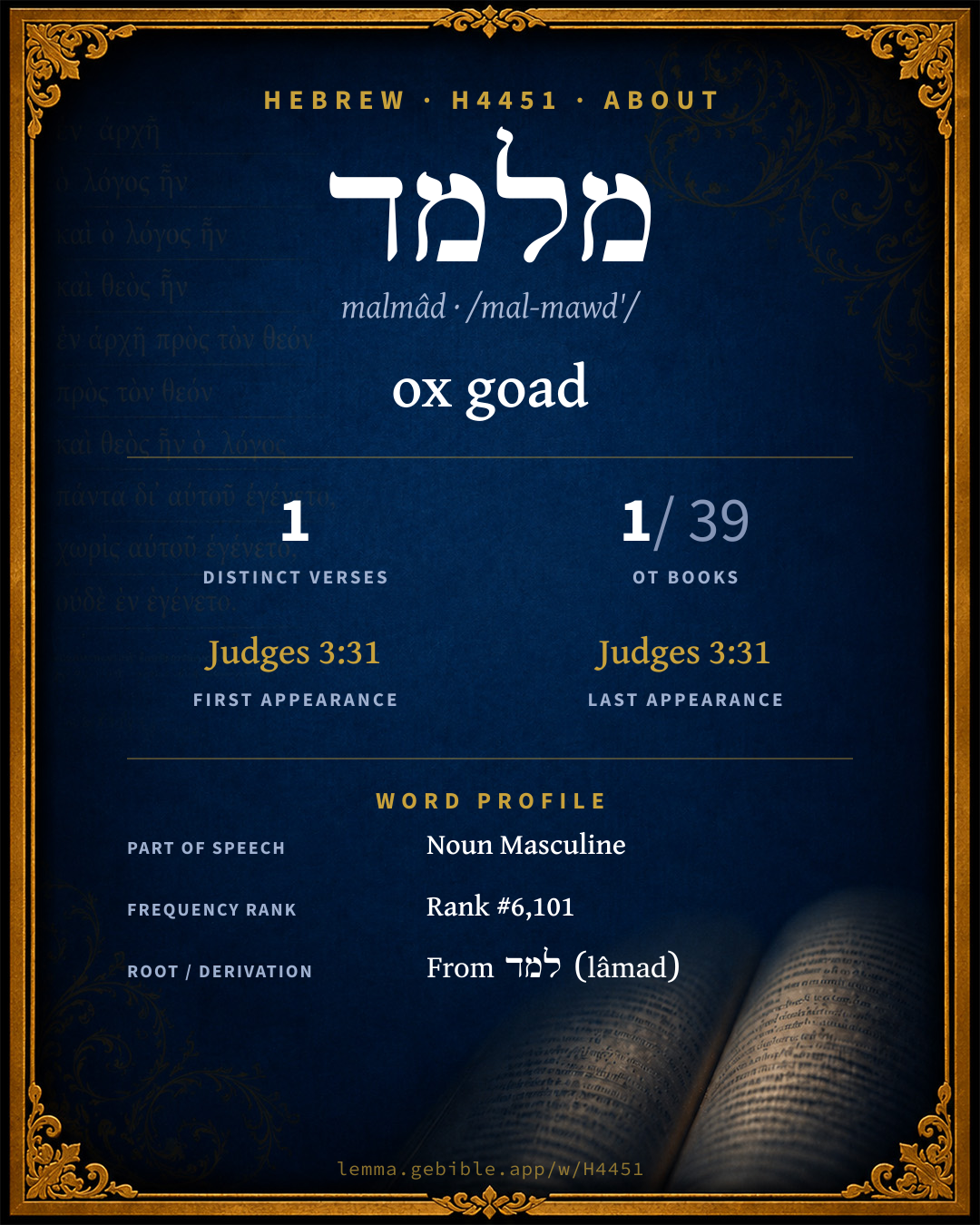
מַלְמֵד
ox goad
Full lexicon entry — Brown-Driver-Briggs (BDB)
From Brown-Driver-Briggs (BDB)
Where this word appears
Grammar key — what these labels mean
Noun type
- Common
- A common noun — a general class of person, place, or thing (“king,” “city,” “water”), not a specific name.
State
- Construct
- A noun bound to a following noun in a possessive / “of” relationship (the construct chain).
Gender
- Masculine
- Grammatically masculine.
Number
- Singular
- One.
Every verse where H4451 appears — 1 distinct verse across 1 book. Click any verse to open its interlinear word-by-word view. Verse text shown in the World English Bible for context — . Each verse’s Hebrew form is shown with its reference; the English is not keyword-highlighted, since the data carries no word-level English alignment. Use “Compare translations” on any verse to read it across multiple English versions. This concordance covers the Hebrew Bible; Septuagint (Greek Old Testament) occurrences are not indexed here.
Judges 1 verse
About this entry
At a glance — auto-summarized from this page’s data, not written by a person. Every figure links to its source below. This summary describes the numbers; it doesn’t interpret them.
At its core, מלמד (malmâd) means “ox goad.” A scarce word — 1 verse in all of the Hebrew Bible. Its uses cluster heavily in Judges (100% of all occurrences). Its lone occurrence is Judges 3:31. Sharing its root, it stands alongside למד, למוד and תלמיד. Each statement above links to its evidence; the full detail follows below.
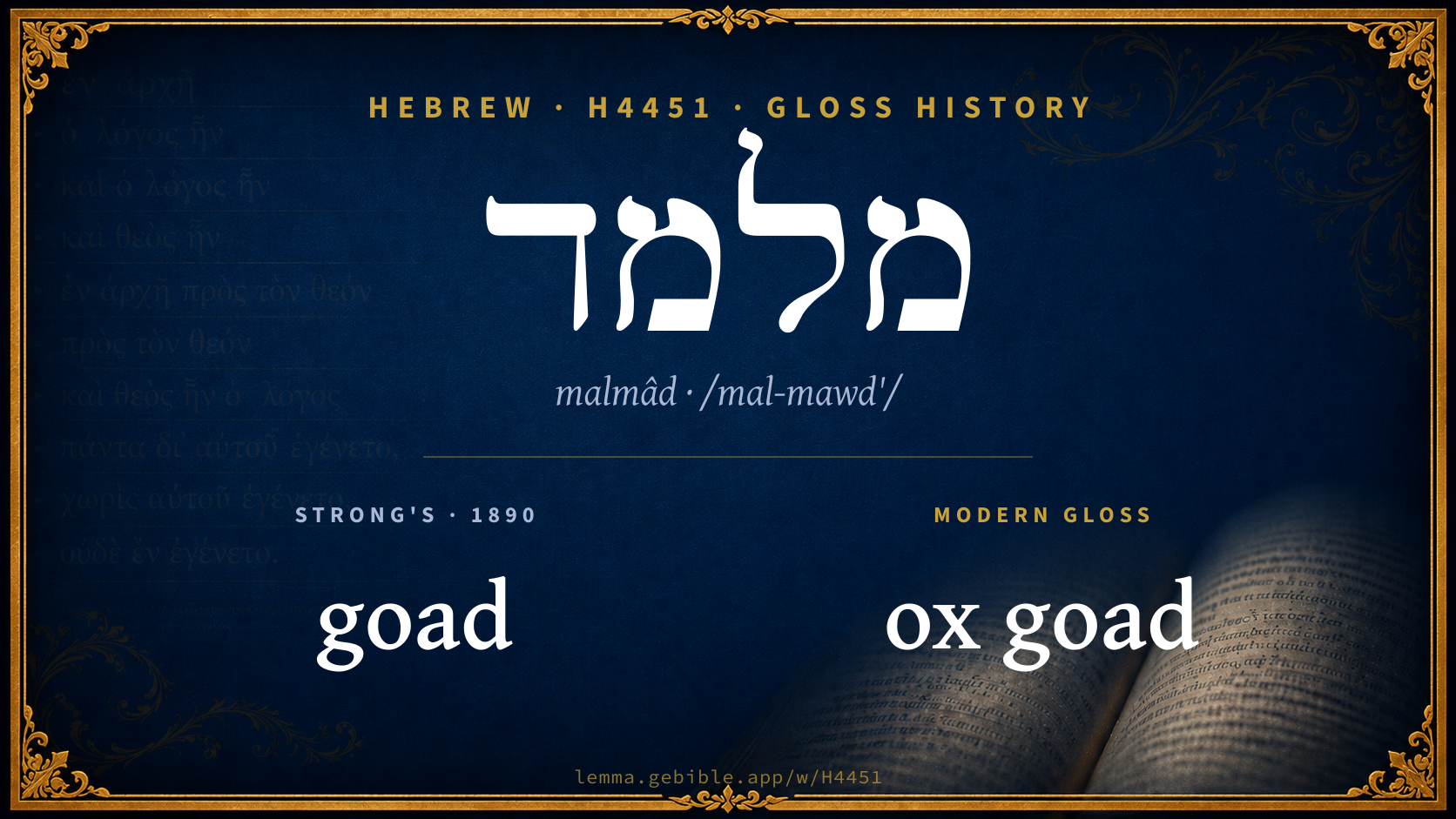
Gloss history
Strong's 1890 vs modern scholarship
About this word
Strong's H4451 catalogs a Hebrew word from the Hebrew Old Testament.
These counts are not copied from any lexicon or concordance. They are computed here, from the morphology-tagged Hebrew Old Testament. What Lemma adds →
- 1
- distinct verses
- The word appears in 1 distinct verse.
- 1 / 39
- OT books
- The word appears in 1 of 39 Old Testament books.
- #6,101
- by frequency
- Rank #6,101 (rank 6,101 of 8,640 Hebrew words by occurrence).
View all 1 occurrence in the concordance →
Most concentrated in
- Judges 1 verse 100%
By section of the Old Testament
By traditional corpus
Conventional, traditional groupings — biblical authorship is debated, so this is a traditional corpus grouping, not an authorship claim. Each share is this word’s portion of its verses in that division of the Hebrew canon. Each figure is a share of the word’s 1 distinct verse.
- Prophets (Nevi'im) 1 verse · 100%
How translations render this word
Counts come from each version’s own published word-to-Strong’s tagging or interlinear alignment — an approximate guide to how each version renders this word, not a word-level alignment the data otherwise carries. Because each total is that version’s own tagged count, the per-version totals vary from one another and need not match the appearance or distinct-verse counts above. These counts may also differ from a printed concordance because Lemma counts each distinctly tagged rendering and does not collapse phrase taggings into a single head-word total. This is a fixed set of word-tagged versions (KJV, ASV, BSB, ULT) and does not change with the reading translation you choose elsewhere. Each version’s license is shown beside its name below (and on Sources).
- King James Version: Goad 1×
- American Standard Version: - goad 1×
- Berean Standard Bible: Oxgoad 1×
- unfoldingWord Literal Text: Goad of 1×
King James Version Public Domain
Renders H4451 across 1 tagged occurrence — most commonly:
American Standard Version Public Domain
Renders H4451 across 1 tagged occurrence — most commonly:
Berean Standard Bible Public Domain
Renders H4451 across 1 tagged occurrence — most commonly:
unfoldingWord Literal Text CC BY-SA 4.0
Renders H4451 across 1 tagged occurrence — most commonly:
Senses in BDB
The 1 sense BDB distinguishes for this word, in lexicon order (not ranked by frequency or importance). The full entry — with sub-senses — is in the Lexicon Entry tab.
- ox goad
Word origin
[ מַלְמֵד ] n.[m.] ox-goad;—cstr. מַלְמַד Ju 3:31.
— Brown-Driver-Briggs (Oxford 1906, public domain), digitized via Sefaria, supplemented by the OpenScriptures HebrewLexicon (CC BY 4.0). See Sources.
Derived from למד (lâmad) (H3925) — to learn.
Jastrow Dictionary
A second Hebrew/Aramaic lexicon for comparison, covering Aramaic and post-biblical (Talmudic, Targumic, Midrashic) usage that the biblical-Hebrew BDB does not. Matched by lemma rather than by Strong’s number, so a lemma may carry more than one Jastrow headword (shown separately below), and the entries cover usage well beyond the Bible.
לָמֵד I
- (b. h.)
- 1. to be joined, affixed to, v. Pi.
- to accustom, train. Part. pass. לָמוּד, f. לְמוּדָה; pl. לְמוּדִים, לְמוּדִין; לְמוּדוֹת. Y. Ter. IV, 42ᵈ כמות שהוא ל׳ according to what he is used to. Lev. R. s. 4 אינה ל׳ מבית וכ׳ she is not used (to handle T’rumah) from her father’s house. Dem. IV, 4 ואם … ל׳ וכ׳ but if a priest or the poor are habitual guests at his table. Sifra K’dosh. Par. 3, ch. VI, v. לִימּוּד; a. fr.—3) to learn, study. Ab. II, 5 לא הביישן לָמֵד וכ׳ he who is bashful will not learn, nor can the hot-tempered teach, v. בַּיְישָׁן. Ib. IV, 1 הלוֹמֵד מכל אדם he who learns from everybody. Ib. 20 הל׳ ילד he who studies at an early age; הל׳ זקן who begins to study at an advanced age. Ib. I, 9 שמא … יִלְמְדוּ לשקר lest through them (your intricate cross-examinations) they may be led to tell a lie. Taan. 7ᵃ; Macc. 10ᵃ הרבה לָמַדְתִּי וכ׳ I have learned much from my teachers, more from my colleagues, and most from my pupils; a. v. fr.—B. Mets. 71ᵃ, a. fr. הא לָמַדְתָּ here you learn, i.e. this proves. [Targ. Esth. I, 1 מכאן אתה לָמֵד from this you will learn.]
- 1. to join; to arrange. Sabb. 125ᵇ צאו ולַמְּדוּם go out and place them (the building stones) in order (for sitting thereon the next day).—V. לִימּוּדִים.
- 2. to train, accustom. Hor. 13ᵇ יְלַמֵּד אדם עצמו וכ׳ man should train his body (to relieve his bowels) early in the morning &c. Nidd. 66ᵇ לעולם ילמד אדם בתוך וכ׳ man should make it a rule in his house; a. fr.—Part. pass. מְלוּמָּד, f. מְלוּמֶּדֶת; pl. מְלוּמָּדִים, מְלוּמָּדִין; מְלוּמָּדוֹת trained, experienced. Snh. 109ᵃ top (in Chald. dict.) דמל׳ בניסין הוא for he has experience in miracles. Taan. 25ᵃ. Succ. 29ᵃ מפני שמל׳ במכות הן (not במכותיהן; Ms. M. שרגילין) because they (the Jews) have experience in afflictions; a. e.
- 3. to teach, instruct; to argue. Keth. 50ᵃ הלומד … ומְלַמְּדָהּ he who studies the Law and teaches it. Pes. 112ᵃ לַמְּדֵנִי תורה teach me the Law; איני מְלַמֶּדְךָ I will not teach thee. Ib. כשאתה מְלַמֵּד … לַמְּדֵהוּ וכ׳ when thou teachest thy son, teach him from a revised (correct) copy. Snh. 19ᵇ אהרן ילד ומשה לי׳ וכ׳ Aaron begot (his sons), but Moses taught them, therefore they are recorded under his name; a. v. fr.—מְלַמֵּד תינוקות primary teacher. Ib. 17ᵇ. B. Bath. 21ᵃ מְלַמְּדֵי ת׳ teachers.—ל׳ זכות על to argue in favor of, to plead for; ל׳ חובה to plead against. Sabb. 32ᵃ ואפי׳ … מְלַמְּדִים … ואחד מלמד עליו זכות ניצול and even if nine hundred … plead against him, and one (good deed) for him, he will be saved; a. v. fr.—Esp. (in textual interpret.) to lead, hint, throw light on. Sifra Emor Par. 4, ch. IV הייתי אומר תושב … בא שכיר ולי׳ על התושב וכ׳ I might have thought toshab (Lev. XXII, 10) meant one hired for a limited period; therefore sakhir (ibid.) comes in to throw light on toshab that it means one bought for life; Kidd. 4ᵃ; Yeb. 70ᵃ.—Sifra introd. יצא מן הכלל לְלַמֵּד is specified for the sake of illustration, v. כְּלָל. Meïl. 11ᵇ, a. fr. שני כתובים … אין מְלַמְּדִין two verses which coincide (teach the same), prove nothing, cannot serve as an illustration for similar cases; a. fr. e.g. Leviticus 22:10
- to practice. Gitt. 24ᵇ; Zeb. 2ᵇ בסופרים העשויים להִתְלַמֵּד וכ׳ it treats of scribes who are in the habit of writing documents merely for practice. Gitt. 60ᵃ לכתוב … להתל׳ בה to write one portion of the Pentateuch for a child for practicing purposes; a. fr.
מַלְמֵד
- ox-goad. Kel. IX, 6, v. דָּֽרְבָן. Y. Snh. X, 28ᵃ מ׳ שהוא מְלַמֵּד וכ׳ it is called malmed, because it trains the cow &c.; Pesik. Baḥod., p. 153ᵃ; a. e.
A Dictionary of the Targumim, the Talmud Babli and Yerushalmi, and the Midrashic Literature (Marcus Jastrow; London, Luzac, 1903) — Public Domain. Digitized via Sefaria. Digitized via Sefaria. Full attribution on Sources.
Same root — word family
Other BDB entries built from the same root as H4451, grouped by Strong’s listed origin. These share a root / origin per the lexicon — not necessarily a shared meaning. Each links to that word’s own entry.
Derives from
Shares the same root
Compare all same-root words → They share a root, not necessarily a meaning.
Septuagint verse parallels
This word appears in 1 verse that also exists in the Greek Old Testament (Septuagint), out of the 1 Hebrew verse it occurs in. You can read those verses in Greek by switching the Old Testament edition to the Septuagint.
Read these verses in the Septuagint
This is a verse-level parallel only — the same verses exist in both the Hebrew and Greek Old Testaments. No word-level Hebrew↔Greek correspondence is claimed: the data carries no such alignment, so no Greek word is shown as this Hebrew word’s translation. Coverage is not total — the Septuagint omits the deuterocanon and renumbers the Psalms, so some Hebrew verses have no direct Greek parallel.