
Psalms 119:171

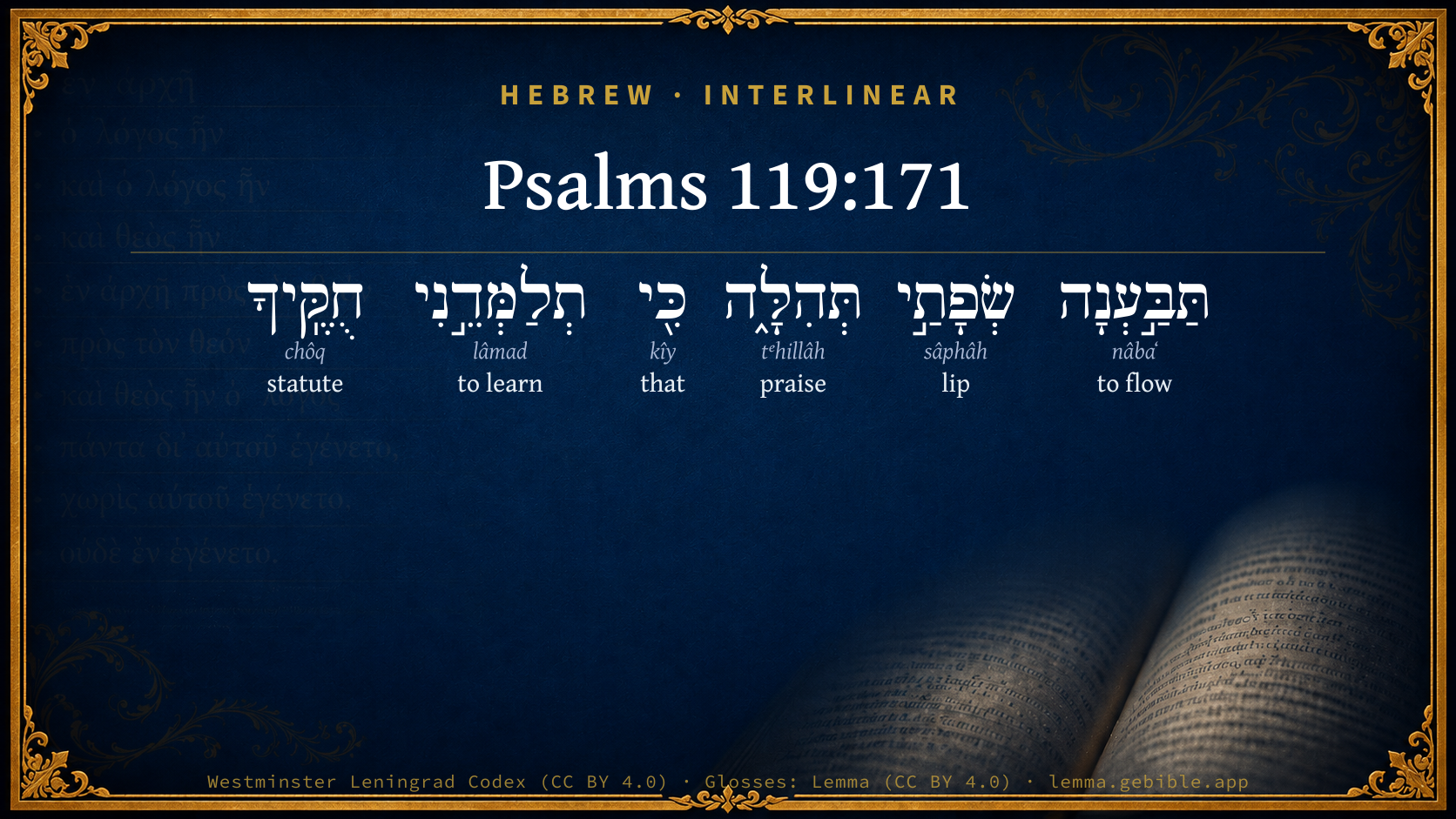
Hebrew (Westminster Leningrad Codex) Psalms 119:171 appears in the Hebrew Old Testament. The text above is from the Westminster Leningrad Codex. Each word links to its Strong’s number, a concise gloss, and parsing drawn from the Open Scriptures Hebrew Bible morphology. Click any word for its full Brown-Driver-Briggs (BDB) entry.
Download image
Cite this verse

Psalms 119:171 (World English Bible). Public Domain. Lemma interlinear Bible study tool, https://lemma.gebible.app/v/psalms/119/171.

Show BibTeX & RIS
BibTeX
RIS
English Translation
Let my lips utter praise, For you teach me your statutes.
World English Bible · Public Domain
Download a study sheet

One document with this verse’s original text, its word-by-word gloss line, the meaning frame, cross-references with their text, attributed commentary, and full source and license credits — printable, and it pastes into notes with its structure intact.

This verse Autodidact and up

Study sheet (.html) Plain text (.txt)

A passage Seminary Student

Up to 50 verses in one chapter. A passage sheet keeps up to 6 commentary sources and 12 cross-references per verse, in the order this page ranks them, and says so on the sheet whenever that leaves anything out. Ask for a single verse and you get the Autodidact verse sheet above.

Everything on this page stays free to read, with no account — the sheet is a download of what is already on screen, not access to it.

Want to remove ads? Support Godless Engineer
Compare translations 3

The same verse in 3 English versions, stacked beneath the original-language interlinear above. Click any original word for its lexicon entry.

Each is an independent rendering of the whole verse — the interlinear is not word-aligned to these translations.

Highlighted words mark where these versions differ — a whole-verse word diff, not a word-by-word alignment.

  • World English Bible Public Domain
    Let my lips utter praise, For you teach me your statutes.
  • King James Version Public Domain
    My lips shall utter praise, when thou hast taught me thy statutes.
  • unfoldingWord Literal Text CC BY-SA 4.0
    May my lips gush out praise, for you teach me your statutes.

unfoldingWord Literal Text — © unfoldingWord, licensed CC BY-SA 4.0. Word-aligned USFM3 via Door43 (git.door43.org/unfoldingWord/en_ult).

Versions to compare (up to 4)

3 of 4 selected

Show all 17 translations

Every available English version of this verse, each an independent rendering of the whole verse.

  • World English Bible Public Domain
    Let my lips utter praise, For you teach me your statutes.
  • Berean Standard Bible Public Domain
    My lips pour forth praise, for You teach me Your statutes.
  • Majority Standard Bible Public Domain
    My lips pour forth praise, for You teach me Your statutes.
  • King James Version Public Domain
    My lips shall utter praise, when thou hast taught me thy statutes.
  • American Standard Version (1901) Public Domain
    Let my lips utter praise; For thou teachest me thy statutes.
  • Revised Version (1885) Public Domain
    Let my lips utter praise; for thou teachest me thy statutes.
  • Geneva Bible (1599) Public Domain
    My lippes shall speake praise, when thou hast taught me thy statutes.
  • Young's Literal Translation Public Domain
    My lips do utter praise, For Thou dost teach me Thy statutes.
  • Literal Standard Version CC BY-SA 4.0
    My lips utter praise, || For You teach me Your statutes.
  • Unlocked Literal Bible CC BY-SA 4.0
    May my lips pour out praise, for you teach me your statutes.
  • unfoldingWord Literal Text CC BY-SA 4.0
    May my lips gush out praise, for you teach me your statutes.
  • Darby Bible Public Domain
    My lips shall pour forth praise when thou hast taught me thy statutes.
  • World Messianic Bible Public Domain
    Let my lips utter praise, for you teach me your statutes.
  • Webster's Bible Public Domain
    My lips shall utter praise, when thou hast taught me thy statutes.
  • Free Bible Version CC BY-SA 4.0
    Let me pour out my words of praise, for you teach me what to do.
  • Bible in Basic English Public Domain
    Let my lips be flowing with praise, because you have given me knowledge of your rules.
  • JPS Tanakh (1917) Public Domain
    Let my lips utter praise: because Thou teachest me Thy statutes.

Literal Standard Version (2020), Covenant Press — licensed CC BY-SA 4.0. Text via the HelloAO Bible API (eBible.org). Unlocked Literal Bible (unfoldingWord) — licensed CC BY-SA 4.0. Text via the HelloAO Bible API (eBible.org). unfoldingWord Literal Text — © unfoldingWord, licensed CC BY-SA 4.0. Word-aligned USFM3 via Door43 (git.door43.org/unfoldingWord/en_ult). Free Bible Version, Dr. Jonathan Gallagher — licensed CC BY-SA 4.0. Text via the HelloAO Bible API (eBible.org).

Word by word

More ways to search: Search by grammar → Find every occurrence → Compare this word →

Practice this passage: Drill this verse → Learn its vocabulary →

About this verse

These counts appear in no published source. They are computed here, from the morphology-tagged text and Lemma’s own curated glosses. What Lemma adds →

6
words
6
distinct lemmas
Wisdom
section

Notable vocabulary

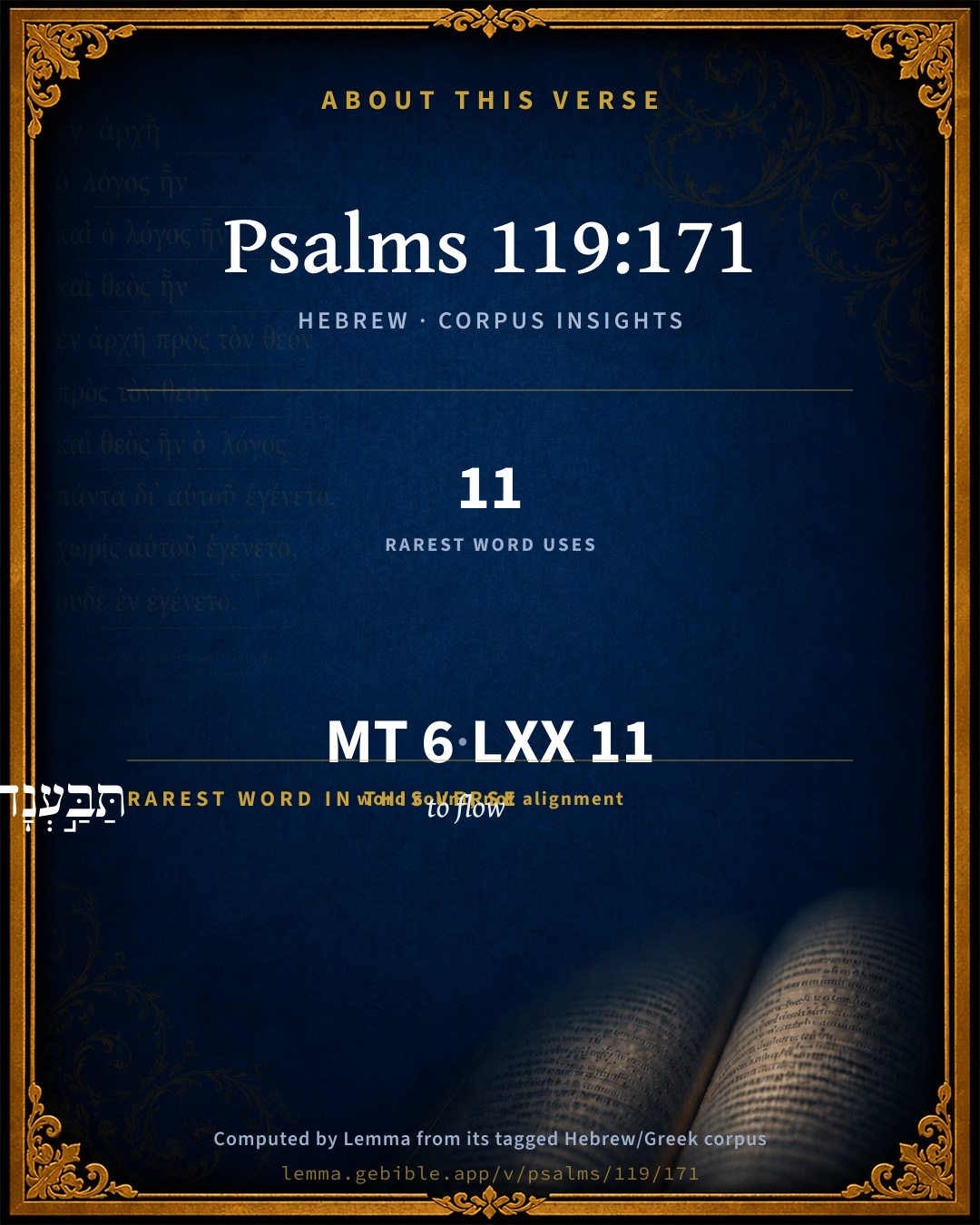
The rarest word here is תַּבַּ֣עְנָה to flow H5042 — appearing just 11 times in the whole Hebrew Bible.

Shared distinctive vocabulary

תַּבַּ֣עְנָה to flow H5042 occurs in 11 verses of the Hebrew Bible. Also found in:

Grammatical profile

  • 2 verbs
  • 3 nouns
  • 1 conjunction

Verb forms

  • תַּבַּ֣עְנָה Hiphil · Imperfect
  • תְלַמְּדֵ֣נִי Piel · Imperfect

Hebrew & Septuagint length

In English translation the verse runs 11 words from the Hebrew and 14 from the Septuagint (LXX English) — closely comparable.

A rough comparison of the two English renderings, which tokenize alike — not a word-level alignment.

Word counts can differ between the Hebrew and the Greek without any difference in meaning — e.g. the Hebrew direct-object marker אֵת has no separate Greek word, and Greek often adds the article ὁ.

In the original languages it is 6 Hebrew tokens and 11 Greek tokens — but the two are counted differently (Hebrew bundles its prefixes and suffixes into one token; the Greek is in lemma form), so that isn’t a like-for-like length.

Cross-references

6

Topical passages linked to Psalms 119:171 in the Treasury of Scripture Knowledge — connected by theme and wording, ordered by reader-vote popularity; previews shown in the World English Bible.

  • Psalms 71:23–24 My lips shall shout for joy! My soul, which you have redeemed, sings praises to you!
  • Psalms 94:12 Blessed is the man whom you discipline, Yah, And teach out of your law;
  • Psalms 51:15 Lord, open my lips. My mouth shall declare your praise.
  • Psalms 71:17 God, you have taught me from my youth. Until now, I have declared your wondrous works.
  • Psalms 119:7 I will give thanks to you with uprightness of heart, When I learn your righteous judgments.
  • Psalms 50:23 Whoever offers the sacrifice of thanksgiving glorifies me, And prepares his way so that I will show God's salvation to him."

Cross-references courtesy of OpenBible.info (CC BY 4.0).

Hebrew and Greek witnesses Masoretic Hebrew ↔ Greek Septuagint

The same verse in the two great witnesses to the Old Testament, shown verse-for-verse.

You’re reading Greek Psalm 118 (Hebrew Psalm 119). The Septuagint counts the superscription, so verse numbers can differ from the Hebrew — chapter-level alignment, not verse-by-verse. Numbering follows Rahlfs.

These are two independent witnesses, not word-aligned to each other, and the Septuagint is shown in lemma (dictionary) form.

Hebrew Psalms 119:171 Masoretic · Westminster Leningrad Codex

תַּבַּ֣עְנָה שְׂפָתַ֣י תְּהִלָּ֑ה כִּ֖י תְלַמְּדֵ֣נִי חֻקֶּֽיךָ

Let my lips utter praise, For you teach me your statutes.

World English Bible · Public Domain

Greek LXX Greek Psalm 118:171 Septuagint · lemma form

ἐκἐρεύγομαι ὁ χεῖλος ἐγώ ὕμνος ὅταν διδάσκω ἐγώ ὁ δικαίωμα σύ

Let my lips utter a hymn, when you shall have taught me your ordinances.

LXX2012 (modern English Septuagint) · Public Domain

Hebrew: Westminster Leningrad Codex (CC BY 4.0). Greek: Septuagint (public domain); English from LXX2012 (modern English Septuagint) (Public Domain). How the Septuagint differs from the Hebrew →

Commentary

Notes on Psalms 119:171 from classic Christian and Jewish commentators (each source and its license shown beneath its notes). The classic Christian expositions comment on the surrounding passage and are grouped to its opening verse, so a note may address several verses; the Jewish commentaries on the Tanakh (Rashi and others) are per-verse, so they appear only where the commentator wrote on this verse.

Lemma curates 59 commentaries, every one of them public domain or Creative Commons licensed, each selected and text-cleaned for this edition rather than reprinted as found. About our sources →

The Cambridge Bible for Schools and Colleges

gen. ed. J. J. S. Perowne

171, 172. Let my lips pour forth praise,

Because thou teachest me thy statutes.

Let my tongue sing of thy word,

For all thy commandments are righteousness.

The optative form of the verb in Psa_119:172 is in favour of a similar rendering in Psa_119:171. He prays for a spirit of joyous, exuberant thankfulness for God’s continuous teaching, and for the character of the law which is the substance of that teaching.

The Cambridge Bible for Schools and Colleges (gen. ed. J. J. S. Perowne; Cambridge University Press, 1878–1918) — public domain. Text from a community e-Sword module.

Trapp's Complete Commentary

John Trapp

Psa 119:171 My lips shall utter praise, when thou hast taught me thy statutes.

Ver. 171. My lips shall utter praise] Eructabunt labia mea hymnum. A metaphor either from a fountain casting out waters; vel a ructu qui eibum copiosum sequitur. Semper, et hilariter.

John Trapp, A Commentary or Exposition upon All the Books of the Old and New Testament (1647–1656) — public domain. Text from a community e-Sword module.

J. A. Alexander on Psalms

Joseph Addison Alexander

171. (Psa 119:171) My lips shall pour forth praise; for thou wilt teach me thy statutes. The first verb means to cause to gush or flow, and is the same with that in Psa 19:2; Psa 78:2. It here denotes eager, abundant, and unceasing praise. The last clause expresses the confident expectation of the blessing so often and importunately asked throughout the psalm. As if he had said, Now shall my lips praise, for I am about to receive what I had prayed for; thou wilt, indeed, teach me thy statutes. The translation when thou hast taught me (or shalt teach me) is less exact, less forcible, and really included in the other.

Joseph Addison Alexander, The Psalms Translated and Explained (1850) — public domain. Text from a community e-Sword module.

Geneva Bible (1599)

Geneva Bible translators

The word signifieth to pour forth continually.

All his prayer and desire is to profit in the word of God.

Geneva Bible (1599) marginal notes — public domain. Text via Bolls.life.

Matthew Henry's Commentary

Here is, 1. A great favour which David expects from God, that he will teach him his statutes. This he had often prayed for in this psalm, and urged his petition for it with various arguments; and now that he is drawing towards the close of the psalm he speaks of it as taken for granted. Those that are humbly earnest with God for his grace, and resolve with Jacob that they will not let him go unless he bless them with spiritual blessings, may be humbly confident that they shall at length obtain what they are so importunate for. The God of Israel will grant them those things which they request of him. 2. The grateful sense he promises to have of that favour: My lips shall utter praise when thou hast taught me. (1.) Then he shall have cause to praise God. Those that are taught of God have a great deal of reason to be thankful, for this is the foundation of all these spiritual blessings, which are the best blessings, and the earnest of eternal blessings. (2.) Then he shall know how to praise God, and have a heart to do it. All that are taught of God are taught this lesson; when God opens the understanding, opens the heart, and so opens the lips, it is that the mouth may show forth his praise. We have learned nothing to purpose if we have not learned to praise God. (3.) Therefore he is thus importunate for divine instructions, that he might praise God. Those that pray for God's grace must aim at God's glory, Eph 1:12.

Matthew Henry's Commentary on the Whole Bible (1708–1710) — public domain (CC PDM 1.0). Text via the HelloAO Bible API.

Adam Clarke's Commentary

Verse 171. My lips shall utter praise] תהלה tehillah, a song of praise.

Adam Clarke's Commentary on the Bible (1810–1826) — public domain. Text from a community e-Sword/MySword module.

John Calvin's Commentaries

171. My lips shall speak praise. David now shows in another way than in the preceding verse, how high a privilege he accounted it to be admitted by God among the number of His disciples, and to profit aright in His school, by declaring that, if so privileged, he will hasten forward to render thanks to him with fluent tongue. The word נבע, naba, which he employs, is a metaphor taken from the bubbling up of fountains, and accordingly it signifies not simply to speak, but to pour forth speech copiously. As therefore he a little before showed the earnestness of his desire by praying, so now he affirms that his rejoicing will bear testimony that he desires nothing more than to be thoroughly imbued with heavenly truth. He again confirms the doctrine, That the way by which we become truly wise is, first by submitting ourselves to the Word of God, and not following our own imaginations; and, secondly, by God’s opening our understanding and subduing it to the obedience of his will. He here joins together both these truths — namely, that when God has set before us His law, from which we are to learn what, ever is profitable for our welfare, He, at the same time, teaches us inwardly. It were not enough to have our ears stricken with the outward sound, did not God illuminate our minds by the Spirit of understanding, and correct our obduracy by the Spirit of docility. As the labor of teachers is to no purpose until virtue and efficacy has been given to it, so it is also to be noticed that such as are truly taught of God, are not led away from the law and the Scriptures by secret revelations, like some fanatics, who think that they linger still at their A B C, unless disdainfully trampling under foot the Word of God, they fly away after their own foolish fancies.

John Calvin's Commentaries (1540-1563) — public domain. Text from the Calvin Translation Society English edition (1840s-50s) via the Christian Classics Ethereal Library (ccel.org). Calvin's coverage is partial (roughly two-thirds of the Bible); uncommented books and verses are honest gaps, never fabricated. The 19th-century editor's footnotes and remarks are omitted so the notes are faithfully Calvin's own voice.

Ellicott's Commentary for English Readers

TAU.

(171) Shall utter.—Better, preserving the metaphor of the Hebrew, pour forth a stream of praise.

A Bible Commentary for English Readers, edited by Charles John Ellicott (1878–1897) — public domain. Text from a community e-Sword module.

John Gill's Exposition

I have gone astray like a lost sheep,.... In desert places, as it is the nature of sheep to do (o). A sheep he was, a sheep of Christ, given him by the Father; known by him, and that knew him; knew his voice, and followed him; a sheep of his hand, and of his pasture; one of the lost sheep of the house of Israel, who had been lost in Adam, though recovered by grace; and had gone astray before conversion, but now returned to the Shepherd and Bishop of souls; and since conversion had gone astray from the Shepherd and fold, from the word and precepts of it, through inadvertence, the prevalence of corruption, the snares of the world, and the temptations of Satan; which he both deprecates and owns, Psa 119:10; though it may be understood, as it is by many interpreters, of his being forced, by the persecutions of his enemies, to wander from the courts of God, and from place to place:

seek thy servant; as a shepherd does his sheep when gone astray, which will not return of itself unless sought after: thou art my Shepherd, as if he should say, look me up, restore my soul; suffer me not to wander from thee, and go astray from thy word and ordinances: and when he calls himself his servant, it carries in it an argument for being looked up and sought out; since he was his servant, not by nature, but by grace; not by force, but willingly; he was his and devoted to his service. And another follows:

for I do not forget thy commandments; he retained a knowledge of them, an affection for them, and a desire to observe them; though he had gone astray from them, either in a criminal way, through the power and prevalence of sin, or against his will, through the force of persecution.

(o) So Aristotle observes, Hist. Animal. l. 9. c. 3. the same word that is used for feeding sheep is also translated "wander", Num. xiv. 33. so "errant" is used by Virgil for feeding with security, Bucolic. Eclog. 2, Vid. Servium in ib.

Next: Psalms Chapter 120

John Gill's Exposition of the Whole Bible (1746–1763) — public domain (CC PDM 1.0). Text via the HelloAO Bible API.

Albert Barnes' Notes on the Bible

My lips shall utter praise, when thou hast taught me thy statutes - The sentiment here is the same as in Psa 119:7. The language is varied, but the meaning here, as in that verse, is, I will praise thee in proportion as I learn thy precepts or thy law. The more I learn of thy will, the more I will praise thee. I shall see more for which to offer praise and adoration, and I shall be more and more inclined to praise and adore time. Each new degree of knowledge will excite a corresponding desire to praise thee. This will be true of all who love God, while this life lasts, and forever. The ever-increasing knowledge of God will excite ever-increasing praise; and as God is infinite and eternal, it follows that the increase of knowledge and of happiness, in those who are saved, will be eternal. These things will go hand in hand forever and ever.

Albert Barnes' Notes on the Bible (1834–1885) — public domain. Text from a community e-Sword/MySword module.

The Treasury of David

Charles H. Spurgeon

Ver. 171. My lips shall utter praise, when thou hast taught we thy statutes. He will not always be pleading for himself, he will rise above all selfishness, and render thanks for the benefit received. He promises to praise God when he has obtained practical instruction in the life of godliness: this is something to praise for, no blessing is more precious. The best possible praise is that which proceeds from men who honour God, not only with their lips, but in their lives. We learn the music of heaven in the school of holy living. He whose life honours the Lord is sure to be a man of praise. David would not only be grateful in silence, but he would express that gratitude in appropriate terms: his lips would utter what his life had practised. Eminent disciples are wont to speak well of the master who instructed them, and this holy man, when taught the statutes of the Lord, promises to give all the glory to him to whom it is due.

Ver. 171. My lips shall utter praise. You have stood at the fountain head of a stream of water, and admired while it bubbled up, and ran down in a clear little rivulet, till at length it swelled the mighty river. Such is the allusion here. The heart taught of God, cannot contain itself, but breaks out in praise and singing. This would be the effect of divine illumination, and this would be felt to be a privilege, yea, and a high duty. Have you not found so, believers, specially on common occasions? Be assured, such utterances are the sign of a renewed heart; yea, of a heart filled with all gratitude of right feeling. John Stephen.

Ver. 171. My lips shall utter praise, etc.

O make me, Lord, thy statutes learn!

Keep in thy ways my feet,

Then shall my lips divinely burn;

Then shall my songs be sweet.

Each sin I cast away shall make

My soul more strong to soar;

Each deed of holiness shall wake

A strain divine the more.

My voice shall more delight thine ear

The more I wait on time;

The service bring my song more near

The angelic harmony.

T. H. Gill, in "Breathings of the Better Life" 1881.

Ver. 171. Taught; taught to praise; praising; praising for being taught.

Ver. 171. Learning to sing by learning to obey.

Ver. 171. The Happy Scholar.

1. He rejoices in the lesson he has learnt.

2. In the Teacher who has taught him.

3. Looks forward to the end of his lesson as the time for the full singing of his song. C.A.D.

Ver. 171. Lessons in Praise.

1. It is saints' work.

2. It is sacred work, not to be hurriedly rushed into.

3. It needs Spirit instructed singers. W.B.H.

Psalms 119:172*

Charles H. Spurgeon's The Treasury of David (1869–1885) — public domain. Psalms only. Text from a community e-Sword/MySword module.

The Pulpit Commentary

My lips shall utter praise, when thou hast taught me thy statutes; rather, let my lips pour forth praise, for thou teachest me thy statutes. The psalmist feels that his prayer for enlightenment (ver. 169b) is answered, or just about to be answered, and that therefore it behooves him to gush forth with praise like a fountain (comp. ver. 7).

Joy in God"s response.

The metaphor in the Hebrew is "pour forth a stream of praise." "You have stood at the fountain-bead of a stream of water, and admired while it bubbled up and ran down in a cleat" little rivulet, tilt at length it swelled into the mighty river. Such is the allusion here. The heart taught of God cannot contain itself, but breaks out in praise and singing. This would be the effect of Divine illumination, and this would be felt to be a privilege, yea, a high duty" (John Stephen).

I JOY FINDS EXPRESSION IS PRAISE. "IS any merry, let him sing psalms." There are natural expressions, by the body and the bodily faculties, of all the various emotions. Let a man be unsophisticated, and free from external restraints, and his body will respond to his moods. He will tear things if he is vexed. He will drop his head if he is convicted of doing wrong. He will flush if lie is taken by surprise; and so on. If a man is glad, he wants to sing. Send a party of young people out for a day of pleasure, and they must sing. The genuine religious man, who finds joy in God anti in God"s Word, must praise; he cannot help it. He must become ungenuine in order to keep praise in. Our public services have so much of the element of praise, because it is expected that God"s people will ever be full of the "joy of the Lord.

II PRAISE FINDS RENEWAL FOR THE JOY. Many things live and grow through expression, and soul-joy in God is one of them. Silence joy, and it will fade and die down. Let it speak, let it sing, and it will ever grow louder, stronger, worthier. We shall love to sing, delight in singing, and so the joy of our hearts will grow stronger and stronger. Praise has its aspect as a duty we owe to God. "Whoso offereth praise glorifieth me." But we need not miss seeing how much it does for us, in the renewing of our soul"s joy in God. R.T.

The Pulpit Commentary (1880–1919), ed. H.D.M. Spence-Jones & Joseph S. Exell — public domain. Text from a community e-Sword module.

unfoldingWord translationNotes

Door43 World Missions Community

May my lips pour out praise

The psalmist speaks of his lips as if they were a container and his praise a liquid that could be poured out. Here the word "lips" is a synecdoche which represents the whole person. AT: "I desire to praise you much" (See: Metaphor and Synecdoche)

my tongue sing

The psalmist speaks of his tongue either 1) as if it were a person or 2) as a synecdoche for his whole being. AT: "me sing" (See: Metaphor and Synecdoche)

translationWords

praise

statute

word of God

command

unfoldingWord translationNotes — © Distant Shores Media and the Door43 World Missions Community, licensed CC BY-SA 4.0. Source: git.door43.org/Door43/en_tn.

Rashi

Rabbi Shlomo Yitzchaki (Rashi)

will utter will speak.

Rashi on the Tanakh — English translations: “The Judaica Press complete Tanach with Rashi, translated by A. J. Rosenberg” (CC BY 4.0); “Pentateuch with Rashi's commentary by M. Rosenbaum and A.M. Silbermann, 1929-1934” (public domain); “The Metsudah Tanach series, Lakewood, N.J” (CC BY 4.0); and “The Book of Joshua, Metsudah Publications, 1997” (CC BY 4.0). Text via Sefaria.

Lesson kit

Teaching starters — assembled from the data on this page, not authored interpretation. Every prompt links to the verse data it draws on. Edit before teaching.

Psalms, in the Wisdom, opens this verse with 6 words (6 distinct Hebrew lemmas). Its most distinctive word is nâbaʻ (“to flow”). A historical commentator’s framing appears above. Read the whole chapter for the surrounding context.

Discussion questions

  1. What does “to flow” (nâbaʻ) contribute to the verse as a whole?
  2. Psalms 19:2 shares the word «to flow» with this verse. How do the two illuminate each other?
  3. These translations render this verse differently. What is at stake in choosing one wording over another?
  4. The verb «תַּבַּ֣עְנָה» is Hiphil Imperfect. How does its form color the action?
  5. Reading how The Cambridge Bible for Schools and Colleges and Trapp's Complete Commentary read this verse, where do the two commentators agree and where do they part?

Things to notice

Reading settings

Reading text

Shown beneath each verse's original-language words.

Old Testament
Old Testament edition

Read the OT as the Masoretic Hebrew (MT) or the Greek Septuagint (LXX).

English shown for the Greek Septuagint (in the Hebrew ↔ Greek comparison).

Comparing translations? Open the Compare panel on any verse page to stack up to four side by side.