

Psalms 119:124

Hebrew (Westminster Leningrad Codex) Psalms 119:124 appears in the Hebrew Old Testament. The text above is from the Westminster Leningrad Codex. Each word links to its Strong’s number, a concise gloss, and parsing drawn from the Open Scriptures Hebrew Bible morphology. Click any word for its full Brown-Driver-Briggs (BDB) entry.
Download image
Cite this verse

Psalms 119:124 (World English Bible). Public Domain. Lemma interlinear Bible study tool, https://lemma.gebible.app/v/psalms/119/124.

Show BibTeX & RIS
BibTeX
RIS
English Translation
Deal with your servant according to your loving kindness. Teach me your statutes.
World English Bible · Public Domain
Download a study sheet

One document with this verse’s original text, its word-by-word gloss line, the meaning frame, cross-references with their text, attributed commentary, and full source and license credits — printable, and it pastes into notes with its structure intact.

This verse Autodidact and up

Study sheet (.html) Plain text (.txt)

A passage Seminary Student

Up to 50 verses in one chapter. A passage sheet keeps up to 6 commentary sources and 12 cross-references per verse, in the order this page ranks them, and says so on the sheet whenever that leaves anything out. Ask for a single verse and you get the Autodidact verse sheet above.

Everything on this page stays free to read, with no account — the sheet is a download of what is already on screen, not access to it.

Want to remove ads? Support Godless Engineer
Compare translations 3

The same verse in 3 English versions, stacked beneath the original-language interlinear above. Click any original word for its lexicon entry.

Each is an independent rendering of the whole verse — the interlinear is not word-aligned to these translations.

Highlighted words mark where these versions differ — a whole-verse word diff, not a word-by-word alignment.

  • World English Bible Public Domain
    Deal with your servant according to your loving kindness. Teach me your statutes.
  • King James Version Public Domain
    Deal with thy servant according unto thy mercy, and teach me thy statutes.
  • unfoldingWord Literal Text CC BY-SA 4.0
    Deal with your servant according to your covenant faithfulness, and teach me your statutes.

unfoldingWord Literal Text — © unfoldingWord, licensed CC BY-SA 4.0. Word-aligned USFM3 via Door43 (git.door43.org/unfoldingWord/en_ult).

Versions to compare (up to 4)

3 of 4 selected

Show all 17 translations

Every available English version of this verse, each an independent rendering of the whole verse.

  • World English Bible Public Domain
    Deal with your servant according to your loving kindness. Teach me your statutes.
  • Berean Standard Bible Public Domain
    Deal with Your servant according to Your loving devotion, and teach me Your statutes.
  • Majority Standard Bible Public Domain
    Deal with Your servant according to Your loving devotion, and teach me Your statutes.
  • King James Version Public Domain
    Deal with thy servant according unto thy mercy, and teach me thy statutes.
  • American Standard Version (1901) Public Domain
    Deal with thy servant according unto thy lovingkindness, And teach me thy statutes.
  • Revised Version (1885) Public Domain
    Deal with thy servant according unto thy mercy, and teach me thy statutes.
  • Geneva Bible (1599) Public Domain
    Deale with thy seruant according to thy mercie, and teache me thy statutes.
  • Young's Literal Translation Public Domain
    Do with Thy servant according to Thy kindness. And Thy statutes teach Thou me.
  • Literal Standard Version CC BY-SA 4.0
    Do with Your servant according to Your kindness. And teach me Your statutes.
  • Unlocked Literal Bible CC BY-SA 4.0
    Show your servant your covenant faithfulness, and teach me your statutes.
  • unfoldingWord Literal Text CC BY-SA 4.0
    Deal with your servant according to your covenant faithfulness, and teach me your statutes.
  • Darby Bible Public Domain
    Deal with thy servant according to thy loving-kindness, and teach me thy statutes.
  • World Messianic Bible Public Domain
    Deal with your servant according to your loving kindness. Teach me your statutes.
  • Webster's Bible Public Domain
    Deal with thy servant according to thy mercy, and teach me thy statutes.
  • Free Bible Version CC BY-SA 4.0
    Please treat me, your servant, according to your trustworthy love. Teach me what you want me to do.
  • Bible in Basic English Public Domain
    Be good to your servant in your mercy, and give me teaching in your rules.
  • JPS Tanakh (1917) Public Domain
    Deal with Thy servant according unto Thy mercy, and teach me Thy statutes.

Literal Standard Version (2020), Covenant Press — licensed CC BY-SA 4.0. Text via the HelloAO Bible API (eBible.org). Unlocked Literal Bible (unfoldingWord) — licensed CC BY-SA 4.0. Text via the HelloAO Bible API (eBible.org). unfoldingWord Literal Text — © unfoldingWord, licensed CC BY-SA 4.0. Word-aligned USFM3 via Door43 (git.door43.org/unfoldingWord/en_ult). Free Bible Version, Dr. Jonathan Gallagher — licensed CC BY-SA 4.0. Text via the HelloAO Bible API (eBible.org).

Word by word

More ways to search: Search by grammar → Find every occurrence → Compare this word →

Practice this passage: Drill this verse → Learn its vocabulary →

About this verse

These counts appear in no published source. They are computed here, from the morphology-tagged text and Lemma’s own curated glosses. What Lemma adds →

6
words
6
distinct lemmas
Wisdom
section

Grammatical profile

  • 2 verbs
  • 3 nouns
  • 1 preposition

Verb forms

  • עֲשֵׂ֖ה Qal · Imperative
  • לַמְּדֵֽנִי Piel · Imperative

Hebrew & Septuagint length

In English translation the verse runs 13 words from the Hebrew and 13 from the Septuagint (LXX English) — the same length.

A rough comparison of the two English renderings, which tokenize alike — not a word-level alignment.

Word counts can differ between the Hebrew and the Greek without any difference in meaning — e.g. the Hebrew direct-object marker אֵת has no separate Greek word, and Greek often adds the article ὁ.

Cross-references

17

Topical passages linked to Psalms 119:124 in the Treasury of Scripture Knowledge — connected by theme and wording, ordered by reader-vote popularity; previews shown in the World English Bible.

  • Psalms 119:12 Blessed are you, Yahweh. Teach me your statutes.
  • Daniel 9:18 My God, turn your ear, and hear; open your eyes, and see our desolations, and the city which is called by your name: for we do not present our petitions before you for our righteousness, but for your great mercies' sake.
  • Psalms 103:10 He has not dealt with us according to our sins, Nor repaid us for our iniquities.
  • Psalms 119:76–77 Please let your loving kindness be for my comfort, According to your word to your servant.
  • Psalms 130:7 Israel, hope in Yahweh, For with Yahweh there is loving kindness. With him is abundant redemption.
  • Psalms 51:1 Have mercy on me, God, according to your loving kindness. According to the multitude of your tender mercies, blot out my transgressions.
  • Psalms 69:13 But as for me, my prayer is to you, Yahweh, in an acceptable time. God, in the abundance of your loving kindness, answer me in the truth of your salvation.
  • Psalms 119:26 I declared my ways, and you answered me. Teach me your statutes.
  • Psalms 119:132 Turn to me, and have mercy on me, As you always do to those who love your name.
  • Psalms 69:16 Answer me, Yahweh, for your loving kindness is good. According to the multitude of your tender mercies, turn to me.
  • Luke 18:13 But the tax collector, standing far away, wouldn't even lift up his eyes to heaven, but beat his breast, saying, 'God, be merciful to me, a sinner!'
  • 2 Timothy 1:16–18 May the Lord grant mercy to the house of Onesiphorus, for he often refreshed me, and was not ashamed of my chain,
  • Nehemiah 9:20 You gave also your good Spirit to instruct them, and didn't withhold your manna from their mouth, and gave them water for their thirst.
  • Psalms 79:8 Don't hold the iniquities of our forefathers against us. Let your tender mercies speedily meet us, For we are in desperate need.
  • Psalms 119:41 Let your loving kindness also come to me, Yahweh, Your salvation, according to your word.
  • Psalms 143:10–12 Teach me to do your will, For you are my God. Your Spirit is good. Lead me in the land of uprightness.

Cross-references courtesy of OpenBible.info (CC BY 4.0).

Hebrew and Greek witnesses Masoretic Hebrew ↔ Greek Septuagint

The same verse in the two great witnesses to the Old Testament, shown verse-for-verse.

You’re reading Greek Psalm 118 (Hebrew Psalm 119). The Septuagint counts the superscription, so verse numbers can differ from the Hebrew — chapter-level alignment, not verse-by-verse. Numbering follows Rahlfs.

These are two independent witnesses, not word-aligned to each other, and the Septuagint is shown in lemma (dictionary) form.

Hebrew Psalms 119:124 Masoretic · Westminster Leningrad Codex

עֲשֵׂ֖ה עִם עַבְדְּךָ֥ כְחַסְדֶּ֗ךָ וְחֻקֶּ֥יךָ לַמְּדֵֽנִי

Deal with your servant according to your loving kindness. Teach me your statutes.

World English Bible · Public Domain

Greek LXX Greek Psalm 118:124 Septuagint · lemma form

ποιέω μετά ὁ δοῦλος σύ κατά ὁ ἔλεος σύ καί ὁ δικαίωμα σύ διδάσκω ἐγώ

Deal with your servant according to your mercy, and teach me your ordinances.

LXX2012 (modern English Septuagint) · Public Domain

Hebrew: Westminster Leningrad Codex (CC BY 4.0). Greek: Septuagint (public domain); English from LXX2012 (modern English Septuagint) (Public Domain). How the Septuagint differs from the Hebrew →

Commentary

Notes on Psalms 119:124 from classic Christian and Jewish commentators (each source and its license shown beneath its notes). The classic Christian expositions comment on the surrounding passage and are grouped to its opening verse, so a note may address several verses; the Jewish commentaries on the Tanakh (Rashi and others) are per-verse, so they appear only where the commentator wrote on this verse.

Lemma curates 59 commentaries, every one of them public domain or Creative Commons licensed, each selected and text-cleaned for this edition rather than reprinted as found. About our sources →

Trapp's Complete Commentary

John Trapp

Psa 119:124 Deal with thy servant according unto thy mercy, and teach me thy statutes.

Ver. 124. Deal with thy servant according to thy mercy] i.e. Show me so much mercy as to teach me thy statutes. Cathedram in ccelis habet qui cords docet. Divine learning is of God’s free favour. If common skill, then this much more cometh "forth from the Lord of hosts, who is wonderful in counsel, and excellent in working," Isa 28:19.

John Trapp, A Commentary or Exposition upon All the Books of the Old and New Testament (1647–1656) — public domain. Text from a community e-Sword module.

The Biblical Illustrator

Joseph S. Exell

Psa_119:124-126

Deal with Thy servant according unto Thy mercy.

In these words we have a prayer

I. For merciful treatment.

1. Not according to Thy justice. This would involve our ruin.

2. Not according to the mercy of men. This would be worthless. But according to Thy mercy. That mercy is all-compassionate, all-sufficient, and all-powerful.

II. For moral instruction. Teach me Thy statutes. Give me understanding, that I may know Thy testimonies.

1. God has given us statutes, laws for the regulation of our conduct.

2. These statutes are to be obeyed. Obedience to them is essential to our well-being.

3. These statutes, to be obeyed, must be understood. Hence the force of the prayer, Give me understanding.

III. For divine intervention to terminate wickedness (verse 126). There is a sense in which men cannot make void Gods laws. They cannot annul them, they cannot modify them. They can neither remove or lessen their obligation. The only way in which they can make them void is by practically ignoring them; and this is an evil which God will put an end to. (Homilist.)

The Biblical Illustrator, edited by Joseph S. Exell (c. 1880s–1900s) — public domain. Text from a community e-Sword module.

J. A. Alexander on Psalms

Joseph Addison Alexander

124. (Psa 119:124) Deal with thy servant according to thy mercy, and thy statutes teach me. The first words strictly mean do with thy servant, which may be an ellipsis for do good to him, or deal kindly with him, as in Psa 119:65. See above, on Psa 109:21.

Joseph Addison Alexander, The Psalms Translated and Explained (1850) — public domain. Text from a community e-Sword module.

Geneva Bible (1599)

Geneva Bible translators

He boasteth not that he is God’s servant, but hereby putteth God in mind that as he made him his by his grace, so he would continue his favor toward him.

Geneva Bible (1599) marginal notes — public domain. Text via Bolls.life.

Matthew Henry's Commentary

Here is, 1. David's petition for divine instruction: "Teach me thy statutes; give me to know all my duty; when I am in doubt, and know not for certain what is my duty, direct me, and make it plain to me; now that I am afflicted, oppressed, and my eyes are ready to fail for thy salvation, let me know what my duty is in this condition." In difficult times we should desire more to be told what we must do than what we may expect, and should pray more to be led into the knowledge of scripture-precepts than of scripture-prophecies. If God, who gave us his statutes, do not teach us, we shall never learn them. How God teaches is implied in the next petition: Give me understanding (a renewed understanding, apt to receive divine light), that I may know thy testimonies. It is God's prerogative to give an understanding, that understanding without which we cannot know God's testimonies. Those who know most of God's testimonies desire to know more, and are still earnest with God to teach them, never thinking they know enough. 2. His pleas to enforce this petition. (1.) He pleads God's goodness to him: Deal with me according to thy mercy. The best saints count this their best plea for any blessing, "Let me have it according to thy mercy;" for we deserve no favour from God, nor can we claim any as a debt, but we are most likely to be easy when we cast ourselves upon God's mercy and refer ourselves to it. Particularly, when we come to him for instruction, we must beg it as a mercy, and reckon that in being taught we are well dealt with. (2.) He pleads his relation to God: "I am thy servant, and have work to do for thee; therefore teach me tod o it and to do it well." The servant has reason to expect that, if he be at a loss about his work, his master should teach him, and, if it were in his power, give him an understanding. "Lord," says David, "I desire to serve thee; show me how." If any man resolve to do God's will as his servant, he shall be made to know his testimonies, Joh 7:17; Psa 25:14.

Matthew Henry's Commentary on the Whole Bible (1708–1710) — public domain (CC PDM 1.0). Text via the HelloAO Bible API.

John Calvin's Commentaries

124. Deal with thy servant according to thy goodness. The two clauses of this verse must be read correctly; for he does not first separately desire God to deal well with him, and next desire him to be his master and teacher. He rather beseeches him in the exercise of that goodness and mercy, which he is wont to display towards all his people, to instruct him in his law. The object of the Prophet’s request then is, that God would teach him in his statutes. But he begins with the divine mercy, employing it as an argument to prevail with God to grant him what he desires. This prayer then must be resolved thus: Lord, deal gently with me, and manifest thy goodness towards me by instructing me in thy commandments. Our whole happiness undoubtedly consists in our having that true wisdom which is to be derived from the word of God; and our only hope of obtaining this wisdom lies in God’s being pleased to display his mercy and goodness towards us. The Prophet, therefore, magnifies the greatness and excellence of the benefit of being instructed in the divine law, when he requests that it may be bestowed upon him as a free gift.

John Calvin's Commentaries (1540-1563) — public domain. Text from the Calvin Translation Society English edition (1840s-50s) via the Christian Classics Ethereal Library (ccel.org). Calvin's coverage is partial (roughly two-thirds of the Bible); uncommented books and verses are honest gaps, never fabricated. The 19th-century editor's footnotes and remarks are omitted so the notes are faithfully Calvin's own voice.

The Cambridge Bible for Schools and Colleges

gen. ed. J. J. S. Perowne

124, 125. The remedy for the despondency of which Psa_119:123 speaks. Fuller knowledge of God’s law will sustain him under the trial. Cp. Psa_94:12 ff. In both verses he pleads his relation to Jehovah as His servant as the ground of his prayer.

The Cambridge Bible for Schools and Colleges (gen. ed. J. J. S. Perowne; Cambridge University Press, 1878–1918) — public domain. Text from a community e-Sword module.

John Gill's Exposition

Therefore I esteem all thy precepts concerning all things to be right,.... He had an impartial regard to all the commandments of God; and valued one as well as another, and walked according to all of them; making no difference either in his affection or practice between one and another, as being more or less necessary, just, and right: he had an equal respect to the lighter and weightier matters of the law; and, like Zacharias and Elisabeth, walked in all the commandments and ordinances of the Lord blameless; looking upon them all, with respect to everything commanded or forbidden by them, to be just and equitable;

and I hate every false way; every command, institution, and ordinance of men, which are opposed to the will of God; every false way of worship, all superstition and idolatry; every false doctrine whatsoever is contrary to the testimonies and word of God: and indeed where there is a true love of the word, worship, and ordinances of God, there must be an hatred of these.

John Gill's Exposition of the Whole Bible (1746–1763) — public domain (CC PDM 1.0). Text via the HelloAO Bible API.

Albert Barnes' Notes on the Bible

Deal with thy servant according unto thy mercy - Not according to justice - for, sinners as we are, we can never urge that as a plea before God. No man who knows himself could ask of God to deal with him according to the strict and stern principles of justice. But we may ask him to deal with us according to mercy - for mercy is our only plea, and the mercy of God - vast and boundless - constitutes such a ground of appeal as we need. No man can have any other; no man need desire any other.

And teach me thy statutes - See the notes at Psa 119:12. Show thy mercy to me in teaching me thy law.

Albert Barnes' Notes on the Bible (1834–1885) — public domain. Text from a community e-Sword/MySword module.

Matthew Poole's English Annotations

Not according to strict justice, nor according to my sins.

Matthew Poole's English Annotations on the Holy Bible (1683–1685) — public domain. Text from a community e-Sword/MySword module.

The Treasury of David

Charles H. Spurgeon

Ver. 124. Deal with thy servant according unto thy mercy. Here he recollects himself: although before men he was so clear that he could challenge the word of righteousness, yet before the Lord, as his servant, he felt that he must appeal to mercy. We feel safest here. Our heart has more rest in the cry, "God be merciful to me, "than in appealing to justice. It is well to be able to say, "I have done judgment and justice, "and then to add in all lowliness, yet "deal with thy servant according unto thy mercy." The title of servant covers a plea; a master should clear the character of his servant if he be falsely accused, and rescue him from those who would oppress him; and, moreover, the master should show mercy to a servant? even if he deal severely with a stranger. The Lord condescendingly deals, or has communications with his servants, not spurning them, but communing with them; and this he does in a tender and merciful way, for in any other form of dealing we should be crushed into the dust. "And teach me thy statutes." This will be one way of dealing with us in mercy. We may expect a master to teach his own servant the meaning of his own orders. Yet since our ignorance arises from our own sinful stupidity, it is great mercy on God's part that he condescends to instruct us in his commands. For our ruler to become our teacher is an act of great grace, for which we cannot be too grateful. Among our mercies this is one of the choicest.

Ver. 124. Deal with thy servant according unto thy mercy. If I am a "servant" of God, I can bring my services before him only upon the ground of "mercy"; feeling that for my best performances I need an immeasurable world of mercy pardoning saving everlasting mercy; and yet I am emboldened by the blood of Jesus to plead for my soul "Deal with thy servant according unto thy mercy."

But then I am ignorant as well as guilty; and yet I dare not pray for divine teaching, much and hourly as I need it, until I have afresh obtained mercy. "Mercy" is the first blessing, not only in point of importance, but in point of order. I must seek the Lord, and know him as a Saviour, before I can go to him with any confidence to be my teacher. But when once I have found acceptance to my petition "Deal with thy servant according unto thy mercy" my way will be opened to follow on my petition "Teach me thy statutes. Give me understanding, that if may know thy testimonies" that I may know, walk, yea, "run in the way of thy commandments" with an enlarged heart, Ps 119:32. My plea is the same as I have before urged with acceptance (Ps 119:94) "I am thy servant." Charles Bridges.

Ver. 124. Thy mercy. All the year round, every hour of every day, God is richly blessing us; both when we sleep and when we wake, his mercy waits upon us. The sun may leave off shining, but our God will never cease to cheer his children with his love. Like a river, his lovingkindness is always flowing with a fulness inexhaustible as his own nature, which is its source. Like the atmosphere which always surrounds the earth, and is always ready to support the life of man, the benevolence of God surrounds all his creatures; in it, as in their element, they live, and move, and have their being. Yet as the sun on summer days appears to gladden us with beams more warm and bright than at other times, and as rivers are at certain seasons swollen with the rain, and as the atmosphere itself on occasions is fraught with more fresh, more bracing, or more balmy influences than heretofore, so is it with the mercy of God; it hath its golden hours, its days of overflow, when the Lord magnifies his grace and lifteth high his love before the sons of men. C.H.S.

Ver. 124. Teach me. David had Nathan and Gad the prophets; and beside them, the ordinary Levites to teach him. He read the word of God diligently, and did meditate in the law night and day; but he acknowledgeth all this was nothing unless God did teach him. Other teachers speak to the ear, but God speaks to the heart: so Paul preached to Lydia, but God opened her heart. Let us pray for this grace. William Cowper.

Ver. 124-125. The servant of God.

1. Making profession: "I am thy servant."

2. Making confession of guilt, dulness, ignorance.

3. Making petition for mercy, understanding, and teaching. C.A.D.

Ver. 124. Heavenly instruction a great mercy.

Ver. 124.

1. His confidence in divine mercy.

2. His submission to divine authority.

3. His prayer for divine teaching. G.R.

Ver. 124. A Perfect Prayer.

1. As to the matter of it.

(a) Here is nothing superfluous; no petition for wealth,

nor for honours, nor for anything the worldling covets.

(b) Here is nothing wanting; "Deal with thy servant

according to thy mercy" comprehends everything the

guilty soul needs; "Teach me thy statutes" comprehends

all a saint needs to be anxious for.

2. As to the manner of it.

(a) It is direct and definite.

(b) It is simple and fervent.

(c) It is reverent yet bold.

3. As to the spirit of it.

(a) "Deal with thy servant"; a sense of obligation; a

feeling of devotedness; a spirit of consecration to

holy work.

(b) "Deal...according to thy mercy"; a sense of

unworthiness; becoming humility; submissiveness to the

divine will as to what form the mercy shall take; great

faith in the mercy, its freeness and sufficiency.

(c) "Teach me thy statutes." Longing for holiness, sense of

ignorance, of weakness, of dependence upon special

divine spiritual influence. J.F.

Psalms 119:125*

Charles H. Spurgeon's The Treasury of David (1869–1885) — public domain. Psalms only. Text from a community e-Sword/MySword module.

The Pulpit Commentary

Deal with thy servant according unto thy mercy (comp. vers. 41, 77). And teach me thy statutes. This phrase occurs so often that it becomes a sort of refrain (comp. vers. 11, 26, 33, 64, 68, 108, 135).

The Pulpit Commentary (1880–1919), ed. H.D.M. Spence-Jones & Joseph S. Exell — public domain. Text from a community e-Sword module.

Lesson kit

Teaching starters — assembled from the data on this page, not authored interpretation. Every prompt links to the verse data it draws on. Edit before teaching.

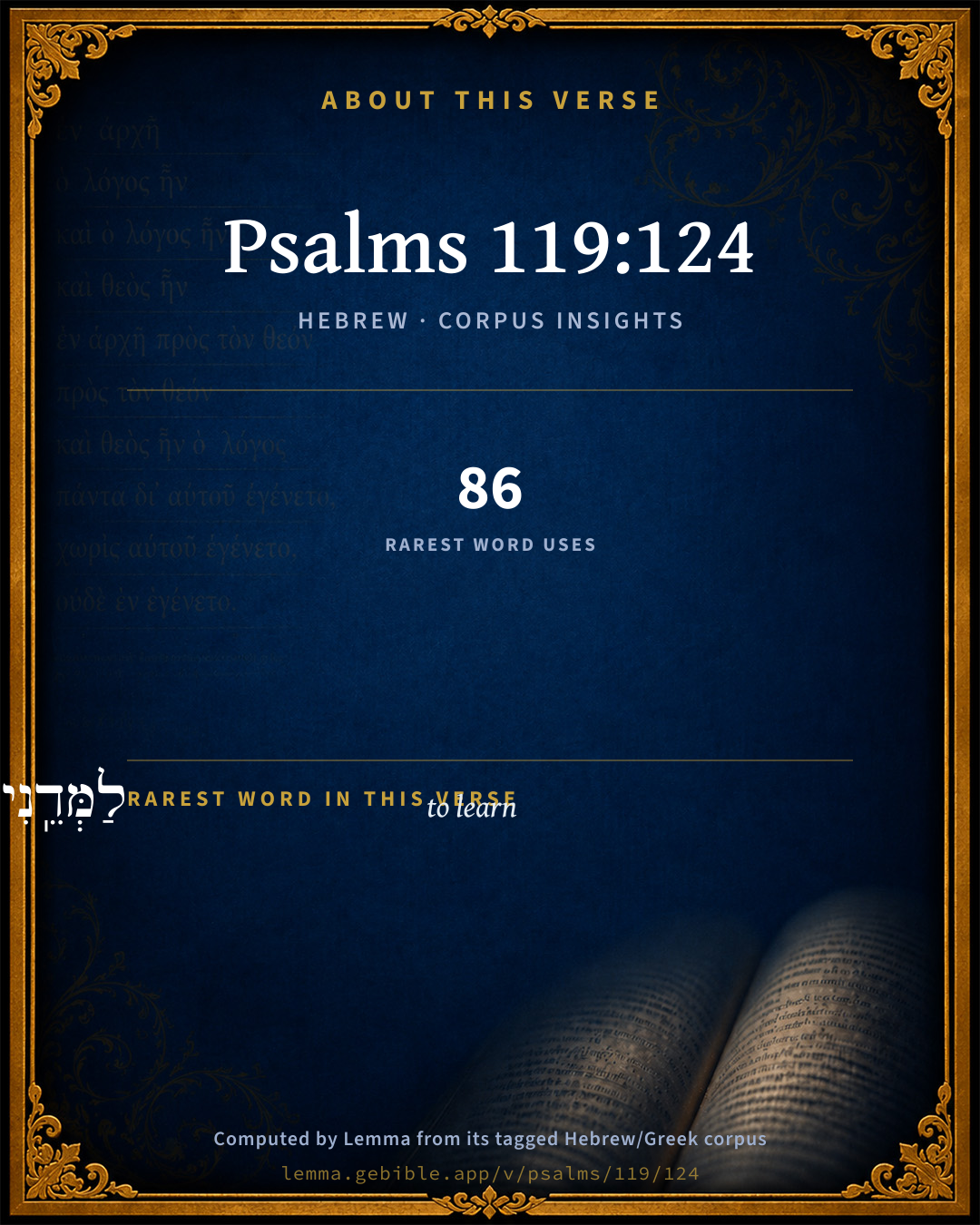
Psalms, in the Wisdom, opens this verse with 6 words (6 distinct Hebrew lemmas). Its most distinctive word is lâmad (“to learn”). A historical commentator’s framing appears above. Read the whole chapter for the surrounding context.

Discussion questions

  1. How does “to learn” (lâmad) shape what this verse is saying?
  2. Psalms 119:12 shares this passage’s theme. How do the two illuminate each other?
  3. The translations on this page render this verse differently — a whole-verse word diff, not a word-by-word alignment. What might account for the different wordings?
  4. The verb «עֲשֵׂ֖ה» is Qal Imperative. How does its form color the action?
  5. Reading how Trapp's Complete Commentary and The Biblical Illustrator read this verse, where do the two commentators agree and where do they part?

Things to notice

Reading settings

Reading text

Shown beneath each verse's original-language words.

Old Testament
Old Testament edition

Read the OT as the Masoretic Hebrew (MT) or the Greek Septuagint (LXX).

English shown for the Greek Septuagint (in the Hebrew ↔ Greek comparison).

Comparing translations? Open the Compare panel on any verse page to stack up to four side by side.