
Psalms 119:108

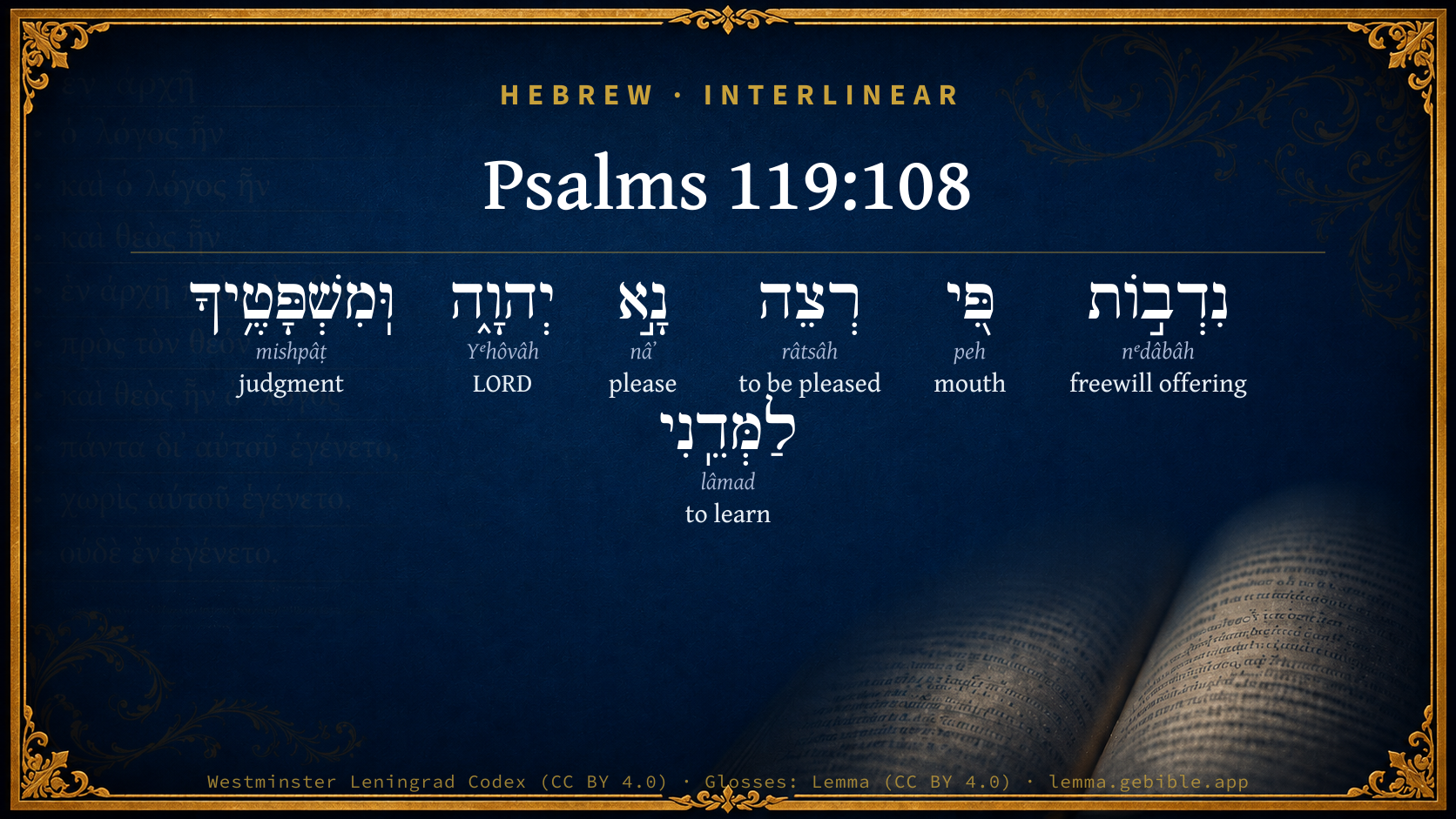
Hebrew (Westminster Leningrad Codex) Psalms 119:108 appears in the Hebrew Old Testament. The text above is from the Westminster Leningrad Codex. Each word links to its Strong’s number, a concise gloss, and parsing drawn from the Open Scriptures Hebrew Bible morphology. Click any word for its full Brown-Driver-Briggs (BDB) entry.
Download image
Cite this verse

Psalms 119:108 (World English Bible). Public Domain. Lemma interlinear Bible study tool, https://lemma.gebible.app/v/psalms/119/108.

Show BibTeX & RIS
BibTeX
RIS
English Translation
Accept, I beg you, the willing offerings of my mouth. Yahweh, teach me your ordinances.
World English Bible · Public Domain
Download a study sheet

One document with this verse’s original text, its word-by-word gloss line, the meaning frame, cross-references with their text, attributed commentary, and full source and license credits — printable, and it pastes into notes with its structure intact.

This verse Autodidact and up

Study sheet (.html) Plain text (.txt)

A passage Seminary Student

Up to 50 verses in one chapter. A passage sheet keeps up to 6 commentary sources and 12 cross-references per verse, in the order this page ranks them, and says so on the sheet whenever that leaves anything out. Ask for a single verse and you get the Autodidact verse sheet above.

Everything on this page stays free to read, with no account — the sheet is a download of what is already on screen, not access to it.

Want to remove ads? Support Godless Engineer
Compare translations 3

The same verse in 3 English versions, stacked beneath the original-language interlinear above. Click any original word for its lexicon entry.

Each is an independent rendering of the whole verse — the interlinear is not word-aligned to these translations.

Highlighted words mark where these versions differ — a whole-verse word diff, not a word-by-word alignment.

  • World English Bible Public Domain
    Accept, I beg you, the willing offerings of my mouth. Yahweh, teach me your ordinances.
  • King James Version Public Domain
    Accept, I beseech thee, the freewill offerings of my mouth, O LORD, and teach me thy judgments.
  • unfoldingWord Literal Text CC BY-SA 4.0
    Please accept the freewill offerings of my mouth, Yahweh, and teach me your judgments.

unfoldingWord Literal Text — © unfoldingWord, licensed CC BY-SA 4.0. Word-aligned USFM3 via Door43 (git.door43.org/unfoldingWord/en_ult).

Versions to compare (up to 4)

3 of 4 selected

Show all 17 translations

Every available English version of this verse, each an independent rendering of the whole verse.

  • World English Bible Public Domain
    Accept, I beg you, the willing offerings of my mouth. Yahweh, teach me your ordinances.
  • Berean Standard Bible Public Domain
    Accept the freewill offerings of my mouth, O LORD, and teach me Your judgments.
  • Majority Standard Bible Public Domain
    Accept the freewill offerings of my mouth, O LORD, and teach me Your judgments.
  • King James Version Public Domain
    Accept, I beseech thee, the freewill offerings of my mouth, O LORD, and teach me thy judgments.
  • American Standard Version (1901) Public Domain
    Accept, I beseech thee, the freewill-offerings of my mouth, O Jehovah, And teach me thine ordinances.
  • Revised Version (1885) Public Domain
    Accept, I beseech thee, the freewill offerings of my mouth, O LORD, and teach me thy judgments.
  • Geneva Bible (1599) Public Domain
    O Lord, I beseeche thee accept the free offerings of my mouth, and teach mee thy iudgements.
  • Young's Literal Translation Public Domain
    Free-will-offerings of my mouth, Accept, I pray Thee, O Jehovah, And Thy judgments teach Thou me.
  • Literal Standard Version CC BY-SA 4.0
    Please accept [the] free-will offerings of my mouth, O YHWH, || And teach me Your judgments.
  • Unlocked Literal Bible CC BY-SA 4.0
    Yahweh, please accept the freewill offerings of my mouth, and teach me your righteous decrees.
  • unfoldingWord Literal Text CC BY-SA 4.0
    Please accept the freewill offerings of my mouth, Yahweh, and teach me your judgments.
  • Darby Bible Public Domain
    Accept, I beseech thee, Jehovah, the voluntary-offerings of my mouth, and teach me thy judgments.
  • World Messianic Bible Public Domain
    Accept, I beg you, the willing offerings of my mouth. LORD, teach me your ordinances.
  • Webster's Bible Public Domain
    Accept, I beseech thee, the free-will-offerings of my mouth, O LORD, and teach me thy judgments.
  • Free Bible Version CC BY-SA 4.0
    Lord, please accept my offerings of praise that I freely give you. Teach me your rules.
  • Bible in Basic English Public Domain
    Take, O Lord, the free offerings of my mouth, and give me knowledge of your decisions.
  • JPS Tanakh (1917) Public Domain
    Accept, I beseech Thee, the freewill-offerings of my mouth, O LORD, and teach me Thine ordinances.

Literal Standard Version (2020), Covenant Press — licensed CC BY-SA 4.0. Text via the HelloAO Bible API (eBible.org). Unlocked Literal Bible (unfoldingWord) — licensed CC BY-SA 4.0. Text via the HelloAO Bible API (eBible.org). unfoldingWord Literal Text — © unfoldingWord, licensed CC BY-SA 4.0. Word-aligned USFM3 via Door43 (git.door43.org/unfoldingWord/en_ult). Free Bible Version, Dr. Jonathan Gallagher — licensed CC BY-SA 4.0. Text via the HelloAO Bible API (eBible.org).

Word by word

More ways to search: Search by grammar → Find every occurrence → Compare this word →

Practice this passage: Drill this verse → Learn its vocabulary →

About this verse

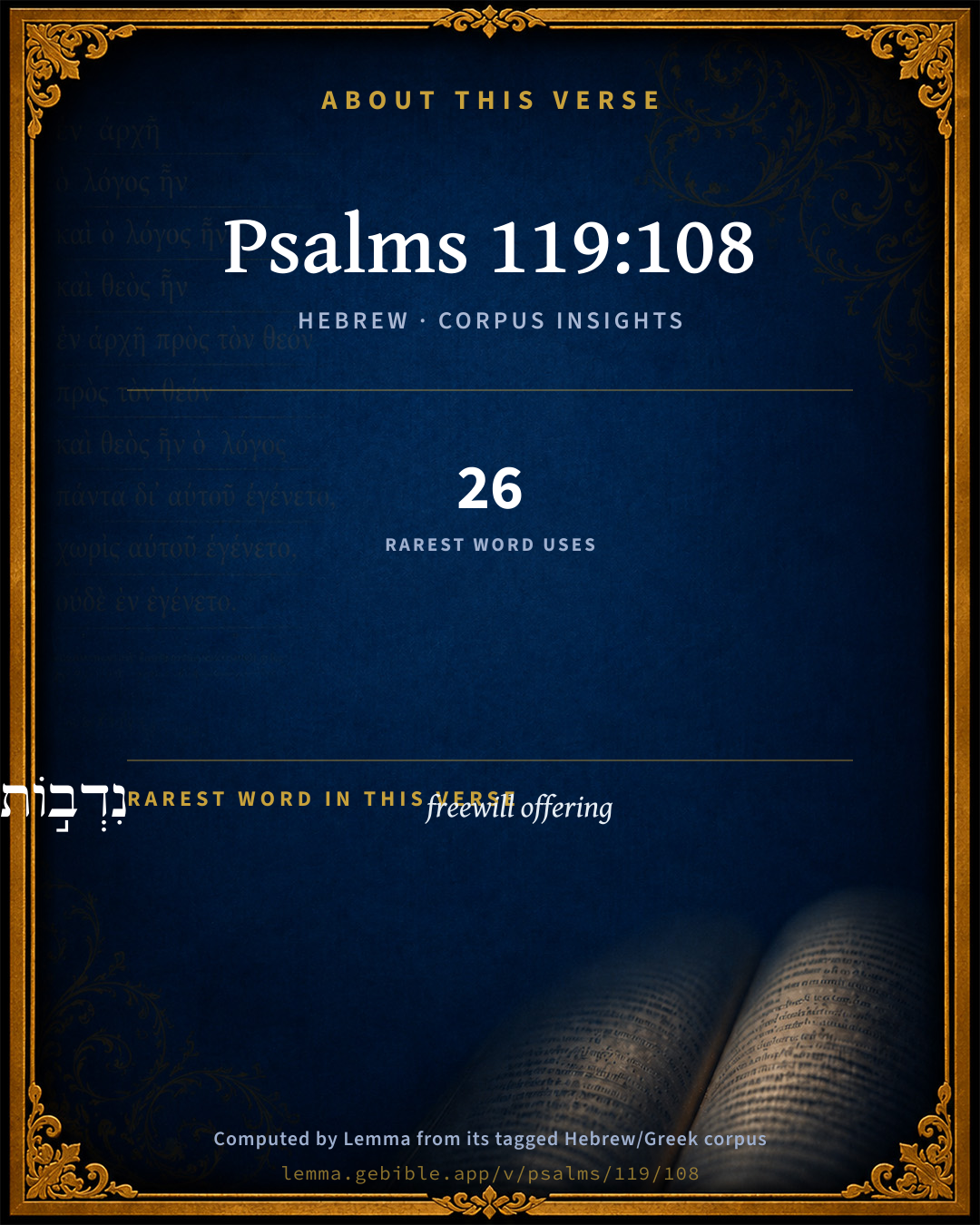
These counts appear in no published source. They are computed here, from the morphology-tagged text and Lemma’s own curated glosses. What Lemma adds →

7
words
7
distinct lemmas
Wisdom
section

Shared distinctive vocabulary

נִדְב֣וֹת freewill offering H5071 occurs in 25 verses of the Hebrew Bible. Also found in:

Grammatical profile

  • 2 verbs
  • 4 nouns
  • 1 particle

Verb forms

  • רְצֵה Qal · Imperative
  • לַמְּדֵֽנִי Piel · Imperative

Hebrew & Septuagint length

In English translation the verse runs 15 words from the Hebrew and 18 from the Septuagint (LXX English) — closely comparable.

A rough comparison of the two English renderings, which tokenize alike — not a word-level alignment.

Word counts can differ between the Hebrew and the Greek without any difference in meaning — e.g. the Hebrew direct-object marker אֵת has no separate Greek word, and Greek often adds the article ὁ.

Cross-references

7

Topical passages linked to Psalms 119:108 in the Treasury of Scripture Knowledge — connected by theme and wording, ordered by reader-vote popularity; previews shown in the World English Bible.

  • Hebrews 13:15 Through him, then, let us offer up a sacrifice of praise to God continually, that is, the fruit of lips which make confession to his name.
  • Hosea 14:2 Take words with you, and return to Yahweh. Tell him, "Forgive all our sins, And accept that which is good: So we offer like bulls our lips.
  • Numbers 29:39 These you shall offer to Yahweh in your set feasts, besides your vows, and your freewill-offerings, for your burnt offerings, and for your meal-offerings, and for your drink-offerings, and for your peace-offerings.
  • Psalms 119:12 Blessed are you, Yahweh. Teach me your statutes.
  • Psalms 119:169 Let my cry come before you, Yahweh. Give me understanding according to your word.
  • Psalms 119:130 The entrance of your words gives light. It gives understanding to the simple.
  • Psalms 119:26 I declared my ways, and you answered me. Teach me your statutes.

Cross-references courtesy of OpenBible.info (CC BY 4.0).

Hebrew and Greek witnesses Masoretic Hebrew ↔ Greek Septuagint

The same verse in the two great witnesses to the Old Testament, shown verse-for-verse.

You’re reading Greek Psalm 118 (Hebrew Psalm 119). The Septuagint counts the superscription, so verse numbers can differ from the Hebrew — chapter-level alignment, not verse-by-verse. Numbering follows Rahlfs.

These are two independent witnesses, not word-aligned to each other, and the Septuagint is shown in lemma (dictionary) form.

Hebrew Psalms 119:108 Masoretic · Westminster Leningrad Codex

נִדְב֣וֹת פִּ֭י רְצֵה נָ֣א יְהוָ֑ה וּֽמִשְׁפָּטֶ֥יךָ לַמְּדֵֽנִי

Accept, I beg you, the willing offerings of my mouth. Yahweh, teach me your ordinances.

World English Bible · Public Domain

Greek LXX Greek Psalm 118:108 Septuagint · lemma form

ὁ ἑκούσιος ὁ στόμα ἐγώ εὐδοκέω δή κύριος καί ὁ κρίμα σύ διδάσκω ἐγώ

Accept, I pray you, O Lord, the free will offerings of my mouth, and teach me your judgments.

LXX2012 (modern English Septuagint) · Public Domain

On this verse, John Gill's Exposition discusses the Septuagint’s reading. Read the note in Commentary ↓

Hebrew: Westminster Leningrad Codex (CC BY 4.0). Greek: Septuagint (public domain); English from LXX2012 (modern English Septuagint) (Public Domain). How the Septuagint differs from the Hebrew →

Commentary

Notes on Psalms 119:108 from classic Christian and Jewish commentators (each source and its license shown beneath its notes). The classic Christian expositions comment on the surrounding passage and are grouped to its opening verse, so a note may address several verses; the Jewish commentaries on the Tanakh (Rashi and others) are per-verse, so they appear only where the commentator wrote on this verse.

Lemma curates 59 commentaries, every one of them public domain or Creative Commons licensed, each selected and text-cleaned for this edition rather than reprinted as found. About our sources →

Trapp's Complete Commentary

John Trapp

Psa 119:108 Accept, I beseech thee, the freewill offerings of my mouth, O LORD, and teach me thy judgments.

Ver. 108. Accept, I beseech thee, the freewill offerings] My prayers and praises; prayers for thine assistance, and praises for thine enablements, Psa 50:14; Psa 107:22

And teach me thy judgments] This is a request that David hath never done with.

John Trapp, A Commentary or Exposition upon All the Books of the Old and New Testament (1647–1656) — public domain. Text from a community e-Sword module.

The Biblical Illustrator

Joseph S. Exell

Psa_119:108

Accept, I beseech Thee, the freewill offerings of my mouth, O Lord, and teach me Thy judgments.

An aspiration of piety

This short prayer cries out for two things.

I. For Divine acceptance of true worship. Accept, I beseech Thee, etc.

1. Worship is an offering. It is the soul offering its highest devotions.

2. Worship is an offering proclaimed of my mouth. The soul rings out aloud in speech and song its devotion.

3. Worship is an offering of freewill. No constraint; it goes out as the aroma from the rose, as the beam from the sun.

II. For Divine instruction. Teach me Thy judgments, or laws.

1. Knowledge of the laws of God is the most important of all knowledge.

2. This most important knowledge can only be imparted by God. (Homilist.)

Gods acceptance of our sufferings

It is a great grace that the Lord should accept anything from us, if we consider these three things. First, who the Lord is. Next, what we are. Thirdly, what it is we have to give unto Him. As for the Lord, He is all-sufficient, and stands in need of nothing we can give Him. As for us, we are poor creatures living by His liberality; yea, begging from all the rest of His creatures; from the sun and moon; from the air, the water, and the earth; from fowls and fishes; yea, from the worms; some give us light; some meat, some cloth; and are such beggars as we meet to give to a King? And thirdly, if we well consider, what is it that we give? Have we anything to give but that which we have received from Him? (Bp. Cowper.)

Sincere offerings

There is nothing so small but if it come from a good heart God will accept it: the widows mite; a cupful of cold water; yea, and the praise of our lips, although it have no other external oblation joined with it; but, where men may do more and will not, it is an argument their heart is not sincerely affected toward Him, and their praises are not welcome to Him. (Bp. Cowper.)

The Biblical Illustrator, edited by Joseph S. Exell (c. 1880s–1900s) — public domain. Text from a community e-Sword module.

J. A. Alexander on Psalms

Joseph Addison Alexander

108. (Psa 119:108) The free-will offerings of my mouth accept, I pray thee, 0 Jehovah, and thy judgments teach me. For the meaning of the first Hebrew word see above, on Ps. 110:8. It is here a figure for prayers and praises, as appears from the addition of my mouth. The verb accept is one continually used in the Law, with respect to sacrificial offerings. See above, on Psa 51:16, and compare Psa 50:14. The recurrence of the prayer, thy judgments teach me, shews that the writer's object was to make everything tend to this conclusion, and that however a sentence may begin, it cannot be complete without a repetition of this favourite idea.

Joseph Addison Alexander, The Psalms Translated and Explained (1850) — public domain. Text from a community e-Sword module.

Tyndale Open Study Notes

Tyndale Open Resources

119:108-112 offering of praise: This Hebrew expression is unique in the Old Testament (cp. 50:23). • The psalmist is vulnerable to his opponents because of his commitment to a wise life.

Tyndale Open Study Notes — © Tyndale Open Resources, licensed CC BY-SA 4.0. Text via the HelloAO Bible API.

Geneva Bible (1599)

Geneva Bible translators

That is, my prayers and thanksgiving which sacrifice Hosea calleth the calves of the lips, Hos. 14:3.

Geneva Bible (1599) marginal notes — public domain. Text via Bolls.life.

Matthew Henry's Commentary

Two things we are here taught to pray for, in reference to our religious performances: - 1. Acceptance of them. This we must aim at in all we do in religion, that, whether present or absent, we may be accepted of the Lord. What David here earnestly prays for the acceptance of are the free-will-offerings, not of his purse, but of his mouth, his prayers and praises. The calves of our lips (Hos 14:2), the fruit of our lips (Heb 13:15), these are the spiritual offerings which all Christians, as spiritual priests, must offer to God; and they must be free-will-offerings, for we must offer them abundantly and cheerfully, and it is this willing mind that is accepted. The more there is of freeness and willingness in the service of God the more pleasing it is to him. 2. Assistance in them: Teach me thy judgments. We cannot offer any thing to God which we have reason to think he will accept of, but what he is pleased to instruct us in the doing of; and we must be as earnest for the grace of God in us as for the favour of God towards us.

Matthew Henry's Commentary on the Whole Bible (1708–1710) — public domain (CC PDM 1.0). Text via the HelloAO Bible API.

Adam Clarke's Commentary

Verse 108. The freewill-offerings of my mouth] נדבות פי nidboth pi, the voluntary offerings which I have promised. Or, As we are in captivity, and cannot sacrifice to thee, but would if we could; accept the praises of our mouth, and the purposes of our hearts, instead of the sacrifices and offerings which we would bring to thy altar, but cannot.

Adam Clarke's Commentary on the Bible (1810–1826) — public domain. Text from a community e-Sword/MySword module.

John Calvin's Commentaries

108. O Jehovah! I beseech thee, let the flee-will-offerings of my mouth. This verse may be read in one connected sentence, as well as divided into two members. According to the former view, the sense will be, Receive, e Lord, my sacrifices, to this end, that thou mayest teach me thy commandments. If we prefer dividing the verse into two clauses, then it will consist of two separate prayers; first, a prayer that God would accept the prophet’s sacrifices; and, secondly, a prayer that he would instruct him in the doctrine of the law. I am rather inclined to follow the first opinion. The prophet affirms, as we have seen elsewhere, that nothing was more precious to him than to understand the doctrine of the law. Lord, as if he had said, do thou, according to thy good pleasure, accept the sacrifices which I offer thee; and as my chief desire is, to be instructed aright in thy law, grant that I may be a partaker of this blessing, which I am so anxious to obtain. We should mark all the places in which the knowledge of divine truth is preferred to all the other benefits bestowed upon mankind; and doubtless, since it contains in it the pledge of everlasting salvation, there is good reason why it should be esteemed as an inestimable treasure. Yet the prophet begins at a point remote from this, praying that God would vouchsafe to approve of and accept his services. By the word נדבות, nidboth, I have no doubt he denotes the sacrifices which were called free-will-offerings. I indeed grant that he speaks properly of vows and prayers; but as the chosen people to propitiate God, were wont to offer sacrifices, according as every man had ability, he alludes to that custom which prevailed under the law; even as Hosea (Hosea 14:2) designates the praises of God “the calves of the lips.” It was the design of God, by that ceremony, to testify to the fathers that no prayers were acceptable to him, but those which were joined with sacrifice, that they might always turn their minds to the Mediator. In the first place, he acknowledges that he was unworthy of obtaining any thing by his prayers, and that, if God heard him, it proceeded from his free and unmerited grace. In the second place, he desires that God would be favorable to him in the way of enabling him to profit aright in the doctrine of the law. The verb, רצה ratsah, which he uses: signifies to favor of mere good will. Whence it follows, that there is nothing meritorious in our prayers, and that, whenever God hears them, it is in the exercise of his free goodness.

John Calvin's Commentaries (1540-1563) — public domain. Text from the Calvin Translation Society English edition (1840s-50s) via the Christian Classics Ethereal Library (ccel.org). Calvin's coverage is partial (roughly two-thirds of the Bible); uncommented books and verses are honest gaps, never fabricated. The 19th-century editor's footnotes and remarks are omitted so the notes are faithfully Calvin's own voice.

Ellicott's Commentary for English Readers

(108) Freewill offerings of my mouth—i.e., thanks and praise.

A Bible Commentary for English Readers, edited by Charles John Ellicott (1878–1897) — public domain. Text from a community e-Sword module.

The Cambridge Bible for Schools and Colleges

gen. ed. J. J. S. Perowne

108. the freewill offerings of my mouth] The sacrifice of prayer and praise (Heb_13:15); voluntary vows of devotion to the law. Cp. Psa_19:14.

teach me &c.] Cp. Psa_119:12 &c. Vows of obedience are vain without Divine instruction and grace.

The Cambridge Bible for Schools and Colleges (gen. ed. J. J. S. Perowne; Cambridge University Press, 1878–1918) — public domain. Text from a community e-Sword module.

John Gill's Exposition

I have inclined mine heart to perform thy statutes alway,.... He had prayed to God to incline his heart to them, Psa 119:36; and by the grace of God his heart was inclined to obedience to them; and nothing but that can incline the heart, which is naturally averse unto them: the carnal mind is not subject to the law of God, nor can it be, until it is made so by the grace of God, Rom 8:7; and by this the psalmist had prevailed upon his heart to keep the statutes of the Lord, and do them, and that continually; for a good man is desirous of being steadfast and immovable, always abounding in the work of the Lord;

even unto the end; the end of life, as long as he lived. The Septuagint and Vulgate Latin version render it, "for a recompence"; and the Arabic version, "for an eternal recompence"; but the Ethiopic version the reverse, "not for a recompence", or benefit: which latter is the truth, though neither of them a right version; for the statutes are to be kept, not for the sake of a recompence of reward, but from love to God, and; in duty to him, without any mercenary views; though the word does sometimes signify "a reward", and may be rendered here, "for ever there is a reward" (i); as there is "in", though not "for", keeping the commands; see Psa 19:11.

(i) "in aeternum est retributio", Clarius.

John Gill's Exposition of the Whole Bible (1746–1763) — public domain (CC PDM 1.0). Text via the HelloAO Bible API.

Albert Barnes' Notes on the Bible

Accept, I beseech thee, the free-will offerings of my mouth - Or, the meaning of the word here rendered “free-will,” see the notes at Psa 110:3. It conveys the idea that there is no constraint or compulsion; that the offering is a prompting of the heart. The offering might be that of flour, or grain, or fruits, or property of any kind, as devoted to God; or it might be, as here, an offering of the lips, expressed in prayer and praise. Either of them might be acceptable to God; their being accepted in either case would depend on the good pleasure of God, and hence, the psalmist prays that his offering might be thus acceptable. Compare Heb 13:15.

And teach me thy judgments - Thy commands; thy laws. See the notes at Psa 119:12.

Albert Barnes' Notes on the Bible (1834–1885) — public domain. Text from a community e-Sword/MySword module.

Matthew Poole's English Annotations

The free-will offerings of my mouth; either,

1. Those which I have promised with my mouth, though I am not now in a capacity of performing my promises, as being banished from thy house. Or rather,

2. The sacrifices of prayer and praises, which I do freely and frequently offer unto thee; which are called sacrifices, as Psa 50:14, and calves of our lips, Hos 14:2.

Matthew Poole's English Annotations on the Holy Bible (1683–1685) — public domain. Text from a community e-Sword/MySword module.

The Treasury of David

Charles H. Spurgeon

Ver. 108. Accept, I beseech thee, the freewill offerings of my mouth, O Lord. The living praise the living God, and therefore the quickened one presents his sacrifice. He offers prayer, praise, confession, and testimony these, presented with his voice in the presence of an audience, were the tribute of his mouth unto Jehovah. He trembles lest these should be so ill uttered as to displease the Lord, and therefore he implores acceptance. He pleads that the homage of his mouth was cheerfully and spontaneously rendered; all his utterances were freewill offerings. There can be no value in extorted confessions: God's revenues are not derived from forced taxation, but from freewill donation. There can be no acceptance where there is no willingness; there is no work of free grace where there is no fruit of free will. Acceptance is a favour to be sought from the Lord with all earnestness, for without it our offerings are worse than useless. What a wonder of grace that the Lord will accept anything of such unworthy ones as we are!

And teach me thy judgments. When we render unto the Lord our best, we become all the more concerned to do better. If, indeed, the Lord shall accept us, we then desire to be further instructed, that we may be still more acceptable, After quickening we need teaching: life without light, or zeal without knowledge, would be but half a blessing. These repeated cries for teaching show the humility of the man of God, and also discover to us our own need of similar instruction. Our judgment needs educating till it knows, agrees with, and acts upon, the judgments of the Lord. Those judgments are not always so clear as to be seen at once; we need to be taught in them till we admire their wisdom and adore their goodness as soon as ever we perceive them.

Ver. 108. The freewill offerings of the mouth, may be the offerings which the mouth had promised and vowed. And who can lay claim to these as the Lord? His are all things. John Stephen.

Ver. 108. The freewill offerings of my mouth. This place makes known that species of sacrifices, which neither tribulations nor poverty of means can hinder, and which does not require an external temple, but in desert places and among heathen may be offered by a godly man. And these sacrifices of the mouth God himself makes more of than if all the flocks of the whole earth had been offered to him, and all the treasures of gold, and of silver, and of precious stones. Wolfgang Musculus.

Ver. 108. Freewill offerings. This expression is often used in the law (Le 22:18 Nu 29:39 1Ch 31:14 Am 1:4-5). What are these freewill offerings? They are distinguished from God's stated worship, and distinguished from that service which fell under a vow. Besides the stated peace offerings, there were certain sacrifices performed upon certain occasions, to testify God's general goodness, and upon receipt of some special mercy; and you will find these sacrifices to be expressly distinguished from such services as men bound themselves to by vow (Le 7:16)... These serve to teach us two things.

First. They are to teach us how ready we should be to take all occasions of thankfulness and spiritual worship; for, besides their vowed services and instituted sacrifices, they had their freewill offerings, offered to God in thankfulness for some special blessing received, or for deliverance from danger.

Secondly. It shows with what voluntariness and cheerfulness we should go about God's worship in the Gospel, and what a free disposition of heart there should be, and edge upon our affections, in all things that we offer to God; in this latter sense our offerings to God prayer and praise should be freewill offerings, come from us not like water out of a still forced by the fire, but like water out of a fountain with native freeness, readily and freely. Thomas Manton.

Ver. 108. Offerings. All God's people are made priests unto God; for every offering supposes a priest: so it is said, that Christ Jesus hath made us kings and priests (Re 1:6). All Christians have a communion with Christ in all his offices, whatever Christ was, that certainly they are in some measure and degree. Thomas Manton.

Ver. 108. Accept...the freewill offerings of my mouth, O Lord. It is a great grace that the Lord should accept anything from us, if we consider these three things: First, who the Lord is; next, what we are; thirdly, what it is we have to give unto him.

As for the Lord, he is all sufficient, and stands in need of nothing we can give him. Our goodness extends not to the Lord

As for us, we are poor creatures, living by his liberality; yea, begging from all the rest of his creatures; from the sun and moon; from the air, the water, and the earth; from fowls and fishes; yea, from the worms: some give us light, some meat, some clothes; and are such beggars as we meet to give to a king?

And, thirdly, if we well consider, What is it that we give? Have we anything to give but that which we have received from him? and whereof we may say with David, "O Lord, all things are of thee, and of thine own have we given thee again" (1Ch 29:14). Let this humble us, and restrain us from that vain conceit of meriting at God's hand.

David at this time, in his great necessity, having no other sacrifice to offer unto the Lord, offers him the calves of his lips; but no doubt, when he might, he offered more.

There is nothing so small, but if it come from a good heart, God will accept it: the widow's mite, a cup of cold water; yea, and the praise of our lips, although it has no other external oblation joined with it: but where men may do more, and will not, it is an argument that their heart is not sincerely affected toward him, and their praises are not welcome to him. William Cowper.

Ver. 108. Accept...the freewill offerings of my mouth, O Lord, and teach me thy judgments. Two things we are here taught to pray for in reference to our religious performances.

1. Acceptance of them: this we must aim at in all we do in religion, that whether present or absent we may be accepted of the Lord. That which David here earnestly prays for the acceptance of is "the freewill offerings, "not of his purse, but of his "mouth, "his prayers and praises; "the calves of our lips" (Ho 14:2); "the fruit of our lips" (Heb 13:15); these are the spiritual offerings which all Christians, as spiritual priests, must offer to God; and they must be "freewill offerings; "for we must offer them abundantly and cheerfully; and it is this willing mind that is accepted. The more there is of freeness and willingness in the service of God, the more pleasing it is to him.

2. Assistance in them: "Teach me thy judgments." We cannot offer any thing to God which we have reason to think he will accept of, but what he is pleased to instruct us in the doing of; and we must be as earnest for the grace of God in us as for the favour of God toward us. Matthew Henry.

Ver. 108. Teach me thy judgments. As if the man of God should say, This is one thing whereunto I will give over myself, even to see how thou dost punish the wicked, and conduct thy children. So that we must learn, that as it is necessary to understand the law and the gospel, so is it requisite to discern God's judgments. For as we cannot learn the one without observing God's mercy; so we cannot attain to the other without marking his vengeance. We must see always by the peculiar teaching of God's Spirit, how the Lord punishes in justice, and yet in mercy; in wrath, and yet in love; in rigour and hatred of our sin, humbling us with one hand; in pity and compassion to our salvation, comforting us with the other hand. We see then how the prophet prayeth, both to see them and to mark them: we need teach this often, because we dream so much of fatal necessity, and of the connections of natural causes, or else because we call not discern between the crosses of the godly and the ungodly. This is then a singular gift of God, to discern how by the self same means the Lord both humbleth the good and overthroweth the wicked. Richard Greenham.

Ver. 108. Consider,

1. The instructive title given to prayer and praise: "The free will offerings of my mouth."

(a) It shows the believer to be a priest: "offerings."

(b) It shows the peculiarity of his service: "free will."

(c) It implies wholehearted consecration.

2. The humility portrayed in the prayer: "Accept, I beseech thee."

(a) Here is no pharisaic boasting.

(b) Even the free will offering is felt to need an "I

beseech thee."

3. The longing desire for further instruction in order to a more perfect obedience: "Teach me thy judgments." J.P.

Ver. 108. Free will seeking free grace. W.D.

Ver. 108. Work for "Free willers".

1. Offerings of Prayer for each of the blessings of salvation.

2. Offerings of Repudiation of all claim to unassisted good.

3. Offerings of Praise for sovereign grace. W.B.H.

Psalms 119:109*

Charles H. Spurgeon's The Treasury of David (1869–1885) — public domain. Psalms only. Text from a community e-Sword/MySword module.

The Pulpit Commentary

Accept, I beseech thee, the freewill offerings of my mouth, O Lord; i.e. my prayers and praises. The lifting up of the hands to God is a kind of sacrifice. (Psa_141:2) And teach me thy judgments. And, in return, make me to understand thy statutes (comp. vers. 12, 26, 33, etc.).

The Pulpit Commentary (1880–1919), ed. H.D.M. Spence-Jones & Joseph S. Exell — public domain. Text from a community e-Sword module.

John Wesley's Explanatory Notes

Offerings - The sacrifices of prayer and praise.

John Wesley, Explanatory Notes Upon the Whole Bible (1754–1765) — public domain. Text via the GEBible commentary corpus.

Rashi

Rabbi Shlomo Yitzchaki (Rashi)

The freewill offering of my mouth Words of appeasement that my mouth offers You. Every נדבה, is an expression of appeasement.

Rashi on the Tanakh — English translations: “The Judaica Press complete Tanach with Rashi, translated by A. J. Rosenberg” (CC BY 4.0); “Pentateuch with Rashi's commentary by M. Rosenbaum and A.M. Silbermann, 1929-1934” (public domain); “The Metsudah Tanach series, Lakewood, N.J” (CC BY 4.0); and “The Book of Joshua, Metsudah Publications, 1997” (CC BY 4.0). Text via Sefaria.

Lesson kit

Teaching starters — assembled from the data on this page, not authored interpretation. Every prompt links to the verse data it draws on. Edit before teaching.

Psalms, in the Wisdom, opens this verse with 7 words (7 distinct Hebrew lemmas). Its most distinctive word is nᵉdâbâh (“freewill offering”). A historical commentator’s framing appears above. Read the whole chapter for the surrounding context.

Discussion questions

  1. How does “freewill offering” (nᵉdâbâh) shape what this verse is saying?
  2. Exodus 35:29 shares the word «freewill offering» with this verse. How do the two illuminate each other?
  3. The translations on this page render this verse differently — a whole-verse word diff, not a word-by-word alignment. What might account for the different wordings?
  4. The verb «רְצֵה» is Qal Imperative. How does its form color the action?
  5. Reading how Trapp's Complete Commentary and The Biblical Illustrator read this verse, where do the two commentators agree and where do they part?

Things to notice

Reading settings

Reading text

Shown beneath each verse's original-language words.

Old Testament
Old Testament edition

Read the OT as the Masoretic Hebrew (MT) or the Greek Septuagint (LXX).

English shown for the Greek Septuagint (in the Hebrew ↔ Greek comparison).

Comparing translations? Open the Compare panel on any verse page to stack up to four side by side.