

Psalms 51:13

Hebrew (Westminster Leningrad Codex) Psalms 51:13 appears in the Hebrew Old Testament. The text above is from the Westminster Leningrad Codex. Each word links to its Strong’s number, a concise gloss, and parsing drawn from the Open Scriptures Hebrew Bible morphology. Click any word for its full Brown-Driver-Briggs (BDB) entry.
Download image
Cite this verse

Psalms 51:13 (World English Bible). Public Domain. Lemma interlinear Bible study tool, https://lemma.gebible.app/v/psalms/51/13.

Show BibTeX & RIS
BibTeX
RIS
English Translation
Then I will teach transgressors your ways. Sinners shall be converted to you.
World English Bible · Public Domain
Download a study sheet

One document with this verse’s original text, its word-by-word gloss line, the meaning frame, cross-references with their text, attributed commentary, and full source and license credits — printable, and it pastes into notes with its structure intact.

This verse Autodidact and up

Study sheet (.html) Plain text (.txt)

A passage Seminary Student

Up to 50 verses in one chapter. A passage sheet keeps up to 6 commentary sources and 12 cross-references per verse, in the order this page ranks them, and says so on the sheet whenever that leaves anything out. Ask for a single verse and you get the Autodidact verse sheet above.

Everything on this page stays free to read, with no account — the sheet is a download of what is already on screen, not access to it.

Want to remove ads? Support Godless Engineer
Compare translations 3

The same verse in 3 English versions, stacked beneath the original-language interlinear above. Click any original word for its lexicon entry.

Each is an independent rendering of the whole verse — the interlinear is not word-aligned to these translations.

Highlighted words mark where these versions differ — a whole-verse word diff, not a word-by-word alignment.

  • World English Bible Public Domain
    Then I will teach transgressors your ways. Sinners shall be converted to you.
  • King James Version Public Domain
    Then will I teach transgressors thy ways; and sinners shall be converted unto thee.
  • unfoldingWord Literal Text CC BY-SA 4.0
    Let me teach transgressors your ways, that sinners may return to you.

unfoldingWord Literal Text — © unfoldingWord, licensed CC BY-SA 4.0. Word-aligned USFM3 via Door43 (git.door43.org/unfoldingWord/en_ult).

Versions to compare (up to 4)

3 of 4 selected

Show all 18 translations

Every available English version of this verse, each an independent rendering of the whole verse.

  • World English Bible Public Domain
    Then I will teach transgressors your ways. Sinners shall be converted to you.
  • Berean Standard Bible Public Domain
    Then I will teach transgressors Your ways, and sinners will return to You.
  • Majority Standard Bible Public Domain
    Then I will teach transgressors Your ways, and sinners will return to You.
  • King James Version Public Domain
    Then will I teach transgressors thy ways; and sinners shall be converted unto thee.
  • American Standard Version (1901) Public Domain
    Then will I teach transgressors thy ways; And sinners shall be converted unto thee.
  • Revised Version (1885) Public Domain
    Then will I teach transgressors thy ways; and sinners shall be converted unto thee.
  • Geneva Bible (1599) Public Domain
    Then shall I teache thy wayes vnto the wicked, and sinners shalbe conuerted vnto thee.
  • Douay-Rheims (1899) Public Domain
    Cast me not away from thy face; and take not thy holy spirit from me.
  • Young's Literal Translation Public Domain
    I teach transgressors Thy ways, And sinners unto Thee do return.
  • Literal Standard Version CC BY-SA 4.0
    I teach transgressors Your ways, || And sinners return to You.
  • Unlocked Literal Bible CC BY-SA 4.0
    Then will I teach transgressors your ways, and sinners will be converted to you.
  • unfoldingWord Literal Text CC BY-SA 4.0
    Let me teach transgressors your ways, that sinners may return to you.
  • Darby Bible Public Domain
    I will teach transgressors thy ways, and sinners shall return unto thee.
  • World Messianic Bible Public Domain
    Then I will teach transgressors your ways. Sinners will be converted to you.
  • Webster's Bible Public Domain
    \\51:11\\Cast me not away from thy presence; and take not thy holy spirit from me.
  • Free Bible Version CC BY-SA 4.0
    Then I will teach your ways to rebellious people, and these sinners will come back to you.
  • Bible in Basic English Public Domain
    Then will I make your ways clear to wrongdoers; and sinners will be turned to you.
  • JPS Tanakh (1917) Public Domain
    (51-15) Then will I teach transgressors Thy ways; and sinners shall return unto Thee.

Literal Standard Version (2020), Covenant Press — licensed CC BY-SA 4.0. Text via the HelloAO Bible API (eBible.org). Unlocked Literal Bible (unfoldingWord) — licensed CC BY-SA 4.0. Text via the HelloAO Bible API (eBible.org). unfoldingWord Literal Text — © unfoldingWord, licensed CC BY-SA 4.0. Word-aligned USFM3 via Door43 (git.door43.org/unfoldingWord/en_ult). Free Bible Version, Dr. Jonathan Gallagher — licensed CC BY-SA 4.0. Text via the HelloAO Bible API (eBible.org).

Word by word

More ways to search: Search by grammar → Find every occurrence → Compare this word →

Practice this passage: Drill this verse → Learn its vocabulary →

About this verse

These counts appear in no published source. They are computed here, from the morphology-tagged text and Lemma’s own curated glosses. What Lemma adds →

6
words
6
distinct lemmas
Wisdom
section

Notable vocabulary

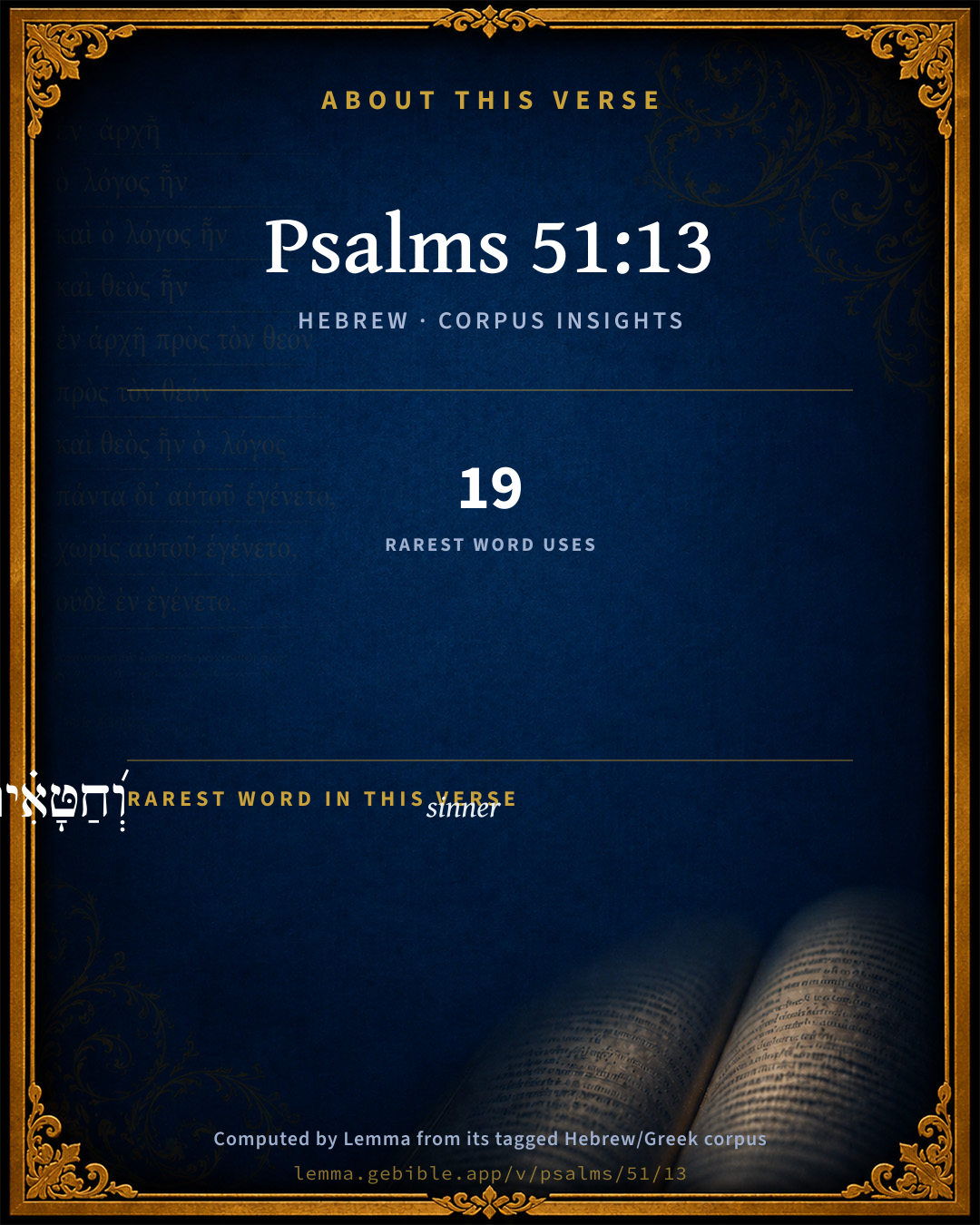
The rarest word here is וְ֝חַטָּאִ֗ים sinner H2400 — appearing just 19 times in the whole Hebrew Bible.

Shared distinctive vocabulary

וְ֝חַטָּאִ֗ים sinner H2400 occurs in 19 verses of the Hebrew Bible. Also found in:

Grammatical profile

  • 3 verbs
  • 1 noun
  • 1 adjective
  • 1 preposition

Verb forms

  • אֲלַמְּדָ֣ה Piel · Cohortative
  • פֹשְׁעִ֣ים Qal · Participle Active
  • יָשֽׁוּבוּ Qal · Imperfect

Hebrew & Septuagint length

In English translation the verse runs 13 words from the Hebrew and 14 from the Septuagint (LXX English) — closely comparable.

A rough comparison of the two English renderings, which tokenize alike — not a word-level alignment.

Word counts can differ between the Hebrew and the Greek without any difference in meaning — e.g. the Hebrew direct-object marker אֵת has no separate Greek word, and Greek often adds the article ὁ.

Cross-references

21

Topical passages linked to Psalms 51:13 in the Treasury of Scripture Knowledge — connected by theme and wording, ordered by reader-vote popularity; previews shown in the World English Bible.

  • Luke 22:32 but I prayed for you, that your faith wouldn't fail. You, when once you have turned again, establish your brothers."
  • James 5:19–20 Brothers, if any among you wanders from the truth, and someone turns him back,
  • Acts 3:19 "Repent therefore, and turn again, that your sins may be blotted out, so that there may come times of refreshing from the presence of the Lord,
  • Acts 26:18–20 to open their eyes, that they may turn from darkness to light and from the power of Satan to God, that they may receive remission of sins and an inheritance among those who are sanctified by faith in me.'
  • Jeremiah 31:18 I have surely heard Ephraim bemoaning himself [thus], You have chastised me, and I was chastised, as a calf unaccustomed [to the yoke]: turn you me, and I shall be turned; for you are Yahweh my God.
  • John 21:15–17 So when they had eaten their breakfast, Jesus said to Simon Peter, "Simon, son of Jonah, do you love me more than these?" He said to him, "Yes, Lord; you know that I have affection for you." He said to him, "Feed my lambs."
  • Acts 2:38–41 Peter said to them, "Repent, and be baptized, everyone of you, in the name of Jesus Christ for the forgiveness of sins, and you will receive the gift of the Holy Spirit.
  • Acts 15:3 They, being sent on their way by the assembly, passed through both Phoenicia and Samaria, declaring the conversion of the Gentiles. They caused great joy to all the brothers.
  • Psalms 19:7 Yahweh's law is perfect, restoring the soul. Yahweh's testimony is sure, making wise the simple.
  • Psalms 22:27 All the ends of the earth shall remember and turn to Yahweh. All the relatives of the nations shall worship before you.
  • Psalms 25:8 Good and upright is Yahweh, Therefore he will instruct sinners in the way.
  • Psalms 32:5 I acknowledged my sin to you. I didn't hide my iniquity. I said, I will confess my transgressions to Yahweh, And you forgave the iniquity of my sin. Selah.
  • Psalms 32:8–10 I will instruct you and teach you in the way which you shall go. I will counsel you with my eye on you.
  • Isaiah 2:3 Many peoples shall go and say, "Come, let's go up to the mountain of Yahweh, To the house of the God of Jacob; And he will teach us of his ways, And we will walk in his paths. For out of Zion the law shall go forth, And the word of Yahweh from Jerusalem.
  • Isaiah 6:10 Make the heart of this people fat; Make their ears heavy, and shut their eyes; Lest they see with their eyes, And hear with their ears, And understand with their heart, And turn again, and be healed."
  • Zechariah 3:1–8 He showed me Joshua the high priest standing before the angel of Yahweh, and Satan standing at his right hand to be his adversary.
  • Matthew 18:3 and said, "Most assuredly I tell you, unless you turn, and become as little children, you will in no way enter into the Kingdom of Heaven.
  • Acts 9:19–22 He took food and was strengthened. Saul stayed several days with the disciples who were at Damascus.
  • 2 Corinthians 5:8–20 We are of good courage, I say, and are willing rather to be absent from the body, and to be at home with the Lord.
  • Psalms 25:4 Show me your ways, Yahweh. Teach me your paths.
  • Acts 13:10 and said, "Full of all deceit and all cunning, you son of the devil, you enemy of all righteousness, will you not cease to pervert the right ways of the Lord?

Cross-references courtesy of OpenBible.info (CC BY 4.0).

Hebrew and Greek witnesses Masoretic Hebrew ↔ Greek Septuagint

The same verse in the two great witnesses to the Old Testament, shown verse-for-verse.

You’re reading Greek Psalm 50 (Hebrew Psalm 51). The Septuagint counts the superscription, so verse numbers can differ from the Hebrew — chapter-level alignment, not verse-by-verse. Numbering follows Rahlfs.

These are two independent witnesses, not word-aligned to each other, and the Septuagint is shown in lemma (dictionary) form.

Hebrew Psalms 51:13 Masoretic · Westminster Leningrad Codex

אֲלַמְּדָ֣ה פֹשְׁעִ֣ים דְּרָכֶ֑יךָ וְ֝חַטָּאִ֗ים אֵלֶ֥יךָ יָשֽׁוּבוּ

Then I will teach transgressors your ways. Sinners shall be converted to you.

World English Bible · Public Domain

Greek LXX Greek Psalm 50:13 Septuagint · lemma form

μή ἀποῥίπτω ἐγώ ἀπό ὁ πρόσωπον σύ καί ὁ πνεῦμα ὁ ἅγιος σύ μή ἀντι ἀναἔρχομαι ἀπό ἐγώ

Then will I teach transgressors your ways; and ungodly men shall turn to you.

LXX2012 (modern English Septuagint) · Public Domain

Hebrew: Westminster Leningrad Codex (CC BY 4.0). Greek: Septuagint (public domain); English from LXX2012 (modern English Septuagint) (Public Domain). How the Septuagint differs from the Hebrew →

Commentary

Notes on Psalms 51:13 from classic Christian and Jewish commentators (each source and its license shown beneath its notes). The classic Christian expositions comment on the surrounding passage and are grouped to its opening verse, so a note may address several verses; the Jewish commentaries on the Tanakh (Rashi and others) are per-verse, so they appear only where the commentator wrote on this verse.

Lemma curates 59 commentaries, every one of them public domain or Creative Commons licensed, each selected and text-cleaned for this edition rather than reprinted as found. About our sources →

Trapp's Complete Commentary

John Trapp

Psa 51:13 [Then] will I teach transgressors thy ways; and sinners shall be converted unto thee.

Ver. 13. Then will I teach transgressors thy ways] Instruunt nos Patres tum docentes, tum labentes, saith Augustine: Two ways the saints teach us. First, By their doctrine. Secondly, By their falls and failings. David had taught men this last way to his cost, that it is triste mortalitatis privilegium licere aliquando peccare; now he promiseth by his example and instruction to teach transgressors, those that are in the very bonds and hands of the devil, God’s ways of mercy to the penitent; and that they must either turn to God or burn for ever in hell.

And sinners shall be converted unto thee] They shall give not the half, but the whole turn; and it shall appear by them. The turning of a sinner from evil to good is like the turning of a bell from one side to another; you cannot turn it but it will make a sound, and report its own motion.

John Trapp, A Commentary or Exposition upon All the Books of the Old and New Testament (1647–1656) — public domain. Text from a community e-Sword module.

Joseph Benson's Commentary

Psa 51:13. Then will I teach transgressors thy way — Thy will and their duty, and the way to eternal happiness; or, rather, the manner of thy dealing with sinners, whom thou dost so severely chastise for their sins, and yet so graciously receive to mercy upon their repentance. Both which I will show them in my own example, for I will make known unto them my fall and recovery, through thy grace, although I shall thereby publish, not only thy goodness, but my own shame, which I shall most willingly bear, that I may, in some measure, repair the injury which I have done to thy cause and to my fellow-creatures, by my public and scandalous crimes. And sinners shall be converted unto thee — I persuade myself that my endeavours shall not want success; and that either thy justice and severity on the one hand, or thy goodness and clemency on the other, will bring some sinners to repentance. Certainly, as Dr. Delaney observes in this verse, this instance of David’s miserable fall and happy restoration is well “fitted to mortify the vanity and merit of human virtue, and to raise the power and price of humble penitence, to abate the pride of self-sufficiency, and support the hope of frailty! Who can confide in his own strength when he sees a David fall? Who can despair of divine mercy when he sees him forgiven? Sad triumph of sin over all that is great and excellent in man! Glorious triumph of repentance over all that is shameful and dreadful in sin!” Book 4. chap. 24.

Joseph Benson's Commentary on the Old and New Testaments (1811–1818) — public domain. Text from a community e-Sword module.

J. A. Alexander on Psalms

Joseph Addison Alexander

15. (Psa 51:13). (Then) will I teach transgressrs thy ways, and sinners unto thee shall return. Here begins the expression of his thankfulness, or rather a description of the way in which he is determined to express it. The word supplied at the beginning points out the connection of the verses. "Then, when these petitions have been answered, I will teach," etc. The form of the Hebrew verb denotes a strong desire and a settled purpose, as if he had said, "I am resolved to teach." Transgressors, rebels, traitors, apostates. See above, on ver. 5 (3). Thy ways, as well the ways in which thou walkest as the ways in which thou requirest us to walk, the course of pro vidence and the course of duty. See above, on Psa 18:22; Psa 18:31 (21, 30). In both these senses, he might naturally wish to "vindicate the ways of God to man." Of this resolution a partial fulfilment is recorded in Psa 32:8-9. The effect of such instructions is recorded in the last clause of the verse before us. The Hebrew verb there used is not a passive(shall be converted), but an active form, shall turn or return to the Lord, perhaps with an allusion to the great original apostasy, in which the whole race is involved. See above, on Psa 22:28 (27). To this verse there seems to be particular allusion in our Saviour's words to Peter, Luk 22:32.

Joseph Addison Alexander, The Psalms Translated and Explained (1850) — public domain. Text from a community e-Sword module.

Tyndale Open Study Notes

Tyndale Open Resources

51:13 As he learns from his sin and its consequences, the psalmist wants to teach others.

Tyndale Open Study Notes — © Tyndale Open Resources, licensed CC BY-SA 4.0. Text via the HelloAO Bible API.

Geneva Bible (1599)

Geneva Bible translators

He promiseth to endeavor that others by his example may turn to God.

Geneva Bible (1599) marginal notes — public domain. Text via Bolls.life.

Jamieson, Fausset & Brown

Robert Jamieson, A. R. Fausset & David Brown

Then--Such will be the effect of this gracious work.

ways--of providence and human duty (Psa 18:21, Psa 18:30; Psa 32:8; Luk 22:32).

Jamieson, Fausset & Brown — Commentary Critical and Explanatory on the Whole Bible (1871) — public domain (CC PDM 1.0). Text via the HelloAO Bible API.

Adam Clarke's Commentary

Verse 13. Then will I teach transgressors] I will show myself to be grateful; I will testify of thy loving-kindness; I will call on transgressors to consider the error of their ways; and shall set before them so forcibly thy justice and mercy, that sinners shall be converted unto thee. With a little change I can adopt the language of Dr. Delaney on this place: "Who can confide in his own strength, when he sees David fall? Who can despair of Divine mercy when he sees him forgiven? Sad triumph of sin over all that is great or excellent in man! Glorious triumph of grace over all that is shameful and dreadful in sin!"

Adam Clarke's Commentary on the Bible (1810–1826) — public domain. Text from a community e-Sword/MySword module.

John Calvin's Commentaries

13 I will teach transgressors thy ways Here he speaks of the gratitude which he would feel should God answer his prayer, and engages to show it by exerting himself in effecting the conversion of others by his example. Those who have been mercifully recovered from their falls will feel inflamed by the common law of charity to extend a helping hand to their brethren; and in general, such as are partakers of the grace of God are constrained by religious principle, and regard for the divine glory, to desire that others should be brought into the participation of it. The sanguine manner in which he expresses his expectation of converting others is not unworthy of our notice. We are too apt to conclude that our attempts at reclaiming the ungodly are vain and ineffectual, and forget that God is able to crown them with success.

John Calvin's Commentaries (1540-1563) — public domain. Text from the Calvin Translation Society English edition (1840s-50s) via the Christian Classics Ethereal Library (ccel.org). Calvin's coverage is partial (roughly two-thirds of the Bible); uncommented books and verses are honest gaps, never fabricated. The 19th-century editor's footnotes and remarks are omitted so the notes are faithfully Calvin's own voice.

Ellicott's Commentary for English Readers

(13) Shall be converted.—Better, shall turn to thee. (See Note Psa_50:23.)

A Bible Commentary for English Readers, edited by Charles John Ellicott (1878–1897) — public domain. Text from a community e-Sword module.

The Cambridge Bible for Schools and Colleges

gen. ed. J. J. S. Perowne

13. Having experienced the joy of penitence and restoration, he will endeavour to instruct transgressors in the ways of Jehovah in which they have refused to walk (Isa_42:24), those commandments which they have refused to keep, so that they may return to Him from Whom they have gone astray. Psalms 32 has been thought to be the fulfilment of this resolution. This resolve is however, it is said, “little appropriate to David, whose natural and right feeling in connexion with his great sin must rather have been that of silent humiliation than of an instant desire to preach his forgiveness to other sinners.” But surely an endeavour to undo the evil effects of a sin whereby he “had given great occasion to the enemies of the Lord to blaspheme” would be one of the most fitting fruits of repentance.

13–17. Resolutions of thanksgiving.

The Cambridge Bible for Schools and Colleges (gen. ed. J. J. S. Perowne; Cambridge University Press, 1878–1918) — public domain. Text from a community e-Sword module.

John Gill's Exposition

Then will I teach transgressors thy ways,.... David was a prophet as well as a king; see Act 2:30; and taught men the fear of the Lord, Psa 34:11, and instructed them in his ways, as he here promises he would; by which are meant, either the ways which God prescribes and directs men to walk in, as the paths of faith, holiness, and truth, and the ways of his commandments; or which he himself has walked in; meaning not the ways of his providence, which are sometimes past finding out; but the ways of his grace, the steps and methods he has taken in the salvation of men, by forming the scheme of it, by choosing unto it, by making a covenant with his Son, and appointing him to effect it; and particularly his ways and methods in receiving and pardoning backsliders, when returned by repentance to him; and who may be meant by "transgressors" here: and then the sense is, that David, upon his being received and pardoned, would teach others like himself how graciously God had dealt with him; how plenteous he is in mercy; how ready to forgive, and how faithful to his promises; and so encourage them to go to him, and acknowledge their transgressions, and seek pardoning grace at his hands, who does abundantly pardon, and whose ways are not as theirs; see Isa 55:7;

and sinners shall be converted unto thee: or "that sinners may be converted unto thee" (p); this being the end of teaching by the word, and the means of the conversion of profane and unregenerate sinners, through the power of divine grace; though rather this seems to be understood of the conversion of God's own people after backslidings, and not of first conversion; see Luk 22:32.

(p) "ut peccatores convertantur", Junius & Tremellius, Gejerus, Michaelis.

John Gill's Exposition of the Whole Bible (1746–1763) — public domain (CC PDM 1.0). Text via the HelloAO Bible API.

Albert Barnes' Notes on the Bible

Then will I teach transgressors thy ways - As an expression of gratitude, and as the result of his own painful experience. He would show them, from that experience, the evil and the bitterness of sin in itself; he would show them with what dreadful consequences sin must always be followed; he would show them the nature of true repentance; he would show them what was required in order that sin might be forgiven; he would encourage them to come to that God who had forgiven him. So the Saviour charged Peter, from his own bitter experience in having fallen under the power of temptation, to strengthen and encourage those who were struggling with the depravity of their own hearts, and who were in danger of falling: “And when thou art converted, strengthen thy brethren,” Luk 22:32.

And sinners shall be converted unto thee - They would see from his case the evil of transgression; they would learn from his example that mercy might be found; they would be persuaded to flee from the wrath to come. The best preparation for success in winning souls to God, and turning them from the error of their ways, is a deep personal experience of the guilt and the danger of sin, and of the great mercy of God in its forgiveness. No man can hope to be successful who has not experienced this in his own soul; no one who has, will labor wholly in vain in such a work.

Albert Barnes' Notes on the Bible (1834–1885) — public domain. Text from a community e-Sword/MySword module.

Matthew Poole's English Annotations

Thy ways; either,

1. Thy will and their duty, and the way to their eternal happiness; or rather,

2. The manner of thy dealing with sinners; whom thou dost so severely chastise for their sins, and yet so graciously receive to mercy upon their repentance; both which I will show them in my own example, which I will declare unto them, although I shall therewith publish my own shame; which I shall most willingly bear, that I may in some measure repair the injury which I have done to thee and others by my public and scandalous crimes.

Sinners shall be converted unto thee; and I persuade myself that my endeavours shall not want success; and that either thy justice or severity, or thy goodness and clemency, will bring them to repentance.

Matthew Poole's English Annotations on the Holy Bible (1683–1685) — public domain. Text from a community e-Sword/MySword module.

The Treasury of David

Charles H. Spurgeon

Ver. 13. Then will I teach transgressors thy ways. It was his fixed resolve to be a teacher of others; and assuredly none instruct others so well as those who have been experimentally taught of God themselves. Reclaimed poachers make the best gamekeepers. Huntingdon's degree of S.S., or Sinner Saved, is more needful for a soul winning evangelist than either M.A. or D.D. The pardoned sinner's matter will be good, for he has been taught in the school of experience, and his manner will be telling, for he will speak sympathetically, as one who has felt what he declares. The audience the psalmist would choose is memorable--he would instruct transgressors like himself; others might despise them, but, "a fellow feeling makes us wondrous kind." If unworthy to edify saints, he would creep in along with the sinners, and humbly tell them of divine love. The mercy of God to one is an illustration of his usual procedure, so that our own case helps us to understand his "ways, "or his general modes of action: perhaps, too, David under that term refers to the preceptive part of the word of God, which, having broken, and having suffered thereby, he felt that he could vindicate and urge upon the reverence of other offenders. And sinners shall be converted unto thee. My fall shall be the restoration of others. Thou wilt bless my pathetic testimony to the recovery of many who, like myself, have turned aside unto crooked ways. Doubtless this Psalm and the whole story of David, have produced for many ages the most salutary results in the conversion of transgressors, and so evil has been overruled for good.

Ver. 13. Then will I teach transgressors thy ways, etc. We see our duty craves that when we have received mercy from God for ourselves, we should make vantage of it for the edification of others. Every talent received from God should be put to profit, but specially the talent of mercy; as it is greatest, so the Lord requires greater fruit of it, for his own glory, and for the edification of our brethren. Seeing we are vessels of mercy, should not the scent and sweet odour of mercy go from us to others? This duty Christ craved from Peter: "And thou, when thou art converted, confirm thy brethren." And this duty, as David here promises, so we may read how he did perform it: "Come unto me, all ye that fear God, and I will tell you what he hath done for my soul." The property of a Christian is, fides per delectionem efficax, faith worked by love. What availeth it to pretend faith toward God, where there is no love toward thy neighbour? and wherein can thy love be declared more than in this, to draw thy neighbour to the participation of that same merit whereunto God hath called thee? By the law a man was bound to bring home his neighbour's wandering beast if he had met with it before; how much more, then, to turn again his neighbour himself when he wanders from the Lord his God? If two men walking on the way should both fall into one pit, and the one being relieved out of it should go his way and forget his neighbour, might it not justly be called a barbarous and inhuman cruelty? We have all fallen into one and the same mire of iniquity; since the Lord hath put out his merciful hand to draw us out of this prison of sin, shall we refuse to put out our hand to see if possibly we may draw up our brethren with us? William Cowper (Bishop).

Ver. 13.

1. It is not our duty to seek the conversion of others until we are converted ourselves.

2. The greater enjoyment we have in the ways of God, the more faithfully and earnestly we shall make them known to others.

3. The more faithfully and earnestly we make them known to others the more they will be influenced by them.

Psalms 51:14*

Charles H. Spurgeon's The Treasury of David (1869–1885) — public domain. Psalms only. Text from a community e-Sword/MySword module.

Whedon's Commentary on the Bible

Daniel D. Whedon

13. Will I teach transgressors—Thus the psalmist would show forth his gratitude for that renewal and establishment in righteousness for which he agonizes. And for this he would be prepared only when he himself should be fully reinstated in the divine favour. How he fulfilled this promise is shown in some of his subsequent psalms, as Psalms 32, 40, , 103, which should be read in this connexion.

Thy ways—The way of thy commandments.

Shall be converted—Shall turn to thee. The verb is active, and is broadly significant of entire and hearty repentance. The example of his forgiveness should encourage others to repent.

Daniel D. Whedon (gen. ed.), Commentary on the Old and New Testaments (1874–1909) — public domain. Text from a community e-Sword module.

The Pulpit Commentary

Vers. 13-17. The psalmist now turns from prayer to promise. If God will grant his petitions, restore him to favour, and renew his spiritual life, then he will make such return as is possible to him. First, he will teach transgressors God"s ways (ver. 13). Next, he will extol his righteousness, and show forth his praise (vers. 14, 15). Finally, he will offer him, not bloody sacrifice, but the sacrifice in which he delights sacrifice of a broken spirit, a broken and contrite heart" (vers. 16, 17). Such sacrifice, he is sure, God will not despise.

Then will I teach transgressors thy ways. The truly grateful heart cannot be satisfied without making some return to God for his goodness. The most satisfactory return is by deeds, not words. David"s determination is to do his best to promote the glory of God by bringing others to salvation, turning them from their own evil ways to the "ways" that God would have them walk in. And sinners shall be converted unto thee. The result, he hopes, will be the conversion to God of many "sinners". (comp. Psa_32:8)

Vers. 13-19. Working for God.

With a conscience set free from guilt, with a heart renewed by the Spirit of God, and full of thankfulness for God"s great mercy, he cannot keep silent, but will seek to turn other sinners to God. The thirty-second psalm shows how this resolution was kept.

I HE WHO BY HIS EXAMPLE HAD TAUGHT OTHERS TO SIN WILL NOW SEEK TO CONVERT THEM TO THE WAY OF OBEDIENCE. (Ver. 13) To the ways of God"s commandment. We cannot undo all the evil which our example has done; but we can in part repair it if we renew our lives.

II DELIVERED FROM HIS SIN, HE WOULD PROCLAIM THE RIGHTEOUSNESS OF GOD IN PUNISHING AND DELIVERING HIM. (Ver. 14) God is good and righteous in both in punishing and saving from sin. "If we confess our sins, he is faithful and righteous to forgive us our sins, and to cleanse us from all unrighteousness.

III THE CONSCIOUSNESS OF PARDONED SIN UNCLOSES THE LIPS WHICH SIN HAD SEALED, AND HE CAN NOW TRULY PRAISE GOD. (Ver. 15) God opens the lips by giving the sense of forgiveness; then we can preach and sing with a full heart.

IV THE TRUEST SACRIFICE WE CAN OFFER TO GOD FOR OUR SIN IS REPENTANCE. (Vers. 16, 17) Not blood or burnt offering; the cleansing of the heart by sorrow and renewal of mind the work of God"s Spirit.

V WHEN A MAN HAS BEEN TRULY RESTORED HIMSELF, HIS SYMPATHIES WIDEN OUT WITH PRAYER FOR THE NATION AND THE WORLD. (Vers. 18, 19) Genuine concern for others is founded upon the regeneration of our own spiritual nature. Zeal for others is spurious if we have not been zealous about ourselves; like those philosophers Cowper speaks of"Giving lives to distant worlds, And trifling in our own.

The Pulpit Commentary (1880–1919), ed. H.D.M. Spence-Jones & Joseph S. Exell — public domain. Text from a community e-Sword module.

Rashi

Rabbi Shlomo Yitzchaki (Rashi)

and do not take Your holy spirit from me that the holy spirit should not be withdrawn from me.

Rashi on the Tanakh — English translations: “The Judaica Press complete Tanach with Rashi, translated by A. J. Rosenberg” (CC BY 4.0); “Pentateuch with Rashi's commentary by M. Rosenbaum and A.M. Silbermann, 1929-1934” (public domain); “The Metsudah Tanach series, Lakewood, N.J” (CC BY 4.0); and “The Book of Joshua, Metsudah Publications, 1997” (CC BY 4.0). Text via Sefaria.

Lesson kit

Teaching starters — assembled from the data on this page, not authored interpretation. Every prompt links to the verse data it draws on. Edit before teaching.

Psalms, in the Wisdom, opens this verse with 6 words (6 distinct Hebrew lemmas). Its most distinctive word is chaṭṭâʼ (“sinner”). A historical commentator’s framing appears above. Read the whole chapter for the surrounding context.

Discussion questions

  1. What does “sinner” (chaṭṭâʼ) contribute to the verse as a whole?
  2. Genesis 13:13 shares the word «sinner» with this verse. How do the two illuminate each other?
  3. The translations on this page render this verse differently — a whole-verse word diff, not a word-by-word alignment. What might account for the different wordings?
  4. The verb «אֲלַמְּדָ֣ה» is Piel Cohortative. How does its form color the action?
  5. Reading how Trapp's Complete Commentary and Joseph Benson's Commentary read this verse, where do the two commentators agree and where do they part?

Things to notice

Reading settings

Reading text

Shown beneath each verse's original-language words.

Old Testament
Old Testament edition

Read the OT as the Masoretic Hebrew (MT) or the Greek Septuagint (LXX).

English shown for the Greek Septuagint (in the Hebrew ↔ Greek comparison).

Comparing translations? Open the Compare panel on any verse page to stack up to four side by side.