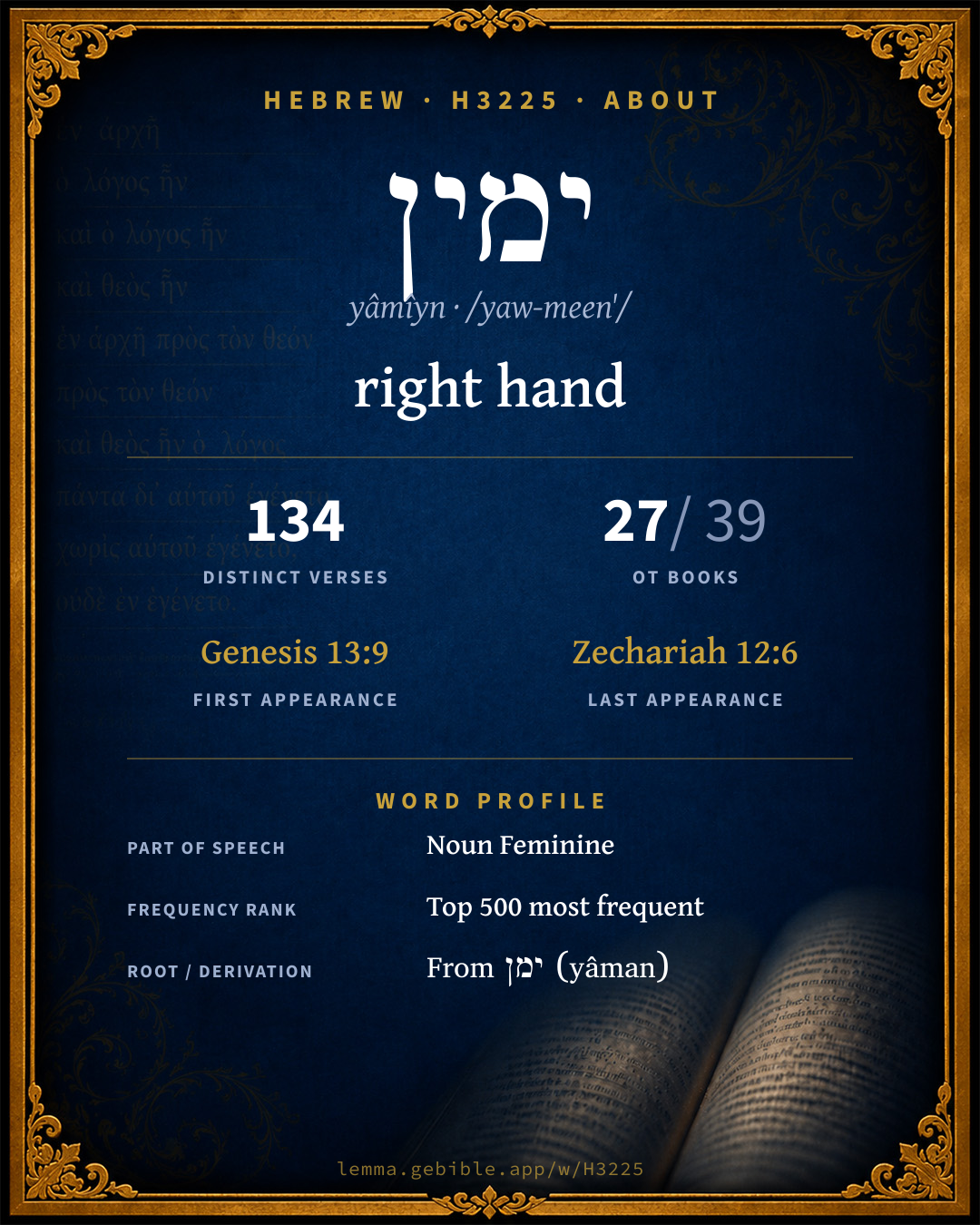
יָמִין
right hand
also: right, right side fuller range ↓
Full lexicon entry — Brown-Driver-Briggs (BDB)
From Brown-Driver-Briggs (BDB)
Where this word appears
Grammar key — what these labels mean
Part of speech
- Noun
- A naming word — a person, place, thing, or idea.
Noun type
- Common
- A common noun — a general class of person, place, or thing (“king,” “city,” “water”), not a specific name.
- Proper
- A name of a specific person, place, or people (e.g. Abraham, Zion, Israel).
State
- Construct
- A noun bound to a following noun in a possessive / “of” relationship (the construct chain).
- Absolute
- The independent form of a noun, not bound to a following word.
Gender
- Feminine
- Grammatically feminine.
Number
- Singular
- One.
Every verse where H3225 appears in the Book of Song of Solomon — 2 distinct verses. Click any verse to open its interlinear word-by-word view. Verse text shown in the World English Bible for context — . Each verse’s Hebrew form is shown with its reference; the English is not keyword-highlighted, since the data carries no word-level English alignment. Use “Compare translations” on any verse to read it across multiple English versions. This concordance covers the Hebrew Bible; Septuagint (Greek Old Testament) occurrences are not indexed here.
Song of Solomon
About this entry
At a glance — auto-summarized from this page’s data, not written by a person. Every figure links to its source below. This summary describes the numbers; it doesn’t interpret them.
At its core, ימין (yâmîyn) means “right hand.” Beyond its headline sense, its full sense range takes in “right” and “right side”. It turns up in 134 verses across 27 books, a common footprint. The word gravitates to Psalms (29%), then Isaiah and Judges. It first appears in Genesis 13:9. Dig into 134-verse concordance and the renderings breakdown below.
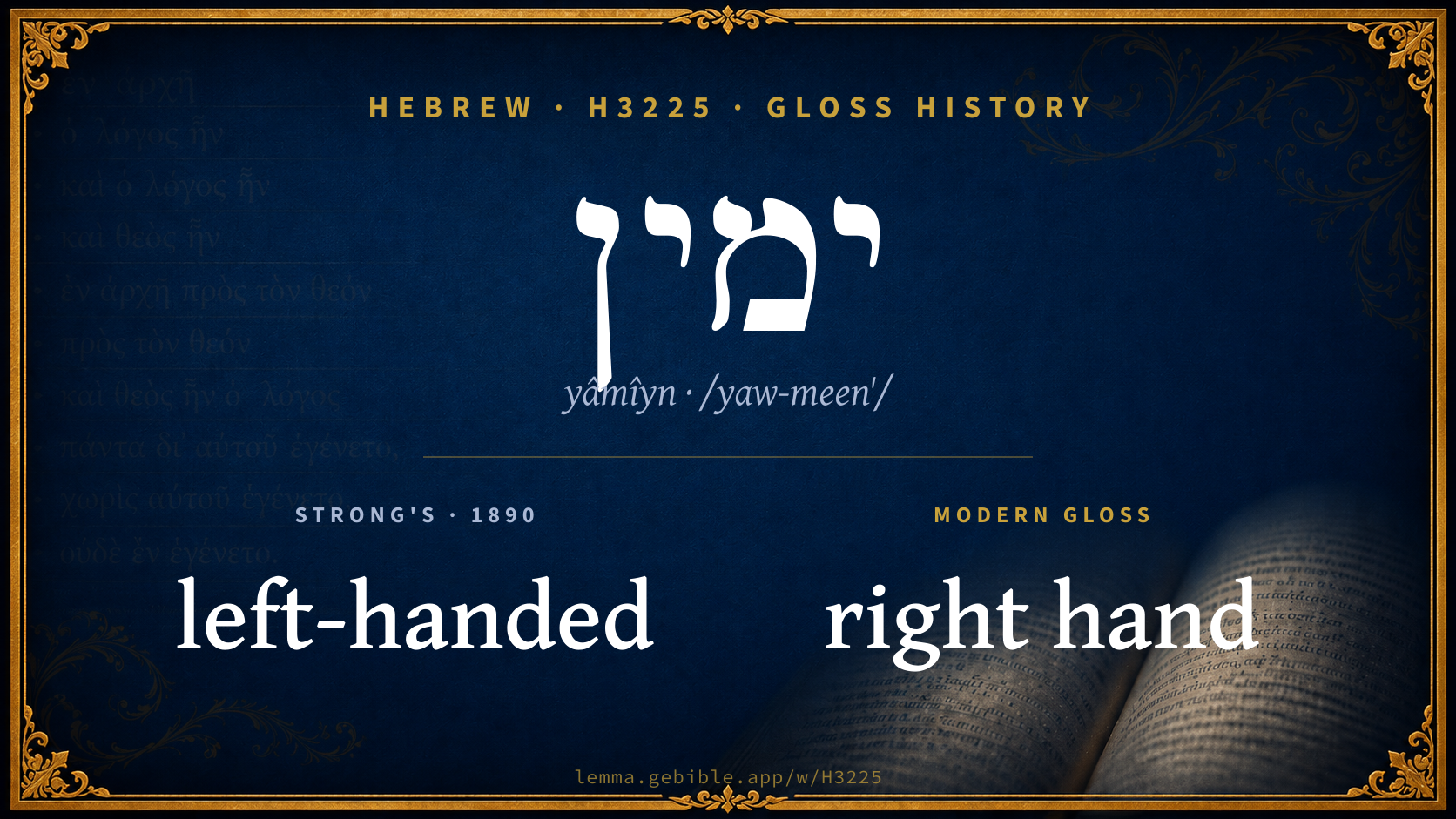
Gloss history
Strong's 1890 vs modern scholarship
About this word
Strong's H3225 catalogs a Hebrew word from the Hebrew Old Testament.
These counts are not copied from any lexicon or concordance. They are computed here, from the morphology-tagged Hebrew Old Testament. What Lemma adds →
- 134
- distinct verses
- The word appears in 134 distinct verses.
- 27 / 39
- OT books
- The word appears in 27 of 39 Old Testament books.
- #318
- by frequency
- Top 500 most frequent Hebrew words (rank 318 of 8,640 Hebrew words by occurrence).
View all 134 occurrences in the concordance →
By section of the Old Testament
By traditional corpus
Conventional, traditional groupings — biblical authorship is debated, so this is a traditional corpus grouping, not an authorship claim. Each share is this word’s portion of its verses in that division of the Hebrew canon. Each figure is a share of the word’s 134 distinct verses.
- Writings (Ketuvim) 60 verses · 45%
- Prophets (Nevi'im) 49 verses · 37%
- Torah (Pentateuch) 25 verses · 19%
How translations render this word
Counts come from each version’s own published word-to-Strong’s tagging or interlinear alignment — an approximate guide to how each version renders this word, not a word-level alignment the data otherwise carries. Because each total is that version’s own tagged count, the per-version totals vary from one another and need not match the appearance or distinct-verse counts above. These counts may also differ from a printed concordance because Lemma counts each distinctly tagged rendering and does not collapse phrase taggings into a single head-word total. This is a fixed set of word-tagged versions (KJV, ASV, BSB, ULT) and does not change with the reading translation you choose elsewhere. Each version’s license is shown beside its name below (and on Sources).
BDB lists this Strong’s number as 2 distinct words (homographs). Each count above pools all of them and is not split by sense — see the Senses section below. A low-frequency rendering may belong to a different one of those words, not the primary meaning.
- King James Version†: Right hand 87×, Right 21×, Right side 5×
- American Standard Version†: Right hand 73×, Right 19×, Right side 5×
- Berean Standard Bible†: Right hand 54×, Right 48×, South 9×
- unfoldingWord Literal Text†: Right 59×, Right hand 54×, Right hand of 8×
King James Version Public Domain
Renders H3225 across 137† tagged occurrences — most commonly:
Plus 20 renderings that appear only once — usually multi-word phrases or single function words the recovered tagging swept in, not distinct renderings. Not rendered by a distinct English word in 2 further occurrences.
American Standard Version Public Domain
Renders H3225 across 133† tagged occurrences — most commonly:
Plus 28 renderings that appear only once — usually multi-word phrases or single function words the recovered tagging swept in, not distinct renderings.
Berean Standard Bible Public Domain
Renders H3225 across 133† tagged occurrences — most commonly:
Plus 10 renderings that appear only once — usually multi-word phrases or single function words the recovered tagging swept in, not distinct renderings. Not rendered by a distinct English word in 7 further occurrences.
unfoldingWord Literal Text CC BY-SA 4.0
Renders H3225 across 146† tagged occurrences — most commonly:
Plus 12 renderings that appear only once — usually multi-word phrases or single function words the recovered tagging swept in, not distinct renderings.
12 senses and sub-senses in the full BDB
What do BDB’s symbols mean?
BDB uses these scholarly abbreviations:
| Symbol | Meaning |
|---|---|
| 𝔊 | the Septuagint (the ancient Greek translation, LXX) |
| 𝔙 | the Vulgate (the Latin translation) |
| 𝔖 | the Syriac version (the Peshitta) |
| 𝔗 | the Targum (the Aramaic translation) |
| ψ | the Psalms |
| √ | root (the underlying root or stem) |
| ‖ | parallel passage (a synonymous or contrasted parallel) |
| † | the dagger: every passage where the word occurs is cited |
The 12 senses and sub-senses the full Brown-Driver-Briggs lexicon distinguishes for this word, in lexicon order (not ranked by frequency), with BDB’s own verbatim wording and sub-sense lettering. Shown in Hebrew script with BDB’s own scholarly abbreviations. The condensed entry is in the Lexicon Entry tab. See also the Forms in the corpus table below.
ימין I
- 1. right hand:
- a. lit. of man, often opp. שׂמֹאול Gn 48:13, 14 (cf. v 18), Dn 12:7; יָדַע בֵּין־יְמִינוֹ לִשְׂמֹאלוֹ Jon 4:11 distinguish between one’s right hand and one’s left; שׁלח ימין Ju 5:26 (‖ יד); as holding the lot Ez 21:27; also of right hand as skilful ψ 137:5; as receiving bribes 26:10 (‖ יָדַיִם); used in false swearing יְמִינָם יְמִין שֶׁקֶר 144:8, 11 their right hand is a right hand of falsehood; often also c. יַד, יַד־יִמִינוֹ Gn 48:17 (E) hand of his right = his right hand Ju 7:20 2 S 20:9; אִטֵּר יַד־יְמִינוֹ Ju 3:15; 20:16 bound as to one’s right hand, i.e. left-handed. e.g. Genesis 48:13
- b. fig., of right hand as held by י׳ Is 41:10, 13; 45:1; so יַד־ימיני ψ 73:23. e.g. Isaiah 41:10
- c. right hand of י׳, as instr. of delivering Israel Ex 15:6(×2), 12 +, cf. בִּגְבוּרוֹת יֵשַׁע יְמִינוֹ ψ 20:7; שְׁנוֹת יְמִין עֶלְיוֹן 77:11, ‖ זְרוֹעַ 98:1; as acquiring the temple-site 78:54; as holding his servant 18:36 (line om. in ‖ 2 S 22:36), cf. 63:9 & בִּימִין צִדְקִי Is 41:10; as finding, lighting upon (מצא) his enemies ψ 21:9 (‖ יד); as full of צֶדֶק 48:11; as dispensing blessings 16:11 נעמות בימינך (cf. Pr 3:16 of wisdom, personified); used in divine oath Is 62:8 (‖ זְרוֹעַ). e.g. Exodus 15:6
- 2. of situation on, or direction toward, the right:
- a. of situation, c. מִן, מִימִינָם וּמִשְּׂמֹאלָם Ex 14:22, 29 a wall on their right hand and on their left hand; similarly 2 S 16:6; 1 K 7:39, 49 = 2 Ch 3:17; 4:6, 1 K 22:19 (= 2 Ch 18:18 c. על), 2 Ch 4:7, 8 ψ 91:7 (‖ מִצִּדְּךָ); for protection 16:8; מימין ל 2 K 23:13; Ez 10:3; c. לְ, וַתֵּשֶׁב לִימִינוֹ 1 K 2:19, so ψ 110:1; 45:10; 109:31; c. עַל־ Zc 3:1; 1 Ch 6:24; 2 Ch 18:18 (= 1 K 22:19 c. מן), Ne 8:4 Jb 30:12; ψ 109:6 cf. 110:5; without prep. יְמִין הָעִיר 2 S 24:5; Jb 23:9. e.g. Exodus 14:22
- b. of direction toward, lit. נָטָה ימין Nu 20:17; 22:26 (both JE); סוּר ימין Dt 2:27; 1 S 6:12; פָּרַץ ימין ושׂ׳ Is 54:3; also (vb. הִפָּרֶד in prev. cl.) Gn 13:9; הַבֵּיט ימין ψ 142:5, and looking is implied also in Ez 1:10 (c. אֶל־; opp. מֵהַשְּׂמֹאול); c. עַל, נטה (לָלֶכֶת) על הַיָּמִין 2 S 2:19, 21; פנה על־ימין Gn 24:49; sq. אֶל, of course (הלך) of boundary Jos 17:1; c. לְ, לַיָּמִין מֵעַל לַחוֹמָה Ne 12:31 (vb. om., went) to the right above the wall; fig. of moral deviation, סוּר מִן־הַדָּבָר … יָמִין וּשְׂמֹאול Dt 17:11, so 5:29; 17:20; 28:14; Jos 1:7; 23:6; 2 K 22:2 = 2 Ch 34:2; נטה ימין ושׂ׳ Pr 4:27; also (very late) of the right as morally good, לֵב חָכָם לִימִינוֹ (opp. שׂמאל) Ec 10:2 De Reuss Now. e.g. Numbers 20:17
- 3. of other parts of the body, besides hand (v. יַד־ימינו etc. supr.): right thigh יֶרֶךְ יְמִינוֹ Ju 3:16, 24; eye עֵין יָמִין 1 S 11:2; עין ימינו Zc 11:17(×2) especially שׁוֹק הַיָּמִין i.e. the right (upper) leg of sacrificial animal Ex 29:22; Lv 7:32, 33; 8:25, 26; 9:21; Nu 18:18. e.g. Judges 3:16
- 4. = south, because when facing east the right hand is toward the south: מִימִין הַיְשִׁימוֹן 1 S 23:19; אֶל־יְמִין v 24; ישׁב מִימִינֵךְ Ez 16:46 (‖ על־שׂמאולך); צָפוֹן וְיָמִין ψ 89:13; also perhaps 2 S 24:5; 2 K 23:13 ψ 107:3, v. יָם 9. e.g. 1 Samuel 23:19
ימין II
- 1. son of Simeon Gn 46:10; Ex 6:15; Nu 26:12; 1 Ch 4:24. e.g. Genesis 46:10
- 2. man of Judah 1 Ch 2:27. e.g. 1 Chronicles 2:27
- 3. Levite (?) name, time of Ezra Ne 8:7. e.g. Nehemiah 8:7
Senses from the full Brown-Driver-Briggs lexicon (Brown, Driver, Briggs; Oxford 1906 — public domain), digitized via Sefaria, supplemented by the OpenScriptures HebrewLexicon (CC BY 4.0). Full attribution on Sources.
Word origin
n.f. Ex 15:6 (Pr 27:16 no except, v. Now Str) right hand (NH id.; SI3 מימן on the right; Aramaic יַמִּינָא, ܝܰܡܺܝܢܳܐ; Arabic يَمِينٌ right, right side, right hand, south; Ethiopic የማን right hand, ይምን right side; Sab. ימן right hand, ימנת south, are also quoted; Assyrian imnu, right, right side, on the right, DlHWB 307)—abs. יָמִין Gn 13:9 + 40 times; cstr. יְמִין 1 S 23:24 + 19 times; sf. יְמִינִי Je 22:24 + 6 times, etc.; always sg.:—
— Brown-Driver-Briggs (Oxford 1906, public domain), digitized via Sefaria, supplemented by the OpenScriptures HebrewLexicon (CC BY 4.0). See Sources.
Derived from ימן (yâman) (H3231) — to choose right.
Jastrow Dictionary
A second Hebrew/Aramaic lexicon for comparison, covering Aramaic and post-biblical (Talmudic, Targumic, Midrashic) usage that the biblical-Hebrew BDB does not. Matched by lemma rather than by Strong’s number, so a lemma may carry more than one Jastrow headword (shown separately below), and the entries cover usage well beyond the Bible.
יָמִין
- (sub. יַד) f.(b. h.; v. אָמַן) [firm,] right hand. Men. 37ᵃ מה כתיבה בִּי׳ as the writing is done with the right hand, so is the binding to be done with the right hand (on the left). Ib. אטר … בִּימִינוֹ וכ׳ a left-handed man ties the T’fillin on his right hand, because this is his left (weak) hand. Lam. R. to II, 3 (ref. to קץ הימין, Dan. XII, 13) קץ נתתי לִימִינִי וכ׳ I have fixed a term to (the servitude of) my right hand (power); when I redeem my children, I vindicate my right hand. Zeb. 62ᵇ, a. fr. דרך י׳ towards the right; a. fr.—Denom. יְמָנִי, f. יְמָנִית. e.g. Daniel 12:13
A Dictionary of the Targumim, the Talmud Babli and Yerushalmi, and the Midrashic Literature (Marcus Jastrow; London, Luzac, 1903) — Public Domain. Digitized via Sefaria. Digitized via Sefaria. Full attribution on Sources.
Forms in the corpus
The 76 distinct written forms H3225 takes in the Hebrew Bible, most frequent first — each parse links to that state’s occurrences in the concordance. Hebrew forms include their vowel points and cantillation, so a single lemma takes many written forms.
The 60 most common forms are shown; 16 rarer forms follow in the full concordance.
Same root — word family
Other BDB entries built from the same root as H3225, grouped by Strong’s listed origin. These share a root / origin per the lexicon — not necessarily a shared meaning. Each links to that word’s own entry.
Derives from
Shares the same root
Derived from this word
Proper names from this root
People and places named from this root — a name, not an additional meaning of the word.
Compare all same-root words → Showing 4 of 8 — not the complete family. 2 of the same-root words are proper names (people or places). They share a root, not necessarily a meaning.
Septuagint verse parallels
This word appears in 127 verses that also exist in the Greek Old Testament (Septuagint), out of the 134 Hebrew verses it occurs in. You can read those verses in Greek by switching the Old Testament edition to the Septuagint.
Read these verses in the Septuagint
- Genesis 13:9
- Exodus 14:22
- Leviticus 7:32
- Numbers 18:18
- Deuteronomy 2:27
- Joshua 1:7
- Judges 3:15
- 1 Samuel 6:12
- 2 Samuel 2:19
- 1 Kings 2:19
- 2 Kings 12:9
- 1 Chronicles 6:39
This is a verse-level parallel only — the same verses exist in both the Hebrew and Greek Old Testaments. No word-level Hebrew↔Greek correspondence is claimed: the data carries no such alignment, so no Greek word is shown as this Hebrew word’s translation. Coverage is not total — the Septuagint omits the deuterocanon and renumbers the Psalms, so some Hebrew verses have no direct Greek parallel.