
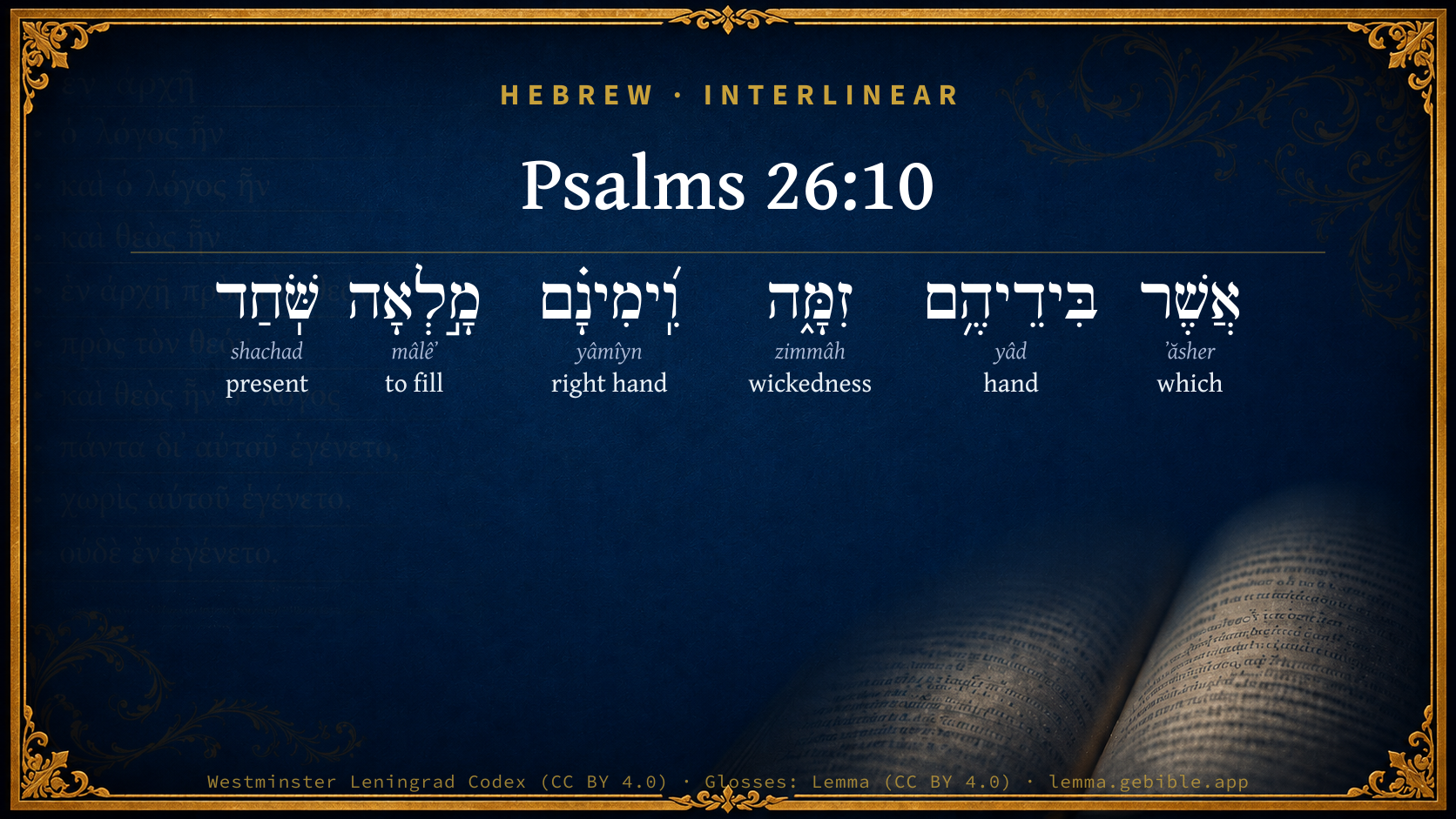
Psalms 26:10

Hebrew (Westminster Leningrad Codex) Psalms 26:10 appears in the Hebrew Old Testament. The text above is from the Westminster Leningrad Codex. Each word links to its Strong’s number, a concise gloss, and parsing drawn from the Open Scriptures Hebrew Bible morphology. Click any word for its full Brown-Driver-Briggs (BDB) entry.
Download image
Cite this verse

Psalms 26:10 (World English Bible). Public Domain. Lemma interlinear Bible study tool, https://lemma.gebible.app/v/psalms/26/10.

Show BibTeX & RIS
BibTeX
RIS
English Translation
In whose hands is wickedness, Their right hand is full of bribes.
World English Bible · Public Domain
Download a study sheet

One document with this verse’s original text, its word-by-word gloss line, the meaning frame, cross-references with their text, attributed commentary, and full source and license credits — printable, and it pastes into notes with its structure intact.

This verse Autodidact and up

Study sheet (.html) Plain text (.txt)

A passage Seminary Student

Up to 50 verses in one chapter. A passage sheet keeps up to 6 commentary sources and 12 cross-references per verse, in the order this page ranks them, and says so on the sheet whenever that leaves anything out. Ask for a single verse and you get the Autodidact verse sheet above.

Everything on this page stays free to read, with no account — the sheet is a download of what is already on screen, not access to it.

Want to remove ads? Support Godless Engineer
Compare translations 3

The same verse in 3 English versions, stacked beneath the original-language interlinear above. Click any original word for its lexicon entry.

Each is an independent rendering of the whole verse — the interlinear is not word-aligned to these translations.

Highlighted words mark where these versions differ — a whole-verse word diff, not a word-by-word alignment.

  • World English Bible Public Domain
    In whose hands is wickedness, Their right hand is full of bribes.
  • King James Version Public Domain
    In whose hands is mischief, and their right hand is full of bribes.
  • unfoldingWord Literal Text CC BY-SA 4.0
    who in their hands an evil scheme and their right hand is full of bribes.

unfoldingWord Literal Text — © unfoldingWord, licensed CC BY-SA 4.0. Word-aligned USFM3 via Door43 (git.door43.org/unfoldingWord/en_ult).

Versions to compare (up to 4)

3 of 4 selected

Show all 18 translations

Every available English version of this verse, each an independent rendering of the whole verse.

  • World English Bible Public Domain
    In whose hands is wickedness, Their right hand is full of bribes.
  • Berean Standard Bible Public Domain
    in whose hands are wicked schemes, whose right hands are full of bribes.
  • Majority Standard Bible Public Domain
    in whose hands are wicked schemes, whose right hands are full of bribes.
  • King James Version Public Domain
    In whose hands is mischief, and their right hand is full of bribes.
  • American Standard Version (1901) Public Domain
    In whose hands is wickedness, And their right hand is full of bribes.
  • Revised Version (1885) Public Domain
    In whose hands is mischief, and their right hand is full of bribes.
  • Geneva Bible (1599) Public Domain
    In whose handes is wickednes, and their right hand is full of bribes.
  • Douay-Rheims (1899) Public Domain
    In whose hands are iniquities: their right hand is filled with gifts.
  • Young's Literal Translation Public Domain
    In whose hand `is' a wicked device, And their right hand `is' full of bribes.
  • Literal Standard Version CC BY-SA 4.0
    In whose hand [is] a wicked scheme, || And their right hand [is] full of bribes.
  • Unlocked Literal Bible CC BY-SA 4.0
    in whose hands there is a plot, and whose right hand is full of bribes.
  • unfoldingWord Literal Text CC BY-SA 4.0
    who in their hands an evil scheme and their right hand is full of bribes.
  • Darby Bible Public Domain
    In whose hands are evil devices, and their right hand is full of bribes.
  • World Messianic Bible Public Domain
    in whose hands is wickedness; their right hand is full of bribes.
  • Webster's Bible Public Domain
    In whose hands is mischief, and their right hand is full of bribes.
  • Free Bible Version CC BY-SA 4.0
    whose hands carry out their evil schemes and grab hold of bribes.
  • Bible in Basic English Public Domain
    In whose hands are evil designs, and whose right hands take money for judging falsely.
  • JPS Tanakh (1917) Public Domain
    In whose hands is craftiness, and their right hand is full of bribes.

Literal Standard Version (2020), Covenant Press — licensed CC BY-SA 4.0. Text via the HelloAO Bible API (eBible.org). Unlocked Literal Bible (unfoldingWord) — licensed CC BY-SA 4.0. Text via the HelloAO Bible API (eBible.org). unfoldingWord Literal Text — © unfoldingWord, licensed CC BY-SA 4.0. Word-aligned USFM3 via Door43 (git.door43.org/unfoldingWord/en_ult). Free Bible Version, Dr. Jonathan Gallagher — licensed CC BY-SA 4.0. Text via the HelloAO Bible API (eBible.org).

Word by word

More ways to search: Search by grammar → Find every occurrence → Compare this word →

Practice this passage: Drill this verse → Learn its vocabulary →

About this verse

These counts appear in no published source. They are computed here, from the morphology-tagged text and Lemma’s own curated glosses. What Lemma adds →

6
words
6
distinct lemmas
Wisdom
section

Notable vocabulary

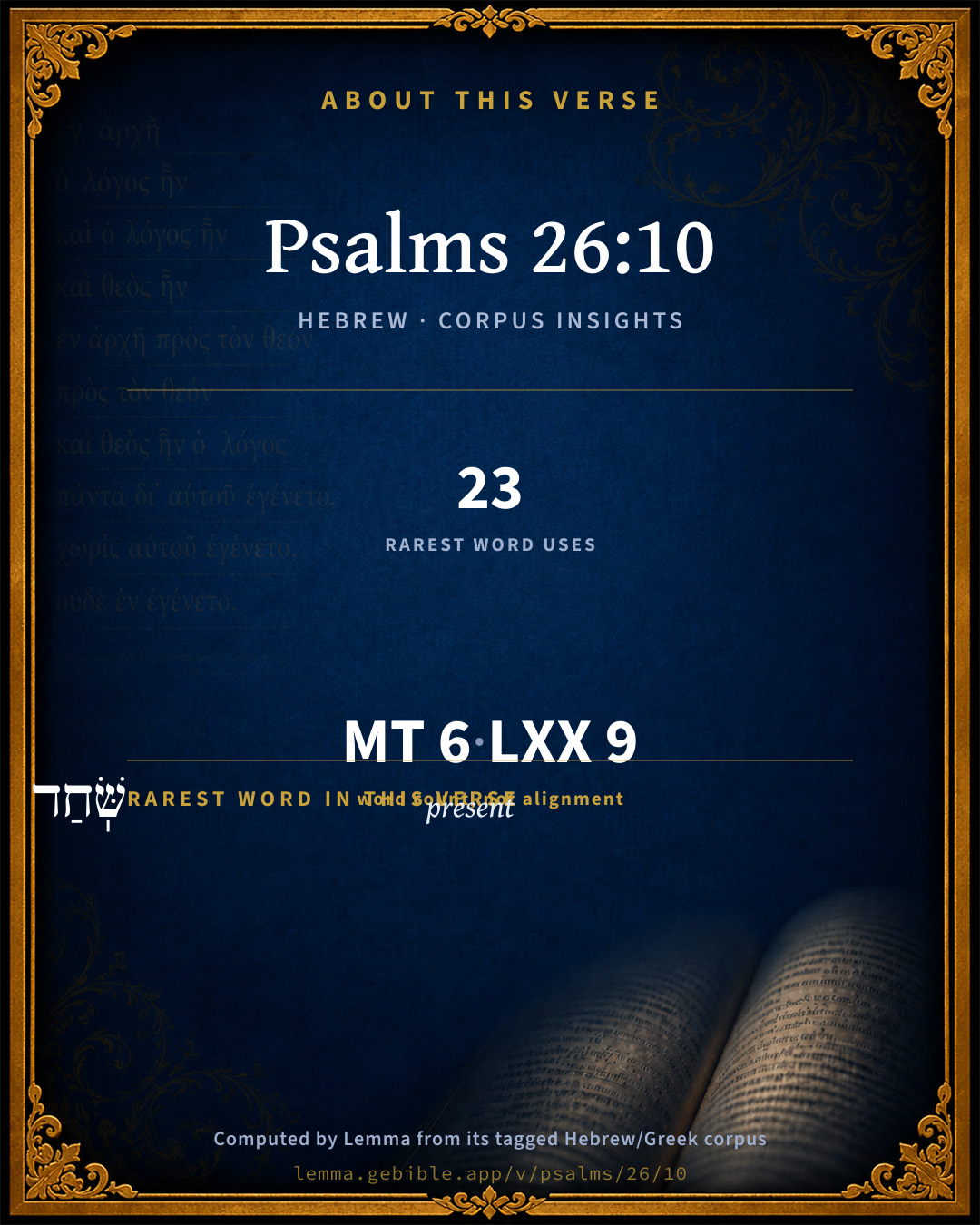
The rarest word here is שֹּֽׁחַד present H7810 — appearing just 23 times in the whole Hebrew Bible.

Shared distinctive vocabulary

שֹּֽׁחַד present H7810 occurs in 21 verses of the Hebrew Bible. Also found in:

Grammatical profile

  • 1 verb
  • 4 nouns
  • 1 particle

Verb forms

  • מָ֣לְאָה Qal · Perfect

Hebrew & Septuagint length

In English translation the verse runs 12 words from the Hebrew and 13 from the Septuagint (LXX English) — closely comparable.

A rough comparison of the two English renderings, which tokenize alike — not a word-level alignment.

Word counts can differ between the Hebrew and the Greek without any difference in meaning — e.g. the Hebrew direct-object marker אֵת has no separate Greek word, and Greek often adds the article ὁ.

In the original languages it is 6 Hebrew tokens and 9 Greek tokens — but the two are counted differently (Hebrew bundles its prefixes and suffixes into one token; the Greek is in lemma form), so that isn’t a like-for-like length.

Cross-references

17

Topical passages linked to Psalms 26:10 in the Treasury of Scripture Knowledge — connected by theme and wording, ordered by reader-vote popularity; previews shown in the World English Bible.

  • Exodus 23:8 You shall take no bribe, for a bribe blinds those who have sight and perverts the words of the righteous.
  • Deuteronomy 16:19 You shall not wrest justice: you shall not respect persons; neither shall you take a bribe; for a bribe does blind the eyes of the wise, and pervert the words of the righteous.
  • 1 Samuel 8:3 His sons didn't walk in his ways, but turned aside after lucre, and took bribes, and perverted justice.
  • Psalms 52:2 Your tongue plots destruction, Like a sharp razor, working deceitfully.
  • Micah 7:3 Their hands are on that which is evil to do it diligently. The ruler and judge ask for a bribe; And the powerful man dictates the evil desire of his soul. Thus they conspire together.
  • Psalms 10:14 But you do see trouble and grief; You consider it to take it into your hand. You help the victim and the fatherless.
  • Psalms 11:2 For, behold, the wicked bend their bows. They set their arrows on the strings, That they may shoot in darkness at the upright in heart.
  • Psalms 36:4 He plots iniquity on his bed. He sets himself in a way that is not good; He doesn't abhor evil.
  • Psalms 55:9–11 Confuse them, Lord, and confound their language, For I have seen violence and strife in the city.
  • Proverbs 1:16 For their feet run to evil. They hurry to shed blood.
  • Proverbs 4:16 For they don't sleep, unless they do evil. Their sleep is taken away, unless they make someone fall.
  • Isaiah 33:15 He who walks righteously, and speaks blamelessly; he who despises the gain of oppressions, who shakes his hands from taking a bribe, who stops his ears from hearing of blood, and shuts his eyes from looking on evil:
  • Ezekiel 22:12–13 In you have they taken bribes to shed blood; you have taken interest and increase, and you have greedily gained of your neighbors by oppression, and have forgotten me, says the Lord Yahweh.
  • Amos 5:12 For I know how many your offenses, And how great are your sins-- You who afflict the just, Who take a bribe, And who turn aside the needy in the courts.
  • Micah 2:1–3 Woe to those who devise iniquity And work evil on their beds! When the morning is light, they practice it, Because it is in the power of their hand.
  • Matthew 26:3–4 Then the chief priests, the scribes, and the elders of the people were gathered together in the court of the high priest, who was called Caiaphas.
  • Acts 23:12 When it was day, some of the Jews banded together, and bound themselves under a curse, saying that they would neither eat nor drink until they had killed Paul.

Cross-references courtesy of OpenBible.info (CC BY 4.0).

Hebrew and Greek witnesses Masoretic Hebrew ↔ Greek Septuagint

The same verse in the two great witnesses to the Old Testament, shown verse-for-verse.

You’re reading Greek Psalm 25 (Hebrew Psalm 26). The Septuagint counts the superscription, so verse numbers can differ from the Hebrew — chapter-level alignment, not verse-by-verse. Numbering follows Rahlfs.

These are two independent witnesses, not word-aligned to each other, and the Septuagint is shown in lemma (dictionary) form.

Hebrew Psalms 26:10 Masoretic · Westminster Leningrad Codex

אֲשֶׁר בִּידֵיהֶ֥ם זִמָּ֑ה וִֽ֝ימִינָ֗ם מָ֣לְאָה שֹּֽׁחַד

In whose hands is wickedness, Their right hand is full of bribes.

World English Bible · Public Domain

Greek LXX Greek Psalm 25:10 Septuagint · lemma form

ὅς ἐν χείρ ἀνομία ὁ δεξιός αὐτός πίμπλημι δῶρον

in whose hands are iniquities, and their right hand is filled with bribes.

LXX2012 (modern English Septuagint) · Public Domain

Hebrew: Westminster Leningrad Codex (CC BY 4.0). Greek: Septuagint (public domain); English from LXX2012 (modern English Septuagint) (Public Domain). How the Septuagint differs from the Hebrew →

Commentary

Notes on Psalms 26:10 from classic Christian and Jewish commentators (each source and its license shown beneath its notes). The classic Christian expositions comment on the surrounding passage and are grouped to its opening verse, so a note may address several verses; the Jewish commentaries on the Tanakh (Rashi and others) are per-verse, so they appear only where the commentator wrote on this verse.

Lemma curates 59 commentaries, every one of them public domain or Creative Commons licensed, each selected and text-cleaned for this edition rather than reprinted as found. About our sources →

Trapp's Complete Commentary

John Trapp

Psa 26:10 In whose hands [is] mischief, and their right hand is full of bribes.

Ver. 10. In whose hands is mischief] Wicked contrivance. Here we have the true portraiture of a corrupt courtier, such as Saul’s were.

John Trapp, A Commentary or Exposition upon All the Books of the Old and New Testament (1647–1656) — public domain. Text from a community e-Sword module.

The Biblical Illustrator

Joseph S. Exell

Psa_26:10

Their right hand is full of bribes.

Virtue hated by the wicked

Saul not only sought Davids life with his own hand, but bribed others to seek it, and betray him into his power (1Sa_22:6-19). In this way the Jews treated the Son of David. Failing to accomplish His death themselves, they at last bribed one of His own disciples to betray Him into their hands. It is strange that goodness should have always met with such treatment at the hands of the world. Many have thought, in their ignorance of the human heart, that virtue only needs to be presented in her own beautiful colours to be at once loved by all. So an eminent Scotch divine thought when, after depicting in terms of glowing eloquence the moral beauty and amiability of virtue, he exclaimed, O virtue, if thou wert embodied, all men would love thee! His colleague later, addressing the same congregation, said, My reverend friend observed that if virtue were embodied all men would love her. Virtue has been embodied. But how was she treated? Did all men love her? No; she was despised and rejected of men, who, after defaming, insulting, and scourging her, led her to Calvary, where they crucified her between two thieves. (D. Caldwell, M. A.)

The Biblical Illustrator, edited by Joseph S. Exell (c. 1880s–1900s) — public domain. Text from a community e-Sword module.

J. A. Alexander on Psalms

Joseph Addison Alexander

10. (Psa 26:10) In whose hands is crime, and their right hand is filled with a bribe. The first clause exhibits the peculiar construction of the relative in Hebrew with the personal pronoun expressed, of which it is the substitute in other languages. Who (or as to whom)—in their hands (is) crime. This last word is a very strong one, used in the Law to denote specifically acts of gross impurity, but signifying really any wicked act or purpose. The common version, mischief, is too weak. The last word in the verse denotes especially a judicial bribe (Psa 15:5), and may be intended to suggest that the whole description has reference to unrighteous rulers, or to wicked men in public office.

Joseph Addison Alexander, The Psalms Translated and Explained (1850) — public domain. Text from a community e-Sword module.

Geneva Bible (1599)

Geneva Bible translators

Whose cruel hands do execute the malicious devices of their hearts.

Geneva Bible (1599) marginal notes — public domain. Text via Bolls.life.

Jamieson, Fausset & Brown

Robert Jamieson, A. R. Fausset & David Brown

Their whole conduct is that of violence and fraud.

Jamieson, Fausset & Brown — Commentary Critical and Explanatory on the Whole Bible (1871) — public domain (CC PDM 1.0). Text via the HelloAO Bible API.

Adam Clarke's Commentary

Verse 10. Their right hand is full of bribes] He speaks of persons in office, who took bribes to pervert judgment and justice.

Adam Clarke's Commentary on the Bible (1810–1826) — public domain. Text from a community e-Sword/MySword module.

John Calvin's Commentaries

10. For in their hands is maliciousness. The Hebrew word זמה, zimmah, signifies properly an inward stratagem, or device. But here it is not improperly applied to the hands, because David wished to intimate, that the wicked, of whom he was speaking, not only secretly imagined deceits, but also vigorously executed with their hands the malice which their hearts devised. When he farther says, Their right hands are full of bribes, we may infer from this, that it was not the common people whom he pointed out for observation, but the nobility themselves, who were most guilty of practising this corruption. Although the common and baser sort of men may be hired for reward, and suborned as agents in wickedness, yet we know that bribes are offered chiefly to judges, and other great men who are in power; and we likewise know, that at the time referred to here the worst of men bore sway. It was no wonder, therefore, that David complained that justice was exposed to sale. We are farther admonished by this expression, that those who delight in gifts can scarcely do otherwise than sell themselves to iniquity. Nor is it in vain, unquestionably, that God declares that

“gifts blind the eyes of the wise, and pervert the hearts of the righteous,” (Deuteronomy 16:19.)

John Calvin's Commentaries (1540-1563) — public domain. Text from the Calvin Translation Society English edition (1840s-50s) via the Christian Classics Ethereal Library (ccel.org). Calvin's coverage is partial (roughly two-thirds of the Bible); uncommented books and verses are honest gaps, never fabricated. The 19th-century editor's footnotes and remarks are omitted so the notes are faithfully Calvin's own voice.

John Gill's Exposition

In whose hands is mischief,.... Every abominable wickedness; as idolatry, adultery, murder, &c. the word signifies and is sometimes used for mischief conceived in the mind, artificially devised and contrived there; here mischief committed, the hand being the instrument of action, and intends whatever is prejudicial to the person, character, and properties of men;

and their right hand is full of bribes; whereby the eyes of judges are blinded, the words of the righteous perverted, men's persons respected, and judgment wrested, Deu 16:19.

John Gill's Exposition of the Whole Bible (1746–1763) — public domain (CC PDM 1.0). Text via the HelloAO Bible API.

Albert Barnes' Notes on the Bible

In whose hands is mischief - The word here rendered “mischief,” means properly “purpose, counsel, plan;” then, an evil purpose, “mischief, wickedness, crime.” The idea is, either that they intended to do mischief, and that they employed their hands to accomplish it, or that the fruit or result of their wicked plans was in their hands; that is, they had in their possession what they had secured by robbery, or plunder, or dishonesty.

And their right hand is full of bribes - Margin: “filled with.” The word here rendered “bribes” means properly “a gift,” or “present;” and then, a gift offered to a judge to procure an unjust sentence, 2Ki 16:8; Pro 6:35; Exo 23:8; Deu 10:17. The general meaning is that he did not desire to be associated either with men who openly committed crime, or with those who could be corrupted in the administration of justice.

Albert Barnes' Notes on the Bible (1834–1885) — public domain. Text from a community e-Sword/MySword module.

Matthew Poole's English Annotations

In whose hands is mischief; who not only imagine mischief in their hearts, but persist in it, and execute it with their hands.

Their right hand; which should be stretched out to execute justice, and punish offenders.

Matthew Poole's English Annotations on the Holy Bible (1683–1685) — public domain. Text from a community e-Sword/MySword module.

The Treasury of David

Charles H. Spurgeon

Ver. 10. In whose hands is mischief. They have both hands full of it, plotting it and carrying it out. And their right hand, with which they are most dexterous, is full of bribes; like thieves who would steal with impunity, they carry a sop for the dogs of justice. He who gives bribes is every way as guilty as the man who takes them, and in the matter of our parliamentary elections the rich villain who give the bribe is by far the worse. Bribery, in any form or shape, should be as detestable to a Christian as carrion to a dove, or garbage to a lamb. Let those whose dirty hands are fond of bribes remember that neither death nor the devil can be bribed to let them escape their well earned doom.

Ver. 10. Their right hand is full of bribes. If the great men in Turkey should use their religion of Mahomet to sell, as our patrons commonly sell benefices here (the office of preaching, the office of salvation), it should be taken as an intolerable thing; the Turk would not suffer it in his commonwealth. Patrons be charged to see the office done, and not to seek a lucre and a gain by their patronage. There was a patron in England that had a benefice fallen into his hand, and a good brother of mine came unto him, and brought him up thirty apples in a dish, and gave them to his man to carry them to his master. It is like he gave one to his man for his labour, to make up the gain, and so there was thirty-one. This man cometh to his master, and presented him with the dish of apples, saying, "Sir, such a man hath sent you a dish of fruit, and desireth you to be good unto him for such a benefice." "Tush, tush, "said he, "this is no apple matter, I will none of his apples, I have as good as these (or any he hath) in mine own orchard." The man came to the priest again, and told him what his master said. "Then, "said the priest, "desire him yet to prove one of them for my sake, he shall find them much better than they look for." He cut one of them, and found ten pieces of gold in it. "Marry, "said he, "this is a good apple." The priest standing not far off, hearing what the gentleman said, cried out and answered, "they are all one apples, I warrant you, sir; they grew all on one tree, and have all one taste." "Well, he is a good fellow, let him have it, "said the patron, etc. Get you a graft of this same tree, and I warrant you it shall stand you in better stead than all St. Paul's learning. Hugh Latimer.

Ver. 10. Bribes. They that see furthest into the law, and most clearly discern the cause of justice, if they suffer the dust of bribes to be thrown into their sight, their eyes will water and twinkle, and fall at last to blind connivance. It is a wretched thing when justice is made a hackney that may be backed for money, and put on with golden spurs, even to the desired journey's end of injury and iniquity. Far be from our souls this wickedness, that the ear which should be open to complaints should be stopped with the earwax of partiality. Alas! poor truth, that she must now be put to charges of a golden ear pick, or she cannot be heard! Thomas Adams.

Ver. 10.

What makes all doctrines plain and clear?

About two hundred pounds a year,

And that which was proved true before

Proved false again? Two hundred more.

Samuel Butler (1600-1680), in Hudibras. Part 3. Canto 1.

None.

Psalms 26:11*

Charles H. Spurgeon's The Treasury of David (1869–1885) — public domain. Psalms only. Text from a community e-Sword/MySword module.

Whedon's Commentary on the Bible

Daniel D. Whedon

10. Mischief—The word here denotes crime, infamy.

Full of bribes—See on Psa_15:5

Daniel D. Whedon (gen. ed.), Commentary on the Old and New Testaments (1874–1909) — public domain. Text from a community e-Sword module.

The Pulpit Commentary

In whose hands is mischief; i.e. who are always occupied with some mischief or other always engaged in carrying out wicked devices. (see Pro_12:2 Pro_14:17) And their right hand is full of bribes. Which they have taken to condemn the innocent. (comp. Psa_15:5 Isa_1:23 Jer_22:17,eze Jer_22:12 Hos_4:10 Mic_3:11, etc.)

The sin of bribery.

"Their right hand is full of bribes." Christians have undeniably a far higher standard of morality supplied by the gospel than was possible in earlier times under any other dispensation. How, then, is this paradox to be solved that we find Old Testament saints trying themselves by severer tests, and aiming at a higher level both of morality and of devotion than multitudes of professed Christians attempt to reach or even deem attainable? The practice of bribery has often attained, in nominally Christian commonwealths, such proportions as to endanger public welfare and honour, and this with the connivance of many religious people; yet it is here condemned as worthy to he classed with the worst crimes, utterly inconsistent with "innocency" and "integrity". (vers. 6, 11; cf. Isa_35:1-5) Subject The sin of bribery, and the duty of Christians to oppose it to the utmost of their power.

I BRIBERY MEANS A BARGAIN TO BETRAY A SOLEMN PUBLIC TRUST. The constitution bestows the vote, not for the voter"s private benefit, but that fit men may be chosen to office; it is a trust for the community. Suppose a prime minister were to sell the offices at his disposal, or a jury to sell their verdict, or a judge his sentence, would not the world cry shame? The scale is different, but the principle is the same.

II BRIBERY POWERFULLY CORRUPTS PUBLIC MORALITY AND NATIONAL CHARACTER. For patriotism and public spirit it substitutes selfishness; for honest, independent conviction, base disregard of principle. It destroys the sense of public honour; it degrades office by making the qualification, not fitness, but pelf; it puts the making of laws and ordering of justice in the hands of men who have begun by breaking the law and insulting justice; it degrades alike the giver and the receiver.

III BRIBERY TENDS TO PRODUCE CORRUPT GOVERNMENT AND DISHONEST LEGISLATION. It is true a man"s conscience may allow him to give a bribe, yet forbid him to take one; hut how long would this inconsistency last if the innocency of giving bribes were generally allowed? If an elector may sell his vote, why not a member of parliament or of council? What right would an elector have to complain if his representative were to say, "I have bought my seat, and paid for it, and have a right to make a profit out of it"?

A Christian"s reputation should be dear to him, not for his own sake alone, hut for his Lord"s, for the gospel"s and the Church"s sake. He should he able to say, with St. Paul, Act_24:16. (cf. 1Ti_5:22 Php_4:8) Some excellent Christians, it is true, would limit "whatsoever things," etc., to the concerns of private life. But by what right? A Christian, they say, is a citizen of the heavenly city, and has no concern with earthly politics. But he cannot help having concern. He is also a citizen of his earthly country, whether he will or no, and has all the privileges of a citizen and the benefits of the commonwealth. Privilege and benefit mean duty and responsibility. Love to our neighbour and care for the poor do not surely cease to be Christian duties when the welfare of a whole nation, and of other nations, or the care of the poor at home and the enslaved and oppressed in other lands, call for the strong arm of law and national government.

HOMILIES BY C. CLEMANCE Vers. 1-12. Assailed integrity"s final appeal.

It seems evident that this psalm was written by some Old Testament saint who was surrounded by ungodly men, by whom he was assailed, reproached, and slandered. From them he appeals to God. By the heading of the psalm we are pointed to David as the author. And there is no reason for questioning that. Mr. Fausset, in his most suggestive book, "Horae Psalmicae," working along the line of "undesigned coincidences," remarks, "Another feature of undesigned coincidence is the unmistakable identity of David"s character, as he reveals it in the Psalms, and as the independent historian describes it in the Books of Samuel and Chronicles. Thus the same ardent love to the house of God appears in both. How instinctively one feels the harmony between the character self-portrayed in Psa_26:8 Psa_27:4; and Psa_69:9! Compare the historian"s record of his words to Zadok, (2Sa_15:25) and still more in 1Ch_29:2, 1Ch_29:3." Undoubtedly, thus read and compared, the Psalms and the history mutually throw light upon and confirm each other. But in following out our plan in this section of dealing with each psalm as a unity we find this, as well as all the rest, furnishing material for pulpit exposition, which we could ill afford to lose. Our topic isAssailed integritys final appeal.

I WE HAVE HERE THE CHARACTER OF AN UPRIGHT MAN, SKETCHED BY HIMSELF. It may not be a very wholesome exercise for a man to be engaged in to sketch a moral portraiture of himself. Painters have often painted their own portraits; that requires but an outward gaze on one"s outer self; but to delineate one"s own likeness morally requires much introspection. Few can carry on much of that without becoming morbid through the process; and fewer still, perhaps, have fidelity enough to do it adequately and correctly. Yet there may be circumstances under which such abnormal work becomes even necessary (as we shall point out presently). And when such is the case, it is well if we can honestly point to such features of character and life as are presented to us here.

1. The psalmist has a goodly foundation on which his life was built up.

(1) Trust in Jehovah (ver. 1).

(2) God"s loving-kindness (ver. 3).

(3) God"s truth (ver. 3); i.e. God"s faithfulness.

Note: That all the supports of the psalmist"s integrity were outside himself. Happy is the man that, under all the circumstances of life, can stay his mind and heart on Divine faithfulness and love. If such underlying props cease to sustain, moral and spiritual worth will soon pine from lack of motive and hope. It is one of the evils of the day that some of our most popular novelists delineate religion without God.

2. The life built up on this foundation was one which may with advantage be imitated. It was a life of:

(1) Integrity (ver. 11).

(2) Straightforward progress (ver. 1). No sliding.

(3) Avoidance of evil associations (vers. 4, 5).

(4) Cultivation of holy worship, song, and thanksgiving in the sanctuary( vers. 6-8, 12).

Note:

(a) Those to whom God is the support of their life, will show a life worthy of such support.

(b) Those who most value communion with God and a life hidden with him, will most fully appreciate and most diligently cultivate that stimulus and comfort which come from mingling with God"s people in the worship of the sanctuary.

II THE MOST UPRIGHT OF MEN MAY BE MISUNDERSTOOD, UNAPPRECIATED, MISREPRESENTED, AND ASSAILED. Speaking roughly and generally, it is no doubt true that, on the whole, a man"s reputation will be the reflection of what he is, and that most men go for what they are worth. And yet, so long as there are envious hearts, jealous dispositions, unbridled tongues, few can be regarded as absolutely safe from detraction and slander. Our Lord Jesus implies and even states as much as this. (cf. Mat_5:44 Mat_10:25 Mat_18:6, 7 Joh_15:18) See Peter"s words; (1Pe_2:12 1Pe_4:14) see Paul"s words. (Rom_12:18, Rom_12:19) Paul had to boar much in the way of depreciation from some who even denied his apostleship. Job was surrounded with "miserable comforters," who thought, by defaming him, to defend God! Such trials are hard to bear. They may arise

(1) from the occasional foibles of a good man being magnified by the slanderer into sins;

(2) from the utter impossibility of bad men reading aright the character of the just and pure. Having no virtue themselves, they cannot credit others with any. "Doth Job fear God for nought?" "He hath a devil," etc. Many can say the words in Psa_56:5.

III IT IS AN INFINITE RELIEF, UNDER SUCH CIRCUMSTANCES, THAT THE RELIEVER CAN APPEAL TO HIS GOD. The whole psalm is such an appeal. True, the Infinite Eye can discern flaws and faults where we suspect none; but then the same perfect gaze discerns the desire after being right and pure and true, however far the believer may be from realizing his own ideal. The suppliant has to do, moreover, with One who never misunderstands, and whose glory is in his loving-kindness and truth. And from a Christian point of view we must remember that we have a High Priest who was in all points tried like as we are, yet without sin, and who can therefore pity what is frail, and pardon what is wrong. What a mercy to have such a throne of grace to which to flee

IV THE APPEAL WILL BE MARKED BY SPECIFIC ENTREATY. Here there are four lines of supplication.

1. That God would vindicate him, and not let him be mixed up in confusion with the men whose sin he hates (vers. 1, 9, 10). He looks to God, as Job did, as his Vindicator. (Job_19:25)

2. That God would search and prove him. (ver. 2; cf. Psa_139:23, Psa_139:24)

3. That God would purify him (ver. 3). So the word here rendered "try" indicates. He is upright before men, but he does not pretend to be perfect before God.

4. That God would entirely deliver him from the surroundings of ungenial and unholy men (vers. 9, 10). Whether the psalmist intended any reference to a future state or no, the believer now cannot help so applying the words. Who could endure the thought of evil and good always being mixed up together? The Divine mandate is, "Let both grow together until the harvest". (Mat_13:13) Then will come the final severance.

V THE RESULT OF SUCH APPEAL WILL NOT BE FRUITLESS OR VAIN. (Ver. 12) "His prayer has been heard; he is safe; he stands on the open, level table-land, where he has room to move, and where his enemies cannot hem him in; and therefore he fulfils the resolve made before (ver. 7), and publicly pours out his thanksgivings to God" (Perowne). Whoever thus lays his complaints before God will find deliverance in God"s own appointed time; we must leave, however, the "when" with the great Defender. Either

(1) on earth in our day,

(2) on earth after our day, or

(3) in heaven, God will bring us and our reputation out to the light.

He shall bring forth thy righteousness as the light, and thy judgment as the noonday". C. (Psa_37:5, Psa_37:6)

The Pulpit Commentary (1880–1919), ed. H.D.M. Spence-Jones & Joseph S. Exell — public domain. Text from a community e-Sword module.

Rashi

Rabbi Shlomo Yitzchaki (Rashi)

plots Heb. זמה. Every זמה in Scripture is an expression of a plan, some for good and some for evil.

Rashi on the Tanakh — English translations: “The Judaica Press complete Tanach with Rashi, translated by A. J. Rosenberg” (CC BY 4.0); “Pentateuch with Rashi's commentary by M. Rosenbaum and A.M. Silbermann, 1929-1934” (public domain); “The Metsudah Tanach series, Lakewood, N.J” (CC BY 4.0); and “The Book of Joshua, Metsudah Publications, 1997” (CC BY 4.0). Text via Sefaria.

Lesson kit

Teaching starters — assembled from the data on this page, not authored interpretation. Every prompt links to the verse data it draws on. Edit before teaching.

Psalms, in the Wisdom, opens this verse with 6 words (6 distinct Hebrew lemmas). Its most distinctive word is shachad (“present”). A historical commentator’s framing appears above. Read the whole chapter for the surrounding context.

Discussion questions

  1. The word shachad carries the sense “present.” How does it shape the verse?
  2. How does Exodus 23:8, which shares the word «present», read alongside this verse?
  3. These translations render this verse differently; the difference is in the English rendering, not the original. What questions does that raise?
  4. «מָ֣לְאָה» is a Qal Perfect verb. How does that grammatical form shape the action described?
  5. Compare how Trapp's Complete Commentary and The Biblical Illustrator read this verse. Where do they agree or differ?

Things to notice

Reading settings

Reading text

Shown beneath each verse's original-language words.

Old Testament
Old Testament edition

Read the OT as the Masoretic Hebrew (MT) or the Greek Septuagint (LXX).

English shown for the Greek Septuagint (in the Hebrew ↔ Greek comparison).

Comparing translations? Open the Compare panel on any verse page to stack up to four side by side.