
Psalms 89:12

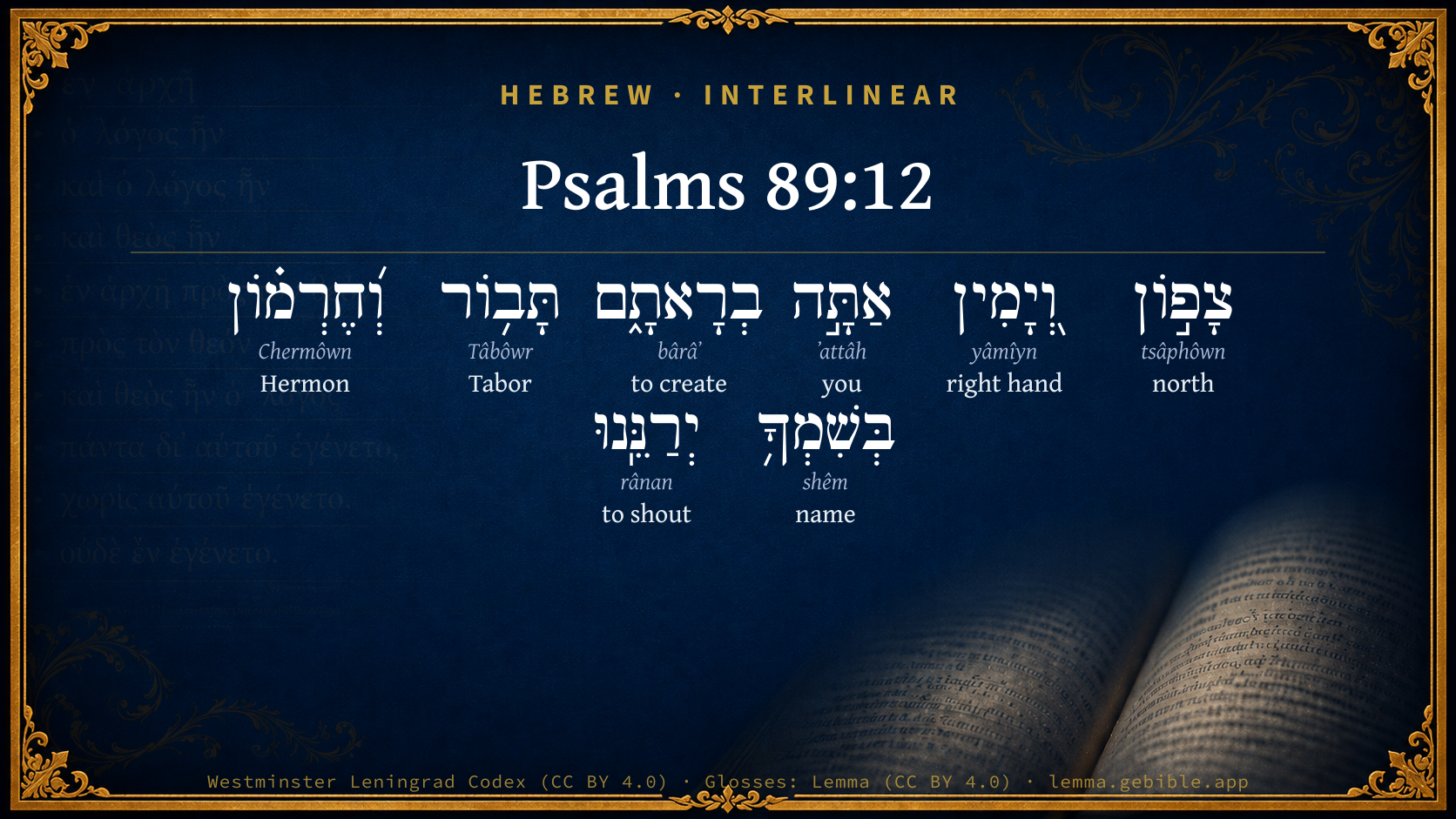
Hebrew (Westminster Leningrad Codex) Psalms 89:12 appears in the Hebrew Old Testament. The text above is from the Westminster Leningrad Codex. Each word links to its Strong’s number, a concise gloss, and parsing drawn from the Open Scriptures Hebrew Bible morphology. Click any word for its full Brown-Driver-Briggs (BDB) entry.
Download image
Cite this verse

Psalms 89:12 (World English Bible). Public Domain. Lemma interlinear Bible study tool, https://lemma.gebible.app/v/psalms/89/12.

Show BibTeX & RIS
BibTeX
RIS
English Translation
The north and the south, you have created them. Tabor and Hermon rejoice in your name.
World English Bible · Public Domain
Download a study sheet

One document with this verse’s original text, its word-by-word gloss line, the meaning frame, cross-references with their text, attributed commentary, and full source and license credits — printable, and it pastes into notes with its structure intact.

This verse Autodidact and up

Study sheet (.html) Plain text (.txt)

A passage Seminary Student

Up to 50 verses in one chapter. A passage sheet keeps up to 6 commentary sources and 12 cross-references per verse, in the order this page ranks them, and says so on the sheet whenever that leaves anything out. Ask for a single verse and you get the Autodidact verse sheet above.

Everything on this page stays free to read, with no account — the sheet is a download of what is already on screen, not access to it.

Want to remove ads? Support Godless Engineer
Compare translations 3

The same verse in 3 English versions, stacked beneath the original-language interlinear above. Click any original word for its lexicon entry.

Each is an independent rendering of the whole verse — the interlinear is not word-aligned to these translations.

Highlighted words mark where these versions differ — a whole-verse word diff, not a word-by-word alignment.

  • World English Bible Public Domain
    The north and the south, you have created them. Tabor and Hermon rejoice in your name.
  • King James Version Public Domain
    The north and the south thou hast created them: Tabor and Hermon shall rejoice in thy name.
  • unfoldingWord Literal Text CC BY-SA 4.0
    The north and the south, you, you created them; Tabor and Hermon shout joyfully in your name.

unfoldingWord Literal Text — © unfoldingWord, licensed CC BY-SA 4.0. Word-aligned USFM3 via Door43 (git.door43.org/unfoldingWord/en_ult).

Versions to compare (up to 4)

3 of 4 selected

Show all 18 translations

Every available English version of this verse, each an independent rendering of the whole verse.

  • World English Bible Public Domain
    The north and the south, you have created them. Tabor and Hermon rejoice in your name.
  • Berean Standard Bible Public Domain
    North and south You created; Tabor and Hermon shout for joy at Your name.
  • Majority Standard Bible Public Domain
    North and south You created; Tabor and Hermon shout for joy at Your name.
  • King James Version Public Domain
    The north and the south thou hast created them: Tabor and Hermon shall rejoice in thy name.
  • American Standard Version (1901) Public Domain
    The north and the south, thou hast created them: Tabor and Hermon rejoice in thy name.
  • Revised Version (1885) Public Domain
    The north and the south, thou hast created them: Tabor and Hermon rejoice in thy name.
  • Geneva Bible (1599) Public Domain
    Thou hast created the North and the South: Tabor and Hermon shall reioyce in thy Name.
  • Douay-Rheims (1899) Public Domain
    Thine are the heavens, and thine is the earth: the world and the fulness thereof thou hast founded:
  • Young's Literal Translation Public Domain
    North and south Thou hast appointed them, Tabor and Hermon in Thy name do sing.
  • Literal Standard Version CC BY-SA 4.0
    North and south You have appointed them, || Tabor and Hermon sing in Your Name.
  • Unlocked Literal Bible CC BY-SA 4.0
    You created the north and the south. Tabor and Hermon rejoice in your name.
  • unfoldingWord Literal Text CC BY-SA 4.0
    The north and the south, you, you created them; Tabor and Hermon shout joyfully in your name.
  • Darby Bible Public Domain
    The north and the south, *thou* hast created them: Tabor and Hermon triumph in thy name.
  • World Messianic Bible Public Domain
    You have created the north and the south. Tabor and Hermon rejoice in your name.
  • Webster's Bible Public Domain
    \\89:11\\The heavens are thine, the earth also is thine: as for the world, and the fullness of it, thou hast founded them.
  • Free Bible Version CC BY-SA 4.0
    You created north and south; Mount Tabor and Mount Hermon celebrate you.
  • Bible in Basic English Public Domain
    You have made the north and the south; Tabor and Hermon are sounding with joy at your name.
  • JPS Tanakh (1917) Public Domain
    (89-13) The north and the south, Thou hast created them; Tabor and Hermon rejoice in Thy name.

Literal Standard Version (2020), Covenant Press — licensed CC BY-SA 4.0. Text via the HelloAO Bible API (eBible.org). Unlocked Literal Bible (unfoldingWord) — licensed CC BY-SA 4.0. Text via the HelloAO Bible API (eBible.org). unfoldingWord Literal Text — © unfoldingWord, licensed CC BY-SA 4.0. Word-aligned USFM3 via Door43 (git.door43.org/unfoldingWord/en_ult). Free Bible Version, Dr. Jonathan Gallagher — licensed CC BY-SA 4.0. Text via the HelloAO Bible API (eBible.org).

Word by word

More ways to search: Search by grammar → Find every occurrence → Compare this word →

Practice this passage: Drill this verse → Learn its vocabulary →

תָּב֥וֹר
Tâbôwr
H8396
“Tabor”
Noun, Proper
Part of Speech
Noun
Type
Proper
Full BDB Definition

Origin: from a root corresponding to H8406

TWOT: None

Tabor = "mound" - a mountain in the plain of Esdraelon rising abruptly and insulated except for a narrow ridge on the west connecting it to the hills of Nazareth (noun proper mountain) - a town around the summit of Mount Tabor (1) (noun proper locative) - a city of the Merarite Levites located in the territory of Zebulun (noun proper locative) - the place of an oak tree which was on the homeward journey of Saul after he had been anointed by Samuel (noun proper arbour)
  1. צָפ֣וֹן tsâphôwn H6828 “north” Noun, Common, Feminine, Singular, Absolute
  2. וְ֭יָמִין yâmîyn H3225 “and · right hand” Conjunction + Noun, Common, Feminine, Singular, Absolute
  3. אַתָּ֣ה ʼattâh H859 “you” Pronoun, Personal, 2nd Person, Masculine, Singular
  4. בְרָאתָ֑ם bârâʼ H1254 “to create · them” Verb, Qal, Perfect, 2nd Person, Masculine, Singular + Suffix, Personal, 3rd Person, Masculine, Plural
  5. וְ֝חֶרְמ֗וֹן Chermôwn H2768 “and · Hermon” Conjunction + Noun, Proper
  6. בְּשִׁמְךָ֥ shêm H8034 “in/at · name · your” Preposition + Noun, Common, Masculine, Singular, Construct + Suffix, Personal, 2nd Person, Masculine, Singular
  7. יְרַנֵּֽנוּ rânan H7442 “to shout” Verb, Piel, Imperfect, 3rd Person, Masculine, Plural

About this verse

These counts appear in no published source. They are computed here, from the morphology-tagged text and Lemma’s own curated glosses. What Lemma adds →

8
words
8
distinct lemmas
Wisdom
section

Notable vocabulary

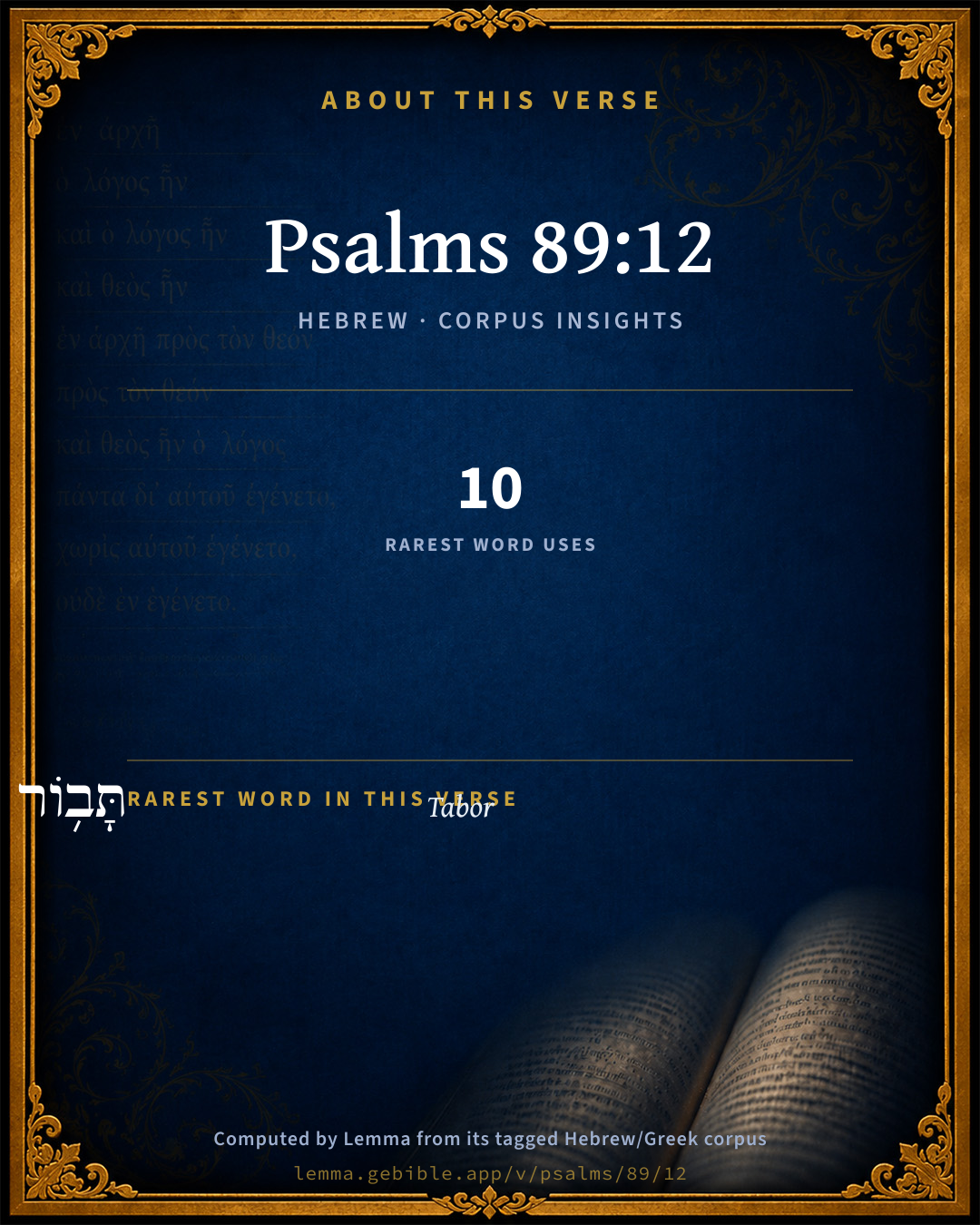
The rarest word here is תָּב֥וֹר Tabor H8396 — appearing just 10 times in the whole Hebrew Bible.

Shared distinctive vocabulary

תָּב֥וֹר Tabor H8396 occurs in 10 verses of the Hebrew Bible. Also found in:

Grammatical profile

  • 2 verbs
  • 5 nouns
  • 1 pronoun

Verb forms

  • בְרָאתָ֑ם Qal · Perfect
  • יְרַנֵּֽנוּ Piel · Imperfect

Hebrew & Septuagint length

In English translation the verse runs 16 words from the Hebrew and 16 from the Septuagint (LXX English) — the same length.

A rough comparison of the two English renderings, which tokenize alike — not a word-level alignment.

Word counts can differ between the Hebrew and the Greek without any difference in meaning — e.g. the Hebrew direct-object marker אֵת has no separate Greek word, and Greek often adds the article ὁ.

Cross-references

13

Topical passages linked to Psalms 89:12 in the Treasury of Scripture Knowledge — connected by theme and wording, ordered by reader-vote popularity; previews shown in the World English Bible.

  • Joshua 12:1 Now these are the kings of the land, whom the children of Israel struck, and possessed their land beyond the Jordan toward the sunrise, from the valley of the Arnon to Mount Hermon, and all the Arabah eastward:
  • Joshua 19:22 and the border reached to Tabor, and Shahazumah, and Beth-shemesh; and the goings out of their border were at the Jordan: sixteen cities with their villages.
  • Job 26:7 He stretches out the north over empty space, And hangs the earth on nothing.
  • Deuteronomy 3:8–9 We took the land at that time out of the hand of the two kings of the Amorites who were beyond the Jordan, from the valley of the Arnon to Mount Hermon;
  • Judges 4:6 She sent and called Barak the son of Abinoam out of Kedesh-naphtali, and said to him, Hasn't Yahweh, the God of Israel, commanded, [saying], Go and draw to Mount Tabor, and take with you ten thousand men of the children of Naphtali and of the children of Zebulun?
  • Judges 4:12 They told Sisera that Barak the son of Abinoam was gone up to Mount Tabor.
  • Psalms 98:8 Let the rivers clap their hands. Let the mountains sing for joy together.
  • Psalms 133:3 Like the dew of Hermon, That comes down on the hills of Zion: For there Yahweh gives the blessing, Even life forevermore.
  • Psalms 65:12–13 The wilderness grasslands overflow. The hills are clothed with gladness.
  • Isaiah 35:1–2 The wilderness and the dry land shall be glad; and the desert shall rejoice, and blossom as the rose.
  • Isaiah 49:13 Sing, heavens; and be joyful, earth; and break forth into singing, mountains: for Yahweh has comforted his people, and will have compassion on his afflicted.
  • Isaiah 55:12–13 For you shall go out with joy, and be led forth with peace: the mountains and the hills shall break forth before you into singing; and all the trees of the fields shall clap their hands.
  • Jeremiah 46:18 As I live, says the King, whose name is Yahweh of Hosts, surely like Tabor among the mountains, and like Carmel by the sea, so shall he come.

Cross-references courtesy of OpenBible.info (CC BY 4.0).

Hebrew and Greek witnesses Masoretic Hebrew ↔ Greek Septuagint

The same verse in the two great witnesses to the Old Testament, shown verse-for-verse.

You’re reading Greek Psalm 88 (Hebrew Psalm 89). The Septuagint counts the superscription, so verse numbers can differ from the Hebrew — chapter-level alignment, not verse-by-verse. Numbering follows Rahlfs.

These are two independent witnesses, not word-aligned to each other, and the Septuagint is shown in lemma (dictionary) form.

Hebrew Psalms 89:12 Masoretic · Westminster Leningrad Codex

צָפ֣וֹן וְ֭יָמִין אַתָּ֣ה בְרָאתָ֑ם תָּב֥וֹר וְ֝חֶרְמ֗וֹן בְּשִׁמְךָ֥ יְרַנֵּֽנוּ

The north and the south, you have created them. Tabor and Hermon rejoice in your name.

World English Bible · Public Domain

Greek LXX Greek Psalm 88:12 Septuagint · lemma form

σύ εἰμί ὁ οὐρανός καί σός εἰμί ὁ γῆ ὁ οἰκέω καί ὁ πλήρωμα αὐτός σύ θεμελιόω

You have created the north and the west: Thabor and Hermon shall rejoice in your name.

LXX2012 (modern English Septuagint) · Public Domain

Hebrew: Westminster Leningrad Codex (CC BY 4.0). Greek: Septuagint (public domain); English from LXX2012 (modern English Septuagint) (Public Domain). How the Septuagint differs from the Hebrew →

Commentary

Notes on Psalms 89:12 from classic Christian and Jewish commentators (each source and its license shown beneath its notes). The classic Christian expositions comment on the surrounding passage and are grouped to its opening verse, so a note may address several verses; the Jewish commentaries on the Tanakh (Rashi and others) are per-verse, so they appear only where the commentator wrote on this verse.

Lemma curates 59 commentaries, every one of them public domain or Creative Commons licensed, each selected and text-cleaned for this edition rather than reprinted as found. About our sources →

Trapp's Complete Commentary

John Trapp

Psa 89:12 The north and the south thou hast created them: Tabor and Hermon shall rejoice in thy name.

Ver. 12. Tabor and Hermon] That is, the west and east of Judaea, but put here for the west and east of the world. Judaea was the world of the world, as Athens the Greece of Greece, as Solon the epitome of Athens.

John Trapp, A Commentary or Exposition upon All the Books of the Old and New Testament (1647–1656) — public domain. Text from a community e-Sword module.

The Treasury of David

Charles H. Spurgeon

Ver. 12. The north and the south thou hast created them. North and south, opposite poles, agree in thisthat Jehovah fashioned them.

Tabor and Hermon shall rejoice in thy name, that is to say, east and west are equally formed by thee, and therefore give thee praise. Turn to all points of the compass, and behold the Lord is there. The regions of snow and the gardens of the sun are his dominions: both the land of the dawning and the home of the setting sun rejoice to own his sway. Tabor was on the west of Jordan and Hermon on the east, and it seems natural to consider these two mountains as representatives of the east and west. Keble paraphrases the passage thus:

"Both Heman moist, and Tabor lone,

They wait on thee with glad acclaim."

Ver. 12. The north and the south thou hast created them. etc. The heights of Huttin, commonly fixed on by tradition as the Mount of Beatitudes, appear a little to the west of Tiberias. Over these the graceful top of Mount Tabor is seen, and beyond it the little Hermon, famous for its dews; and still farther, and apparently higher, the bleak mountains of Gilboa, on which David prayed that there might fall no dew nor rain. A view of the position of Tabor and Hermon from such a situation as that which we now occupied, shewed us how accurately they might be reckoned the "umbilicus terroe" the central point of the land, and led us to infer that this is the true explanation of the manner in which they are referred to in the Ps 89:12. It is as if the Psalmist had said North, South, and all that is between or in other words, the whole land from North to South, to its very centre and throughout its very marrowshall rejoice in thy name. R.M. Macheyne.

Ver. 12. Tabor and Hermon. These hills, the one to the east and the other to the west, in Canaan, were much frequented by the saints of God. David speaks of the sacred hill of Hermon, and compares brotherly love to the dew of it. Ps 42:6 133:3. And Tabor, yet more eminent for the memorable spot of Christ's transfiguration, and from whence God the Father proclaimed his perfect love and approbation of Jesus as his dear Son. Well might this hymn, therefore, in allusion to those glorious events, call even the holy hills to rejoice in Jehovah's name, Mt 17:1-5. Robert Hawker.

Ver. 12. The joy of creation in its Creator.

Psalms 89:13*

Charles H. Spurgeon's The Treasury of David (1869–1885) — public domain. Psalms only. Text from a community e-Sword/MySword module.

J. A. Alexander on Psalms

Joseph Addison Alexander

13. (Psa 89:12) North, and south, thou didst create them; Tabor and Hermon in thy name rejoice. The pronoun at the end of the first clause is superfluous in English; the original construction requires north and south to be taken absolutely, (as for) the north and south, thou bast created them. The word for north originally means concealment; that for south the right hand. The east and west are represented by two mountains on either side of Jordan. As to Hermon, see above, on Psa 42:6. The points of the compass are here put, like heaven and earth in the preceding context, for the whole world, and described as rejoicing in God's name, i. e. praising his perfections by their very existence.

Joseph Addison Alexander, The Psalms Translated and Explained (1850) — public domain. Text from a community e-Sword module.

Tyndale Open Study Notes

Tyndale Open Resources

89:12 Mount Tabor was in northern Israel. Mount Hermon formed the extreme northern border of the nation.

Tyndale Open Study Notes — © Tyndale Open Resources, licensed CC BY-SA 4.0. Text via the HelloAO Bible API.

Geneva Bible (1599)

Geneva Bible translators

Tabor is a mountain Westward from Jerusalem, and Hermon Eastward: so the Prophet signifieth that all parts and places of the world shall obey God’s power for the deliverance of his Church.

Geneva Bible (1599) marginal notes — public domain. Text via Bolls.life.

Adam Clarke's Commentary

Verse 12. The north and the south] It is generally supposed that by these four terms all the four quarters of the globe are intended. Tabor, a mountain of Galilee, was on the west of Mount Hermon, which was beyond Jordan, to the east of the source of that river.

Adam Clarke's Commentary on the Bible (1810–1826) — public domain. Text from a community e-Sword/MySword module.

Ellicott's Commentary for English Readers

(12) Tabor and Hermon.—Introduced not only as standing roughly for west and east, but for their prominence and importance in the landscape. (Comp. Hos_5:1.)

Shall rejoice.—Better, sing for joy.

A Bible Commentary for English Readers, edited by Charles John Ellicott (1878–1897) — public domain. Text from a community e-Sword module.

The Cambridge Bible for Schools and Colleges

gen. ed. J. J. S. Perowne

12. The north and the south] The furthest extremities of the world. Cp. Job_26:7.

Tabor and Hermon] These mountains are named, not so much to represent the West and East of the land, as because they are the grandest and most conspicuous natural features of Palestine. Tabor is described as a “strange and beautiful mountain,” towering “over the monotonous undulations of the surrounding hills,” and “so thickly studded with trees, as to rise from the plain like a mass of verdure.” In Jer_46:18 it is used as an emblem of pre-eminence. Hermon was “the image of unearthly grandeur, which nothing else but perpetual snow can give; especially as seen in the summer, when ‘the firmament around it seems to be on fire.’ ” Stanley, Sinai and Palestine, pp. 350, 404.

shall rejoice in thy name] Better as R.V., rejoice. Nature is a revelation of its Creator, and rejoices in the fulfilment of its office. Cp. Psa_19:1; Psa_65:12-13.

The Cambridge Bible for Schools and Colleges (gen. ed. J. J. S. Perowne; Cambridge University Press, 1878–1918) — public domain. Text from a community e-Sword module.

John Gill's Exposition

Thou hast a mighty arm,.... Christ is the arm of the Lord, and a mighty one he is, and so is the Gospel, which is the power of God unto salvation; here it seems to design the almighty power of God, displayed in the works of creation and providence; see Isa 51:9.

strong is thy hand; thy "left hand", as some, it being distinguished from his right hand, mentioned in the next clause; the Targum adds,

"to redeem thy people;''

the work of redemption was put into the hand of Christ, and it prospered in his hand, and his own arm brought salvation to him; and his hand is strong to keep and preserve his people, where they are put, and where they are safe; and the hand of the Lord is strong to correct and chastise them, and sometimes his hand lies heavy upon them, and presses them sore, when it becomes them to humble themselves under his "mighty hand": and it also strong to punish his and their enemies:

and high is thy right hand; when it is lifted up in a way of judgment against wicked men, and for the defence of his people, then may it be said to be exalted: and it is high enough to reach the highest and most powerful of his adversaries; see Psa 118:16. The Targum adds,

"to build the house of thy sanctuary.''

Some render (c) these two last clauses as a wish or prayer; "let thy hand be strong, and let thy right hand be lifted up".

(c) So Paginus, Montana, and V. L.

John Gill's Exposition of the Whole Bible (1746–1763) — public domain (CC PDM 1.0). Text via the HelloAO Bible API.

Albert Barnes' Notes on the Bible

The north and the south, thou hast created them - All that there is in the north and in the south - in the northern and the southern sky - the constellations and the stars; and all that there is in the earth - in the regions of cold and of heat - far as they extend in either direction. The word rendered “north” here - צפון tsâphôn - means properly that which is hidden or dark, and was applied to the north, because the ancients regarded it as the seat of gloom and darkness. Hom. Od., ix. 25. The south, on the other hand, was regarded by them as illuminated and made bright by the beams of the sun. The word rendered “south” - ימין yâmı̂yn - means literally the right hand, and was applied to the south because the ancient geographers were supposed to face the east, as now they are supposed to face the north. Compare the notes at Job 23:9.

Tabor and Hermon - That is, the west and the east - the former of these mountains being on the western side of Palestine, the other on the eastern, and both of them being objects of beauty and grandeur. The idea is, that God had control of all parts of the universe; that the world in every direction, and in every part, declared his power, and made known his greatness.

Shall rejoice in thy name - Or, do rejoice in thee. That is, They, as it were, exult in thee as their God. They are clothed with beauty, as if full of joy; and they acknowledge that all this comes from thee as the great Creator. Compare Psa 65:8, Psa 65:12; Psa 96:11-12.

Albert Barnes' Notes on the Bible (1834–1885) — public domain. Text from a community e-Sword/MySword module.

Matthew Poole's English Annotations

The north and the south; the northern and southern parts of the world, yea, even the remotest ends thereof; though not yet known to us, were made and are ruled by thee. Or possibly he may understand the northern and southern empires, and people of the world, who have from time to time annoyed and disturbed the kingdom of David and of Israel, of which this Psalm principally treats, such as Syria, Chaldea, and Assyria; which in Scripture phrase are called the north, in reference to that kingdom; and Egypt, and Ethiopia, and Arabia, which are southward from it. These, saith he, are all thy creatures, and none of them can withstand thee, if thou wilt undertake to deliver thy people. But this I only propose with submission.

Tabor and Hermon; two eminent mountains in the land of Canaan; Tabor in the west and within Jordan, Hermon on the east and without Jordan; by which he may understand either, first, The western and eastern parts of the world; and so all the four parts of the world are contained in this verse. But this may seem an uncouth and incongruous description of the east and west, partly because the north and the south here mentioned are not those parts of the land of Canaan, but of the world with respect to it; and therefore the east and west should in reason have been so too; and partly because these places were not so situated in Canaan, for Tabor was not in the west part of Canaan, but rather in the middle space between the sea and Jordan; and Hermon was not so much on the east as on the north, being indeed the northern border of the land without Jordan. Or, secondly, The several parts of the land of Canaan, both within Jordan, where Mount Tabor is; and without it, where Hermon lies. And the mountains may be named rather than the valleys, because when their fertility is expressed, the fertility of the valleys is more strongly supposed.

Shall rejoice, i.e. shall be fruitful and prosperous, and so give their inhabitants cause to rejoice. Joy and singing are oft ascribed to mountains and fields, &c., in a poetical strain.

In thy name; in or by thy favour, and the fruits thereof.

Matthew Poole's English Annotations on the Holy Bible (1683–1685) — public domain. Text from a community e-Sword/MySword module.

Whedon's Commentary on the Bible

Daniel D. Whedon

12. Tabor and Hermon—Not the “Little Hermon,” south of Tabor, as some have supposed, but the celebrated spur of Anti-Lebanon of that name, both mentioned poetically as representative mountains, the former for its beauty, the latter for its grandeur. These shall rejoice—shout for joy—leading the anthem of the mountains in Jehovah’s praise for his glorious deeds toward his people.

Daniel D. Whedon (gen. ed.), Commentary on the Old and New Testaments (1874–1909) — public domain. Text from a community e-Sword module.

The Pulpit Commentary

The north and the south then hast created them: Tabor and Hermon shall rejoice in thy Name. As in ver. 11 "heaven and earth" stand for all creation, the whole of the material universe, so here the four points of the compass designate the same. Tabor and Herman undoubtedly represent the west and the east. They present themselves to the poet"s mind as standing over against each other, one on this side, and the other on that side, of Jordan.

The Pulpit Commentary (1880–1919), ed. H.D.M. Spence-Jones & Joseph S. Exell — public domain. Text from a community e-Sword module.

John Wesley's Explanatory Notes

Tabor - The several parts of the land of Canaan, both within Jordan, where mount Tabor is; and without it, where Hermon lies. Rejoice - Shall be fruitful and prosperous, and so give their inhabitants cause to rejoice. In - By thy favour.

John Wesley, Explanatory Notes Upon the Whole Bible (1754–1765) — public domain. Text via the GEBible commentary corpus.

Lesson kit

Teaching starters — assembled from the data on this page, not authored interpretation. Every prompt links to the verse data it draws on. Edit before teaching.

Psalms, in the Wisdom, opens this verse with 8 words (8 distinct Hebrew lemmas). Its most distinctive word is Tâbôwr (“Tabor”). A historical commentator’s framing appears above. Read the whole chapter for the surrounding context.

Discussion questions

  1. How does “Tabor” (Tâbôwr) shape what this verse is saying?
  2. Joshua 19:22 shares the word «Tabor» with this verse. How do the two illuminate each other?
  3. These translations render this verse differently; the difference is in the English rendering, not the original. What questions does that raise?
  4. The verb «בְרָאתָ֑ם» is Qal Perfect. How does its form color the action?
  5. Reading how Trapp's Complete Commentary and The Treasury of David read this verse, where do the two commentators agree and where do they part?

Things to notice

Reading settings

Reading text

Shown beneath each verse's original-language words.

Old Testament
Old Testament edition

Read the OT as the Masoretic Hebrew (MT) or the Greek Septuagint (LXX).

English shown for the Greek Septuagint (in the Hebrew ↔ Greek comparison).

Comparing translations? Open the Compare panel on any verse page to stack up to four side by side.